


EN 1555-3:2002
(Main)Plastics piping systems for the supply of gaseous fuels - Polyethylene (PE) - Part 3: Fittings
Plastics piping systems for the supply of gaseous fuels - Polyethylene (PE) - Part 3: Fittings
This Part of prEN 1555 specifies the characteristics of fusion fittings made from polyethylene(PE) as well as of mechanical fittings made from PE and other materials for piping systems in the field of the supply of gaseous fuels. It also specifies the test parameters for the test methods referred to in the present standard. In conjunction with the other Parts of prEN 1555, it is applicable to PE fittings, their joints and to joints with components of PE and other materials intended to be used under the following conditions:- a maximum operating pressure, MOP, up to and including 10 bar; - an operating temperature of 20°C as ref.
Kunststoff-Rohrleitungssysteme für die Gasversorgung - Polyethylen (PE) - Teil 3: Formstücke
Dieser Teil von EN 1555 legt Anforderungen an Formstücke aus Polyethylen (PE) für Schweißverbindungen und an Formstücke aus PE oder anderen Werkstoffen für mechanische Verbindungen fest, die in Rohrleitungs-systemen für die Gasversorgung eingesetzt werden.
Sie legt auch die Prüfparameter für die Prüfverfahren fest, auf die in dieser Norm verwiesen wird.
Zusammen mit den übrigen Teilen der EN 1555 (siehe Vorwort) gilt dieser Teil für Formstücke aus PE, deren Verbindungen untereinander sowie mit anderen Rohrleitungsteilen aus PE und anderen Werkstoffen, die unter den folgenden Bedingungen für die Gasversorgung vorgesehen sind:
a) der maximal zulässige Betriebsdruck MOP beträgt nicht mehr als 10 bar ;
b) es gilt eine Betriebstemperatur von 20 °C als Bezugstemperatur.
ANMERKUNG 1 Für andere Betriebstemperaturen können Minderungsfaktoren verwendet werden, siehe EN 1555-5.
EN 1555 enthält Festlegungen über maximal zulässige Betriebsdrücke und legt Anforderungen an die Einfärbung von Rohrleitungsteilen sowie die Verwendung von Zusatzstoffen fest.
ANMERKUNG 2 Der Anwender bzw. Auftraggeber ist unter Berücksichtigung der eigenen Anforderungen sowie der geltenden nationalen Festlegungen und Verlegepraktiken für die entsprechende Auswahl dieser Kriterien verantwortlich.
Diese Norm gilt für die folgenden Arten von Formstücken:
a) Heizwendel-Schweißmuffen;
b) Heizwendel-Schweißsattel;
c) Formstücke mit Schweißenden (für Heizelementstumpfschweißung und Heizwendelschweißung);
d) mechanische Rohrverbinder.
Die Formstücke können beispielsweise als Verbindungsstücke, Reduzierstücke, T-Stücke, Winkel, Bogen oder Verschlussstücke ausgeführt sein.
Systèmes de canalisations en plastique pour la distribution de combustibles gazeux - Polyéthylène (PE) - Partie 3: Raccords
La présente Partie de l'EN 1555 spécifie les caractéristiques des raccords soudables en polyéthylène (PE) ainsi que celles des raccords mécaniques fabriqués en PE et autres matières, pour les systèmes de canalisations destinées à la distribution de combustibles gazeux.
Elle spécifie également les paramètres d'essai des méthodes d'essai auxquelles la présente norme fait référence.
Conjointement avec les autres Parties de l'EN 1555 (voir Avant-propos), elle s'applique aux tubes en PE et à leurs assemblages, ainsi qu'à leurs assemblages avec des composants en PE et autres matières, destinés à être utilisés dans les conditions suivantes :
a) une pression maximale de service, MOP, jusques et y compris 10 bar ) ;
b) une température de service de 20 °C, comme température de référence.
NOTE 1 Pour d'autres températures de service, il convient d'utiliser des facteurs de réduction, voir l'EN 1555 5.
L'EN 1555 concerne une gamme de pressions maximales de service et donne les exigences concernant la couleur et les additifs.
NOTE 2 Il est de la responsabilité de l'acheteur ou du prescripteur de faire le choix approprié de ces différents aspects, en prenant en compte les exigences particulières et les réglementations nationales correspondantes ainsi que les pratiques ou codes de pose.
La présente norme est applicable aux raccords des types suivants :
a) raccords à emboîture électrosoudable ;
b) selles électrosoudables ;
c) raccords à bout mâle (pour soudage bout à bout à l'aide d'outils chauffants et pour soudage par emboîture électrosoudable) ;
d) raccords mécaniques.
Les raccords peuvent être, par exemple, des manchons, des tés égaux, des tés réduits, des réductions, des coudes ou des bouchons.
Cevni sistemi iz polimernih materialov za oskrbo s plinastimi gorivi - Polietilen (PE) - 3. del: Fitingi
General Information
- Status
- Withdrawn
- Publication Date
- 17-Dec-2002
- Withdrawal Date
- 07-Sep-2010
- Technical Committee
- CEN/TC 155 - Plastics piping systems and ducting systems
- Drafting Committee
- CEN/TC 155/WG 19 - Systems for the supply of gaseous fluids - PE
- Current Stage
- 9960 - Withdrawal effective - Withdrawal
- Start Date
- 08-Sep-2010
- Completion Date
- 08-Sep-2010
- Directive
- 89/106/EEC - Construction products
Relations
- Effective Date
- 08-Jun-2022
- Effective Date
- 28-Jan-2026
- Effective Date
- 28-Jan-2026
- Effective Date
- 28-Jan-2026
- Effective Date
- 08-Jun-2022

Get Certified
Connect with accredited certification bodies for this standard

ICC Evaluation Service
Building products evaluation and certification.

QAI Laboratories
Building and construction product testing and certification.

Aboma Certification B.V.
Specialized in construction, metal, and transport sectors.
Sponsored listings
Frequently Asked Questions
EN 1555-3:2002 is a standard published by the European Committee for Standardization (CEN). Its full title is "Plastics piping systems for the supply of gaseous fuels - Polyethylene (PE) - Part 3: Fittings". This standard covers: This Part of prEN 1555 specifies the characteristics of fusion fittings made from polyethylene(PE) as well as of mechanical fittings made from PE and other materials for piping systems in the field of the supply of gaseous fuels. It also specifies the test parameters for the test methods referred to in the present standard. In conjunction with the other Parts of prEN 1555, it is applicable to PE fittings, their joints and to joints with components of PE and other materials intended to be used under the following conditions:- a maximum operating pressure, MOP, up to and including 10 bar; - an operating temperature of 20°C as ref.
This Part of prEN 1555 specifies the characteristics of fusion fittings made from polyethylene(PE) as well as of mechanical fittings made from PE and other materials for piping systems in the field of the supply of gaseous fuels. It also specifies the test parameters for the test methods referred to in the present standard. In conjunction with the other Parts of prEN 1555, it is applicable to PE fittings, their joints and to joints with components of PE and other materials intended to be used under the following conditions:- a maximum operating pressure, MOP, up to and including 10 bar; - an operating temperature of 20°C as ref.
EN 1555-3:2002 is classified under the following ICS (International Classification for Standards) categories: 23.040.45 - Plastics fittings; 91.140.40 - Gas supply systems. The ICS classification helps identify the subject area and facilitates finding related standards.
EN 1555-3:2002 has the following relationships with other standards: It is inter standard links to EN 1555-3:2010, EN 15001-1:2009, EN 14408-3:2004, CEN/TS 1555-7:2003, EN 1555-3:2002/A1:2005. Understanding these relationships helps ensure you are using the most current and applicable version of the standard.
EN 1555-3:2002 is associated with the following European legislation: EU Directives/Regulations: 305/2011, 89/106/EEC. When a standard is cited in the Official Journal of the European Union, products manufactured in conformity with it benefit from a presumption of conformity with the essential requirements of the corresponding EU directive or regulation.
EN 1555-3:2002 is available in PDF format for immediate download after purchase. The document can be added to your cart and obtained through the secure checkout process. Digital delivery ensures instant access to the complete standard document.
Standards Content (Sample)
2003-01.Slovenski inštitut za standardizacijo. Razmnoževanje celote ali delov tega standarda ni dovoljeno.Cevni sistemi iz polimernih materialov za oskrbo s plinastimi gorivi - Polietilen (PE) - 3. del: FitingiKunststoff-Rohrleitungssysteme für die Gasversorgung - Polyethylen (PE) - Teil 3: FormstückeSystemes de canalisations en plastique pour la distribution de combustibles gazeux - Polyéthylene (PE) - Partie 3: RaccordsPlastics piping systems for the supply of gaseous fuels - Polyethylene (PE) - Part 3: Fittings91.140.40Sistemi za oskrbo s plinomGas supply systems83.140.30Cevi, fitingi in ventili iz polimernih materialovPlastics pipes, fittings and valvesICS:Ta slovenski standard je istoveten z:EN 1555-3:2002SIST EN 1555-3:2003en01-oktober-2003SIST EN 1555-3:2003SLOVENSKI
STANDARD
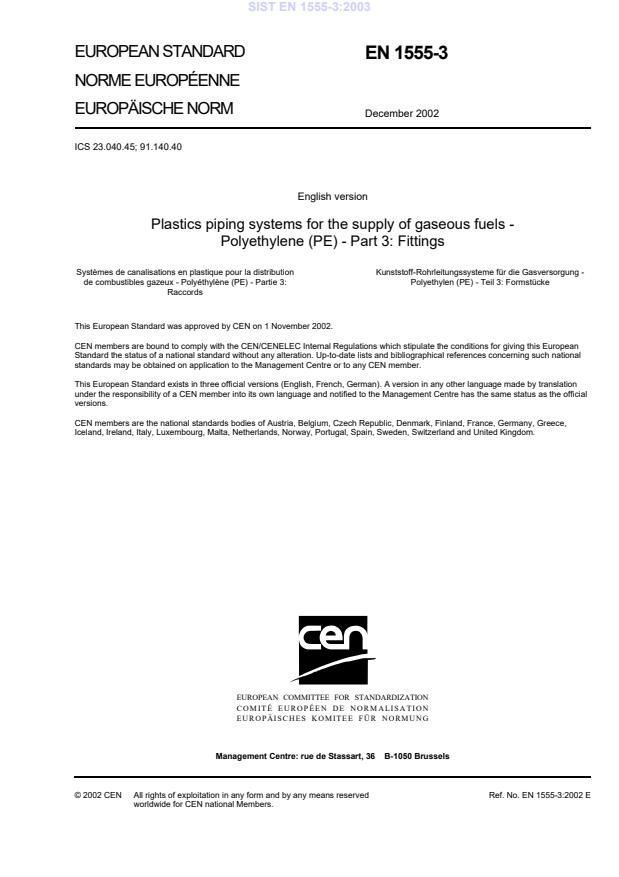
EUROPEAN STANDARDNORME EUROPÉENNEEUROPÄISCHE NORMEN 1555-3December 2002ICS 23.040.45; 91.140.40English versionPlastics piping systems for the supply of gaseous fuels -Polyethylene (PE) - Part 3: FittingsSystèmes de canalisations en plastique pour la distributionde combustibles gazeux - Polyéthylène (PE) - Partie 3:RaccordsKunststoff-Rohrleitungssysteme für die Gasversorgung -Polyethylen (PE) - Teil 3: FormstückeThis European Standard was approved by CEN on 1 November 2002.CEN members are bound to comply with the CEN/CENELEC Internal Regulations which stipulate the conditions for giving this EuropeanStandard the status of a national standard without any alteration. Up-to-date lists and bibliographical references concerning such nationalstandards may be obtained on application to the Management Centre or to any CEN member.This European Standard exists in three official versions (English, French, German). A version in any other language made by translationunder the responsibility of a CEN member into its own language and notified to the Management Centre has the same status as the officialversions.CEN members are the national standards bodies of Austria, Belgium, Czech Republic, Denmark, Finland, France, Germany, Greece,Iceland, Ireland, Italy, Luxembourg, Malta, Netherlands, Norway, Portugal, Spain, Sweden, Switzerland and United Kingdom.EUROPEAN COMMITTEE FOR STANDARDIZATIONCOMITÉ EUROPÉEN DE NORMALISATIONEUROPÄISCHES KOMITEE FÜR NORMUNGManagement Centre: rue de Stassart, 36
B-1050 Brussels© 2002 CENAll rights of exploitation in any form and by any means reservedworldwide for CEN national Members.Ref. No. EN 1555-3:2002 ESIST EN 1555-3:2003
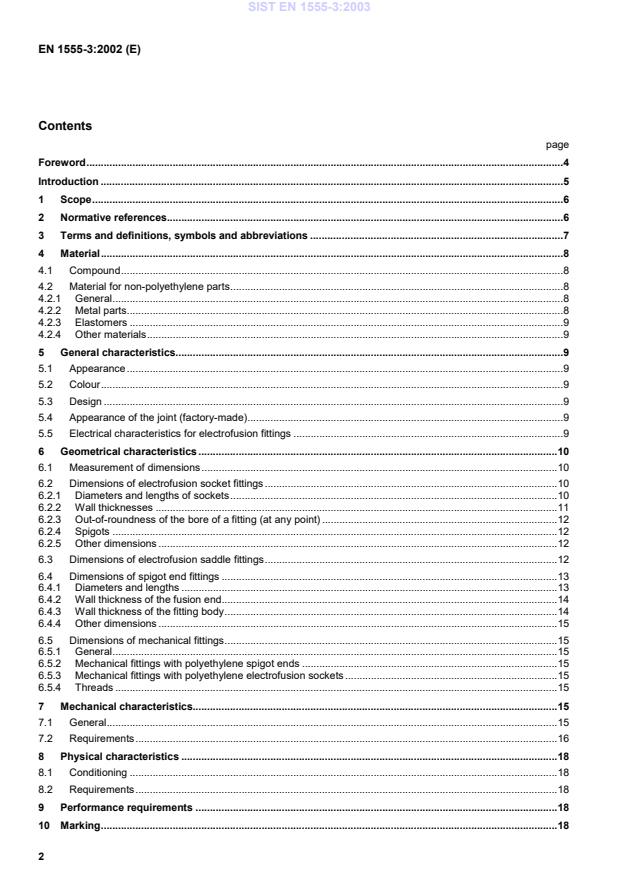
Examples of typical terminal connection for electrofusion fittings.20Bibliography.22SIST EN 1555-3:2003
a maximum operating pressure, MOP, up to and including 10 bar 1);b)
an operating temperature of 20 °C as reference temperature.NOTE 1For other operating temperatures, derating coefficients should be used, see EN 1555-5.EN 1555 covers a range of maximum operating pressures and gives requirements concerning colours andadditives.NOTE 2It is the responsibility of the purchaser or specifier to make the appropriate selections from these aspects, taking into account theirparticular requirements and any relevant national regulations and installation practices or codes.This standard is applicable for fittings of the following types:a)
electrofusion socket fittings;b)
electrofusion saddle fittings;c)
spigot end fittings (for butt fusion using heated tools and electrofusion socket fusion);d)
mechanical fittings.The fittings can e.g. be in the form of couplers, equal and reduced tees, reducers, bends or caps.2 Normative referencesThis European Standard incorporates by dated or undated reference, provisions from other publications. Thesenormative references are cited at the appropriate places in the text, and the publications are listed hereafter. Fordated references, subsequent amendments to or revisions of any of these publications apply to this EuropeanStandard only when incorporated in it by amendment or revision. For undated references the latest edition of thepublication referred to applies (including amendments).EN 682, Elastomeric seals - Materials requirements for seals used in pipes and fittings carrying gas andhydrocarbon fluids.EN 728, Plastics piping and ducting systems ¾ Polyolefin pipes and fittings ¾ Determination of oxidation inductiontime.EN 921, Plastics piping systems — Thermoplastics pipes — Determination of resistance to internal pressure atconstant temperature.EN 1555-1:2002, Plastics piping systems for the supply of gaseous fuels ¾ Polyethylene (PE) ¾ Part 1: GeneralEN 1555-2:2002, Plastics piping systems for the supply of gaseous fuels ¾ Polyethylene (PE) ¾ Part 2: Pipes.EN 1555-5:2002, Plastics piping systems for the supply of gaseous fuels ¾ Polyethylene (PE) ¾ Part 5: Fitness forpurpose of the system.EN 1716, Plastics piping systems - Polyethylene (PE) tapping tees - Test method for impact resistance of anassembled tapping tee.
1)
1 bar = 0,1 MPaSIST EN 1555-3:2003
anddesignation.ISO 228-1, Pipe threads where pressure-tight joints are not made on the threads - Part 1: Dimensions, tolerancesand designation.ISO 10838-1, Mechanical fittings for polyethylene piping systems for the supply of gaseous fuels ¾ Part 1: Metalfittings for pipes of nominal outside diameter less than or equal to 63 mm.ISO 10838-2, Mechanical fittings for polyethylene piping systems for the supply of gaseous fuels ¾ Part 2: Metalfittings for pipes of nominal outside diameter greater than 63 mm.ISO 10838-3, Mechanical fittings for polyethylene piping systems for the supply of gaseous fuels ¾ Part 3:Thermoplastic fittings for pipes of nominal outside diameter less than or equal to 63 mm.ISO 13953, Polyethylene (PE) pipes and fittings - Determination of the tensile strength and failure mode of testpieces from a butt-fused joint.ISO 13954, Plastics pipes and fittings - Peel decohesion test for polyethylene (PE) electrofusion assemblies ofnominal outside diameter greater than or equal to 90 mm.ISO 13955, Plastics pipes and fittings - Crushing decohesion test for polyethylene (PE) electrofusion assemblies.ISO/DIS 13956,Plastics pipes and fittings - Determination of cohesive strength - Tear test for polyethylene (PE)assemblies.3 Terms and definitions, symbols and abbreviationsFor the purposes of this European Standard, the terms and definitions, symbols and abbreviations given inEN 1555-1:2002 apply, together with the following.3.1electrofusion socket fittingpolyethylene (PE) fitting which contains one or more integral heating elements, that are capable of transformingelectrical energy into heat to realise a fusion joint with a spigot end or a pipe3.2electrofusion saddle fittingpolyethylene (PE) fitting which contains one or more integral heating elements, that are capable of transformingelectrical energy into heat to realise a fusion joint onto a pipe3.2.1tapping teeelectrofusion saddle fitting (top loading or wrap round) which contains an integral cutter, to cut through the wall ofthe main pipe. The cutter remains in the body of the saddle after installation3.2.2branch saddleelectrofusion saddle fitting (top loading or wrap round) which requires an ancillary cutting tool for drilling a hole inthe adjoining main pipeSIST EN 1555-3:2003
during storage;b)
under the effect of the gas conveyed therein;c)
with respect to the service environment and operating conditions.The requirements for the level of material performance of non-polyethylene parts shall be at least as stringent asthat of the compound for the piping system.Fittings material in contact with the PE pipe shall not adversely affect pipe performance or initiate stress cracking.4.2.2 Metal partsAll metal parts susceptible to corrosion shall be adequately protected.When dissimilar metallic materials are used which can be in contact with moisture, steps shall be taken to avoid thepossibility of galvanic corrosion.SIST EN 1555-3:2003
...
Questions, Comments and Discussion
Ask us and Technical Secretary will try to provide an answer. You can facilitate discussion about the standard in here.
Loading comments...