

EN 868-5:2018
(Main)Packaging for terminally sterilized medical devices - Part 5: Sealable pouches and reels of porous materials and plastic film construction - Requirements and test methods
- Abstract
This document specifies test methods and values for sealable pouches and reels manufactured from porous materials complying with either EN 868 part 2, 3, 6, 7, 9 or 10 and plastic film complying with Clause 4. These sealable pouches and reels are used as sterile barrier systems and/or packaging systems that are intended to maintain sterility of terminally sterilized medical devices to the point of use.
Other than the general requirements as specified in EN ISO 11607 1 and EN ISO 11607 2 this part of EN 868 specifies materials, test methods and values that are specific to the products covered by this document.
The materials specified in this part of EN 868 are intended for single use only.
- Status
- Published
- Publication Date
- 18-Dec-2018
- Withdrawal Date
- 29-Jun-2019
- Technical Committee
- CEN/TC 102 - Sterilizers for medical purposes
- Drafting Committee
- CEN/TC 102/WG 4 - Packaging materials
- Current Stage
- 9092 - Decision on results of review/2YR ENQ - revise - Review Enquiry
- Start Date
- 11-Nov-2024
- Completion Date
- 07-Oct-2026


Overview
EN 868-5:2018 is a CEN European standard that defines requirements and test methods for sealable pouches and reels used as sterile barrier systems for terminally sterilized medical devices. It covers products made from a porous material face combined with a plastic film face (plastic/porous laminates) intended to maintain sterility to the point of use. The standard complements general packaging requirements in EN ISO 11607‑1 and validation requirements in EN ISO 11607‑2 by specifying materials, test methods and numeric values particular to pouches and reels. Materials covered are intended for single use only.
Key topics and technical requirements
- Material construction
- Porous material must comply with EN 868 parts 2, 3, 6, 7, 9 or 10.
- Plastic film must be a composite of two or more layers and be free from pinholes and foreign matter after visual inspection.
- Interply bond of plastic layers shall not separate or become cloudy after the intended sterilization (see Annex B).
- Mechanical performance
- Plastic film breaking factor: ≥ 20 N per 15 mm width (machine and cross direction) when tested to ASTM D882.
- Seal(s) overall width: ≥ 6 mm (sum of ribs for ribbed seals).
- Seal and closure
- Pouches: sealed on three sides; reels: sealed along parallel sides.
- Pouches must allow peelability (thumb notch ≤ 12 mm or a lip ≥ 1.0 mm) to enable aseptic opening.
- Seal strength requirements (Annex D): minimum 1.5 N/15 mm for steam and 1.2 N/15 mm for other processes for healthcare facility use (industry may set different values based on validation).
- Seals must be continuous and not cause disruption of adjacent porous material upon opening.
- Process indicators
- Type I (process) indicators printed on pouches/reels must comply with EN ISO 11140‑1 and be ≥ 100 mm² each.
- Test methods and annexes
- Annex B: resistance to sterilization
- Annex C: pinhole detection in laminate
- Annex D: seal strength
- Annex E: peel characteristics
- Annex F: fibre orientation
Applications
- Design, manufacture and qualification of sealable pouches and reels for steam, ethylene oxide, irradiation and other sterilization processes.
- Packaging validation and quality control for medical device manufacturers, contract packagers and test laboratories.
- Selection of sterile barrier systems by hospital sterilization departments and sterile services units to ensure reliable aseptic presentation.
Who should use this standard
- Packaging engineers and product developers for medical devices
- Regulatory and quality assurance teams (medical device industry)
- Sterile processing departments in healthcare facilities
- Test laboratories performing material and seal validation
- Contract packagers and suppliers of sterile packaging materials
Related standards
- EN ISO 11607‑1 / EN ISO 11607‑2 (general packaging and process validation)
- EN 868 parts 2, 3, 6, 7, 9, 10 (material-specific requirements)
- EN ISO 11140‑1 (chemical indicators)
- ASTM D882, ASTM F88 (tensile and seal tests referenced)
Keywords: EN 868-5, sealable pouches, reels, porous materials, plastic film, sterile barrier systems, seal strength, sterilization packaging, test methods.
Relations
- Effective Date
- 26-Dec-2018
- Effective Date
- 25-Aug-2026
- Effective Date
- 28-Jan-2026
- Effective Date
- 28-Jan-2026
- Effective Date
- 28-Jan-2026
- Effective Date
- 28-Jan-2026
- Effective Date
- 28-Jan-2026
- Effective Date
- 28-Jan-2026
- Effective Date
- 28-Jan-2026
- Effective Date
- 28-Jan-2026
- Effective Date
- 28-Jan-2026
- Effective Date
- 28-Jan-2026
- Referred By
EN 13060:2014 - Small steam sterilizers - Effective Date
- 28-Jan-2026
- Effective Date
- 28-Jan-2026
- Effective Date
- 28-Jan-2026
Get Certified
Connect with accredited certification bodies for this standard

BSI Group
BSI (British Standards Institution) is the business standards company that helps organizations make excellence a habit.

TÜV Rheinland
TÜV Rheinland is a leading international provider of technical services.

TÜV SÜD
TÜV SÜD is a trusted partner of choice for safety, security and sustainability solutions.
Sponsored listings
Frequently Asked Questions
EN 868-5:2018 is a standard published by the European Committee for Standardization (CEN). Its full title is "Packaging for terminally sterilized medical devices - Part 5: Sealable pouches and reels of porous materials and plastic film construction - Requirements and test methods". This standard covers: This document specifies test methods and values for sealable pouches and reels manufactured from porous materials complying with either EN 868 part 2, 3, 6, 7, 9 or 10 and plastic film complying with Clause 4. These sealable pouches and reels are used as sterile barrier systems and/or packaging systems that are intended to maintain sterility of terminally sterilized medical devices to the point of use. Other than the general requirements as specified in EN ISO 11607 1 and EN ISO 11607 2 this part of EN 868 specifies materials, test methods and values that are specific to the products covered by this document. The materials specified in this part of EN 868 are intended for single use only.
This document specifies test methods and values for sealable pouches and reels manufactured from porous materials complying with either EN 868 part 2, 3, 6, 7, 9 or 10 and plastic film complying with Clause 4. These sealable pouches and reels are used as sterile barrier systems and/or packaging systems that are intended to maintain sterility of terminally sterilized medical devices to the point of use. Other than the general requirements as specified in EN ISO 11607 1 and EN ISO 11607 2 this part of EN 868 specifies materials, test methods and values that are specific to the products covered by this document. The materials specified in this part of EN 868 are intended for single use only.
EN 868-5:2018 is classified under the following ICS (International Classification for Standards) categories: 11.080.30 - Sterilized packaging. The ICS classification helps identify the subject area and facilitates finding related standards.
EN 868-5:2018 has the following relationships with other standards: It is inter standard links to EN 868-5:2009, ISO 8601:2004, EN 868-3:2017, EN 868-6:2017, EN ISO 11140-1:2014, EN 868-10:2018, EN 868-7:2017, EN ISO 11607-1:2017, EN 1090-5:2017, EN 868-9:2018, EN 868-2:2017, EN 14180:2014, EN 13060:2014, EN 13060:2004+A2:2010, EN 1422:1997+A1:2009. Understanding these relationships helps ensure you are using the most current and applicable version of the standard.
EN 868-5:2018 is available in PDF format for immediate download after purchase. The document can be added to your cart and obtained through the secure checkout process. Digital delivery ensures instant access to the complete standard document.
Standards Content (Sample)
2003-01.Slovenski inštitut za standardizacijo. Razmnoževanje celote ali delov tega standarda ni dovoljeno.Verpackungen für in der Endverpackung zu sterilisierende Medizinprodukte - Teil 5: Siegelfähige Klarsichtbeutel und -schläuche aus porösen Materialien und Kunststoff-Verbundfolie - Anforderungen und PrüfverfahrenEmballages des dispositifs médicaux stérilisés au stade terminal - Partie 5: Sachets et gaines scellables constitués d'une face matière poreuse et d'une face film plastique - Exigences et méthodes d'essaiPackaging for terminally sterilized medical devices - Part 5: Sealable pouches and reels of porous materials and plastic film construction - Requirements and test methods11.080.30Sterilizirana embalažaSterilized packagingICS:Ta slovenski standard je istoveten z:EN 868-5:2018SIST EN 868-5:2019en,fr,de01-marec-2019SIST EN 868-5:2019SLOVENSKI
STANDARDSIST EN 868-5:20091DGRPHãþD
EUROPEAN STANDARD NORME EUROPÉENNE EUROPÄISCHE NORM
EN 868-5
December
t r s z ICS
s sä r z rä u r Supersedes EN
z x zæ wã t r r {English Version
Packaging for terminally sterilized medical devices æ Part
wã Sealable pouches and reels of porous materials and plastic film construction æ Requirements and test methodsEmballages des dispositifs médicaux stérilisés au stade terminal æ Partie
wã Sachets et gaines scellables constitués d 5une face matière poreuse et d 5une face film plastique æ Exigences et méthodes d 5essai
Verpackungen für in der Endverpackung zu sterilisierende Medizinprodukte æ Teil
wã Siegelfähige Klarsichtbeutel und æschläuche aus porösen Materialien und KunststoffæVerbundfolie æ Anforderungen und Prüfverfahren This European Standard was approved by CEN on
t r August
t r s zä
egulations which stipulate the conditions for giving this European Standard the status of a national standard without any alterationä Upætoædate lists and bibliographical references concerning such national standards may be obtained on application to the CENæCENELEC Management Centre or to any CEN memberä
translation under the responsibility of a CEN member into its own language and notified to the CENæCENELEC Management Centre has the same status as the official versionsä
CEN members are the national standards bodies of Austriaá Belgiumá Bulgariaá Croatiaá Cyprusá Czech Republicá Denmarká Estoniaá Finlandá Former Yugoslav Republic of Macedoniaá Franceá Germanyá Greeceá Hungaryá Icelandá Irelandá Italyá Latviaá Lithuaniaá Luxembourgá Maltaá Netherlandsá Norwayá Polandá Portugalá Romaniaá Serbiaá Slovakiaá Sloveniaá Spainá Swedená Switzerlandá Turkey and United Kingdomä
EUROPEAN COMMITTEE FOR STANDARDIZATION COMITÉ EUROPÉEN DE NORMALISATION EUROPÄISCHES KOMITEE FÜR NORMUNG
CEN-CENELEC Management Centre:
Rue de la Science 23,
B-1040 Brussels
t r s z CEN All rights of exploitation in any form and by any means reserved worldwide for CEN national Membersä Refä Noä EN
z x zæ wã t r s z ESIST EN 868-5:2019
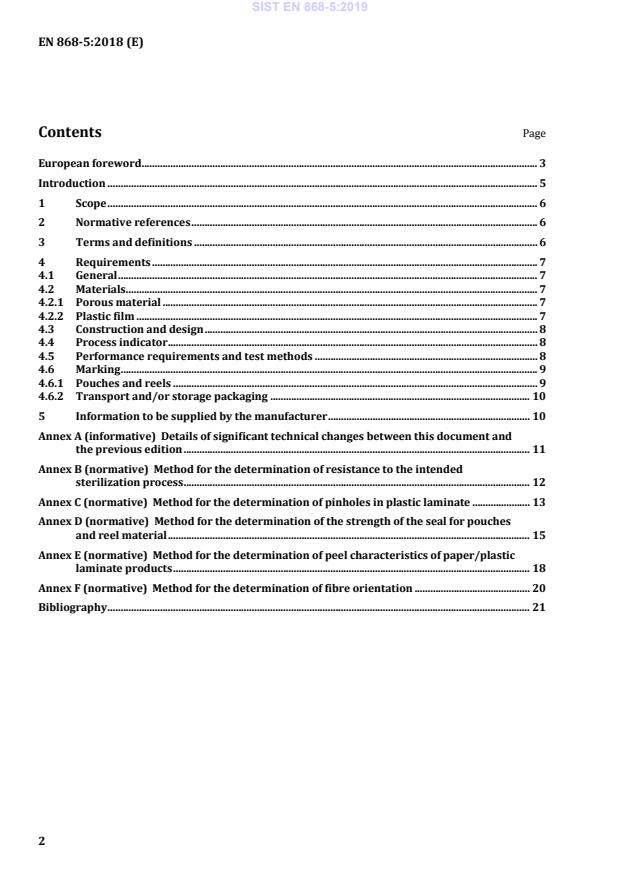
Details of significant technical changes between this document and the previous edition . 11 Annex B (normative)
Method for the determination of resistance to the intended sterilization process . 12 Annex C (normative)
Method for the determination of pinholes in plastic laminate . 13 Annex D (normative)
Method for the determination of the strength of the seal for pouches and reel material . 15 Annex E (normative)
Method for the determination of peel characteristics of paper/plastic laminate products . 18 Annex F (normative)
Method for the determination of fibre orientation . 20 Bibliography . 21
...