

EN 15425:2023
(Main)Adhesives - One component polyurethane (PUR) for load-bearing timber structures - Classification and performance requirements
- Abstract
This document establishes a classification for one component polyurethane (PUR) adhesives according to their suitability for use in load-bearing timber products in defined climatic exposure conditions, and specifies performance requirements for such adhesives for the factory manufacture or factory-like manufacturing of load-bearing timber products only.
It also classifies “adhesive product lines” where all the products within the line have the same chemical composition except for a different amount of catalyst.
This document only specifies the performance of adhesives for use in an environment corresponding to the defined conditions.
The performance requirements of this document are applicable to the adhesives only, not to the manufactured timber products. This document does not cover the performance of adhesives for on-site gluing (except for factory-like conditions) or the production of wood-based panels, except solid wood panels, or modified and stabilized wood with considerably reduced swelling and shrinkage properties, e.g. acetylated wood, heat treated wood and polymer impregnated wood.
This document is primarily intended for use by adhesive manufacturers and for use in timber products bonded with adhesives, to assess or control the quality of adhesives. The requirements are applicable to the type testing of the adhesives. Production control activities are outside the scope of this document.
Adhesives meeting the requirements of this document are adequate for use in load-bearing timber products, provided that the bonding process has been carried out according to an appropriate product standard.
This document does not address the classification and use of adhesives in combination with the spraying of water before or during the bonding process; see informative Annex C of this document.
This does neither allow nor forbid the use of adhesives in combination with the spraying of water.
- Status
- Withdrawn
- Publication Date
- 14-Feb-2023
- Withdrawal Date
- 06-Oct-2026
- Technical Committee
- CEN/TC 193 - Adhesives
- Drafting Committee
- CEN/TC 193/SC 1/WG 4 - Tests for 'Novel' load bearing adhesives for wood
- Current Stage
- 9960 - Withdrawal effective - Withdrawal
- Start Date
- 03-Jun-2026
- Completion Date
- 07-Oct-2026

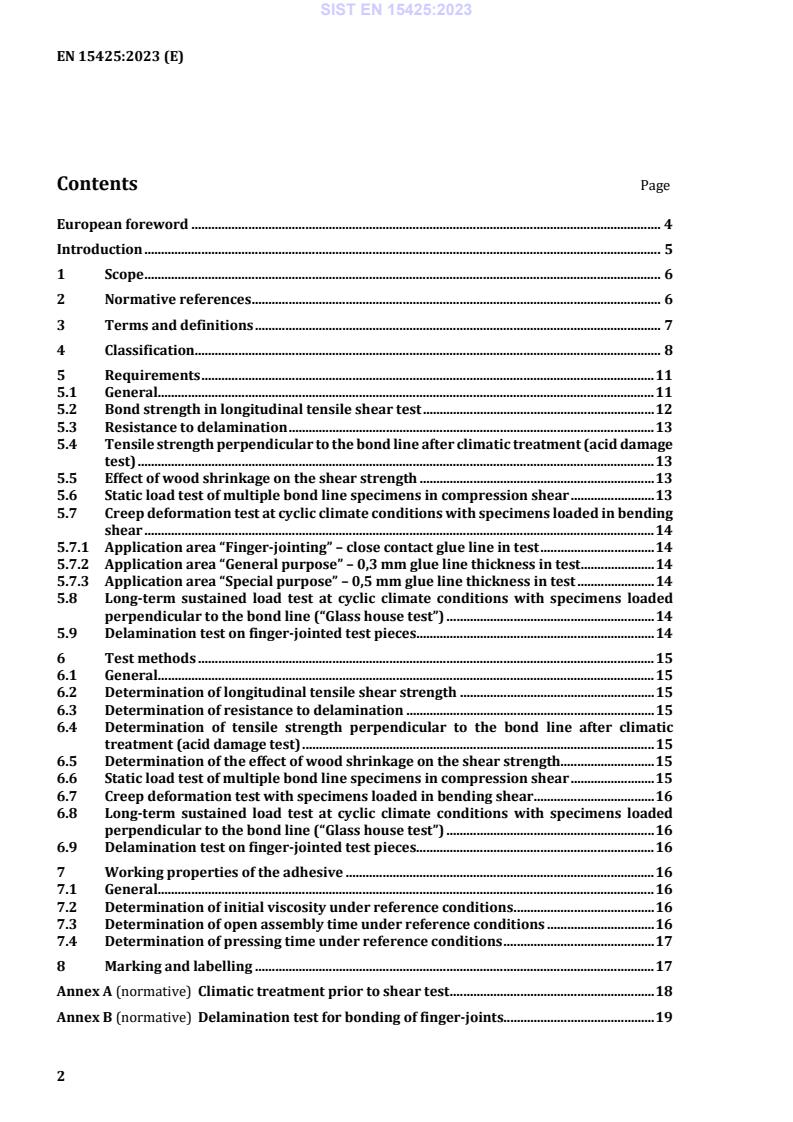
Overview
EN 15425:2023 is the CEN standard for one-component polyurethane (PUR) adhesives used in load-bearing timber structures. Published in February 2023 (approved 18 Dec 2022) and superseding EN 15425:2017, it establishes a classification system and defines performance requirements for PUR adhesives used in factory or factory-like manufacture of structural timber products. The standard addresses adhesive performance under defined climatic exposure conditions and applies to adhesive product lines (same chemistry, different catalyst content). It does not cover on‑site gluing (except factory‑like conditions), most wood‑based panels (except solid wood panels), or heavily modified/stabilized woods.
Key topics and requirements
- Classification of PUR adhesives according to suitability for specified climatic conditions (including reference to service class conditions such as indoor/service class 1).
- Performance requirements focused on the adhesive itself (not the bonded timber product) for type testing.
- Test methods referenced - includes a suite of test standards used to verify performance:
- EN 302 series (e.g., EN 302-1 longitudinal tensile shear, EN 302-2 resistance to delamination, EN 302-4 wood shrinkage effects, EN 302-8 static load of multiple bond lines)
- EN 15416 series (e.g., “Glass house test” long-term sustained load, creep deformation tests, open assembly and pressing times)
- EN ISO 2555 for viscosity measurement
- Specific mechanical and durability assessments: bond shear strength, delamination resistance, tensile strength perpendicular to the bond line after climatic treatment (acid damage tests), creep deformation under cyclic climate, and long‑term sustained load.
- Working properties and labelling: determination of viscosity, open assembly time and pressing time; marking and labelling requirements are specified.
- Annexes: normative annexes for climatic treatment and finger-joint delamination tests; informative Annex C provides guidance on bonding with water-spraying (does not mandate or prohibit).
Applications and who uses this standard
- Adhesive manufacturers - for product classification, type testing and quality assessment of PUR adhesives for structural timber.
- Timber product manufacturers (glulam, finger‑jointed products, glued solid timber) - to select adhesives proven suitable for factory production and specified climate exposures.
- Test laboratories and certification bodies - to perform required EN 302/EN 15416 tests and report compliance.
- Specifiers, engineers and standards bodies - to reference appropriate adhesive performance when designing and approving load‑bearing timber structures in accordance with product standards and Eurocode 5.
Related standards
- EN 302 series (test methods for adhesives for load‑bearing timber)
- EN 15416 series (long‑term and climate cycling tests)
- EN 923 (terms and definitions)
- EN 14080 (glued laminated timber requirements)
- EN ISO 2555 (viscosity testing)
Keywords: EN 15425:2023, PUR adhesives, one-component polyurethane, load-bearing timber structures, adhesive classification, delamination test, shear strength, glass house test, timber adhesive standards.
Relations
- Effective Date
- 18-Sep-2019
- Effective Date
- 18-Mar-2026
- Effective Date
- 22-Jul-2026
- Effective Date
- 22-Jul-2026
- Effective Date
- 18-Mar-2026
- Effective Date
- 28-Jan-2026
- Effective Date
- 28-Jan-2026
- Effective Date
- 28-Jan-2026
- Effective Date
- 28-Jan-2026
- Refers
EN 14080:2013 - Timber structures - Glued laminated timber and glued solid timber - Requirements - Effective Date
- 28-Jan-2026
- Effective Date
- 28-Jan-2026
- Effective Date
- 28-Jan-2026
- Effective Date
- 28-Jan-2026
- Effective Date
- 28-Jan-2026
- Effective Date
- 28-Jan-2026
Get Certified
Connect with accredited certification bodies for this standard

DIN CERTCO
DIN Group product certification.

Smithers Quality Assessments
US management systems and product certification.
Sponsored listings
Frequently Asked Questions
EN 15425:2023 is a standard published by the European Committee for Standardization (CEN). Its full title is "Adhesives - One component polyurethane (PUR) for load-bearing timber structures - Classification and performance requirements". This standard covers: This document establishes a classification for one component polyurethane (PUR) adhesives according to their suitability for use in load-bearing timber products in defined climatic exposure conditions, and specifies performance requirements for such adhesives for the factory manufacture or factory-like manufacturing of load-bearing timber products only. It also classifies “adhesive product lines” where all the products within the line have the same chemical composition except for a different amount of catalyst. This document only specifies the performance of adhesives for use in an environment corresponding to the defined conditions. The performance requirements of this document are applicable to the adhesives only, not to the manufactured timber products. This document does not cover the performance of adhesives for on-site gluing (except for factory-like conditions) or the production of wood-based panels, except solid wood panels, or modified and stabilized wood with considerably reduced swelling and shrinkage properties, e.g. acetylated wood, heat treated wood and polymer impregnated wood. This document is primarily intended for use by adhesive manufacturers and for use in timber products bonded with adhesives, to assess or control the quality of adhesives. The requirements are applicable to the type testing of the adhesives. Production control activities are outside the scope of this document. Adhesives meeting the requirements of this document are adequate for use in load-bearing timber products, provided that the bonding process has been carried out according to an appropriate product standard. This document does not address the classification and use of adhesives in combination with the spraying of water before or during the bonding process; see informative Annex C of this document. This does neither allow nor forbid the use of adhesives in combination with the spraying of water.
This document establishes a classification for one component polyurethane (PUR) adhesives according to their suitability for use in load-bearing timber products in defined climatic exposure conditions, and specifies performance requirements for such adhesives for the factory manufacture or factory-like manufacturing of load-bearing timber products only. It also classifies “adhesive product lines” where all the products within the line have the same chemical composition except for a different amount of catalyst. This document only specifies the performance of adhesives for use in an environment corresponding to the defined conditions. The performance requirements of this document are applicable to the adhesives only, not to the manufactured timber products. This document does not cover the performance of adhesives for on-site gluing (except for factory-like conditions) or the production of wood-based panels, except solid wood panels, or modified and stabilized wood with considerably reduced swelling and shrinkage properties, e.g. acetylated wood, heat treated wood and polymer impregnated wood. This document is primarily intended for use by adhesive manufacturers and for use in timber products bonded with adhesives, to assess or control the quality of adhesives. The requirements are applicable to the type testing of the adhesives. Production control activities are outside the scope of this document. Adhesives meeting the requirements of this document are adequate for use in load-bearing timber products, provided that the bonding process has been carried out according to an appropriate product standard. This document does not address the classification and use of adhesives in combination with the spraying of water before or during the bonding process; see informative Annex C of this document. This does neither allow nor forbid the use of adhesives in combination with the spraying of water.
EN 15425:2023 is classified under the following ICS (International Classification for Standards) categories: 83.180 - Adhesives. The ICS classification helps identify the subject area and facilitates finding related standards.
EN 15425:2023 has the following relationships with other standards: It is inter standard links to EN 15425:2017, EN 15425:2023+A1:2026, EN 13183-3:2005, EN 13183-2:2002, EN 302-8:2023+A1:2026, EN 923:2015, EN 15416-3:2025, EN 15416-5:2025, EN 302-2:2023, EN 14080:2013, EN 15416-1:2025, EN 302-8:2023, EN 15416-4:2025, EN 302-4:2023, EN 302-3:2023. Understanding these relationships helps ensure you are using the most current and applicable version of the standard.
EN 15425:2023 is available in PDF format for immediate download after purchase. The document can be added to your cart and obtained through the secure checkout process. Digital delivery ensures instant access to the complete standard document.
Standards Content (Sample)
SLOVENSKI STANDARD
01-april-2023
Lepila - Enokomponentni poliuretan (PUR) za nosilne lesene konstrukcije -
Razvrstitev in zahtevane lastnosti
Adhesives - One component polyurethane (PUR) for load-bearing timber structures -
Classification and performance requirements
Klebstoffe - Einkomponenten-Klebstoffe auf Polyurethanbasis (PUR) für tragende
Holzbauteile - Klassifizierung und Leistungsanforderungen
Adhésifs - Adhésifs polyuréthane monocomposants (PUR) pour structures portantes en
bois - Classification et exigences de performance
Ta slovenski standard je istoveten z: EN 15425:2023
ICS:
83.180 Lepila Adhesives
91.080.20 Lesene konstrukcije Timber structures
2003-01.Slovenski inštitut za standardizacijo. Razmnoževanje celote ali delov tega standarda ni dovoljeno.
EN 15425
EUROPEAN STANDARD
NORME EUROPÉENNE
February 2023
EUROPÄISCHE NORM
ICS 83.180 Supersedes EN 15425:2017
English Version
Adhesives - One component polyurethane (PUR) for load-
bearing timber structures - Classification and performance
requirements
Adhésifs - Adhésifs polyuréthane monocomposants Klebstoffe - Einkomponenten-Klebstoffe auf
(PUR) pour structures portantes en bois - Classification Polyurethanbasis (PUR) für tragende Holzbauteile -
et exigences de performance Klassifizierung und Leistungsanforderungen
This European Standard was approved by CEN on 18 December 2022.
CEN members are bound to comply with the CEN/CENELEC Internal Regulations which stipulate the conditions for giving this
European Standard the status of a national standard without any alteration. Up-to-date lists and bibliographical references
concerning such national standards may be obtained on application to the CEN-CENELEC Management Centre or to any CEN
member.
This European Standard exists in three official versions (English, French, German). A version in any other language made by
translation under the responsibility of a CEN member into its own language and notified to the CEN-CENELEC Management
Centre has the same status as the official versions.
CEN members are the national standards bodies of Austria, Belgium, Bulgaria, Croatia, Cyprus, Czech Republic, Denmark, Estonia,
Finland, France, Germany, Greece, Hungary, Iceland, Ireland, Italy, Latvia, Lithuania, Luxembourg, Malta, Netherlands, Norway,
Poland, Portugal, Republic of North Macedonia, Romania, Serbia, Slovakia, Slovenia, Spain, Sweden, Switzerland, Türkiye and
United Kingdom.
EUROPEAN COMMITTEE FOR STANDARDIZATION
COMITÉ EUROPÉEN DE NORMALISATION
EUROPÄISCHES KOMITEE FÜR NORMUNG
CEN-CENELEC Management Centre: Rue de la Science 23, B-1040 Brussels
© 2023 CEN All rights of exploitation in any form and by any means reserved Ref. No. EN 15425:2023 E
worldwide for CEN national Members.
Contents Page
European foreword . 4
Introduction . 5
1 Scope . 6
2 Normative references . 6
3 Terms and definitions . 7
4 Classification. 8
5 Requirements . 11
5.1 General. 11
5.2 Bond strength in longitudinal tensile shear test . 12
5.3 Resistance to delamination . 13
5.4 Tensile strength perpendicular to the bond line after climatic treatment (acid damage
test) . 13
5.5 Effect of wood shrinkage on the shear strength . 13
5.6 Static load test of multiple bond line specimens in compression shear . 13
5.7 Creep deformation test at cyclic climate conditions with specimens loaded in bending
shear . 14
5.7.1 Application area “Finger-jointing” – close contact glue line in test . 14
5.7.2 Application area “General purpose” – 0,3 mm glue line thickness in test . 14
5.7.3 Application area “Special purpose” – 0,5 mm glue line thickness in test . 14
5.8 Long-term sustained load test at cyclic climate conditions with specimens loaded
perpendicular to the bond line (“Glass house test”) . 14
5.9 Delamination test on finger-jointed test pieces. 14
6 Test methods . 15
6.1 General. 15
6.2 Determination of longitudinal tensile shear strength . 15
6.3 Determination of resistance to delamination . 15
6.4 Determination of tensile strength perpendicular to the bond line after climatic
treatment (acid damage test) . 15
6.5 Determination of the effect of wood shrinkage on the shear strength. 15
6.6 Static load test of multiple bond line specimens in compression shear . 15
6.7 Creep deformation test with specimens loaded in bending shear . 16
6.8 Long-term sustained load test at cyclic climate conditions with specimens loaded
perpendicular to the bond line (“Glass house test”) . 16
6.9 Delamination test on finger-jointed test pieces. 16
7 Working properties of the adhesive . 16
7.1 General. 16
7.2 Determination of initial viscosity under reference conditions . 16
7.3 Determination of open assembly time under reference conditions . 16
7.4 Determination of pressing time under reference conditions . 17
8 Marking and labelling . 17
Annex A (normative) Climatic treatment prior to shear test . 18
Annex B (normative) Delamination test for bonding of finger-joints. 19
B.1 Production of the specimens . 19
B.2 Testing . 20
B.3 Expression of results . 21
B.4 Test report . 21
B.4.1 Adhesive . 21
B.4.2 Preparation of test pieces and testing procedure . 21
B.4.3 Test results. 22
Annex C (informative) Information on bonding operations with one-component
polyurethane adhesives in combination with water-spraying . 23
Bibliography . 24
European foreword
This document (EN 15425:2023) has been prepared by Technical Committee CEN/TC 193 “Adhesives”,
the secretariat of which is held by UNE.
This European Standard shall be given the status of a national standard, either by publication of an
identical text or by endorsement, at the latest by August 2023, and conflicting national standards shall be
withdrawn at the latest by August 2023.
Attention is drawn to the possibility that some of the elements of this document may be the subject of
patent rights. CEN shall not be held responsible for identifying any or all such patent rights.
This document supersedes EN 15425:2017.
a) for adhesive type “Special purpose”, the test according to EN 302-8 is performed with a bond line
thickness of 0,5 mm;
b) an additional adhesive subtype I-SP-70-0,5 has been added in Table 1;
c) for adhesive type FJ, the test according to EN 302-2 is required only with short closed assembly time,
and the test according to EN 15416-5 is only required with thin glue line;
d) for finger joint delamination tests on additional wood species, the reference to EN 301 has been
replaced by a new Annex B;
e) for the delamination test according to EN 302-2 with preservative treated wood, a test with Scots
pine (Pinus sylvestris) and silver fir (Abies alba) covers also Norway spruce (Picea abies L.);
f) the description of the test procedure for an “adhesive line” has been modified;
g) the description of a test procedure when a primer is used in all bonding operations has been added
in Clause 4;
h) provisions and maximum tolerance for testing and application of a primer have been added in 5.1;
i) information on water spraying has been included in the scope and as a new Annex C.
Any feedback and questions on this document should be directed to the users’ national standards body.
A complete listing of these bodies can be found on the CEN website.
According to the CEN-CENELEC Internal Regulations, the national standards organisations of the
following countries are bound to implement this European Standard: Austria, Belgium, Bulgaria, Croatia,
Cyprus, Czech Republic, Denmark, Estonia, Finland, France, Germany, Greece, Hungary, Iceland, Ireland,
Italy, Latvia, Lithuania, Luxembourg, Malta, Netherlands, Norway, Poland, Portugal, Republic of North
Macedonia, Romania, Serbia, Slovakia, Slovenia, Spain, Sweden, Switzerland, Türkiye and the United
Kingdom.
Introduction
This document is one of a series dealing with one component polyurethane adhesives for use with timber
structures, and is published in support of product standards for load-bearing timber structures in
connection with EN 1995-1-1, Eurocode 5: Design of timber structures — Part 1-1: General — Common
rules and rules for buildings.
The series consists of:
— one standard for classification and performance requirements (EN 15425);
— eight test methods (EN 302-1, EN 302-2, EN 302-3, EN 302-4, EN 302-8, EN 15416-1 (“Glass house
test”), EN 15416-3 and Annex B of this document) used to assess the performance of adhesives after
specified heat and humidity treatments; and
— three test methods (EN ISO 2555 (reference in EN 302-7), EN 15416-4, and EN 15416-5) to
characterize the working properties of the adhesives.
Safety statement
Persons using this document should be familiar with the normal laboratory practice, if applicable. This
document cannot address all of the safety problems, if any, associated with its use. It is the responsibility
of the user to establish appropriate safety and health practices and to ensure compliance with any
regulatory conditions.
Environmental statement
It is understood that some of the material permitted in this document may have negative environmental
impact. As technological advantages lead to better alternatives for these materials, they will be eliminated
from this European Standard to the extent possible.
At the end of the test, it is recommended that the users of this document take care to carry out an
appropriate disposal of the wastes, according to local regulations.
1 Scope
This document establishes a classification for one component polyurethane (PUR) adhesives according
to their suitability for use in load-bearing timber products in defined climatic exposure conditions, and
specifies performance requirements for such adhesives for the factory manufacture or factory-like
manufacturing of load-bearing timber products only.
It also classifies “adhesive product lines” where all the products within the line have the same chemical
composition except for a different amount of catalyst.
This document only specifies the performance of adhesives for use in an environment corresponding to
the defined conditions.
The performance requirements of this document are applicable to the adhesives only, not to the
manufactured timber products. This document does not cover the performance of adhesives for on-site
gluing (except for factory-like conditions) or the production of wood-based panels, except solid wood
panels, or modified and stabilized wood with considerably reduced swelling and shrinkage properties,
e.g. acetylated wood, heat treated wood and polymer impregnated wood.
This document is primarily intended for use by adhesive manufacturers and for use in timber products
bonded with adhesives, to assess or control the quality of adhesives. The requirements are applicable to
the type testing of the adhesives. Production control activities are outside the scope of this document.
Adhesives meeting the requirements of this document are adequate for use in load-bearing timber
products, provided that the bonding process has been carried out according to an appropriate product
standard.
This document does not address the classification and use of adhesives in combination with the spraying
of water before or during the bonding process; see informative Annex C of this document.
This does neither allow nor forbid the use of adhesives in combination with the spraying of water.
2 Normative references
The following documents are referred to in the text in such a way that some or all of their content
constitutes requirements of this document. For dated references, only the edition cited applies. For
undated references, the latest edition of the referenced document (including any amendments) applies.
EN 302-1, Adhesives for load-bearing timber structures — Test methods — Part 1: Determination of
longitudinal tensile shear strength
EN 302-2, Adhesives for load-bearing timber structures — Test methods — Part 2: Determination of
resistance to delamination
EN 302-3, Adhesives for load-bearing timber structures — Test methods — Part 3: Determination of the
effect of acid damage to wood fibres by temperature and humidity cycling on the transverse tensile strength
EN 302-4, Adhesives for load-bearing timber structures — Test methods — Part 4: Determination of the
effects of wood shrinkage on the shear strength
EN 302-8, Adhesives for load-bearing timber structures — Test methods — Part 8: Static load test of
multiple bond line specimens in compression shear
EN 923, Adhesives — Terms and definitions
EN 13183-2, Moisture content of a piece of sawn timber — Part 2: Estimation by electrical resistance
method
EN 13183-3, Moisture content of a piece of sawn timber — Part 3: Estimation by capacitance method
EN 14080, Timber structures — Glued laminated timber and glued solid timber — Requirements
EN 15416-1, Adhesives for load bearing timber structures other than phenolic and aminoplastic — Test
methods — Part 1: Long-term tension load test perpendicular to the bond line at varying climate conditions
with specimens perpendicular to the glue line (Glass house test)
EN 15416-3, Adhesives for load bearing timber structures other than phenolic and aminoplastic — Test
methods — Part 3: Creep deformation test at cyclic climate conditions with specimens loaded in bending
shear
EN 15416-4, Adhesives for load bearing timber structures other than phenolic and aminoplastic — Test
methods — Part 4: Determination of open assembly time under referenced conditions
EN 15416-5, Adhesives for load bearing timber structures other than phenolic and aminoplastic — Test
methods — Part 5: Determination of minimum pressing time under referenced conditions
EN ISO 2555, Plastics — Resins in the liquid state or as emulsions or dispersions — Determination of
apparent viscosity using a single cylinder type rotational viscometer method (ISO 2555)
3 Terms and definitions
For the purposes of this document, the terms and definitions given in EN 923 and the following apply.
ISO and IEC maintain terminology databases for use in standardization at the following addresses:
— ISO Online browsing platform: available at https://www.iso.org/obp
— IEC Electropedia: available at https://www.electropedia.org/
3.1
one component polyurethane (PUR) adhesive
isocyanate containing urethane polymers, which are cross-linked by reaction with water
3.2
service class 1
climatic conditions characterized by a moisture content in the materials corresponding to a temperature
of 20 °C and the relative humidity of the surrounding air only exceeding 65 % for a few weeks per year
Note 1 to entry: In service class 1, which comprises typical indoor conditions, the average moisture content in most
soft woods will not exceed 12 %.
[SOURCE: EN 1995-1-1:2004, 2.3.1.3, modified – Indoor conditions have been added in Note 1 to entry.]
3.3
service class 2
climatic conditions characterized by a moisture content in the materials corresponding to a temperature
of 20 °C and the relative humidity of the surrounding air only exceeding 85 % for a few weeks per year
Note 1 to entry: In service class 2, to which most covered exterior conditions belong, the average moisture content
in most soft woods will not exceed 20 %.
[SOURCE: EN 1995-1-1:2004, 2.3.1.3, modified – Covered exterior conditions have been added in Note 1
to entry.]
3.4
service class 3
climatic conditions leading to higher moisture contents than in service class 2
Note 1 to entry: Exterior conditions typically belong to service class 3.
[SOURCE: EN 1995-1-1:2004, 2.3.1.3, modified – Note 1 to entry has been added.]
3.5
glue line
adhesive layer between the wood members
3.6
bond line
glue line including the two intermediate zones between adhesive and wood
3.7
close contact glue line
glue line of thickness maximum 0,1 mm
Note 1 to entry: Close contact glue line can be achieved by pressing together two plane wood members with a
clamping pressure of (0,8 ± 0,1) N/mm without additional groves, spacers or similar devices.
3.8
thick glue line
glue line of nominal thickness in the range of 0,3 mm to 1,0 mm at the time of bonding
Note 1 to entry: Thick glue lines are achieved by using spacers, grooves or similar devices when two plain members
are glued together.
3.9
adhesive product line
series of products, all with the same chemical composition except for a different amount of catalyst
Note 1 to entry: Only for this reason the products have different reactivity.
3.10
primer treatment
application of a coating (primer) substance to both adherend surfaces, prior to the application of an
adhesive to improve adhesion and/or durability of the bond
Note 1 to entry: This does not include application of pure water.
4 Classification
Adhesives for structural purpose shall produce joints of such strength and durability that the integrity of
the bond is maintained in the assigned service class throughout the expected life of the structure.
PUR-adhesives according to EN 15425 are classified by type (climate condition in use), maximum test
temperature and maximum glue line thickness in use. These three classification criteria are subdivided
as follows.
Type I: to be used in service classes 1, 2 and 3.
Type II: to be used in service class 1 only.
Maximum test temperature: 50 °C, 70 °C or 90 °C.
Maximum glue line thickness in use: 0,1 mm, 0,3 mm and 0,5 mm.
Depending on the maximum glue line thickness in use, the adhesives are assigned to different application
areas as described below and shown in Table 1.
— Special purpose adhesives (SP): to be used for glue lines between laminations (maximum glue line
thickness 0,5 mm) and for finger-joints in laminations and structural timber.
— General purpose adhesives (GP): to be used for glue lines between laminations (maximum glue
line thickness 0,3 mm) and for finger-joints in laminations and structural timber.
— Finger-jointing adhesives (FJ): to be used for finger-jointing of laminations and structural timber
only (maximum glue line thickness 0,1 mm).
NOTE The definition of “Special purpose”, “General purpose” and “Type” can be different in other standards.
Each area of application and use shall be given in the designation code of the adhesive.
Table 1 — Adhesive classes
b
Adhesive class Application Max. test Max. glue line Service classes
a
(designation code) area temperature thickness
Test Use
°C mm mm
Normal use
General purpose
EN 15425 I 70 GP 0,3
70 0,5 0,3 1, 2, 3
Special use
Special purpose 90 1,0 0,5 1, 2, 3
EN 15425 I 90 SP 0,5
Special purpose 70 1,0 0,5 1, 2, 3
EN 15425 I 70 SP 0,5
General purpose 90 0,5 0,3 1, 2, 3
EN 15425 I 90 GP 0,3
Finger-jointing 90 0,3 0,1 1, 2, 3
EN 15425 I 90 FJ 0,1
Finger-jointing 70 0,3 0,1 1, 2, 3
EN 15425 I 70 FJ 0,1
General purpose 50 0,5 0,3 1
EN 15425 II 50 GP 0,3
Finger-jointing 50 0,3 0,1 1
EN 15425 II 50 FJ 0,1
a
Tested according to EN 302-8 and Annex A, designation A6, A7 or A8.
b
The application of the adhesive types in the different service classes can be restricted by national regulations
applicable at the end use site of the bonded timber structures.
A classification to a certain “maximum test temperature” will automatically be valid for lower
temperatures.
Table 2 specifies the tests that shall be performed for each application area. References are given to the
actual subclause in this document and to the European Standard the tests are based on.
Table 2 — Necessary tests for adhesives used in different application areas
Glue line EN 302-1 EN 302-2 EN 302-3 EN 302-4 EN 302-8 EN 15416-3 EN 15416-1
Application
thickness (based (based (based (based (based (based (based
area
a b c
in test on 6.2) on 6.3) on 6.4) on 6.5) on 6.6) on 6.7) on 6.8)
mm
d
0,1 X X X
Special
0,5 X X X X X X
purpose
1,0 X
d
0,1 X X X X
General
0,3 X
purpose
0,5 X X X X
d e
0,1 X X X X X X
Finger-
jointing
0,3 X
a
Climate treatment A1 to A5 and A6 or A7 or A8, depending on maximum test temperature (see Table 1 and
Annex A).
b
Only for wood surface treated with a primer with pH-value less than 3.
c
Maximum test temperature according to Table 1.
d
As defined in 3.6, close contact.
e
Test only with short closed assembly time.
When testing an adhesive product line within one of the three application areas given in Table 2, the test
program shall be as follows:
— full scale testing of the slowest product and the fastest product in the adhesive product line according
to the test methods listed in Table 2. For determination of the working properties, testing according
to Clause 7 shall be performed;
— partly testing of the product closest to the mean reactivity will be performed according to EN 302-1
based on 6.2, EN 302-2 based on 6.3 and EN 302-8 based on 6.6. For determination of the working
properties, testing according to 7.3 and 7.4 shall be performed;
— if a primer treatment is used before the bonding of specific wood species, the required tests for the
primer treatment (see Table 2 and 5.1) shall be performed with the fastest and the slowest product
of the adhesive product line;
— if an adhesive line is intended for bonding of face laminations and finger-joints in other wood species
than Norway spruce (Picea abies L.)/silver fir (Abies alba)/Scots pine (Pinus sylvestris), the required
test according to EN 302-2 shall be performed with the fastest and the slowest product of the
adhesive line;
— if an adhesive line is only intended for bonding of finger-joints in other wood species than Norway
spruce (Picea abies L.)/silver fir (Abies alba)/Scots pine (Pinus sylvestris), the test according to
EN 302-2 may be replaced by the test according to Annex B with the fastest product of the adhesive
line.
When testing an adhesive or an adhesive line within the application area General purpose or Special
purpose according to Table 2 using a primer in all classification tests, the primer shall be used within all
bonding operations of load bearing timber products made of wood species Norway spruce (Picea
abies L.), silver fir (Abies alba) or Scots pine (Pinus sylvestris). In addition, the following provisions apply:
— for the bond
...