


EN 12004:2007
(Main)Adhesives for tiles - Requirements, evaluation of conformity, classification and designation
Adhesives for tiles - Requirements, evaluation of conformity, classification and designation
This European Standard is applicable to ceramic tile adhesives for internal and external tile installations on walls, floors and ceilings.
This standard gives the terminology concerning the products, working methods, application properties, etc, for ceramic tile adhesives.
This European Standard specifies the values of performance requirements for ceramic tile adhesives (cementitious, dispersion and reaction resin adhesives).
This European Standard does not provide criteria or recommendations for the design and installation of ceramic tiles.
NOTE Ceramic tile adhesives may also be used for other types of tiles (natural and agglomerated stones, etc.), if they do not adversely affect these materials.
Mörtel und Klebstoffe für Fliesen und Platten - Anforderungen, Konformitätsbewertung, Klassifizierung und Bezeichnung
Diese Europäische Norm gilt für Mörtel und Klebstoffe für die Verarbeitung keramischer Fliesen und Platten an Wänden, Böden und Decken für innen und außen.
Diese Norm enthält die Terminologie für die Produkte, Arbeitsverfahren, Verwendungseigenschaften usw. für Mörtel und Klebstoffe für keramische Fliesen und Platten.
Diese Europäische Norm legt die Werte für die Leistungsanforderungen fest, die an Mörtel und Klebstoffe für keramische Fliesen und Platten (zementhaltige Mörtel, Dispersions- und Reaktionsharzklebstoffe) gestellt werden.
In dieser Europäischen Norm sind keine Kriterien oder Empfehlungen für die Ausführung und Verarbeitung keramischer Fliesen und Platten enthalten.
ANMERKUNG Mörtel und Klebstoffe für keramische Fliesen und Platten dürfen auch für andere Arten von Fliesen und Platten (Naturwerkstein, Betonwerkstein usw.) verwendet werden, wenn diese Materialien hierdurch nicht beeinträchtigt werden.
Colles à carrelage - Exigences, évaluation de la conformité, classification et désignation
La présente Norme européenne s'applique aux colles à carrelage céramique destinées à la pose intérieure et extérieure sur les murs, les sols et les plafonds.
Cette norme définit la terminologie concernant les produits, les méthodes d'application, les propriétés de mise en oeuvre, etc. applicables aux colles à carrelage céramique.
La présente Norme européenne spécifie les valeurs d'exigences performancielles relatives aux colles à carrelage céramique (mortier-colles, adhésifs en dispersion, colles réactives).
La présente Norme européenne ne contient ni critères, ni recommandations de conception et de pose de carrelage.
NOTE Les colles à carrelage peuvent aussi être utilisées pour la pose d'autres types de carrelages (carreaux de pierres naturelles ou carreaux agglomérés, etc.) que les revêtements céramiques, si elles sont compatibles avec ces matériaux.
Lepila in malte za ploščice - Zahteve, ovrednotenje skladnosti, klasifikacija in označevanje
General Information
- Status
- Withdrawn
- Publication Date
- 28-Aug-2007
- Withdrawal Date
- 19-Jun-2012
- Technical Committee
- CEN/TC 67 - Ceramic tiles
- Drafting Committee
- CEN/TC 67/WG 3 - Adhesives and grouts for tiles
- Current Stage
- 9960 - Withdrawal effective - Withdrawal
- Start Date
- 20-Jun-2012
- Completion Date
- 20-Jun-2012
- Directive
- 89/106/EEC - Construction products
Relations
- Effective Date
- 22-Dec-2008
- Effective Date
- 22-Dec-2008
- Effective Date
- 22-Dec-2008
- Effective Date
- 18-Jan-2023

Get Certified
Connect with accredited certification bodies for this standard

ICC Evaluation Service
Building products evaluation and certification.

QAI Laboratories
Building and construction product testing and certification.

Smithers Quality Assessments
US management systems and product certification.
Sponsored listings
Frequently Asked Questions
EN 12004:2007 is a standard published by the European Committee for Standardization (CEN). Its full title is "Adhesives for tiles - Requirements, evaluation of conformity, classification and designation". This standard covers: This European Standard is applicable to ceramic tile adhesives for internal and external tile installations on walls, floors and ceilings. This standard gives the terminology concerning the products, working methods, application properties, etc, for ceramic tile adhesives. This European Standard specifies the values of performance requirements for ceramic tile adhesives (cementitious, dispersion and reaction resin adhesives). This European Standard does not provide criteria or recommendations for the design and installation of ceramic tiles. NOTE Ceramic tile adhesives may also be used for other types of tiles (natural and agglomerated stones, etc.), if they do not adversely affect these materials.
This European Standard is applicable to ceramic tile adhesives for internal and external tile installations on walls, floors and ceilings. This standard gives the terminology concerning the products, working methods, application properties, etc, for ceramic tile adhesives. This European Standard specifies the values of performance requirements for ceramic tile adhesives (cementitious, dispersion and reaction resin adhesives). This European Standard does not provide criteria or recommendations for the design and installation of ceramic tiles. NOTE Ceramic tile adhesives may also be used for other types of tiles (natural and agglomerated stones, etc.), if they do not adversely affect these materials.
EN 12004:2007 is classified under the following ICS (International Classification for Standards) categories: 83.180 - Adhesives; 91.100.10 - Cement. Gypsum. Lime. Mortar. The ICS classification helps identify the subject area and facilitates finding related standards.
EN 12004:2007 has the following relationships with other standards: It is inter standard links to EN 12004:2001/A1:2002, EN 12004:2001/A1:2002/AC:2002, EN 12004:2001, EN 12004:2007+A1:2012. Understanding these relationships helps ensure you are using the most current and applicable version of the standard.
EN 12004:2007 is associated with the following European legislation: EU Directives/Regulations: 305/2011, 89/106/EEC; Standardization Mandates: M/127. When a standard is cited in the Official Journal of the European Union, products manufactured in conformity with it benefit from a presumption of conformity with the essential requirements of the corresponding EU directive or regulation.
EN 12004:2007 is available in PDF format for immediate download after purchase. The document can be added to your cart and obtained through the secure checkout process. Digital delivery ensures instant access to the complete standard document.
Standards Content (Sample)
2003-01.Slovenski inštitut za standardizacijo. Razmnoževanje celote ali delov tega standarda ni dovoljeno.R]QDþHYDQMHMörtel und Klebstoffe für Fliesen und Platten - Anforderungen, Konformitätsbewertung, Klassifizierung und BezeichnungColles a carrelage - Exigences, évaluation de la conformité, classification et désignationAdhesives for tiles - Requirements, evaluation of conformity, classification and designation91.100.23Ceramic tiles91.100.10Cement. Mavec. Apno. MaltaCement. Gypsum. Lime. Mortar83.180LepilaAdhesivesICS:Ta slovenski standard je istoveten z:EN 12004:2007SIST EN 12004:2007en01-oktober-2007SIST EN 12004:2007SLOVENSKI
STANDARDSIST EN 12004:2002/A1:2002/AC:2002SIST EN 12004:2002/A1:2002SIST EN 12004:20021DGRPHãþD
EUROPEAN STANDARDNORME EUROPÉENNEEUROPÄISCHE NORMEN 12004August 2007ICS 83.180; 91.100.10Supersedes EN 12004:2001
English VersionAdhesives for tiles - Requirements, evaluation of conformity,classification and designationColles à carrelage - Exigences, évaluation de la conformité,classification et désignationMörtel und Klebstoffe für Fliesen und Platten -Anforderungen, Konformitätsbewertung, Klassifizierung undBezeichnungThis European Standard was approved by CEN on 4 February 2007.CEN members are bound to comply with the CEN/CENELEC Internal Regulations which stipulate the conditions for giving this EuropeanStandard the status of a national standard without any alteration. Up-to-date lists and bibliographical references concerning such nationalstandards may be obtained on application to the CEN Management Centre or to any CEN member.This European Standard exists in three official versions (English, French, German). A version in any other language made by translationunder the responsibility of a CEN member into its own language and notified to the CEN Management Centre has the same status as theofficial versions.CEN members are the national standards bodies of Austria, Belgium, Bulgaria, Cyprus, Czech Republic, Denmark, Estonia, Finland,France, Germany, Greece, Hungary, Iceland, Ireland, Italy, Latvia, Lithuania, Luxembourg, Malta, Netherlands, Norway, Poland, Portugal,Romania, Slovakia, Slovenia, Spain, Sweden, Switzerland and United Kingdom.EUROPEAN COMMITTEE FOR STANDARDIZATIONCOMITÉ EUROPÉEN DE NORMALISATIONEUROPÄISCHES KOMITEE FÜR NORMUNGManagement Centre: rue de Stassart, 36
B-1050 Brussels© 2007 CENAll rights of exploitation in any form and by any means reservedworldwide for CEN national Members.Ref. No. EN 12004:2007: ESIST EN 12004:2007
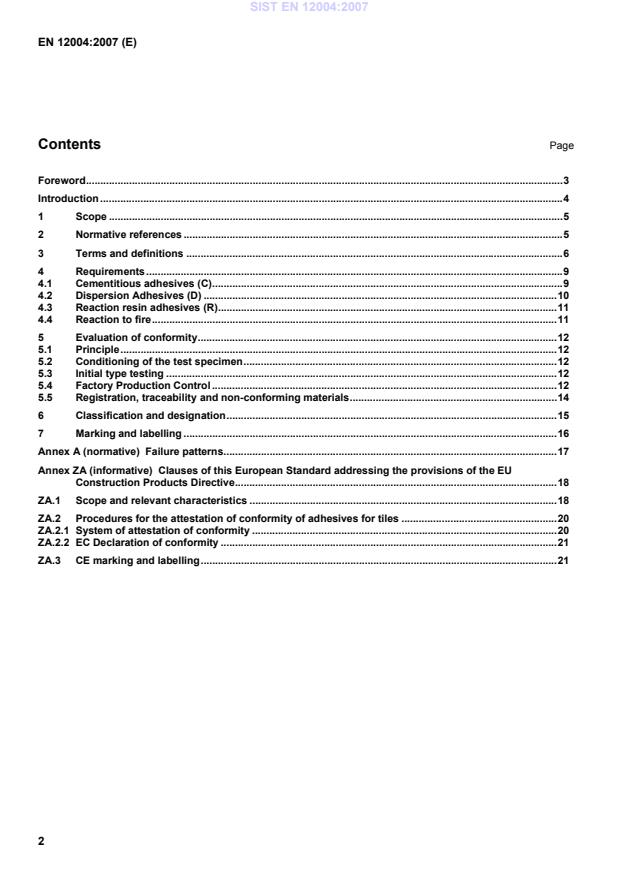
Failure patterns.17 Annex ZA (informative)
Clauses of this European Standard addressing the provisions of the EU Construction Products Directive.18 ZA.1 Scope and relevant characteristics.18 ZA.2 Procedures for the attestation of conformity of adhesives for tiles.20 ZA.2.1 System of attestation of conformity.20 ZA.2.2 EC Declaration of conformity.21 ZA.3 CE marking and labelling.21
EN 1308, Adhesives for tiles – Determination of slip EN 1324:2007, Adhesives for tiles – Determination of shear adhesion strength of dispersion adhesives EN 1346, Adhesives for tiles – Determination of open time EN 1347, Adhesives for tiles – Determination of wetting capability EN 1348:2007, Adhesives for tiles – Determination of tensile adhesion strength for cementitious adhesives EN 12002, Adhesives for tiles – Determination of transverse deformation for cementitious adhesives and grouts EN 12003:1997, Adhesives for tiles – Determination of shear adhesion strength of reaction resin adhesives EN 12808-1, Adhesives and grouts for tiles – Part 1: Determination of chemical resistance of reaction resin mortars EN 13501-1, Fire classification of construction products and building elements – Part 1: Classification using
data from reaction to fire tests
NOTE The adhesive is usually applied with a trowel to obtain a layer and then combed with a notched trowel to achieve the right thickness and planarity 3.1.2 fixing surface plane rigid surface upon which the tile is fixed 3.1.3 wall and floor tiles tiles made out of ceramic or natural and agglomerated stones 3.2 Products 3.2.1 cementitious adhesive mixture of hydraulic binding agents, aggregates, and organic additives
NOTE 1 The adhesives are mixed with water or liquid admix just before use. NOTE 2 Cementitious adhesives are designated as type C. 3.2.2 dispersion adhesive mixture of organic binding agent(s) in the form of an aqueous polymer dispersion, organic additives and mineral fillers
NOTE 1 The mixture is ready for use NOTE 2 Dispersion adhesives are designated as type D. 3.2.3 reaction resin adhesive mixture of synthetic resin, mineral fillers and organic additives in which hardening occurs by chemical reaction
NOTE 1 They are available in one or more component forms NOTE 2 reaction resin adhesive are designated as type R 3.3 Tools and working methods 3.3.1 notched trowel toothed tool, which makes it possible to apply the adhesive as a series of ribs of a uniform thickness onto the fixing surface and/or the reverse face of the tile SIST EN 12004:2007
NOTE The tiles are then fixed before a film forms on the surface of the adhesive 3.3.3 application to both surfaces, Floating and buttering method adhesive applied to the fixing surface and to the reverse of the tiles NOTE The combined layer of adhesive should not exceed the maximum recommended thickness. The tiles are then fixed before a film forms on the surface of the adhesive 3.4 Application properties 3.4.1 shelf life time of storage under stated conditions during which an adhesive is expected to maintain its working properties 3.4.2 maturing time interval between the time when the cementitious adhesive is mixed and the time when it is ready for use 3.4.3 pot-life maximum time interval during which the adhesive can be used after mixing 3.4.4 open time maximum interval after application at which tiles can be embedded in the applied adhesive and meet the specified tensile adhesion strength requirement
NOTE Open time is measured by the method described in EN 1346 3.4.5 wetting capability ability of a combed adhesive layer to wet the tile
NOTE Wetting capability is measured by the method described in EN 1347 3.4.6 slip downward movement of a tile applied to a combed adhesive layer on a vertical or inclined surface NOTE Slip is measured by the method described in EN 1308 3.4.7 adjustability maximum time interval after which the tile’s position in the adhesive layer can be adjusted without significant loss of adhesion strength 3.5 Final properties 3.5.1 adhesion strength maximum strength per unit surface area which can be measured by shear or tensile testing SIST EN 12004:2007
NOTE In this case the strength of the adhesive is greater than the test value 3.7 Characteristics 3.7.1 fundamental characteristics characteristics that an adhesive absolutely has to have 3.7.2 Optional characteristics 3.7.2.1 additional characteristics characteristics for specific service conditions where enhanced levels of performance are required 3.7.2.2 special characteristics characteristics of the adhesive which provide further information about its general performance SIST EN 12004:2007
Characteristic Requirement Test Method Initial tensile adhesion strength ≥ 0,5 N/mm2 8.2 of EN 1348:2007 Tensile adhesion strength after water immersion ≥ 0,5 N/mm2 8.3 of EN 1348:2007 Tensile adhesion strength after heat ageing ≥ 0,5 N/mm2 8.4 of EN 1348:2007 Tensile adhesion strength after freeze-thaw cycles ≥ 0,5 N/mm2 8.5 of EN 1348:2007 Open time: tensile adhesion strength ≥ 0,5 N/mm2 after not less than 20 min EN 1346 1 b FAST SETTING ADHESIVES
Characteristic Requirement Test Method Early tensile adhesion strength ≥ 0,5 N/mm2 after not more than 6 h 8.2 of EN 1348:2007 Open time: tensile adhesion strength ≥ 0,5 N/mm2 after not less than 10 min EN 1346 All other requirements as in Table 1a
EN 1348 OPTIONAL CHARACTERISTICS 1 c SPECIAL CHARACTERISTICS
Characteristic Requirement Test Method Slip ≤ 0,5 mm EN 1308 Extended open time: tensile adhesion strength ≥ 0,5 N/mm2 after not less than 30 min EN 1346 Deformable adhesive: transverse deformation ≥ 2,5 mm and < 5 mm EN 12002 Highly deformable adhesive: transverse deformation: ≥ 5 mm EN 12002 1 d ADDITIONAL CHARACTERISTICS
Characteristic Requirement
Test Method High initial tensile adhesion strength ≥ 1 N/mm2 8.2 of EN 1348:2007 High tensile adhesion strength after water immersion ≥ 1 N/mm2 8.3 of EN 1348:2007 High tensile adhesion strength after heat ageing ≥ 1 N/mm2 8.4 of EN 1348:2007 High tensile adhesion strength after freeze-thaw cycles ≥ 1 N/mm2 8.5 of EN 1348:2007
4.2 Dispersion Adhesives (D) All the dispersion adhesives shall comply with the characteristics specified in Table 2a. Tables 2b and 2c give the optional characteristics that can be required for special service conditions. Table 2 — Requirements for Dispersion Adhesives (D) 2 a FUNDAMENTAL CHARACTERISTICS
Characteristic Requirement Test Method Initial shear adhesion strength ≥ 1 N/mm2 7.2 of EN 1324:2007 Shear adhesion strength after heat ageing ≥ 1 N/mm2 7.4 of EN 1324:2007 Open time: tensile adhesion strength ≥ 0,5 N/mm2 after not less than 20 min EN 1346 OPTIONAL CHARACTERISTICS 2 b SPECIAL CHARACTERISTICS
Characteristic Requirement Test Method Slip ≤ 0,5 mm EN 1308 Extended open time: tensile adhesion strength ≥ 0,5 N/mm2 after not less than 30 min EN 1346 2 c ADDITIONAL CHARACTERISTICS
Characteristic Requirement Test Method Adhesion strength after water immersion ≥ 0,5 N/mm2 7.3 of EN 1324:2007 Adhesion at elevated temperature ≥ 1 N/mm2 7.5 of EN 1324:2007
Characteristic Requirement Test Method Initial shear adhesion strength ≥ 2 N/mm2 7.3 of EN 12003:1997 Shear adhesion strength after water immersion≥ 2 N/mm2 7.4 of EN 12003:1997 Open time: tensile adhesion strength ≥ 0,5 N/mm2 after not less than 20 min EN 1346 OPTIONAL CHARACTERISTICS 3 b SPECIAL CHARACTERISTICS
Characteristic Requirement Test Method Slip ≤ 0,5 mm EN 1308 3 c ADDITIONAL CHARACTERISTICS
Characteristic Requirement Test Method Shear adhesion strength after thermal shock ≥ 2 N/mm2 7.5 of EN 12003:1997
4.4 Reaction to fire Reaction to fire shall be declared when the product is subject to regulatory requirements and may be declared when not subject to such requirements. Tile adhesives with no more than 1 % of organic material content are considered to be reaction to fire Class A1 (or Class A1fl) without the need for testing. Any adhesive which does not meet the above requirements shall be tested and classified (mounted, where the test method(s) require it, in a manner representative of its intended end use) in accordance with EN 13501-1. Test conditions are the following: - substrate: paper-faced gypsumplaster board - conditioning: 28 days, (23 ± 2)°C and (50 ± 5) % relative humidity.
- number of specimen: 6 a) Test specimen for fire class E (or class Efl) in accordance with fire test EN ISO 11925-2:
Apply
the adhesive with a notched trowel (10 mm x 10 mm notches at 20 mm centres) b) Additional test specimen for fire class A2, B, C or D (or class A2fl, Bfl, Cfl or Dfl) fire test EN 13823 or EN ISO 9239-1: Apply
the adhesive with a notched trowel (10 mm x 10 mm notches at 20 mm centres). Position and align ceramic tiles with facial dimensions (50 ± 1)mm x (50 ± 1) mm
type BIa according to EN 14411 into the adhesive. Place the tiles 5 mm apart. SIST EN 12004:2007
Tolerance
6 h
+
15 min
7 days
+
3 h 14 days
+
6 h 21 days
+
h 28 days
+ 12 h 5.3 Initial type testing On first evaluation of a product to the requirements of this standard, or before the beginning of sale of a new product, appropriate initial type testing shall be carried out to confirm that the characteristics of the product meet the requirements of this standard. Tests which have previously been performed in accordance with the provisions of this standard (same product, same characteristic, test method, sampling procedure, etc.) may be taken into account for the purpose of demonstrating satisfactory initial type testing. Initial type tests shall also be carried out on existing products after any change in raw materials or manufacturing procedures that can modify the declared values of the characteristics or application properties. In these cases the appropriate initial type testing to be carried out are those for the characteristics and properties that can be affected and need confirmation; any new property or properties arising from a change of formulation or manufacturing procedure shall be tested and the results reported. The initial type testing shall be performed as listed in Table 4. The results of initial type testing shall be recorded and be available for inspection. They shall be kept for at least 10 years after the date of last manufacture of the products to which they relate. 5.4 Factory Production Control 5.4.1 General A Factory Production Control (FPC) plan
...
Questions, Comments and Discussion
Ask us and Technical Secretary will try to provide an answer. You can facilitate discussion about the standard in here.
Loading comments...