

EN 12621:2006
(Main)Machinery for the supply and circulation of coating materials under pressure - Safety requirements
- Abstract
1.1 This European Standard applies to the design and construction of machinery for the supply and circulation of coating and/or auxiliary materials under pressure – in the following called "machine" (see 3.1).
The coating material is supplied by air pressure or airless.
NOTE Machines covered by this European Standard may be linked with e.g. colour mixing machinery, atomising and spraying equipment, spray booths and stands and/or automated coating machinery.
The pressure related parts of the machines covered are classified as no higher than category I under article 9 of the Pressure Equipment Directive 97/23/EC.
This European Standard deals with the significant hazards, hazardous situations and events relevant to the machinery for the supply and circulation of coating and/or auxiliary materials under pressure, when they are used as intended and under the conditions foreseen by the manufacturer (see Clause 4).
Machinery for the supply and circulation of coating and/or auxiliary materials under pressure consists of the following equipment:
¾ pump units;
¾ pressure vessels;
¾ non-pressurised containers;
¾ interconnecting pipes and hoses
¾ flanges, nozzles, couplings, supports, lifting equipment etc.;
¾ agitators;
¾ filters;
¾ pulsation damping devices;
¾ all safety devices (e.g. level monitoring equipment);
¾ equipment for heating and/or cooling of the coating materials.
The machine may be fixed or mobile.
1.2 This European Standard excludes:
¾ pressure related hazards of equipment classified as higher than category 1 under article 9 of the Pressure Equipment Directive 97/23/EC;
¾ atomising and spraying equipment as dealt with in EN 1953:1998 and the supply hoses for this equipment;
¾ atomising and spraying equipment as dealt with in EN 50144-2-7:2001, EN 50260-2-7:2002 and the supply hoses for this equipment.
1.3 This European Standard does not apply to:
¾ processing of foodstuffs and pharmaceuticals;
¾ design and construction of pipes and hoses
- Status
- Withdrawn
- Publication Date
- 17-Jan-2006
- Withdrawal Date
- 01-Jun-2010
- Technical Committee
- CEN/TC 271 - Surface treatment equipment - Safety
- Drafting Committee
- CEN/TC 271/WG 2 - Machines for coating and color mixing
- Current Stage
- 9960 - Withdrawal effective - Withdrawal
- Start Date
- 02-Jun-2010
- Completion Date
- 02-Jun-2010
- Directive
- 94/9/EC - Equipment and protective systems intended for use in potentially explosive atmospheres (ATEX)OJ Ref: C, C 97 OJ Date: 16-Apr-2010

Relations
- Effective Date
- 03-Apr-2010
Frequently Asked Questions
EN 12621:2006 is a standard published by the European Committee for Standardization (CEN). Its full title is "Machinery for the supply and circulation of coating materials under pressure - Safety requirements". This standard covers: 1.1 This European Standard applies to the design and construction of machinery for the supply and circulation of coating and/or auxiliary materials under pressure – in the following called "machine" (see 3.1). The coating material is supplied by air pressure or airless. NOTE Machines covered by this European Standard may be linked with e.g. colour mixing machinery, atomising and spraying equipment, spray booths and stands and/or automated coating machinery. The pressure related parts of the machines covered are classified as no higher than category I under article 9 of the Pressure Equipment Directive 97/23/EC. This European Standard deals with the significant hazards, hazardous situations and events relevant to the machinery for the supply and circulation of coating and/or auxiliary materials under pressure, when they are used as intended and under the conditions foreseen by the manufacturer (see Clause 4). Machinery for the supply and circulation of coating and/or auxiliary materials under pressure consists of the following equipment: ¾ pump units; ¾ pressure vessels; ¾ non-pressurised containers; ¾ interconnecting pipes and hoses ¾ flanges, nozzles, couplings, supports, lifting equipment etc.; ¾ agitators; ¾ filters; ¾ pulsation damping devices; ¾ all safety devices (e.g. level monitoring equipment); ¾ equipment for heating and/or cooling of the coating materials. The machine may be fixed or mobile. 1.2 This European Standard excludes: ¾ pressure related hazards of equipment classified as higher than category 1 under article 9 of the Pressure Equipment Directive 97/23/EC; ¾ atomising and spraying equipment as dealt with in EN 1953:1998 and the supply hoses for this equipment; ¾ atomising and spraying equipment as dealt with in EN 50144-2-7:2001, EN 50260-2-7:2002 and the supply hoses for this equipment. 1.3 This European Standard does not apply to: ¾ processing of foodstuffs and pharmaceuticals; ¾ design and construction of pipes and hoses
1.1 This European Standard applies to the design and construction of machinery for the supply and circulation of coating and/or auxiliary materials under pressure – in the following called "machine" (see 3.1). The coating material is supplied by air pressure or airless. NOTE Machines covered by this European Standard may be linked with e.g. colour mixing machinery, atomising and spraying equipment, spray booths and stands and/or automated coating machinery. The pressure related parts of the machines covered are classified as no higher than category I under article 9 of the Pressure Equipment Directive 97/23/EC. This European Standard deals with the significant hazards, hazardous situations and events relevant to the machinery for the supply and circulation of coating and/or auxiliary materials under pressure, when they are used as intended and under the conditions foreseen by the manufacturer (see Clause 4). Machinery for the supply and circulation of coating and/or auxiliary materials under pressure consists of the following equipment: ¾ pump units; ¾ pressure vessels; ¾ non-pressurised containers; ¾ interconnecting pipes and hoses ¾ flanges, nozzles, couplings, supports, lifting equipment etc.; ¾ agitators; ¾ filters; ¾ pulsation damping devices; ¾ all safety devices (e.g. level monitoring equipment); ¾ equipment for heating and/or cooling of the coating materials. The machine may be fixed or mobile. 1.2 This European Standard excludes: ¾ pressure related hazards of equipment classified as higher than category 1 under article 9 of the Pressure Equipment Directive 97/23/EC; ¾ atomising and spraying equipment as dealt with in EN 1953:1998 and the supply hoses for this equipment; ¾ atomising and spraying equipment as dealt with in EN 50144-2-7:2001, EN 50260-2-7:2002 and the supply hoses for this equipment. 1.3 This European Standard does not apply to: ¾ processing of foodstuffs and pharmaceuticals; ¾ design and construction of pipes and hoses
EN 12621:2006 is classified under the following ICS (International Classification for Standards) categories: 87.100 - Paint coating equipment. The ICS classification helps identify the subject area and facilitates finding related standards.
EN 12621:2006 has the following relationships with other standards: It is inter standard links to EN 12621:2006+A1:2010. Understanding these relationships helps ensure you are using the most current and applicable version of the standard.
EN 12621:2006 is associated with the following European legislation: EU Directives/Regulations: 94/9/EC, 98/37/EC; Standardization Mandates: M/079, M/BC/CEN/92/46. When a standard is cited in the Official Journal of the European Union, products manufactured in conformity with it benefit from a presumption of conformity with the essential requirements of the corresponding EU directive or regulation.
EN 12621:2006 is available in PDF format for immediate download after purchase. The document can be added to your cart and obtained through the secure checkout process. Digital delivery ensures instant access to the complete standard document.
Standards Content (Sample)
2003-01.Slovenski inštitut za standardizacijo. Razmnoževanje celote ali delov tega standarda ni dovoljeno.Machinery for the supply and circulation of coating materials under pressure - Safety requirements9DUQRVWQH]DKWHYHInstallations d'alimentation et de circulation de produits de revetement sous pression - Prescriptions de sécuritéFörder- und Umlaufanlagen für Beschichtungsstoffe unter Druck - Sicherheitsanforderungen87.100Oprema za nanašanje premazovPaint coating equipmentICS:SIST EN 12621:2006enTa slovenski standard je istoveten z:EN 12621:200601-maj-2006SIST EN 12621:2006SLOVENSKI
STANDARD
EUROPEAN STANDARDNORME EUROPÉENNEEUROPÄISCHE NORMEN 12621January 2006ICS 87.100 English VersionMachinery for the supply and circulation of coating materialsunder pressure - Safety requirementsInstallations d'alimentation et de circulation de produits derevêtement sous pression - Prescriptions de sécuritéFörder- und Umlaufanlagen für Beschichtungsstoffe unterDruck - SicherheitsanforderungenThis European Standard was approved by CEN on 9 December 2005.CEN members are bound to comply with the CEN/CENELEC Internal Regulations which stipulate the conditions for giving this EuropeanStandard the status of a national standard without any alteration. Up-to-date lists and bibliographical references concerning such nationalstandards may be obtained on application to the Central Secretariat or to any CEN member.This European Standard exists in three official versions (English, French, German). A version in any other language made by translationunder the responsibility of a CEN member into its own language and notified to the Central Secretariat has the same status as the officialversions.CEN members are the national standards bodies of Austria, Belgium, Cyprus, Czech Republic, Denmark, Estonia, Finland, France,Germany, Greece, Hungary, Iceland, Ireland, Italy, Latvia, Lithuania, Luxembourg, Malta, Netherlands, Norway, Poland, Portugal, Romania,Slovakia, Slovenia, Spain, Sweden, Switzerland and United Kingdom.EUROPEAN COMMITTEE FOR STANDARDIZATIONCOMITÉ EUROPÉEN DE NORMALISATIONEUROPÄISCHES KOMITEE FÜR NORMUNGManagement Centre: rue de Stassart, 36
B-1050 Brussels© 2006 CENAll rights of exploitation in any form and by any means reservedworldwide for CEN national Members.Ref. No. EN 12621:2006: E
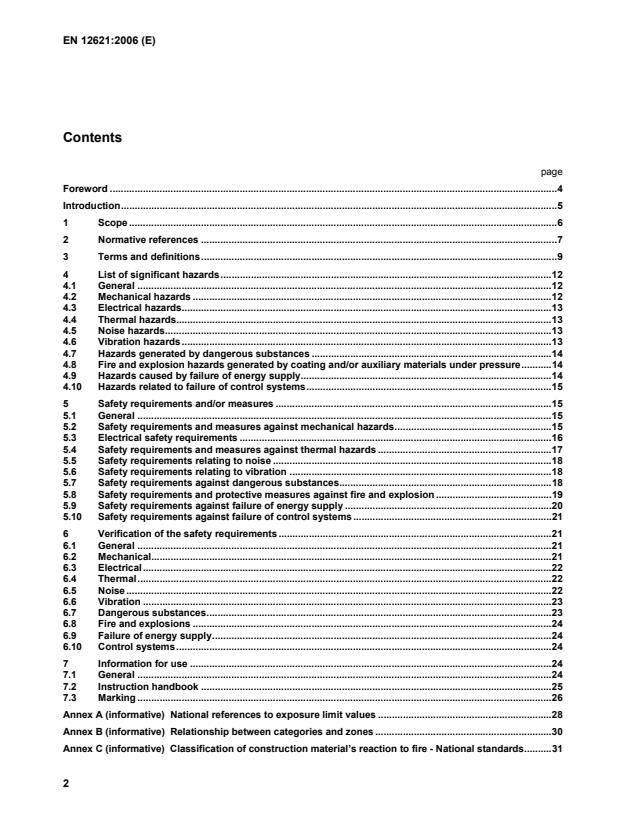
National references to exposure limit values.28 Annex B (informative)
Relationship between categories and zones.30 Annex C (informative)
Classification of construction material’s reaction to fire - National standards.31
Relationship between this
European Standard and the Essential Requirements of EU Directive 98/37/EC.32 Annex ZB (informative)
Relationship between this European Standard and the Essential Requirements of EU Directive 94/9/EC.33 Bibliography.34
1 Scope 1.1 This European Standard applies to the design and construction of machinery for the supply and circulation of coating and/or auxiliary materials under pressure – in the following called "machine" (see 3.1). The coating material is supplied by air pressure or airless. NOTE Machines covered by this European Standard may be linked with e.g. colour mixing machinery, atomising and spraying equipment, spray booths and stands and/or automated coating machinery.
The pressure related parts of the machines covered are classified as no higher than category I under article 9 of the Pressure Equipment Directive 97/23/EC. This European Standard deals with the significant hazards, hazardous situations and events relevant to the machinery for the supply and circulation of coating and/or auxiliary materials under pressure, when they are used as intended and under the conditions foreseen by the manufacturer (see Clause 4). Machinery for the supply and circulation of coating and/or auxiliary materials under pressure consists of the following equipment: pump units; pressure vessels; non-pressurised containers; interconnecting pipes and hoses flanges, nozzles, couplings, supports, lifting equipment etc.; agitators; filters; pulsation damping devices; all safety devices (e.g. level monitoring equipment); equipment for heating and/or cooling of the coating materials. The machine may be fixed or mobile. 1.2 This European Standard excludes: pressure related hazards of equipment classified as higher than category 1 under article 9 of the Pressure Equipment Directive 97/23/EC; atomising and spraying equipment as dealt with in EN 1953:1998 and the supply hoses for this equipment; atomising and spraying equipment as dealt with in EN 50144-2-7:2001, EN 50260-2-7:2002 and the supply hoses for this equipment. 1.3 This European Standard does not apply to: processing of foodstuffs and pharmaceuticals;
methodology EN 1494:2000, Mobile or movable jacks and associated lifting equipment EN 1570:1998, Safety requirements for lifting tables prEN 1829-1, High pressure cleaners — High pressure water jet machines — Safety
requirements — Part 1: General description EN 1953:1998, Atomising and spraying equipment for coating materials — Safety requirements EN 13445-1:2002, Unfired pressure vessels — Part 1: General EN 13463-1:2001, Non-electrical equipment for potentially explosive atmospheres — Part 1: Basic method and requirements EN 13463-5:2003, Non-electrical equipment intended for use in potentially explosive atmospheres — Part 5: Protection by constructional safety "c" EN 13478:2001, Safety of machinery — Fire prevention and protection EN 14462:2005, Surface treatment equipment — Noise test code for surface treatment equipment including its ancillary handling equipment — Accuracy grades 2 and 3
EN 50050:2001, Electrical apparatus for potentially explosive atmospheres — Electrostatic hand-held spraying equipment EN 50059:1990, Specification for electrostatic hand-held spraying equipment for non-flammable material for
painting and finishing EN 50176:1996, Automatic electrostatic spraying installations for flammable liquid spraying material EN 60079-0:2004, Electrical apparatus for explosive gas atmospheres — Part 0: General requirements (IEC 60079-0:2004) EN 60079-15, Electrical apparatus for explosive gas atmospheres — Part 15: Type of protection "n"
(IEC 60079-15:2001, modified) EN 60204-1:1997, Safety of machinery — Electrical equipment of machines — Part 1: General requirements (IEC 60204-1:1997) EN 61000-6-1:2001, Electromagnetic compatibility (EMC) — Part 6-1: Generic standards — Immunity for residential, commercial and light-industrial environments (IEC 61000-6-1:1997, modified) EN 61000-6-2:2001, Electromagnetic compatibility (EMC) — Part 6-2: Generic standards — Immunity for industrial environments (IEC 61000-6-2:1999, modified) EN 61000-6-3:2001, Electromagnetic compatibility (EMC) — Part 6-3: Generic standards — Emission standard for residential, commercial and light-industrial environments (IEC 61000-6-3:1996, modified) EN 61000-6-4:2001, Electromagnetic compatibility (EMC) — Part 6-4: Generic standards — Emission standard for industrial environments (IEC 61000-6-4:1997, modified)
sealers and adhesives. 3.11 auxiliary material material used for functions e.g.: solvents, compressed air (for cleaning), water, compressed air (for maintenance) 3.12 flammable substance substance in form of gas, vapour, liquid, solid, or mixtures of these, able to undergo an exothermic reaction with air when ignited (see 3.1 of EN 1127-1:1997) NOTE “Flammable substances” and “combustible material” are equivalently used terms in this European Standard. 3.13 explosion range range of concentration of a flammable substance with air, within which an explosion can occur (see 3.13 of EN 1127-1:1997) 3.14 hazardous areas areas where hazards due to explosive atmosphere may exist. The probability of occurrence of explosive atmospheres is classified in zones. NOTE Limits of hazardous zones are given in Annex B 3.14.1 zone 0 place in which an explosive atmosphere consisting of a mixture with air of flammable substances in the form of gas, vapour or mist is present continuously or for long periods or frequently (see 6.3.2 of EN 1127-1:1997)
EN 61000-6-2:1994. NOTE It is recommended that manufacturers use only components that have been identified as conforming for immunity and emission to harmonised EMC standards and apply them in accordance with the supplier’s recommendations. 5.4 Safety requirements and measures against thermal hazards Machines with equipment for heating and/or cooling of coating material shall be designed and constructed to minimise any risk of injury caused by contact, radiation or convection from hot or very cold surfaces of the machine and its parts or coating material. Limits of temperatures of touchable surfaces given in EN 563 shall be observed. The hazard of touching hot surfaces shall preferably be reduced by: limitation of coating material temperature; insulation; guarding to keep distance (screen, barrier, according to EN 953) and where necessary: marking and warning signals according to EN 894-1, EN 894-2, EN 894-3, EN 61310-1 and EN 981; instructions of use of personal protective equipment (see 7.2). Protection against burns by hot surfaces shall be secured by means of appropriate insulation or protection against contact of all elements within arm's reach and within the working area. According to EN 563 at an ambient temperature of 20 °C the surface temperature shall be less than 60 °C. Exceptions are permissible in small localised areas of the surface (for example flanges of burners, bolts). Any parts of the machine not normally in contact with the human body which may exceed these temperatures will require special warnings in the instruction handbook including recommended contact time limits as shown in EN 563. Such surfaces shall also be fitted with warning labels indicating the risks and stating the maximum temperature that these surfaces may reach. For pipelines, 1 label/3m is required. For non-metallic components such as hoses and seals, the manufacturers recommendations shall be observed. Machines with equipment for heating and/or cooling of coating material shall be safeguarded to prevent the coating material exceeding the maximum allowable temperature for the intended use. When temperature limiting controls are used, over-temperature shall be at least be avoided by end of scale of the temperature setting device or protection of the maximum set point by key lock or code system. Where applicable, these machines shall be equipped with a temperature limiting device interlocked with the power supply of the heating system and shall trigger optical and/or audible alarms. The set point adjustment shall only be accessible by a competent person. The reset of the cut-off shall be manual and the restart of the heating shall not be done automatically. Temperature control devices and temperature limiting devices shall be independent from each other.
...