

EN 352-3:2002
(Main)Hearing protectors - General requirements - Part 3: Ear-muffs attached to an industrial safety helmet
- Abstract
This part of the standard specifies requirements for construction, design, performance, marking and user information for ear-muffs fitted to an industrial helmet which complies with EN 397, Industrial safety helmets. In particular, it calls for the sound attenuation of the ear-muffs, measured in accordance with EN 24869-1, to be declared and to be not less than a specified minimum. The requirements of this standard are intended to take account of the ergonomic interaction between the wearer, the device and where possible the working environment in which the device is likely to be used (see Annex ZA, of this standard and EN 458).
- Status
- Withdrawn
- Publication Date
- 22-Oct-2002
- Withdrawal Date
- 06-Oct-2026
- Technical Committee
- CEN/TC 159 - Hearing protectors
- Current Stage
- 9960 - Withdrawal effective - Withdrawal
- Start Date
- 18-Nov-2020
- Completion Date
- 07-Oct-2026
- Directive
- 2016/425 - Regulation (EU) 2016/425 of the European Parliament and of the Council of 9 March 2016 on personal protective equipment and repealing Council Directive 89/686/EECOJ Ref: C, C 113 OJ Date: 27-Mar-2018
89/686/EEC - Personal protective equipment (PPE)OJ Ref: C 203, C 24, C 247, C 306, C 46, C 91 OJ Date: 28-Aug-2003


Relations
- Effective Date
- 22-Dec-2008
- Effective Date
- 25-Nov-2020
- Effective Date
- 28-Jan-2026
- Effective Date
- 28-Jan-2026
- Effective Date
- 28-Jan-2026
- Effective Date
- 28-Jan-2026
- Effective Date
- 28-Jan-2026
- Effective Date
- 28-Jan-2026
Get Certified
Connect with accredited certification bodies for this standard

CIS Institut d.o.o.
Personal Protective Equipment (PPE) certification body. Notified Body NB-2890 for EU Regulation 2016/425 PPE.

Kiwa BDA Testing
Building and construction product certification.
Kmetijski inštitut Slovenije
Agricultural Institute of Slovenia. Soil testing, plant health, agricultural product analysis.
Sponsored listings
Frequently Asked Questions
EN 352-3:2002 is a standard published by the European Committee for Standardization (CEN). Its full title is "Hearing protectors - General requirements - Part 3: Ear-muffs attached to an industrial safety helmet". This standard covers: This part of the standard specifies requirements for construction, design, performance, marking and user information for ear-muffs fitted to an industrial helmet which complies with EN 397, Industrial safety helmets. In particular, it calls for the sound attenuation of the ear-muffs, measured in accordance with EN 24869-1, to be declared and to be not less than a specified minimum. The requirements of this standard are intended to take account of the ergonomic interaction between the wearer, the device and where possible the working environment in which the device is likely to be used (see Annex ZA, of this standard and EN 458).
This part of the standard specifies requirements for construction, design, performance, marking and user information for ear-muffs fitted to an industrial helmet which complies with EN 397, Industrial safety helmets. In particular, it calls for the sound attenuation of the ear-muffs, measured in accordance with EN 24869-1, to be declared and to be not less than a specified minimum. The requirements of this standard are intended to take account of the ergonomic interaction between the wearer, the device and where possible the working environment in which the device is likely to be used (see Annex ZA, of this standard and EN 458).
EN 352-3:2002 is classified under the following ICS (International Classification for Standards) categories: 13.340.20 - Head protective equipment. The ICS classification helps identify the subject area and facilitates finding related standards.
EN 352-3:2002 has the following relationships with other standards: It is inter standard links to EN 352-3:1996, EN 352-3:2020, EN ISO 4869-2:2018, EN 13819-1:2002, EN 397:2025, EN 960:1994, EN 13819-2:2002, EN 352-6:2002. Understanding these relationships helps ensure you are using the most current and applicable version of the standard.
EN 352-3:2002 is associated with the following European legislation: EU Directives/Regulations: 2016/425, 89/686/EEC, 93/68/EEC, 93/95/EEC, 96/58/EC; Standardization Mandates: M/BC/CEN/90/2. When a standard is cited in the Official Journal of the European Union, products manufactured in conformity with it benefit from a presumption of conformity with the essential requirements of the corresponding EU directive or regulation.
EN 352-3:2002 is available in PDF format for immediate download after purchase. The document can be added to your cart and obtained through the secure checkout process. Digital delivery ensures instant access to the complete standard document.
Standards Content (Sample)
2003-01.Slovenski inštitut za standardizacijo. Razmnoževanje celote ali delov tega standarda ni dovoljeno.Gehörschützer - Allgemeine Anforderungen - Teil 3: An Industriehelmen befestigte KapselgehörschützerProtecteurs individuels contre le bruit - Exigences générales - Partie 3: Serre tete montés sur casque de sécurité industrielHearing protectors - General requirements - Part 3: Ear-muffs attached to an industrial safety helmet13.340.20Varovalna oprema za glavoHead protective equipmentICS:Ta slovenski standard je istoveten z:EN 352-3:2002SIST EN 352-3:2003en01-januar-2003SIST EN 352-3:2003SLOVENSKI
STANDARDSIST EN 352-3:19981DGRPHãþD
EUROPEAN STANDARDNORME EUROPÉENNEEUROPÄISCHE NORMEN 352-3October 2002ICS 13.340.20Supersedes EN 352-3:1996English versionHearing protectors - General requirements - Part 3: Ear-muffsattached to an industrial safety helmetProtecteurs individuels contre le bruit - Exigencesgénérales - Partie 3: Serre tête montés sur casque deprotection pour l'industrieGehörschützer - Allgemeine Anforderungen - Teil 3: AnIndustriehelmen befestigte KapselgehörschützerThis European Standard was approved by CEN on 18 August 2002.CEN members are bound to comply with the CEN/CENELEC Internal Regulations which stipulate the conditions for giving this EuropeanStandard the status of a national standard without any alteration. Up-to-date lists and bibliographical references concerning such nationalstandards may be obtained on application to the Management Centre or to any CEN member.This European Standard exists in three official versions (English, French, German). A version in any other language made by translationunder the responsibility of a CEN member into its own language and notified to the Management Centre has the same status as the officialversions.CEN members are the national standards bodies of Austria, Belgium, Czech Republic, Denmark, Finland, France, Germany, Greece,Iceland, Ireland, Italy, Luxembourg, Malta, Netherlands, Norway, Portugal, Spain, Sweden, Switzerland and United Kingdom.EUROPEAN COMMITTEE FOR STANDARDIZATIONCOMITÉ EUROPÉEN DE NORMALISATIONEUROPÄISCHES KOMITEE FÜR NORMUNGManagement Centre: rue de Stassart, 36
B-1050 Brussels© 2002 CENAll rights of exploitation in any form and by any means reservedworldwide for CEN national Members.Ref. No. EN 352-3:2002 ESIST EN 352-3:2003
(informative)
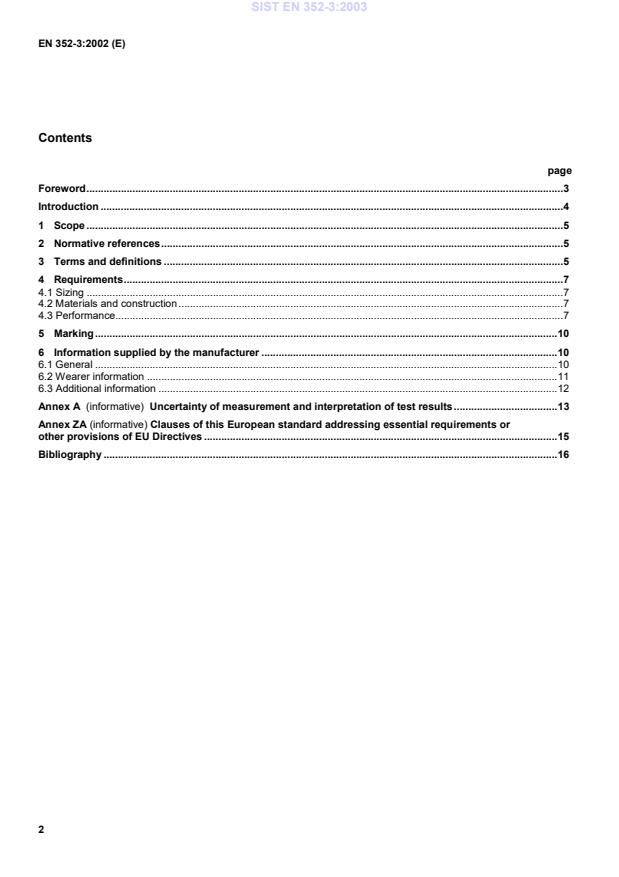
Uncertainty of measurement and interpretation of test results.13Annex ZA (informative) Clauses of this European standard addressing essential requirements orother provisions of EU Directives.15Bibliography.16SIST EN 352-3:2003
It includes the means of attachment to thesafety helmet shell3.3cushiondeformable component, usually containing a foam plastic or fluid filling, fitted to the rim of the cup to improve thecomfort and fit of the ear-muffs on the headSIST EN 352-3:2003
The cups may be pressed against the head with a headband or by means ofa device attached to a safety helmet or other equipment3.6headbandband designed to enable the ear-muffs to fit securely around the ears by exerting force against the cups andpressure through the cushions.
In the case of helmet mounted ear-muffs it is deemed to be that part of the helmetmounted ear-muffs which supports the cups. It comprises the safety helmet shell and the cup support arms, and isintended to be functionally equivalent to the headband of headband ear-muffs3.7helmetheadgear, primarily intended to protect the upper part of a wearer’s head against injury from falling objects andwhich complies with the requirements of EN 3973.8external vertical distancevertical distance between the top of the test headform on which the helmet is mounted and the highest point on theoutside surface of the helmet shell3.9insertion lossmean algebraic difference in decibels between the one-third octave band sound pressure level, measured by themicrophone of the acoustic test fixture in a specified sound field under specified conditions, with the hearingprotector absent, and the sound pressure level with the hearing protector on, with other conditions identical3.10parking positionposition of the ear-muffs in which the cups are located above the level of the lower edge of the helmet shell, asspecified by the ear-muffs manufacturer in accordance with 6.2(h) (see also 3.12)3.11sound attenuationfor a given test signal, the mean difference in decibels between the threshold of hearing with and without thehearing protector in place, for a panel of test subjects3.12stand-by positionposition of the ear-muffs in which the cups are located below the level of the lower edge of the helmet shell and inwhich the cushions are held away from the side of the head or pinna (see also 3.10)3.13basic combinationhelmet mounted ear-muffs which includes the first or only model or size of helmet to which a given model of ear-muffs is fitted, and which will undergo all the tests in the standard (see also 3.14)3.14supplementary combinationhelmet mounted ear-muffs which include a model or size of helmet, (other than the helmet of the basiccombination), to which is fitted the same model of ear-muffs as for the basic combination, and which will undergoan abbreviated set of tests (see also 3.13)SIST EN 352-3:2003
A model of helmet mounted ear-muffs may fall into more than one size range.4.2 Materials and construction4.2.1 Materials4.2.1.1 Those parts of the ear-muffs that may come into contact with the skin shall be non-staining, soft, pliable andnot known to be likely to cause skin irritatio
...