

EN 15051-1:2025
(Main)Workplace exposure - Measurement of the dustiness of bulk materials - Part 1: Requirements and choice of test methods
- Abstract
This document specifies the environmental conditions, the sample handling and analytical procedures and the method of calculating and presenting the results. Reasons are given for the need for more than one method and advice is given on the choice of method to be used.
This document establishes a categorization scheme for dustiness to provide a standardized way to express and communicate the results to users of the bulk materials. Details of the scheme for each method are given in FprEN 15051-2:2025 and FprEN 15051-3:2025.
This document is applicable to powdered, granular or pelletized bulk materials.
This document does not apply to test the dust released during mechanical reduction of solid bulk materials (e.g. cut, crushed) or to test application procedures for the bulk materials.
- Status
- Published
- Publication Date
- 04-Nov-2025
- Technical Committee
- CEN/TC 137 - Assessment of workplace exposure
- Drafting Committee
- CEN/TC 137/WG 3 - Particulate matter
- Current Stage
- 6060 - Definitive text made available (DAV) - Publishing
- Start Date
- 05-Nov-2025
- Due Date
- 12-Oct-2025
- Completion Date
- 05-Nov-2025

Overview
EN 15051-1:2025 is a European standard developed by CEN that provides a systematic approach for the measurement of dustiness in bulk materials at the workplace. The standard specifies requirements for environmental control, sample handling, analytical procedures, and methods for calculating and reporting dustiness results. It establishes guidance on selecting the most suitable test method and ensures consistent categorization of dustiness, which is crucial for occupational health, workplace safety, and risk assessment in industries handling powdered, granular, or pelletized bulk materials.
Key Topics
- Dustiness Measurement: The standard defines procedures for assessing the propensity of bulk materials to release dust under specified conditions. It covers inhalable, thoracic, and respirable fractions, which are pertinent to worker health.
- Choice of Test Methods: EN 15051-1:2025 outlines the reasoning for multiple testing methods and provides advice on selecting the most appropriate one based on the material and workplace scenario.
- Environmental and Sample Handling Conditions: Stringent requirements are outlined for humidity, temperature, and sample conditioning. Proper sample representation and handling are emphasized to ensure the reliability of results.
- Categorization Scheme: The standard introduces a uniform scheme categorizing dustiness into very low, low, moderate, or high, facilitating clear communication of test outcomes within the industry.
- Reporting and Documentation: Detailed instructions are provided for comprehensive reporting, including environmental conditions, analytical methods, and dustiness categorizations.
Applications
EN 15051-1:2025 is invaluable for sectors involved in the processing, handling, storage, or transport of bulk materials, such as:
- Industrial Manufacturing: Powdered chemicals, construction materials, and industrial minerals.
- Occupational Hygiene and Safety: Enables occupational hygienists, producers, and employers to identify, assess, and mitigate workplace exposure to airborne dust.
- Product Development and Quality Control: Supports manufacturers in improving material formulations to reduce dust emissions and select less dusty alternatives.
- Risk Assessment and Control Design: Assists engineers in planning ventilation, filtration, and other control measures, based on standardized dustiness data.
- Regulatory Compliance: Facilitates adherence to European health and safety regulations concerning workplace air quality and exposure limits.
The standard applies specifically to the dustiness of powdered, granular, or pelletized bulk materials. It does not cover testing of dust generated during mechanical reduction processes (such as cutting or crushing), nor application procedures for bulk materials.
Related Standards
- EN 15051-2:2025: Specifies the rotating drum method for dustiness testing, simulating repeated handling processes.
- EN 15051-3:2025: Describes the continuous drop method, suited for scenarios where one-time dropping or pouring is typical.
- EN 1540: Provides common workplace exposure terminology, referenced throughout EN 15051.
- EN 481: Relates to the health-related fractions of airborne particles (inhalable, thoracic, respirable).
- EN 17199 series: Applies to dustiness measurement of bulk materials possibly containing nano-objects.
Practical Value
By implementing EN 15051-1:2025, organizations ensure:
- Consistent and reproducible dustiness measurements across laboratories and industrial sectors.
- Enhanced workplace safety through informed control measures.
- Better product stewardship by minimizing product loss and environmental contamination.
- Reliable comparison and communication of dustiness across products and suppliers.
- Full alignment with evolving European and international occupational safety standards.
Adopting this standard helps manufacturers, safety professionals, and employers create safer, healthier workplaces through effective dustiness assessment and control strategies.
Relations
- Effective Date
- 19-Jan-2023
- Effective Date
- 28-Jan-2026
- Effective Date
- 28-Jan-2026
- Effective Date
- 28-Jan-2026
- Effective Date
- 28-Jan-2026
- Effective Date
- 28-Jan-2026
- Effective Date
- 28-Jan-2026
- Effective Date
- 28-Jan-2026
- Effective Date
- 28-Jan-2026
- Effective Date
- 28-Jan-2026
- Effective Date
- 12-Jul-2023
Get Certified
Connect with accredited certification bodies for this standard

CIS Institut d.o.o.
Personal Protective Equipment (PPE) certification body. Notified Body NB-2890 for EU Regulation 2016/425 PPE.

Kiwa BDA Testing
Building and construction product certification.
Kmetijski inštitut Slovenije
Agricultural Institute of Slovenia. Soil testing, plant health, agricultural product analysis.
Sponsored listings
Frequently Asked Questions
EN 15051-1:2025 is a standard published by the European Committee for Standardization (CEN). Its full title is "Workplace exposure - Measurement of the dustiness of bulk materials - Part 1: Requirements and choice of test methods". This standard covers: This document specifies the environmental conditions, the sample handling and analytical procedures and the method of calculating and presenting the results. Reasons are given for the need for more than one method and advice is given on the choice of method to be used. This document establishes a categorization scheme for dustiness to provide a standardized way to express and communicate the results to users of the bulk materials. Details of the scheme for each method are given in FprEN 15051-2:2025 and FprEN 15051-3:2025. This document is applicable to powdered, granular or pelletized bulk materials. This document does not apply to test the dust released during mechanical reduction of solid bulk materials (e.g. cut, crushed) or to test application procedures for the bulk materials.
This document specifies the environmental conditions, the sample handling and analytical procedures and the method of calculating and presenting the results. Reasons are given for the need for more than one method and advice is given on the choice of method to be used. This document establishes a categorization scheme for dustiness to provide a standardized way to express and communicate the results to users of the bulk materials. Details of the scheme for each method are given in FprEN 15051-2:2025 and FprEN 15051-3:2025. This document is applicable to powdered, granular or pelletized bulk materials. This document does not apply to test the dust released during mechanical reduction of solid bulk materials (e.g. cut, crushed) or to test application procedures for the bulk materials.
EN 15051-1:2025 is classified under the following ICS (International Classification for Standards) categories: 13.040.30 - Workplace atmospheres. The ICS classification helps identify the subject area and facilitates finding related standards.
EN 15051-1:2025 has the following relationships with other standards: It is inter standard links to EN 15051-1:2013, EN 15051-3:2025, EN 1540:2021, EN 17199-5:2019, EN 17199-1:2019, EN 15051-2:2025, EN 17199-5:2025, EN 17199-4:2019, EN 17199-3:2019, EN 17199-2:2019, EN 15051-2:2013+A1:2016. Understanding these relationships helps ensure you are using the most current and applicable version of the standard.
EN 15051-1:2025 is available in PDF format for immediate download after purchase. The document can be added to your cart and obtained through the secure checkout process. Digital delivery ensures instant access to the complete standard document.
Standards Content (Sample)
SLOVENSKI STANDARD
01-februar-2026
Nadomešča:
SIST EN 15051-1:2014
Izpostavljenost na delovnem mestu - Meritve prašnosti razsutih materialov - 1. del:
Zahteve in izbira preskusnih metod
Workplace exposure - Measurement of the dustiness of bulk materials - Part 1:
Requirements and choice of test methods
Exposition am Arbeitsplatz Messung des Staubungsverhaltens von Schüttgütern - Teil 1:
Anforderungen und Auswahl der Prüfverfahren
Exposition sur les lieux de travail - Mesurage du pouvoir de resuspension des matériaux
pulvérulents en vrac - Partie 2 : Méthode du tambour rotatif
Ta slovenski standard je istoveten z: EN 15051-1:2025
ICS:
13.040.30 Kakovost zraka na delovnem Workplace atmospheres
mestu
2003-01.Slovenski inštitut za standardizacijo. Razmnoževanje celote ali delov tega standarda ni dovoljeno.
EN 15051-1
EUROPEAN STANDARD
NORME EUROPÉENNE
November 2025
EUROPÄISCHE NORM
ICS 13.040.30 Supersedes EN 15051-1:2013
English Version
Workplace exposure - Measurement of the dustiness of
bulk materials - Part 1: Requirements and choice of test
methods
Exposition sur les lieux de travail - Mesurage du Exposition am Arbeitsplatz - Messung des
pouvoir de resuspension des matériaux en vrac - Partie Staubungsverhaltens von Schüttgütern - Teil 1:
1 : Exigences et choix des méthodes d'essai Anforderungen und Auswahl der Prüfverfahren
This European Standard was approved by CEN on 15 September 2025.
CEN members are bound to comply with the CEN/CENELEC Internal Regulations which stipulate the conditions for giving this
European Standard the status of a national standard without any alteration. Up-to-date lists and bibliographical references
concerning such national standards may be obtained on application to the CEN-CENELEC Management Centre or to any CEN
member.
This European Standard exists in three official versions (English, French, German). A version in any other language made by
translation under the responsibility of a CEN member into its own language and notified to the CEN-CENELEC Management
Centre has the same status as the official versions.
CEN members are the national standards bodies of Austria, Belgium, Bulgaria, Croatia, Cyprus, Czech Republic, Denmark, Estonia,
Finland, France, Germany, Greece, Hungary, Iceland, Ireland, Italy, Latvia, Lithuania, Luxembourg, Malta, Netherlands, Norway,
Poland, Portugal, Republic of North Macedonia, Romania, Serbia, Slovakia, Slovenia, Spain, Sweden, Switzerland, Türkiye and
United Kingdom.
EUROPEAN COMMITTEE FOR STANDARDIZATION
COMITÉ EUROPÉEN DE NORMALISATION
EUROPÄISCHES KOMITEE FÜR NORMUNG
CEN-CENELEC Management Centre: Rue de la Science 23, B-1040 Brussels
© 2025 CEN All rights of exploitation in any form and by any means reserved Ref. No. EN 15051-1:2025 E
worldwide for CEN national Members.
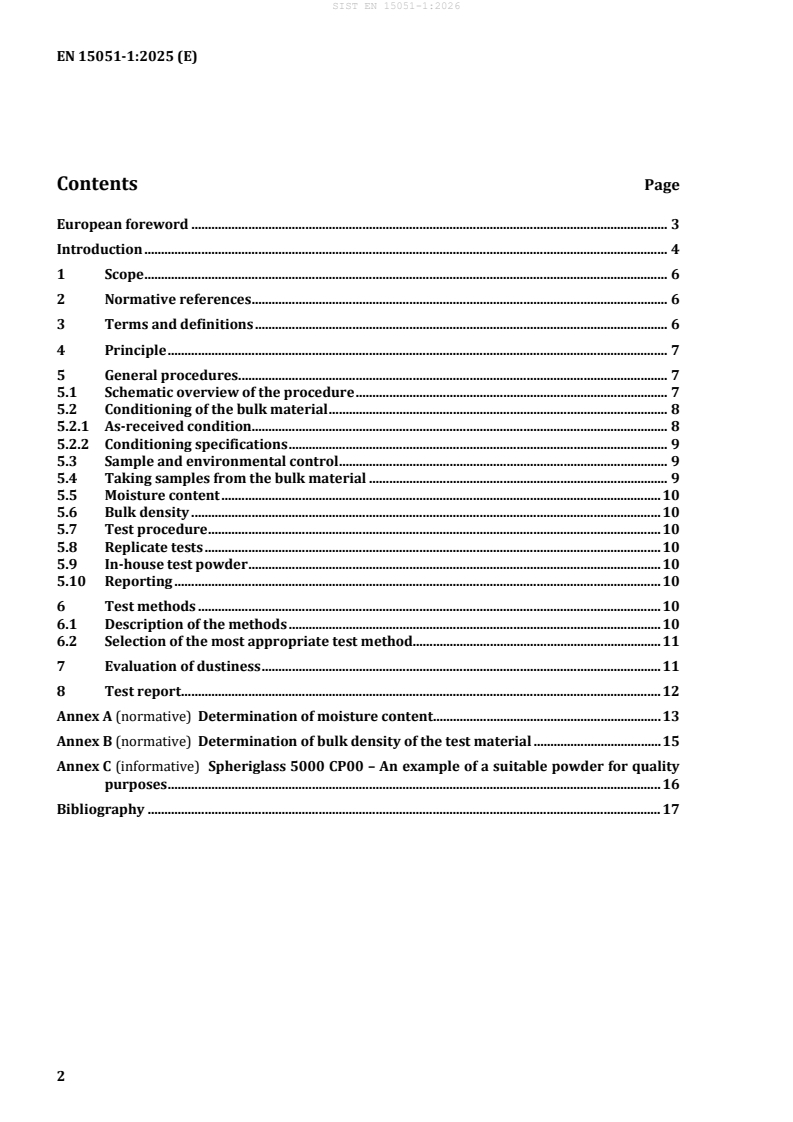
Contents Page
European foreword . 3
Introduction . 4
1 Scope . 6
2 Normative references . 6
3 Terms and definitions . 6
4 Principle . 7
5 General procedures . 7
5.1 Schematic overview of the procedure . 7
5.2 Conditioning of the bulk material . 8
5.2.1 As-received condition. 8
5.2.2 Conditioning specifications . 9
5.3 Sample and environmental control . 9
5.4 Taking samples from the bulk material . 9
5.5 Moisture content . 10
5.6 Bulk density . 10
5.7 Test procedure . 10
5.8 Replicate tests . 10
5.9 In-house test powder . 10
5.10 Reporting . 10
6 Test methods . 10
6.1 Description of the methods . 10
6.2 Selection of the most appropriate test method. 11
7 Evaluation of dustiness . 11
8 Test report . 12
Annex A (normative) Determination of moisture content. 13
Annex B (normative) Determination of bulk density of the test material . 15
Annex C (informative) Spheriglass 5000 CP00 – An example of a suitable powder for quality
purposes . 16
Bibliography . 17
European foreword
This document (EN 15051-1:2025) has been prepared by Technical Committee CEN/TC 137 “Assessment
of workplace exposure to chemical and biological agents”, the secretariat of which is held by DIN.
This European Standard shall be given the status of a national standard, either by publication of an
identical text or by endorsement, at the latest by May 2026, and conflicting national standards shall be
withdrawn at the latest by May 2026.
Attention is drawn to the possibility that some of the elements of this document may be the subject of
patent rights. CEN shall not be held responsible for identifying any or all such patent rights.
This document supersedes EN 15051-1:2013.
— the introduction was revised to better explain the purpose of dustiness testing;
— 5.1: a schematic overview of the test procedure has been added;
— 5.8: information about an in-house / test powder has been added;
— Annex C: an example of a suitable powder for quality purposes (Spheriglass 5000 CP00) has been
added.
EN 15051 Workplace exposure – Measurement of the dustiness of bulk materials consists of the following
parts:
— Part 1: Requirements and choice of test methods;
— Part 2: Rotating drum method;
— Part 3: Continuous drop method.
EN 15051-2 and EN 15051-3 give details of two test apparatus and test methods for the reproducible
production of dust from a bulk material under standard conditions, and the measurement of the
inhalable, thoracic and respirable fractions of this dust, with reference to the existing European
standards, where relevant (see Clause 6).
Any feedback and questions on this document should be directed to the users’ national standards body.
A complete listing of these bodies can be found on the CEN website.
According to the CEN-CENELEC Internal Regulations, the national standards organisations of the
following countries are bound to implement this European Standard: Austria, Belgium, Bulgaria, Croatia,
Cyprus, Czech Republic, Denmark, Estonia, Finland, France, Germany, Greece, Hungary, Iceland, Ireland,
Italy, Latvia, Lithuania, Luxembourg, Malta, Netherlands, Norway, Poland, Portugal, Republic of North
Macedonia, Romania, Serbia, Slovakia, Slovenia, Spain, Sweden, Switzerland, Türkiye and the United
Kingdom.
Introduction
The control of dust emissions during the handling and transportation of bulk materials is an important
consideration in the design and operation of many industrial processes. Excessive airborne dust levels in
workplaces are undesirable for several reasons:
— they can cause adverse health effects to the workers;
— their control can involve the use of costly ventilation and filtration systems;
— they can contaminate machinery and products;
— they can be costly in terms of product losses.
It is therefore advantageous for occupational hygienists and process engineers to have relevant
information about the propensity of bulk materials to release airborne particles (i.e. dust) (the
“dustiness” of the bulk material) so that risks can be evaluated, controlled and minimized.
Dustiness testing measures the propensity of a bulk materials e.g. powder to become airborne in response
to a mechanical stimulus. Dustiness is a relative term and the measurement obtained will depend on
specified method parameters including: the test apparatus used (design and volume), the mechanical
stimulus and energy level applied, the condition and properties of the tested bulk material, the amount
of bulk material tested (volume or mass), the sampling duration or volume of air sampled and various
environmental variables (e.g. relative humidity, temperature and electrostatic effects). If one changes the
extent of one or more method parameters then the outcome (e.g. dustiness values) can change
significantly. The test and the variables therefore need to be closely specified to ensure reproducibility.
A single method of dustiness testing is unlikely to represent and reproduce the many types of processing
and handling used in industry. This has meant that a number of bespoke methods have been developed
and used in some industry sectors but are limited in their scope and application and were not designed
to measure and express results in terms of the health-related fractions: i.e. inhalable, thoracic and
respirable, as defined in EN 481. Therefore, a clear need for a European Standard was presented, leading
to the initial publication of EN 15051 as a single document in 2006. In 2013, the standard was
restructured into three separate parts: EN 15051-1, which outlines general requirements, and two test
methods. EN 15051-2 (rotating drum test) and EN 15051-3 (continuous drop test) were designed to
simulate two of the main handling methods: small-scale repeated discreet handling (e.g. shovelling,
dispensing, batch preparation and weighing etc.) and larger scale conveyancing of bulk dust into silos
and hoppers. EN 15051-2 separates the airborne dust into the three health related fractions using porous
foams and EN 15051-3 measures the respirable fraction using a well-characterized cyclone sampler.
The EN 15051 standard was originally developed in 2006 based on the results of the European
project SMT4-CT96-2074 Development of a Method for Dustiness Testing (see [1]). This project
investigated the dustiness of 12 bulk materials, with the intention to test as wide a range of bulk materials
as possible, i.e. magnitude of dustiness, industrial sectors, chemical composition and particle size
distribution. In 2013, the standard was revised based on important comments from industrial users of
the standard (e.g. Industrial Minerals Association), a number of research papers (for example, [2] and
[3]) and the potential influence of the expanding database of dustiness results.
The level of the dustiness generally depends on material-specific and process-specific parameters. The
most important material-specific parameters are:
— the particle size distribution of the bulk material;
— its bulk density;
— its moisture content (“bulk material moisture content”);
— its chemical composition;
— physical characteristics like electrostatic charge distribution.
Process-specific parameters are mainly determined by the type of handling and are essentially
determined by:
— the type and level of energy that leads to dust release;
— the duration of the energy effect.
For a specific chemical substance in a powder form, it is important to understand that its particle size
distribution cannot predict its dustiness behaviour and respectively its dustiness values cannot predict
the size distribution of this substance.
The results of the dustiness test are expressed in terms of the ratio of the mass of dust released of specific
health-related fractions (mg) / mass of material tested (kg) for specified method parameters. They are
relative values, so a specific scale for dustiness has been derived for each method, which enables a
categorization of the powder into: very low, low, medium and high dustiness categories, for the applicable
health-related fraction/s measured. The scale is specific to the dustiness method selected and for the
specified method parameters.
The dustiness values of a specific method can be used for comparing and ranking powders and assess
whether the current controls are adequate. The information also supports risk and safe by design
assessments. The results provide users (e.g. manufacturers, producers, occupational hygienists and
workers) with information on the potential for dust emissions, when the bulk material is handled or
processed in workplaces. They provide the manufacturers of bulk materials with information that can
help to improve their products. They allow the users of the bulk materials to assess the effects of pre-
treatments, and also to select less dusty products, if available. It is envisaged that different branches of
industry might develop their own categorization schemes using experimentally determined dustiness
values of the bulk materials of interest.
However, dustiness test methods measure dust at emission source and does not consider the
transportation of the airborne particles within a workplace environment to the breathing zone of a
worker. Concentrations of respirable, thoracic or inhalable dust in the workplace air, resulting from the
processing and handling of bulk materials, will depend on a wide variety of factors (e.g. environmental
factors, quantity used, engineering controls, transport of particles from source to worker’s breathing
zone, type of activities). Therefore, dustiness values do not provide workplace exposure concentrations.
The test methods produce samples with the potential for chemical analysis of the contents. However, it
is important to understand that for a mixture, the mass percentage of a substance in the bulk material
will be different (lower or higher) to the mass percentage of the same substance in the dust collected by
the foams and the filter (rotating drum) or by the respirable and inhalable samplers (continuous drop).
A bulk material is expected to be made of solid particles and granular materials. For a mixture, the size
distribution of each substance is likely to be different and furthermore, during disturbance and attrition
of the bulk material in the dustiness testers, it is very likely that the airborne particle size distribution of
each substance is different from each other and from its original size distribution in the bulk material.
This document does not discuss the sample preparation for further chemical analysis of dust released
from bulk materials (except in terms of health-related fractions).
For the measurement of dustiness of bulk materials that possibly contain or release nano-objects and
their agglomerates and aggregates (NOAA), the EN 17199 series [4, 5, 6, 7, 8] apply.
1 Scope
This document specifies the environmental conditions, the sample handling and analytical procedures
and the method of calculating and presenting the results. Reasons are given for the need for more than
one method and advice is given on the choice of method to be used.
This document establishes a categorization scheme for dustiness to provide a standardized way to
express and communicate the results to users of the bulk materials. Details of the scheme for each method
are given in EN 15051-2:2025 and EN 15051-3:2025.
This document is applicable to powdered, granular or pelletized bulk materials.
This document does not apply to test the dust released during mechanical reduction of solid bulk
materials (e.g. cut, crushed) or to test application procedures for the bulk materials.
2 Normative references
The following documents are referred to in the text in such a way that some or all of their content
constitutes requirements of this document. For dated references, only the edition cited applies. For
undated references, the latest edition of the referenced document (including any amendments) applies.
EN 1540, Workplace exposure — Terminology
EN 15051-2:2025, Workplace exposure — Measurement of the dustiness of bulk materials — Part 2:
Rotating drum method
EN 15051-3:2025, Workplace exposure — Measurement of the dustiness of bulk materials — Part 3:
Continuous drop method
3 Terms and definitions
For the purpose of this document, the terms and definitions given in EN 1540 and the following apply.
NOTE In particular, the following terms of EN 1540 are used in this document: airborne dust, dustiness,
dustiness mass fraction, inhalable fraction, respirable fraction, thoracic fraction and health related fractions.
ISO and IEC maintain terminology databases for use in standardization at the following addresses:
— ISO Online browsing platform: available at https://www.iso.org/obp/
— IEC Electropedia: available at https://www.electropedia.org/
3.1
inhalable dustiness mass fraction
w
I,t
ratio of the inhalable dust mass produced by the dustiness test procedure, to the test mass for the
respective test method t
Note 1 to entry: The different test methods are specified in EN 15051-2:2025 and EN 15051-3:2025, and t has the
value A and B for the two methods respectively.
3.2
respirable dustiness mass fraction
w
R,t
ratio of the respirable dust mass produced by the dustiness test procedure to the test mass for the
respective test method t
Note 1 to entry: The different test methods are specified in EN 15051-2:2025 and EN 15051-3:2025, and t has the
value A and B for the two methods respectively.
3.3
thoracic dustiness mass fraction
w
T,t
ratio of the thoracic dust mass produced by the dustiness test procedure to the initial mass for the
respective test method t
Note 1 to entry: The different test methods are specified in EN 15051-2:2025 and EN 15051-3:2025, and t has the
value A and B for the two methods respectively.
4 Principle
A dustiness tester consists of the following elements:
— dust generation section;
— dust transfer section;
— sampling section;
— size fractionator(s);
— dust collection section.
A standard volume or a minimum quantity of bulk material, with known moisture content and bulk
density, is weighed and then placed in the dust generation section, where it is treated under standard
conditions for a set period of time. The airborne dust released is drawn from the dust generation section,
through the dust transfer section, into the sampling section. Here, the size fractionator(s) classifies the
airborne dust according to aerodynamic partic
...