

EN 15573:2008
(Main)Earth-moving machinery - Design requirements for circulation on the road
- Abstract
This European Standard specifies the requirements for earth-moving machinery described in EN ISO 6165 [2], intended to travel on the road.
This European Standard specifies the appropriate technical measures to eliminate or reduce risks arising from the significant hazards, hazardous situations and events during on road travel of earth-moving machinery.
This European Standard does not apply to earth-moving machinery with a width exceeding 3 metres (see 4.2.5).
This European Standard does not apply to earth-moving machinery on legs e.g. walking excavators.
This European Standard does not cover the hazards relevant to non-riding and remote control earth-moving machinery.
This European Standard is not applicable to earth-moving machines manufactured before the publication date of this European Standard by CEN.
- Status
- Published
- Publication Date
- 06-May-2008
- Technical Committee
- CEN/TC 151 - Construction equipment and building material machines - Safety
- Drafting Committee
- CEN/TC 151/WG 1 - Earth-moving machinery - Safety
- Current Stage
- 9020 - Submission to 2 Year Review Enquiry - Review Enquiry
- Start Date
- 15-Jul-2026
- Completion Date
- 15-Jul-2026



Overview
EN 15573:2008 – Earth-moving Machinery: Design Requirements for Road Circulation is a European standard developed by CEN. It establishes essential technical and safety requirements for earth-moving machinery, as defined in EN ISO 6165, intended to travel on public roads. The standard addresses the design features necessary to prevent or minimize risks associated with hazards, hazardous situations, or events that may occur during on-road travel. EN 15573:2008 ensures that earth-moving machines can safely and efficiently move between worksites, storage areas, or for maintenance and refueling, while remaining compliant with road safety and regulatory requirements.
This standard applies only to machines with a maximum width up to 3 meters and excludes walking excavators, non-riding, or remote-control machines, and those manufactured prior to the standard's publication.
Key Topics
EN 15573:2008 addresses a range of vital design and functional requirements, including:
- Dimensions and Masses: Sets maximum limits on mass, axle load, length, width (not exceeding 3 meters), and height to ensure safe interaction with public traffic and infrastructure.
- Speed and Control: Specifies maximum permissible road speeds, speed marking requirements, and the necessity of speedometers for faster machines.
- Safety Systems: Details requirements for braking systems (service, secondary, and parking), dynamic stability, and operator’s control interfaces.
- Steering Systems: Covers standards for steering, including requirements for secondary steering systems, especially for machines with higher design speeds.
- Road Preservation: Addresses features such as tyre/rim specifications, solid/pneumatic tyres, and provisions for protecting road surfaces, particularly for tracklaying machines.
- Visibility and Operator Station: Establishes standards for mirrors, visibility from the operator's position, and additional features like demisting/defrosting systems and restraint systems.
- Lighting and Marking: Specifies requirements for lighting, signalling, marking lights, and reflex-reflector devices to ensure visibility and compliance with road use regulations.
- Trailer Connections: Outlines requirements for coupling devices, lighting sockets, and trailer braking.
- Additional Protections: Covers requirements for noise emission, protruding parts, fenders, and fuel tank integrity.
Applications
EN 15573:2008 is widely relevant for:
- Manufacturers of earth-moving machinery who must design machines capable of safe and legal on-road travel.
- Construction and Civil Engineering Firms that frequently transfer machinery between sites using public roads.
- Regulatory bodies and Authorities overseeing machinery conformance and road safety compliance.
- Equipment Rental Companies needing to ensure their fleets meet current safety and design standards.
Ensuring compliance with EN 15573:2008 helps organizations minimize operational risks, meet legal obligations, and reduce the likelihood of road incidents involving large machinery.
Related Standards
To fully implement EN 15573:2008, several other standards are referenced for detailed technical and safety issues:
- EN ISO 6165: Earth-moving machinery - Basic nomenclature and classification.
- EN 474 (All Parts): Earth-moving machinery - Safety.
- EN ISO 3450: Braking systems of rubber-tyred machines.
- EN ISO 6683: Seat belts and seat belt anchorages.
- ISO 5006: Operator’s field of view.
- ISO 5010: Steering requirements.
- ISO 10265: Braking systems for crawler machines.
- ISO 12509: Lighting, signalling, and marking lights.
- ISO 10261: Product identification numbering.
- ISO 9533: Warning alarm test method.
Consulting these standards ensures harmonized, comprehensive compliance for any machine intended for road use.
By adhering to EN 15573:2008, organizations can assure the safety, roadworthiness, and reliability of earth-moving machinery during on-road operations, aligning with best practices in the construction and heavy equipment sectors.
Relations
- Effective Date
- 25-Feb-2026
- Effective Date
- 25-Feb-2026
- Effective Date
- 25-Feb-2026
- Effective Date
- 25-Feb-2026
- Effective Date
- 25-Feb-2026
- Effective Date
- 25-Feb-2026
- Effective Date
- 25-Feb-2026
- Effective Date
- 25-Feb-2026
- Effective Date
- 25-Feb-2026
- Refers
ISO 21507:2005 - Earth-moving machinery — Performance requirements for non-metallic fuel tanks - Effective Date
- 25-Feb-2026
- Effective Date
- 25-Feb-2026
- Effective Date
- 25-Feb-2026
- Effective Date
- 25-Feb-2026
- Effective Date
- 25-Feb-2026
- Effective Date
- 25-Feb-2026
Frequently Asked Questions
EN 15573:2008 is a standard published by the European Committee for Standardization (CEN). Its full title is "Earth-moving machinery - Design requirements for circulation on the road". This standard covers: This European Standard specifies the requirements for earth-moving machinery described in EN ISO 6165 [2], intended to travel on the road. This European Standard specifies the appropriate technical measures to eliminate or reduce risks arising from the significant hazards, hazardous situations and events during on road travel of earth-moving machinery. This European Standard does not apply to earth-moving machinery with a width exceeding 3 metres (see 4.2.5). This European Standard does not apply to earth-moving machinery on legs e.g. walking excavators. This European Standard does not cover the hazards relevant to non-riding and remote control earth-moving machinery. This European Standard is not applicable to earth-moving machines manufactured before the publication date of this European Standard by CEN.
This European Standard specifies the requirements for earth-moving machinery described in EN ISO 6165 [2], intended to travel on the road. This European Standard specifies the appropriate technical measures to eliminate or reduce risks arising from the significant hazards, hazardous situations and events during on road travel of earth-moving machinery. This European Standard does not apply to earth-moving machinery with a width exceeding 3 metres (see 4.2.5). This European Standard does not apply to earth-moving machinery on legs e.g. walking excavators. This European Standard does not cover the hazards relevant to non-riding and remote control earth-moving machinery. This European Standard is not applicable to earth-moving machines manufactured before the publication date of this European Standard by CEN.
EN 15573:2008 is classified under the following ICS (International Classification for Standards) categories: 53.100 - Earth-moving machinery. The ICS classification helps identify the subject area and facilitates finding related standards.
EN 15573:2008 has the following relationships with other standards: It is inter standard links to ISO 5676:1983, ISO 6489-3:2004, ISO 12509:2004, ISO 10261:2002, ISO 5006:2006, ISO 9533:1989, ISO 6011:2003, ISO 10265:2008, ISO 6746-2:2003, ISO 21507:2005, ISO 10263-5:1994, ISO 10968:2004, ISO 6746-1:2003, ISO 1724:2003, ISO 15998:2008. Understanding these relationships helps ensure you are using the most current and applicable version of the standard.
EN 15573:2008 is available in PDF format for immediate download after purchase. The document can be added to your cart and obtained through the secure checkout process. Digital delivery ensures instant access to the complete standard document.
Standards Content (Sample)
SLOVENSKI STANDARD
01-julij-2008
Stroji za zemeljska dela - Zahteve projektiranja za uporabo na cesti
Earth-moving machinery - Design requirements for circulation on the road
Erdbaumaschinen - Anforderungen an die Anwendung auf der Straße
Engins de terrassement - Prescriptions de conception pour la circulation sur route
Ta slovenski standard je istoveten z: EN 15573:2008
ICS:
53.100 Stroji za zemeljska dela Earth-moving machinery
2003-01.Slovenski inštitut za standardizacijo. Razmnoževanje celote ali delov tega standarda ni dovoljeno.
EUROPEAN STANDARD
EN 15573
NORME EUROPÉENNE
EUROPÄISCHE NORM
May 2008
ICS 53.100
English Version
Earth-moving machinery - Design requirements for circulation on
the road
Engins de terrassement - Prescriptions de conception pour Erdbaumaschinen - Anforderungen an die Anwendung auf
la circulation sur route der Straße
This European Standard was approved by CEN on 7 March 2008.
CEN members are bound to comply with the CEN/CENELEC Internal Regulations which stipulate the conditions for giving this European
Standard the status of a national standard without any alteration. Up-to-date lists and bibliographical references concerning such national
standards may be obtained on application to the CEN Management Centre or to any CEN member.
This European Standard exists in three official versions (English, French, German). A version in any other language made by translation
under the responsibility of a CEN member into its own language and notified to the CEN Management Centre has the same status as the
official versions.
CEN members are the national standards bodies of Austria, Belgium, Bulgaria, Cyprus, Czech Republic, Denmark, Estonia, Finland,
France, Germany, Greece, Hungary, Iceland, Ireland, Italy, Latvia, Lithuania, Luxembourg, Malta, Netherlands, Norway, Poland, Portugal,
Romania, Slovakia, Slovenia, Spain, Sweden, Switzerland and United Kingdom.
EUROPEAN COMMITTEE FOR STANDARDIZATION
COMITÉ EUROPÉEN DE NORMALISATION
EUROPÄISCHES KOMITEE FÜR NORMUNG
Management Centre: rue de Stassart, 36 B-1050 Brussels
© 2008 CEN All rights of exploitation in any form and by any means reserved Ref. No. EN 15573:2008: E
worldwide for CEN national Members.
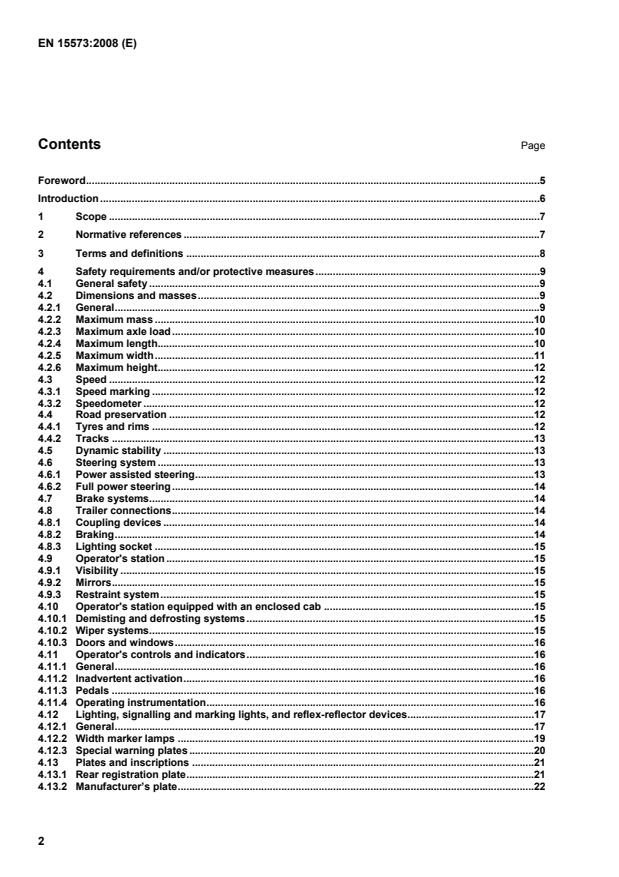
Contents Page
Foreword.5
Introduction .6
1 Scope .7
2 Normative references .7
3 Terms and definitions .8
4 Safety requirements and/or protective measures.9
4.1 General safety .9
4.2 Dimensions and masses.9
4.2.1 General.9
4.2.2 Maximum mass .10
4.2.3 Maximum axle load.10
4.2.4 Maximum length.10
4.2.5 Maximum width.11
4.2.6 Maximum height.12
4.3 Speed .12
4.3.1 Speed marking .12
4.3.2 Speedometer .12
4.4 Road preservation .12
4.4.1 Tyres and rims .12
4.4.2 Tracks .13
4.5 Dynamic stability .13
4.6 Steering system .13
4.6.1 Power assisted steering.13
4.6.2 Full power steering.14
4.7 Brake systems.14
4.8 Trailer connections.14
4.8.1 Coupling devices .14
4.8.2 Braking.14
4.8.3 Lighting socket .15
4.9 Operator's station .15
4.9.1 Visibility .15
4.9.2 Mirrors.15
4.9.3 Restraint system.15
4.10 Operator's station equipped with an enclosed cab .15
4.10.1 Demisting and defrosting systems.15
4.10.2 Wiper systems.15
4.10.3 Doors and windows.16
4.11 Operator's controls and indicators.16
4.11.1 General.16
4.11.2 Inadvertent activation.16
4.11.3 Pedals .16
4.11.4 Operating instrumentation.16
4.12 Lighting, signalling and marking lights, and reflex-reflector devices.17
4.12.1 General.17
4.12.2 Width marker lamps .19
4.12.3 Special warning plates .20
4.13 Plates and inscriptions .21
4.13.1 Rear registration plate.21
4.13.2 Manufacturer’s plate.22
4.13.3 Identification Number.22
4.14 Warning devices .22
4.15 Noise emission measurement.22
4.15.1 Limits .22
4.15.2 Conditions of measurement.22
4.15.3 Method of Measurement .23
4.15.4 Interpretation of results .23
4.16 Protruding appliance protection.24
4.17 Uncontrolled motion .24
4.18 Fenders.24
4.19 Fuel tanks.24
5 Verification of safety requirements and/or protective measures.24
Annex A (informative) Speed marking signs.26
A.1 General .26
A.2 Colour .26
A.3 Size.26
Annex B (normative) Ground contact pressure.27
B.1 General .27
B.2 Definitions .27
B.2.1 Crawler base, L .27
B.2.2 Tread contact area, T .28
A
B.3 Requirements.28
B.3.1 Calculation of average ground contact pressure, PG – dual track systems.28
B.3.2 Calculation of average ground contact pressure, PG – multi-track systems .28
Annex C (normative) Braking requirements .29
C.1 Machines with a design speed ≤ 40 km/h .29
C.2 Machines with a design speed > 40 km/h .29
C.2.1 Test conditions.29
C.2.2 Performance tests .29
C.3 Machines with a hydrostatic drive system .30
C.3.1 General requirements .30
C.3.2 Failure of the brakes .31
C.3.3 Brake testing.32
C.3.4 Machine recovery .33
Annex D (informative) Equivalent requirements.34
Annex E (informative) A-deviations.35
Bibliography.37
Figures
Figure 1. 11
Figure 2 — Alignment of the width marker lamps. 19
Figure 3 — Installation arrangement of panels. 21
Figure 4 — Measuring positions . 23
Figure A.1 — Speed marking . 26
Figure B.1 — Crawler base . 27
Figure B.2 — Track tread profiles. 28
Tables
Table 1 — Maximum mass . 10
Table 2 — Maximum axle load . 10
Table 3 — Maximum length. 11
Table 4 — Deviations from ISO 12509. 18
Table 5 — Alignment of width marker lamps. 20
Table A.1 — Speed marking/classification . 26
Table C.1 — Performance requirements (informative). 29
Table C.2 — Performance requirements. 32
Foreword
This document (EN 15573:2008) has been prepared by Technical Committee CEN/TC 151 “Construction
equipment and building material machines - Safety”, the secretariat of which is held by DIN.
This European Standard shall be given the status of a national standard, either by publication of an identical
text or by endorsement, at the latest by November 2008, and conflicting national standards shall be withdrawn
at the latest by November 2008.
Attention is drawn to the possibility that some of the elements of this document may be the subject of patent
rights. CEN [and/or CENELEC] shall not be held responsible for identifying any or all such patent rights.
This standard intends to harmonise the various technical requirements of the EEA applicable to earth-moving
machinery for their circulation on the road. Earth-moving machinery fulfilling the requirements of this standard
may be subject to certain administrative provisions before being permitted to travel on the road.
According to the CEN/CENELEC Internal Regulations, the national standards organizations of the following
countries are bound to implement this European Standard: Austria, Belgium, Bulgaria, Cyprus, Czech
Republic, Denmark, Estonia, Finland, France, Germany, Greece, Hungary, Iceland, Ireland, Italy, Latvia,
Lithuania, Luxembourg, Malta, Netherlands, Norway, Poland, Portugal, Romania, Slovakia, Slovenia, Spain,
Sweden, Switzerland and the United Kingdom.
Introduction
This European Standard is a type C standard as stated in EN ISO 12100.
The machinery concerned and the extent to which hazards, hazardous situations and events are covered are
indicated in the scope of this standard.
When provisions of this type C standard are different from those which are stated in type A or B standards, the
provisions of this type C standard take precedence over the provisions of the other standards, for machines
that have been designed and built according to the provisions of this type C standard.
1 Scope
This European Standard specifies the requirements for earth-moving machinery described in EN ISO 6165 [2],
intended to travel on the road.
This European Standard specifies the appropriate technical measures to eliminate or reduce risks arising from
the significant hazards, hazardous situations and events during on road travel of earth-moving machinery.
This European Standard does not apply to earth-moving machinery with a width exceeding 3 metres (see
4.2.5).
This European Standard does not apply to earth-moving machinery on legs e.g. walking excavators.
This European Standard does not cover the hazards relevant to non-riding and remote control earth-moving
machinery.
This European Standard is not applicable to earth-moving machines manufactured before the publication date
of this European Standard by CEN.
2 Normative references
The following referenced documents are indispensable for the application of this document. For dated
references, only the edition cited applies. For undated references, the latest edition of the referenced
document (including any amendments) applies.
EN 474 (all parts), Earth-moving machinery — Safety
EN 500 (all parts), Mobile road construction machinery — Safety
EN ISO 3450:1996, Earth-moving machinery — Braking systems of rubber-tyred machines — Systems and
performance requirements and test procedures (ISO 3450:1996)
EN ISO 3457, Earth-moving machinery — Guards — Definitions and requirements (ISO 3457:2003)
EN ISO 6683, Earth-moving machinery — Seat belts and seat belt anchorages – Performance requirements
and tests (ISO 6683:2005)
EN ISO 12100-1:2003, Safety of machinery — Basic concepts, general principles for design — Part 1: Basic
terminology, methodology (ISO 12100-1:2003)
ISO 1724:2003, Road vehicles — Connectors for the electrical connection of towing and towed vehicles —
7-pole connector type 12 N (normal) for vehicles with 12 V nominal supply voltage
ISO 5006:2006, Earth-moving machinery — Operator's field of view – Test method and performance criteria
ISO 5010, Earth-moving machinery — Rubber-tyred machines — Steering requirements
ISO 5676:1983, Tractors and machinery for agriculture and forestry — Hydraulic coupling — Braking circuit
ISO 6011, Earth-moving machinery — Visual display of machine operation
ISO 6014, Earth-moving machinery — Determination of ground speed
ISO 6016, Earth-moving machinery — Methods of measuring the masses of whole machines, their equipment
and components
ISO/FDIS 6395:2007, Earth-moving machinery — Determination of sound power level — Dynamic test
conditions
ISO 6489-3:2004, Agricultural vehicles — Mechanical connections between towed and towing vehicles —
Part 3: Tractor drawbar
ISO 6746-1, Earth-moving machinery — Definitions of dimensions and codes — Part 1: Base machine
ISO 6746-2, Earth-moving machinery — Definitions of dimensions and codes — Part 2: Equipment and
attachments
ISO 9533, Earth-moving machinery — Machine mounted forward and reverse audible warning alarm —
Sound test method
ISO 10261, Earth-moving machinery — Product identification numbering system
ISO 10263-5, Earth-moving machinery — Operator enclosure environment — Part 5: Windscreen defrosting
system test method
ISO 10265, Earth-moving machinery — Crawler machines — Performance requirements and test procedures
for braking systems
ISO 10968, Earth-moving machinery — Operator's controls
ISO 12509:2004, Earth-moving machinery — Lighting, signalling and marking lights, and reflex-reflector
devices
ISO/DIS 14401-1:2007, Earth-moving machinery — Field of vision of surveillance and rear-view mirrors —
Part 1: Test methods
ISO/DIS 14401-2:2007, Earth-moving machinery — Field of vision of surveillance and rear-view mirrors —
Part 2: Performance criteria
ISO/DIS 15998:2005, Earth-moving machinery — Machine-control systems (MCS) using electronic
components — Performance criteria and tests for functional safety
ISO 21507, Earth-moving machinery — Performance requirements for non-metallic fuel tanks
3 Terms and definitions
For the purposes of this document, the terms and definitions given in EN ISO 12100-1:2003 apply.
Earth-moving machinery and their families are defined in EN ISO 6165 [2].
Definitions used in EN and ISO standards referred to in this European Standard are also valid for this
document.
Additional definitions specifically needed for this European Standard are added below.
3.1
intended operation
use in earth-moving operation e.g. excavation, loading, transportation, drilling, spreading, compacting or
trenching of earth, rock or other materials
3.2
road
public traffic area for use by motor vehicles for travel or transportation, with the exception of the sites of
temporary road works e.g. for repairs, maintenance, alterations, improvements, installations or any other
works to, above or under a road, including works to road equipment (lighting, barriers, walls…) and roads not
open to the public e.g. on new housing and industrial developments, to which public traffic is not permitted
3.3
travel on the road
use on the road for purposes other than intended operation i.e. travelling between sites of work, to and from
the site of normal storage, or travelling for refuelling of the machine
3.4
tracklaying
(tracked/crawler)
machine with endless track drive system
3.5
multiple wheel
(roller)
machine with more than two wheels on one or more of the axles, used primarily for compaction performance
(for road levelling)
4 Safety requirements and/or protective measures
4.1 General safety
Earth-moving machinery intended for travel on the road shall comply with the requirements and/or protective
measures of EN 474 or EN 500, so far as not modified by requirements of this European Standard.
NOTE Machinery is covered by directive 98/37/EC [29].
4.2 Dimensions and masses
4.2.1 General
Machines shall be designed in accordance with the requirements of 4.2.2 to 4.2.6, and equipped so that their
dimensions and mass minimise disruptions to the traffic on public roads.
Dimensions and masses of earth-moving machinery shall be determined in accordance with ISO 6016. Unless
specifically designed for the purpose of carrying loads during travel on the road i.e. dumpers, the mass of
earth-moving machinery does not include any load other than loose tools or appliances necessary for the
intended operation and carried on the machine during travel on the road.
Dimensional measurements of earth-moving machinery shall be in accordance with ISO 6746-1 and
ISO 6746-2.
Machines shall be assessed with equipment and attachments in the transport configuration as specified by the
manufacturer. See also Annex A of ISO 5006.
NOTE One or more A-deviations are relevant to this requirement. See Annex E.
Motor vehicles as defined in directive 70/156/EEC [11].
4.2.2 Maximum mass
The maximum mass of earth-moving machinery designed to travel on the road should not exceed the limits
defined in Table 1:
Table 1 — Maximum mass
Machine configuration Maximum mass
kg
2-axle machines 19 000
3-axle machines 26 000
4-axle machines 32 000
Tracklaying machines 24 000
Multiple wheel machines 19 000
Subject to local conditions i.e. bridge capacities, the maximum mass of earth-moving machinery on certain
roads may be increased according to the following formula:
M ≤ 12 000 ×A
where
M is the maximum mass (kg)
A is the number of axles
NOTE 1 Earth-moving machinery with a maximum mass exceeding the limits shown in Table 1 may be considered as
abnormal transport and be subject to local use restrictions which are not dealt with in this European Standard.
NOTE 2 Load restrictions on roads may vary according to seasonal changes e.g. in very low or very high temperature
conditions.
4.2.3 Maximum axle load
The maximum axle loads of earth-moving machinery designed to travel on the road shall not exceed the limits
defined in Table 2.
Table 2 — Maximum axle load
Machine configuration Maximum axle load
Driven and non-driven axles 13 000 kg
Tracklaying machines 9 000 kg/m between first and last track roller (see also 4.4.2)
NOTE One or more A-deviations are relevant to this requirement. See Annex E.
4.2.4 Maximum length
The maximum length of earth-moving machinery designed to travel on the road shall not exceed the limits
defined in Table 3. The maximum length includes any mounted equipment or attachments located in the travel
position as specified by the manufacturer (see also Annex A of ISO 5006).
Table 3 — Maximum length
Machine configuration Maximum length
m
Rigid machines 12
Articulated machines The length of the machine must be such that it is able to manoeuvre in left
and right directions for a complete circular trajectory (360°) inside an area
defined by two concentric circles, the outer circle having a radius of 12,5 m
and the inner circle having a radius of 5,3 m, without any of the machine's
outermost points (excluding mirrors, indicators, tyre bulge, folding
components – lift-up steps and flexible mud-flaps) projecting outside the
circumferences of the circles (see Figure 1).
NOTE Earth-moving machinery with a maximum length exceeding the limits shown in Table 3 may be considered as
abnormal transport and be subject to local use restrictions which are not dealt with in this European Standard.
R = 12,5 m
r = 5,3 m
Figure 1
4.2.5 Maximum width
The maximum width of earth-moving machinery designed to travel on the road shall not exceed 3 m.
The maximum width includes any mounted equipment or attachments located in the travel position as
specified by the manufacturer (see also Annex A of ISO 5006) but shall exclude mirrors, indicators, tyre bulge,
folding components – lift-up steps (in their working position) and flexible mud-flaps.
Above 2,55 m additional requirements/protective measures for travel on the road are specified in this
European Standard.
NOTE Earth-moving machinery with a maximum width exceeding 2,55 m may be considered as abnormal transport
and be subject to local use restrictions which are not dealt with in this European Standard.
4.2.6 Maximum height
The maximum height of earth-moving machinery designed to travel on the road shall not exceed 4 m with
maximum size (rolling radius) tyres – excluding a flexible aeriel. The maximum height includes any mounted
equipment or appliances located in the travel position as specified by the manufacturer (see also Annex A of
ISO 5006).
4.3 Speed
The maximum speed shall be verified in accordance with ISO 6014. A tolerance on the speed of + 10 % or
+ 3 km/h, whichever is the least, is permitted. The test shall be conducted with maximum size (rolling radius)
tyres at the recommended cold inflation pressure as specified by the manufacturer and with the machine in
the lightest operational condition.
Maximum on-road speed of an earth-moving machine equipped with one or more smooth steel wheels (roller)
is limited to 10 km/h.
NOTE The speed of earth-moving machinery with smooth steel wheels may be subject to local use restrictions which
are not dealt with in this European Standard.
4.3.1 Speed marking
Earth-moving machinery with a design speed < 60 km/h shall have an allocated space at the rear for a sign
indicating the permissible on-road speed.
The space shall allow for the installation of a speed marking sign at the rear of the machine (substantially
vertical) at a height 300 mm to 1 500 mm from the ground. This may be increased to 2 100 mm if required by
the design and shape of the machine.
Information for the sign (format and size) is given in Annex A.
The need for a sign and the marked permissible speed is dependent on local requirements, and can change
depending on use, license and insurance.
4.3.2 Speedometer
Earth-moving machinery with a maximum speed > 30 km/h shall be equipped with a speedometer.
The speedometer shall comply with the requirements in 4.11.4.
4.4 Road preservation
The design of earth-moving machinery shall minimise the risk of road damage.
4.4.1 Tyres and rims
Tyres should be compatible with the axle loading and design speed of the machine and shall be marked with
the manufacturer's name (tyre manufacturer), the load index and speed rating.
In circumstances where it is necessary to install tyres which have a speed rating which is not compatible with
the maximum speed of the machine e.g. a low speed high capacity tyre for the intended operation, a
warning/instruction shall be provided to the operator to show the maximum allowable speed for the installed
tyres.
NOTE Load index and speed rating data should be determined in accordance with the European Tyre and Rim
Technical Organisation (ETRTO) Standards Manual.
Tyres may be pneumatic or solid. Solid tyres are permissible on earth-moving machinery with a maximum
speed ≤ 17 km/h.
Pneumatic tyres may be foam filled (to protect against loss of stability in case of puncture or rupture) or have a
liquid ballast. In case the use of liquid ballast is permitted, advice shall be given concerning the maximum
travel speed (if less than the maximum speed of the machine).
Treadless tyres are permissible on earth-moving machinery with a design speed ≤ 30 km/h.
Steel wheels/tyres i.e. rollers, are permissible for travel on the road provided that they do not have any tread
pattern.
4.4.2 Tracks
Tracklaying machines shall have a tread lug pattern such that static ground contact pressure is ≤ 0.8 N/mm²
measured in accordance with Annex B.
Steel tracked machines shall have a resilient material interposed between the ground and the track and be
arranged so that the steel parts of the track do not contact the road.
4.5 Dynamic stability
Machine behaviour during travel on the road shall be assessed at various speeds, including maximum speed
and during turning. Control of the machine shall be ensured at all times.
ISO 15037-2 [9] and ISO 14792 [8] may provide suitable information for determining machine behaviour
during travel on the road.
Where necessary, means of ensuring controllability by the operator e.g. equipment/attachment, axle or wheel
suspension shall be fitted.
4.6 Steering system
The performance of the steering system of wheeled earth-moving machinery (including machines with a
design speed ≤ 20 km/h) shall comply with ISO 5010.
The weight distribution of the machine shall ensure a minimum static axle load of 20 % of the total machine
mass on the steered axle(s) measured on a substantially horizontal surface.
The steering system shall be such that the movement of the steering control (steering wheel, lever or pedal)
shall correspond to the intended direction of steering. It shall be designed to assure safe and easy machine
control during normal and secondary operating conditions.
If the steering system has switchable steer modes (e.g. 2WS, 4WS, crab or inversed function in certain
machine configurations), it shall be possible to positively engage the mode required for travel on the road.
Inadvertent activation of other steer modes shall be minimised in accordance with the requirements of 4.11.2.
It should be possible to easily identify the steering mode that is engaged.
If the machine has more than one steering control, it shall be possible to deactivate the control system that is
not recommended for travel on the road. Deactivation shall be in accordance with the requirements of 4.11.2.
The steering system of tracklaying machines with a design speed (forward/reverse) > 20 km/h shall be
gradual.
4.6.1 Power assisted steering
A secondary steering system is not required for machines with a design speed ≤ 20 km/h.
For machines with a design speed > 20 km/h, a secondary steering system is required where the steering
input force under emergency conditions (failure of the normal steering) exceeds 350 N.
It shall be possible to verify the function of the secondary steering system during normal operation.
4.6.2 Full power steering
A secondary steering system is required.
For machines with a design speed more than 60 km/h the required system redundancy shall be evaluated in
accordance with ISO/DIS 15998:2005.
It shall be possible to verify the function of the secondary steering system during normal operation.
4.7 Brake systems
Earth-moving machinery shall be equipped with a service brake system, a secondary brake system and a
parking brake system, efficient under the manufacturer's intended conditions of service, load, speed, terrain
and slope, for travel on the road.
The operation of the service and secondary brake shall be gradual.
The braking equipment shall not be adversely affected by any vibration that it may be subjected to in normal
use. The equipment shall be able to resist the corrosion and ageing phenomena which could lead to a sudden
loss of braking efficiency.
Brake systems of crawler machines shall comply with ISO 10265.
Brake systems of wheeled machines shall comply with the requirements in Annex C.
Wheeled machines shall have braking capacity of equal nominal rating on each wheel of a braked axle.
4.8 Trailer connections
4.8.1 Coupling devices
The mechanical coupling devices enabling the connection of a trailer shall be so designed that the safety
according to the state of the art is provided. The connections and their locking mechanisms shall ensure that
under normal operating conditions no unintentional unlatching can occur. Sufficient angular movement shall
be ascertained.
Coupling devices should be in accordance with ISO 6489-3:2004.
NOTE Other devices e.g. ISO 6489-1 [5], ISO 6489-2 [6], ISO 6489-4 [7] and national trailer couplings are
acceptable according to customer requirements.
4.8.2 Braking
Earth-moving machinery designed and equipped to tow a trailer more than 20 km/h and where the sum of the
trailed axle loads is more than 3 500 kg shall be equipped with a trailer braking circuit according to
ISO 5676:1983.
The parking braking system of the machine shall be capable of holding the machine combination, machine
and an un-braked trailer 3 500 kg mass (or less if the permissible un-braked towable mass as specified by the
machine manufacturer is less) stationary on a 12 % up or down gradient.
4.8.3 Lighting socket
Earth-moving machinery designed and equipped to tow a trailer shall be equipped with a lighting socket
according to ISO 1724:2003.
4.9 Operator's station
4.9.1 Visibility
Earth-moving machines shall comply with ISO 5006 so that the operator has sufficient visibility from the
operator's station in relation to the travel areas of the machine that are necessary for travel on the road.
4.9.2 Mirrors
Earth-moving machines shall be equipped with rear view mirrors according to ISO/DIS 14401-1:2007 and
ISO/DIS 14401-2:2007.
Mirrors shall be of an approved type e.g. ECE R 46 [35] (see Bibliography), unless they are fitted to meet only
the requirements of ISO 5006.
If the bottom edge of the mirror is less than 2 metres above the ground, the mirror shall not project laterally
more than 0,20 metres from the machine (measured without mirrors and mirror mounting devices).
Mirrors that project laterally by more than 0,20 metres from the machine (and installed more than 2 metres
above the ground) shall be of the foldable type so that they can easily be put back in position after being
knocked out of alignment.
NOTE One or more A-deviations are relevant to this requirement. See Annex E.
4.9.3 Restraint system
Machines fitted with an operator protective structure (ROPS, TOPS) shall have an operator restraint system
that meets the requirements specified in EN ISO 6683.
4.10 Operator's station equipped with an enclosed cab
4.10.1 Demisting and defrosting systems
4.10.1.1 Demisting system
Facilities shall be provided to demist the front windscreen.
4.10.1.2 Defrosting system
A system shall be provided to defrost the front windscreen and rear window, for example by means of a
heating system or a particular defrosting device. The defrosting system for the windscreen shall meet the
requirements specified in ISO 10263-5.
4.10.2 Wiper systems
The front window shall be fitted with motorised windscreen wiper(s) and washer(s). The area swept by the
wiper(s) must ensure an unobstructed forward view corresponding to a chord of the semi-circle of vision at
least 8 m long within the sector of vision as described in ISO 5006. The wiper(s) shall have a frequency of ≥
20 cycles/min.
If it is necessary to view through the rear window using an internally mounted rear view mirror, the rear
window shall also be fitted with a motorised wiper and washer.
The tank of the window washer(s) shall be easily accessible. The system shall function in the temperature
range of – 18°C to + 65°C. The function shall not decrease if the solution (water and washer fluid) contains up
to 50 % methyl or isopropyl alcohol (or equivalent) washer fluid.
4.10.3 Doors and windows
Doors and windows shall be securely held in their functional positions; measures shall be taken for preventing
inadvertent opening. Doors shall be retained at their intended operating position(s) by a positive engagement
device.
Windscreens and windows shall be made of safety glass or other material, which provides similar safety
performance and shall be of an approved type e.g. ECE R 43 [34], 92/22/EEC [27], 89/173/EEC [26], FMVSS
No 205 [38], ANSI Z26.1 [39](see Bibliography).
For machines with a maximum speed > 30 km/h, only laminated windscreens are permitted.
4.11 Operator's controls and indicators
4.11.1 General
The controls (hand levers, pedals, switches, etc.) and indicators of the machine, equipment, attachment, shall
be chosen, designed, constructed and arranged according to ISO 10968.
4.11.2 Inadvertent activation
Controls which, if operated intentionally or due to inadvertent activation during travel on the road, could cause
a hazard due to movement of equipment, shall be so arranged or deactivated or guarded as to minimise the
risk. Arrangement shall minimise inadvertent activation during travel e.g. permissioning controls. Deactivation
devices shall either be self-acting or acting by compulsory actuation of the relevant device. Guarding may
include mechanical locking of the control.
4.11.3 Pedals
Pedals shall have an appropriate size, shape and be adequately spaced. The pedals shall have a slip-
resistant surface and shall be easy to clean.
If the pedals of an earth-moving machine have the same function (clutch, brake and accelerator) as on a
motor vehicle, they shall be arranged in the same manner to avoid the risk of confusion.
4.11.4 Operating instrumentation
Control indicators for safe and proper operation of the machine shall follow the safety colours and safety
signs/requirements according to ISO 6011.
If the earth-moving machine is equipped with a speedometer (see Clause 4.3.2), the speedometer shall
comply with the visual display characteristics as defined in ISO 6011. The speedometer shall display the
speed in km/h or mph in accordance with the requirements of the market in which the machine is first placed.
NOTE For countries in which mph is used and in the case of an analogue display, it is permissible for the display to
show speed in both mph and km/h.
On earth-moving machinery with a design speed more than 40 km/h, there shall be the following relationship
between the indicated speed (v1 ) and the true speed (v2 ):
v2
Displays in km/h 0 ≤v1 −v2 ≤ + 4km /h
v2
Displays in mph 0 ≤v1 −v2 ≤ + 2.5mph
4.12 Lighting, signalling and marking lights, and reflex-reflector devices
4.12.1 General
Earth-moving machines shall be equipped with lighting, signalling devices and reflectors
...