

EN 18100:2025
(Main)Mountaineering equipment - Helmets for ski mountaineers - Safety requirements and test methods
- Abstract
This document specifies requirements and test methods for protective helmets for ski mountaineers intended to protect the head of the user in order to reduce the risk of impact injury.
This document is also applicable to protective helmets used in activities with similar hazards including but not limited to; ski-touring, speed-touring, ski fitness, split-boarding, skimo, telemark touring, but does not apply to protective helmets for alpine skiers and snowboarders.
- Status
- Published
- Publication Date
- 14-Oct-2025
- Technical Committee
- CEN/TC 158 - Head protection
- Drafting Committee
- CEN/TC 158/WG 13 - Helmets for mountaineers
- Current Stage
- 6060 - Definitive text made available (DAV) - Publishing
- Start Date
- 15-Oct-2025
- Due Date
- 13-Oct-2025
- Completion Date
- 15-Oct-2025
- Directive
- 2016/425 - Regulation (EU) 2016/425 of the European Parliament and of the Council of 9 March 2016 on personal protective equipment and repealing Council Directive 89/686/EECOJ Ref: OJ L, 2026/1279 OJ Date: 16-Jun-2026

Overview
EN 18100:2025 - Mountaineering equipment - Helmets for ski mountaineers - Safety requirements and test methods is a CEN draft standard that specifies construction, performance and test methods for protective helmets intended for ski mountaineering and related uphill/downhill activities (for example ski-touring, split‑boarding, skimo, telemark touring). The standard aims to reduce head‑impact injury risk while addressing the specific needs of ascent and descent phases (ventilation, thermal comfort) and does not apply to helmets for alpine skiers and snowboarders.
Key topics and requirements
- Scope & definitions: Clarifies terms such as ski mountaineering and helmet types to ensure consistent application.
- Construction requirements: Materials, shell design, retention systems, ventilation, field of vision, ergonomics and weight are specified to balance protection and comfort during long climbs and descents.
- Performance requirements:
- Shock absorption (linear impacts) to reduce transmitted forces to the head.
- Resistance to penetration for relevant impact areas (note: off‑crown penetration test was not introduced given lower risk in ski mountaineering).
- Retention system strength and effectiveness (including roll‑off resistance) to keep the helmet in place under real‑world loads.
- Rules for non‑integral additional protective devices (e.g., visors).
- Test methods: Detailed procedures for material examination, retention testing, ventilation and ergonomics evaluation, conditioning (UV, ambient, thermal plus/minus), sampling, headforms, force transmission and reporting.
- Limitations: Rotational or tangential impact testing is not currently included; only linear impact tests are specified. Users are advised about the residual risk and need for replacement after severe impacts.
- Marking and instructions: Manufacturer labelling and user guidance requirements to support safe selection and use.
Applications and who uses this standard
- Helmet manufacturers and R&D teams: design and validate ski‑mountaineering helmets to meet safety and comfort expectations.
- Test laboratories and certification bodies: perform standardized tests for shock absorption, penetration and retention system performance.
- Procurement, retailers and event organisers (e.g., ISMF events): set purchase and equipment rules aligned with an activity‑specific standard.
- Safety officers and professional guides: assess helmet suitability for mixed uphill/downhill mountain activities.
- End users (ski mountaineers): better informed choices about helmets optimized for ascent ventilation and descent protection.
Related standards
- EN 12492 - Helmets for mountaineers
- EN 1077 - Helmets for alpine skiers and snowboarders (Class B referenced historically)
- EN 13087 series - Protective helmet test methods
- EN ISO 13688 - General protective clothing requirements
- Regulation (EU) 2016/425 - Personal protective equipment (informative Annex ZA relation)
Keywords: EN 18100, helmets for ski mountaineers, ski‑touring helmet standard, safety requirements, test methods, CEN.
Relations
- Effective Date
- 22-Jul-2026
- Effective Date
- 22-Jul-2026
- Effective Date
- 20-May-2026
- Effective Date
- 20-May-2026
- Refers
EN 13087-1:2000/A1:2001 - Protective helmets - Test methods - Part 1: Conditions and conditioning - Effective Date
- 28-Jan-2026
- Effective Date
- 28-Jan-2026
- Effective Date
- 28-Jan-2026
- Effective Date
- 28-Jan-2026
- Effective Date
- 28-Jan-2026
- Effective Date
- 28-Jan-2026
- Effective Date
- 28-Jan-2026
- Effective Date
- 28-Jan-2026
Frequently Asked Questions
EN 18100:2025 is a standard published by the European Committee for Standardization (CEN). Its full title is "Mountaineering equipment - Helmets for ski mountaineers - Safety requirements and test methods". This standard covers: This document specifies requirements and test methods for protective helmets for ski mountaineers intended to protect the head of the user in order to reduce the risk of impact injury. This document is also applicable to protective helmets used in activities with similar hazards including but not limited to; ski-touring, speed-touring, ski fitness, split-boarding, skimo, telemark touring, but does not apply to protective helmets for alpine skiers and snowboarders.
This document specifies requirements and test methods for protective helmets for ski mountaineers intended to protect the head of the user in order to reduce the risk of impact injury. This document is also applicable to protective helmets used in activities with similar hazards including but not limited to; ski-touring, speed-touring, ski fitness, split-boarding, skimo, telemark touring, but does not apply to protective helmets for alpine skiers and snowboarders.
EN 18100:2025 is classified under the following ICS (International Classification for Standards) categories: 97.220.40 - Outdoor and water sports equipment. The ICS classification helps identify the subject area and facilitates finding related standards.
EN 18100:2025 has the following relationships with other standards: It is inter standard links to EN 960:2006, EN 13087-1:2000, ISO 6487:2015, ISO 6487:2015/Amd 1:2017, EN 13087-1:2000/A1:2001, EN 13087-6:2012, EN 71-19:2024, EN 13087-5:2012, EN 13087-2:2012, EN ISO 13688:2013/A1:2021, EN ISO 2313-1:2021, EN ISO 13688:2013. Understanding these relationships helps ensure you are using the most current and applicable version of the standard.
EN 18100:2025 is associated with the following European legislation: EU Directives/Regulations: 2016/425; Standardization Mandates: M/571, M/571 AMD 1. When a standard is cited in the Official Journal of the European Union, products manufactured in conformity with it benefit from a presumption of conformity with the essential requirements of the corresponding EU directive or regulation.
EN 18100:2025 is available in PDF format for immediate download after purchase. The document can be added to your cart and obtained through the secure checkout process. Digital delivery ensures instant access to the complete standard document.
Standards Content (Sample)
SLOVENSKI STANDARD
01-februar-2026
Gorniška oprema - Čelade za turno smučanje - Varnostne zahteve in preskusne
metode
Mountaineering equipment - Helmets for ski mountaineers - Safety requirements and test
methods
Bergsteigerausrüstung - Helme für Skitourengeher - Sicherheitstechnische
Anforderungen und Prüfverfahren
Équipement d’alpinisme et d’escalade - Casques de skieurs alpinistes - Exigences de
sécurité et méthodes d’essai
Ta slovenski standard je istoveten z: EN 18100:2025
ICS:
13.340.20 Varovalna oprema za glavo Head protective equipment
97.220.40 Oprema za športe na Outdoor and water sports
prostem in vodne športe equipment
2003-01.Slovenski inštitut za standardizacijo. Razmnoževanje celote ali delov tega standarda ni dovoljeno.
EN 18100
EUROPEAN STANDARD
NORME EUROPÉENNE
October 2025
EUROPÄISCHE NORM
ICS 97.220.40
English Version
Mountaineering equipment - Helmets for ski mountaineers
- Safety requirements and test methods
Équipements d'alpinisme et d'escalade - Casques de Bergsteigerausrüstung - Helme für Skitourengeher -
skieurs alpinistes - Exigences de sécurité et méthodes Sicherheitstechnische Anforderungen und
d'essai Prüfverfahren
This European Standard was approved by CEN on 1 September 2025.
CEN members are bound to comply with the CEN/CENELEC Internal Regulations which stipulate the conditions for giving this
European Standard the status of a national standard without any alteration. Up-to-date lists and bibliographical references
concerning such national standards may be obtained on application to the CEN-CENELEC Management Centre or to any CEN
member.
This European Standard exists in three official versions (English, French, German). A version in any other language made by
translation under the responsibility of a CEN member into its own language and notified to the CEN-CENELEC Management
Centre has the same status as the official versions.
CEN members are the national standards bodies of Austria, Belgium, Bulgaria, Croatia, Cyprus, Czech Republic, Denmark, Estonia,
Finland, France, Germany, Greece, Hungary, Iceland, Ireland, Italy, Latvia, Lithuania, Luxembourg, Malta, Netherlands, Norway,
Poland, Portugal, Republic of North Macedonia, Romania, Serbia, Slovakia, Slovenia, Spain, Sweden, Switzerland, Türkiye and
United Kingdom.
EUROPEAN COMMITTEE FOR STANDARDIZATION
COMITÉ EUROPÉEN DE NORMALISATION
EUROPÄISCHES KOMITEE FÜR NORMUNG
CEN-CENELEC Management Centre: Rue de la Science 23, B-1040 Brussels
© 2025 CEN All rights of exploitation in any form and by any means reserved Ref. No. EN 18100:2025 E
worldwide for CEN national Members.
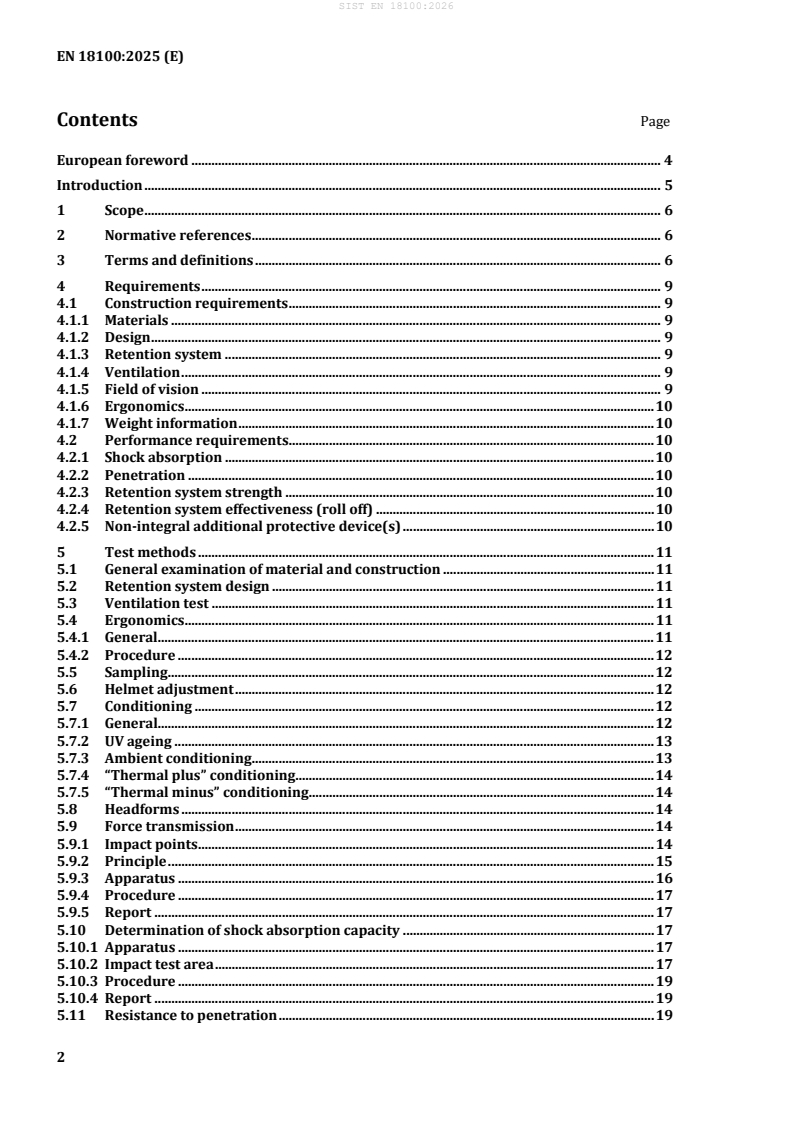
Contents Page
European foreword . 4
Introduction . 5
1 Scope . 6
2 Normative references . 6
3 Terms and definitions . 6
4 Requirements . 9
4.1 Construction requirements . 9
4.1.1 Materials . 9
4.1.2 Design . 9
4.1.3 Retention system . 9
4.1.4 Ventilation . 9
4.1.5 Field of vision . 9
4.1.6 Ergonomics . 10
4.1.7 Weight information . 10
4.2 Performance requirements . 10
4.2.1 Shock absorption . 10
4.2.2 Penetration . 10
4.2.3 Retention system strength . 10
4.2.4 Retention system effectiveness (roll off) . 10
4.2.5 Non-integral additional protective device(s) . 10
5 Test methods . 11
5.1 General examination of material and construction . 11
5.2 Retention system design . 11
5.3 Ventilation test . 11
5.4 Ergonomics . 11
5.4.1 General. 11
5.4.2 Procedure . 12
5.5 Sampling . 12
5.6 Helmet adjustment . 12
5.7 Conditioning . 12
5.7.1 General. 12
5.7.2 UV ageing . 13
5.7.3 Ambient conditioning . 13
5.7.4 “Thermal plus” conditioning . 14
5.7.5 “Thermal minus” conditioning . 14
5.8 Headforms . 14
5.9 Force transmission . 14
5.9.1 Impact points . 14
5.9.2 Principle . 15
5.9.3 Apparatus . 16
5.9.4 Procedure . 17
5.9.5 Report . 17
5.10 Determination of shock absorption capacity . 17
5.10.1 Apparatus . 17
5.10.2 Impact test area . 17
5.10.3 Procedure . 19
5.10.4 Report . 19
5.11 Resistance to penetration . 19
5.11.1 Impact area . 19
5.11.2 Principle . 19
5.11.3 Apparatus . 20
5.11.4 Procedure . 22
5.11.5 Report . 22
5.12 Determination of retention system strength . 22
5.12.1 Apparatus . 22
5.12.2 Procedure . 22
5.12.3 Report . 22
5.13 Retention system effectiveness . 22
5.13.1 Principle . 22
5.13.2 Apparatus . 23
5.13.3 Procedure . 23
5.13.4 Report . 25
6 Marking . 25
7 Manufacturer’s instructions and information . 25
Annex A (informative) Recommendations on the materials and construction for thermal
comfort of helmets for ski mountaineers . 26
Annex B (informative) Mountaineering equipment standards . 27
Annex ZA (informative) Relationship between this European Standard and the essential
Requirements of Regulation (EU) 2016/425 of the European Parliament and of the
Council of 9 March 2016 on personal protective equipment aimed to be covered . 29
Bibliography . 31
European foreword
This document (EN 18100:2025) has been prepared by Technical Committee CEN/TC 158 “Head
protection”, the secretariat of which is held by SIS.
This European Standard shall be given the status of a national standard, either by publication of an
identical text or by endorsement, at the latest by April 2026 and conflicting national standards shall be
withdrawn at the latest by April 2026.
Attention is drawn to the possibility that some of the elements of this document may be the subject of
patent rights. CEN shall not be held responsible for identifying any or all such patent rights.
This document has been prepared under a standardization request addressed to CEN by the European
Commission. The Standing Committee of the EFTA States subsequently approves these requests for its
Member States.
For the relationship with EU Legislation, see informative Annex ZA, which is an integral part of this
document.
Any feedback and questions on this document should be directed to the users’ national standards body.
A complete listing of these bodies can be found on the CEN website.
According to the CEN-CENELEC Internal Regulations, the national standards organizations of the
following countries are bound to implement this European Standard: Austria, Belgium, Bulgaria, Croatia,
Cyprus, Czech Republic, Denmark, Estonia, Finland, France, Germany, Greece, Hungary, Iceland, Ireland,
Italy, Latvia, Lithuania, Luxembourg, Malta, Netherlands, Norway, Poland, Portugal, Republic of North
Macedonia, Romania, Serbia, Slovakia, Slovenia, Spain, Sweden, Switzerland, Türkiye and the United
Kingdom.
Introduction
Helmets for ski mountaineers are intended to provide protection to the wearer:
— during the ascent, similar to mountaineering, with risk of falling rocks, ice or other objects;
— during the descent, similar to alpine skiing, with the risk of falling onto a surface.
At the time of writing, the ISMF’s (International Ski Mountaineering Federation) “Sporting Rules and
Regulations” require that helmets comply with EN 12492 “Helmets for mountaineers” and EN 1077
class B “Helmets for alpine skiers and snowboarders”. Those requirements lead to insufficient helmet
ventilation during ascent and discomfort for the user during such activities and therefore increases the
risk of the user not wearing the protective helmet. This double certification could preferably be replaced
by a specific standard for ski mountaineers with more relevant requirements.
The intention of this document is to reduce the potential injury risk associated with the hazards but will
not eliminate them completely. No off-crown penetration test has been introduced in this document
because the risk of penetration in ski mountaineering (3.1) is considered low compared to alpine skiing
and hence leads to the possibility of better ventilation.
A proportion of the energy of an impact is absorbed by the helmet, thereby reducing the force of the blow
sustained by the head. The structure of the helmet may be damaged in absorbing this energy and any
helmet that sustains a severe blow needs to be replaced even if damage is not apparent. There are limits
to the amount of protection that can be provided and wearing a helmet cannot always prevent serious
injury, long-term disability or death. A helmet may only be a part of the protection that is required to
carry out this activity.
A list of mountaineering equipment standards is found in informative Annex B.
Angled and tangential (rotational) impacts are one of the causes of head injuries. CEN/TC 158 has
published a new test method, EN 17950:2024. CEN/TC158 WG 13 requires more time to validate the
requirements of the test method which then can be used in future revisions of this document.
1 Scope
This document specifies requirements and test methods for protective helmets for ski mountaineers
intended to protect the head of the user in order to reduce the risk of impact injury.
This document is also applicable to protective helmets used in activities with similar hazards including
but not limited to: ski-touring, speed-touring, ski fitness, split-boarding, skimo and telemark touring, but
does not apply to protective helmets for alpine skiers and snowboarders.
2 Normative references
The following documents are referred to in the text in such a way that some or all of their content
constitutes requirements of this document. For dated references, only the edition cited applies. For
undated references, the latest edition of the referenced document (including any amendments) applies.
EN 960:2006, Headforms for use in the testing of protective helmets
EN 13087-1:2000, Protective helmets — Test methods — Part 1: Conditions and conditioning
EN 13087-2:2012, Protective helmets — Test methods — Part 2: Shock absorption
EN 13087-5:2012, Protective helmets — Test methods — Part 5: Retention system strength
EN 13087-6:2012, Protective helmets — Test methods — Part 6: Field of vision
EN ISO 13688:2013, Protective clothing — General requirements (ISO 13688:2013)
ISO 6487:2015, Road vehicles — Measurement techniques in impact tests — Instrumentation
3 Terms and definitions
For the purposes of this document, the following terms and definitions apply.
ISO and IEC maintain terminology databases for use in standardization at the following addresses:
— ISO Online browsing platform: available at https://www.iso.org/obp/
— IEC Electropedia: available at https://www.electropedia.org/
3.1
ski mountaineering
sport or recreational activity of skiing and climbing across mountainous terrain involving a mix of
mountaineering and skiing techniques with equipment specially designed for walking uphill as well as
skiing downhill, primarily but not exclusively outside lift-served areas
3.2
helmet for ski mountaineers
item to be worn on the head, intended to absorb the energy of a foreseeable impact thus reducing the risk
of injury to the head during ski mountaineering (3.1) and related activities with similar hazards
Note 1 to entry: Helmet for mountaineers is hereafter referred to as helmet.
As amended by EN 13087-1:2000/A1:2001.
As amended by EN 13688:2013/A1:2021.
As amended by ISO 6487:2015/Amd 1:2017.
3.3
shell
structure that provides the general outer form of the helmet
3.4
helmet type
category of helmets, which does not differ in such essential respects as the materials or dimensions or
construction of the helmet, of the retention system (3.6) or of the protective padding (3.5)
3.5
helmet size
range of helmet adjustment to the head
3.6
protective padding
material which is used to absorb impact energy
3.7
retention system
complete assembly by means of which the helmet is maintained in position on the head, including any
devices for adjustment of the system or to enhance the wearer's comfort
3.8
chin strap
part of the retention system (3.7) which passes under the wearer's jaw to retain the helmet in position
3.9
headform
shape replacing the head which is used for testing certain characteristics
Note 1 to entry: The headform is designed in accordance with EN 960:2006.
3.10
helmet positioning index
HPI
vertical distance measured on the vertical longitudinal plane, between the brow of the helmet front part
and the reference plane (B), when the helmet is placed on the appropriate reference headform (3.9)
Note 1 to entry: The vertical longitudinal plane and the reference plane are defined in EN 960:2006.
Note 2 to entry: See Figure 1.
Dimension in millimetres (with a tolerance of ±1 mm)
Key
1 helmet positioning index (HPI)
AA’ AA’ plane, see EN 960:2006
B reference plane
Figure 1 — Helmet positioning index
3.11
accessory
additional device which can be attached to the helmet and are intended to be fully removable by the user,
but which provide no protective function to the wearer
Note 1 to entry: A helmet accessory can be a lamp, camera, etc.
3.12
non-integral additional protective function
additional protective device(s) attached to the helmet intended to be removable by the user, but are not
specifically required in order for the helmet to satisfy this document
Note 1 to entry: Non-integral additional function can be a visor.
4 Requirements
4.1 Construction requirements
4.1.1 Materials
When checked according to 5.1, for those parts of the helmet that come into contact with the skin,
materials which are known to be likely to cause skin irritation or any adverse effect on health shall not
be used. For a material not in general use, advice as to its suitability shall be sought before its
introduction.
Helmet materials which come, or could come into contact with the skin when worn on the head, shall be
in accordance with EN ISO 13688:2013, 4.2.
Recommendations on the materials and construction for thermal comfort of helmets for ski mountaineers
is found in informative Annex A.
4.1.2 Design
When checked according to 5.1, there shall be no sharp edges, roughness or internal projection(s) on any
part of the helmet which is in contact or potential contact with the wearer when the helmet is worn, such
as is likely to cause injury to the wearer.
4.1.3 Retention system
The helmet shall be fitted with a retention system (3.7), including a chin strap (3.8). The chin strap (3.8)
shall be adjustable in length.
The part of the chin strap (3.8) which comes into contact with the jaw shall have a minimum width of
15 mm when tested according to 5.2.
4.1.4 Ventilation
The helmet shall be ventilated.
When checked in accordance with 5.3, the overall sum of the ventilation areas shall not be less than 4 cm .
When each ventilation hole is tested in accordance with 5.3, the pin shall not come into contact with the
testing headform (3.9).
NOTE Holes intended for accessories (e.g. visor, ear protection) are not considered as ventilation holes.
4.1.5 Field of vision
When tested in accordance with EN 13087-6:2012, there shall be no occultation in the field of vision
bounded by angles as follows:
— horizontally 105°;
— upwards 25°;
— downwards 45°.
If the helmet has a visor with an integral protective function, it shall be tested with the visor in use and
in parking position.
4.1.6 Ergonomics
The helmet shall be designed to minimize any discomfort to the wearer and shall remain in place when
fitted and fastened according to the manufacturer's instructions and information. When tested according
to 5.4, there shall only be YES responses recorded.
4.1.7 Weight information
Each helmet type (3.4) shall be weighed using a weighing machine with an accuracy of 0,1 gram. Each
measurement shall be within the range of ±10 % compared to the weight indicated in subclause 6 f).
The tolerance indicated in 7 h) shall be no more than ±10 %.
NOTE The range of ±10 % covers the variability of 3 times the standard deviation in helmet production.
4.2 Performance requirements
4.2.1 Shock absorption
4.2.1.1 Vertical force transmission
When a helmet is tested according to 5.9 with the hemispherical striker described in 5.9.3.4, the force
transmitted to the headform (3.9) shall not exceed 10 kN.
4.2.1.2 Front, side and back force transmission
When a helmet is tested according to 5.9 with the flat striker described in 5.9.3.4, the force transmitted
to the headform (3.9) shall not exceed 10 kN.
4.2.1.3 Shock absorbing capacity
When tested according to 5.10, the peak acceleration shall not, for each impact, exceed 250 g.
4.2.2 Penetration
When a helmet is tested according to 5.11 the two impact points shall be at least 50 mm apart from each
other. There shall be no contact between the striker described in 5.11.3.4 and the headform.
If this area has ventilation holes, the centre of a ventilation hole shall be impacted.
4.2.3 Retention system strength
When tested according to 5.12, the dynamic extension shall not exceed 35 mm and the residual extension
shall not exceed 25 mm. For this purpose, the extension shall include slippage of the fastening device.
Following the test, the retention system (3.7) shall still permit the helmet to be released from the
headform (3.9). Damage to the retention system (3.7) shall be accepted provided that the above
requirements are met.
4.2.4 Retention system effectiveness (roll off)
When tested according to 5.13, for the front way and back way tests, the helmet shall not come off the
headform (3.9).
4.2.5 Non-integral additional protective device(s)
When non-integral additional protective device(s) is or are submitted with the helmet for test, the helmet
shall satisfy the relevant requirements of this document with and without this or these item(s) fitted.
5 Test methods
5.1 General examination of material and construction
Confirm by reference to appropriate documentation (e.g. materials specification, safety data sheets
relating to the helmet), by normal or corrected vision and/or tactile examination and/or by measurement
of the helmet that it conforms to 4.1.1 and 4.1.2.
NOTE The following list of documents is given for information and as examples of documents to be examined:
a) materials specifications;
b) safety data sheets relating to the materials;
c) information relating to the suitability of the materials for use with food, in medical devices, or other relevant
applications;
d) information relating to toxicological, allergenic, carcinogenic, toxic to reproduction or mutagenic investigations
on the materials;
e) information relating to ecotoxicological and other environmental investigations on the materials.
5.2 Retention system design
Check that the chin strap (3.8) is adjustable in length.
The width of the chin strap shall be measured on sample 1 prior to testing and without any tension on
the strap. Record the result.
5.3 Ventilation test
Check the sum of the minimum cross-sectional area of each ventilation hole, e.g using the measurement
provided by the manufacturer.
The helmet shall be fitted to the headform (3.9) corresponding to the maximum helmet size (3.5) and
adjusted in accordance with 5.6. If applicable, adjustable ventilation hole(s) shall be fully opened before
the test begins. If applicable, any removable thermal liner shall be removed before the test begins.
A (20 ± 0,1) mm diameter steel pin with a length of (100 ± 1) mm shall be inserted using only the weight
of the pin,
...