

EN 13087-6:2012
(Main)Protective helmets - Test methods - Part 6: Field of vision
- Abstract
This European Standard specifies test methods for protective helmets. The purpose of these tests is to enable assessment of the performance of the helmet as specified in the appropriate helmet standard.
This European Standard specifies the test method for field of vision.
- Status
- Published
- Publication Date
- 07-Feb-2012
- Technical Committee
- CEN/TC 158 - Head protection
- Drafting Committee
- CEN/TC 158/WG 11 - Headforms and test methods
- Current Stage
- 9093 - Decision to confirm - Review Enquiry
- Start Date
- 18-Dec-2023
- Completion Date
- 07-Oct-2026
89/686/EEC - Personal protective equipment (PPE)OJ Ref: C, C 395 OJ Date: 20-Dec-2012



Overview
EN 13087-6:2012 - "Protective helmets - Test methods - Part 6: Field of vision" is a CEN test-method standard that defines how to measure the field of vision (field of view) of protective helmets. It is intended as a supplement to product-specific helmet standards and provides a reproducible method to assess whether a helmet design obstructs a wearer’s visual field under standardized conditions.
Key topics and requirements
- Scope: Specifies a test method only; performance limits (pass/fail criteria), sample numbers and conditioning are provided in the relevant helmet/product standard.
- Test principle: Helmet is mounted on a standardized test headform and the visual field is assessed against marked reference points and planes on the headform.
- Apparatus:
- Headforms in accordance with EN 960:2006
- Ballast mass of (5,0 + 0,5) kg to stabilise the helmet on the headform
- Angle templates or equivalent means to measure vision angles
- Procedure highlights:
- Ambient conditions and conditioning follow EN 13087‑1
- Helmet fitted to the headform per manufacturer instructions (or to simulate typical in‑use fitting)
- Headform marked with basic, reference, vertical transverse and vertical longitudinal planes and points K1, K2, L1, L2
- Assessment for occultation (obstruction) horizontally from L1/L2 and vertically upwards from L1/L2 and downwards from K1/K2
- Reporting:
- State whether occultation occurs in the specified field of vision
- Include an estimate of measurement uncertainty for each measurement (Annex A)
- Normative and regulatory relationship:
- Uses EN 960 and EN 13087-1
- Supports conformity to the Essential Requirements of EU Directive 89/686/EEC (see Annex ZA)
Applications and who uses this standard
- Helmet manufacturers - to validate design and ensure that visors, peak/brims or shells do not unduly restrict vision
- Independent testing laboratories and conformity assessment bodies - to perform standardized field-of-vision tests for certification
- PPE compliance officers, safety engineers and procurement teams - to verify that helmet models meet the visual-field requirements referenced in product standards
- Designers and R&D teams - to guide iterative changes that improve peripheral and vertical visibility without compromising protection
Related standards
- EN 13087-1: Conditions and conditioning (referenced for ambient/test conditions)
- EN 960:2006: Headforms for helmet testing
- Other parts of EN 13087 series (Parts 2–10) that cover shock absorption, penetration resistance, retention systems, flame resistance, electrical properties, rigidity and radiant heat
Keywords: EN 13087-6:2012, protective helmets, field of vision, test methods, CEN, EN 960, PPE, helmet standard, field of view, measurement uncertainty.
Relations
- Effective Date
- 15-Feb-2012
- Effective Date
- 27-Jun-2009
- Effective Date
- 22-Jul-2026
- Effective Date
- 22-Jul-2026
- Effective Date
- 28-Jan-2026
- Effective Date
- 28-Jan-2026
- Effective Date
- 28-Jan-2026
- Effective Date
- 28-Jan-2026
- Effective Date
- 28-Jan-2026
- Effective Date
- 28-Jan-2026
- Effective Date
- 28-Jan-2026
- Effective Date
- 28-Jan-2026
- Effective Date
- 28-Jan-2026
- Effective Date
- 28-Jan-2026
- Referred By
EN 13781:2012 - Protective helmets for drivers and passengers of snowmobiles and bobsleighs - Effective Date
- 28-Jan-2026
Get Certified
Connect with accredited certification bodies for this standard

CIS Institut d.o.o.
Personal Protective Equipment (PPE) certification body. Notified Body NB-2890 for EU Regulation 2016/425 PPE.

Kiwa BDA Testing
Building and construction product certification.
Kmetijski inštitut Slovenije
Agricultural Institute of Slovenia. Soil testing, plant health, agricultural product analysis.
Sponsored listings
Frequently Asked Questions
EN 13087-6:2012 is a standard published by the European Committee for Standardization (CEN). Its full title is "Protective helmets - Test methods - Part 6: Field of vision". This standard covers: This European Standard specifies test methods for protective helmets. The purpose of these tests is to enable assessment of the performance of the helmet as specified in the appropriate helmet standard. This European Standard specifies the test method for field of vision.
This European Standard specifies test methods for protective helmets. The purpose of these tests is to enable assessment of the performance of the helmet as specified in the appropriate helmet standard. This European Standard specifies the test method for field of vision.
EN 13087-6:2012 is classified under the following ICS (International Classification for Standards) categories: 13.340.20 - Head protective equipment. The ICS classification helps identify the subject area and facilitates finding related standards.
EN 13087-6:2012 has the following relationships with other standards: It is inter standard links to EN 13087-6:2000/A1:2001, EN 13087-6:2000, EN 960:2006, EN 13087-1:2000, EN 1384:2017, EN 16473:2014, EN 1077:2007, EN 18100:2025, EN 1384:2023, EN 1080:2013, CEN/TR 16149:2011, EN 16471:2014, EN 13277-8:2017, EN ISO 10256-2:2024, EN 13781:2012. Understanding these relationships helps ensure you are using the most current and applicable version of the standard.
EN 13087-6:2012 is associated with the following European legislation: EU Directives/Regulations: 2016/425, 89/686/EEC; Standardization Mandates: M/031. When a standard is cited in the Official Journal of the European Union, products manufactured in conformity with it benefit from a presumption of conformity with the essential requirements of the corresponding EU directive or regulation.
EN 13087-6:2012 is available in PDF format for immediate download after purchase. The document can be added to your cart and obtained through the secure checkout process. Digital delivery ensures instant access to the complete standard document.
Standards Content (Sample)
2003-01.Slovenski inštitut za standardizacijo. Razmnoževanje celote ali delov tega standarda ni dovoljeno.Schutzhelme - Prüfverfahren - Teil 6: SichtfeldCasques de protection - Méthodes d'essai - Partie 6: Champ visuelProtective helmets - Test methods - Part 6: Field of vision13.340.20Varovalna oprema za glavoHead protective equipmentICS:Ta slovenski standard je istoveten z:EN 13087-6:2012SIST EN 13087-6:2012en,fr,de01-julij-2012SIST EN 13087-6:2012SLOVENSKI
STANDARDSIST EN 13087-6:2000/A1:2002SIST EN 13087-6:20001DGRPHãþD
EUROPEAN STANDARD NORME EUROPÉENNE EUROPÄISCHE NORM
EN 13087-6
February 2012 ICS 13.340.20 Supersedes EN 13087-6:2000English Version
Protective helmets - Test methods - Part 6: Field of vision
Casques de protection - Méthodes d'essai - Partie 6: Champ visuel
Schutzhelme - Prüfverfahren - Teil 6: Sichtfeld This European Standard was approved by CEN on 17 December 2011.
CEN members are bound to comply with the CEN/CENELEC Internal Regulations which stipulate the conditions for giving this European Standard the status of a national standard without any alteration. Up-to-date lists and bibliographical references concerning such national standards may be obtained on application to the CEN-CENELEC Management Centre or to any CEN member.
This European Standard exists in three official versions (English, French, German). A version in any other language made by translation under the responsibility of a CEN member into its own language and notified to the CEN-CENELEC Management Centre has the same status as the official versions.
CEN members are the national standards bodies of Austria, Belgium, Bulgaria, Croatia, Cyprus, Czech Republic, Denmark, Estonia, Finland, France, Germany, Greece, Hungary, Iceland, Ireland, Italy, Latvia, Lithuania, Luxembourg, Malta, Netherlands, Norway, Poland, Portugal, Romania, Slovakia, Slovenia, Spain, Sweden, Switzerland, Turkey and United Kingdom.
EUROPEAN COMMITTEE FOR STANDARDIZATION
COMITÉ EUROPÉEN DE NORMALISATION EUROPÄISCHES KOMITEE FÜR NORMUNG
Management Centre:
Avenue Marnix 17,
B-1000 Brussels © 2012 CEN All rights of exploitation in any form and by any means reserved worldwide for CEN national Members. Ref. No. EN 13087-6:2012: ESIST EN 13087-6:2012
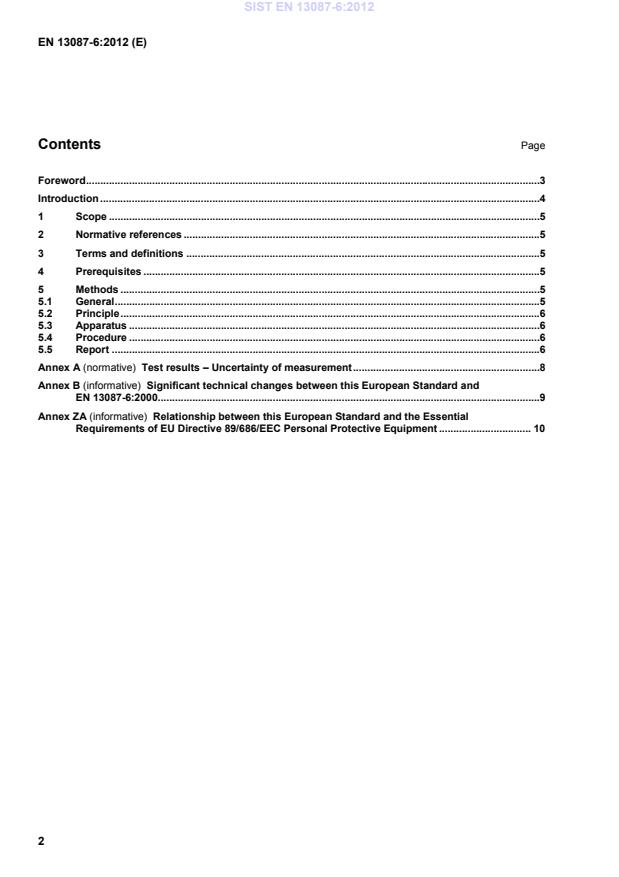
Test results – Uncertainty of measurement .8Annex B (informative)
Significant technical changes between this European Standard and EN 13087-6:2000.9Annex ZA (informative)
Relationship between this European Standard and the Essential Requirements of EU Directive 89/686/EEC Personal Protective Equipment . 10 SIST EN 13087-6:2012
...