

EN 16327:2014
(Main)Fire-fighting - Positive-pressure proportioning systems (PPPS) and compressed-air foam systems (CAFS)
- Abstract
This European Standard applies to systems which add a foam concentrate to the water discharged from a fire-fighting centrifugal pump either:
a) by a positive-pressure proportioning system (PPPS) alone, or
b) together with compressed-air by means of a compressed-air foam system (CAFS).
In both cases pressure is applied to the foam concentrate in order to permit continuous operation. Such systems are permanently installed in fire-fighting vehicles. Permanently installed or fixed systems in buildings or structures are not covered by this European Standard.
NOTE 1 This European Standard is intended to be used in conjunction with EN 1846–2 and EN 1846–3.
This European Standard applies to the design, manufacture and operation of such systems. This European Standard deals with all significant hazards, hazardous situations and events relevant to PPPS and CAFS when they are used as intended and under conditions of misuse which are reasonably foreseeable by the manufacture (see Clause 4).
NOTE 2 Performance requirements are also given (see Clause 7).
This European Standard applies to systems which are used at ambient temperatures ranging from −15 °C to +35 °C as stated in EN 1846 3.
For systems to be used at temperature outside this temperature range, the particular temperature range should be specified by the user and the manufacturer should determine by a risk assessment any need for additional precautions.
This European Standard does not apply to the technical safety requirements concerning the design and manufacturing of drives, auxiliary equipment, sources of energy or pumps. Furthermore, this European Standard does not deal with special hazards arising from the particular conditions under which these systems are used, for example:
c) handling of any equipment, devices etc. which are connected to the system or are joined to it (e.g. handling of branch pipes/nozzles and pressure hoses);
a) events specific to the location where the system is set up (e.g. on public roads);
f) decommissioning and disposal;
g) operation without supervision;
h) immunity against electromagnetic fields and electrostatic discharge.
Hazards relating to any kind of mechanical, electrical, hydraulic, pneumatic and other equipment dealt with by the respective standards for such equipment are not covered by the present standard. References to the relevant standards are made wherever such standards exist and whenever necessary.
This European Standard does not deal with the hazards arising from noise.
NOTE 3 EN 1846–2 covers hazards arising from noise for the complete vehicle.
This European Standard does not deal with hazards related to handling foam concentrates or contact with.
NOTE 4 Additive installation is dealt with in EN 1846–3.
This European Standard is not applicable to systems which are manufactured before the date of publication of this European Standard by CEN.
- Status
- Published
- Publication Date
- 11-Feb-2014
- Withdrawal Date
- 30-Aug-2014
- Technical Committee
- CEN/TC 192 - Fire service equipment
- Drafting Committee
- CEN/TC 192/WG 2 - Firefighting pumps
- Current Stage
- 9060 - Closure of 2 Year Review Enquiry - Review Enquiry
- Start Date
- 02-Sep-2019
- Completion Date
- 02-Sep-2019
- Directive
- 2006/42/EC - Directive 2006/42/EC of the European Parliament and of the Council of 17 May 2006 on machinery, and amending Directive 95/16/EC (recast)OJ Ref: C, C 220 OJ Date: 11-Jul-2014

Overview
EN 16327:2014 is a CEN European standard that specifies requirements for fire‑fighting systems installed in vehicles that proportion foam concentrate into water using positive‑pressure proportioning systems (PPPS) and/or deliver finished foam by compressed‑air foam systems (CAFS). It covers design, manufacture, operation, performance testing and user information for permanently installed vehicle systems operating typically between −15 °C and +35 °C. Fixed building installations and systems manufactured before publication are excluded.
Key topics and technical requirements
- Scope & classification
- Applies to PPPS and CAFS that inject pressurised foam concentrate into the discharge of a fire‑fighting centrifugal pump.
- Includes system classification and designation for typical nozzle flows and combined use.
- Safety requirements (Clause 6)
- General safety measures for mechanical, electrical and thermal hazards.
- Ergonomic design, maintenance access, protection against overspeed and safe shutdown devices.
- Requirements for continuous operation and handling foreseeable misuse.
- Additional CAFS‑specific safety controls for compressed‑air systems.
- Performance requirements (Clause 7)
- Minimum operational performance (flow, proportioning accuracy, operating ranges) and tests for finished foam quality.
- Type testing and documentation
- Type test reports, labelling/marking requirements and comprehensive user information (symbols, warnings, operating diagrams).
- Annexes
- Test procedures (including finished‑foam tests), sample operating range diagrams and acceptance test guidance.
Practical applications and who uses this standard
- Vehicle manufacturers and upfitters - to design and install compliant PPPS/CAFS on fire engines and rescue vehicles.
- Fire and rescue services / procurement teams - for setting technical specifications, acceptance testing and safe operation of foam systems.
- Equipment designers and OEMs - to ensure proportioning accuracy, safety features and CAFS integration meet EN 16327 requirements.
- Maintenance personnel and safety engineers - for inspection, servicing schedules and user information required by the standard.
- Certification bodies / test laboratories - for type testing and verification against the standard’s performance clauses.
Related standards
- EN 1846‑2 and EN 1846‑3 - intended to be used in conjunction with EN 16327 for vehicle installation and additive systems.
- EN 1028 / EN 14710 - related centrifugal pump standards referenced for pump interface and compatibility.
- EN ISO 12100 - overarching machinery safety principles (standard type C relationship explained in the foreword).
Keywords: EN 16327:2014, PPPS, CAFS, positive‑pressure proportioning systems, compressed‑air foam systems, fire‑fighting vehicles, foam concentrate, performance requirements, safety requirements, EN 1846.
Relations
- Effective Date
- 25-Aug-2026
- Effective Date
- 25-Aug-2026
- Effective Date
- 09-Feb-2026
- Effective Date
- 09-Feb-2026
- Effective Date
- 09-Feb-2026
- Effective Date
- 09-Feb-2026
- Effective Date
- 28-Jan-2026
- Effective Date
- 28-Jan-2026
- Effective Date
- 28-Jan-2026
- Effective Date
- 28-Jan-2026
- Effective Date
- 28-Jan-2026
- Effective Date
- 28-Jan-2026
- Refers
EN 547-3:1996+A1:2008 - Safety of machinery - Human body measurements - Part 3: Anthropometric data - Effective Date
- 28-Jan-2026
- Effective Date
- 28-Jan-2026
- Effective Date
- 28-Jan-2026
Get Certified
Connect with accredited certification bodies for this standard

CIS Institut d.o.o.
Personal Protective Equipment (PPE) certification body. Notified Body NB-2890 for EU Regulation 2016/425 PPE.

Kiwa BDA Testing
Building and construction product certification.
Kmetijski inštitut Slovenije
Agricultural Institute of Slovenia. Soil testing, plant health, agricultural product analysis.
Sponsored listings
Frequently Asked Questions
EN 16327:2014 is a standard published by the European Committee for Standardization (CEN). Its full title is "Fire-fighting - Positive-pressure proportioning systems (PPPS) and compressed-air foam systems (CAFS)". This standard covers: This European Standard applies to systems which add a foam concentrate to the water discharged from a fire-fighting centrifugal pump either: a) by a positive-pressure proportioning system (PPPS) alone, or b) together with compressed-air by means of a compressed-air foam system (CAFS). In both cases pressure is applied to the foam concentrate in order to permit continuous operation. Such systems are permanently installed in fire-fighting vehicles. Permanently installed or fixed systems in buildings or structures are not covered by this European Standard. NOTE 1 This European Standard is intended to be used in conjunction with EN 1846–2 and EN 1846–3. This European Standard applies to the design, manufacture and operation of such systems. This European Standard deals with all significant hazards, hazardous situations and events relevant to PPPS and CAFS when they are used as intended and under conditions of misuse which are reasonably foreseeable by the manufacture (see Clause 4). NOTE 2 Performance requirements are also given (see Clause 7). This European Standard applies to systems which are used at ambient temperatures ranging from −15 °C to +35 °C as stated in EN 1846 3. For systems to be used at temperature outside this temperature range, the particular temperature range should be specified by the user and the manufacturer should determine by a risk assessment any need for additional precautions. This European Standard does not apply to the technical safety requirements concerning the design and manufacturing of drives, auxiliary equipment, sources of energy or pumps. Furthermore, this European Standard does not deal with special hazards arising from the particular conditions under which these systems are used, for example: c) handling of any equipment, devices etc. which are connected to the system or are joined to it (e.g. handling of branch pipes/nozzles and pressure hoses); a) events specific to the location where the system is set up (e.g. on public roads); f) decommissioning and disposal; g) operation without supervision; h) immunity against electromagnetic fields and electrostatic discharge. Hazards relating to any kind of mechanical, electrical, hydraulic, pneumatic and other equipment dealt with by the respective standards for such equipment are not covered by the present standard. References to the relevant standards are made wherever such standards exist and whenever necessary. This European Standard does not deal with the hazards arising from noise. NOTE 3 EN 1846–2 covers hazards arising from noise for the complete vehicle. This European Standard does not deal with hazards related to handling foam concentrates or contact with. NOTE 4 Additive installation is dealt with in EN 1846–3. This European Standard is not applicable to systems which are manufactured before the date of publication of this European Standard by CEN.
This European Standard applies to systems which add a foam concentrate to the water discharged from a fire-fighting centrifugal pump either: a) by a positive-pressure proportioning system (PPPS) alone, or b) together with compressed-air by means of a compressed-air foam system (CAFS). In both cases pressure is applied to the foam concentrate in order to permit continuous operation. Such systems are permanently installed in fire-fighting vehicles. Permanently installed or fixed systems in buildings or structures are not covered by this European Standard. NOTE 1 This European Standard is intended to be used in conjunction with EN 1846–2 and EN 1846–3. This European Standard applies to the design, manufacture and operation of such systems. This European Standard deals with all significant hazards, hazardous situations and events relevant to PPPS and CAFS when they are used as intended and under conditions of misuse which are reasonably foreseeable by the manufacture (see Clause 4). NOTE 2 Performance requirements are also given (see Clause 7). This European Standard applies to systems which are used at ambient temperatures ranging from −15 °C to +35 °C as stated in EN 1846 3. For systems to be used at temperature outside this temperature range, the particular temperature range should be specified by the user and the manufacturer should determine by a risk assessment any need for additional precautions. This European Standard does not apply to the technical safety requirements concerning the design and manufacturing of drives, auxiliary equipment, sources of energy or pumps. Furthermore, this European Standard does not deal with special hazards arising from the particular conditions under which these systems are used, for example: c) handling of any equipment, devices etc. which are connected to the system or are joined to it (e.g. handling of branch pipes/nozzles and pressure hoses); a) events specific to the location where the system is set up (e.g. on public roads); f) decommissioning and disposal; g) operation without supervision; h) immunity against electromagnetic fields and electrostatic discharge. Hazards relating to any kind of mechanical, electrical, hydraulic, pneumatic and other equipment dealt with by the respective standards for such equipment are not covered by the present standard. References to the relevant standards are made wherever such standards exist and whenever necessary. This European Standard does not deal with the hazards arising from noise. NOTE 3 EN 1846–2 covers hazards arising from noise for the complete vehicle. This European Standard does not deal with hazards related to handling foam concentrates or contact with. NOTE 4 Additive installation is dealt with in EN 1846–3. This European Standard is not applicable to systems which are manufactured before the date of publication of this European Standard by CEN.
EN 16327:2014 is classified under the following ICS (International Classification for Standards) categories: 13.220.10 - Fire-fighting. The ICS classification helps identify the subject area and facilitates finding related standards.
EN 16327:2014 has the following relationships with other standards: It is inter standard links to ISO 7000:2014, ISO 8598:1996, EN 61310-3:2008, EN 60529:1991, EN 61310-1:2008, EN 61310-2:2008, EN 1028-2:2002+A1:2008, EN ISO 13732-1:2008, EN 2286:1989, EN 1028-1:2002+A1:2008, EN ISO 13732-3:2008, EN 2854-003:2021, EN 547-3:1996+A1:2008, EN 1005-3:2002+A1:2008, EN 894-1:1997+A1:2008. Understanding these relationships helps ensure you are using the most current and applicable version of the standard.
EN 16327:2014 is associated with the following European legislation: EU Directives/Regulations: 2006/42/EC; Standardization Mandates: M/396. When a standard is cited in the Official Journal of the European Union, products manufactured in conformity with it benefit from a presumption of conformity with the essential requirements of the corresponding EU directive or regulation.
EN 16327:2014 is available in PDF format for immediate download after purchase. The document can be added to your cart and obtained through the secure checkout process. Digital delivery ensures instant access to the complete standard document.
Standards Content (Sample)
2003-01.Slovenski inštitut za standardizacijo. Razmnoževanje celote ali delov tega standarda ni dovoljeno.RPSULPLUDQRFeuerwehrwesen - Druckzumischanlagen (DZA) und Druckluftschaumanlagen (DLS)Lutte contre l'incendie - Systèmes proportionneurs à pression positive (SPPP) et systèmes de mousse à air comprimé (CAFS)Fire-fighting - Positive pressure foam proportioning systems (PPFPS) and compressed air foam systems (CAFS)13.220.10Gašenje požaraFire-fightingICS:Ta slovenski standard je istoveten z:EN 16327:2014SIST EN 16327:2014en,fr,de01-april-2014SIST EN 16327:2014SLOVENSKI
STANDARD
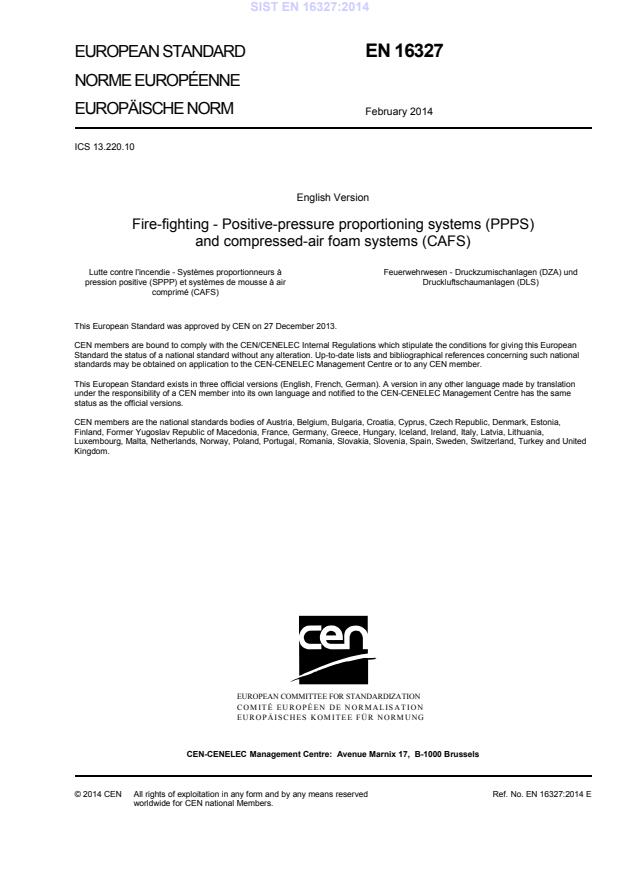
EUROPEAN STANDARD NORME EUROPÉENNE EUROPÄISCHE NORM
EN 16327
February 2014 ICS 13.220.10 English Version
Fire-fighting - Positive-pressure proportioning systems (PPPS) and compressed-air foam systems (CAFS)
Lutte contre l'incendie - Systèmes proportionneurs à pression positive (SPPP) et systèmes de mousse à air comprimé (CAFS)
Feuerwehrwesen - Druckzumischanlagen (DZA) und Druckluftschaumanlagen (DLS) This European Standard was approved by CEN on 27 December 2013.
CEN members are bound to comply with the CEN/CENELEC Internal Regulations which stipulate the conditions for giving this European Standard the status of a national standard without any alteration. Up-to-date lists and bibliographical references concerning such national standards may be obtained on application to the CEN-CENELEC Management Centre or to any CEN member.
This European Standard exists in three official versions (English, French, German). A version in any other language made by translation under the responsibility of a CEN member into its own language and notified to the CEN-CENELEC Management Centre has the same status as the official versions.
CEN members are the national standards bodies of Austria, Belgium, Bulgaria, Croatia, Cyprus, Czech Republic, Denmark, Estonia, Finland, Former Yugoslav Republic of Macedonia, France, Germany, Greece, Hungary, Iceland, Ireland, Italy, Latvia, Lithuania, Luxembourg, Malta, Netherlands, Norway, Poland, Portugal, Romania, Slovakia, Slovenia, Spain, Sweden, Switzerland, Turkey and United Kingdom.
EUROPEAN COMMITTEE FOR STANDARDIZATION
COMITÉ EUROPÉEN DE NORMALISATION EUROPÄISCHES KOMITEE FÜR NORMUNG
CEN-CENELEC Management Centre:
Avenue Marnix 17,
B-1000 Brussels © 2014 CEN All rights of exploitation in any form and by any means reserved worldwide for CEN national Members. Ref. No. EN 16327:2014 ESIST EN 16327:2014
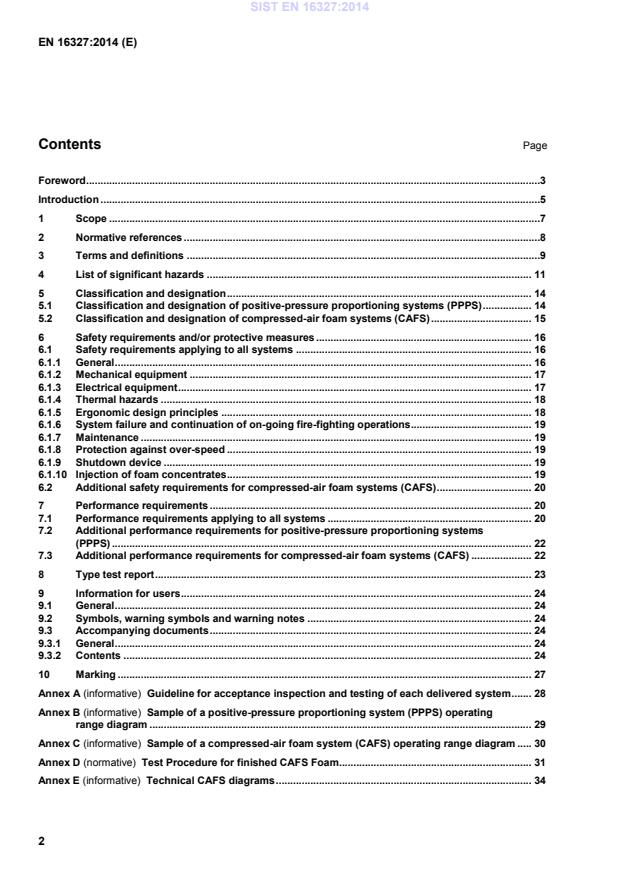
Guideline for acceptance inspection and testing of each delivered system . 28 Annex B (informative)
Sample of a positive-pressure proportioning system (PPPS) operating range diagram . 29 Annex C (informative)
Sample of a compressed-air foam system (CAFS) operating range diagram . 30 Annex D (normative)
Test Procedure for finished CAFS Foam. 31 Annex E (informative)
Technical CAFS diagrams . 34 SIST EN 16327:2014
Relationship between this European Standard and the Essential Requirements of EU Directive 2006/42/EC . 36 Bibliography . 37
Figures Figure B.1– Sample diagram showing the operating range of a type PPPS 2400 positive-pressure proportioning system. 29 Figure C.1 – Sample diagram showing the operating range of a compressed-air foam system (CAFS); maximum flows at ratio adjusted settings . 30 Figure D.1 — Collecting vessel for determination of expansion and drainage time . 32 Figure D.2 — Foam collector for expansion and drainage measurement . 32 Figure D.3 — Arrangement of nozzle and collecting-device during test . 33 Figure E.1 — Sample of a typical system diagram for CAFS with a single mixing device . 34 Figure E.2 — Sample of a typical CAFS with multiple mixing devices . 35
Tables Table 1 — List of significant hazards . 12 Table 2 – Classification of positive-pressure proportioning systems (PPPS) . 14 Table 3 – Classification of compressed-air foam systems (CAFS) . 15
3.9.1 air/foam solution volume ratio relationship between parts of liquid (solution) and parts of air (at atmospheric pressure) being mixed together in a CAFS mixing device Note 1 to entry: The measurement units are l/min. 3.9.2 flushing procedure procedure described by the manufacturer to ensure that the foam proportioning system and associated pipework on the fire-fighting centrifugal pump to the discharge connection is adequately flushed of foam concentrate and solution to avoid any damage EXAMPLE Corrosion. 3.10 operating pressure of the compressed-air foam system p pressure, specified by the compressed-air foam system manufacturer, at the system input connection at which all performance and safety requirements are met 4 List of significant hazards This clause contains all the significant hazards, hazardous situations and events, as far as they are dealt with in this European Standard, identified by risk assessment as significant for this type of machinery and which necessitates action to eliminate or reduce the risk. The significant hazards are given in Table 1, which is based on the principles of EN ISO 12100:2010, Annex B. Also shown are the subclause references to the safety requirements and/or protective measures in this document, if applicable. When the present standard was compiled, it was assumed that: a) the systems are operated by properly trained personnel only; b) components not subject to particular requirements are: 1) designed according to standard engineering practice and calculation methods, including due consideration to all modes of failure; 2) designed to be mechanically robust; 3) made of materials with strength and quality meeting the requirements of this European Standard; 4) manufactured of flawless materials. c) no hazardous materials (e.g. asbestos) are used; d) components are kept in good condition in order to maintain the required characteristics; e) the structural dimensions of load-bearing elements ensure safe operation and remain fully operational even after testing; SIST EN 16327:2014
5 Classification and designation 5.1 Classification and designation of positive-pressure proportioning systems (PPPS) Positive-pressure proportioning systems (PPPS) are classified according to the criteria shown in Table 2, whereby a dosage ratio of between 0fo % and 1 % is to be assumed in all cases. Table 2 – Classification of positive-pressure proportioning systems (PPPS) Short designation Guarantee point 1 nominal foam solution delivery rate at nominal dosage ratio of 1 % l/min Guarantee point 2 foam solution delivery rate at dosage ratio of 0fo % at least l/min PPPS 200 200 100 PPPS 400 400 100 PPPS 800 800 100 PPPS 1600 1600 200 PPPS 2400 2400 800 NOTE 1 The values stated for guarantee point 1 are minimum requirements. NOTE 2 The values stated for guarantee point 2 specifies the values above which foam concentrate is to be added. This ensures that an adequate dosage is achieved even for delivery rates lower than the nominal delivery rate (e.g. if only one nozzle/branch pipe is utilized). Positive-pressure proportioning systems (PPPS) which conform to this standard shall be designated as follows: a) long designation; b) number of this European standard EN 16327; c) short designation PPPS; d) additive dosage ratio range, SIST EN 16327:2014
5.2 Classification and designation of compressed-air foam systems (CAFS) Compressed-air foam systems (CAFS) are classified according to the criteria shown in Table 3 and by the positive-pressure proportioning system (PPPS) used in conjunction with them (see Table 2). Table 3 – Classification of compressed-air foam systems (CAFS) Short designation Guarantee point 1 Nominal foam solution delivery rate at nominal proportioning rate of 1 % l/min Guarantee point 2 Nominal air delivery rate at normal condition l/min CAFS 200 200 600 CAFS 400 400 1 200 CAFS 800 800 2 400 CAFS 1600 1 600 4 800 Where compressed-air foam systems with higher volume delivery rates are required, the manufacturer and the customer are to reach a special agreement on characteristics of these. The nominal air delivery rate from the compressor shall comply with Table 3. The nominal foam solution delivery rate shall be as required by the customer but at least it shall be possible to generate wet foam (see 3.4). NOTE See sample diagram showing the operating range of a compressed-air foam system (CAFS) in Annex C. Compressed-air foam systems (CAFS) conforming to this standard are to be designated as follows: a) long designation; b) number of this European standard EN 16327; SIST EN 16327:2014
In all cases, a positive-pressure proportioning system (PPPS) capable of achieving at least the foam solution delivery rate specified in Table 2 shall be used. 6 Safety requirements and/or protective measures 6.1 Safety requirements applying to all systems 6.1.1 General Conformity to all requirements shall be verified by the measures described (type test). In addition, each system put on the market shall meet the requirements of this document that are indicated by “(IND)” in the verification procedures (standing for individual test) before dispatch. NOTE A guideline for acceptance testing and inspection on delivery of a system is given in informative Annex A. The system shall still be in a working condition and in compliance with this standard after completion of the tests. Positive-pressure proportioning systems (PPPS) and compressed-air foam systems (CAFS) shall comply with the safety requirements and/or protective measures of this clause. In addition, the provisions of EN 1846-2 and EN 1846-3 also apply to positive-pressure proportioning systems and compressed-air foam systems permanently installed in fire-fighting vehicles. In addition, the systems shall be designed according to the principles of EN ISO 12100 for relevant but not significant hazards (e.g. sharp edges), which are not dealt with by this document. General requirements regarding electromagnetic compatibility (EMC) can be met by applying the corresponding clauses of EN oo012 (CISPR 12) on interference emissions, provided that the system is only powered by internal-combustion engines, or by applying the generic standards EN 61000-6-3 for interference emissions and EN 61000-6-2 for immunity to disturbance. In order to check whether all hazards of a system have been dealt with in this clause, the manufacturer should carry out a risk assessment for the system to determine any additional hazards not covered by this European Standard. When additional hazards are identified, it is the responsibility of the manufacturer to incorporate suitable protective measures to reduce the risk from these hazards to an acceptable level. In order to minimize the risks associated with operating and installing the system, information for user/operating instructions in accordance with Clause 9 shall be provided. SIST EN 16327:2014
...