

EN ISO 4895:1999
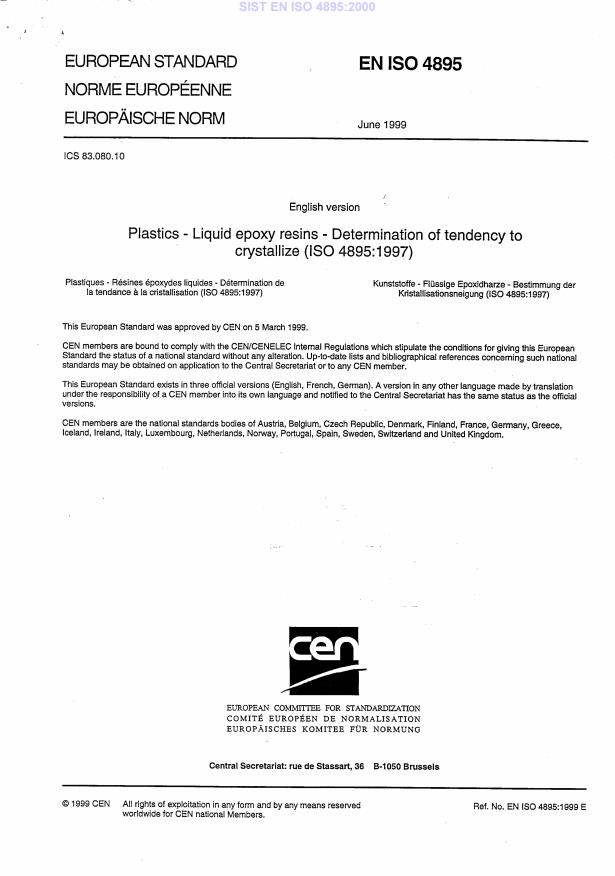
(Main)Plastics - Liquid epoxy resins - Determination of tendency to crystallize (ISO 4895:1997)
- Status
- Withdrawn
- Publication Date
- 22-Jun-1999
- Withdrawal Date
- 06-Oct-2026
- Technical Committee
- CEN/TC 249 - Plastics
- Drafting Committee
- CEN/TC 249 - Plastics
- Current Stage
- 9960 - Withdrawal effective - Withdrawal
- Start Date
- 16-Jul-2014
- Completion Date
- 07-Oct-2026

Relations
- Effective Date
- 23-Jul-2014
- Effective Date
- 25-Aug-2026
- Effective Date
- 25-Aug-2026
- Effective Date
- 09-Feb-2026
- Effective Date
- 28-Jan-2026
Get Certified
Connect with accredited certification bodies for this standard

DIN CERTCO
DIN Group product certification.

Smithers Quality Assessments
US management systems and product certification.
Sponsored listings
Frequently Asked Questions
EN ISO 4895:1999 is a standard published by the European Committee for Standardization (CEN). Its full title is "Plastics - Liquid epoxy resins - Determination of tendency to crystallize (ISO 4895:1997)". This standard covers: Diese Internationale Norm legt ein Verfahren zur Bestimmung der Kristallisationsneigung flüssiger Epoxidharze fest. Die Kristallisationsneigung wird bestimmt, indem man in bestimmten Zeitintervallen Änderungen in der Fluidität und den Begin der Kristallisation beobachtet.
Diese Internationale Norm legt ein Verfahren zur Bestimmung der Kristallisationsneigung flüssiger Epoxidharze fest. Die Kristallisationsneigung wird bestimmt, indem man in bestimmten Zeitintervallen Änderungen in der Fluidität und den Begin der Kristallisation beobachtet.
EN ISO 4895:1999 is classified under the following ICS (International Classification for Standards) categories: 83.080.10 - Thermosetting materials. The ICS classification helps identify the subject area and facilitates finding related standards.
EN ISO 4895:1999 has the following relationships with other standards: It is inter standard links to EN ISO 4895:2014, ISO 6353-3:1987, ISO 3001:1999, ISO 6353-2:1983, EN 14344:2004. Understanding these relationships helps ensure you are using the most current and applicable version of the standard.
EN ISO 4895:1999 is available in PDF format for immediate download after purchase. The document can be added to your cart and obtained through the secure checkout process. Digital delivery ensures instant access to the complete standard document.
Standards Content (Sample)
2003-01.Slovenski inštitut za standardizacijo. Razmnoževanje celote ali delov tega standarda ni dovoljeno.Kunststoffe - Flüssige Epoxidharze - Bestimmung der Kristallisationsneigung (ISO 4895:1997)Plastiques - Résines époxydes liquides - Détermination de la tendance a la cristallisation (ISO 4895:1997)Plastics - Liquid epoxy resins - Determination of tendency to crystallize (ISO 4895:1997)83.080.10DuromeriThermosetting materialsICS:Ta slovenski standard je istoveten z:EN ISO 4895:1999SIST EN ISO 4895:2000en01-maj-2000SIST EN ISO 4895:2000SLOVENSKI
STANDARD
AReference numberISO 4895:1997(E)INTERNATIONALSTANDARDISO4895Second edition1997-11-15Plastics — Liquid epoxy resins —Determination of tendency to crystallizePlastiques — Résines époxydes liquides — Détermination de la tendanceà la cristallisationSIST EN ISO 4895:2000
ISO 4895:1997(E)©
ISO 1997All rights reserved. Unless otherwise specified, no part of this publication may be reproducedor utilized in any form or by any means, electronic or mechanical, including photocopying andmicrofilm, without permission in writing from the publisher.International Organization for StandardizationCase postale 56 · CH-1211 Genève 20 · SwitzerlandInternetcentral@iso.chX.400c=ch; a=400net; p=iso; o=isocs; s=centralPrinted in SwitzerlandiiForewordISO (the International Organization for Standardization) is a worldwidefederation of national standards bodies (ISO member bodies). The work ofpreparing International Standards is normally carried out through ISOtechnical committees. Each member body interested in a subject for whicha technical committee has been established has the right to be representedon that committee. International organizations, governmental and non-governmental, in liaison with ISO, also take part in the work. ISOcollaborates closely with the International Electrotechnical Commission(IEC) on all matters of electrotechnical standardization.Draft International Standards adopted by the technical committees arecirculated to the member bodies for voting. Publication as an InternationalStandard requires approval by at least 75 % of the member bodies castinga vote.International Standard ISO 4895 was prepared by Technical CommitteeISO/TC 61, Plastics, Subcommittee SC 12, Thermosetting materials.This second edition cancels and replaces the first edition (ISO 4895:1987),which has been technically revised.SIST EN ISO 4895:2000
© ISOISO 4895:1997(E)iiiIntroductionThe tendency of liquid epoxy resins to crystallize varies depending onfactors such as basic composition, purity, additives, homogeneity andwater content, in addition to external factors such as storage historyand ambient temperature.As it is rather difficult to indicate the tendency quantitatively by observationand comparison, the tendency is therefore to express the results byobserving, at intervals, the changes in fluidity and appearance of samples.SIST EN ISO 4895:2000
INTERNATIONAL STANDARD
© ISOISO 4895:1997(E)1Plastics — Liquid epoxy resins — Determination oftendency to crystallize1
ScopeThis International Standard specifies a method for determining the tendency of liquid epoxy resins to crystallize. Thetendency to crystallize is determined by observing, at specified time intervals, changes in fluidity and the onset ofcrystallization.2
Normative referencesThe following standards contain provisions which, through reference in this text, constitute provisions of thisInternational Standard. At the time of publication, the editions indicated were valid. All standards are subject torevision, and parties to agreements based on this International Standard are encouraged to investigate thepossibility of applyi
...