


EN 737-2:1998
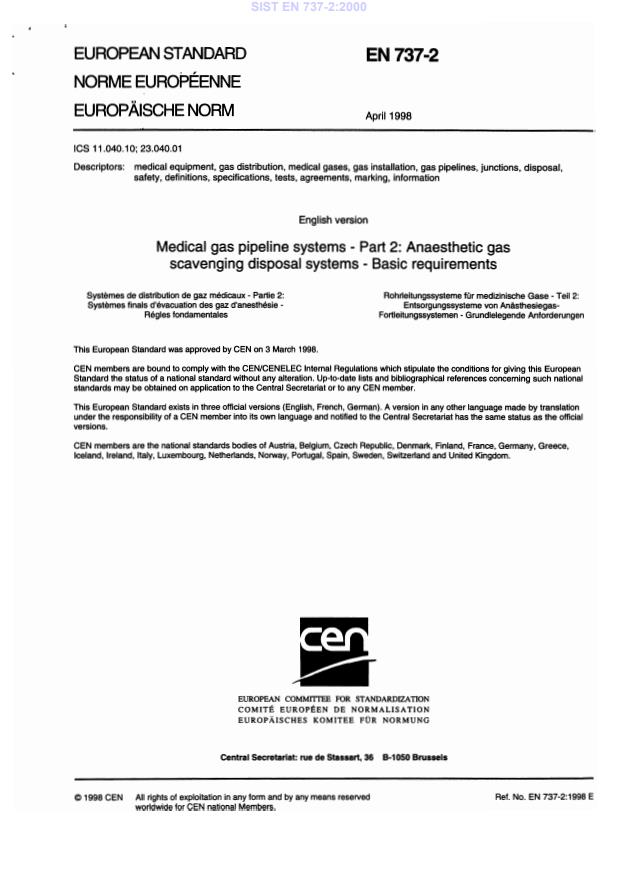
(Main)Medical gas pipeline systems - Part 2: Anaesthetic gas scavenging disposal systems - Basic requirements
Medical gas pipeline systems - Part 2: Anaesthetic gas scavenging disposal systems - Basic requirements
This Part of this European Standard specifies basic requirements for the installation, function, performance, documentation, testing and commissioning of anaesthetic gas scavenging (AGS) disposal systems to ensure patient and operator safety by the safe removal of excess anaesthetic gases and vapours from the clinical environment. It includes basic requirements for the power device, pipeline system, performance and for non-interchangeability between key components. This Part of this European standard specifies: a) the compatibility and safe performance between the disposal system and the other components of the AGSS by design, installation and commissioning; b) the use of appropriate materials; c) the testing of correct installation to ensure achievement of the performance intended by the manufacturer; d) the marking of pipeline and components. This Part of this European Standard addresses only those disposal systems which are intended to be connected via AGSS terminal units which comply with EN 737-4 to a receiving system which complies with prEN 740.
Rohrleitungssysteme für medizinische Gase - Teil 2: Entsorgungssysteme von Anästhesiegas-Fortleitungssystemen - Grundlegende Anforderungen
Dieser Teil dieser Europäischen Norm legt grundlegende Anforderungen an Installation, Funktion, Leistung, Dokumentation, Prüfung und Inbetriebnahme von Entsorgungssystemen eines Anästhesiegas-Fortleitungs-(AGF)- Systems fest, um durch die sichere Entfernung überschüssiger Anästhesiegase und Anästhesiemitteldämpfe aus der klinischen Umgebung die Sicherheit von Patient und Betreiber sicherzustellen. Er enthält grundlegende Anforderungen an das Antriebssystem, das Rohrleitungssystem, die Leistung und an die Nichtaustauschbarkeit von Schlüsselkomponenten.
Systèmes de distribution de gaz médicaux - Partie 2: Systèmes finals d'évacuation des gaz d'anesthésie - Règles fondamentales
La présente partie de cette norme européenne spécifie les prescriptions fondamentales d'installation, de fonctionnement, de performances, de documentation, d'essais et de mise en service de systèmes finals d'évacuation des gaz d'anesthésie (SEGA) permettant de garantir la sécurité des patients et des opérateurs par le retrait, en toute sécurité, des surplus de gaz d'anesthésie et de vapeurs provenant de l'environnement clinique.
Sistemi napeljav za medicinske pline - 2. del: Sistemi za odstranjevanje anestezijskih plinov in hlapov - Osnovne zahteve
General Information
- Status
- Withdrawn
- Publication Date
- 21-Apr-1998
- Withdrawal Date
- 31-Mar-2007
- Technical Committee
- CEN/TC 215 - Respiratory and anaesthetic equipment
- Drafting Committee
- CEN/TC 215/WG 3 - Medical gas supply systems
- Current Stage
- 9960 - Withdrawal effective - Withdrawal
- Start Date
- 01-Apr-2007
- Completion Date
- 01-Apr-2007
- Directive
- 93/42/EEC - Medical devices
Relations
- Effective Date
- 22-Dec-2008
- Effective Date
- 09-Feb-2026
- Effective Date
- 22-Dec-2008
- Effective Date
- 22-Dec-2008

Get Certified
Connect with accredited certification bodies for this standard

BSI Group
BSI (British Standards Institution) is the business standards company that helps organizations make excellence a habit.

TÜV Rheinland
TÜV Rheinland is a leading international provider of technical services.

TÜV SÜD
TÜV SÜD is a trusted partner of choice for safety, security and sustainability solutions.
Sponsored listings
Frequently Asked Questions
EN 737-2:1998 is a standard published by the European Committee for Standardization (CEN). Its full title is "Medical gas pipeline systems - Part 2: Anaesthetic gas scavenging disposal systems - Basic requirements". This standard covers: This Part of this European Standard specifies basic requirements for the installation, function, performance, documentation, testing and commissioning of anaesthetic gas scavenging (AGS) disposal systems to ensure patient and operator safety by the safe removal of excess anaesthetic gases and vapours from the clinical environment. It includes basic requirements for the power device, pipeline system, performance and for non-interchangeability between key components. This Part of this European standard specifies: a) the compatibility and safe performance between the disposal system and the other components of the AGSS by design, installation and commissioning; b) the use of appropriate materials; c) the testing of correct installation to ensure achievement of the performance intended by the manufacturer; d) the marking of pipeline and components. This Part of this European Standard addresses only those disposal systems which are intended to be connected via AGSS terminal units which comply with EN 737-4 to a receiving system which complies with prEN 740.
This Part of this European Standard specifies basic requirements for the installation, function, performance, documentation, testing and commissioning of anaesthetic gas scavenging (AGS) disposal systems to ensure patient and operator safety by the safe removal of excess anaesthetic gases and vapours from the clinical environment. It includes basic requirements for the power device, pipeline system, performance and for non-interchangeability between key components. This Part of this European standard specifies: a) the compatibility and safe performance between the disposal system and the other components of the AGSS by design, installation and commissioning; b) the use of appropriate materials; c) the testing of correct installation to ensure achievement of the performance intended by the manufacturer; d) the marking of pipeline and components. This Part of this European Standard addresses only those disposal systems which are intended to be connected via AGSS terminal units which comply with EN 737-4 to a receiving system which complies with prEN 740.
EN 737-2:1998 is classified under the following ICS (International Classification for Standards) categories: 11.040.10 - Anaesthetic, respiratory and reanimation equipment; 23.040.01 - Pipeline components and pipelines in general. The ICS classification helps identify the subject area and facilitates finding related standards.
EN 737-2:1998 has the following relationships with other standards: It is inter standard links to EN ISO 7396-2:2007, EN 60079-17:2003, EN 737-2:1998/A1:1999, EN 737-2:1998/AC:2000. Understanding these relationships helps ensure you are using the most current and applicable version of the standard.
EN 737-2:1998 is associated with the following European legislation: EU Directives/Regulations: 93/42/EEC; Standardization Mandates: M/023. When a standard is cited in the Official Journal of the European Union, products manufactured in conformity with it benefit from a presumption of conformity with the essential requirements of the corresponding EU directive or regulation.
EN 737-2:1998 is available in PDF format for immediate download after purchase. The document can be added to your cart and obtained through the secure checkout process. Digital delivery ensures instant access to the complete standard document.
Standards Content (Sample)
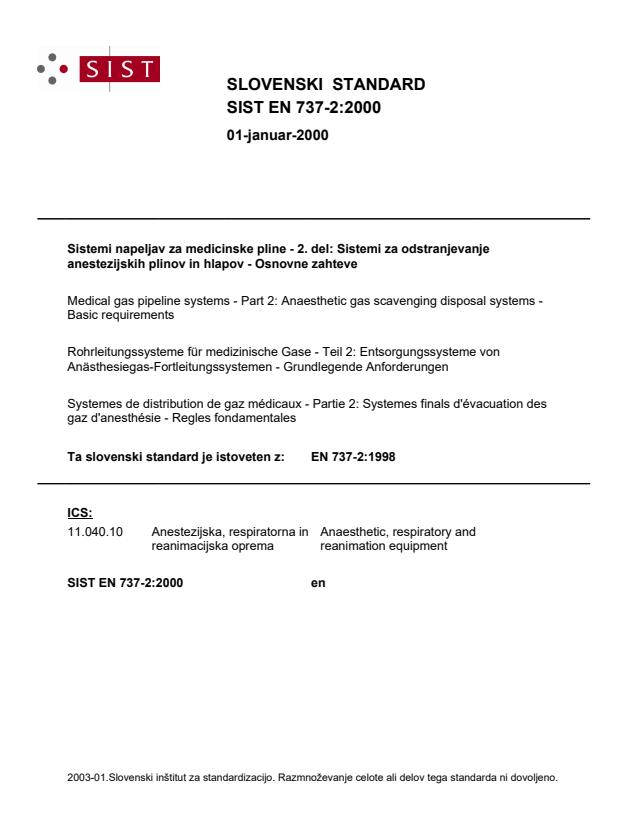
2003-01.Slovenski inštitut za standardizacijo. Razmnoževanje celote ali delov tega standarda ni dovoljeno.Sistemi napeljav za medicinske pline - 2. del: Sistemi za odstranjevanje anestezijskih plinov in hlapov - Osnovne zahteveRohrleitungssysteme für medizinische Gase - Teil 2: Entsorgungssysteme von Anästhesiegas-Fortleitungssystemen - Grundlegende AnforderungenSystemes de distribution de gaz médicaux - Partie 2: Systemes finals d'évacuation des gaz d'anesthésie - Regles fondamentalesMedical gas pipeline systems - Part 2: Anaesthetic gas scavenging disposal systems - Basic requirements11.040.10Anestezijska, respiratorna in reanimacijska opremaAnaesthetic, respiratory and reanimation equipmentICS:Ta slovenski standard je istoveten z:EN 737-2:1998SIST EN 737-2:2000en01-januar-2000SIST EN 737-2:2000SLOVENSKI
STANDARD
SIST EN 737
...
Questions, Comments and Discussion
Ask us and Technical Secretary will try to provide an answer. You can facilitate discussion about the standard in here.
Loading comments...