

EN 16603-20-01:2020
(Main)Space engineering - Multipactor, design and test
- Abstract
This standard defines the requirements and recommendations for the design and test of RF components and equipment to achieve acceptable performance with respect to multipactor-free operation in service in space. The standard includes:
- verification planning requirements,
- definition of a route to conform to the requirements,
- design and test margin requirements,
- design and test requirements, and
- informative annexes that provide guidelines on the design and test processes.
This standard is intended to result in the effective design and verification of the multipactor performance of the equipment and consequently in a high confidence in achieving successful product operation.
This standard covers multipactor events occurring in all classes of RF satellite components and equipment at all frequency bands of interest. Operation in single carrier CW and pulse modulated mode are included, as well as multi-carrier operations. A detailed clause on secondary emission yield is also included.
This standard does not include breakdown processes caused by collisional processes, such as plasma formation.
This standard is applicable to all space missions.
This standard may be tailored for the specific characteristic and constrains of a space project in conformance with ECSS-S-ST-00.
- Status
- Published
- Publication Date
- 22-Sep-2020
- Withdrawal Date
- 30-Mar-2021
- Technical Committee
- CEN/CLC/TC 5 - Space
- Drafting Committee
- CEN/CLC/TC 5 - Space
- Current Stage
- 6060 - Definitive text made available (DAV) - Publishing
- Start Date
- 23-Sep-2020
- Completion Date
- 23-Sep-2020

Overview
EN 16603-20-01:2020 - Space engineering: Multipaction, design and test is a European space standard that defines requirements and recommendations to ensure multipactor‑free operation of RF components and equipment in space. It covers design, analysis and verification (by test or by analysis) across all satellite RF component classes and frequency bands, including single‑carrier CW, pulsed, and multicarrier operation. The standard is intended to increase confidence in successful product operation and is applicable to all space missions. It may be tailored to project constraints in conformance with ECSS‑S‑ST‑00.
Key technical topics and requirements
This standard addresses the full verification lifecycle for preventing multipactor in vacuum RF systems. Key topics include:
- Verification planning: Requirements for a multipactor verification plan and verification routes (analysis, test, or combined).
- Design and test margins: Required margins to apply during analysis and testing to demonstrate safe operational envelopes.
- Design analysis: Field analysis, multipactor charts, frequency selection and levels of analysis for predicting multipactor susceptibility.
- Test requirements and procedures: Test bed configuration, validation, sequence, acceptance criteria, reporting and steps to follow on detected events.
- Test conditions: Environmental controls such as cleanliness, pressure and temperature; signal characteristics for single‑frequency, multi‑frequency and pulsed tests; electron seeding and seeding verification techniques.
- Detection methods: Recommended detection methods and parameters (sensitivity, rise time, verification).
- Secondary electron emission (SEY): Detailed clause on SEY measurements - procedures, worst‑case justification, sample conditions and selection of SEY data.
- Informative annexes: Guidance on document deliverables and the design/test process.
Important exclusion: the standard does not cover collisional breakdown processes (e.g., plasma formation).
Practical applications and who should use it
This standard is used by:
- Satellite payload and RF subsystem designers and engineers seeking to mitigate multipactor risks.
- Test laboratories and systems engineers developing multipactor test campaigns and facilities.
- Program managers, verification and quality assurance teams defining qualification routes and acceptance criteria.
- Contractors and procurement teams ensuring deliverables meet multipactor design and verification requirements.
Typical applications include high‑power satellite RF amplifiers, filters, waveguides, antennas and complex microwave assemblies used in telecommunications, navigation, Earth observation and science missions.
Related standards
- Originates from ECSS‑E‑ST‑20‑01C and supersedes EN 14777:2004.
- Can be tailored in line with ECSS‑S‑ST‑00 project tailoring rules.
Keywords: EN 16603-20-01:2020, multipactor, space engineering, RF components, multipactor‑free, verification, testing, SEY, multicarrier, CW, pulsed, space missions.
Relations
- Effective Date
- 30-Sep-2020
- Effective Date
- 09-Feb-2026
Get Certified
Connect with accredited certification bodies for this standard

BUREAU VERITAS Certification Germany
Bureau Veritas certification in Germany.

Element Materials Technology
Materials testing and product certification.

AQMS Ltd.
AQMS provides ISO certification to SMEs across the UK.
Sponsored listings
Frequently Asked Questions
EN 16603-20-01:2020 is a standard published by the European Committee for Standardization (CEN). Its full title is "Space engineering - Multipactor, design and test". This standard covers: This standard defines the requirements and recommendations for the design and test of RF components and equipment to achieve acceptable performance with respect to multipactor-free operation in service in space. The standard includes: - verification planning requirements, - definition of a route to conform to the requirements, - design and test margin requirements, - design and test requirements, and - informative annexes that provide guidelines on the design and test processes. This standard is intended to result in the effective design and verification of the multipactor performance of the equipment and consequently in a high confidence in achieving successful product operation. This standard covers multipactor events occurring in all classes of RF satellite components and equipment at all frequency bands of interest. Operation in single carrier CW and pulse modulated mode are included, as well as multi-carrier operations. A detailed clause on secondary emission yield is also included. This standard does not include breakdown processes caused by collisional processes, such as plasma formation. This standard is applicable to all space missions. This standard may be tailored for the specific characteristic and constrains of a space project in conformance with ECSS-S-ST-00.
This standard defines the requirements and recommendations for the design and test of RF components and equipment to achieve acceptable performance with respect to multipactor-free operation in service in space. The standard includes: - verification planning requirements, - definition of a route to conform to the requirements, - design and test margin requirements, - design and test requirements, and - informative annexes that provide guidelines on the design and test processes. This standard is intended to result in the effective design and verification of the multipactor performance of the equipment and consequently in a high confidence in achieving successful product operation. This standard covers multipactor events occurring in all classes of RF satellite components and equipment at all frequency bands of interest. Operation in single carrier CW and pulse modulated mode are included, as well as multi-carrier operations. A detailed clause on secondary emission yield is also included. This standard does not include breakdown processes caused by collisional processes, such as plasma formation. This standard is applicable to all space missions. This standard may be tailored for the specific characteristic and constrains of a space project in conformance with ECSS-S-ST-00.
EN 16603-20-01:2020 is classified under the following ICS (International Classification for Standards) categories: 49.140 - Space systems and operations. The ICS classification helps identify the subject area and facilitates finding related standards.
EN 16603-20-01:2020 has the following relationships with other standards: It is inter standard links to EN 14777:2004, ISO 14644-1:2015. Understanding these relationships helps ensure you are using the most current and applicable version of the standard.
EN 16603-20-01:2020 is associated with the following European legislation: Standardization Mandates: M/496. When a standard is cited in the Official Journal of the European Union, products manufactured in conformity with it benefit from a presumption of conformity with the essential requirements of the corresponding EU directive or regulation.
EN 16603-20-01:2020 is available in PDF format for immediate download after purchase. The document can be added to your cart and obtained through the secure checkout process. Digital delivery ensures instant access to the complete standard document.
Standards Content (Sample)
SLOVENSKI STANDARD
01-december-2020
Nadomešča:
SIST EN 14777:2005
Vesoljska tehnika - Multipaction, zasnova in preskušanje
Space engineering - Multipaction, design and test
Raumfahrttechnik - Multipaction-Konzeption und -Test
Systèmes sol et opérations - Conception et test prenant en compte l'effet Multipactor
Ta slovenski standard je istoveten z: EN 16603-20-01:2020
ICS:
49.140 Vesoljski sistemi in operacije Space systems and
operations
2003-01.Slovenski inštitut za standardizacijo. Razmnoževanje celote ali delov tega standarda ni dovoljeno.
EUROPEAN STANDARD
EN 16603-20-01
NORME EUROPÉENNE
EUROPÄISCHE NORM
September 2020
ICS 49.140
Supersedes EN 14777:2004
English version
Space engineering - Multipactor, design and test
Ingénierie spatiale - Multipactor, conception et tests Raumfahrttechnik - Multipaction, Konzeption und Test
This European Standard was approved by CEN on 17 May 2020.
CEN and CENELEC members are bound to comply with the CEN/CENELEC Internal Regulations which stipulate the conditions for
giving this European Standard the status of a national standard without any alteration. Up-to-date lists and bibliographical
references concerning such national standards may be obtained on application to the CEN-CENELEC Management Centre or to
any CEN and CENELEC member.
This European Standard exists in three official versions (English, French, German). A version in any other language made by
translation under the responsibility of a CEN and CENELEC member into its own language and notified to the CEN-CENELEC
Management Centre has the same status as the official versions.
CEN and CENELEC members are the national standards bodies and national electrotechnical committees of Austria, Belgium,
Bulgaria, Croatia, Cyprus, Czech Republic, Denmark, Estonia, Finland, France, Germany, Greece, Hungary, Iceland, Ireland, Italy,
Latvia, Lithuania, Luxembourg, Malta, Netherlands, Norway, Poland, Portugal, Republic of North Macedonia, Romania, Serbia,
Slovakia, Slovenia, Spain, Sweden, Switzerland, Turkey and United Kingdom.
CEN-CENELEC Management Centre:
Rue de la Science 23, B-1040 Brussels
© 2020 CEN/CENELEC All rights of exploitation in any form and by any means Ref. No. EN 16603-20-01:2020 E
reserved worldwide for CEN national Members and for
CENELEC Members.
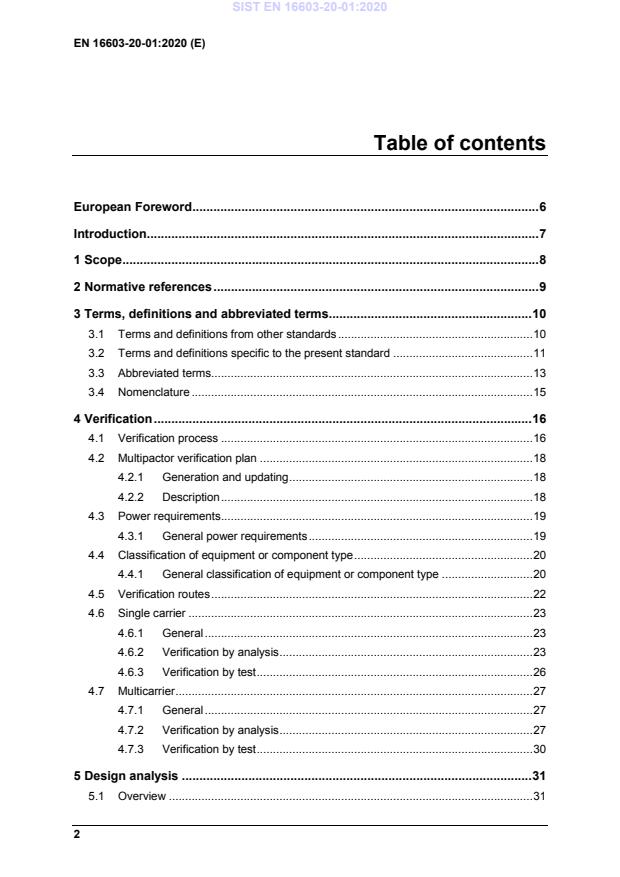
Table of contents
European Foreword . 6
Introduction . 7
1 Scope . 8
2 Normative references . 9
3 Terms, definitions and abbreviated terms . 10
3.1 Terms and definitions from other standards . 10
3.2 Terms and definitions specific to the present standard . 11
3.3 Abbreviated terms. 13
3.4 Nomenclature . 15
4 Verification . 16
4.1 Verification process . 16
4.2 Multipactor verification plan . 18
4.2.1 Generation and updating . 18
4.2.2 Description . 18
4.3 Power requirements . 19
4.3.1 General power requirements . 19
4.4 Classification of equipment or component type . 20
4.4.1 General classification of equipment or component type . 20
4.5 Verification routes . 22
4.6 Single carrier . 23
4.6.1 General . 23
4.6.2 Verification by analysis . 23
4.6.3 Verification by test . 26
4.7 Multicarrier . 27
4.7.1 General . 27
4.7.2 Verification by analysis . 27
4.7.3 Verification by test . 30
5 Design analysis . 31
5.1 Overview . 31
5.2 Field analysis . 31
5.3 Multipactor design analysis . 32
5.3.1 Frequency selection . 32
5.3.2 Design analysis levels . 32
5.3.3 Available data for Multipactor analysis . 37
6 Multipactor - Test conditions . 45
6.1 Cleanliness . 45
6.2 Pressure . 45
6.3 Temperature . 46
6.4 Signal characteristics . 47
6.4.1 Applicable bandwidth . 47
6.4.2 Single-frequency test case . 47
6.4.3 Multi-frequency test case . 47
6.4.4 Pulsed testing . 49
6.5 Electron seeding . 50
6.5.1 General . 50
6.5.2 Multipactor test in CW operation . 50
6.5.3 Multipactor test in pulsed operation . 50
6.5.4 Multipactor test in multi-carrier operation . 50
6.5.5 Seeding sources . 50
6.5.6 Seeding verification . 51
7 Multipactor - Methods of detection . 52
7.1 General . 52
7.2 Detection methods . 52
7.3 Detection method parameters . 53
7.3.1 Verification . 53
7.3.2 Sensitivity . 53
7.3.3 Rise time . 54
8 Multipactor - Test procedure . 55
8.1 General . 55
8.2 Test bed configuration . 55
8.3 Test bed validation. 56
8.4 Test sequence . 57
8.5 Acceptance criteria . 61
8.5.1 Definitions . 61
8.5.2 Multipactor Free Equipment or component . 61
8.5.3 Steps in case of Discharges or Events during test. 61
8.5.4 Investigation of Test Anomalies. 66
8.6 Test procedure . 66
8.7 Test reporting . 67
9 Secondary electron emission yield requirements . 68
9.1 General . 68
9.2 SEY measurements justification . 68
9.3 Worst case SEY measurement . 68
9.4 SEY measurements conditions . 69
9.4.1 Environmental conditions . 69
9.4.2 SEY test bed conditions . 69
9.4.3 SEY sample characteristics . 70
9.5 SEY measurements procedure . 70
9.5.1 SEY Measurements procedure documents . 70
9.5.2 SEY measurement calibration . 71
9.6 ECSS SEY data selection . 71
Annex A (informative) Multipactor document delivery per review . 72
Bibliography . 74
Figures
Figure 3-1: Minimum inflexion point for Silver multipactor chart. . 12
Figure 4-1: Verification routes per component/equipment type and qualification status
for multipactor conformance . 22
Figure 5-1: Multipactor chart for standard Aluminium obtained with parameters from
Table 9-1 . 42
Figure 5-2: Multipactor chart for standard Copper obtained with parameters from Table
9-1 . 42
Figure 5-3: Multipactor chart for standard Silver obtained with parameters from Table
9-1 . 43
Figure 5-4: Multipactor chart for standard Gold obtained with parameters from Table
9-1 . 43
Figure 5-5: Comparison of Multipactor charts for all standard materials obtained with
parameters from Table 9-1 . 44
Figure 8-1: Illustration of test sequence . 60
Figure 8-2: Illustration of test sequence following first Event . 63
Figure 8-3: Illustration of test sequence following first potential discharge . 65
Tables
Table 4-1: Classification of equipment or component type according to the qualification
status and heritage from a multipactor point of view (adapted from Table 5-
1 of ECSS-E-ST-10-02) . 17
Table 4-2: Classification of equipment or component type according to the material and
the geometry . 21
Table 4-3: Analysis margins w.r.t. nominal power applicable to P1 and P2 equipment or
components with Bm or Cm category verified by analysis . 24
Table 4-4: Analysis margins w.r.t. nominal power applicable to P1 and P2 equipment or
components with Dm category verified by analysis . 25
Table 4-5: Test margins w.r.t. nominal power applicable to P1, P2 and P3 equipment or
components verified by test . 26
Table 4-6: Analysis margins applicable to P1 and P2 equipment or components with
Bm or Cm category verified by analysis . 28
Table 4-7: Analysis margins applicable to P1 and P2 equipment or components with
Dm category verified by analysis . 29
Table 4-8: Test margins w.r.t. nominal power applicable to P1, P2 and P3 equipment or
components verified by test . 30
Table 5-1: Tabulated values of the lowest breakdown voltage threshold boundary of the
multipactor charts, computed with the SEY data of Table 9-1 . 38
Table 9-1: SEY parameters for Al, Cu, Au and Ag materials . 71
Table A-1 : Multipactor deliverable document per review . 73
European Foreword
This document (EN 16603-20-01:2020) has been prepared by Technical
Committee CEN-CENELEC/TC 5 “Space”, the secretariat of which is held by
DIN.
This standard (EN 16603-20-01:2020) originates from ECSS-E-ST-20-01C.
This European Standard shall be given the status of a national standard, either
by publication of an identical text or by endorsement, at the latest by March
2021, and conflicting national standards shall be withdrawn at the latest by
March 2021.
Attention is drawn to the possibility that some of the elements of this document
may be the subject of patent rights. CEN [and/or CENELEC] shall not be held
responsible for identifying any or all such patent rights.
This document supersedes EN 14777:2004.
This document has been prepared under a standardization request given to
CEN by the European Commission and the European Free Trade Association.
This document has been developed to cover specifically space systems and has
therefore precedence over any EN covering the same scope but with a wider
domain of applicability (e.g. : aerospace).
According to the CEN-CENELEC Internal Regulations, the national standards
organizations of the following countries are bound to implement this European
Standard: Austria, Belgium, Bulgaria, Croatia, Cyprus, Czech Republic,
Denmark, Estonia, Finland, Former Yugoslav Republic of Macedonia, France,
Germany, Greece, Hungary, Iceland, Ireland, Italy, Latvia, Lithuania,
Luxembourg, Malta, Netherlands, Norway, Poland, Portugal, Romania, Serbia,
Slovakia, Slovenia, Spain, Sweden, Switzerland, Turkey and the United
Kingdom.
Introduction
In the context of increased RF power and equipment or component
miniaturization, more and more attention shall be paid to multipactor which is
critical for space missions based on satellite telecommunication or navigation
payloads, or active microwave instruments for Earth Observation or Science.
The multipactor phenomenon is an electron avalanche discharge occurring in
high vacuum initiated by primary electrons inside a RF component in presence
of a high local RF voltage or electric field.
In order to verify by analysis that a RF equipment or component is multipactor
free, accurate EM modelling tools are required. These tools need more and
more computation resources to cope with RF equipment or components with
complex geometries, advanced manufacturing techniques, new materials and
processes, and complex RF signals. The verification by test also requires some
up-to-date test facilities, that provide high power amplification, electron
seeding techniques, multiple and accurate detection methods, ability to
generate complex signals, and the ability to reproduce the space representative
environment conditions.
This standard is an update of previous version of ECSS-E-20-01A Rev.1, that
includes the state-of-art of new verification approaches, and associated
margins.
Scope
This standard defines the requirements and recommendations for the design
and test of RF components and equipment to achieve acceptable performance
with respect to multipactor-free operation in service in space. The standard
includes:
verification planning requirements,
definition of a route to conform to the requirements,
design and test margin requirements,
design and test requirements, and
informative annexes that provide guidelines on the design and test
processes.
This standard is intended to result in the effective design and verification of the
multipactor performance of the equipment and consequently in a high
confidence in achieving successful product operation.
This standard covers multipactor events occurring in all classes of RF satellite
components and equipment at all frequency bands of interest in high vacuum
-5
conditions (pressure lower than 10 hPa). Operation in single carrier CW and
pulse modulated mode are included, as well as unmodulated multi-carrier
operations. A detailed clause on secondary emission yield is also included.
This standard does not include breakdown processes caused by collisional
processes, such as plasma formation.
This standard is applicable to all space missions.
This standard may be tailored for the specific characteristic and constrains of a
space project in conformance with ECSS-S-ST-00.
Normative references
The following normative documents contain provisions which, through
reference in this text, constitute provisions of this ECSS Standard. For dated
references, subsequent amendments to, or revision of any of these publications
do not apply. However, parties to agreements based on this ECSS Standard are
encouraged to investigate the possibility of applying the more recent editions of
the normative documents indicated below. For undated references, the latest
edition of the publication referred to applies.
EN reference Reference in text Title
EN 16601-00 ECSS-S-ST-00-01 ECSS – Glossary of terms
EN 16603-10-02 ECSS-E-ST-10-02 Space engineering –Verification
EN 16603-10-03 ECSS-E-ST-10-03 Space engineering - Testing
EN 16602-20 ECSS-Q-ST-20 Space product assurance – Quality assurance
EN 16602-20-08 ECSS-Q-ST-20-08 Space product assurance – Storage, handling and
transportation of spacecraft hardware
EN 16602-70-01 ECSS-Q-ST-70-01 Space product assurance – Cleanliness and
contamination control
EN 16602-70-02 ECSS-Q-ST-70-02 Space product assurance – Thermal vacuum
outgassing test for the screening of space materials
ESCC-20600 Preservation, packaging and despatch of ESCC
component
ISO 14644–1:2015 Cleanrooms and associated controlled environments
– Part 1: Classification of air cleanliness by particle
concentration
Terms, definitions and abbreviated terms
3.1 Terms and definitions from other standards
a. For the purpose of this standard, the terms and definitions from ECSS-S-
ST-00-01 apply, in particular the following terms:
1. acceptance
2. assembly
3. bakeout
4. batch
5. component
6. development
7. equipment
8. integration
9. uncertainty
10. validation
11. verification
b. For the purpose of this standard, the terms and definitions from ECSS-E-
ST-10-02 apply, in particular the following terms:
1. acceptance stage
2. analysis
3. inspection
4. model philosophy
5. qualification stage
6. review of design
7. test
8. verification level
c. For the purpose of this standard, the terms and definitions from ECSS-E-
ST-10-03 apply, in particular the following terms:
1. acceptance margin
2. qualification margin
d. For the purpose of this standard, the terms and definitions from ECSS-Q-
ST-70-02 apply, in particular the following terms:
1. outgassing
3.2 Terms and definitions specific to the present
standard
3.2.1 analysis margin
required margin of the nominal power with respect to the theoretical threshold
power resulting from a Multipactor analysis
3.2.2 assembly
process of mechanical mating of hardware after the manufacturing process
3.2.3 backscattered electron
incident electron that was re-emitted from the material surface with or without
energy loss.
3.2.4 batch
group of equipment or component produced in a limited amount of time with
the same manufacturing tools, that originates from the same manufacturing lot,
and followed the same manufacturing processes
NOTE This definition is more specific than the one
from the ECSS Glossary ECSS-S-ST-00-01.
3.2.5 batch acceptance margin
allowance of the power level above the nominal power over the specified
equipment or component lifetime, excluding testing, to be applied to equipment
or component of the same batch
3.2.6 critical gap
Vacuum region within a component or equipment, surrounded by surfaces of
any material at which the discharge occurs at the lowest input power for a
given frequency within the operating frequency band.
NOTE Critical gap does not correspond necessarily to
the smallest gap.
3.2.7 discharge
simultaneous response on two or more
independent detection methods
NOTE The term "multipactor discharge" is
synonymous.
3.2.8 event
short time response on one detection method
3.2.9 ferromagnetic material
substances which have a large, positive susceptibility to an external magnetic
field, exhibit a strong attraction to magnetic fields and are able to retain their
magnetic properties after the external magnetic field has been removed.
3.2.10 gap voltage
voltage over the critical gap
3.2.11 heritage
status of verification based on previously verified reference component or
equipment including all relevant parameters
NOTE The relevant parameters are listed in Table 4-1.
3.2.12 multicarrier average power
sum of the average power of each carrier
𝑁
𝑃 =∑𝑃
𝑎𝑣𝑔 𝑖
𝑖=1
where:
Pi is the average power of each individual carrier
N is the number of carriers
3.2.13 minimum inflexion point
frequency times gap distance product, corresponding to multipactor order one,
at which there is a change in the slope of the breakdown voltage curve and the
breakdown voltage is minimized
NOTE Figure 3-1 is given as example. See for more
information the Multipactor handbook ECSS-E-
HB-20-01.
Figure 3-1: Minimum inflexion point for Silver multipactor chart.
3.2.14 multipactor discharge
see "discharge"
3.2.15 multipactor threshold
lowest power level for which a multipactor
discharge has occurred
3.2.16 multicarrier signal
signal composed of a number of independent
CW signals at different frequencies
3.2.17 qualification test
test performed on a single unit for establishing that a suitable margin exists in
the design and built standard
NOTE Such suitable margin is the qualification
margin.
3.2.18 RF boundary conditions
impedance matching conditions at all RF ports of the equipment or component
3.2.19 secondary electron emission yield (SEY)
see "total secondary electron emission coefficient"
3.2.20 total secondary electron emission coefficient
ratio of the number of all emitted electrons to the number of incident electrons
of defined incident kinetic energy and angle, specific of a material surface
under electron irradiation under high vacuum conditions
NOTE 1 The total secondary electron coefficient is the
sum of the true secondary electron coefficient
and the backscattered electron coefficient.
NOTE 2 The term "secondary electron emission yield"
is synonymous.
3.3 Abbreviated terms
For the purpose of this Standard, the abbreviated terms from ECSS-S-ST-00-01
and the following apply:
Abbreviation Meaning
alternating current/direct current
AC/DC
batch acceptance test
BAT
back-scattered electron emission
BSE
Critical Design Review
CDR
carbon-fibre-reinforced plastic
CFRP
continuous wave
CW
direct current
DC
Abbreviation Meaning
declared materials list
DML
declared processes list
DPL
documents requirements definition
DRD
device under test
DUT
equipment qualification status review
EQSR
European Cooperation for Space Standardization
ECSS
electromagnetic
EM
electromagnetic compatibility
EMC
European remote sensing satellite
ERS
European Space Components Coordination
ESCC
flight model
FM
high power amplifier
HPA
intermediate frequency
IF
low noise amplifier
LNA
output multiplexer
OMUX
preliminary design review
PDR
particle in cell
PIC
process identification document
PID
passive intermodulation product
PIMP
radio frequency
RF
secondary electron emission
SEE
system requirements review
SRR
regulated electron gun
REG
radioactive source
RS
secondary emission yield
SEY
TEM transverse electromagnetic mode
test review board
TRB
temperature reference point
TRP
test readiness review
TRR
thermal vacuum chamber
TVAC
travelling wave tube amplifier
TWTA
Abbreviation Meaning
unit acceptance test
UAT
ultraviolet
UV
voltage standing wave ratio
VSWR
wave guide
WG
worst case analysis
WOCA
3.4 Nomenclature
The following nomenclature applies throughout this document:
a. The word “shall” is used in this Standard to express requirements. All
the requirements are expressed with the word “shall”.
b. The word “should” is used in this Standard to express recommendations.
All the recommendations are expressed with the word “should”.
NOTE It is expected that, during tailoring,
recommendations in this document are either
converted into requirements or tailored out.
c. The words “may” and “need not” are used in this Standard to express
positive and negative permissions, respectively. All the positive
permissions are expressed with the word “may”. All the negative
permissions are expressed with the words “need not”.
d. The word “can” is used in this Standard to express capabilities or
possibilities, and therefore, if not accompanied by one of the previous
words, it implies descriptive text.
NOTE In ECSS “may” and “can” have completely
different meanings: “may” is normative
(permission), and “can” is descriptive.
e. The present and past tenses are used in this Standard to express
statements of fact, and therefore they imply descriptive text.
Verification
4.1 Verification process
a. The process of verification of the equipment with respect to multipactor
performance shall demonstrate conformance to the margin requirements
defined in clauses 4.6 and 4.7.
b. Verification of the equipment with respect to multipactor shall be
performed as part of the overall verification process specified in ECSS-E-
ST-10-02, by applying Table 4-1.
c. Each equipment shall have a dedicated multipactor verification plan as
specified in 4.2.2a.
NOTE It can involve a combination of design analyses,
inspections, development testing, qualification
testing, batch acceptance testing and equipment
or component acceptance testing.
d. Multipactor performance shall be verified at equipment level.
e. If multipactor performance cannot be verified at equipment level, as
specified in 4.1d, then verification may be performed at component level.
f. The process of verification of the component with respect to multipactor
performance shall demonstrate conformance to the margin requirements
defined in clauses 4.6 and 4.7.
g. Verification of the component with respect to multipactor shall be
performed as part of the overall verification process specified in ECSS-E-
ST-10-02, by applying Table 4-1.
h. Each component shall have a dedicated multipactor verification plan as
specified in 4.2.2a.
NOTE It can involve a combination of design analyses,
inspections, development testing, qualification
testing, batch acceptance testing and equipment
or component acceptance testing.
i. Multipactor performance shall be verified at component level.
Table 4-1: Classification of equipment or component type according to the qualification status and heritage from a multipactor
point of view (adapted from Table 5-1 of ECSS-E-ST-10-02)
Category Description Comments Verification type
Off the shelf equipment or component without modifications and:
subjected to a multipactor verification process (only analysis or
also test) with a power level and qualification environment at
Am Review of design
least as severe as that imposed by the actual mission
requirements, and
produced by the same manufacturer and using the same
manufacturing processes and procedures
Off the shelf equipment or component without modifications.
However:
It has been subjected to a multipactor verification process (only
For this document, modification of Review of design, analysis
analysis or also test) with a power level less severe as that
project specifications apply to power margin evaluation and if
Bm
imposed by the actual mission requirements, and qualification
only necessary test
environment at least as severe as that imposed by the actual
mission requirements, and
produced by the same manufacturer and using the same
manufacturing processes and procedures
Existing equipment or component with modifications. Modification
includes:
In case the equipment or component
minor changes to design
with modification includes a change of Review of design, analysis
change of parts
Cm materials and processes, the materials margin evaluation and if
change of materials, processes, manufacturer
and processes subject to change see necessary test
change to a more severe environment imposed by the actual
requirement 9.2a.
mission requirements
change of frequency
change of signal characteristics
Review of design, analysis
Newly designed and developed equipment or component or use of No analysis and test heritage for the
Dm
margin evaluation and if
non-already qualified material or process. new design or material and process
necessary test
4.2 Multipactor verification plan
4.2.1 Generation and updating
a. A multipactor verification plan shall be produced at EQSR and, if
necessary, updated at the PDR and the CDR at the latest.
b. The multipactor verification plan specified in 4.2.2a shall be kept up-to-
date and under configuration control.
NOTE The detailed verification plan adopted for any
particular project can depend on the
qualification status of the equipment and on the
model philosophy or production philosophy
adopted.
c. The inputs for the multipactor verification plan shall include as a
minimum:
1. equipment or component requirements specification,
2. proposed design,
3. equipment or the component qualification status as per Table 4-1,
4. equipment or component type as per Table 4-2.
4.2.2 Description
a. The multipactor verification plan shall be in conformance with the
Verification Plan DRD specified in Annex A of ECSS-E-ST-10-02 plus the
following items:
1. the verification route as per Figure 4-1,
2. list of the multipactor deliverable documents per review,
3. description of tests or analysis to be performed.
NOTE The list of Multipactor deliverable documents is
given in Table A-1.
b. The multipactor verification plan shall present a coherent sequence of
activities that are proposed in order to provide adequate evidence that
the requirement specifications for the product are achieved for each
delivered item.
c. The multipactor verification plan shall state the criteria for successful
completion of each of the verification activities.
4.3 Power requirements
4.3.1 General power requirements
4.3.1.1 Nominal power
a. The nominal power shall be the specified input power for which the
equipment or component is designed and verified to be multipactor free.
b. The nominal power shall be the RF power level to which the analysis
margin and test margin refers.
c. The nominal power specified at equipment or component level shall
exclude RF boundary conditions, neither from payload assembly nor
from test bed.
NOTE The nominal power for multicarrier signal can
be given as power per carrier, or a list of power
per carrier.
4.3.1.2 Increased power P due to payload mismatch
a. The increased power P of the Table 4-3, Table 4-4, Table 4-6 and Table
4-7 shall be calculated including the mismatch at the RF boundaries of
the equipment or the component.
NOTE Further details can be found in the Handbook
ECSS-E-HB-20-01.
4.3.1.3 Failure
a. At payload level, the design and the verification of the equipment or
component identified as critical shall include failure modes.
b. As a minimum, the failure modes shall include the following:
1. failed equipment
2. hot switching
3. overdrive scenario
4. unexpected thermal variations
5. unexpected full or partial RF power reflection
6. unexpected increase of input power
c. For multipactor design and verification, the failures modes shall be
included only if the equipment recovery is possible.
d. For multipactor design and verification, failure modes that are not
recoverable should not be taken.
e. At equipment or component level, the multipactor design and
verification shall include the impact of the applicable failure modes
identified at payload level.
f. The increased power P shall be determined by taking the change of RF
boundary conditions due to the failure mode that yields the worst case
among the ones defined in 4.3.1.3c.
4.4 Classification of equipment or component type
4.4.1 General classification of equipment or
component type
a. The classification of equipment or component types given in Table 4-1
and in Table 4-2 shall be used to determine the applicable multipactor
margin.
NOTE This requirement defines a classification of
equipment or component types according to the
materials employed in the construction and the
geometry and according to the qualification
status from a multipactor point of view.
b. In case of doubt when determining the classification of any particular
equipment or component, the type with a higher number and a lower
level of qualification status shall be used.
c. An equipment consisting of several components shall have the type of
the component with the highest number and the lowest level of
qualification status.
d. An RF equipment assembly consisting of equipment shall have the type
of the equipment with the highest number and the lowest level of
qualification status.
e. In case the equipment or component has multiple potential critical gaps
of different nature, each one shall be classified as P1 or P2 and follow the
verification approach as defined in 4.2.
NOTE Examples of potential critical gaps of different
nature are metal/metal, metal/dielectric or
dielectric/dielectric.
f. In case SEY characterization of materials present in an equipment or
component including dielectrics materials is not performed, it shall be
considered as P3 equipment or component.
Table 4-2: Classification of equipment or component type according to the material
and the geometry
Type Characteristics Parameters for equipment or component
knowledge
Minimum parameters:
P1 Equipment or component with metal
RF path dimensions of the equipment or
only in the critical gap area. Metal(s) and
component
geometry of equipment or component are
Tuning range of the equipment or
known.
component (if applicable)
SEY of the metal(s)
CTE of the material(s) (if applicable)
DC EM field (if applicable)
(1)
P2 Equipment or component with dielectric Minimum parameters:
and possibly metal in the critical gap
RF path dimensions of the equipment or
area. Dielectric material(s), metal(s) and
component
geometry of the equipment or component
Tuning range of the equipment or
are known.
component (if applicable)
SEY of the dielectrics and possibly metal(s)
CTE of the material(s) (if applicable)
DC EM field (if applicable)
Charging (if applicable)
(1)
P3 Any equipment or components not If any of the parameters needed for P1 or P2 is
classified as Type P1 or Type P2. unknown, the component or equipment is
classified as P3.
(1)
Any P2/P3 component/equipment with a geometry involving 3 media (dielectric, metal and vacuum) and with a
sharp edge in the metallic part exhibiting high RF field are prone to generate breakdown phenomena such as
“triple-point” discharge which are difficult to analyse and predict. (For more information, see the corresponding
clause of the Multipactor handbook ECSS-E-HB-20-01).
4.5 Verification routes
a. Verification shall be accomplished by one of the verification routes
shown in Figure 4-1.
Figure 4-1: Verification routes per component/equipment type and qualification
status for multipactor conformance
4.6 Single carrier
4.6.1 General
Clause 4.6 states the numerical values of the margins to be used for CW and
pulsed systems.
4.6.2 Verification by analysis
4.6.2.1 Analysis types
a. The Multipactor analysis shall be performed following one of the two
possible design analysis levels, L1 and L2, as per clause 5.3.2.
4.6.2.2 Analysis margins
a. The nominal margins shown in Table 4-3 and Table 4-4 for the different
contributions and equipment or component types according to the
heritage shall be applied.
b. The reduced margins, as indicated in Table 4-3 and Table 4-4, may be
used if justification is given by the supplier.
NOTE The nominal and reduced margins as indicated
in Table 4-3 and Table 4-4 include modelling
error.
Table 4-3: Analysis margins w.r.t. nominal power applicable to P1 and P2 equipment or components with Bm or Cm category
verified by analysis
L1 analysis L2 analysis L2 analysis L2 analysis
P1 equipment or P1 equipment or P1 equipment or P2 equipment or
(1)
component component component (other component
cases)
(no presence of
dielectrics or
Justification type
ferromagnetic
material in the
whole equipment)
Margin type Margin Margin Margin Margin
[dB] [dB] [dB] [dB]
Nominal dimension & ECSS SEY
Nominal margin 6+ΔP 7+ΔP 8+ΔP N/A
Manufacturing tolerance/thermal
Reduced margin 5+ΔP 6+ΔP 7+ΔP N/A
stability dimension & ECSS SEY
Nominal dimension & WOCA SEY
(ageing, temperature) justified by
(3)
Reduced margin 4+ΔP 5+ΔP 6+ΔP
8+ΔP
(2)
measurement
Manufacturing tolerance/thermal
stability dimension & WOCA SEY
(3)
Reduced margin 3+ΔP 4+ΔP 5+ΔP 7+ΔP
(ageing, temperature) justified by
(1) (2)
measurement
(1)
Worst case analysis combining both as-built/thermal stability dimension and real SEY characterized by measurement.
(2)
The SEY is characterized by measurement by the supplier as described in the clause 9.2.
(3)
Charging impact is considered as per 5.3.2.3.2c.
Table 4-4: Analysis margins w.r.t. nominal power applicable to P1 and P2 equipment or components with Dm category verified
by analysis
L1 analysis L2 analysis
P1 equipment or P1 equipment or P1 equipment or P2 equipment or
(1)
component component component (other component
cases)
(no presence of
dielectrics or
Justification type
ferromagnetic
material in the
whole equipment)
Margin type Margin Margin Margin Margin
[dB] [dB] [dB] [dB]
Manufacturing tolerance/thermal
stability dimension &
...