

EN 12977-3:2008
(Main)Thermal solar systems and components - Custom built systems - Part 3: Performance test methods for solar water heater stores
- Abstract
This European Standard specifies test methods for the performance characterization of stores which are intended for use in small custom built systems as specified in prCEN/TS 12977-1.
Stores tested according to this document are commonly used in solar hot water systems. However, also the thermal performance of all other thermal stores with water as storage medium can be assessed according to the test methods specified in this document.
The document applies to stores with a nominal volume between 50 l and 3 000 l.
This document does not apply to combistores. Performance test methods for solar combistores are specified in prCEN/TS 12977-4.
- Status
- Withdrawn
- Publication Date
- 05-Aug-2008
- Withdrawal Date
- 03-Apr-2012
- Technical Committee
- CEN/TC 312 - Thermal solar systems and components
- Current Stage
- 9960 - Withdrawal effective - Withdrawal
- Start Date
- 04-Apr-2012
- Completion Date
- 04-Apr-2012

Relations
- Effective Date
- 22-Dec-2008
- Effective Date
- 11-Apr-2012
Get Certified
Connect with accredited certification bodies for this standard

DNV
DNV is an independent assurance and risk management provider.

Lloyd's Register
Lloyd's Register is a global professional services organisation specialising in engineering and technology.

DIBt (Deutsches Institut für Bautechnik)
German Institute for Building Technology.
Sponsored listings
Frequently Asked Questions
EN 12977-3:2008 is a standard published by the European Committee for Standardization (CEN). Its full title is "Thermal solar systems and components - Custom built systems - Part 3: Performance test methods for solar water heater stores". This standard covers: This European Standard specifies test methods for the performance characterization of stores which are intended for use in small custom built systems as specified in prCEN/TS 12977-1. Stores tested according to this document are commonly used in solar hot water systems. However, also the thermal performance of all other thermal stores with water as storage medium can be assessed according to the test methods specified in this document. The document applies to stores with a nominal volume between 50 l and 3 000 l. This document does not apply to combistores. Performance test methods for solar combistores are specified in prCEN/TS 12977-4.
This European Standard specifies test methods for the performance characterization of stores which are intended for use in small custom built systems as specified in prCEN/TS 12977-1. Stores tested according to this document are commonly used in solar hot water systems. However, also the thermal performance of all other thermal stores with water as storage medium can be assessed according to the test methods specified in this document. The document applies to stores with a nominal volume between 50 l and 3 000 l. This document does not apply to combistores. Performance test methods for solar combistores are specified in prCEN/TS 12977-4.
EN 12977-3:2008 is classified under the following ICS (International Classification for Standards) categories: 27.160 - Solar energy engineering; 91.140.10 - Central heating systems; 91.140.65 - Water heating equipment. The ICS classification helps identify the subject area and facilitates finding related standards.
EN 12977-3:2008 has the following relationships with other standards: It is inter standard links to ENV 12977-3:2001, EN 12977-3:2012. Understanding these relationships helps ensure you are using the most current and applicable version of the standard.
EN 12977-3:2008 is available in PDF format for immediate download after purchase. The document can be added to your cart and obtained through the secure checkout process. Digital delivery ensures instant access to the complete standard document.
Standards Content (Sample)
2003-01.Slovenski inštitut za standardizacijo. Razmnoževanje celote ali delov tega standarda ni dovoljeno.HPThermische Solaranlagen und ihre Bauteile - Kundenspezifisch gefertigte Anlagen - Teil 3: Leistungsprüfung von Warmwasserspeichern für SolaranlagenInstallations solaires thermiques et leurs composants - Installations assemblées à façon - Partie 3: Méthodes d'essai des performances des dispositifs de stockage des installations de chauffage solaire de l'eauThermal solar systems and components - Custom built systems - Part 3: Performance test methods for solar water heater stores91.140.65Oprema za ogrevanje vodeWater heating equipment91.140.10Sistemi centralnega ogrevanjaCentral heating systems27.160Solar energy engineeringICS:Ta slovenski standard je istoveten z:EN 12977-3:2008SIST EN 12977-3:2008en,fr,de01-november-2008SIST EN 12977-3:2008SLOVENSKI
STANDARDSIST ENV 12977-3:20021DGRPHãþD
EUROPEAN STANDARDNORME EUROPÉENNEEUROPÄISCHE NORMEN 12977-3August 2008ICS 91.140.10; 91.140.65; 27.160Supersedes ENV 12977-3:2001
English VersionThermal solar systems and components - Custom built systems- Part 3: Performance test methods for solar water heater storesInstallations solaires thermiques et leurs composants -Installations assemblées à façon - Partie 3: Méthodesd'essai des performances des dispositifs de stockage desinstallations de chauffage solaire de l'eauThermische Solaranlagen und ihre Bauteile -Kundenspezifisch gefertigte Anlagen - Teil 3:Leistungsprüfung von Warmwasserspeichern fürSolaranlagenThis European Standard was approved by CEN on 15 May 2008.CEN members are bound to comply with the CEN/CENELEC Internal Regulations which stipulate the conditions for giving this EuropeanStandard the status of a national standard without any alteration. Up-to-date lists and bibliographical references concerning such nationalstandards may be obtained on application to the CEN Management Centre or to any CEN member.This European Standard exists in three official versions (English, French, German). A version in any other language made by translationunder the responsibility of a CEN member into its own language and notified to the CEN Management Centre has the same status as theofficial versions.CEN members are the national standards bodies of Austria, Belgium, Bulgaria, Cyprus, Czech Republic, Denmark, Estonia, Finland,France, Germany, Greece, Hungary, Iceland, Ireland, Italy, Latvia, Lithuania, Luxembourg, Malta, Netherlands, Norway, Poland, Portugal,Romania, Slovakia, Slovenia, Spain, Sweden, Switzerland and United Kingdom.EUROPEAN COMMITTEE FOR STANDARDIZATIONCOMITÉ EUROPÉEN DE NORMALISATIONEUROPÄISCHES KOMITEE FÜR NORMUNGManagement Centre: rue de Stassart, 36
B-1050 Brussels© 2008 CENAll rights of exploitation in any form and by any means reservedworldwide for CEN national Members.Ref. No. EN 12977-3:2008: ESIST EN 12977-3:2008
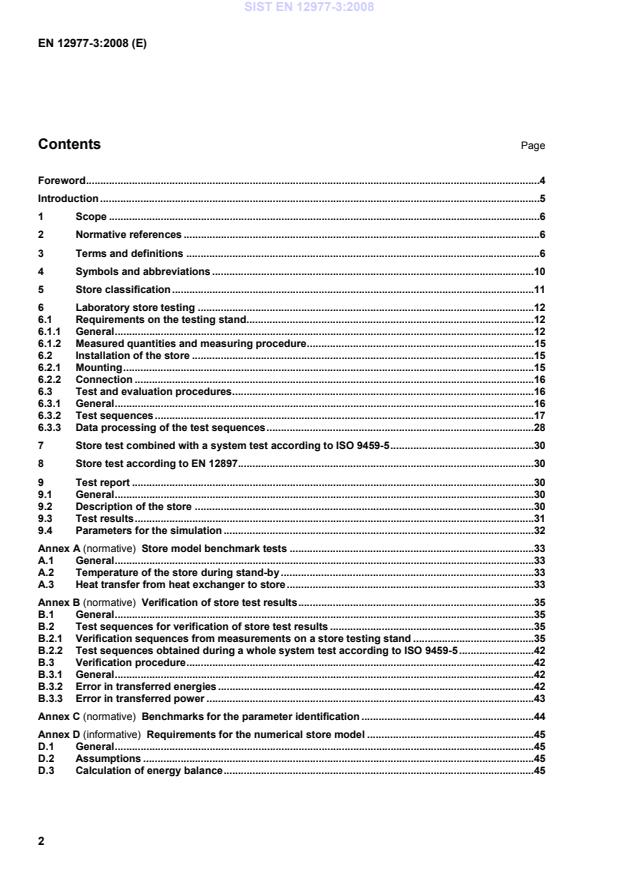
Store model benchmark tests.33 A.1 General.33 A.2 Temperature of the store during stand-by.33 A.3 Heat transfer from heat exchanger to store.33 Annex B (normative)
Verification of store test results.35 B.1 General.35 B.2 Test sequences for verification of store test results.35 B.2.1 Verification sequences from measurements on a store testing stand.35 B.2.2 Test sequences obtained during a whole system test according to ISO 9459-5.42 B.3 Verification procedure.42 B.3.1 General.42 B.3.2 Error in transferred energies.42 B.3.3 Error in transferred power.43 Annex C (normative)
Benchmarks for the parameter identification.44 Annex D (informative)
Requirements for the numerical store model.45 D.1 General.45 D.2 Assumptions.45 D.3 Calculation of energy balance.45 SIST EN 12977-3:2008
Determination of store parameters by means of “up-scaling” and
“down-scaling”.47 E.1 General.47 E.2 Requirements.47 E.3 Determination of store parameters.48 E.3.1 Thermal capacity of store.48 E.3.2 Height of store.48 E.3.3 Determination of heat loss capacity rate.48 E.3.4 Relative heights of the connections and the temperature sensors.48 E.3.5 Heat exchangers.48 E.3.6 Parameter describing the degradation of thermal stratification during stand-by.49 E.3.7 Parameter describing the quality of thermal stratification during direct discharge.49 Annex F (informative)
Determination of hot water comfort.50 Bibliography.51
prCEN/TS 12977-2: Test methods
EN 12977-3: Performance test methods for solar water heater stores
prCEN/TS 12977-4:
Performance test methods for solar combistores
prCEN/TS 12977-5:
Performance test methods for control equipment
NOTE The “prCEN/TS” standards are expected to become CEN/TS standards in the future. According to the CEN/CENELEC Internal Regulations, the national standards organizations of the following countries are bound to implement this European Standard: Austria, Belgium, Bulgaria, Cyprus, Czech Republic, Denmark, Estonia, Finland, France, Germany, Greece, Hungary, Iceland, Ireland, Italy, Latvia, Lithuania, Luxembourg, Malta, Netherlands, Norway, Poland, Portugal, Romania, Slovakia, Slovenia, Spain, Sweden, Switzerland and the United Kingdom. SIST EN 12977-3:2008
Introduction The test methods for stores of solar heating systems as described in this European Standard are required for the determination of the thermal performance of small custom built systems as specified in prCEN/TS 12977-1. The test method described in this European Standard delivers a complete set of parameters, which are needed for the simulation of the thermal behaviour of a store being part of a small custom built thermal solar system. For the determination of store parameters such as the thermal capacity and the heat loss rate the method standardised in EN 12897 can be used as an alternative. NOTE 1 The already existing test methods for stores of conventional heating systems are not sufficient with regard to thermal solar systems. This is due to the fact that the performance of thermal solar systems depends much more on the thermal behaviour of the store (e.g. stratification, heat losses), than conventional systems do. Hence this separate document for the performance characterisation of stores for solar heating systems is needed. NOTE 2 For additional information about the test methods for the performance characterisation of stores, see [1] in Bibliography.
1 Scope This European Standard specifies test methods for the performance characterization of stores which are intended for use in small custom built systems as specified in prCEN/TS 12977-1.
Stores tested according to this document are commonly used in solar hot water systems. However, also the thermal performance of all other thermal stores with water as storage medium can be assessed according to the test methods specified in this document. The document applies to stores with a nominal volume between 50 l and 3 000 l. This document does not apply to combistores. Performance test methods for solar combistores are specified in prCEN/TS 12977-4.
2 Normative references The following referenced documents are indispensable for the application of this document. For dated references, only the edition cited applies. For undated references, the latest edition of the referenced document (including any amendments) applies. EN 12828, Heating systems in buildings — Design for water-based heating systems EN 12897, Water supply – Specification for indirectly heated unvented (closed) storage water heaters EN ISO 9488:1999, Solar energy — Vocabulary (ISO 9488:1999) ISO 9459-5, Solar heating — Domestic water heating systems — Part 5: System performance characterization by means of whole-system tests and computer simulation 3 Terms and definitions For the purposes of this document, the terms and definitions given in EN ISO 9488:1999 and the following apply. 3.1 ambient temperature mean value of the temperature of the air surrounding the store 3.2 charge process of transferring energy into the store by means of a heat source 3.3 charge connection pipe connection used for charging the storage device 3.4 combistore one store used for both domestic hot water preparation and space heating SIST EN 12977-3:2008
3.6 constant flow rate, V~&
flow rate which is achieved when the mean value of V~& over the period of 0,5 “reduced charge/discharge volumes” (see 3.34) is within V~&± V~& • 0,1 NOTE The symbol ”~” above a certain value indicates that the corresponding value is a mean value.
3.7 constant charge power, c~P charge power which is achieved when the mean value c~P over the period of 0,5 reduced charge volumes is within
c~P ± c~P • 0,1 NOTE The symbol ”~” above a certain value indicates that the corresponding value is a mean value.
3.8 conditioning process of creating a uniform temperature inside the store by discharging the store with D,i~ϑ = 20 °C until a steady state is reached NOTE The conditioning at the beginning of a test sequence is intended to provide a well-defined initial system state, i. e. a uniform temperature in the entire store. 3.9 discharge connection pipe connection used for discharging the storage device 3.10 dead volume/dead capacity volume/capacity of the store which is only heated due to heat conduction (e.g. below a heat exchanger) 3.11 direct charge/discharge transfer or removal of thermal energy in or out of the store, by directly exchanging the fluid in the store 3.12 discharge process of decreasing thermal energy inside the store caused by the hot water load SIST EN 12977-3:2008
time integral of the measured power over one or more test sequences, excluding time periods used for conditioning at the beginning of the test sequences 3.25 measured power, Px,m power calculated from measured volume flow rate as well as measured inlet and outlet temperatures 3.26 mixed state when the local store temperature is not a function of the vertical store height 3.27 model parameter parameter used for quantification of a physical effect, if this physical effect is implemented in a mathematical model in a way which is not analogous to its appearance in reality, or if several physical effects are lumped in the model (e.g. a stratification number) 3.28 nominal flow rate, nV& nominal volume of the entire store divided by 1 h 3.29 nominal heating power, Pn nominal volume of the entire store multiplied by 10 W/l 3.30 nominal volume, Vn fluid volume of the store as specified by the manufacturer 3.31 operating heat loss capacity rate, (UA)op,s,a heat loss capacity rate of the store during charge or discharge 3.32 predicted energy, Qxp time integral of the predicted power over one or more test sequences, excluding time periods used for conditioning at the beginning of the test sequences 3.33 predicted power, Pxp power calculated from measured volume flow rate, as well as measured inlet temperature and calculated outlet temperature NOTE The outlet temperature is predicted by numerical simulation. 3.34 reduced charge/discharge volume integral of a charge/discharge flow rate divided by the store volume 3.35 stand-by state of operation in which no energy is deliberately transferred to or removed from the store SIST EN 12977-3:2008
Cs thermal capacity of the entire store, in J/K cp specific heat capacity, in J/(kg K) Pn nominal heating power, in W Px,m measured power transferred through the charge (x = C) or discharge (x = D) circuit, in W SIST EN 12977-3:2008
relative error in mean power transferred during charge (x = C) or discharge (x = D), in % εx,Q
relative error in energy transferred during charge (x = C) or discharge (x = D), in % ρ density, in kg/m³ 5 Store classification Hot water stores are classified by distinction between different charge and discharge modes. Five groups are defined as shown in Table 1. SIST EN 12977-3:2008
Table 1 — Classification of the stores Group Charge mode Discharge mode 1 direct direct 2 indirect direct 3 direct indirect 4 indirect indirect 5 stores that cannot be assigned to groups 1 to 4
NOTE 1 All stores may have one or more additional electrical heating elements. 6 Laboratory store testing 6.1 Requirements on the testing stand 6.1.1 General The hot water store shall be tested separately from the whole solar system on a store testing stand. The testing stand configuration shall be determined by the classification of hot water stores as described in Clause 5. An example of a representative hydraulic testing stand configuration is shown in Figure 1 and Figure 2.
The circuits are intended to simulate the charge and discharge loop of the solar system and to provide fluid flow with a constant or well controlled temperature. The full test stand consists of one charge and one discharge circuit. NOTE 1 If the store consists of more than one charge or discharge devices (e.g. two heat exchangers), then these are tested separately. The testing stand shall be located in an air-conditioned room where the room temperature of 20 °C should not vary more than ± 2 K during the test. Both circuits shall fulfil the following requirements: the flow rate shall be adjustable and stable within
±5 %; the working temperature range shall be between 10 °C and 90 °C; NOTE 2 A typical heating power of the charge circuit is in the range of 15 kW. the minimum cooling power in the discharge circuit shall be at least 25 kW at a fluid temperature of 20 °C; NOTE 3 A typical heating power of the discharge circuit is in the range of 25 kW. NOTE 4 If mains water at a constant pressure and a constant temperature below 20 °C is available, it is recommended to design the discharge circuit in a way, that it can be operated as closed loop or as open loop using mains water to discharge the store.
NOTE 5 The electrical power of the pump (P102) should be chosen in such a way that the temperature increase induced by the pump (P102) is either less than 0,6 K/h when the charge circuit is "short-circuited" and operated at room temperature (“short-circuited” means that no storage device is connected and SV102, V113, V115 and V116 are closed, see Figure 1) or an additional cooling device should be integrated in the circuit.
Key FF Flow meter HX Heat exchanger OP Overheating protection P Pump ST Store (belonging to test facility)
SV Solenoid valve TT Temperature sensor TIC Temperature indicator and controller V Valve Figure 1 — Charge circuit of the store testing stand The heating medium water in the charge circuit (see Figure 1) is pumped through the cooler (HX101) and the temperature controlled heaters (TIC106) by the pump (P101). A buffer tank (ST101) is used to balance the remaining control deviations. By means of the bypass (V107) the flow through the store can be controlled, it also ensures a continuously high flow through the heating section and therefore good control characteristics. With the solenoid valve (SV101) the heating medium can bypass the store to prepare a sudden increase of the inlet temperature into the store. The temperature sensors are placed near the inlet (TT101) and outlet (TT102) connections of the store; the connection to the store is established through insulated flexible pipes.
The charge circuit can be operated closed, under pressure (design pressure 2,5 bar, membrane pressure expansion tank and pressure relief valve (V109)) as well as open (valve (V108) open) with the tank (ST102) SIST EN 12977-3:2008
NOTE 7 See [2] and [3] in Bibliography for further information on the use of reference heaters. The heat transfer fluid used for testing may be water or a fluid recommended by the manufacturer. The specific heat capacity and density of the fluid used shall be known with an accuracy of 1 % within the range of the fluid temperatures occurring during the tests.
Key FF Flow meter HX Heat exchanger P Pump SV Solenoid valve
TT Temperature sensor TIC Temperature indicator and controller V Valve Figure 2 — Discharge circuit of the store testing stand SIST EN 12977-3:2008
NOTE Uncertainties in the difference in the charging and discharging medium temperature, between store inlet and store outlet close to 0,02 K can be achieved with modern well
matched and calibrated transducers. Hence it is possible to measure low temperature differences with small uncertainties. The relevant data shall be measured every 10 s at least and the measured data shall be recorded as mean values of at most three measured values. The temperature sensors shall have a relaxation time of less than 10 s (i.e. 90 % of the temperature variation is detected by the sensor immersed in the heat transfer fluid within 10 s after an abrupt step in the fluid temperature). Prior to each store test a zero measurement should be performed where the fluid in the charge or discharge circuit is pumped over the short-circuited charge or discharge circuit. “Short-circuited” means that flow pipe and return pipe of the corresponding circuits are directly connected (recommended volume flow approximately 0,6 m³/h, temperatures 20 °C, 40 °C, 60 °C, 80 °C). If the measured temperature difference exceeds the permissible uncertainty of 0,05 K, the temperature sensors shall be calibrated. A reference heater may also be used for the zero measurement. 6.2 Installation of the store 6.2.1 Mounting The store shall be mounted on the testing stand according to the manufacturer's instructions. SIST EN 12977-3:2008
The connections at the storage device, as delivered by the manufacturer, are considered as the thermal demarcation between the storage device and the testing stand.
The solenoid valves shall be placed as near as possible to the inlet and outlet connections of the storage device.
Connections of the store which do not lead to the charge or discharge circuit of the testing stand shall be closed, and not connected heat exchangers shall be filled up with water. All closed connections shall be insulated in the same way as the store. Since fluid in closed heat exchangers expands with increasing temperature, a pressure relief valve shall be mounted.
NOTE The performance of a solar heating system depends on the individual installation and actual boundary conditions. With regard to the heat losses of the store besides deficits in the thermal insulation, badly designed connections can increase the heat loss capacity rate of the store due to natural convection that occurs internally in the pipe. In order to avoid this effect the connections of the pipes should be designed in such a way that no natural convection inside the pipe occurs. This can be achieved e.g. if the pipe is directly going downwards after leaving the store or by using a siphon. 6.3 Test and evaluation procedures 6.3.1 General The aim of store testing as specified in this document is the determination of parameters required for the detailed description of the thermal behaviour of a hot water store. Therefore, a mathematical computer model for the store is necessary. The basic requirements for suitable models are specified in Annex A and Annex D. The following parameters shall be known for the simulation of a store being part of a thermal solar system: a) Stored water: 1) height; 2) effective volume respectively effective thermal capacity; 3) heights of the inlet and outlet connections; 4) heat loss capacity rate of the entire store; 5) if the insulation varies for different heights of the store, the distribution of the heat loss capacity rate should be determined for the different parts of the store; SIST EN 12977-3:2008
7) a parameter describing the characteristic of thermal stratification during direct discharge; NOTE 2 An additional parameter may be used to describe the influence of different draw-off flow rates on the thermal stratification inside the store, if this effect is relevant. 8) positions of the temperature sensors (e.g. the sensors of the collector loop and auxiliary heater control). b) Heat exchangers: 1) heights of the inlet and outlet connections; 2) volume; 3) heat transfer capacity rate as a function of temperature and mass flow rate (in case the mass flow rate is variable); 4) information on the capacity in respect of stratified charging; NOTE 3 The capacity in respect of stratified charging can be determined from the design of the heat exchanger as well as from the course in time of the heat exchanger inlet and outlet temperatures. 5) heat loss rate from the heat exchanger to the ambient (necessary only for mantled heat exchangers and external heat exchangers). c) Electrical auxiliary heat source: 1) position in the store;
2) axis direction of heating element (horizontal or vertical). If the auxiliary heater is installed in a vertical way, its length is also required;
3) efficiency that characterises the fraction of the electric power converted to thermal and transferred inside the store. NOTE 4 Badly designed electrical auxiliary heaters may cause significant heat losses during operation. In this case the electrical power supplied to the heater is not equal to the thermal energy input to the store. The following clauses describe how the listed parameters can be determined. Therefore, specific test sequences are necessary. The test sequences indicated by letters (e.g. TEST A) can be subdivided into phases indicated by a number (e.g. A1 – conditioning). Between the end of one phase and the start of the following phase, a maximum stand-by time of 10 min is allowed. During this stand-by time, only the ambient temperature shall be measured and recorded.
NOTE 5 One essential point of the described methods is that measurements inside the store are avoided.
NOTE 6 The determination of all the store parameters listed above is possible only according to the method described under 6.3.3. However, some of the parameters may also be determined according to the method described under 6.3.2. 6.3.2 Test sequences This Clause describes the thermal test sequences for the different groups of stores. SIST EN 12977-3:2008
group 1
group 2
group 3
group 4
6.3.2.2.1 6.3.2.2.2 6.3.2.2.3 6.3.2.2.4 Determination of the thermal stratification during discharge with a 'high' flow rate Test S
6.3.2.3 Determination of the stand-by heat loss capacity rate of the entire store Test L:
group 1
group 2
group 3
group 4
6.3.2.4.1 6.3.2.4.2 6.3.2.4.3 6.3.2.4.4 Determination of the heat transfer capacity rate and
the position of the auxiliary heat exchanger(s) Test NiA for stores with auxiliary heat exchanger(s) 6.3.2.5 Determination of the position(s) and length(s) of the electrical heating source(s) Test EiA for stores with electrical heating source(s) 6.3.2.6 Determination of the degradation of thermal stratification during stand-by Test NiA and Test NiB for stores of groups 1 and 3
Test NiA and Test NiB for stores of groups 2 and 4
Test EiA and Test EiB for stores with electrical auxiliary heating sources only 6.3.2.7.1
6.3.2.5 6.3.2.7.2 6.3.2.6 6.3.2.7.3
NOTE 1 The exact vertical positions of the upper connections of the heat exchangers above which the store is charged in a mixed way, have a minor influence on the thermal behaviour of the store. Hence these vertical positions do not need to be determined by means of parameter identification. It is recommended to measure the corresponding positions or to determine them from the drawing of the store. The following applies to all tests for determination of the heat transfer capacity rate of the heat exchangers: The flow rates through the heat exchangers as well as the heating powers which are given for the determination of the heat transfer capacity rate (dependent on temperature) of the heat exchangers are recommendations. Other flow rates and heating powers may also be used if they better correspond to the real operating conditions or are specified in the manufacturer's instructions. This shall, however, be specified in the test report. NOTE 2 The heat transfer capacity rate of immersed heat exchangers increases with the mean local temperature (the water becomes more dilute), the transmitted heating power and the flow rate through the heat exchanger. Therefore, different results for different operating conditions are expected.
The storage device shall be connected to the testing stand according to 6.2.
The connections which enable a complete discharge of the store shall be fitted to the discharge circuit of the testing stand. The connections which enable a complete charge of the store shall be fitted to the charge circuit of the testing stand. 6.3.2.2.1 Group 1 The goal of this test is the determination of the effective store volume and the thermal stratification during discharge with a relatively 'low' flow rate. Test C (group 1) Test phase C1: conditioning until steady-state is reached, test phase C2: charging until ϑC, = 55 °C, test phase C3: discharging until steady-state is reached. Table 4 — Flow rates and store inlet temperatures for Test C (group 1) Charge circuit Discharge circuit Test phase Process C~V& l/h C,i~ϑ °C oC,~ϑ °C D~V& l/h D,i~ϑ °C oD,~ϑ °C C1 conditioning 0 – – 0,5 × nV& 20,0 variable C2 charge 0,5 × nV& 60,0 variable 0 – – C3 discharge 0 – – 0,5 × nV& 20,0 variable
6.3.2.2.2 Group 2 The goal of this test is the determination of the effective store volume, the heat transfer capacity rate of the charge heat exchanger and the stratification during discharge with a relatively 'low' flow rate. SIST EN 12977-3:2008
Test C (group 2) Test phase C1: conditioning until steady-state is reached, test phase C2: charge with constant charge power of nC0,1~PP×= until ϑC,o = 60 °C, test phase C3: discharge until steady-state is reached. Table 5 — Flow rates and store inlet temperatures for Test C (group 2) Charge circuit Discharge circuit Test phase Process C~V& l/h C,i~ϑ °C oC,~ϑ °C D~V& l/h D,i~ϑ °C oD,~ϑ °C C1 conditioning 0 – – 0,5 × nV& 20,0 variable C2 charge 1,2 × nV& variable variable 0 – – C3 discharge 0 – – 0,5 × nV& 20,0 variable
6.3.2.2.3 Group 3 The goal of this test is the determination of the effective store volume and the heat transfer capacity rate of the discharge heat exchanger with a relatively 'low' flow rate. The thermal stratification during discharge can, of course, only be assessed if the store is discharged stratified. Test C (group 3) Test phase C1: conditioning until steady-state is reached, test phase C2: charge until ϑC,o = 55 °C, test phase C3: discharge until steady-state is reached. SIST EN 12977-3:2008
Table 6 — Flow rates and store inlet temperatures for Test C (group 3) Charge circuit Discharge circuit Test phase Process C~V& l/h C,i~ϑ °C oC,~ϑ °C D~V& l/h D,i~ϑ °C oD,~ϑ °C C1 conditioning 0 – – 0,5 × nV& 20,0 variable C2 charge 0,5 × nV& 60,0 variable 0 – – C3 discharge 0 – – 0,5 × nV& 20,0 variable
...