

EN 14012:2008
(Main)Postal services - Quality of service - Complaints handling principles
- Abstract
This European Standard specifies complaints handling principles related to domestic and international postal services. It applies to both national and cross border services. Attention is given to how to handle complaints in multiple operator situations. The standard also gives guidance for compensation and redress procedures.
This European Standard may be applied to all types of postal service both Universal service and non-universal service and by all types of postal organizations. It defines various types of complaints and establishes a methodology for handling complaints in order to improve the service given to postal users. It also gives guidance for complaints handling processes to be set up by postal service providers in order to improve quality of service.
This European Standard provides guidelines beyond the requirements given in ISO 10002 and ISO 9001 in order to consider both the effectiveness and efficiency of a complaint handling process, and consequently the potential for improvement of the performance of an organization. When compared to ISO 9001, the objectives of customer satisfaction and product quality are extended to include the satisfaction of interested parties and the performance of the organization.
This European Standard is applicable to the processes of the organization and consequently the quality management principles on which it is based can be deployed throughout the organization. The focus of this European Standard is the achievement of ongoing improvement, measured through the satisfaction of customers and other interested parties.
It should be noted that the number of complaints received might not be related to the level of service given. A large number of complaints may on the contrary reflect the effectiveness of the postal operator's complaint handling process.
This European Standard consists of guidance and recommendations and is neither intended for certification, regulatory or contractual use, nor as a guide to the imple
- Status
- Withdrawn
- Publication Date
- 25-Nov-2008
- Withdrawal Date
- 06-Oct-2026
- Technical Committee
- CEN/TC 331 - Postal services
- Drafting Committee
- CEN/TC 331/WG 1 - Quality of service
- Current Stage
- 9960 - Withdrawal effective - Withdrawal
- Start Date
- 18-Sep-2019
- Completion Date
- 07-Oct-2026
97/67/EC - Common rules for the development of the internal market of Community postal services and the improvement of quality of serviceOJ Ref: C, C 159 OJ Date: 13-May-2015


Relations
- Effective Date
- 22-Dec-2008
- Effective Date
- 25-Sep-2019
- Effective Date
- 25-Aug-2026
- Effective Date
- 28-Jan-2026
Get Certified
Connect with accredited certification bodies for this standard

Great Wall Tianjin Quality Assurance Center
Established 1993, first batch to receive national accreditation with IAF recognition.
Hong Kong Quality Assurance Agency (HKQAA)
Hong Kong's leading certification body.

Innovative Quality Certifications Pvt. Ltd. (IQCPL)
Known for integrity, providing ethical & impartial Assessment & Certification. CMMI Institute Partner.
Sponsored listings
Frequently Asked Questions
EN 14012:2008 is a standard published by the European Committee for Standardization (CEN). Its full title is "Postal services - Quality of service - Complaints handling principles". This standard covers: This European Standard specifies complaints handling principles related to domestic and international postal services. It applies to both national and cross border services. Attention is given to how to handle complaints in multiple operator situations. The standard also gives guidance for compensation and redress procedures. This European Standard may be applied to all types of postal service both Universal service and non-universal service and by all types of postal organizations. It defines various types of complaints and establishes a methodology for handling complaints in order to improve the service given to postal users. It also gives guidance for complaints handling processes to be set up by postal service providers in order to improve quality of service. This European Standard provides guidelines beyond the requirements given in ISO 10002 and ISO 9001 in order to consider both the effectiveness and efficiency of a complaint handling process, and consequently the potential for improvement of the performance of an organization. When compared to ISO 9001, the objectives of customer satisfaction and product quality are extended to include the satisfaction of interested parties and the performance of the organization. This European Standard is applicable to the processes of the organization and consequently the quality management principles on which it is based can be deployed throughout the organization. The focus of this European Standard is the achievement of ongoing improvement, measured through the satisfaction of customers and other interested parties. It should be noted that the number of complaints received might not be related to the level of service given. A large number of complaints may on the contrary reflect the effectiveness of the postal operator's complaint handling process. This European Standard consists of guidance and recommendations and is neither intended for certification, regulatory or contractual use, nor as a guide to the imple
This European Standard specifies complaints handling principles related to domestic and international postal services. It applies to both national and cross border services. Attention is given to how to handle complaints in multiple operator situations. The standard also gives guidance for compensation and redress procedures. This European Standard may be applied to all types of postal service both Universal service and non-universal service and by all types of postal organizations. It defines various types of complaints and establishes a methodology for handling complaints in order to improve the service given to postal users. It also gives guidance for complaints handling processes to be set up by postal service providers in order to improve quality of service. This European Standard provides guidelines beyond the requirements given in ISO 10002 and ISO 9001 in order to consider both the effectiveness and efficiency of a complaint handling process, and consequently the potential for improvement of the performance of an organization. When compared to ISO 9001, the objectives of customer satisfaction and product quality are extended to include the satisfaction of interested parties and the performance of the organization. This European Standard is applicable to the processes of the organization and consequently the quality management principles on which it is based can be deployed throughout the organization. The focus of this European Standard is the achievement of ongoing improvement, measured through the satisfaction of customers and other interested parties. It should be noted that the number of complaints received might not be related to the level of service given. A large number of complaints may on the contrary reflect the effectiveness of the postal operator's complaint handling process. This European Standard consists of guidance and recommendations and is neither intended for certification, regulatory or contractual use, nor as a guide to the imple
EN 14012:2008 is classified under the following ICS (International Classification for Standards) categories: 03.240 - Postal services. The ICS classification helps identify the subject area and facilitates finding related standards.
EN 14012:2008 has the following relationships with other standards: It is inter standard links to EN 14012:2003, EN 14012:2019, ISO 10002:2004, EN 16321-1:2013. Understanding these relationships helps ensure you are using the most current and applicable version of the standard.
EN 14012:2008 is associated with the following European legislation: EU Directives/Regulations: 2002/39/EC, 97/67/EC; Standardization Mandates: M/240, M/312. When a standard is cited in the Official Journal of the European Union, products manufactured in conformity with it benefit from a presumption of conformity with the essential requirements of the corresponding EU directive or regulation.
EN 14012:2008 is available in PDF format for immediate download after purchase. The document can be added to your cart and obtained through the secure checkout process. Digital delivery ensures instant access to the complete standard document.
Standards Content (Sample)
2003-01.Slovenski inštitut za standardizacijo. Razmnoževanje celote ali delov tega standarda ni dovoljeno.LPostalische Dienstleistungen - Dienstqualität - Grundsätze der Bearbeitung von BeschwerdenServices postaux - Qualité du service - Principes de traitement des réclamationsPostal services - Quality of service - Complaints handling principles03.240Poštne storitvePostal servicesICS:Ta slovenski standard je istoveten z:EN 14012:2008SIST EN 14012:2009en01-januar-2009SIST EN 14012:2009SLOVENSKI
STANDARDSIST EN 14012:20041DGRPHãþD
EUROPEAN STANDARDNORME EUROPÉENNEEUROPÄISCHE NORMEN 14012November 2008ICS 03.240Supersedes EN 14012:2003
English VersionPostal services - Quality of service - Complaints handlingprinciplesServices postaux - Qualité du service - Principes detraitement des réclamationsPostalische Dienstleistungen - Dienstqualität - Grundsätzeder Bearbeitung von BeschwerdenThis European Standard was approved by CEN on 25 October 2008.CEN members are bound to comply with the CEN/CENELEC Internal Regulations which stipulate the conditions for giving this EuropeanStandard the status of a national standard without any alteration. Up-to-date lists and bibliographical references concerning such nationalstandards may be obtained on application to the CEN Management Centre or to any CEN member.This European Standard exists in three official versions (English, French, German). A version in any other language made by translationunder the responsibility of a CEN member into its own language and notified to the CEN Management Centre has the same status as theofficial versions.CEN members are the national standards bodies of Austria, Belgium, Bulgaria, Cyprus, Czech Republic, Denmark, Estonia, Finland,France, Germany, Greece, Hungary, Iceland, Ireland, Italy, Latvia, Lithuania, Luxembourg, Malta, Netherlands, Norway, Poland, Portugal,Romania, Slovakia, Slovenia, Spain, Sweden, Switzerland and United Kingdom.EUROPEAN COMMITTEE FOR STANDARDIZATIONCOMITÉ EUROPÉEN DE NORMALISATIONEUROPÄISCHES KOMITEE FÜR NORMUNGManagement Centre: rue de Stassart, 36
B-1050 Brussels© 2008 CENAll rights of exploitation in any form and by any means reservedworldwide for CEN national Members.Ref. No. EN 14012:2008: ESIST EN 14012:2009
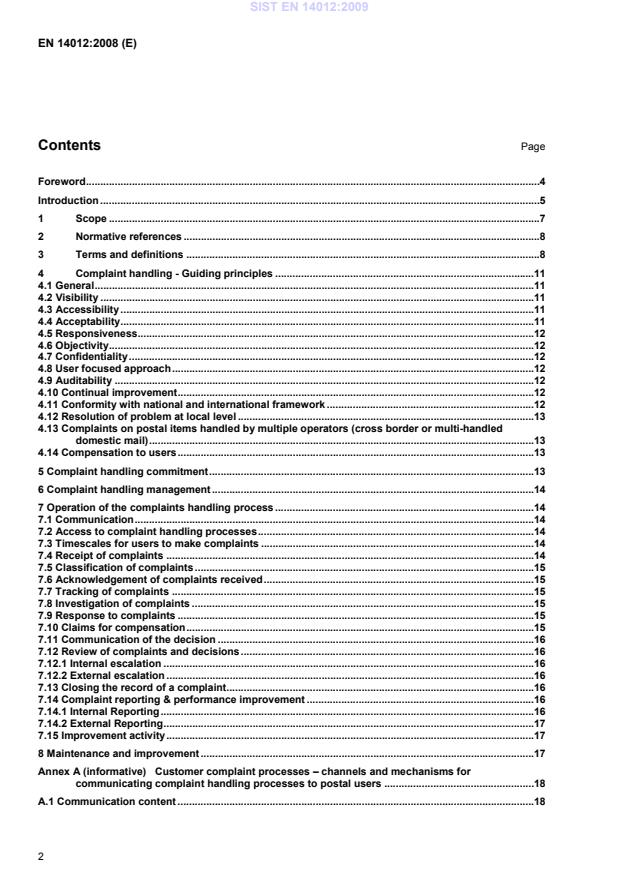
2 Contents Page Foreword.4 Introduction.5 1 Scope.7 2 Normative references.8 3 Terms and definitions.8 4 Complaint handling - Guiding principles.11 4.1 General.11 4.2 Visibility.11 4.3 Accessibility.11 4.4 Acceptability.11 4.5 Responsiveness.12 4.6 Objectivity.12 4.7 Confidentiality.12 4.8 User focused approach.12 4.9 Auditability.12 4.10 Continual improvement.12 4.11 Conformity with national and international framework.12 4.12 Resolution of problem at local level.13 4.13 Complaints on postal items handled by multiple operators (cross border or multi-handled domestic mail).13 4.14 Compensation to users.13 5 Complaint handling commitment.13 6 Complaint handling management.14 7 Operation of the complaints handling process.14 7.1 Communication.14 7.2 Access to complaint handling processes.14 7.3 Timescales for users to make complaints.14 7.4 Receipt of complaints.14 7.5 Classification of complaints.15 7.6 Acknowledgement of complaints received.15 7.7 Tracking of complaints.15 7.8 Investigation of complaints.15 7.9 Response to complaints.15 7.10 Claims for compensation.15 7.11 Communication of the decision.16 7.12 Review of complaints and decisions.16 7.12.1 Internal escalation.16 7.12.2 External escalation.16 7.13 Closing the record of a complaint.16 7.14 Complaint reporting & performance improvement.16 7.14.1 Internal Reporting.16 7.14.2 External Reporting.17 7.15 Improvement activity.17 8 Maintenance and improvement.17 Annex A (informative)
Customer complaint processes – channels and mechanisms for communicating complaint handling processes to postal users.18 A.1 Communication content.18 SIST EN 14012:2009
Complaint channels.19 B.1 List of complaint channels involved.19 B.2 Channel operation.19 B.2.1 General.19 B.2.2 Telephone complaints.19 B.2.3 Complaints made in writing.19 B.2.4 E-mail complaints.20 B.2.5 Complaints made in person.20 B.2.6 Other facilities.20 Annex C (informative)
Capturing user information on complaints.21 Annex D (informative)
Complaint categorisation and classification.23 D.1 Introduction.23 D.2 Complaint justification.23 D.3 Complaint ownership.23 D.4 Complaint categories.24 D.5 Reasons for complaint.24 Annex E (informative)
Responses.25 E.1 Content of responses – suggested sequence.25 E.2 Issues to be considered can include.25 E.3 Timescales for responses.25 Annex F (informative)
Complaint reporting.26 F.1 General.26 F.2 Timescales for reporting.26 F.3 Report content.26 F.4 Extra monitoring data.27 Annex G (normative)
Performance improvement activity.29 G.1 General.29 G.2 Assessing the organization is able to deal with the information of the complaint handling process.29 G.2.1 Organization of complaint information dissemination:.29 G.2.2 Examples of complaint analysis contribution to performance improvement:.29 G.3 Assessing how the complaint handling process drives continual improvement.29 Annex H (informative)
Continual improvement.31 H.1 Continual improvement of the complaint handling process.31 H.2 Continual improvement of products and services.31 Annex I (informative)
Transferring from 1st edition of the EN 14012 to this 2nd edition of the EN 14012.32 I.1 General.32 I.2 Classification of complaints.32 I.2.1 Classification process.32 I.2.2 Categories of complaints.33 I.2.3 Complaints about lost items.34 I.2.4 Maximum handling time.34 I.3 Measurement of complaints.35 I.3.1 Records.35 I.3.2 Statistical indicators.35 I.3.3 Reporting statistics about complaints.36 I.4 Report on statistical indicators.37 I.4.1 General.37 I.4.2 Permanent statistical indicators.38 Bibliography.46
4 Foreword This document (EN 14012:2008) has been prepared by Technical Committee CEN/TC
“331”, the secretariat of which is held by NEN. This European Standard shall be given the status of a national standard, either by publication of an identical text or by endorsement, at the latest by May 2009, and conflicting national standards shall be withdrawn at the latest by May 2009. This document supersedes EN 14012:2003. Attention is drawn to the possibility that some of the elements of this document may be the subject of patent rights. CEN [and/or CENELEC] shall not be held responsible for identifying any or all such patent rights. The content has been extensively revised to reflect: an increased requirement for postal operators and organizations to demonstrate a stronger focus on providing a quality mail and associated complaint handling experience to postal users; limiting the number of measuring parameters; and
stronger alignment with ISO 10002 adhering to the measuring method described in the first edition of EN 14012 means that also the measuring requirements of this revised 2nd edition of EN 14012 are met. Annex F contains general information regarding measuring and reporting of complaints based on the criteria described in the first edition of EN 14012 and included in Annex I. However this revised second edition of EN 14012 contains more requirements on improvements and corrective actions According to the CEN/CENELEC Internal Regulations, the national standards organizations of the following countries are bound to implement this European Standard: Austria, Belgium, Bulgaria, Cyprus, Czech Republic, Denmark, Estonia, Finland, France, Germany, Greece, Hungary, Iceland, Ireland, Italy, Latvia, Lithuania, Luxembourg, Malta, Netherlands, Norway, Poland, Portugal, Romania, Slovakia, Slovenia, Spain, Sweden, Switzerland and the United Kingdom. SIST EN 14012:2009
The service provider can use complaints in its continuous quality improvement of the postal service. The level of complaints and the reasons for complaints provide important information about the satisfaction of users with different aspects of the postal service. There needs to be commitment to effective complaints handling at all levels within the postal organization. An investigation carried out by the European postal regulators CERP in 2004 showed that the costs for fully implementing the first edition of EN 14012:2003 were likely to be too high, even for postal service organizations with existing established and sophisticated complaint management & measurement/ reporting systems. This prompted CEN/TC 331 to start a revision of the European Standard in 2005, incorporating annexes about guidance for its use. This Second version of EN 14012 does not force those who already are using EN 14012:2003 to change their measurement systems to comply with the European Standard, but gives an opportunity to measure less extensively. This second version is also aligned with ISO 10002 on Complaints handling and thus places more emphasis on the need for overall quality improvements within the postal organizations. Regulatory aspects, information about business sensitive information and special requirements for Universal services have deliberately been left out of this European Standard. The reasons are that it is up to the regulatory and governmental bodies, as well as in contracts between business partners, to refer to business agreements and this European Standard, and to state which part has to be followed and for which service. National regulators may have more specific requirements than those given in this European Standard. In this second edition of EN 14012, the general structure of ISO 10002 is followed. For general complaints handling rules that are not postal specific, references are made to the latest version of ISO 10002, which may be revised independently of EN 14012. The intention of the modified EN 14012 is to provide guidance on how to set up a complaints handling system for postal service operators that can deliver positive solutions for postal users who complain and provide sufficient information about quality of service related to complaints. Postal specific issues which need to be taken into account are:- many postal organization employees are in frequent contact with postal users during the delivery of their core job and may be able to deal with complaints on the spot. Most of this contact is not recognised as complaint handling contact and is therefore not formally recorded. (For example, a postman conducting regular collection and delivery activity); SIST EN 14012:2009
6 cross border mail may generate cross border complaints where it may be difficult to establish which postal operator is responsible; postal operations involving multiple operators carrying an item of mail will result in complaints being made to organizations that may or may not be the responsibility of that organization; person who complains may not be the person who has paid for the service; for example, a recipient of a mail item complaining about an incorrect delivery procedure; postal business in Europe is regulated by European and national regulatory law. This regulatory law focuses primarily on the Universal Postal Service (which differs from Member State to Member State)
Attention is given to how to handle complaints in multiple operator situations. The standard also gives guidance for compensation and redress procedures.
This European Standard may be applied to all types of postal service both Universal service and non-universal service and by all types of postal organizations. It defines various types of complaints and establishes a methodology for handling complaints in order to improve the service given to postal users. It also gives guidance for complaints handling processes to be set up by postal service providers in order to improve quality of service. This European Standard provides guidelines beyond the requirements given in ISO 10002 and ISO 9001 in order to consider both the effectiveness and efficiency of a complaint handling process, and consequently the potential for improvement of the performance of an organization. When compared to ISO 9001, the objectives of customer satisfaction and product quality are extended to include the satisfaction of interested parties and the performance of the organization. This European Standard is applicable to the processes of the organization and consequently the quality management principles on which it is based can be deployed throughout the organization. The focus of this European Standard is the achievement of ongoing improvement, measured through the satisfaction of customers and other interested parties. It should be noted that the number of complaints received might not be related to the level of service given. A large number of complaints may on the contrary reflect the effectiveness of the postal operator's complaint handling process.
This European Standard consists of guidance and recommendations and is neither intended for certification, regulatory or contractual use, nor as a guide to the implementation of ISO 9001. In Annex I the relationship with the second edition of this European Standard is explained.
"access to customer service information" complaint complaint about the information provided by the service provider on the specifications of its products and services NOTE 1 Examples would be complaints about availability of information on product specifications and prices, about incorrect information and advice, or about information on complaints procedures. NOTE 2 Complaints about information provided by a contractor or franchisee of the service provider would be included in this category. 3.2 "access to postal services" complaint complaint about how and when postal services are available NOTE 1 Examples would be complaints about opening hours at post offices, about queues at post offices, about cleanliness of post offices, or about access for disabled and handicapped people. NOTE 2 Complaints about access points for postal services provided by the service provider through franchised operations are also included in the access to postal services category of complaints. 3.3
"behaviour and competence of postal employees" complaint complaint regarding the behaviour of individual postal employees and the way individual employees operate postal procedures NOTE 1 Examples would be complaints about rudeness or behaviour of employees which is inconsiderate of users of the postal service. NOTE 2 Complaints about mistakes resulting in loss of, damage to or delay to postal items or causing delivery problems is not included in this complaints category. 3.4
cause of complaint originating event leading to a complaint NOTE E.g. specific explanation for a service failure or customer perception of failure, generating a complaint. 3.5
compensation redress given to a complainant by a service provider
NOTE Compensation rules are generally specified in the terms of business.
complaint expression of dissatisfaction made to an organization, related to the perceived failure of its products, services or policies, or the complaints-handling process itself, where a response or resolution is explicitly or implicitly expected NOTE Organizations may have a more detailed definition of what comprises a complaint in their respective complaint handling approaches. 3.8 complaints handling process
process starting at the receipt of a complaint through a series of actions resulting in a final response or any necessary escalation
3.9 "complaint handling" complaint complaint expressing dissatisfaction about the way in which a previous complaint has been treated NOTE Reasons for dissatisfaction could include the time taken to handle the complaint or the response received from the service provider. 3.10 cross border mail mail distributed from one country to another country
[EN 14534:2007] 3.11
customer natural or legal person having a business relationship with a postal operator
NOTE A consumer who purchases postal services is a customer.
cf. User
3.12
customer service interaction of the organization with the user throughout the life cycle of a product or service
3.13
feedback opinions, comments and expressions of interest in the products or services or the complaints handling process 3.14 final response communication by means of which the service provider informs a complainant of the results of any investigation caused by a complaint, and whether the complaint is considered to be justified or not NOTE 1 A continued dialogue between the service provider and an unsatisfied customer, after the complainant has been informed about the results of the investigation in the final response, is considered a new complaint about complaint handling. NOTE 2 Even if the complainant is still not satisfied with the content of the final response, the specific complaint is solved by the final response.
general complaint complaint that is based on a question of opinion or dissatisfaction in general with the service the postal operator provides without reference to a perceived specific service or product failure NOTE 1 General Complaints are neither related to a specific item or items nor to a specific customer or postal service user. NOTE 2 The process for handling general complaints may differ from the process for specific complaints. cf. specific complaint 3.16
item damaged complaint complaint regarding damage to the contents or envelope or wrapping of a postal item 3.17
"item lost or substantially delayed" complaint complaint regarding a postal item not received, in whole or in part, by the recipient within a specified period of time NOTE Each postal operator may define a specific ‘loss’ time depending on the product or service used. 3.18
justified complaint complaint regarding a subject for which the service provider, after investigation if necessary, recognises that it
may not have fulfilled its obligations in whole or in part NOTE Examples of the obligations of the service provider are its general terms of business and its regulatory and legal requirements. 3.19
"mail delivery" complaint complaint about when, where or how postal items have been delivered at the delivery address 3.20
"misdelivery" complaint complaint about postal item delivered to the wrong address or the wrong addressee (if appropriate) 3.21 multiple operator(s) carriage of mail that involves more than one operator from its introduction into the postal process to its delivery 3.22
"redirection" complaint
complaint about incorrect treatment of postal items that are affected by a permanent or temporary change of address NOTE 1 An example of what would warrant a change of address complaint would be failure to redirect letters to a person’s new address when the service provider has undertaken to do so. NOTE 2 Complaints about temporary changes of address, for example during the summer vacation. 3.23 specific complaint complaint based on a question of fact related to a specific customer or postal service user, and a specific instance or a specific postal item or items SIST EN 14012:2009
NOTE 1 A sender or recipient of a postal item is a user. NOTE 2 The concept of user is wider than customer. cf. customer
4 Complaint handling - Guiding principles 4.1 General The overall reason to effectively manage, register and categorise complaints is to easily find information about opportunities for improvement of the quality of products, services and processes. When choosing activities for continual improvement, the organization should identify which causes of complaints that are the most important to start to deal with. The total volume of complaints and the reasons for those complaints should not be taken as the sole measure of an organization’s performance. Many organizations positively generate complaints from users, even in times of high service performance, to further drive service improvement. Comparing total complaint volumes can be misleading. Complaint volumes should also be reviewed against other factors, such as total volume of postal items. Adherence to the guiding principles set out in 4.2 to 4.14 is recommended for delivering an effective complaint handling process. 4.2 Visibility Information about how and where to complain about postal services should be well publicized to postal users. 4.3 Accessibility
A complaints handling process should be easily accessible to all complainants and through a variety of complaint access channels, so that no complainant would be disadvantaged. Information should be made available on the details of making and resolving complaints. The complaints handling process and supporting information should be easy to understand and use.
Wherever possible, accessibility to the complaints handling process should be free of specific charge. There shall be at least one free of specific charge access channel available to users who wish to contact an organization to make a complaint. 4.4 Acceptability A complaint can be accepted from the sender or the addressee of a postal item or service.
Complaints related to the postal service provision can also be accepted from third parties, authorised to act on behalf of senders or recipients.
4.6 Objectivity Each complaint should be dealt with in an equitable, objective and unbiased manner through the complaints handling process and according to the standard complaint handling procedures in place.
4.7 Confidentiality Personally identifiable information concerning the complainant should be available where needed, but only for the purposes of addressing the complaint within the organization, and should be actively protected from disclosure to any other source (either internally or externally) unless the complainant expressly consents or requests for specific details to be disclosed. 4.8 User focused approach The first goal of complaint handling is the complainant satisfaction and the recovering of confidence in the postal service to engender long-term loyalty to the postal organization involved. Postal organizations should take account of users’ needs and expectations when designing and deploying complaint handling processes. Complaint handling systems should be open to user feedback, and should show commitment to helping the postal organization to resolve the root causes of complaints and to avoid them re-occurring. 4.9 Auditability Postal organizations should have documented procedures regarding complaint handling. These procedures should be auditable, as and when required. 4.10 Continual improvement The continual improvement of the overall quality of service is an objective of the complaint handling system, and using the information from the complaint handling process to improve the overall quality of service should be a permanent objective of any postal organization.
Complaint handling processes should allow analysis of complaint causes.
Postal organizations’ complaint handling systems should be flexible to allow modifications, in order to take into account changing technology, dynamic market conditions and changing user needs and expectations. 4.11 Conformity with national and international framework Organizational or national rules for complaints handling may be more detailed than the procedures outlined in this European Standard. Postal service organizations’ complaint handling processes should be developed and deployed according to any existing national law. SIST EN 14012:2009
Complaints that obviously do not refer to the postal operator that receives the complaint should not be accepted or counted in that organization complaint data. In these cases, the complainant should be informed about appropriate referral channels (the postal operator who is responsible for the specific complaint or the sender of an item if the complainant is the recipient or third party). 4.14 Compensation to users Users are entitled to make claims for compensation if they perceive that the postal organization has not met the product or service specification contained within the organization’s general terms of business. The general terms of business should specify how, when and what level of compensation could be expected to be paid. 5 Complaint handling commitment Postal organizations should be committed to effective and efficient complaints handling and the analysis of complaints should contribute to the improvement of the organization’s products, services and processes. It is particularly important that this is positively accepted and promoted by the postal organization’s top management.
This commitment should be reflected in the definition, adoption and dissemination of policy and procedures for the resolution of complaints. The policy should be made available to users and other interested parties. Management commitment should be shown by the provision of adequate resources, including training, and by
continually following up and analysing the complaint figures and how these have led to the continual improvement of services, products and processes. All personnel in contact with complainants should treat the complainant in a courteous manner and promptly respond to their complaints, or direct them to the appropriate individual or service in the organization that is able to respond to the complaint. All personnel should also: be aware of their roles, responsibilities and authorities in respect of complaints, be aware of what procedures to follow and what information to give to complainants. All employees of the organization should be informed of the organization’s complaint handling procedures and be able to effectively direct the complainant towards the relevant complaint handling channels.
Postal organizations should also take into account (and deploy where possible) good practices of other organizations with regard to complaints handling. The complaints handling process should be linked to and aligned with other processes of the quality management strategy of the organization. 7 Operation of the complaints handling process 7.1 Communication Information concerning ‘how and when to make a complaint’ should be made available to users.
The information should be in clear language. Information and assistance in making a complaint should be provided in whatever language the services were offered in, including alternative formats, such as large print, Braille or audio. No complainant should be disadvantaged when wishing to make a complaint. Annex A contains recommendations on how users can access information on the organization’s complaint handling processes, plus suggested information to be communicated to users. 7.2 Access to complaint handling processes It is important that users can actually make complaints through a range of appropriate access channels. Postal organizations should not make it difficult for any user to complain to the organization.
Mobile postmen, even if they are in contact with customers, may not be required to receipt and register complaints but they should inform customers on how to make a complaint and direct them to appropriate channels. Annex B outlines recommended channels of access for users who wish to complain to a postal organization, plus recommendations on how the channels could work in practice. 7.3 Timescales for users to make complaints The postal organization should define, and communicate to users, a maximum time limit for complaints to be made about postal products or services. Complaints made to postal organizations shall be accepted between maximum and minimum time limits for complaints as appropriate for the different kinds of products or services.
The timescales for users to make complaints may vary depending on the type of complaint the user wishes to make. Different product or service failures will generate different maximum time limits for users to make complaints.
These timescales should be made clear in the information about how to make a complaint, NOTE When setting timescales, other national and international regulations such as UPU regulations should be considered where appropriate. 7.4 Receipt of complaints Upon receipt of a specific complaint it should be recorded with the necessary supporting information and a unique identifier.
Complaint handling personnel should ask the complainant about all facts relevant to the complaint.
Annex C provides suggested complaint details that organizations should collect upon receipt of a complaint.
7.5 Classification of complaints There are many different types of complaints that are received by postal organizations. As well as logging the complaint details, it also should be classified by its cause i.e. the type of problem the complainant is complaining about. Complaints can be received on a single mail item or service failure or be a general dissatisfaction and could generate multiple complaints, which may or may not have the same cause. Once a complaint has been accepted, postal organizations should ensure that the type(s) and cause(s) of each complaint can be recorded in a way allowing for later analysis and input to continuous improvement of the quality of products, services and processes. Annex D contains suggested categorisation and classification of types and causes of complaint. 7.6 Acknowledgement of complaints received Receipt of each complaint should be acknowledged to the complainant in all cases where further enquiry or research is necessary; if possible in the same format the complaint has been made. Acknowledgement should be done as soon as possible but
...