Durability of wood and wood-based products - Natural durability of solid wood - Part 2: Guide to natural durability and treatability of selected wood species of importance in Europe

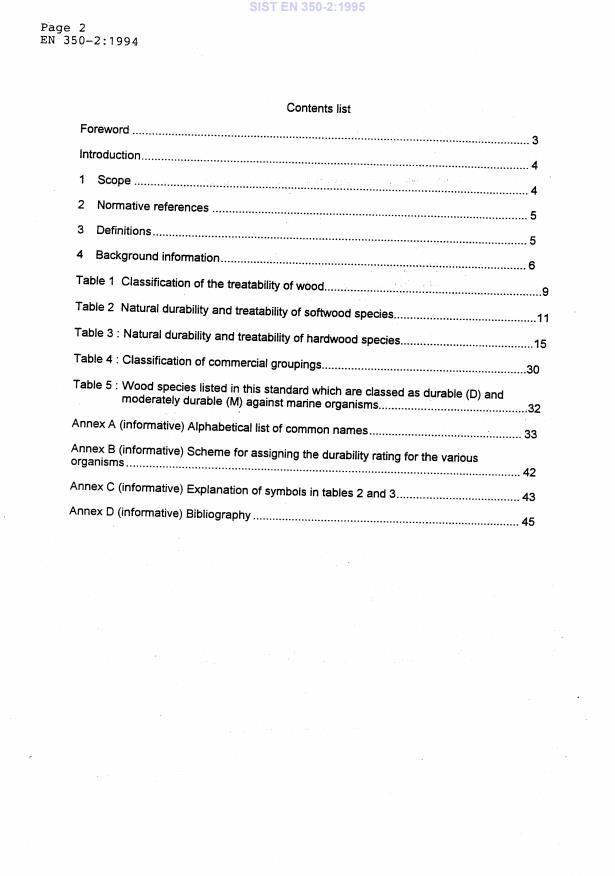
This part of EN 350 lists the natural durability of solid wood for selected wood species, considered of importance to the countries within Europe for constructional purposes.  It lists their relative durability to - wood- destroying fungi - dry wood destroying beetles - termites - marine organisms It also gives information relating to their treatability, origin, density, and sapwood width.

Dauerhaftigkeit von Holz und Holzprodukten - Natürliche Dauerhaftigkeit von Vollholz - Teil 2: Leitfaden für die natürliche Dauerhaftigkeit und Tränkbarkeit von ausgewählten Holzarten von besonderer Bedeutung in Europa

Dieser Teil von EN 350 führt die natürliche Dauerhaftigkeit von ausgewählten Holzarten auf, die in den europäischen Ländern als wichtig für Konstruktionßwecke angesehen werden. Ferner werden Informationen über ihre Tränkbarkeit, Herkunft und Dichte aufgeführt. Es gibt die relative Dauerhaftigkeit gegen - holzzerstörende Pilze - Trockenholz zerstörende Käfer - Termiten - Holzschädlinge im Meerwasser an und enthält auch Angaben über ihre Tränkbarkeit, Herkunft, Dichte und Splintholzbreite.

Durabilité du bois et des matériaux dérivés du bois - Durabilité naturelle du bois massif - Partie 2: Guide de la durabilité naturelle du bois et de l'imprégnabilité d'essences de bois choisies pour leur importance en Europe

La présente partie de l'EN 350 donne la liste des durabilités naturelles du bois massif parmi un choix d'essences de bois jugées importantes pour la construction dans les pays d'Europe.  Elle liste leurs durabilités relatives vis-à-vis: - des champignons lignivores, - des coléoptères xylophages de bois sec, - des termites, - des térébrants marins, et donne aussi des informations sur leur imprégnabilité, leur origine, leur masse volumique et leur largeur d'aubier.

Trajnost lesa in lesnih izdelkov - Naravna trajnost masivnega lesa - 2. del: Naravna trajnost in možnost impregnacije izbranih, v Evropi pomembnih vrst lesa

General Information

Status
Withdrawn
Publication Date
18-May-1994
Withdrawal Date
13-Apr-2025
Current Stage
9960 - Withdrawal effective - Withdrawal
Start Date
17-Aug-2016
Completion Date
14-Apr-2025

Relations

Effective Date
08-Jun-2022

Frequently Asked Questions

EN 350-2:1994 is a standard published by the European Committee for Standardization (CEN). Its full title is "Durability of wood and wood-based products - Natural durability of solid wood - Part 2: Guide to natural durability and treatability of selected wood species of importance in Europe". This standard covers: This part of EN 350 lists the natural durability of solid wood for selected wood species, considered of importance to the countries within Europe for constructional purposes. It lists their relative durability to - wood- destroying fungi - dry wood destroying beetles - termites - marine organisms It also gives information relating to their treatability, origin, density, and sapwood width.

This part of EN 350 lists the natural durability of solid wood for selected wood species, considered of importance to the countries within Europe for constructional purposes. It lists their relative durability to - wood- destroying fungi - dry wood destroying beetles - termites - marine organisms It also gives information relating to their treatability, origin, density, and sapwood width.

EN 350-2:1994 is classified under the following ICS (International Classification for Standards) categories: 71.100.50 - Wood-protecting chemicals; 79.040 - Wood, sawlogs and sawn timber. The ICS classification helps identify the subject area and facilitates finding related standards.

EN 350-2:1994 has the following relationships with other standards: It is inter standard links to EN 350:2016. Understanding these relationships helps ensure you are using the most current and applicable version of the standard.

EN 350-2:1994 is associated with the following European legislation: EU Directives/Regulations: 305/2011, 89/106/EEC; Standardization Mandates: M/112. When a standard is cited in the Official Journal of the European Union, products manufactured in conformity with it benefit from a presumption of conformity with the essential requirements of the corresponding EU directive or regulation.

You can purchase EN 350-2:1994 directly from iTeh Standards. The document is available in PDF format and is delivered instantly after payment. Add the standard to your cart and complete the secure checkout process. iTeh Standards is an authorized distributor of CEN standards.

Standards Content (Sample)


2003-01.Slovenski inštitut za standardizacijo. Razmnoževanje celote ali delov tega standarda ni dovoljeno.Trajnost lesa in lesnih izdelkov - Naravna trajnost masivnega lesa - 2. del: Naravna trajnost in možnost impregnacije izbranih, v Evropi pomembnih vrst lesaDauerhaftigkeit von Holz und Holzprodukten - Natürliche Dauerhaftigkeit von Vollholz - Teil 2: Leitfaden für die natürliche Dauerhaftigkeit und Tränkbarkeit von ausgewählten Holzarten von besonderer Bedeutung in EuropaDurabilité du bois et des matériaux dérivés du bois - Durabilité naturelle du bois massif - Partie 2: Guide de la durabilité naturelle du bois et de l'imprégnabilité d'essences de bois choisies pour leur importance en EuropeDurability of wood and wood-based products - Natural durability of solid wood - Part 2: Guide to natural durability and treatability of selected wood species of importance in Europe79.040Les, hlodovina in žagan lesWood, sawlogs and sawn timber71.100.50Wood-protecting chemicalsICS:Ta slovenski standard je istoveten z:EN
...

Questions, Comments and Discussion

Ask us and Technical Secretary will try to provide an answer. You can facilitate discussion about the standard in here.

Loading comments...

Die Norm EN 350-2:1994 bietet einen umfassenden Leitfaden zur natürlichen Dauerhaftigkeit von Massivholz und eignet sich hervorragend für Fachleute in der Bauindustrie sowie für Anlagen zur Holzverarbeitung. Der Umfang dieser Norm ist auf die natürliche Dauerhaftigkeit und Behandelbarkeit ausgewählter Holzarten, die in Europa von Bedeutung sind, fokussiert. Ein wesentlicher Stärke der Norm ist die detaillierte Auflistung der natürlichen Dauerhaftigkeit von Massivholz gegenüber verschiedenen Bedrohungen durch Holz schädigende Organismen, einschließlich Holz zerstörender Pilze, trockene Holz schädigende Käfer, Termiten und marine Organismen. Diese Informationen sind von entscheidender Bedeutung für die Sicherstellung der Langlebigkeit und Sicherheit von Baukonstruktionen in verschiedenen Umweltbedingungen. Zudem bietet die EN 350-2 wertvolle Informationen über die Behandelbarkeit der Holzarten sowie deren Herkunft, Dichte und die Breite des Kern- und Splintholzes. Diese Aspekte spielen eine entscheidende Rolle bei der Auswahl der richtigen Holzart für spezifische Anwendungen und tragen zur allgemeinen Qualitätssicherung im Bauwesen bei. Die Relevanz dieser Norm ist nicht zu unterschätzen, insbesondere in Bezug auf die nachhaltige Nutzung von Holzressourcen in Europa und den Schutz gegen biologische Schäden. Insgesamt stellt die Norm EN 350-2 eine unverzichtbare Ressource dar, die sowohl theoretische als auch praktische Einsichten in die natürliche Dauerhaftigkeit von Holz bietet und somit für alle Beteiligten im Bereich Holzbau von großem Wert ist.

표준 EN 350-2:1994는 유럽에서 중요한 건축 자재로 고려되는 특정 목재 종의 자연적 내구성에 대한 포괄적인 지침을 제공합니다. 이 문서는 목재와 목재 기반 제품의 내구성에 대한 중요한 정보를 제공합니다. 표준의 범위는 목재 파괴 곰팡이, 건조 목재를 파괴하는 딱정벌레, 흰개미 및 해양 생물에 대한 상대적인 내구성을 나열하며, 이는 건축 분야에서 필수적인 요소입니다. EN 350-2의 강점은 다양한 목재 종의 자연적 내구성을 체계적으로 정리하여, 각 종의 처리 가능성, 원산지, 밀도 및 수목의 폭에 대한 정보를 제공합니다. 이러한 정보는 건축 자재의 선택과 관리에 있어 매우 중요하며, 사용자가 지역에 적합한 목재를 선택하는 데 도움을 줍니다. 이 표준은 유럽 각국에서의 건축 및 설계 시 지속가능성을 고려한 목재 사용의 중요성을 강조하며, 자연 내구성 및 처리 가능성 지침을 통해 목재의 수명을 극대화할 수 있는 전략을 제공합니다. 결과적으로, EN 350-2:1994는 목재와 목재 기반 제품의 사용에 있어 신뢰할 수 있는 기준을 제공하여, 건축 업계의 품질 보증에 중대한 기여를 하고 있습니다.

La norme EN 350-2:1994 traite de la durabilité naturelle des bois massifs et fournit un guide essentiel sur la durabilité naturelle et la traitabilité de certaines espèces de bois jugées importantes pour les constructions en Europe. Son champ d'application est crucial, car il répond aux besoins des pays européens en matière de sélection de matériaux en bois, en s'assurant de leur durabilité face à divers organismes nuisibles, tels que les champignons destructeurs du bois, les insectes xylophages, les termites et les organismes marins. L'une des forces majeures de cette norme est sa capacité à fournir des informations détaillées sur la durabilité relative des différentes essences de bois. En effet, la norme classe ces espèces en fonction de leur résistance aux menaces biologiques, ce qui est d'une grande valeur pour les ingénieurs et les architectes qui cherchent à sélectionner des matériaux adaptés pour des projets de construction durables et résilients. De plus, le document aborde également la traitabilité des espèces sélectionnées. Cela permet aux professionnels du bois de prendre des décisions éclairées sur le traitement des matériaux pour renforcer leur durabilité. Des informations supplémentaires sont aussi fournies sur l'origine des bois, leur densité, et la largeur du bois de cœur, ce qui enrichit considérablement le contenu de la norme. En somme, la norme EN 350-2:1994 est un document référentiel incontournable pour quiconque travaille avec des produits en bois en Europe, en assurant que les choix faits en termes de durabilité naturelle et de traitabilité sont basés sur des données fiables et pertinentes.

EN 350-2:1994の標準文書は、ヨーロッパで重要とされる多くの木材種の自然耐久性についての貴重なガイドを提供しています。この標準の範囲は、特定の木材種の耐久性を列挙し、木材破壊真菌、乾燥木破壊甲虫、シロアリ、そして海洋生物などに対する相対的な耐久性を扱っています。 この文書は、建設における木材の利用において必要不可欠な情報をまとめており、その強みの一つは、耐久性の要素に基づいた詳細な分類です。例えば、各木材種の起源、密度、樹皮の幅などの情報も含まれており、選定された木材種の自然な耐久性と処理可能性についての理解を深めることができます。この視点は、建設業界における持続可能性と資源の効率的な利用に寄与するものです。 さらに、SIST EN 350-2:1995は、施工時の木材選定において非常に重要な役割を果たします。この標準のおかげで、建設業者やデザイナーは、環境に優しい材料を選択し、長期的な性能を保証するための意思決定をより適切に行うことができます。全体として、この文書は木材及び木材製品の耐久性に関する貴重な基準を設定しており、ヨーロッパの建設基準において欠かせない資源です。

EN 350-2:1994 provides comprehensive guidance on the natural durability of solid wood, focusing on selected wood species that hold significant importance in European construction. This standard presents a thorough analysis of wood’s resistance against various threats, including wood-destroying fungi, dry wood-destroying beetles, termites, and marine organisms. By categorizing wood species based on their durability levels, EN 350-2 serves as a crucial resource for architects, builders, and material suppliers seeking to ensure the longevity and safety of wood products in different environments. A notable strength of EN 350-2 lies in its detailed classification of wood species according to their natural durability, offering clear insights into which materials are best suited for specific construction applications. The standard further enriches its practical relevance by providing essential information regarding treatability, origin, density, and sapwood width, which are key factors that influence the overall performance and effectiveness of wood in various settings. Additionally, EN 350-2 stands out for its focus on European wood species, ensuring the guidelines are tailored to the unique ecological and environmental conditions found across the continent. The standard’s emphasis on natural durability and treatability is especially pertinent given the increasing awareness of sustainability and the importance of using resilient materials in construction. In summary, EN 350-2:1994 is an invaluable document that bolsters the understanding of wood durability within the European context. By systematically detailing the natural durability of wood species and their treatability, this standard not only aids in material selection but also contributes to the advancement of sustainable building practices across the region.