

EN 1176-1:2008
(Main)Playground equipment and surfacing - Part 1: General safety requirements and test methods
- Abstract
This part of EN 1176 specifies general safety requirements for public playground equipment and surfacing. Additional safety requirements for specific pieces of playground equipment are specified in subsequent parts of this standard.
This part of EN 1176 covers playground equipment for all children. It has been prepared with full recognition of the need for supervision of young children and of less able or less competent children.
The purpose of this part of EN 1176 is to ensure a proper level of safety when playing in, on or around play-ground equipment, and at the same time to promote activities and features known to benefit children because they provide valuable experiences that will enable them to cope with situations outside the playground.
This part of EN 1176 is applicable to playground equipment intended for individual and collective use by chil-dren, but excluding adventure playgrounds. It is also applicable to equipment and units installed as children's playground equipment although they are not manufactured as such, but excludes those items defined as toys in EN 71 and the Toys Safety Directive.
NOTE Adventure playgrounds are fenced, secured playgrounds, run and staffed in accordance with the widely ac-cepted principles that encourage children's development and often use self-built equipment.
This part of EN 1176 specifies the requirements that will protect the child from hazards that he or she may be unable to foresee when using the equipment as intended, or in a manner that can be reasonably anticipated.
- Status
- Withdrawn
- Publication Date
- 27-May-2008
- Withdrawal Date
- 06-Oct-2026
- Technical Committee
- CEN/TC 136 - Sports, playground and other recreational equipment
- Drafting Committee
- CEN/TC 136/SC 1 - Playground equipment for children
- Current Stage
- 9960 - Withdrawal effective - Withdrawal
- Start Date
- 18-Oct-2017
- Completion Date
- 07-Oct-2026
Buy Documents




Relations
- Replaces
EN 1176-1:1998/A2:2003 - Playground equipment - Part 1: General safety requirements and test method - Effective Date
- 22-Dec-2008
- Replaces
EN 1176-1:1998 - Playground equipment - Part 1: General safety requirements and test methods - Effective Date
- 22-Dec-2008
- Replaces
EN 1176-1:1998/A1:2002 - Playground equipment - Part 1: General safety requirements and test method - Effective Date
- 22-Dec-2008
- Replaces
EN 1176-1:1998/AC:1998 - Playground equipment - Part 1: General safety requirements and test methods - Effective Date
- 22-Dec-2008
- Effective Date
- 25-Oct-2017
- Effective Date
- 03-Jun-2026
- Effective Date
- 25-Mar-2026
- Effective Date
- 28-Jan-2026
- Effective Date
- 28-Jan-2026
- Effective Date
- 28-Jan-2026
- Effective Date
- 28-Jan-2026
- Effective Date
- 28-Jan-2026
- Refers
EN 13411-3:2022 - Terminations for steel wire ropes - Safety - Part 3: Ferrules and ferrule-securing - Effective Date
- 28-Jan-2026
- Effective Date
- 28-Jan-2026
- Effective Date
- 28-Jan-2026
Buy Documents
Frequently Asked Questions
EN 1176-1:2008 is a standard published by the European Committee for Standardization (CEN). Its full title is "Playground equipment and surfacing - Part 1: General safety requirements and test methods". This standard covers: This part of EN 1176 specifies general safety requirements for public playground equipment and surfacing. Additional safety requirements for specific pieces of playground equipment are specified in subsequent parts of this standard. This part of EN 1176 covers playground equipment for all children. It has been prepared with full recognition of the need for supervision of young children and of less able or less competent children. The purpose of this part of EN 1176 is to ensure a proper level of safety when playing in, on or around play-ground equipment, and at the same time to promote activities and features known to benefit children because they provide valuable experiences that will enable them to cope with situations outside the playground. This part of EN 1176 is applicable to playground equipment intended for individual and collective use by chil-dren, but excluding adventure playgrounds. It is also applicable to equipment and units installed as children's playground equipment although they are not manufactured as such, but excludes those items defined as toys in EN 71 and the Toys Safety Directive. NOTE Adventure playgrounds are fenced, secured playgrounds, run and staffed in accordance with the widely ac-cepted principles that encourage children's development and often use self-built equipment. This part of EN 1176 specifies the requirements that will protect the child from hazards that he or she may be unable to foresee when using the equipment as intended, or in a manner that can be reasonably anticipated.
This part of EN 1176 specifies general safety requirements for public playground equipment and surfacing. Additional safety requirements for specific pieces of playground equipment are specified in subsequent parts of this standard. This part of EN 1176 covers playground equipment for all children. It has been prepared with full recognition of the need for supervision of young children and of less able or less competent children. The purpose of this part of EN 1176 is to ensure a proper level of safety when playing in, on or around play-ground equipment, and at the same time to promote activities and features known to benefit children because they provide valuable experiences that will enable them to cope with situations outside the playground. This part of EN 1176 is applicable to playground equipment intended for individual and collective use by chil-dren, but excluding adventure playgrounds. It is also applicable to equipment and units installed as children's playground equipment although they are not manufactured as such, but excludes those items defined as toys in EN 71 and the Toys Safety Directive. NOTE Adventure playgrounds are fenced, secured playgrounds, run and staffed in accordance with the widely ac-cepted principles that encourage children's development and often use self-built equipment. This part of EN 1176 specifies the requirements that will protect the child from hazards that he or she may be unable to foresee when using the equipment as intended, or in a manner that can be reasonably anticipated.
EN 1176-1:2008 is classified under the following ICS (International Classification for Standards) categories: 97.200.40 - Playgrounds. The ICS classification helps identify the subject area and facilitates finding related standards.
EN 1176-1:2008 has the following relationships with other standards: It is inter standard links to EN 1176-1:1998/A2:2003, EN 1176-1:1998, EN 1176-1:1998/A1:2002, EN 1176-1:1998/AC:1998, EN 1176-1:2017, ISO 1834:1999, EN 1991-1-4:2026, EN 351-1:2007, EN 1991-1-3:2025, EN 350-2:1994, EN ISO 9554:2019, EN 335-2:2006, EN 13411-3:2022, EN 636:2012+A1:2015, EN 13411-5:2003+A1:2008. Understanding these relationships helps ensure you are using the most current and applicable version of the standard.
EN 1176-1:2008 is available in PDF format for immediate download after purchase. The document can be added to your cart and obtained through the secure checkout process. Digital delivery ensures instant access to the complete standard document.
Standards Content (Sample)
2003-01.Slovenski inštitut za standardizacijo. Razmnoževanje celote ali delov tega standarda ni dovoljeno.Spielplatzgeräte und Spielplatzböden - Teil 1: Allgemeine sicherheitstechnische Anforderungen und PrüfverfahrenEquipements et sols d'aires de jeux - Partie 1 : Exigences de sécurité et méthodes d'essai généralesPlayground equipment and surfacing - Part 1: General safety require-ments and test methods97.200.40,JULãþDPlaygroundsICS:Ta slovenski standard je istoveten z:EN 1176-1:2008SIST EN 1176-1:2008en,fr,de01-oktober-2008SIST EN 1176-1:2008SLOVENSKI
STANDARDSIST EN 1176-1:2000/A2:2003SIST EN 1176-1:2000/AC:2000SIST EN 1176-1:2000SIST EN 1176-1:2000/A1:20021DGRPHãþD
EUROPEAN STANDARDNORME EUROPÉENNEEUROPÄISCHE NORMEN 1176-1May 2008ICS 97.200.40Supersedes EN 1176-1:1998
English VersionPlayground equipment and surfacing - Part 1: General safetyrequirements and test methodsEquipements et sols d'aires de jeux - Partie 1 : Exigencesde sécurité et méthodes d'essai généralesSpielplatzgeräte und Spielplatzböden - Teil 1: Allgemeinesicherheitstechnische Anforderungen und PrüfverfahrenThis European Standard was approved by CEN on 25 April 2008.CEN members are bound to comply with the CEN/CENELEC Internal Regulations which stipulate the conditions for giving this EuropeanStandard the status of a national standard without any alteration. Up-to-date lists and bibliographical references concerning such nationalstandards may be obtained on application to the CEN Management Centre or to any CEN member.This European Standard exists in three official versions (English, French, German). A version in any other language made by translationunder the responsibility of a CEN member into its own language and notified to the CEN Management Centre has the same status as theofficial versions.CEN members are the national standards bodies of Austria, Belgium, Bulgaria, Cyprus, Czech Republic, Denmark, Estonia, Finland,France, Germany, Greece, Hungary, Iceland, Ireland, Italy, Latvia, Lithuania, Luxembourg, Malta, Netherlands, Norway, Poland, Portugal,Romania, Slovakia, Slovenia, Spain, Sweden, Switzerland and United Kingdom.EUROPEAN COMMITTEE FOR STANDARDIZATIONCOMITÉ EUROPÉEN DE NORMALISATIONEUROPÄISCHES KOMITEE FÜR NORMUNGManagement Centre: rue de Stassart, 36
B-1050 Brussels© 2008 CENAll rights of exploitation in any form and by any means reservedworldwide for CEN national Members.Ref. No. EN 1176-1:2008: ESIST EN 1176-1:2008
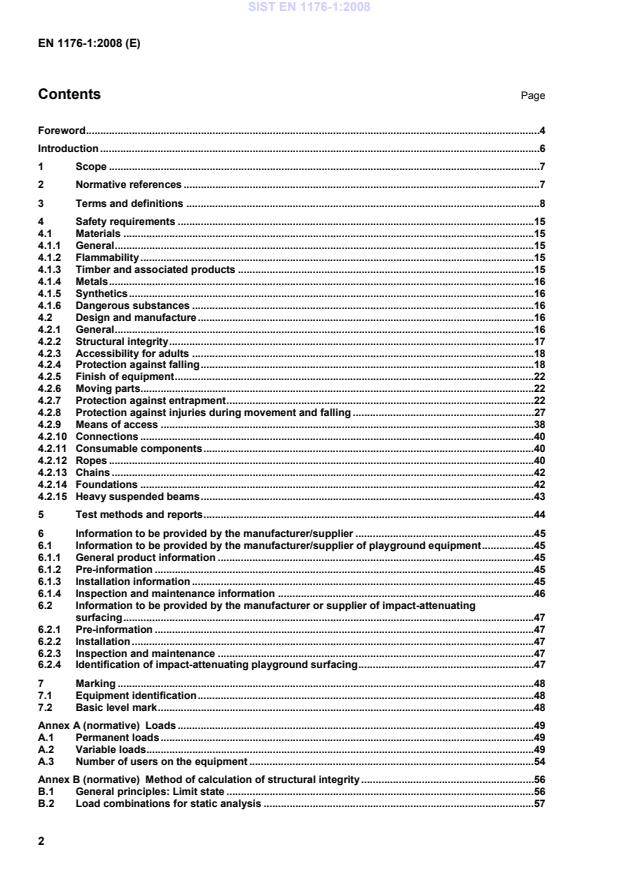
Loads.49 A.1 Permanent loads.49 A.2 Variable loads.49 A.3 Number of users on the equipment.54 Annex B (normative)
Method of calculation of structural integrity.56 B.1 General principles: Limit state.56 B.2 Load combinations for static analysis.57 SIST EN 1176-1:2008
Physical testing of structural integrity.69 C.1 Pass/fail criteria.69 C.2 Test load for equipment.69 C.3 Load application.70 C.4 Test report.70 Annex D (normative)
Test methods for entrapment.71 D.1 General.71 D.2 Head and neck entrapment.71 D.3 Entrapment of clothing (Toggle test).77 D.4 Finger entrapment.80 Annex E (informative)
Overview of possible entrapment situations.83 Annex F (informative)
A–deviations.85 F.1 General.85 F.2 France.85 F.3 Germany.85 Bibliography.88
EN 1177:2008, Impact attenuating playground surfacing — Determination of critical fall height. For inflatable play equipment see: EN 14960, Inflatable play equipment — Safety requirements and test methods. The principal changes from the previous edition of this part of EN 1176 are as follows. a) This part of EN 1176 now includes requirements for surfacing based on those that were previously specified in EN 1177. SIST EN 1176-1:2008
NOTE During movement it is possible to have only one or two points of contact but this is only during a transition from one rest position to the next. 3.3 impact area area that can be hit by a user after falling through the falling space 3.4 playing surface surface of a playground from which the use of the playground equipment commences and which comprises at least the impact area
3.5 free space space in, on or around the equipment that can be occupied by a user undergoing a movement forced by the equipment (e.g. sliding, swinging, rocking) 3.6 free height of fall greatest vertical distance from the clearly intended body support to the impact area below NOTE The intended body support includes those surfaces to which access is encouraged. 3.7 falling space space in, on or around the equipment that can be passed through by a user falling from an elevated part of the equipment (see Figure 1)
NOTE The falling space commences at the free height of fall. SIST EN 1176-1:2008
Key 1 space occupied by equipment 2 falling space 3 free space Figure 1 — Spaces 3.8 minimum space space required for the safe use of equipment, comprising falling space, free space and space occupied by the equipment
3.9 collective use use by more than one user at the same time 3.10 crushing point place where parts of the equipment can move against each other, or against a fixed area so that persons, or parts of their body, can be crushed 3.11 shearing point place where part of the equipment can move past a fixed or other moving part, or past a fixed area so that persons, or parts of their body, can be cut SIST EN 1176-1:2008
Figure 2 — Example of a ladder SIST EN 1176-1:2008
Figure 3 — Example of stairs 3.14 ramp means of access incorporating an inclined surface on which a user can ascend or descend (see Figure 4 and 4.2.9.3 first sentence) NOTE For maximum inclination see 4.2.9.3.
Figure 4 — Example of a ramp
Figure 5 — Grip 3.16 grasp holding of the hand round part of the circumference of a support (see Figure 6)
Figure 6 — Grasp 3.17 entrapment hazard presented by the situation in which a body, or part of a body, or clothing can become trapped NOTE This part of EN 1176 only considers certain types of entrapment where the user is not able to free him/herself and injury is caused by the entrapment.
in the free space, something in the path of a user undergoing a forced movement,
in the falling space, something hard and sharp that a user can hit during a fall from an elevated position, for other types of movement, something unexpected with which a user might collide whilst moving in, on or around the equipment. 3.19 cluster two or more separate pieces of equipment designed to be installed in close proximity to each other to provide continuity in a sequence that is needed for the play activity, e.g. trail of stepping stones 3.20 platform raised surface where one or more users can stand without the need of hand support NOTE The classification of a platform will vary depending on the function of the playground equipment. Surfaces where the user is only able to stand with the aid of hand supports are not classified as platforms. This may be achieved by a number of means, e.g.
reducing the surface area to restrict free movement and encourage holding on; incline the surface to encourage holding on; introducing movement to the surface to encourage holding on. 3.21 handrail rail intended to assist the user to balance 3.22 guardrail rail intended to prevent a user from falling 3.23 barrier device intended to prevent the user from falling and from passing beneath 3.24 easily accessible requiring only basic skills to access the equipment, allowing users to move freely and quickly onto/within the equipment 3.25 routine visual inspection inspection intended to identify obvious hazards that can result from normal use, vandalism or weather condi-tions NOTE Typical hazards can take the form of broken parts or broken bottles.
3.26 operational inspection inspection, more detailed than routine visual inspection, to check the operation and stability of the equipment NOTE Typical checks include an examination for wear.
3.27 annual main inspection inspection intended to establish the overall level of safety of equipment, foundations and playing surfaces NOTE Typical checks include the effects of weather, evidence of rotting or corrosion and any change in the level of safety of the equipment as a result of repairs made, or of added or replaced components.
3.28 steep play element access/egress play element of a gradient greater than 45 degrees from the horizontal 3.29 tiered platforms successive platforms of varying heights allowing the user to ascend or descend on or within the equipment NOTE Stairs are not considered to be tiered platforms. 3.30 critical fall height maximum free height of fall for which a surface will provide an acceptable level of impact attenuation NOTE The critical fall height is determined according to the lowest test result obtained in accordance with EN 1177. 3.31 surface flash rapid spread of flame over the surface of a material without combustion of the basic structure at that time SIST EN 1176-1:2008
4.1 Materials 4.1.1 General Materials shall conform to 4.1.2 to 4.1.5. Materials shall be selected and protected such that the structural integrity of the equipment manufactured from them is not affected before the next relevant maintenance inspection. NOTE 1 EN 1176-7 gives recommendations on maintenance inspections. Materials should be manufactured in a workmanlike manner. NOTE 2 The provisions relating to certain materials in this standard do not imply that other equivalent materials are un-suitable in the manufacture of children's playground equipment.
The selection of materials and their use should be in accordance with appropriate European Standards. Special attention should be given to surface coatings to avoid potential toxic hazards. The choice of materials should be appropriate where extreme climatic or atmospheric conditions are to be ex-pected. Where very low or very high temperatures can be anticipated care should be taken on material selection to avoid possible hazards through direct skin contact. In the choice of a material or substance for playground equipment, consideration should be given to the even-tual disposal of the material or substance having regard to any possible environmental toxic hazard. 4.1.2 Flammability To avoid the risk of fire and associated hazards, materials known to produce surface flash shall not be used. Particular attention should be given to newly developed products whose properties might not be fully known.
NOTE 1 Requirements for adequate exits to ensure escape in cases of fire are given in 4.2.3.
NOTE 2 Attention is drawn to national and local building regulations regarding flammability for equipment installed both indoors and outdoors.
4.1.3 Timber and associated products Timber parts shall be designed in such a way that precipitation can drain off freely and water accumulation shall be avoided. In cases of ground contact, one or more of the following methods shall be used: a) use of timber species with sufficient natural resistance in accordance with classes 1 and 2 of the natural resistance classification given in EN 350-2:1994, 4.2.2; b) construction methods, e.g. post shoe; c) use of timber treated with wood preservatives in accordance with EN 351-1:2007, Figure A.1 and in ac-cordance with EN 335-2:2006, use class 4. Consideration should also be given to other factors which can be unsuitable, such as splintering, poisoning etc. SIST EN 1176-1:2008
Metals that produce toxic oxides that scale or flake shall be protected by a non-toxic coating. 4.1.5 Synthetics If, during maintenance, it is difficult to determine at what point material becomes brittle, manufacturers shall give an indication of the time period after which the part or equipment should be replaced.
It should be possible for the operator of the playground to visually identify excessive wear of the gelcoat of GRP (glass-reinforced plastics) products intended for sliding before the user becomes exposed to the glass fibres.
NOTE This can be achieved for example by the use of different coloured layers in the sliding surface. Consideration should also be given to degradation of structural components through ultraviolet influences. 4.1.6 Dangerous substances
Dangerous substances shall not be used in playground equipment in such a way that they can cause adverse health effects to the user of the equipment.
NOTE Attention is drawn to the provisions of the Dangerous Substances Directive 76/769/EEC and its successive modifications. Prohibited materials include but are not limited to, asbestos, lead, formaldehyde, coal tar oils, carbolineums and polychlorinated biphenyls (PCBs).
4.2 Design and manufacture 4.2.1 General Equipment where the primary play function is augmented by a secondary motion, e.g. rocking and/or rotating, shall conform to the additional parts of EN 1176 relating to both play functions, as appropriate, unless the equipment is specifically covered in just one of the additional parts of EN 1176. The dimensions and degree of difficulty of the equipment should be suitable for the intended user group. The equipment should be designed so that the risk involved in play is apparent and foreseeable by the child.
NOTE For additional safety of equipment that is easily accessible, specific requirements have been included for the following:
protection against falling:
guardrails (4.2.4.3);
barriers (4.2.4.4);
steep elements (4.2.9.4);
Except when intended for water play, all parts of playground equipment should be designed so that they do not accumulate water. 4.2.2 Structural integrity For playground equipment, the structural integrity for the worst case of the intended combinations shall be proved. Structural integrity, including stability of the equipment shall be assessed by one of the following:
a) calculation, in accordance with Annexes A and B;
b) physical testing, in accordance with Annex C; or
c) combination of a) and b).
When calculations are carried out in accordance with Annex B no limit states shall be exceeded at combina-tions of loads as given in B.2.
When tested in accordance with Annex C, the equipment shall not show any cracks, damage or excessive permanent deformation (see C.1.2).
For some equipment, these specific calculations or tests are not always appropriate, but the structural integrity shall be at least equivalent
Each structure shall resist both the permanent and variable loads acting on equipment and parts of equipment as described in Annex C. When playground equipment relies on one post for its stability, the construction should be carried out in order to: minimize rotting or corrosion in parts relevant for stability; allow for controlling degradation and the need for decommission; be used without collapse within the foreseen inspection period when maintained correctly. NOTE 1 No allowance for accidental loads, i.e. loads produced by fire, collision by vehicles or earthquake, need be made for playground equipment.
NOTE 2 The loads associated with fatigue are in general much smaller than the loads in combination with the appro-priate load factors when calculated in accordance with B.2. Therefore playground equipment in general need not be veri-fied for fatigue.
Structural parts shall resist the worst case loading condition.
NOTE 3 To achieve this, it may be necessary to remove that part of the user load causing favourable effects, as shown in Figure 7.
Key 1 remove this part of the load because of favourable effects Figure 7 — Example of removal of that part of the user load which causes a favourable effect 4.2.3 Accessibility for adults Playground equipment shall be designed to ensure that adults are able to gain access to assist children within the equipment.
Enclosed parts of the equipment such as tunnels and playhouses, with an internal distance greater than 2 000 mm from an entry point shall have at least two access openings that are independent of one another and situated on different sides of the equipment. These openings shall not be capable of being locked and shall be accessible without any additional aids (e.g. a ladder that is not an integral part of the equipment). These access openings shall have no dimension less than 500 mm.
Because of the risk of fire, these two openings shall allow the user to leave the equipment by different routes. 4.2.4 Protection against falling 4.2.4.1 Types of protection Figure 8 shows the appropriate type of protection with different heights of equipment. When installed on ramps or stairs, handrails, guardrails or barriers shall commence at the lowest position on the ramp or stairs. SIST EN 1176-1:2008
a) Equipment easily accessible to all ages
b) Equipment not easily accessible Key 1 surfacing in accordance with 4.2.8.5 2 barriers required 3 guardrail required Figure 8 — Protection against falling 4.2.4.2 Handrails Handrails shall be not less than 600 mm and not more than 850 mm above the foot position (see Figure 9). As a minimum, handrails shall conform to the requirements for grasp see 4.2.4.7. SIST EN 1176-1:2008
Key 1 foot position 2 handrail Figure 9 — Guidance on measurement of height of handrail above foot position 4.2.4.3 Guardrails For equipment other than that which is easily accessible, guardrails shall be provided when the platform is 1 000 mm to 2 000 mm above the playing surface. The height to the top of the guardrail shall be not less than 600 mm and not more than 850 mm measured from the surface of the platform, stairs or ramp. Guardrails shall completely surround the platform except for entrance and exit openings necessary for each play element. The width of entrance and exit openings in guardrails, with the exception of stairs, ramps and bridges, shall have a maximum clear opening of 500 mm. For stairs, ramps and bridges the width of the exit opening in the guardrail shall be no greater than the width of these elements. 4.2.4.4 Barriers Except for entrance and exit openings necessary for each play element, barriers shall completely surround the platform. The width of entrance and exit openings in barriers shall have a clear opening of 500 mm maximum, unless a guardrail is provided across the opening (see Figure 10 b and c). For stairs, ramps, bridges, etc., that have additional barriers as part of their structure, the width of the exit opening in the barrier shall be no greater than the width of these elements. There shall be no intermediate horizontal or near horizontal rails or bars that can be used as steps by children attempting to climb. The design of the top of the barriers should not encourage children to stand or sit on them, nor should any infilling encourage climbing. SIST EN 1176-1:2008
The height to the top of the barrier shall be at least 700 mm measured from the surface of the platform, stairs or ramp. Openings in the barrier of easily accessible equipment/parts of equipment that give access to steep play ele-ments shall conform to the requirements of 4.2.9.4. For all other equipment, openings in the barrier provided with a guardrail, which give access to steep play elements, shall not be greater than 1 200 mm (see Figure 10 c).
Dimensions in millimetres
a)
b)
c) Figure 10 — Entrance and exit openings in barriers 4.2.4.5 Strength requirements Barriers and guardrails shall conform to 4.2.2. 4.2.4.6 Grip requirements The cross section of any support designed to be gripped (see Figure 5) shall have a dimension of not less than 16 mm or more than 45 mm in any direction, when measured across its centre.
4.2.4.7 Grasp requirements The cross section of any support designed to be grasped (see Figure 6) shall have a width not exceeding 60 mm.
There shall be no protruding nails, projecting wire rope terminations or pointed or sharp-edged components. Rough surfaces should not present any risk of injury. Protruding bolt threads within any accessible part of the equipment shall be permanently covered, e.g. dome headed nuts. Nuts and bolt heads that project less than 8 mm shall be free from burrs. All welds shall be ground smooth.
NOTE 1 Figure 11 shows examples of protection for nuts and bolts. Corners, edges and projecting parts within the space occupied by the user that protrude more than 8 mm, and which are not shielded by adjacent areas that are not more than 25 mm from the end of the projecting part, shall be rounded off. The minimum radius of the curve shall be 3 mm.
NOTE 2 This requirement is intended only to prevent injuries caused by unintended contact with components.
Corners, edges and projections with a radius less than 3 mm may be in other accessible parts of the equip-ment only if they are not sharp. Dimensions in millimetres
Figure 11 — Examples of protection for nuts and bolts 4.2.6 Moving parts There shall be no crushing points or shearing points between moving and/or stationary parts of the equipment, in accordance with 4.2.7. Parts from which a high impact force can emanate should have an attenuating construction. If moving parts of the equipment can endanger the body, there shall be a ground clearance of at least 400 mm to the ground. 4.2.7 Protection against entrapment 4.2.7.1 General When choosing materials, the manufacturer should take into account the entrapment hazards that can occur through distortion of materials during use.
NOTE 1 Test methods for entrapment are given in Annex D.
NOTE 2 Possible entrapment situations are illustrated in Annex E.
4.2.7.2 Entrapment of the head and neck Equipment shall be constructed so that any openings do not create head and neck entrapment hazards either by head first or feet first passage.
Hazardous situations in which this type of entrapment can be encountered include the following:
completely bound openings through which a user may slide feet first or head first; partially bound or V-shaped openings; other openings (e.g. shearing or moving openings). a) Completely bound openings: Accessible completely bound openings with a lower edge more than 600 mm above ground shall be tested in accordance with D.2.1. Probes C or E shall not pass through any opening unless it also allows the passage of the large head probe D. b) Partially bound and V-shaped openings: Partially bound and V-shaped openings with an entrance at 600 mm or more above the ground shall be con-structed so that either:
1) opening is not accessible when tested in accordance with D.2.2; or
2) if accessible at a position of 600 mm or more above ground when tested in accordance with D.2.2, depending on the angular orientation range of the opening (see Figure D.4), shall conform to the fol-lowing:
Range 1: (template centre line ± 45° from vertical); when the template apex contacts the base of the opening, the depth of the opening shall be less than the length of the template to the under-side of the shoulder section.
Range 2: (template centre line from horizontal to + 45°); when the template apex contacts the base of the opening, the depth of the opening shall be less than the ‘A’ portion of t
...
2003-01.Slovenski inštitut za standardizacijo. Razmnoževanje celote ali delov tega standarda ni dovoljeno.Spielplatzgeräte und Spielplatzböden - Teil 1: Allgemeine sicherheitstechnische Anforderungen und PrüfverfahrenEquipements et sols d'aires de jeux - Partie 1 : Exigences de sécurité et méthodes d'essai généralesPlayground equipment and surfacing - Part 1: General safety require-ments and test methods97.200.40,JULãþDPlaygroundsICS:Ta slovenski standard je istoveten z:EN 1176-1:2008SIST EN 1176-1:2008en,fr,de01-oktober-2008SIST EN 1176-1:2008SLOVENSKI
STANDARDSIST EN 1176-1:2000/A2:2003SIST EN 1176-1:2000/AC:2000SIST EN 1176-1:2000SIST EN 1176-1:2000/A1:20021DGRPHãþD
EUROPÄISCHE NORMEUROPEAN STANDARDNORME EUROPÉENNEEN 1176-1Mai 2008ICS 97.200.40Ersatz für EN 1176-1:1998
Deutsche FassungSpielplatzgeräte und Spielplatzböden - Teil 1: Allgemeinesicherheitstechnische Anforderungen und PrüfverfahrenPlayground equipment and surfacing - Part 1: Generalsafety requirements and test methodsEquipements et sols d'aires de jeux - Partie 1 : Exigencesde sécurité et méthodes d'essai généralesDiese Europäische Norm wurde vom CEN am 25.April 2008 angenommen.Die CEN-Mitglieder sind gehalten, die CEN/CENELEC-Geschäftsordnung zu erfüllen, in der die Bedingungen festgelegt sind, unter denendieser Europäischen Norm ohne jede Änderung der Status einer nationalen Norm zu geben ist. Auf dem letzen Stand befindliche Listendieser nationalen Normen mit ihren bibliographischen Angaben sind beim Management-Zentrum des CEN oder bei jedem CEN-Mitglied aufAnfrage erhältlich.Diese Europäische Norm besteht in drei offiziellen Fassungen (Deutsch, Englisch, Französisch). Eine Fassung in einer anderen Sprache,die von einem CEN-Mitglied in eigener Verantwortung durch Übersetzung in seine Landessprache gemacht und dem Zentralsekretariatmitgeteilt worden ist, hat den gleichen Status wie die offiziellen Fassungen.CEN-Mitglieder sind die nationalen Normungsinstitute von Belgien, Bulgarien, Dänemark, Deutschland, Estland, Finnland, Frankreich,Griechenland, Irland, Island, Italien, Lettland, Litauen, Luxemburg, Malta, den Niederlanden, Norwegen, Österreich, Polen, Portugal,Rumänien, Schweden, der Schweiz, der Slowakei, Slowenien, Spanien, der Tschechischen Republik, Ungarn, dem Vereinigten Königreichund Zypern.EUROPÄISCHES KOMITEE FÜR NORMUNGEUROPEAN COMMITTEE FOR STANDARDIZATIONCOMITÉ EUROPÉEN DE NORMALISATIONManagement-Zentrum: rue de Stassart, 36
B-1050 Brüssel© 2008 CENAlle Rechte der Verwertung, gleich in welcher Form und in welchemVerfahren, sind weltweit den nationalen Mitgliedern von CEN vorbehalten.Ref. Nr. EN 1176-1:2008 DSIST EN 1176-1:2008
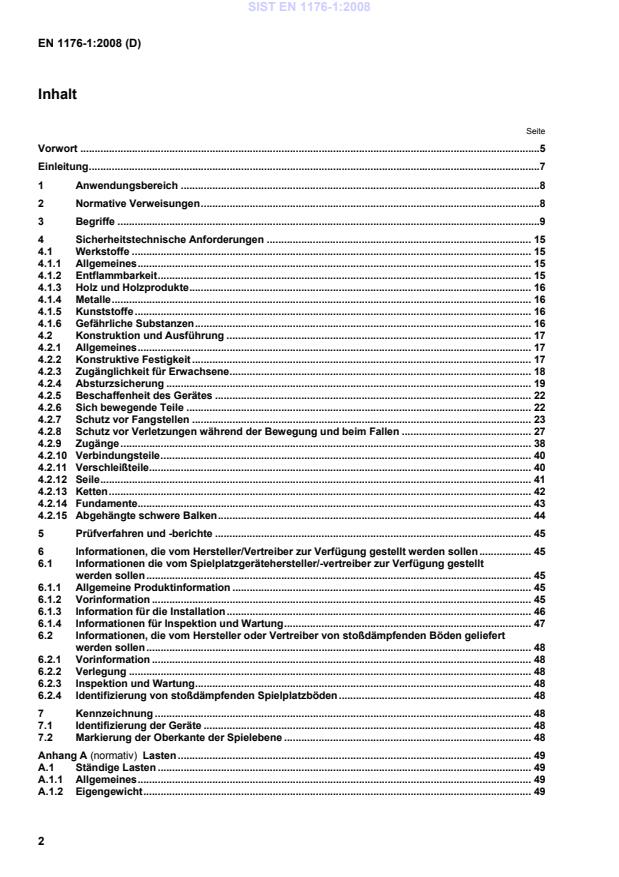
werden sollen.45 6.1.1 Allgemeine Produktinformation.45 6.1.2 Vorinformation.45 6.1.3 Information für die Installation.46 6.1.4 Informationen für Inspektion und Wartung.47 6.2 Informationen, die vom Hersteller oder Vertreiber von stoßdämpfenden Böden geliefert werden sollen.48 6.2.1 Vorinformation.48 6.2.2 Verlegung.48 6.2.3 Inspektion und Wartung.48 6.2.4 Identifizierung von stoßdämpfenden Spielplatzböden.48 7 Kennzeichnung.48 7.1 Identifizierung der Geräte.48 7.2 Markierung der Oberkante der Spielebene.48 Anhang A (normativ)
Lasten.49 A.1 Ständige Lasten.49 A.1.1 Allgemeines.49 A.1.2 Eigengewicht.49 SIST EN 1176-1:2008
Verfahren zur Berechnung der konstruktiven Festigkeit.56 B.1 Allgemeines Nachweisprinzip: Grenzzustände.56 B.1.1 Grenzzustände.56 B.1.2 Grenzzustände der Tragfähigkeit.56 B.1.3 Grenzzustände der Gebrauchstauglichkeit.57 B.2 Lastkombinationen für statische Berechnungen.57 B.3 Ausgearbeitetes Beispiel der Berechnung der Last der Benutzer
(ohne Sicherheitsfaktoren).57 B.3.1 Allgemeines.57 B.3.2 Plattform.59 B.3.3 Brüstung.59 B.3.4 Leiter.59 B.3.5 Gesamtkonstruktion.60 B.4 Berechnung der Lasten an einem Schaukelsitz.60 B.5 Ausgearbeitetes Beispiel für die Lasten an einer Schaukel
(ohne Sicherheitsfaktoren).62 B.6 Berechnung der Lasten für das Tragseil einer Seilbahn.63 B.7 Ausgearbeitetes Beispiel für Kräfte an einer Seilbahn (ohne Sicherheitsfaktoren).65 Anhang C (normativ)
Belastungsversuche zur konstruktiven Festigkeit.68 C.1 Kriterien für Bestanden/Nicht bestanden.68 C.1.1 Belastungsfähigkeit.68 C.1.2 Versagen.68 C.2 Prüflasten für Geräte.68 C.2.1 Lastkombinationen für Versuche.68 C.2.2 Sicherheitsbeiwert für Versuche mit identischen Serienteilen.68 C.2.3 Sicherheitsbeiwert für Versuche an Einzelprodukten.69 C.3 Lastaufbringung.69 C.3.1 Punktlasten.69 C.3.2 Linienförmige Lasten.69 C.3.3 Flächenförmige Lasten.69 C.4 Prüfbericht.69 Anhang D (normativ)
Prüfverfahren für Fangstellen.70 D.1 Allgemeines.70 D.2 Fangstellen für Kopf und Hals.70 D.2.1 Vollständig umschlossene Öffnungen.70 D.2.2 Teilweise umschlossene und V-förmige Öffnungen.72 D.3 Fangstellen für Kleidung (Knebelprüfung).77 D.3.1 Prüfgeräte.77 D.3.2 Durchführung.79 D.4 Fangstellen für Finger.81 D.4.1 Prüfgeräte.81 D.4.2 Durchführung.81 SIST EN 1176-1:2008
Übersicht über mögliche Gefahren durch Fangstellen.83 Anhang F (informativ)
A-Abweichungen.85 F.1 Allgemeines.85 F.2 Frankreich.85 F.3 Deutschland.85 F.3.1 Allgemeines.85 F.3.2 Kinder unter 3 Jahre.85 F.3.3 Stoßdämpfende Böden.86 Literaturhinweise.88
1176 sollte in Verbindung mit EN 1177:2008, Stoßdämpfende Spielplatzböden — Bestimmung der kritischen Fallhöhe
gelesen werden. Bezüglich aufblasbare Spielgeräte siehe EN 14960, Aufblasbare Spielgeräte — Sicherheitstechnische Anforderungen und Prüfverfahren
Folgende: a) Dieser Teil der EN 1176 beinhaltet nun Anforderungen an Böden, die bisher in EN 1177 festgelegt waren; b) Einbeziehung zusätzlicher Anforderungen an Brüstungen und steile Spielelemente;
c) Anforderungen an Fangstellen gelten jetzt für alle Altersgruppen, und die Prüfung für teilweise umschlos-sene Öffnungen wurde näher erläutert, mit neuen Anforderungen abhängig vom Einführwinkel. Entsprechend der CEN/CENELEC-Geschäftsordnung sind die nationalen Normungsinstitute der folgenden Länder gehalten, diese Europäische Norm zu übernehmen: Belgien, Bulgarien, Dänemark, Deutschland, Est-land, Finnland, Frankreich, Griechenland, Irland, Island, Italien, Lettland, Litauen, Luxemburg, Malta, Nieder-lande, Norwegen, Österreich, Polen, Portugal, Rumänien, Schweden, Schweiz, Slowakei, Slowenien, Spanien, Tschechische Republik, Ungarn, Vereinigtes Königreich und Zypern.
EN 335-2:2006, Dauerhaftigkeit von Holz und Holzprodukten — Definition der biologischen Gebrauchsklas-sen — Teil 2: Anwendung bei Vollholz EN 350-2:1994, Dauerhaftigkeit von Holz und Holzprodukten — Natürliche Dauerhaftigkeit von Vollholz — Teil 2: Leitfaden für die natürliche Dauerhaftigkeit und Tränkbarkeit von ausgewählten Holzarten von beson-derer Bedeutung in Europa EN 351-1:2007, Dauerhaftigkeit von Holz und Holzprodukten — Mit Holzschutzmitteln behandeltes Vollholz —Teil 1: Klassifizierung der Schutzmitteleindringung und -aufnahme EN 636, Sperrholz — Anforderungen EN 1177, Stoßdämpfende Spielplatzböden — Bestimmung der kritischen Fallhöhe EN 1991-1-2, Eurocode 1 — Einwirkungen auf Tragwerke — Teil 1-2: Allgemeine Einwirkungen — Brandein-wirkungen auf Tragwerke EN 1991-1-3, Eurocode 1 — Einwirkungen auf Tragwerke — Teil 1-3: Allgemeine Einwirkungen — Schnee-lasten EN 1991-1-4, Eurocode 1 — Einwirkungen auf Tragwerke — Teil
1-4: Allgemeine Einwirkungen, Windlasten EN 13411-3, Endverbindungen für Drahtseile aus Stahldraht — Sicherheit — Teil
3: Pressklemmen und Ver-pressen SIST EN 1176-1:2008
U-förmigem Klemmbügel EN ISO 2307, Faserseile — Bestimmung einiger physikalischer und mechanischer Eigenschaften (ISO 2307:2005) EN ISO 9554, Faserseile — Allgemeine Festlegungen (ISO 9554:2005) EN ISO/IEC 17025, Allgemeine Anforderungen an die Kompetenz von Prüf- und Kalibrierlaboratorien
(ISO/IEC 17025:2005) ISO 1834, Short link chain for lifting purposes — General conditions of acceptance 3 Begriffe Für die Anwendung dieses Dokuments gelten die folgenden Begriffe. 3.1 Spielplatzgerät Gerät und Bauten, einschließlich Bauteile und Konstruktionselemente, an oder mit denen sich Kinder drinnen oder draußen nach eigenen, jederzeit veränderbaren Regeln bzw. Spielmotivationen einzeln oder in Gruppen betätigen können 3.2 Klettergerät Spielplatzgerät, das es dem Benutzer nur erlaubt, sich auf ihm oder in ihm mit Hand- und Fuß/Bein-Unterstützung zu bewegen und das mindestens drei Kontaktpunkte erfordert, von denen einer eine Hand ist.
ANMERKUNG Während der Bewegung ist es möglich, nur einen oder zwei Kontaktpunkte zu haben, aber dies nur während eines Übergangs von einem Ruhepunkt zum nächsten. 3.3 Aufprallfläche Fläche, auf welche ein Benutzer nach einem Sturz durch den Fallraum auftreffen kann 3.4 Spielebene Ebene eines Spielplatzes, von der aus die Benutzung des Gerätes beginnt und die zumindest die Aufprallflä-che einschließt 3.5 Freiraum Raum in, auf oder um das Gerät herum, der von einem Benutzer des Gerätes während einer Bewegung, die durch das Gerät verursacht wird, eingenommen werden kann (z. B. Rutschen, Schaukeln, Wippen) 3.6 freie Fallhöhe größter lotrechter Abstand von der eindeutig beabsichtigten Körperunterstützung zu der Aufprallfläche darun-ter
ANMERKUNG Die beabsichtigte Körperunterstützung schließt solche Standflächen mit ein, zu denen Zugang unter-stützt wird. 3.7 Fallraum Raum in, auf oder um das Gerät herum, der von einem Benutzer eingenommen werden kann, der von einem erhöhten Teil des Gerätes fällt (siehe Bild 1) SIST EN 1176-1:2008
Legende 1 Geräteraum 2 Fallraum 3 Freiraum Bild 1 — Räume 3.8 Mindestraum Raum, der für die sichere Benutzung des Gerätes benötigt wird und den Fallraum, den Freiraum und den Ge-räteraum einschließt 3.9 gemeinsame Benutzung Benutzung durch mehr als einen Benutzer zur gleichen Zeit 3.10 Quetschstelle Stelle, bei der sich Geräteteile so gegeneinander oder gegen eine feste Fläche bewegen können, dass Per-sonen oder deren Körperteile gequetscht werden können 3.11 Scherstelle Stelle, wo sich ein Geräteteil so an einem festen oder anderen sich bewegenden Teil oder an einer festen Fläche vorbei bewegen kann, dass Personen oder deren Körperteile durchtrennt werden können 3.12 Leiter Zugangsvorrichtung mit Sprossen oder Stufen, auf denen ein Benutzer mit Hilfe der Hände auf- oder abstei-gen kann (siehe Bild 2) SIST EN 1176-1:2008
Bild 2 — Beispiel einer Leiter 3.13 Treppen Zugangsvorrichtung aus Stufen, auf denen ein Benutzer auf- oder absteigen kann (siehe Bild 3)
Bild 3 — Beispiel einer Treppe SIST EN 1176-1:2008
Bild 4 — Beispiel einer Rampe 3.15 Umfassungsmöglichkeit Halt, der mit der Hand ganz umschlossen werden kann (siehe Bild 5)
Bild 5 — Umfassungsmöglichkeit SIST EN 1176-1:2008
Bild 6 — Greifmöglichkeit 3.17 Fangstelle Gefährdung, die sich aus der Situation ergibt, in der ein Körper, ein Körperteil oder Kleidungsstück hängen bleiben kann ANMERKUNG Dieser Teil der EN 1176 berücksichtigt nur einige Arten von Fangstellen, bei denen der Benutzer sich nicht selbst befreien kann und eine Verletzung durch diese Fangstelle verursacht wird. 3.18 Hindernis Gegenstand oder Teil eines Gegenstands, der in den Geräteraum, den Fallraum oder den Freiraum eines Be-nutzers hineinragt ANMERKUNG Die Risiken, die mit Hindernissen in Spielplatzgeräten verbunden sind, variieren je nach ihrer Lage in, auf oder um das Gerät herum, z. B.
⎯ im Freiraum, etwas im Bewegungsverlauf des Benutzers bei erzwungener Bewegung, ⎯ im Fallraum, etwas Hartes und Scharfes, das der Benutzer beim Fallen von einer erhöhten Position treffen kann, ⎯ für andere Arten der Bewegung, etwas Unerwartetes, mit dem ein Benutzer während der Bewegung in, auf oder um das Gerät herum zusammenstoßen könnte. 3.19 Gruppe zwei oder mehr getrennte Geräteteile, die so konstruiert sind, dass sie nahe beieinander aufgestellt werden, um die Fortführung der Spielaktivität zu ermöglichen, z. B. ein Pfad von Trittsteinen 3.20 Plattform erhöhte Standfläche auf der ein oder mehrere Benutzer ohne die Notwendigkeit einer Haltemöglichkeit für die Hand stehen kann/können SIST EN 1176-1:2008
Treppen gelten nicht als terrassenförmige Plattformen. SIST EN 1176-1:2008
Die kritische Fallhöhe wird bestimmt mit dem niedrigsten Prüfergebnis nach EN 1177. 3.31 oberflächliches Abflammen schnelle Flammenausbreitung über die Oberfläche eines Materials ohne gleichzeitige Entzündung der Grund-konstruktion 4 Sicherheitstechnische Anforderungen 4.1 Werkstoffe 4.1.1 Allgemeines Werkstoffe müssen 4.1.2 bis 4.1.5 entsprechen. Werkstoffe müssen so ausgewählt und geschützt werden, dass die Standsicherheit der aus ihnen hergestellten Konstruktionen nicht vor der nächsten relevanten Wartungsinspektion beeinträchtigt wird. ANMERKUNG 1 EN 1176-7 gibt Empfehlungen für Wartungsinspektion. Werkstoffe sollten fachgerecht verarbeitet werden. ANMERKUNG 2 Die Bedingungen in Bezug auf bestimmte Werkstoffe in dieser Norm bedeuten nicht, dass andere gleichwertige Werkstoffe für die Herstellung von Kinderspielplatzgeräten ungeeignet sind. Die Wahl der Werkstoffe und ihre Verwendung sollten in Übereinstimmung mit den entsprechenden
Europäischen Normen erfolgen. Um toxische Risiken zu vermeiden, sollte besondere Beachtung auf Oberflächenanstriche gelegt werden. Besondere Sorgfalt sollte auf die Auswahl von Werkstoffen verwendet werden, die für Geräte vorgesehen sind, die extremen Klima- oder Witterungsbedingungen ausgesetzt werden. Bei vorauszusehenden sehr niedrigen oder sehr hohen Temperaturen sollten die Werkstoffe sorgfältig ausge-wählt werden, um mögliche Risiken durch direkten Hautkontakt zu vermeiden. Bei der Wahl eines Werkstoffs oder einer Substanz für Spielplatzgeräte sollte beachtet werden, dass der Werkstoff oder die Substanz möglicherweise entsorgt werden muss und dass dabei alle toxischen Risiken für die Umwelt beachtet werden müssen. 4.1.2 Entflammbarkeit Um Brand oder ähnlichen Gefahren vorzubeugen, dürfen Werkstoffe, die flächig abflammen, nicht verwendet werden. Besondere Aufmerksamkeit gilt neu entwickelten Produkten, deren Eigenschaften nicht vollständig bekannt sind. ANMERKUNG 1 Anforderungen für geeignete Ausgänge, die die Fluchtmöglichkeit bei Feuer sicherstellen, sind unter 4.2.3 aufgeführt. ANMERKUNG 2 Nationale und örtliche Bauvorschriften bezüglich Entflammbarkeit bei Geräten, die sowohl im Inneren eines Gebäudes als auch im Freien installiert sind, sind zu beachten. SIST EN 1176-1:2008
ANMERKUNG Das kann z. B. durch unterschiedliche Färbung der Lagen in der Rutschfläche erreicht werden. Auch die Verwitterung von tragenden Teilen durch UV-Einflüsse sollte beachtet werden. 4.1.6 Gefährliche Substanzen Gefährliche Substanzen dürfen bei der Herstellung von Spielplatzgeräten nicht so verwendet werden, dass sie bei dem Benutzer der Geräte Gesundheitsbeeinträchtigungen verursachen können. ANMERKUNG Es wird auf die Vorschriften der Richtlinie 76/769/EWG und ihrer nachfolgenden Änderungen hingewie-sen. Zu den verbotenen Werkstoffen gehören z. B., sind aber nicht beschränkt auf, Asbest, Blei, Formaldehyd, Steinkoh-lenteeröle, Carbolineum und polychlorierte Biphenyle (PCB). SIST EN 1176-1:2008
ANMERKUNG 3 Hierzu kann es notwendig sein, den Teil der Last der Benutzer zu entfernen, der günstige Effekte verursacht, wie in Bild 7 darges
...