

CEN/TR 16598:2023
(Main)Collection of rationales for EN 1176 - Requirements
- Abstract
This document is a collection of rationales for EN 1176 in order to support the use of EN 1176 by providing additional information and explanations. It does not contain additional requirements it only serves as a supporting document.
- Status
- Published
- Publication Date
- 02-May-2023
- Technical Committee
- CEN/TC 136 - Sports, playground and other recreational equipment
- Drafting Committee
- CEN/TC 136/SC 1 - Playground equipment for children
- Current Stage
- 6060 - Definitive text made available (DAV) - Publishing
- Start Date
- 03-May-2023
- Due Date
- 01-Jun-2023
- Completion Date
- 03-May-2023

Overview
CEN/TR 16598:2023 - Collection of rationales for EN 1176 (Requirements) is a CEN Technical Report that explains the reasoning behind clauses in EN 1176 (playground equipment - safety requirements). Approved 9 January 2023 and prepared by CEN/TC 136, this document does not add new requirements; it provides explanatory background, interpretation and context to support consistent application of EN 1176 across design, manufacture, testing and maintenance of playground equipment. ICS classification: 97.200.40 Playgrounds.
Key topics and technical areas covered
The report organizes rationales by EN 1176 parts and clauses. Major topics explained include:
- Materials and finishes: flammability, timber, metals, synthetics and issues related to dangerous substances.
- Design and structural integrity: general design principles, strength requirements, connections, foundations and load considerations.
- Access and reachability: accessibility for adults, means of access (ladders, stairs, ramps, steep elements) and easily accessible elements.
- Protection against falls and impact: determination of free height of fall, extent of falling and impact areas, and rationale for different impact attenuation approaches (including distinction for equipment with free height of fall greater than 600 mm).
- Barriers, guardrails and handrails: types of protection, grip and grasp requirements to reduce fall and entrapment risk.
- Entrapment hazards: head/neck, clothing/hair, whole body, foot/leg and finger entrapment - explanations of why specific opening sizes and geometries are controlled.
- Moving parts and dynamic behaviour: moving elements, rotating equipment, dynamic loads (e.g., swings), and forced movement protection.
- Equipment-specific rationales: swings (multiple types and suspension methods), slides (starting/run‑out sections, profiles, impact areas), cableways (traveller, grips, speed, ground clearance), carousels and other rotating devices (skirted platforms, flush platforms).
- Testing, marking and information: guidance on test methods, manufacturer/supplier information and data for impact attenuating surfacing.
Practical applications and intended users
CEN/TR 16598:2023 is useful to:
- Playground designers and manufacturers interpreting EN 1176 requirements and selecting compliant designs and materials.
- Specifiers, procurement officers and local authorities creating safety specifications for playground projects.
- Test laboratories and conformity assessors seeking rationale for test methods and reporting.
- Installers and maintenance teams understanding safety-critical features to inspect and maintain equipment.
- Safety auditors and regulators applying EN 1176 consistently.
Related standards
- Primary: EN 1176 (Playground equipment - safety requirements).
- The Technical Report references clauses across Parts 1–5 of EN 1176 and supports their uniform interpretation.
Keywords: EN 1176, CEN/TR 16598, playground safety, playground equipment standard, impact attenuation, free height of fall, entrapment, swings, slides, cableways, carousels.
Relations
- Effective Date
- 19-Jan-2023
- Effective Date
- 28-Jan-2026
- Effective Date
- 28-Jan-2026
- Effective Date
- 28-Jan-2026
- Effective Date
- 28-Jan-2026
- Effective Date
- 28-Jan-2026
- Effective Date
- 28-Jan-2026
- Effective Date
- 28-Jan-2026
- Effective Date
- 28-Jan-2026
- Effective Date
- 28-Jan-2026
- Effective Date
- 28-Jan-2026
- Effective Date
- 28-Jan-2026
- Effective Date
- 28-Jan-2026
- Effective Date
- 28-Jan-2026
- Effective Date
- 28-Jan-2026
Frequently Asked Questions
CEN/TR 16598:2023 is a technical report published by the European Committee for Standardization (CEN). Its full title is "Collection of rationales for EN 1176 - Requirements". This standard covers: This document is a collection of rationales for EN 1176 in order to support the use of EN 1176 by providing additional information and explanations. It does not contain additional requirements it only serves as a supporting document.
This document is a collection of rationales for EN 1176 in order to support the use of EN 1176 by providing additional information and explanations. It does not contain additional requirements it only serves as a supporting document.
CEN/TR 16598:2023 is classified under the following ICS (International Classification for Standards) categories: 97.200.40 - Playgrounds. The ICS classification helps identify the subject area and facilitates finding related standards.
CEN/TR 16598:2023 has the following relationships with other standards: It is inter standard links to CEN/TR 16598:2014, EN 1176-7:2020, EN 1176-6:2017+AC:2019, EN 1176-2:2017+AC:2019, EN 1176-6:2008, EN 1176-6:2017, EN 1176-10:2023, EN 1176-6:1998, EN 1176-4:1998, EN 1176-2:1998/A1:2003, EN 1176-2:2008, EN 1176-3:2017, EN 1176-4:2008, EN 1176-11:2014, EN 1176-4:2017. Understanding these relationships helps ensure you are using the most current and applicable version of the standard.
CEN/TR 16598:2023 is available in PDF format for immediate download after purchase. The document can be added to your cart and obtained through the secure checkout process. Digital delivery ensures instant access to the complete standard document.
Standards Content (Sample)
SLOVENSKI STANDARD
01-oktober-2023
Zbirka osnovnih utemeljitev za EN 1176 - Zahteve
Collection of rationales for EN 1176 - Requirements
Sammlung von grundsätzlichen Überlegungen zur EN 1176 - Anforderungen
Recueil d'exposés des motifs concernant l'EN 1176 - Exigences
Ta slovenski standard je istoveten z: CEN/TR 16598:2023
ICS:
97.200.40 Igrišča Playgrounds
2003-01.Slovenski inštitut za standardizacijo. Razmnoževanje celote ali delov tega standarda ni dovoljeno.
CEN/TR 16598
TECHNICAL REPORT
RAPPORT TECHNIQUE
May 2023
TECHNISCHER REPORT
ICS 97.200.40 Supersedes CEN/TR 16598:2014
English Version
Collection of rationales for EN 1176 - Requirements
Recueil d'exposés des motifs concernant l'EN 1176 - Sammlung von grundsätzlichen Überlegungen zur EN
Exigences 1176 - Anforderungen
This Technical Report was approved by CEN on 9 January 2023. It has been drawn up by the Technical Committee CEN/TC 136.
CEN members are the national standards bodies of Austria, Belgium, Bulgaria, Croatia, Cyprus, Czech Republic, Denmark, Estonia,
Finland, France, Germany, Greece, Hungary, Iceland, Ireland, Italy, Latvia, Lithuania, Luxembourg, Malta, Netherlands, Norway,
Poland, Portugal, Republic of North Macedonia, Romania, Serbia, Slovakia, Slovenia, Spain, Sweden, Switzerland, Türkiye and
United Kingdom.
EUROPEAN COMMITTEE FOR STANDARDIZATION
COMITÉ EUROPÉEN DE NORMALISATION
EUROPÄISCHES KOMITEE FÜR NORMUNG
CEN-CENELEC Management Centre: Rue de la Science 23, B-1040 Brussels
© 2023 CEN All rights of exploitation in any form and by any means reserved Ref. No. CEN/TR 16598:2023 E
worldwide for CEN national Members.
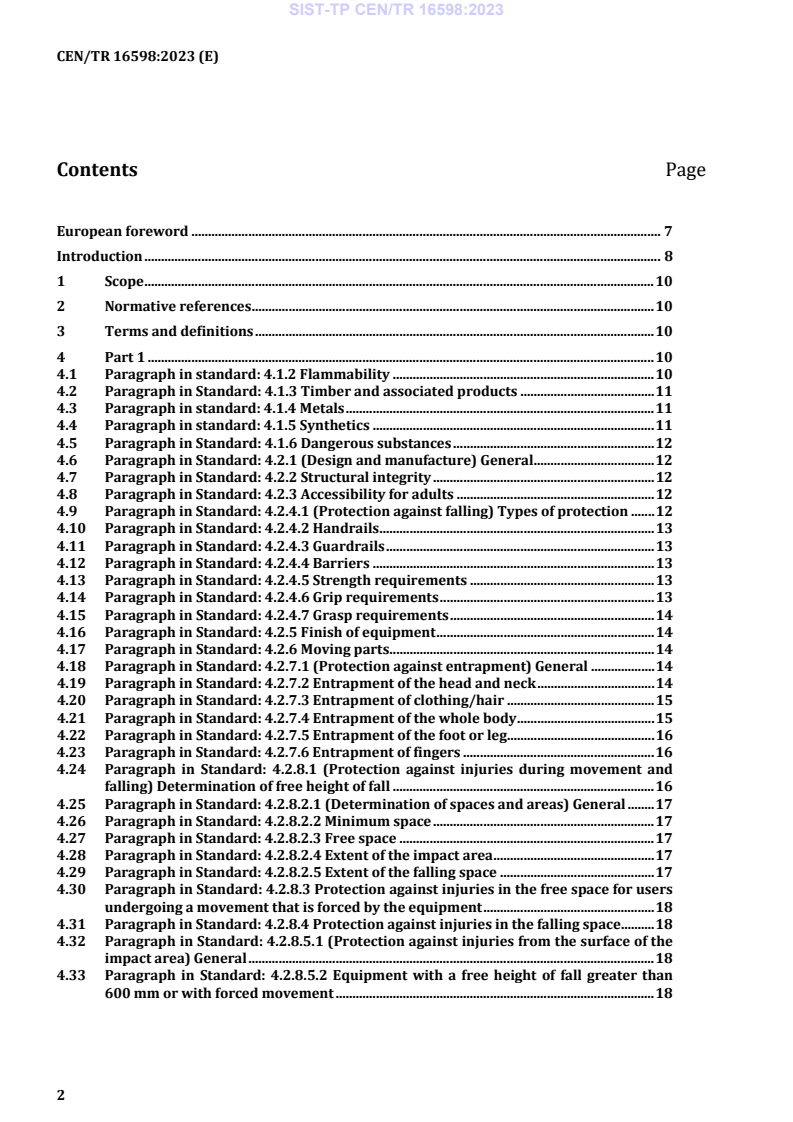
Contents Page
European foreword . 7
Introduction . 8
1 Scope . 10
2 Normative references . 10
3 Terms and definitions . 10
4 Part 1 . 10
4.1 Paragraph in standard: 4.1.2 Flammability . 10
4.2 Paragraph in Standard: 4.1.3 Timber and associated products . 11
4.3 Paragraph in standard: 4.1.4 Metals . 11
4.4 Paragraph in standard: 4.1.5 Synthetics . 11
4.5 Paragraph in Standard: 4.1.6 Dangerous substances . 12
4.6 Paragraph in Standard: 4.2.1 (Design and manufacture) General . 12
4.7 Paragraph in Standard: 4.2.2 Structural integrity . 12
4.8 Paragraph in Standard: 4.2.3 Accessibility for adults . 12
4.9 Paragraph in Standard: 4.2.4.1 (Protection against falling) Types of protection . 12
4.10 Paragraph in Standard: 4.2.4.2 Handrails. 13
4.11 Paragraph in Standard: 4.2.4.3 Guardrails . 13
4.12 Paragraph in Standard: 4.2.4.4 Barriers . 13
4.13 Paragraph in Standard: 4.2.4.5 Strength requirements . 13
4.14 Paragraph in Standard: 4.2.4.6 Grip requirements . 13
4.15 Paragraph in Standard: 4.2.4.7 Grasp requirements . 14
4.16 Paragraph in Standard: 4.2.5 Finish of equipment . 14
4.17 Paragraph in Standard: 4.2.6 Moving parts . 14
4.18 Paragraph in Standard: 4.2.7.1 (Protection against entrapment) General . 14
4.19 Paragraph in Standard: 4.2.7.2 Entrapment of the head and neck . 14
4.20 Paragraph in Standard: 4.2.7.3 Entrapment of clothing/hair . 15
4.21 Paragraph in Standard: 4.2.7.4 Entrapment of the whole body . 15
4.22 Paragraph in Standard: 4.2.7.5 Entrapment of the foot or leg. 16
4.23 Paragraph in Standard: 4.2.7.6 Entrapment of fingers . 16
4.24 Paragraph in Standard: 4.2.8.1 (Protection against injuries during movement and
falling) Determination of free height of fall . 16
4.25 Paragraph in Standard: 4.2.8.2.1 (Determination of spaces and areas) General . 17
4.26 Paragraph in Standard: 4.2.8.2.2 Minimum space . 17
4.27 Paragraph in Standard: 4.2.8.2.3 Free space . 17
4.28 Paragraph in Standard: 4.2.8.2.4 Extent of the impact area . 17
4.29 Paragraph in Standard: 4.2.8.2.5 Extent of the falling space . 17
4.30 Paragraph in Standard: 4.2.8.3 Protection against injuries in the free space for users
undergoing a movement that is forced by the equipment . 18
4.31 Paragraph in Standard: 4.2.8.4 Protection against injuries in the falling space . 18
4.32 Paragraph in Standard: 4.2.8.5.1 (Protection against injuries from the surface of the
impact area) General . 18
4.33 Paragraph in Standard: 4.2.8.5.2 Equipment with a free height of fall greater than
600 mm or with forced movement . 18
4.34 Paragraph in Standard: 4.2.8.5.3 Equipment with a free height of fall not exceeding
600 mm and without forced movement . 19
4.35 Paragraph in Standard: 4.2.8.5.4 Adjacent platforms . 19
4.36 Paragraph in Standard: 4.2.8.6 Protection against injuries due to other types of
movement . 19
4.37 Paragraph in Standard: 4.2.9.1 (Means of access) Ladders . 19
4.38 Paragraph in Standard: 4.2.9.2 Stairs. 19
4.39 Paragraph in Standard: 4.2.9.3 Ramps . 20
4.40 Paragraph in Standard: 4.2.9.4 Steep play elements . 20
4.41 Paragraph in Standard: 4.2.9.5 Easily accessible playground elements . 20
4.42 Paragraph in Standard: 4.2.10 Connections . 20
4.43 Paragraph in Standard: 4.2.11 Consumable components . 21
4.44 Paragraph in Standard: 4.2.12.1 (Ropes) Ropes fixed at one end . 21
4.45 Paragraph in Standard: 4.2.12.2 Ropes fixed at both ends (climbing ropes) . 21
4.46 Paragraph in Standard: 4.2.12.3 Wire ropes . 21
4.47 Paragraph in Standard: 4.2.12.4 Sheathed wire ropes . 22
4.48 Paragraph in Standard: 4.2.12.5 Fibre ropes (textile type) . 22
4.49 Paragraph in Standard: 4.2.13 Chains . 22
4.50 Paragraph in Standard: 4.2.14 Foundations . 22
4.51 Paragraph in Standard: 4.2.15 Heavy suspended rigid beams . 23
4.52 Paragraph in standard 4.2.16 Bouncing facilities . 23
4.53 Paragraph in Standard: 5 Test methods and reports . 23
4.54 Paragraph in Standard: 6 Information to be provided by the manufacturer/supplier
................................................................................................................................................................... 24
4.55 Paragraph in Standard: 7 Information to be provided by the manufacturer or supplier
of the impact attenuating surfacing . 24
5 Part 2 . 24
5.1 Paragraph in Standard: 4.2 (Safety requirements) General . 24
5.2 Paragraph in Standard: 4.3 Seat clearance for single-point swing (Type 3) . 24
5.3 Paragraph in Standard: 4.4.1 (Minimum clearance and lateral stability of swing seats
with more than one point of suspension) Minimum space between the seats of swings
................................................................................................................................................................... 25
5.4 Paragraph in Standard: 4.4.2 Lateral stability of swing seats (Figure 7b) . 25
5.5 Paragraph in Standard: 4.5 Means of suspension . 25
5.6 Paragraph in Standard: 4.6.1 (Impact attenuation of swing seats) Swing seats and
vertical tyre seats and 4.6.2 Cradle swing seats . 25
5.7 Paragraph in Standard: 4.6.3 Swing seats and platforms for several users . 25
5.8 Paragraph in Standard: 4.7 Dynamic load for swing equipment, 4.8.1 and 4.8.2
Structural integrity . 25
5.9 Paragraph in Standard: 4.9 Framework . 26
5.10 Paragraph in Standard: 4.10.1 (Height of fall and impact area) Free height of fall and
4.10.2 Dimensions of falling space and impact area . 26
5.11 Paragraph in Standard: 4.11 Additional requirements for swing seats with several
rotational axes (Type 2) . 26
5.12 Paragraph in Standard: 4.12 Additional requirements for single-point swings (Type
3) . 26
5.13 Paragraph in Standard: 4.13 Additional requirements for contact swings (Type 4)
Objective: prevent injuries caused by collision of two users . 26
5.14 Paragraph in Standard: 5 and 6 See Part 1 . 26
6 Part 3 . 26
6.1 Paragraph in Standard: 4.2 Access . 26
6.2 Paragraph in Standard: 4.3.1 (Starting section) Length and angle . 27
6.3 Paragraph in Standard: 4.3.2 Guarding section . 27
6.4 Paragraph in Standard: 4.3.3 Width . 27
6.5 Paragraph in Standard: 4.3.4 Lateral protection (sides) . 27
6.6 Paragraph in Standard: 4.4.1 (Sliding section) Length and Angle . 27
6.7 Paragraph in Standard: 4.4.2 Width . 27
6.8 Paragraph in Standard: 4.4.3 Sides and profile of the slide . 28
6.9 Paragraph in Standard: 4.5 Run out section . 28
6.10 Paragraph in Standard: 4.6 Surface of the slide . 28
6.11 Paragraph in Standard: 4.7 Free space . 28
6.12 Paragraph in Standard: 4.8 Impact area . 28
6.13 Paragraph in Standard: 4.9.1 Clearance . 28
6.14 Paragraph in Standard: 4.9.2 Position . 29
6.15 Paragraph in Standard 5 and 6 See Part 1 . 29
7 Part 4 . 29
7.1 Paragraph in Standard: 4.2 Framework and fixing points of the cable . 29
7.2 Paragraph in Standard: 4.3 Calculation of forces on the cable of a cableway . 29
7.3 Paragraph in Standard: 4.4 Stops . 29
7.4 Paragraph in Standard: 4.5 Traveller . 29
7.5 Paragraph in Standard: 4.6 Suspension assembly . 29
7.6 Paragraph in Standard: 4.7 Cableways arranged in parallel . 30
7.7 Rationale:s for EN 1176-4 Cableways . 30
7.8 Paragraph in Standard: 4.8 Grips . 30
7.9 Paragraph in Standard: 4.9 Seats . 30
7.10 Paragraph in Standard: 4.10 Speed . 30
7.11 Paragraph in Standard: 4.11 Free height of fall . 30
7.12 Paragraph in Standard: 4.12 Ground clearance . 30
7.13 Paragraph in Standard: 4.13 Cable height . 31
7.14 Paragraph in Standard: 4.14 Falling space and impact area . 31
7.15 Paragraph in Standard: 5 and 6 . 31
8 Part 5 . 31
8.1 Paragraph in Standard: 4.1 Safety requirements General . 31
8.2 Paragraph in Standard: 4.2 Free height of fall . 31
8.3 Paragraph in Standard: 4.3 Free space / falling space . 32
8.4 Paragraph in Standard: 4.4 User stations . 32
8.5 Paragraph in Standard: 4.5 Axis . 32
8.6 Paragraph in Standard: 4.6 Speed of rotation . 32
8.7 Paragraph in Standard: 4.7 Grip handles . 32
8.8 Paragraph in Standard: 4.8 Load capacity and stability . 33
8.9 Paragraph in Standard: 5.1 (Type specific requirements) Carousel Type A (rotating
chairs) . 33
8.10 Paragraph in Standard: 5.2.1 (Carousel Type B (classical carousel)) General . 33
8.11 Paragraph in Standard: 5.2.2 Rotating platform flush to the ground . 33
8.12 Paragraph in Standard: 5.2.3 Rotating platform not flush with the ground . 34
8.13 Paragraph in Standard: 5.2.4 Rotating platform between 110 mm and 400 mm with a
skirt . 34
8.14 Paragraph in Standard: 5.2.5 Rotating platform over 400 mm with a skirt . 34
8.15 Paragraph in Standard: 5.2.6 Rotating platform over 110 mm without a skirt . 34
8.16 Paragraph in Standard: 5.3.1 (Carousel Type C (spinning mushrooms, hanging
glides)) General . 34
8.17 Paragraph in Standard: 5.3.2 Structural integrity . 34
8.18 Paragraph in Standard: 5.3.3 Suspended user station impact requirements . 35
8.19 Paragraph in Standard: 5.3.4 Free space / falling space . 35
8.20 Paragraph in Standard: 5.4.1 (Carousel type D (track-driven carousel)) Drives . 35
8.21 Paragraph in Standard: 5.4.2 Drive wheels . 35
8.22 Paragraph in Standard: 5.4.3 Components of the supporting structure . 35
8.23 Paragraph in Standard: 5.4.4 Tracks . 35
8.24 Paragraph in Standard: 5.5.1 (Carousel type D (giant revolving disks)) General . 36
8.25 Paragraph in Standard: 5.5.2 Upper side . 36
8.26 Paragraph in Standard: 5.5.3 Underside . 36
8.27 Paragraph in Standard: 5.5.4 Ground clearance . 36
8.28 Paragraph in Standard: 5.5.5 Free space / falling space . 36
8.29 Paragraph in Standard: 5 and 6 . 36
9 Part 6 . 37
9.1 General concerns of the task group . 37
9.2 Paragraph in Standard: 4.1 (Safety requirements) General . 37
9.3 Paragraph in Standard: 4.2 Free height of fall . 37
9.4 Paragraph in Standard: 4.3 Seat / stand slope . 37
9.5 Paragraph in Standard: 4.4 Pinch, crush . 38
9.6 Paragraph in Standard: 4.5 Restraint of motion . 38
9.7 Paragraph in Standard: 4.6 Foot rest . 38
9.7.1 1st and 2nd paragraph . 38
9.7.2 3rd paragraph . 38
9.8 Paragraph in Standard: 4.7 Hand support . 38
9.8.1 Whole Clause 4.7 . 38
9.8.2 3rd and 4th paragraph. 38
9.8.3 5th paragraph and Note . 39
9.9 Paragraph in Standard: 4.8 Side view profiles . 39
9.10 Paragraph in Standard: 4.9 Entrapment . 39
9.11 Paragraph in Standard: 4.10 Falling space . 39
9.12 Paragraph in Standard: 5.1 (Additional type requirements) Axial seesaw (Type 1) 39
9.13 Paragraph in Standard: 5.2 Multi-point seesaw / rocking equipment (Type 3A) . 39
9.14 Paragraph in Standard: 5.3 Rocking seesaw (Type 4) . 40
9.15 Paragraph in Standard: 5.4 Overhead axis seesaw (Type 6) . 40
9.16 Paragraph in Standard: 5.5 Forced movement . 40
9.17 Paragraphs in Standard: 6 and 7 . 40
10 Part 7 . 40
10.1 General comment from the task group . 40
10.2 Paragraph in Standard: 4.1 General . 40
10.3 Paragraph in Standard: 4.2 . 41
10.4 Paragraph in Standard: 5 Installation . 41
10.5 Paragraph in Standard: 6.1 Inspection and Maintenance . 41
10.6 Paragraph in Standard: 6.2 . 41
10.7 Paragraph in Standard: 6.3.1 (Specific recommendations) Reinforced materials . 41
10.8 Paragraph in Standard: 6.3.2 One post equipment . 41
10.9 Paragraph in Standard: 7.1 Inspection schedule . 42
10.10 Paragraph in Standard: 7.2 Inspection schedule . 42
10.11 Paragraph in Standard: 8.1.1 (Operation) General recommendations . 42
10.12 Paragraph in Standard: 8.1.2 General recommendations . 42
10.13 Paragraph in Standard: 8.2.1 (Specific recommendations) Assessment of safety
measures . 42
10.14 Paragraph in Standard: 8.2.2 Personnel . 42
10.15 Paragraph in Standard: 8.2.3 Documentation . 42
10.16 Paragraph in Standard: 8.2.4 General safety measures . 43
11 Part 10 . 43
11.1 Paragraph in Standard: 4.2.1 (Emergency procedures and fire safety management)
Materials including flammability . 43
11.2 Paragraph in Standard: 4.2.2.1 (Evacuation) Accessibility for adults . 43
11.3 Paragraph in Standard: 4.2.2.2 General requirements for entrapment of the whole
body . 43
11.4 Paragraph in Standard: 4.2.2.3 Evacuation routes . 43
11.5 Paragraph in Standard: 4.2.2.4 Evacuation slide . 43
11.6 Paragraph in Standard: 4.2.2.5 Distance to the exit . 44
11.7 Paragraph in Standard: 4.2.2.6 Access and egress and 4.2.2.7 Capacity . 44
11.8 Paragraph in Standard: 4.3.1 (Design and manufacture) Structural integrity . 44
11.9 Paragraph in Standard: 4.3.2.1 (Impact protection) Free height of fall and 4.3.2.2
Impact attenuating surfacing (IAS) . 44
11.10 Paragraph in Standard: 4.3.3 External climbability . 44
11.11 Paragraph in Standard: 4.3.4.1 – 4.3.4.3 Visibility . 44
11.12 Paragraph in Standard: 4.3.5.4 (Determination of spaces and areas), Free space . 45
11.13 Paragraph in Standard: 4.3.6 Connections . 45
11.14 Paragraph in Standard: 4.3.7 Rope features . 45
11.15 Paragraph in Standard: 4.3.8 Lighting . 45
11.16 Paragraph in Standard: 4.4 ff. Specific equipment . 45
11.17 Paragraph in Standard: 4.4.3.1 Ball pools . 45
11.18 Paragraph in Standard: 4.4.3.2 Surfacing . 46
11.19 Paragraph in Standard: 4.4.3.3 Sides . 46
11.20 Paragraph in Standard: 4.4.3.5 Depth . 46
11.21 Paragraph in Standard: 4.4.3.6 Ball size . 46
11.22 Paragraph in Standard: 4.4.3.7 Point of entry . 46
12 Part 11 . 46
12.1 Paragraph in Standard: 4.1 (Safety requirements) Protection against falling in spatial
networks . 46
12.2 Paragraph in Standard: 4.2 Mesh size in 3-dimensional arranged planar nets . 46
12.3 Paragraph in Standard: 4.3 Protection against injuries in the falling space . 47
12.4 Objective: protect the user from harm as a result of entrapment . 47
12.5 Paragraph in Standard: 5 and 6 . 47
Annex A (informative) Template for comments/requests regarding the rationales for
specific clauses of the EN 1176 series . 48
Annex B (informative) Tools for better understanding Stage 2 and 4 . 51
B.1 Better understanding of risk assessment for filling out / Stage 2 . 51
B.2 Better understanding of consequences of proposed change / Stage 4 . 52
Bibliography . 53
European foreword
This document (CEN/TR 16598:2023) has been prepared by Technical Committee CEN/TC 136 “Sports,
playground and other recreational facilities and equipment”, the secretariat of which is held by DIN.
Attention is drawn to the possibility that some of the elements of this document may be the subject of
patent rights. CEN shall not be held responsible for identifying any or all such patent rights.
This document supersedes CEN/TR 16598:2014.
In comparison with the previous edition, the following technical modifications have been made:
— Clause 4 – Content has been updated to reflect the changes listed in EN 1176-1:2017 European
Foreword
— Clause 5 - Content has been updated to reflect the changes listed in EN 1176-2:2017 European
Foreword
— Clause 6 - Content has been updated to reflect the changes listed in EN 1176-3:2017 European
Foreword
— Clause 7 - Content has been updated to reflect the changes listed in EN 1176-4:2017 European
Foreword
— Clause 9 - Content has been updated to reflect the changes listed in EN 1176-6:2019 European
Foreword
— Informative Annex A “Template for comments/requests regarding the rationales for specific clauses
of the EN 1176 series” added
— Informative Annex B “Tools for better understanding Stage 2 and 4” added.
This document is intended to be read in conjunction with EN 1176 (all parts).
Any feedback and questions on this document should be directed to the users’ national standards body.
A complete listing of these bodies can be found on the CEN website.
Introduction
To better control the development of EN 1176, CEN TC 136 SC1 has produced a template for the
submission of comments or requests for change to the standard. An example of the template can be found
in Annex A.
The intention of the safety standard for playground equipment was to avoid situations in which a child,
due to his age or ability or stage of development, is unable to foresee and comprehend a risk.
It was the intention to control traps and risks from which severe harm could occur for the user.
In consideration of this, the task group chose the form of a report in which the objective mentions
repeatedly that the aim of the standard is always to protect the child from harm.
It has become apparent that users of the standard have sometimes lost sight of this and were just
considering dimensions, functionality or spaces and special equipment parts without regard for the
safety aim.
When considering the complexity of equipment and the efforts to provide safety, these efforts should be
proportionate to the incidents that take place in real life.
Dimensions should not be taken as absolute because juristic and safety treatments are different in
relation to the risk of a deviation from the standard.
A large number of the objectives for the rationales are repeated. This is intentional as it reinforces the
safety aim of the standard and prevents the misunderstanding of a rationale when taken in isolation.
Working on the rationales for the single paragraphs, it became obvious for the task group that there
where parts in the standard which had been discussed very often and deeply (e.g. the damping qualities
of surfaces, HIC) and there were other parts that had no or very little discussions (e.g. hard edges at the
end of a falling space).
Noticing this it was nearly self-evident to have an assessment / evaluation proposal for all requirements:
a) fundamental safety issues:
1) safety installations / regulations have to prevent situations that may cause the death of a user;
2) safety installations / regulations have to prevent situations that may lead to a loss of extremities
of a user;
3) safety installations / regulations have to prevent situations that may cause a lifetime disability
(e.g. blindness, paraplegia);
4) safety installations / regulations have to prevent situations in which a user is not able to free
himself out of a trap;
b) basic safety issues:
1) safety installations / regulations should prevent situations which overburden the user according
to his age and prevent accidents like bone fractures, bruises, abrasions;
c) standard issues:
1) man-made playground equipment is necessary because urban environments may not offer
natural play facilities. Therefore, this kind of equipment is meant to advance the development of
the child.
As there are very different development levels during childhood it means that the equipment has to be
engineered in such a tricky way that it supports the several stages of development and screens the
different age groups.
At least it should be mentioned that the requirements of the standard are just a concern about the effect
of an equipment on the user. They do not consider the necessity and the social impact of a playground
e.g. in areas where children have no natural resources with which they could play.
The standard cannot account for the behaviour of children. The ideal is that children should use the play
environment as a means of personal development. However, it is accepted that the behaviour of children
cannot be controlled by a technical standard. The best way to deal with this is to adopt a Risk Assessment
process, which will allow the behaviour of children to be considered as part of the inspection of the play
environment.
The Risk Assessment has to take into account the competence and ability of the potential users of the
equipment and the foreseeable risks to those users. It is possible to allow greater challenge and
opportunity in play equipment by controlling access to equipment, the control of access has to take in to
account the abilities and skills of the user. The standard lists some ways in which access can be controlled.
It is not possible to control the way in which parents or carers may influence the use of play equipment,
in particular if they allow, encourage or assist children to overcome controls on access imposed by the
designer.
This technical report does not review the annexes of the different parts of the standard EN 1176.
There is no overlap with EN 71-8.
In order to create a common consciousness of the standard the task group rationales recommend
considering the following SC1 statement:
‘A strong principle of EN 1176 is to accept that some risks offer a strong benefit to users in their
development. These are usually those that are apparent/foreseeable and offer excitement and challenge
to the provision’.
1 Scope
The rationales given in this document describe the main reasons behind the requirements given in
EN 1176. The requirements in the document are the tools (e.g. measures, testing methods etc.) by which
the objectives are intended to be reached.
2 Normative references
The following documents are referred to in the text in such a way that some or all of their content
constitutes requirements of this document. For dated references, only the edition cited applies. For
undated references, the latest edition of the referenced document (including any amendments) applies.
EN 1176 (all parts), Playground equipment and surfacing
3 Terms and definitions
For the purposes of this document, the following terms and definitions apply.
ISO and IEC maintain terminological databases for use in standardization at the following addresses:
• IEC Electropedia: available at http://www.electropedia.org/
• ISO Online browsing platform: available at http://www.iso.org/obp
3.1
objective
intention of the clause in the standard
3.2
risk
possible outcome for the user if the objective is not achieved
3.3
rationale
reason for making this specific requirement
Note 1 to entry: Rationales may be given in the notes given in the requirements. This is mentioned in the document.
3.4
addendum
additional comments and remarks
4 Part 1
4.1 Paragraph in standard: 4.1.2 Flammability
Objective: avoid burning, particularly from those materials which produce flaming droplets of molten
material which are difficult to extinguish.
Risk: in the event of a flash fire there is insufficient time to intervene and protect the user. The outcome
of a fire may be death or disfigurement.
Rationale: the correct selection of materials to ideally prevent this occurring or allow escape from the
equipment.
4.2 Paragraph in Standard: 4.1.3 Timber and associated products
Objective: protect the user from harm as a result of unforeseen failure of equipment due to decay of
wooden parts.
a) wood is a natural material and will decay with time, sufficient attention shall be paid to its design;
protection and maintenance to ensure that structures made of wood are safe especially between
maintenance cycles;
b) wood can splinter;
c) hazards from species and treatments of wood.
Risk:
a) unforeseen failure of equipment;
b) puncture injuries, eye injuries;
c) allergic reaction, it is considered unlikely that poisoning by ingestion will occur.
Rationale:
a) by following the requirements of the standard the possibility of failure of the equipment can be
controlled within the maintenance intervals; and
b) the selection of the wood type can reduce or eliminate this risk.
Addendum: as a natural material, wood will crack as part of the drying process but this does not
necessarily present a dangerous situation.
4.3 Paragraph in standard: 4.1.4 Metals
Objective: protect the user from harm as a result of unforeseen failure of equipment due to corrosion of
metal parts.
Risk: injury may occur due to unforeseen failure of metal components.
Rationale:
a) metals, either as a structural component or as an auxiliary component, can corrode either due to
atmospheric conditions or by electrochemical reaction; sufficient attention shall be paid to its design;
protection and maintenance to ensure that structures made of metal are safe, especially between
maintenance cycles;
b) metals that produce toxic oxidation shall be coated.
4.4 Paragraph in standard: 4.1.5 Synthetics
Objective: protect the user from harm as a result of unrecognized failure of equipment due to aging or
breaking of synthetic materials.
Risk: reinforced materials can produce splinters and cuts; static supporting parts may break.
Rationale: use of coloured gelcoats to indicate wear and maintenance according to intervals given by the
manufacturer can prevent the risk.
4.5 Paragraph in Standard: 4.1.6 Dangerous substances
Objective: protect the user from harm as a result of being exposed to dangerous substances.
Risk: poisoning by skin contact; poisoning by ingestion; chemical burns.
Rationale: following the guidelines given in different standards can reduce the risk.
4.6 Paragraph in Standard: 4.2.1 (Design and manufacture) General
Objective: protect the user groups from excessive demands.
Risk: false estimation of equipment use.
Rationale: play always includes risks (see the introduction to the standard). The intended user shall be
able to use the equipment according to his mental and physical stage of development without getting in
trouble caused by the equipment.
Addendum: the German translation does not completely correspond to the English original text.
4.7 Paragraph in Standard: 4.2.2 Structural integrity
Objective: protect the user from harm as a result of equipment collapse.
Risk: severe injuries may occur if a play structure or parts of it collapse during use.
Rationale: equipment designed according to the methods described will be structurally suitable. There
may be cases where experience or tradition will ensure the integrity of the equipment. Calculation has to
be done under “worst case scenario”.
More attention shall be given to single post equipment, as these constructions may fail more easily than
equipment based on more than two posts in a line.
Corrosion or rotting can make the single post construction break under use.
4.8 Paragraph in Standard: 4.2.3 Accessibility for adults
Objective: children in dangerous, distressed or panic situations should always have the possibility to get
help from adults.
Risk: children may become trapped or pass out.
Rationale: adults should be able to help children in dangerous or panic situations. Children should be able
to leave an equipment safely when danger occurs.
In case of fire help from adults and escaping should be possible. Leaving the equipment shall always be
possible.
4.9 Paragraph in Standard: 4.2.4.1 (Protection against falling) Types of protection
Objective: protect the user from falls in accordance with the competence of the user and the type
...