


EN 13848-6:2014
(Main)Railway applications - Track - Track geometry quality - Part 6: Characterisation of track geometry quality
General Information
- Abstract
This European Standard characterizes the quality of track geometry based on parameters defined in EN 13848 1 and specifies the different track geometry classes which should be considered.
This European Standard covers the following topics:
- description of track geometry quality;
- classification of track quality according to track geometry parameters;
- considerations on how this classification can be used;
- this European Standard applies to high-speed and conventional lines of 1 435 mm and wider gauge;
- this European Standard forms an integral part of EN 13848 series.
- Status
- Withdrawn
- Publication Date
- 25-Mar-2014
- Withdrawal Date
- 16-Sep-2026
- Technical Committee
- CEN/TC 256 - Railway applications
- Drafting Committee
- CEN/TC 256/SC 1/WG 28 - Track geometry quality
- Current Stage
- 9960 - Withdrawal effective - Withdrawal
- Start Date
- 25-Nov-2020
- Completion Date
- 17-Sep-2026

Relations
- Effective Date
- 19-Jan-2023
- Effective Date
- 28-Jan-2026
- Effective Date
- 28-Jan-2026
- Effective Date
- 28-Jan-2026
- Effective Date
- 07-Nov-2018
Get Certified
Connect with accredited certification bodies for this standard

Zavod za gradbeništvo Slovenije (ZAG) - Inšpekcija
ZAG inspection body for construction products, structures, and materials.
Sponsored listings
Frequently Asked Questions
EN 13848-6:2014 is a standard published by the European Committee for Standardization (CEN). Its full title is "Railway applications - Track - Track geometry quality - Part 6: Characterisation of track geometry quality". This standard covers: This European Standard characterizes the quality of track geometry based on parameters defined in EN 13848 1 and specifies the different track geometry classes which should be considered. This European Standard covers the following topics: - description of track geometry quality; - classification of track quality according to track geometry parameters; - considerations on how this classification can be used; - this European Standard applies to high-speed and conventional lines of 1 435 mm and wider gauge; - this European Standard forms an integral part of EN 13848 series.
This European Standard characterizes the quality of track geometry based on parameters defined in EN 13848 1 and specifies the different track geometry classes which should be considered. This European Standard covers the following topics: - description of track geometry quality; - classification of track quality according to track geometry parameters; - considerations on how this classification can be used; - this European Standard applies to high-speed and conventional lines of 1 435 mm and wider gauge; - this European Standard forms an integral part of EN 13848 series.
EN 13848-6:2014 is classified under the following ICS (International Classification for Standards) categories: 93.100 - Construction of railways. The ICS classification helps identify the subject area and facilitates finding related standards.
EN 13848-6:2014 has the following relationships with other standards: It is inter standard links to EN 13848-6:2014+A1:2020, EN 13848-1:2019, EN 13231-1:2006, EN 13231-2:2006, EN 13848-6:2014/FprA1. Understanding these relationships helps ensure you are using the most current and applicable version of the standard.
EN 13848-6:2014 is associated with the following European legislation: EU Directives/Regulations: 2008/57/EC; Standardization Mandates: M/483. When a standard is cited in the Official Journal of the European Union, products manufactured in conformity with it benefit from a presumption of conformity with the essential requirements of the corresponding EU directive or regulation.
EN 13848-6:2014 is available in PDF format for immediate download after purchase. The document can be added to your cart and obtained through the secure checkout process. Digital delivery ensures instant access to the complete standard document.
Standards Content (Sample)
2003-01.Slovenski inštitut za standardizacijo. Razmnoževanje celote ali delov tega standarda ni dovoljeno.Železniške naprave - Zgornji ustroj proge - Kakovost tirne geometrije - 6. del: Karakterizacija kakovosti tirne geometrijeBahnanwendungen - Oberbau - Qualität der Gleisgeometrie - Teil 6: Charakterisierung der geometrischen GleislagequalitätApplications ferroviaires - Voie - Qualité géométrique de la voie - Partie 6: Caractérisation de la qualité géométrique de la voieRailway applications - Track - Track geometry quality - Part 6: Characterisation of track geometry quality93.100Gradnja železnicConstruction of railways45.080Rails and railway componentsICS:Ta slovenski standard je istoveten z:EN 13848-6:2014SIST EN 13848-6:2014en,fr,de01-maj-2014SIST EN 13848-6:2014SLOVENSKI
STANDARD
EUROPEAN STANDARD NORME EUROPÉENNE EUROPÄISCHE NORM
EN 13848-6
March 2014 ICS 93.100 English Version
Railway applications - Track - Track geometry quality - Part 6: Characterisation of track geometry quality
Applications ferroviaires - Voie - Qualité géométrique de la voie - Partie 6: Caractérisation de la qualité géométrique de la voie
Bahnanwendungen - Oberbau - Qualität der Gleisgeometrie - Teil 6: Charakterisierung der geometrischen Gleislagequalität This European Standard was approved by CEN on 3 February 2014.
CEN members are bound to comply with the CEN/CENELEC Internal Regulations which stipulate the conditions for giving this European Standard the status of a national standard without any alteration. Up-to-date lists and bibliographical references concerning such national standards may be obtained on application to the CEN-CENELEC Management Centre or to any CEN member.
This European Standard exists in three official versions (English, French, German). A version in any other language made by translation under the responsibility of a CEN member into its own language and notified to the CEN-CENELEC Management Centre has the same status as the official versions.
CEN members are the national standards bodies of Austria, Belgium, Bulgaria, Croatia, Cyprus, Czech Republic, Denmark, Estonia, Finland, Former Yugoslav Republic of Macedonia, France, Germany, Greece, Hungary, Iceland, Ireland, Italy, Latvia, Lithuania, Luxembourg, Malta, Netherlands, Norway, Poland, Portugal, Romania, Slovakia, Slovenia, Spain, Sweden, Switzerland, Turkey and United Kingdom.
EUROPEAN COMMITTEE FOR STANDARDIZATION
COMITÉ EUROPÉEN DE NORMALISATION EUROPÄISCHES KOMITEE FÜR NORMUNG
CEN-CENELEC Management Centre:
Avenue Marnix 17,
B-1000 Brussels © 2014 CEN All rights of exploitation in any form and by any means reserved worldwide for CEN national Members. Ref. No. EN 13848-6:2014 ESIST EN 13848-6:2014
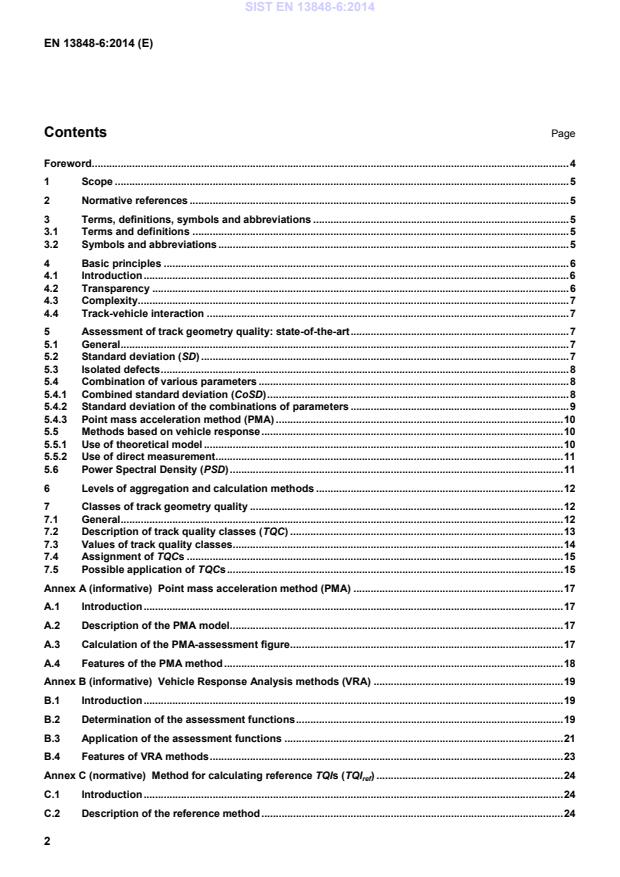
Point mass acceleration method (PMA) . 17 A.1 Introduction . 17 A.2 Description of the PMA model . 17 A.3 Calculation of the PMA-assessment figure . 17 A.4 Features of the PMA method . 18 Annex B (informative)
Vehicle Response Analysis methods (VRA) . 19 B.1 Introduction . 19 B.2 Determination of the assessment functions . 19 B.3 Application of the assessment functions . 21 B.4 Features of VRA methods . 23 Annex C (normative)
Method for calculating reference TQIs (TQIref) . 24 C.1 Introduction . 24 C.2 Description of the reference method . 24 SIST EN 13848-6:2014
3 Annex D (informative)
Method of classification of alternative TQI using the TQCs . 26 D.1 Introduction. 26 D.2 Description of the conversion method . 26 Bibliography . 28
5 1 Scope This European Standard characterizes the quality of track geometry based on parameters defined in EN 13848-1 and specifies the different track geometry classes which should be considered. This European Standard covers the following topics: — description of track geometry quality; — classification of track quality according to track geometry parameters; — considerations on how this classification can be used; — this European Standard applies to high-speed and conventional lines of 1 435 mm and wider gauge; — this European Standard forms an integral part of EN 13848 series. 2 Normative references The following documents, in whole or in part, are normatively referenced in this document and are indispensable for its application. For dated references, only the edition cited applies. For undated references, the latest edition of the referenced document (including any amendments) applies. EN 13848-1, Railway applications - Track - Track geometry quality - Part 1: Characterisation of track geometry 3 Terms, definitions, symbols and abbreviations 3.1 Terms and definitions For the purposes of this document, the following terms and definitions apply. 3.1.1 re-colouring algorithm which modifies the spectral content of a signal aimed to compensate or apply the characteristics of a specific measuring system Note 1 to entry: The re-colouring is used in EN 13848 series to convert a chord measurement signal into a D1 or D2 measurement signal. 3.1.2 track quality class (TQC) characterization of track geometry quality as a function of speed and expressed as a range of TQIs 3.1.3 track quality index (TQI) value that characterises track geometry quality of a track section based on parameters and measuring methods compliant with EN 13848 series 3.2 Symbols and abbreviations For the purposes of this document, the following symbols and abbreviations apply. SIST EN 13848-6:2014
CL Cross level mm CoSD Combined standard deviation mm D1 Wavelength range 3 m <
≤ 25 m m D2 Wavelength range 25 m <
≤ 70 m m D3 Wavelength range 70 m <
≤ 150 m for longitudinal level Wavelength range 70 m <
≤ 200 m for alignment m
Wavelength m G Track gauge mm LL Longitudinal level mm MBS Multi Body System
NTQI National Track Quality Index
PMA Point Mass Acceleration (method)
PSD Power Spectral Density m2/(1/m) SD Standard deviation mm SDLL Standard deviation longitudinal level mm SDAL Standard deviation alignment mm TQI Track Quality Index
TQIref Reference Track Quality Index
TQC Track Quality Class
V Speed km/h VRA Vehicle Response Analysis (method)
NOTE In this European Standard, AL stands for “alignment” and is not to be confused with AL standing for “alert limit” as defined in EN 13848–5:2008+A1:2010. 4 Basic principles 4.1 Introduction It is necessary to standardize the way that track geometry quality is assessed in order to permit safe and cost-effective railway traffic by focusing on the functional requirements of both track and vehicle. Basic parameters for track geometry quality assessment As track geometry measurement, vehicles present their outputs in accordance with the parameters specified in EN 13848-1, any standardized assessment method shall be based on these parameters. 4.2 Transparency Any algorithm for track geometry quality assessment complying with this standard shall be fully documented, reproducible and available in the public domain. SIST EN 13848-6:2014
7 4.3 Complexity Track geometry quality should be assessed by as few TQIs as possible and the algorithm should be understandable by the user. 4.4 Track-vehicle interaction Track quality assessment should reflect the principles of track-vehicle interaction. For example, the track geometry defects of the same amplitude but different wavelengths lead to different vehicle responses and the required wavelength range will be different depending on the track-vehicle interaction parameters to be assessed. 5 Assessment of track geometry quality: state-of-the-art 5.1 General Track geometry quality can be characterized by various TQIs according to the level of aggregation they are used for. The TQIs described in the following sub-clauses are used by at least one of the European Railway Networks. They represent the current state-of-the-art of description of track geometry quality. 5.2 Standard deviation (SD) The standard deviation is one of the most commonly used TQIs by European Railway Networks. It represents the dispersion of a signal over a given track section, in relation to the mean value of this signal over the considered section. 1)(12−−=∑=NxxSDNii where N is the number of values in the sample; xi is the current value of a signal; x is the mean value of a signal; SD is the standard deviation. NOTE 1 Standard deviation is linked to the energy of the signal in a given wavelength range [, ] according to the following relationship: ∫=212)(2λλννdSSDxx, where Sxx is the PSD described in 5.6 below. SD is commonly calculated for the following parameters: — Longitudinal level D1; — Alignment D1. It is also calculated for other parameters such as: — Twist; — Track gauge; — Cross level; SIST EN 13848-6:2014
9 2222.LLLLCLCLGGALALSDwSDwSDwSDwCoSD+++= where SD
standard deviation of the individual geometry parameters; w
weighting factor of the individual geometry parameters; with the indices: AL
alignment, average of left and right rails; G
track gauge; CL
cross level; LL
longitudinal level, average of left and right rails. It is up to the Infrastructure Manager to determine the weighting factors, e.g. for tamping purposes the weighting factor wG should be zero. Another method might be to transform the standard deviations of geometry parameters or their combinations into a dimensionless number that can be used without distinction of line category, speed range and track geometry parameter. 5.4.2 Standard deviation of the combinations of parameters Standard deviation for a combination of track geometry parameters can be evaluated. This is based on the observation that the level of the combined signals may better reflect the vehicle behaviour than the individual signals. For example, a standard deviation, over a sliding 200 m length of track, can be evaluated for the sum of alignment and cross level in D1 as follows: — the alignments of left and right rails are combined into one signal, in curves by choosing the outer rail and on tangent track by either averaging or choosing one of the two rails; — cross level and alignment signals are combined together by using a sign convention so that an alignment defect to the right is added with the same sign to a cross level defect where right rail is lower than the left rail. Figure 1 shows an example of the combination of cross level ûz and alignment ywhere the signs are both positive; — the standard deviation of the combined signals is calculated over a sliding 200 m length of track. SIST EN 13848-6:2014
Key 1 reference position y = (ALright + ALleft) / 2 combination of alignment ûz = zright - zleft cross level s sum of cross level and alignment Figure 1 — Combination of alignment and cross level 5.4.3 Point mass acceleration method (PMA) The PMA method is based on the following principles: — The PMA model considers an unsprung virtual vehicle. It is assumed to be a point mass, thus only the motion of the centre of gravity is investigated. This point mass is guided in a certain distance over the track centre line. — The point mass is moved at a constant speed corresponding to the maximum allowed speed over the measured track section. — Due to the geometrical imperfection of the track, which is described by the longitudinal level and alignment of both rails, the point mass incurs accelerations ay and az in the horizontal and vertical directions. — The vectorial summation of these accelerations is used to characterize the track geometry quality. Theoretical background information as well as features of the PMA method are given in Annex A. 5.5 Methods based on vehicle response 5.5.1 Use of theoretical model Vehicle response analysis (VRA) can be used to make objective, quantified statements about the relationship between the track geometry quality and the vehicle’s responses at various speeds. It takes into consideration factors such as successions of isolated defects that might generate resonance, combinations of defects at the same location and local track design (e.g. curvature and cant). SIST EN 13848-6:2014
11 The VRA method is based on the following principles: — Calculation of vehicle response to the track geometry measured according to EN 13848-1. The vehicle response being represented by the wheel-rail forces and by accelerations of the vehicle running gear and car body; — Consideration of different vehicle types and speeds, taking into account the worst response of all vehicles considered at every measuring point; — The output can be referred back to single parameters like longitudinal level, twist and alignment; — The assessment criteria take into account the limit values given by EN 14363. When using this method attention should be paid to the consistency between the wavelength domain of the track geometry and the frequency range of the vehicle response parameters. An example of a VRA method as well as features of such methods are given in Annex B. 5.5.2 Use of direct measurement Although not generally used for TQIs calculation, direct measurements of vehicle response can help in assessing interaction between running vehicle and track, with respect to safety as well as ride quality. Usually the accelerations of bogie and car body are measured in both lateral and vertical directions, but measurement of wheel-rail forces, such as lateral and vertical forces (Y and Q), can also be made. Inspection runs are usually made on high speed lines, but they can also be of interest on conventional lines. The following principles should be respected when using direct measurement: — The vehicles used for these evaluations are representative of the rolling stock used on the assessed lines. — The runs are made at the maximum speed of the line, with a tolerance of ± 10 %. — The measurements are made at the parts of the vehicle where the highest response is expected, e.g. the leading bogie or wheelset. — The state of the rail surface (wet or dry) is taken into account. — The position of the train shall be known to be able to locate any defects found. 5.6 Power Spectral Density (PSD) The PSD gives the energy of the signal in relation to frequency for a given track geometry parameter measured over a given track section. For a track geometric parameter x, the most commonly used formula to calculate the PSD is given by: )()(1lim)(ννλνλXXSxx∞→= where
is the wavelength and
the respective spatial frequency; ∫+∞∞−−=λλνπνλdexXi2)()( is the Fourier transformation of x(); SIST EN 13848-6:2014
...