

EN 13848-1:2019
(Main)Railway applications - Track - Track geometry quality - Part 1: Characterization of track geometry
- Abstract
This document gives definitions for the principal track geometry parameters and specifies minimum requirements for measurement and the analysis methods. The aim is to allow the comparability of the output of different measuring systems.
This document does not apply to Urban Rail Systems.
- Status
- Published
- Publication Date
- 26-Mar-2019
- Withdrawal Date
- 29-Sep-2019
- Technical Committee
- CEN/TC 256 - Railway applications
- Drafting Committee
- CEN/TC 256/SC 1/WG 28 - Track geometry quality
- Current Stage
- 9093 - Decision to confirm - Review Enquiry
- Start Date
- 03-Sep-2024
- Completion Date
- 21-Oct-2026


Overview
EN 13848-1:2019 - Railway applications - Track - Track geometry quality - Part 1: Characterization of track geometry defines the principal track geometry parameters, measurement requirements and analysis methods to ensure comparable outputs from different measuring systems. The standard establishes a common track coordinate system and parameter definitions for gauge, longitudinal level, cross level, alignment, twist and related quantities. It is intended for mainline railway infrastructure (it does not apply to Urban Rail Systems).
Key topics and technical requirements
- Definitions and terms - precise wording for all principal track geometry parameters and symbols.
- Track coordinate system - standardized reference for position and measurement reporting.
- Principal parameters - treatment of track gauge, longitudinal level, cross level, alignment, twist, including required measurement method descriptions.
- Measurement characteristics - specification of wavelength ranges, resolution, measurement uncertainty, sampling and range of measurement for each parameter.
- Analysis methods - standard procedures for processing raw measurements into parameters and indicators for comparability.
- Filtering and signal processing - normative filter requirements (Annex C) and background guidance (Annex D) including tolerance bands and reference filters.
- Decolouring - new informative Annex A describes decolouring (removal of measurement bias) and verification methods.
- Additional outputs - guidance on acceleration measurement (Annex E), simulation‑ready geometry data (Annex F), cyclic irregularities and dip angle (Annex B).
- Verification and output presentation - requirements to support consistent reporting and comparison between systems.
Practical applications
EN 13848-1:2019 supports consistent, comparable track geometry measurement and reporting for:
- Infrastructure managers conducting condition monitoring, maintenance planning and quality control.
- Measurement system manufacturers and suppliers of track recording vehicles, inspection cars and lightweight devices for calibration and compliance.
- Contractors and maintenance teams specifying acceptance criteria for construction and renewal work.
- Vehicle dynamics engineers and simulation teams using standardized geometry data for ride quality and safety analyses.
- Regulators and auditors assessing conformity with EU Directive 2008/57/EC and national requirements.
By standardizing definitions, filtering and analysis, the standard improves interoperability between measuring systems and enables reliable benchmarking of track quality.
Related standards
- EN 13848-2: Measuring systems - Track recording vehicles
- EN 13848-3: Measuring systems - Track construction and maintenance machines
- EN 13848-4: Measuring systems - Manual and lightweight devices
- EN 13848-5: Geometric quality levels - Plain line, switches and crossings
- EN 13848-6: Characterisation of track geometry quality
- Linked to EU Directive 2008/57/EC (see Annex ZA)
Keywords: EN 13848-1:2019, track geometry, railway track quality, measurement uncertainty, track recording vehicle, alignment, longitudinal level, filtering, decolouring.
Relations
- Effective Date
- 18-Jun-2014
- Effective Date
- 28-Jan-2026
- Effective Date
- 28-Jan-2026
- Effective Date
- 28-Jan-2026
- Effective Date
- 28-Jan-2026
- Effective Date
- 12-Aug-2026
- Effective Date
- 28-Jan-2026
- Effective Date
- 28-Jan-2026
- Effective Date
- 28-Jan-2026
- Effective Date
- 28-Jan-2026
- Effective Date
- 28-Jan-2026
- Effective Date
- 28-Jan-2026
- Effective Date
- 28-Jan-2026
- Effective Date
- 28-Jan-2026
- Effective Date
- 28-Jan-2026
Get Certified
Connect with accredited certification bodies for this standard

Zavod za gradbeništvo Slovenije (ZAG) - Inšpekcija
ZAG inspection body for construction products, structures, and materials.
Sponsored listings
Frequently Asked Questions
EN 13848-1:2019 is a standard published by the European Committee for Standardization (CEN). Its full title is "Railway applications - Track - Track geometry quality - Part 1: Characterization of track geometry". This standard covers: This document gives definitions for the principal track geometry parameters and specifies minimum requirements for measurement and the analysis methods. The aim is to allow the comparability of the output of different measuring systems. This document does not apply to Urban Rail Systems.
This document gives definitions for the principal track geometry parameters and specifies minimum requirements for measurement and the analysis methods. The aim is to allow the comparability of the output of different measuring systems. This document does not apply to Urban Rail Systems.
EN 13848-1:2019 is classified under the following ICS (International Classification for Standards) categories: 93.100 - Construction of railways. The ICS classification helps identify the subject area and facilitates finding related standards.
EN 13848-1:2019 has the following relationships with other standards: It is inter standard links to EN 13848-1:2003+A1:2008, EN 13848-5:2017, EN 13848-2:2020, EN 13848-3:2021, EN 13848-4:2025, EN 13848-6:2026, EN 13848-6:2014+A1:2020, EN 13231-1:2006, CEN/TR 16978:2016, EN 14363:2005, EN 13848-6:2014, EN 13231-1:2013, EN 14969:2006, EN 14363:2016, EN 13231-1:2023. Understanding these relationships helps ensure you are using the most current and applicable version of the standard.
EN 13848-1:2019 is associated with the following European legislation: EU Directives/Regulations: 2008/57/EC, 2016/797/EU, 2016/797/EU, 2016/797/EU, 2016/797/EU, 2016/797/EU, 2016/797/EU, 2016/797/EU, 2016/797/EU, 2016/797/EU, 2016/797/EU, 2016/797/EU, 2016/797/EU, 2016/797/EU; Standardization Mandates: M/024, M/483. When a standard is cited in the Official Journal of the European Union, products manufactured in conformity with it benefit from a presumption of conformity with the essential requirements of the corresponding EU directive or regulation.
EN 13848-1:2019 is available in PDF format for immediate download after purchase. The document can be added to your cart and obtained through the secure checkout process. Digital delivery ensures instant access to the complete standard document.
Standards Content (Sample)
2003-01.Slovenski inštitut za standardizacijo. Razmnoževanje celote ali delov tega standarda ni dovoljeno.Železniške naprave - Zgornji ustroj proge - Kakovost tirne geometrije - 1. del: Karakteristike tirne geometrijeBahnanwendungen - Oberbau - Gleislagequalität - Teil 1: Beschreibung der GleisgeometrieApplications ferroviaires - Voie - Qualité géométrique de la voie - Partie 1: Caractérisation de la géométrie de voieRailway applications - Track - Track geometry quality - Part 1: Characterisation of track geometry93.100Gradnja železnicConstruction of railways45.080Rails and railway componentsICS:Ta slovenski standard je istoveten z:EN 13848-1:2019SIST EN 13848-1:2019en,fr,de01-junij-2019SIST EN 13848-1:2019SLOVENSKI
STANDARDSIST EN 13848-1:2004+A1:20081DGRPHãþD
EUROPEAN STANDARD NORME EUROPÉENNE EUROPÄISCHE NORM
EN 13848-1
March
t r s { ICS
{ uä s r r Supersedes EN
s u z v zæ sã t r r u ªA sã t r r zEnglish Version
Railway applications æ Track æ Track geometry quality æ Part
sã Characterization of track geometry Applications ferroviaires æ Voie æ Qualité géométrique de la voie æ Partie
sã Caractérisation de la géométrie de voie
Bahnanwendungen æ Oberbau æ Gleislagequalität æ Teil
sã Beschreibung der Gleisgeometrie This European Standard was approved by CEN on
t u December
t r s zä
egulations which stipulate the conditions for giving this European Standard the status of a national standard without any alterationä Upætoædate lists and bibliographical references concerning such national standards may be obtained on application to the CENæCENELEC Management Centre or to any CEN memberä
translation under the responsibility of a CEN member into its own language and notified to the CENæCENELEC Management Centre has the same status as the official versionsä
CEN members are the national standards bodies of Austriaá Belgiumá Bulgariaá Croatiaá Cyprusá Czech Republicá Denmarká Estoniaá Finlandá Former Yugoslav Republic of Macedoniaá Franceá Germanyá Greeceá Hungaryá Icelandá Irelandá Italyá Latviaá Lithuaniaá Luxembourgá Maltaá Netherlandsá Norwayá Polandá Portugalá Romaniaá Serbiaá Slovakiaá Sloveniaá Spainá Swedená Switzerlandá Turkey and United Kingdomä
EUROPEAN COMMITTEE FOR STANDARDIZATION COMITÉ EUROPÉEN DE NORMALISATION EUROPÄISCHES KOMITEE FÜR NORMUNG
CEN-CENELEC Management Centre:
Rue de la Science 23,
B-1040 Brussels
t r s { CEN All rights of exploitation in any form and by any means reserved worldwide for CEN national Membersä Refä Noä EN
s u z v zæ sã t r s { ESIST EN 13848-1:2019
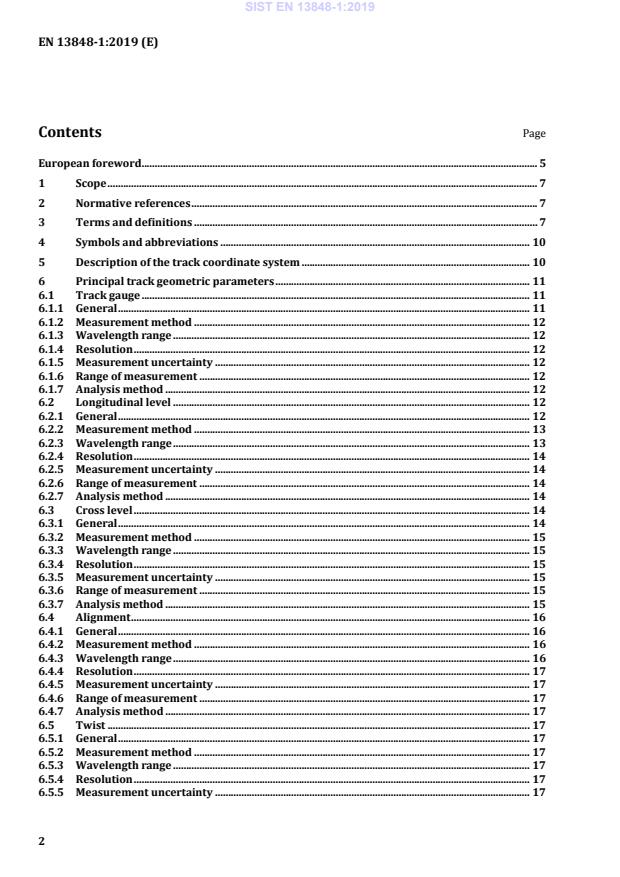
Decolouring process . 19 A.1 Definition of decolouring . 19 A.2 Decolouring method . 20 A.3 Verification of a decolouring process . 21 A.3.1 Introduction. 21 A.3.2 Verification with test signals . 21 A.3.3 Verification with recorded track geometry data . 22 Annex B (informative)
Other parameters . 24 B.1 Introduction. 24 B.2 Parameters obtained by direct measurement . 24 B.3 Parameters obtained by derived measurement to establish in-service values . 24 B.3.1 Cyclic irregularities . 24 B.3.2 Dip angle . 25 B.3.3 Other parameters . 25 B.3.4 Rail measurements . 26 B.3.5 Supporting data . 26 Annex C (normative)
Filter requirements . 27 C.1 General requirements . 27 C.2 Tolerance bands for filter transfer functions . 27 C.2.1 Introduction. 27 C.2.2 Filter for D1 . 27 C.2.3 Filter for D2 . 30 Annex D (informative)
Background to filtering . 33 D.1 Selection of tolerance bands . 33 D.2 Guideline for custom filters . 33 D.3 Implementation of filters . 36 D.3.1 Off-line implementation . 36 D.3.2 Online implementation . 36 D.4 Reference filter . 37 D.5 Conversion of results of deviating filters . 37 D.6 Comparison of different measurement systems . 42 Annex E (informative)
Measurement of acceleration . 43 E.1 Introduction. 43 E.2 Measurement method . 43 E.3 Frequency range . 43 E.4 Range of measurement . 43 E.5 Sampling frequency . 43 E.6 Measurement conditions . 44 E.7 Analysis method . 44 E.8 Output requirements . 44 E.9 Output presentation . 44 Annex F (informative)
Track geometry data for simulation purposes . 45 F.1 Introduction. 45 F.2 Contents of track geometry data for simulation purposes . 45 F.3 Extended wavelength range. 46 F.4 Numerical resolution . 46 F.5 Pre-processing for simulation . 47 SIST EN 13848-1:2019
Relationship between this European Standard and the Essential Requirements of EU Directive 2008/57/EC aimed to be covered . 48 Bibliography . 50
IEC Electropedia: available at http://www.electropedia.org/
ISO Online browsing platform: available at http://www.iso.org/obp
NOTE Refer also to the symbols and definitions described in Clause 4. 3.1 track geometry quality assessment of excursions in the vertical and lateral planes from the mean or designed geometrical characteristics of specified parameters which give rise to safety concerns or have a correlation with ride quality 3.2 gauge face inside face of the running rail head 3.3 running table upper surface of the head of the rail Note 1 to entry: See Figure 1. SIST EN 13848-1:2019
Key 1 running table Figure 1 — Running table 3.4 running surface curved surface defined by the longitudinal displacement of a straight line perpendicular to the centre-line of the track and tangential to both running tables Note 1 to entry: See Figure 2.
Figure 2 — Running surface 3.5 uncertainty quantity defining an interval about a result of a measurement expected to encompass a large fraction of the distribution of values that could reasonably be attributed to the measurand [refer to ISO 21748] Note 1 to entry: The coverage factor is equal to 2. The uncertainty as defined corresponds to a confidence interval of about 95 % of a normal distribution. Note 2 to entry: The value applicable for track recording vehicles is described in EN 13848-2. For other measurement devices specific values may apply according to EN 13848-3 and EN 13848-4. SIST EN 13848-1:2019
8 D0, D1, D2, D3 Wavelength ranges m 9
Wavelength m 10 V1 Amplitude from the zero line. Used in the measurement of Twist mm/m 11 V2 Amplitude from the mean value. Used in the measurement of Twist mm/m 12
º Twist base-length m 13 X, Y, Z Axes of a track coordinate system
5 Description of the track coordinate system The track geometry quality is described by means of a moving right-hand Cartesian coordinate system centred to the track with clockwise rotation (refer to Figure 3): — X-axis: axis represented as an extension of the track towards the direction of running; — Y-axis: axis parallel to the running surface; — Z-axis: axis perpendicular to the running surface and pointing downwards. NOTE This description is for the coordinate system of the measurement vehicle. It is up to the infrastructure manager to define a reference direction of the track. SIST EN 13848-1:2019
Key 1 running direction 2 intersection between considered cross section and running surface 3 track coordinate system Figure 3 — Relationship between the axes of the track coordinate system Rail identification (left or right rail) is not in the scope of the document, but is to be defined for the purpose of exchanging data. 6 Principal track geometric parameters 6.1 Track gauge 6.1.1 General Track gauge, G, is the smallest distance between lines perpendicular to the running surface intersecting each rail head profile at point P in a range from 0 to Zp below the running surface. In this standard Zp is always 14 mm. In the situation of new unworn rail head the point P will be at the limit Zp below the railhead, see Figure 4.
Key 1 running surface Figure 4 — Track gauge for new rail In the situation of worn rail head the height of point P for the left rail can be different from the right rail, see Figure 5. SIST EN 13848-1:2019
Key 1 running surface Figure 5 — Track gauge for worn rail 6.1.2 Measurement method Track gauge can be measured using a contact system or a non-contact system. 6.1.3 Wavelength range Not applicable. 6.1.4 Resolution The values of resolution depend on the type of measuring system and are given in the corresponding parts of the standard EN 13848-2, EN 13848-3 and EN 13848-4. 6.1.5 Measurement uncertainty The values of uncertainty depend on the type of measuring system and are given in the corresponding parts of the standard EN 13848-2, EN 13848-3 and EN 13848-4. 6.1.6 Range of measurement The range shall be the nominal gauge
« s w mm/+50 mm. 6.1.7 Analysis method Individual defects are represented by the amplitude from the nominal value to the peak value (minimum and maximum peak value). 6.2 Longitudinal level 6.2.1 General Longitudinal level is the deviation zll in z-direction of running table levels on any rail from the smoothed vertical position (reference line) expressed in defined wavelength ranges. The smoothing is applied over a length that covers the wavelength range of interest (minimum two times the upper limit of the wavelength range of interest). The reference line and the longitudinal level are calculated from successive measurements (refer to Figure 6). SIST EN 13848-1:2019
Key 1 running table 2 reference line Figure 6 — Longitudinal level 6.2.2 Measurement method Longitudinal level measurements shall be made with either an inertial system or a versine system (that should preferably be asymmetric) or by a combination of both methods. If the versine method of measurement is used, a decolouring of the measured signals is necessary in order to eliminate the influence of the transfer function of the versine system (see Annex A). NOTE In the case of limited analysis length, the longitudinal level can be evaluated also from geodetic measurements. 6.2.3 Wavelength range Three ranges expressed in wavelengths () shall be considered: — D1: 3 m <
¶ 25 m; — D2: 25 m <
¶ 70 m; — D3: 70 m <
¶ 150 m, used for measuring long wavelength defects. Generally this range should only be considered for line speeds greater than 230 km/h. NOTE Other wavelengths longer than 70 m can also be taken into consideration by the vertical curvature parameter (refer to Annex B); however, this does not give an equivalent assessment of D3 domain. In order to detect short wavelength defects, which can generate high dynamic forces, an optional wavelength range can be considered: D0: 1 m <

w m (1) SIST EN 13848-1:2019
Key 1 cross level 2 running surface 3 horizontal reference plane 4 hypotenuse Figure 7 — Cross level 6.3.2 Measurement method Cross level is determined by measuring either the angle between the running surface and the horizontal reference plane or the difference in height between the two running tables. 6.3.3 Wavelength range Not applicable. 6.3.4 Resolution The values of resolution depend on the type of measuring system and are given in the corresponding parts of the standard EN 13848-2, EN 13848-3 and EN 13848-4. 6.3.5 Measurement uncertainty The values of uncertainty depend on the type of measuring system and are given in the corresponding parts of the standard EN 13848-2, EN 13848-3 and EN 13848-4. 6.3.6 Range of measurement The range of measurements shall be ± 225 mm. 6.3.7 Analysis method Individual defects are represented by the amplitude from the low pass filtered value to the peak value. NOTE Usually a sliding mean over 40 m is used as a low pass filter. In addition, the measured values (defined as amplitude between zero and peak values) may be compared with the design values. SIST EN 13848-1:2019
Key P point P according to 6.1.1 2 reference line Figure 8 — Alignment 6.4.2 Measurement method Alignment measurements shall be made with either an inertial system or a versine system (that should preferably be asymmetric) or by a combination of both methods. If the versine method of measurement is used, a decolouring of the measured signals is necessary in order to eliminate the influence of the transfer function of the versine system. 6.4.3 Wavelength range Three ranges expressed in wavelengths () shall be considered: — D1: 3 m <
¶ 25 m; — D2: 25 m <
¶ 70 m; — D3: 70 m <
¶ 200 m, used for measuring long wavelength defects. Generally this range should only be considered for line speeds greater than 230 km/h. In order to detect short wavelength defects, which can generate high dynamic forces, an optional wavelength range can be considered: — D0: 1 m <
¶ 5 m. When measuring in the domain D0, the sampling distance should be reduced to 0,1 m. Due to the lack of experience in this domain no additional requirements are given presently. SIST EN 13848-1:2019
Key 1 low pass filtered value (mean) 2 twist 3 zero line Figure 9 — Twist – Analysis method 7 Measurement conditions In order to reproduce the dynamic effects of vehicles, all of the geometric parameters should preferably be measured on a loaded track, in which case, the applied loading at the measuring point of the rail shall be equivalent to a minimum vertical wheel load of 25 kN when considering a mean track stiffness of 90 kN/mm per rail (wheel load divided by rail deflection) and a rail profile 60E1. There can be differences in all track geometry parameter values according to whether they are measured in loaded or unloaded, or static or dynamic conditions. These differences should be taken into account when comparing measurements made under different conditions. In case of unloaded or static measurement conditions, such conditions shall be documented. The results of measurements shall be within the specified measurement precision for different speeds and for each direction of recording. If this is not the case, the domain of validity and/or the direction of travel shall be specified. All parameters shall be measured at the same location within the sampling distance specified. All principal parameters shall be measured at the same sampling distance. For signal processing and signal analysis reasons this sampling distance should not exceed 0,25 m. The localization uncertainty of all discrete measurements shall be within ± 10 m. The uncertainty of the sampling distance shall be within 1 ‰. SIST EN 13848-1:2019
Decolouring process A.1 Definition of decolouring If track geometry is recorded with a chord measurement system, the measured signals (versine) of longitudinal level and alignment are distorted in magnitude and phase. The process of compensating these distortions of the signals is called “decolouring”, i.e. removing the “colour” due to the chord measurement. For example, decolouring of a chord measurement is required if the track geometry is assessed according to the EN 13848 series or if used for simulation purposes. The distortion depends on the chord length and on the chord division. In the case of an asymmetric chord division, it also depends on the running direction of the measurement car. As an example for the distortion, Figure A.1 shows a comparison between chord measurement and the corresponding decoloured signal along a short track section.
Key 1 decoloured signal 2 chord measurement X distance [m] Y amplitude [mm] Figure A.1 — Example of distortion due to chord measurement The distortion can be described with the help of the transfer function. The magnitude of the transfer function represents the amplification factor as a function of the wavelength. The magnitude lies SIST EN 13848-1:2019
Key X wavelength |m] Y magnitude [-] and phase [°] Figure A.2 — Example of transfer function of chord measurement (chord division: 4 m/6 m) A.2 Decolouring method There are a number of methods for decolouring. A selection of references to literature is given below. — Haigermoser A. Dynotrain Deliverable D2.6 — Final report on track geometry. Tech. rep. Dynotrain Consortium, 2013 — Wolter, Klaus Ulrich: European Patent: Reconstruction of original signals from relative measurements, EP 1543439 A1, DB Netz AG, June 2005 — Aknin, Patrice; Chollet, Hugues: A new approach for the modelling of track geometry recording vehicles and the deconvolution of versine measurements. Vehicle System Dynamics Supplement 33 (1999), pp. 59-70 — Mauer, Lutz: Determination of Track Irregularities and Stiffness Parameters with Inverse Transfer Functions of Track Recording Vehicles. Vehicle System Dynamics Supplement 24 (1995), pp. 117-132 SIST EN 13848-1:2019
Key 1 test signal 2 decolouring 3 decolouring error 4 bandpass filter with zero phase 5 application of versine Figure A.3 — Verification of decolouring with a test signal The comparison of signals at point 4 can be done in the space domain and in the frequency domain by computing the transfer function and coherence function between the output signals of points 1 and 3. For other wavelength ranges a similar process can be applied. SIST EN 13848-1:2019
Key 1 left alignment D1 2 right alignment D1 3 cross check 4 zero phase 5 track gauge Figure A.4 —Verification of decolouring with recorded data SIST EN 13848-1:2019
Other parameters B.1 Introduction The principal track geometric parameters are described in the relevant part of this standard. However, other parameters contribute to an understanding of vehicle track interaction and ride quality. These other parameters can be obtained by direct measurement or by derived measurement. Other supportive data may be necessary in order to facilitate calculation of the derived measurements. A representative list of other parameters is shown in the following. B.2 Parameters obtained by direct measurement The following parameters can be measured directly: — Horizontal curvature (1/m); — Vertical curvature (1/m); — Gradient (mm/m); — Acceleration (m/s2) (refer to Annex E). B.3 Parameters obtained by derived measurement to establish in-service values B.3.1 Cyclic irregularities Cyclic irregularities are a derailment risk that involves a harmonic response by specific types of railway vehicles. Such vehicles are built with a suspension system that is vulnerable to this phenomenon. A cyclic isolated defect occurs when a measured parameter (e.g. longitudinal level at D1) has a value that repeats
...