

EN 660-2:1999
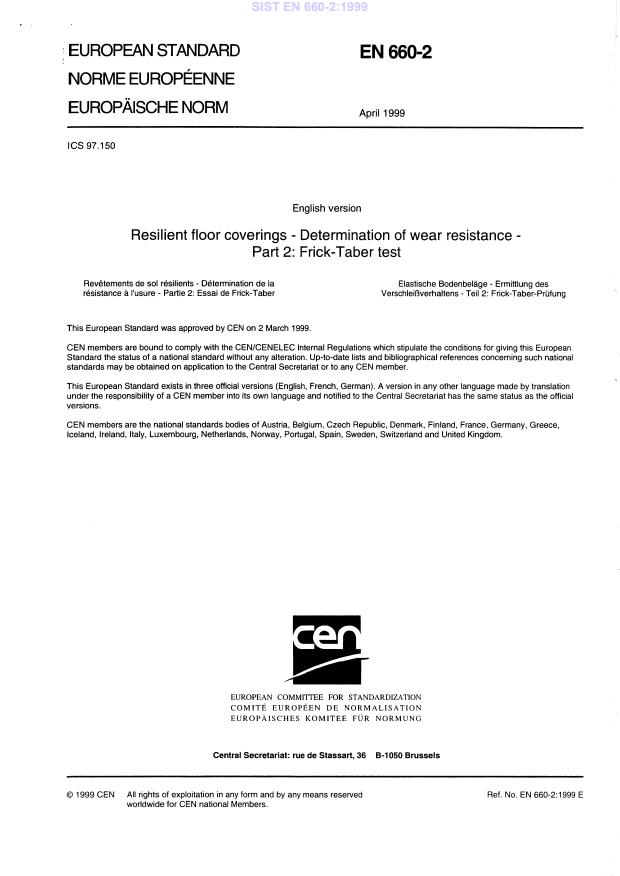
(Main)Resilient floor coverings - Determination of wear resistance - Part 2: Frick-Taber test
- Abstract
This European Standard describes the Frick-Taber method for determining the wear resistance of the wear layer of polyvinyl chloride floor coverings under laboratory conditions. The test method is applicable to floor coverings with smooth surfaces. It can be used to determine the wear resistance of surfaces against abrasion and particularly for ranking different wear layer types within one type of product. It is not appropriate for comparing the wear resistance of different materials, e.g. rubber and polyvinyl chloride.
- Status
- Published
- Publication Date
- 20-Apr-1999
- Withdrawal Date
- 30-Oct-1999
- Technical Committee
- CEN/TC 134 - Resilient and textile floor coverings
- Drafting Committee
- CEN/TC 134/WG 7 - Resilient floor coverings
- Current Stage
- 9093 - Decision to confirm - Review Enquiry
- Start Date
- 10-Mar-2024
- Completion Date
- 30-Sep-2026

Overview
EN 660-2:1999 - Resilient floor coverings: Determination of wear resistance - Part 2: Frick‑Taber test (CEN) defines a laboratory abrasion method to evaluate the wear resistance of the wear layer of polyvinyl chloride (PVC) floor coverings. The standard applies to smooth-surfaced resilient floor coverings and is intended primarily to rank and compare different wear layer types within a single product family under controlled conditions. It is not intended for cross‑material comparisons (for example, PVC vs rubber).
Key topics
- Scope and applicability: Specifies that the method targets PVC wear layers on smooth surfaces and is useful for intra‑product ranking rather than inter‑material comparison.
- Test principle: Uses the Frick‑Taber abrasion approach (a laboratory abrasion test) to assess how a wear layer resists surface wear and abrasion under defined lab conditions.
- Measured outcome: Provides a repeatable basis for comparing relative wear performance of different wear layer formulations or surface constructions.
- Limitations: Clarifies that the results are specific to the test conditions and sample type and should not be used to directly compare fundamentally different materials (e.g., rubber).
- Standard identification: Assigned to the non‑textile floor coverings classification (ICS 97.150).
Applications
- Product development: Manufacturers of PVC floor coverings use EN 660-2:1999 to evaluate and optimize wear-layer formulations and surface treatments during R&D.
- Quality control: Production and QA laboratories apply the Frick‑Taber test to verify batch‑to‑batch consistency of wear resistance.
- Product specification and ranking: Flooring specifiers and procurement teams use test results to rank different wear layer types within the same product family for intended service life and durability expectations.
- Certification and documentation: Test data from EN 660-2:1999 supplement technical files, datasheets, and performance claims for resilient flooring.
Who should use this standard
- Flooring manufacturers and product developers
- Independent testing laboratories and QA teams
- Architects, specifiers, and facility managers requiring comparative wear data
- Importers and compliance officers documenting product performance
Related standards
- EN 660 series (other parts addressing different abrasion test methods and conditions) - useful when selecting complementary test methods for different surface types or comparison needs.
- Reference to CEN standards and national adoptions (e.g., local translations or identical national standards) may be relevant for procurement and compliance.
Keywords: EN 660-2:1999, Frick‑Taber test, wear resistance, resilient floor coverings, PVC floor coverings, abrasion test, smooth surfaces, floor covering testing.
Relations
- Effective Date
- 28-Jan-2026
- Effective Date
- 28-Jan-2026
- Effective Date
- 28-Jan-2026
- Effective Date
- 28-Jan-2026
- Effective Date
- 28-Jan-2026
- Effective Date
- 28-Jan-2026
- Effective Date
- 28-Jan-2026
- Effective Date
- 28-Jan-2026
- Effective Date
- 28-Jan-2026
- Effective Date
- 28-Jan-2026
- Effective Date
- 28-Jan-2026
- Effective Date
- 28-Jan-2026
- Effective Date
- 22-Dec-2008
Frequently Asked Questions
EN 660-2:1999 is a standard published by the European Committee for Standardization (CEN). Its full title is "Resilient floor coverings - Determination of wear resistance - Part 2: Frick-Taber test". This standard covers: This European Standard describes the Frick-Taber method for determining the wear resistance of the wear layer of polyvinyl chloride floor coverings under laboratory conditions. The test method is applicable to floor coverings with smooth surfaces. It can be used to determine the wear resistance of surfaces against abrasion and particularly for ranking different wear layer types within one type of product. It is not appropriate for comparing the wear resistance of different materials, e.g. rubber and polyvinyl chloride.
This European Standard describes the Frick-Taber method for determining the wear resistance of the wear layer of polyvinyl chloride floor coverings under laboratory conditions. The test method is applicable to floor coverings with smooth surfaces. It can be used to determine the wear resistance of surfaces against abrasion and particularly for ranking different wear layer types within one type of product. It is not appropriate for comparing the wear resistance of different materials, e.g. rubber and polyvinyl chloride.
EN 660-2:1999 is classified under the following ICS (International Classification for Standards) categories: 97.150 - Floor coverings. The ICS classification helps identify the subject area and facilitates finding related standards.
EN 660-2:1999 has the following relationships with other standards: It is inter standard links to EN ISO 23996:2012, EN 655:2011, EN 13845:2017, EN 652:2011, EN 651:2011, EN 13892-7:2003, EN 649:2011, EN 650:2012, EN 13845:2005, EN 650:2025, EN 13413:2001, CEN/TS 15398:2016, EN 660-2:1999/A1:2003. Understanding these relationships helps ensure you are using the most current and applicable version of the standard.
EN 660-2:1999 is associated with the following European legislation: EU Directives/Regulations: 305/2011, 89/106/EEC. When a standard is cited in the Official Journal of the European Union, products manufactured in conformity with it benefit from a presumption of conformity with the essential requirements of the corresponding EU directive or regulation.
EN 660-2:1999 is available in PDF format for immediate download after purchase. The document can be added to your cart and obtained through the secure checkout process. Digital delivery ensures instant access to the complete standard document.
Standards Content (Sample)
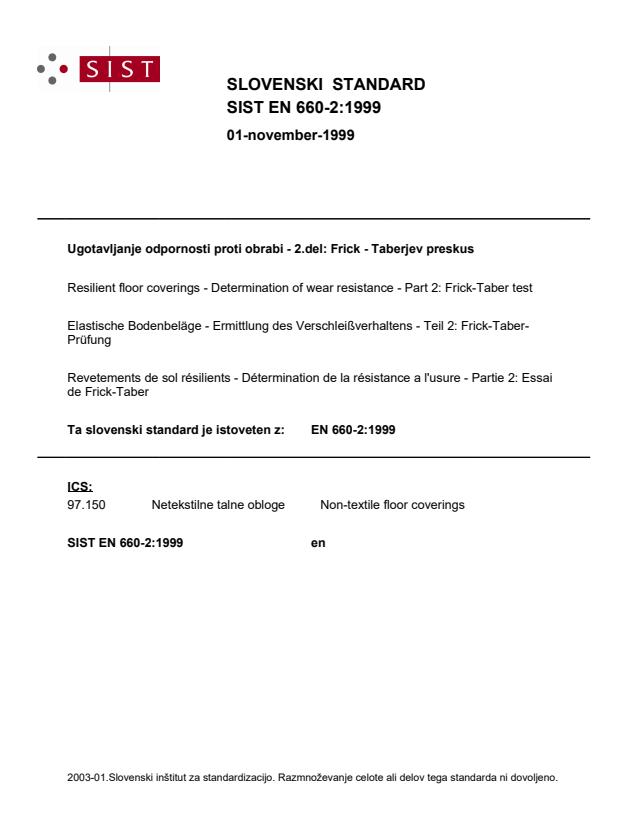
SLOVENSKI STANDARD
01-november-1999
Ugotavljanje odpornosti proti obrabi - 2.del: Frick - Taberjev preskus
Resilient floor coverings - Determination of wear resistance - Part 2: Frick-Taber test
Elastische Bodenbeläge - Ermittlung des Verschleißverhaltens - Teil 2: Frick-Taber-
Prüfung
Revetements de sol résilients - Détermination de la résistance a l'usure - Partie 2: Essai
de Frick-Taber
Ta slovenski standard je istoveten z: EN 660-2:1999
ICS:
97.150 Netekstilne talne obloge Non-textile floor coverings
2003-01.Slovenski inštitut za standardizacijo. Razmnoževanje celote ali delov tega standarda ni dovoljeno.
...