

EN 15221-7:2012
(Main)Facility Management - Part 7: Guidelines for Performance Benchmarking
- Abstract
This European Standard gives guidelines for performance benchmarking and contains clear terms and definitions as well as methods for benchmarking facility management products and services as well as facility management organisations and operations.
This European Standard establishes a common basis for benchmarking facility management costs, floor areas and environmental impacts as well as service quality, satisfaction and productivity.
This European Standard is applicable to Facility Management as defined in EN 15221-1 and detailed in EN 15221-4.
- Status
- Withdrawn
- Publication Date
- 16-Oct-2012
- Withdrawal Date
- 06-Oct-2026
- Technical Committee
- CEN/TC 348 - Facility management
- Drafting Committee
- CEN/TC 348 - Facility management
- Current Stage
- 9960 - Withdrawal effective - Withdrawal
- Start Date
- 05-Nov-2025
- Completion Date
- 07-Oct-2026

Relations
- Effective Date
- 30-Apr-2025
- Effective Date
- 28-Jan-2026
- Refers
EN 15221-6:2011 - Facility Management - Part 6: Area and Space Measurement in Facility Management - Effective Date
- 28-Jan-2026
- Effective Date
- 28-Jan-2026
Get Certified
Connect with accredited certification bodies for this standard

BSI Group
BSI (British Standards Institution) is the business standards company that helps organizations make excellence a habit.

DIBt (Deutsches Institut für Bautechnik)
German Institute for Building Technology.
DIN CERTCO
DIN Group product certification.
Sponsored listings
Frequently Asked Questions
EN 15221-7:2012 is a standard published by the European Committee for Standardization (CEN). Its full title is "Facility Management - Part 7: Guidelines for Performance Benchmarking". This standard covers: This European Standard gives guidelines for performance benchmarking and contains clear terms and definitions as well as methods for benchmarking facility management products and services as well as facility management organisations and operations. This European Standard establishes a common basis for benchmarking facility management costs, floor areas and environmental impacts as well as service quality, satisfaction and productivity. This European Standard is applicable to Facility Management as defined in EN 15221-1 and detailed in EN 15221-4.
This European Standard gives guidelines for performance benchmarking and contains clear terms and definitions as well as methods for benchmarking facility management products and services as well as facility management organisations and operations. This European Standard establishes a common basis for benchmarking facility management costs, floor areas and environmental impacts as well as service quality, satisfaction and productivity. This European Standard is applicable to Facility Management as defined in EN 15221-1 and detailed in EN 15221-4.
EN 15221-7:2012 is classified under the following ICS (International Classification for Standards) categories: 03.080.99 - Other services; 35.240.99 - IT applications in other fields; 91.140.01 - Installations in buildings in general. The ICS classification helps identify the subject area and facilitates finding related standards.
EN 15221-7:2012 has the following relationships with other standards: It is inter standard links to EN 15221-8:2025, EN 15221-4:2011, EN 15221-6:2011, EN 15221-1:2006. Understanding these relationships helps ensure you are using the most current and applicable version of the standard.
EN 15221-7:2012 is available in PDF format for immediate download after purchase. The document can be added to your cart and obtained through the secure checkout process. Digital delivery ensures instant access to the complete standard document.
Standards Content (Sample)
2003-01.Slovenski inštitut za standardizacijo. Razmnoževanje celote ali delov tega standarda ni dovoljeno.Facility Management - Teil 7: Leitlinien für das Leistungs-BenchmarkingFacilities management - Partie 7: Étalonnage comparatif de performanceFacility Management - Part 7: Guidelines for Performance Benchmarking91.040.01Stavbe na splošnoBuildings in general03.080.99Druge storitveOther servicesICS:Ta slovenski standard je istoveten z:EN 15221-7:2012SIST EN 15221-7:2014en01-marec-2014SIST EN 15221-7:2014SLOVENSKI
STANDARD
EUROPEAN STANDARD NORME EUROPÉENNE EUROPÄISCHE NORM
EN 15221-7
October 2012 ICS 03.080.99; 91.140.01 English Version
Facility Management - Part 7: Guidelines for Performance Benchmarking
Facilities management - Partie 7: Étalonnage comparatif de performance
Facility Management - Teil 7: Leitlinien für das Leistungs-Benchmarking This European Standard was approved by CEN on 4 August 2012.
CEN members are bound to comply with the CEN/CENELEC Internal Regulations which stipulate the conditions for giving this European Standard the status of a national standard without any alteration. Up-to-date lists and bibliographical references concerning such national standards may be obtained on application to the CEN-CENELEC Management Centre or to any CEN member.
This European Standard exists in three official versions (English, French, German). A version in any other language made by translation under the responsibility of a CEN member into its own language and notified to the CEN-CENELEC Management Centre has the same status as the official versions.
CEN members are the national standards bodies of Austria, Belgium, Bulgaria, Croatia, Cyprus, Czech Republic, Denmark, Estonia, Finland, Former Yugoslav Republic of Macedonia, France, Germany, Greece, Hungary, Iceland, Ireland, Italy, Latvia, Lithuania, Luxembourg, Malta, Netherlands, Norway, Poland, Portugal, Romania, Slovakia, Slovenia, Spain, Sweden, Switzerland, Turkey and United Kingdom.
EUROPEAN COMMITTEE FOR STANDARDIZATION
COMITÉ EUROPÉEN DE NORMALISATION EUROPÄISCHES KOMITEE FÜR NORMUNG
Management Centre:
Avenue Marnix 17,
B-1000 Brussels © 2012 CEN All rights of exploitation in any form and by any means reserved worldwide for CEN national Members. Ref. No. EN 15221-7:2012: ESIST EN 15221-7:2014
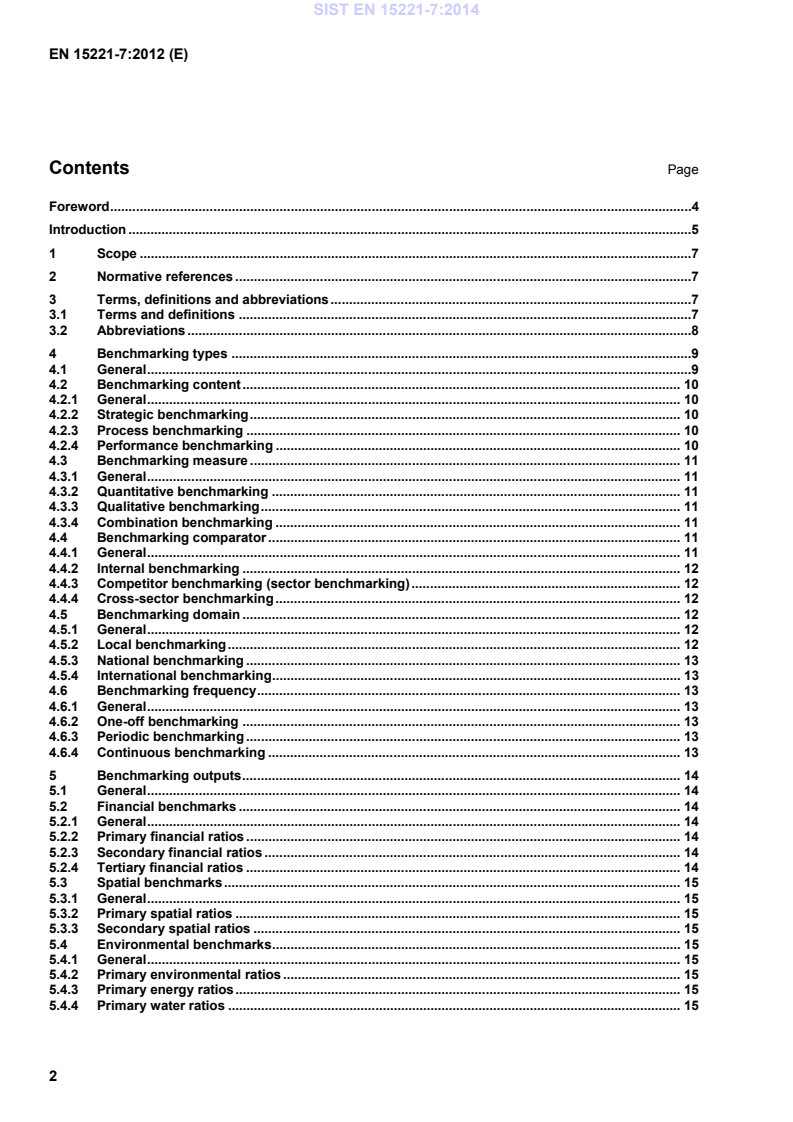
Performance data . 22Annex B (normative)
Collecting contextual data . 25Annex C (normative)
Collecting financial data . 26C.1General . 26C.2General accounting rules . 26C.3Rented versus owned buildings . 26Annex D (normative)
Collecting spatial data . 33D.1General . 33D.2General spatial rules . 33Annex E (normative)
Collecting environmental data . 35Annex F (normative)
Collecting service quality data . 48Annex G (normative)
Collecting satisfaction data . 55Annex H (informative)
Inherent complications and risks . 62Annex I (informative)
Benchmarking examples . 64Bibliography . 68 SIST EN 15221-7:2014
Before starting an FM Benchmarking operation, it is highly recommended to clearly position it regarding
to the four main aspects presented just below and then use the content of this standard to prepare and perform the benchmarking operation. This standard takes as a starting point the idea that Benchmarking can take very different forms depending on four aspects:
a) The perspective of the initiator performing the benchmarking process:
1) customer or consumer of FM services; 2) internal or provider of FM services; b) The objectives of the benchmarking process set by the initiator. These objectives are usually linked. They might include the following broad categories of objectives, which are set out in more detail in the standard: 1) find new ideas; 2) get data to prepare a main decision or to resolve disputes; 3) to reduce costs while maintaining a similar service level received or provided; 4) improve the service level received or provided while maintaining similar costs; 5) improve the use of resources; c) The point in time at which the organisation is considering performing an FM benchmarking operation; d) The benchmarking sample used for comparison, mostly: 1) Similar sector of primary activities, where comparisons are easier; 2) Other sectors of primary activities where the interest is mainly to find possible improvements. SIST EN 15221-7:2014
This standard seeks to simplify a notoriously complex process. Until now, benchmarking projects have often been confused, over-ambitious, and lacking in effective data analysis. By establishing a coherent and comprehensive process for benchmarking, along with useable and logical comparators, and by clarifying the many pitfalls in the comparison process, this standard provides practising facility managers with a range of key indicators to identify areas in which there might be a need to improve the performance of their own team, their supply chain, or the entire organisation in which they work. It is this coherent approach within the EN 15221 series which supports the basis of the Benchmarking standard. It is hoped that this platform will, in a short time, lead to a demand for more commonality in reporting of a range of comparators – financial, quality, and so on – which will make the work of facility managers more easy, and more easily understood by the organisation for which they work. SIST EN 15221-7:2014
EN 15221-1:2006, Facility Management Part 1: Terms and definitions EN 15221-4:2011, Facility Management Part 4: Taxonomy, Classification and Structures in Facility Management EN 15221-6:2011, Facility Management Part 6: Area and Space Measurement in Facility Management 3 Terms, definitions and abbreviations 3.1 Terms and definitions For the purposes of this document, the terms and definitions given in EN 15221-1:2006, EN 15221-4:2011 and EN 15221-6:2011 and the following apply. 3.1.1 benchmarking process of comparing strategies, processes, performances and/or other entities against practices of the same nature, under the same circumstances and with similar measures Note 1 to entry: Typically the purpose of benchmarking is to improve strategies, processes, performances and/or other entities, but may also be used for different purposes such as accountability. Note 2 to entry: Measures can be quantitative or qualitative; comparators can be internal, competitors or cross-sector; domain can be local, national or international; frequency can be one-off, periodic or continuous. Note 3 to entry: It should be recognised that it might also be beneficial to compare entities to practices of a different nature, under different circumstances and/or with dissimilar measures. Note 4 to entry: This definition differs from EN 15221-1:2006. 3.1.2 entity concrete or abstract thing that exists, did exist, or might exist, including associations among these things 3.1.3 benchmark reference point or metric against which a strategy, process, performance and/or other entity can be measured SIST EN 15221-7:2014
Full Time Equivalent NFA
Net Floor Area
Figure 1 — Classification of benchmarking types Depending on the purpose of a benchmarking exercise, the scope (i.e. content, measure, comparator, domain and frequency) will differ. A non-exhaustive list of purposes and their typical scope is provided in Table 1. Table 1 — Typical benchmarking purposes
contentmeasurecomparator domainfrequency quantitative / qualitativepurpose strategy process performance finance space environment service quality satisfaction productivity internal competitor cross-sector local national international one-off periodic continuous Identification of improvement options 999999 9 9999 9 9 9 9999Resource-allocation decisions 9
9 9
9 99
Prioritisation of problem areas
99999 9 999
Verification legal compliance
9 9
99 Identification of best practices 99 999 9 99 9 9
9 99
Budget review and planning 9
9 9
999Alignment with corporate objectives 9
99 9 9 9 999 Improvementof process effectiveness
9 999 9 9999
9 9
99 Assessment of property performance
9999 9 9999 9 9 9 9999- Assessment of cost effectiveness
99 9 9 9 9999- Evaluation of floor space usage
9 9
9 9
99 - Appraisal of environmental impacts
9 9
99 - Assessment of service quality shortfalls
99 9 9 9 9999- Evaluation of end-user satisfaction
9 99
9 9
99 - Appraisal of individual productivity
9 9
99 Content - Strategy
- Process
- Performance Measure - Quantitative
- … … - Qualitative
- … … Comparator- Internal
- Competitor
- Cross-sector Domain- Local
- National
- International Frequency- One-off
- Periodic
- Continuous SIST EN 15221-7:2014
Figure 2 — Benchmarking process
Set objectives(purpose and scope) 1 Define methodology(indicators and benchmarks) 2 Select partners(peers and code of conduct) 3 Collect data(collect and validate) 4 Analyse data(determine and normalize) 5 Determine gaps(compare and explain) 6 Report findings(communicate and discuss) 7 Develop action plan(tasks and milestones) 8 Implement plan(change and monitor) 9 PREPARING IMPROVING COMPARING continuous improvement Process review(review and recalibrate) 10
...