

EN 13383-2:2013
(Main)Armourstone - Part 2: Test methods
- Abstract
This European Standard specifies sampling and test methods for natural, artificial and recycled aggregates for use as armourstone. This European Standard specifies the reference methods to be used for type testing and in case of dispute where an alternative method has been used. For other purposes, in particular factory production control, other methods may be used provided that an appropriate working relationship with the test method has been established.
- Status
- Withdrawn
- Publication Date
- 30-Apr-2013
- Withdrawal Date
- 06-Oct-2026
- Technical Committee
- CEN/TC 154 - Aggregates
- Drafting Committee
- CEN/TC 154/WG 10 - Armourstone
- Current Stage
- 9960 - Withdrawal effective - Withdrawal
- Start Date
- 01-Oct-2014
- Completion Date
- 07-Oct-2026

Relations
- Effective Date
- 08-Jun-2022
- Effective Date
- 25-Aug-2026
- Effective Date
- 28-Jan-2026
- Effective Date
- 28-Jan-2026
- Effective Date
- 28-Jan-2026
- Effective Date
- 28-Jan-2026
- Effective Date
- 28-Jan-2026
- Effective Date
- 28-Jan-2026
- Effective Date
- 28-Jan-2026
- Effective Date
- 28-Jan-2026
- Effective Date
- 28-Jan-2026
- Effective Date
- 28-Jan-2026
- Effective Date
- 28-Jan-2026
- Effective Date
- 22-Oct-2014
Get Certified
Connect with accredited certification bodies for this standard

DIBt (Deutsches Institut für Bautechnik)
German Institute for Building Technology.
DIN CERTCO
DIN Group product certification.

Aboma Certification B.V.
Specialized in construction, metal, and transport sectors.
Sponsored listings
Frequently Asked Questions
EN 13383-2:2013 is a standard published by the European Committee for Standardization (CEN). Its full title is "Armourstone - Part 2: Test methods". This standard covers: This European Standard specifies sampling and test methods for natural, artificial and recycled aggregates for use as armourstone. This European Standard specifies the reference methods to be used for type testing and in case of dispute where an alternative method has been used. For other purposes, in particular factory production control, other methods may be used provided that an appropriate working relationship with the test method has been established.
This European Standard specifies sampling and test methods for natural, artificial and recycled aggregates for use as armourstone. This European Standard specifies the reference methods to be used for type testing and in case of dispute where an alternative method has been used. For other purposes, in particular factory production control, other methods may be used provided that an appropriate working relationship with the test method has been established.
EN 13383-2:2013 is classified under the following ICS (International Classification for Standards) categories: 91.100.15 - Mineral materials and products. The ICS classification helps identify the subject area and facilitates finding related standards.
EN 13383-2:2013 has the following relationships with other standards: It is inter standard links to EN 13383-2:2002, ISO 3310-2:1999, EN 15316-4-6:2007, EN 1097-1:2011, EN 1097-5:2008, EN 933-3:2012, EN 932-1:1996, EN 933-1:2012, EN 933-2:2020, EN 932-5:2012, EN 13383-1:2013, EN 16236:2018, EN 16236:2013, EN 13383-2:2019. Understanding these relationships helps ensure you are using the most current and applicable version of the standard.
EN 13383-2:2013 is associated with the following European legislation: EU Directives/Regulations: 305/2011, 89/106/EEC; Standardization Mandates: M/125. When a standard is cited in the Official Journal of the European Union, products manufactured in conformity with it benefit from a presumption of conformity with the essential requirements of the corresponding EU directive or regulation.
EN 13383-2:2013 is available in PDF format for immediate download after purchase. The document can be added to your cart and obtained through the secure checkout process. Digital delivery ensures instant access to the complete standard document.
Standards Content (Sample)
2003-01.Slovenski inštitut za standardizacijo. Razmnoževanje celote ali delov tega standarda ni dovoljeno.Kamen za obloge pri vodnih zgradbah in drugih gradbenih delih - 2. del: Preskusne metodeWasserbausteine - Teil 2: PrüfverfahrenEnrochements - Partie 2: Méthodes d’éssaisArmourstone - Part 2: Test methods91.100.15Mineralni materiali in izdelkiMineral materials and productsICS:Ta slovenski standard je istoveten z:EN 13383-2:2013SIST EN 13383-2:2013en,fr,de01-julij-2013SIST EN 13383-2:2013SLOVENSKI
STANDARDSIST EN 13383-2:20021DGRPHãþD
EUROPEAN STANDARD NORME EUROPÉENNE EUROPÄISCHE NORM
EN 13383-2
May 2013 ICS 91.100.15 Supersedes EN 13383-2:2002English Version
Armourstone - Part 2: Test methods
Enrochements - Partie 2: Méthodes d'essai
Wasserbausteine - Teil 2: Prüfverfahren This European Standard was approved by CEN on 29 July 2011.
CEN members are bound to comply with the CEN/CENELEC Internal Regulations which stipulate the conditions for giving this European Standard the status of a national standard without any alteration. Up-to-date lists and bibliographical references concerning such national standards may be obtained on application to the CEN-CENELEC Management Centre or to any CEN member.
This European Standard exists in three official versions (English, French, German). A version in any other language made by translation under the responsibility of a CEN member into its own language and notified to the CEN-CENELEC Management Centre has the same status as the official versions.
CEN members are the national standards bodies of Austria, Belgium, Bulgaria, Croatia, Cyprus, Czech Republic, Denmark, Estonia, Finland, Former Yugoslav Republic of Macedonia, France, Germany, Greece, Hungary, Iceland, Ireland, Italy, Latvia, Lithuania, Luxembourg, Malta, Netherlands, Norway, Poland, Portugal, Romania, Slovakia, Slovenia, Spain, Sweden, Switzerland, Turkey and United Kingdom.
EUROPEAN COMMITTEE FOR STANDARDIZATION
COMITÉ EUROPÉEN DE NORMALISATION EUROPÄISCHES KOMITEE FÜR NORMUNG
Management Centre:
Avenue Marnix 17,
B-1000 Brussels © 2013 CEN All rights of exploitation in any form and by any means reserved worldwide for CEN national Members. Ref. No. EN 13383-2:2013: ESIST EN 13383-2:2013
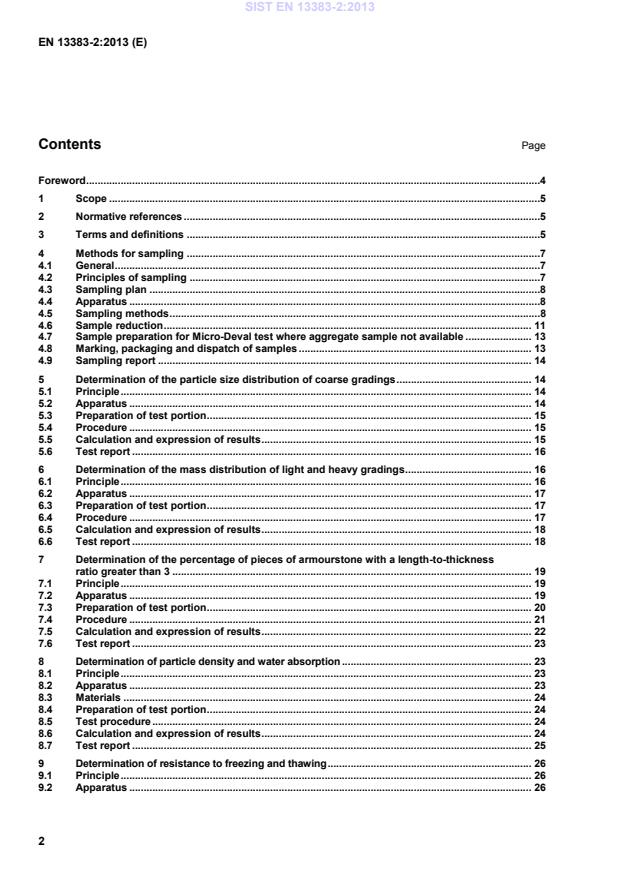
ratio greater than 3 . 19 7.1 Principle . 19 7.2 Apparatus . 19 7.3 Preparation of test portion . 20 7.4 Procedure . 21 7.5 Calculation and expression of results . 22 7.6 Test report . 23 8 Determination of particle density and water absorption . 23 8.1 Principle . 23 8.2 Apparatus . 23 8.3 Materials . 24 8.4 Preparation of test portion . 24 8.5 Test procedure . 24 8.6 Calculation and expression of results . 24 8.7 Test report . 25 9 Determination of resistance to freezing and thawing . 26 9.1 Principle . 26 9.2 Apparatus . 26 SIST EN 13383-2:2013
Example of a sampling report . 34 Annex B (informative)
Example of a particle size distribution of a coarse grading . 36 Annex C (informative)
Example of a mass distribution: reference method . 38 Annex D (informative)
Example method for determination of mass distribution (employing bulk weighing) . 40 Annex E (informative)
Density of water . 44 Annex F (informative)
Precision for determination of particle density and water absorption (see Clause 8) . 45 Annex G (informative)
Guidance on sampling for testing . 46 Annex H (informative)
Guidance on sampling for testing . 51 Bibliography . 56
• changes and clarifications to the sampling and sample reduction clauses, including a new informative annex on sampling from waterborne plant; • introduction of requirements for sample preparation for the Micro-Deval test previously in EN 13383-1; • deletion of an unused wet sieving method for the determination of particle size distribution of coarse gradings of armourstone. • removal to an informative annex of a previously normative alternative to the reference method for determination of mass distribution of light and heavy gradings. Otherwise the majority of the changes from the previous version are editorial. EN 13383 Armourstone consists of the following parts: Part 1: Specifications Part 2: Test methods According to the CEN/CENELEC Internal Regulations, the national standards organisations of the following countries are bound to implement this European Standard: Austria, Belgium, Bulgaria, Croatia, Cyprus, Czech Republic, Denmark, Estonia, Finland, Former Yugoslav Republic of Macedonia, France, Germany, Greece, Hungary, Iceland, Ireland, Italy, Latvia, Lithuania, Luxembourg, Malta, Netherlands, Norway, Poland, Portugal, Romania, Slovakia, Slovenia, Spain, Sweden, Switzerland, Turkey and the United Kingdom.
250 mm 3.5 light grading designation with a nominal upper limit defined by a mass between and including 25 kg and 500 kg 3.6 heavy grading designation with a nominal upper limit defined by a mass of more than 500 kg 3.7 fragment aggregate pieces in the finest fraction of coarse gradings or the lightest fraction of light and heavy gradings for which the particle size distribution or mass distribution requirements apply Note 1 to entry: For further information on grading, see EN 13383-1:2013, Annex A. 3.8 batch production quantity, a delivery quantity, a partial delivery quantity (railway wagon-load, lorry-load, ship's cargo) or a stockpile produced at one time under conditions that are presumed uniform Note 1 to entry: With a continuous process the quantity produced during an agreed period is treated as a batch. 3.9 sampling plan procedure of allocation, withdrawal and preparation of a sample or samples from a material to yield the required information 3.10 sampling increment quantity of material taken from a batch by one operation of the sampling apparatus 3.11 bulk sample aggregation of the sampling increments 3.12 representative sample sample created by taking sampling increments according to sampling plan, which makes it likely that the quality of this sample corresponds to that of the batch 3.13 subsample sample obtained from sampling increments or a bulk sample by means of a sample reduction procedure 3.14 sampler individual or a number of individuals working as a team, or an organisation, taking samples on a routine basis SIST EN 13383-2:2013
Dimensions are approximate Key 1 potential segregation area Figure 1 — Sampling locations in a spread-discharged load SIST EN 13383-2:2013
Figure 2 — Halving a sample by means
Figure 3 — Dividing a sample with
of a separation plane
two separation planes SIST EN 13383-2:2013
250 mm, 180 mm and 125 mm sieves and ± 1,0 mm for the 90 mm and 63 mm sieves. In all cases the 63 mm sieve shall be used. Perforated steel plate sieves shall be in accordance with EN 933-2. 5.2.3 Test sieves, apertures conforming to ISO 3310-2 with apertures smaller than 63 mm. 5.2.4 Receivers, with a volume of at least 0,1 m3, on which the sieves will fit. 5.2.5 Weighing equipment, with a weighing capacity of at least 150 kg, accurate to 0,5 kg. SIST EN 13383-2:2013
Mi is the mass of material retained on a sieve, in kilograms;
ΣMi is the cumulative mass of material retained on all sieves, in kilograms;
m3 is the mass of material passing the sieve with the smallest aperture size, in kilograms. Calculate the cumulative percentage mass (Ri) retained on each sieve to the nearest 0,1 %. Calculate the cumulative percentage mass passing each sieve (Pi) from the following formula:
Pi = 100 - Ri Record to the nearest whole number. 5.6 Test report 5.6.1 Required data The test report shall include the following information: a) reference to this European Standard; b) identity of laboratory; c) identification of the sample; d) mass of test portion; e) cumulative percentages of the masses passing each of the sieves, to the nearest whole number; f) date of test. 5.6.2 Optional data The test report can include the following information: a) name and location of the sample source; b) description of the material and of the sampling procedure; c) graphical presentation of results. 6 Determination of the mass distribution of light and heavy gradings 6.1 Principle The test consists of dividing a material into several fractions by means of weighing individual pieces of armourstone. The average mass of the pieces of armourstone is derived by dividing the total mass excluding fragments by the number of pieces of armourstone. A reference method is specified. The use of other methods not described in this standard for determining mass distribution are permitted, in particular for factory production control, provided that an appropriate working relationship with the reference method has been established. SIST EN 13383-2:2013
6.4 Procedure Weigh each piece of armourstone heavier than a fragment separately (Mi) to ± 5 % of the nominal lower limit of the grading. Weigh all fragments together (Mf) to ± 5 % of the nominal lower limit of the grading. SIST EN 13383-2:2013
Calculate, to the nearest whole number, the cumulative percentage of pieces of armourstone (Pn) with a mass smaller than each specified mass in the mass di
...