


EN 16310:2013
(Main)Engineering services - Terminology to describe engineering services for buildings, infrastructure and industrial facilities
General Information
- Abstract
This European Standard contains a glossary of terms, which can contribute to the conditions for free competition and a level playing field for engineering service providers (including architects) in Europe in the construction of buildings, infrastructure and industrial facilities.
The terminology in this European Standard aims at facilitating the cooperation between sectors and between countries in the field of engineering services. It is structured on the basis of "successive stages" of an operation of construction. It does not concern the description of the contents of the tasks to be performed, neither on their scheduling, nor on the actors concerned, which depend on the national context, the type, and of the importance of the work and its environment.
- Status
- Published
- Publication Date
- 12-Feb-2013
- Withdrawal Date
- 30-Aug-2013
- Technical Committee
- CEN/TC 395 - Engineering consultancy services
- Current Stage
- 9060 - Closure of 2 Year Review Enquiry - Review Enquiry
- Start Date
- 03-Mar-2024
- Completion Date
- 03-Mar-2024
Buy Documents







Overview
EN 16310:2013 (CEN) provides a standardized glossary of terminology for engineering services related to buildings, infrastructure and industrial facilities. The standard is structured around the successive stages of a construction operation (life‑cycle staging) to help engineering service providers, architects, clients and public authorities achieve a common understanding of key terms across European countries. EN 16310:2013 is intended to reduce interpretation differences in cross‑border projects and to contribute to free competition and a level playing field for service providers.
Key topics
- Glossary of terms: Definitions for core concepts such as life cycle, project, project management, contract, procurement, assessment, control, performance, maintenance, life cycle cost (LCC), cost in use, handover, statutory approval, and more.
- Staging framework: Structure based on consecutive project stages and sub‑stages (see Annex A) to enable mapping of national project plans to a common reference.
- Sector mapping: Annex B lists relevant sub‑sectors and disciplines within buildings, infrastructure and industrial facilities to clarify scope boundaries.
- Supporting material: Annex C provides an alphabetical index of terms for quick reference.
- Normative linkage: References sustainability assessment guidance (e.g. EN 15643‑3:2012) where relevant to environmental aspects and social performance.
Practical applications
EN 16310:2013 is valuable for:
- Engineering service providers and architects - to align terminology when preparing scopes of work, proposals and cross‑border consortia arrangements.
- Clients and procurers - to clarify procurement documentation, tender descriptions and evaluation criteria by using agreed definitions.
- Project managers and multidisciplinary teams - to map national plans of work to a common staging framework and reduce misunderstandings during handover, commissioning and operation phases.
- Public authorities and regulators - to ensure consistent use of terminology in statutory approvals, permits and compliance checks.
- Legal and contract specialists - to reference commonly accepted definitions that can reduce contractual disputes arising from differing term interpretations.
Related standards
- EN 15643‑3:2012 (sustainability assessment - social performance) is normatively referenced and complements EN 16310 where environmental and social aspects intersect with engineering services.
By adopting EN 16310:2013 terminology, stakeholders improve cross‑sector and cross‑border collaboration, reduce ambiguity in contracts and procurement, and create a clearer basis for project delivery and life‑cycle decision making.
Relations
- Effective Date
- 28-Jan-2026
Buy Documents
Get Certified
Connect with accredited certification bodies for this standard

Great Wall Tianjin Quality Assurance Center
Established 1993, first batch to receive national accreditation with IAF recognition.
Hong Kong Quality Assurance Agency (HKQAA)
Hong Kong's leading certification body.

Innovative Quality Certifications Pvt. Ltd. (IQCPL)
Known for integrity, providing ethical & impartial Assessment & Certification. CMMI Institute Partner.
Sponsored listings
Frequently Asked Questions
EN 16310:2013 is a standard published by the European Committee for Standardization (CEN). Its full title is "Engineering services - Terminology to describe engineering services for buildings, infrastructure and industrial facilities". This standard covers: This European Standard contains a glossary of terms, which can contribute to the conditions for free competition and a level playing field for engineering service providers (including architects) in Europe in the construction of buildings, infrastructure and industrial facilities. The terminology in this European Standard aims at facilitating the cooperation between sectors and between countries in the field of engineering services. It is structured on the basis of "successive stages" of an operation of construction. It does not concern the description of the contents of the tasks to be performed, neither on their scheduling, nor on the actors concerned, which depend on the national context, the type, and of the importance of the work and its environment.
This European Standard contains a glossary of terms, which can contribute to the conditions for free competition and a level playing field for engineering service providers (including architects) in Europe in the construction of buildings, infrastructure and industrial facilities. The terminology in this European Standard aims at facilitating the cooperation between sectors and between countries in the field of engineering services. It is structured on the basis of "successive stages" of an operation of construction. It does not concern the description of the contents of the tasks to be performed, neither on their scheduling, nor on the actors concerned, which depend on the national context, the type, and of the importance of the work and its environment.
EN 16310:2013 is classified under the following ICS (International Classification for Standards) categories: 01.040.03 - Services. Company organization, management and quality. Administration. Transport. Sociology. (Vocabularies); 03.080.20 - Services for companies. The ICS classification helps identify the subject area and facilitates finding related standards.
EN 16310:2013 has the following relationships with other standards: It is inter standard links to EN 15643-3:2012. Understanding these relationships helps ensure you are using the most current and applicable version of the standard.
EN 16310:2013 is available in PDF format for immediate download after purchase. The document can be added to your cart and obtained through the secure checkout process. Digital delivery ensures instant access to the complete standard document.
Standards Content (Sample)
2003-01.Slovenski inštitut za standardizacijo. Razmnoževanje celote ali delov tega standarda ni dovoljeno.Inženirske storitve - Izrazi za opisovanje inženirskih storitev za stavbe, infrastrukturo in industrijske objekteIngenieurdienstleistungen - Terminologie zur Beschreibung von Ingenieurdienstleistungen für Gebäude, Infrastruktur und IndustrieanlagenServices d'ingénierie - Terminologie destinée à décrire les services d'ingénierie pour les bâtiments, les infrastructures et les installations industriellesEngineering services - Terminology to describe engineering services for buildings, infrastructure and industrial facilities03.080.20Storitve za podjetjaServices for companies01.040.03Storitve. Organizacija podjetja, vodenje in kakovost. Uprava. Transport. Sociologija. (Slovarji)Services. Company organization, management and quality. Administration. Transport. Sociology. (Vocabularies)ICS:Ta slovenski standard je istoveten z:EN 16310:2013SIST EN 16310:2013en01-april-2013SIST EN 16310:2013SLOVENSKI
STANDARD
EUROPEAN STANDARD NORME EUROPÉENNE EUROPÄISCHE NORM
EN 16310
February 2013 ICS 01.040.03; 03.080.20 English Version
Engineering services - Terminology to describe engineering services for buildings, infrastructure and industrial facilities
Services d'ingénierie - Terminologie destinée à décrire les services d'ingénierie pour les bâtiments, les infrastructures et les installations industrielles
Ingenieurdienstleistungen - Terminologie zur Beschreibung von Ingenieurdienstleistungen für Gebäude, Infrastruktur und Industrieanlagen This European Standard was approved by CEN on 7 December 2012.
CEN members are bound to comply with the CEN/CENELEC Internal Regulations which stipulate the conditions for giving this European Standard the status of a national standard without any alteration. Up-to-date lists and bibliographical references concerning such national standards may be obtained on application to the CEN-CENELEC Management Centre or to any CEN member.
This European Standard exists in three official versions (English, French, German). A version in any other language made by translation under the responsibility of a CEN member into its own language and notified to the CEN-CENELEC Management Centre has the same status as the official versions.
CEN members are the national standards bodies of Austria, Belgium, Bulgaria, Croatia, Cyprus, Czech Republic, Denmark, Estonia, Finland, Former Yugoslav Republic of Macedonia, France, Germany, Greece, Hungary, Iceland, Ireland, Italy, Latvia, Lithuania, Luxembourg, Malta, Netherlands, Norway, Poland, Portugal, Romania, Slovakia, Slovenia, Spain, Sweden, Switzerland, Turkey and United Kingdom.
EUROPEAN COMMITTEE FOR STANDARDIZATION
COMITÉ EUROPÉEN DE NORMALISATION EUROPÄISCHES KOMITEE FÜR NORMUNG
Management Centre:
Avenue Marnix 17,
B-1000 Brussels © 2013 CEN All rights of exploitation in any form and by any means reserved worldwide for CEN national Members. Ref. No. EN 16310:2013: ESIST EN 16310:2013
Contents Page Foreword . 3 Introduction . 4 1 Scope . 5 2 Normative references . 5 3 Terms and definitions . 5 Annex A (informative)
Stages in the life cycle of built assets: Buildings, Infrastructure and Industrial Facilities . 12 A.1 General . 12 A.2 Staging . 12 A.3 Statutory approval and tendering . 12 A.4 Stages and sub-stages . 15 Annex B (informative)
Sub Sectors and Disciplines within the Scope of Buildings, Infrastructure and Industrial Facilities . 30 Annex C (informative)
Alphabetical index . 32
Introduction This European Standard contains a glossary of key words concerning engineering services, provided in the construction of buildings, infrastructure and industrial facilities. The glossary can contribute to the conditions for free competition and a level playing field for engineering service providers (including architects) in the European Community. It is intended to lower or remove the barriers that these providers are confronted with in cross border operations and co-operations due to different interpretations of relevant terms in different European countries. The terms that are incorporated in the glossary are in line with those developed by CEN/TC 395 for other industries. Each construction project is managed through a series of stages and therefore staging is important for the management and assessment of engineering services. However, the standard stages in projects and related national plans of work of engineering service providers (including architects) differ from country to country and may also be subject to differences in legislation. For these reasons, it is not the intention of this standard to harmonise national plans of work. However, in cross border operations and co-operations it is important that all parties concerned have a common view on the actual staging and the engineering activities that take place within each stage. To facilitate this, some information about the stages in the life cycle of built assets is given in Annex A. This annex may offer a common reference framework onto which engineering service providers (including architects) can ‘map’ their project-specific scope of work in cross border projects, while the actual scope of work is to be specified in contracts.
1 Scope This European Standard contains a glossary of terms, which can contribute to the conditions for free competition and a level playing field for engineering service providers (including architects) in Europe in the construction of buildings, infrastructure and industrial facilities. The terminology in this European Standard aims at facilitating the cooperation between sectors and between countries in the field of engineering services. It is structured on the basis of "successive stages" of an operation of construction. It does not concern the description of the contents of the tasks to be performed, neither on their scheduling, nor on the actors concerned, which depend on the national context, the type, and of the importance of the work and its environment. 2 Normative references The following documents, in whole or in part, are normatively referenced in this document and are indispensable for its application. For dated references, only the edition cited applies. For undated references, the latest edition of the referenced document (including any amendments) applies. EN 15643-3:2012: Sustainability of construction works — Assessment of buildings — Part 3: Framework for the assessment of social performance
3 Terms and definitions For the purposes of this document, the following terms and definitions apply: 3.1 assessment appraisal judgment ongoing process of gathering, analyzing and reflecting on evidence to make informed and consistent judgments (about the quality
of a service, process or product)
Note 1 to entry: A related term is: control. 3.2 brief written document that states the client’s requirements for a construction project [SOURCE: ISO 6707-2:1993] 3.3 building construction work that has the provision of shelter for its occupants or contents as one of its main purposes; usually partially or totally enclosed and designed to stand permanently in one place [SOURCE: ISO 6707-1:2004] Note 1 to entry: See Annex B. 3.4 client person or organisation that requires a building to be provided, altered or extended and is responsible for initiating and approving the brief [SOURCE: ISO 6707-1:2004]
Note 1 to entry: A related term is: customer, which is defined as an organisation or person that receives a product (see EN ISO 9000:2005).
3.5 construction contracting specific form of procurement, where only the actual execution of the project on site is procured, including facilities and materials Note 1 to entry: Related terms are: contractor prequalification/qualification, contractor surveys, calls for bids/tenders, technical bid tabulations, commercial bids tabulations, contractor selection, contract award. 3.6 contract binding agreement
[SOURCE: EN ISO 9000:2005] Note 1 to entry: No consensus in Europe exists about how and when a contract is legally binding, due to differences in legal requirements. Note 2 to entry: A contract between an Engineering Service Provider (ESP) and a Client may include (references to) general conditions, project specific conditions, a specification of the ESP’s scope of work in the project and financial arrangements. 3.7 control management process in which the actual performance is compared with planned performance, the difference between the two is measured, causes contributing to the difference are identified and corrections are made to eliminate or minimise the difference to an acceptable level
Note 1 to entry: Related terms are: assessment, verification
and validation. Note 2 to entry: In addition to corrections, corrective actions may be taken to eliminate the cause of a detected nonconformity or other undesirable situation. 3.8 cost amount of money necessary for the attainment of a goal Note 1 to entry: Related terms are: project budget, target budget, cost in use, life cycle cost. 3.9 cost in use cost of running/operating a facility or product 3.10 engineering intellectual activities necessary to define, design, produce, sustain and recycle a product, a process or a built asset 3.11 engineering services intellectual tasks provided during one or all stages of the life cycle of a product, a process or a built asset by specialised professionals SIST EN 16310:2013
EXAMPLE Use of energy and mass flow, production and segregation of wastes, water use, land use, emissions to air (examples added to the definition of environmental aspect in ISO 15392). 3.13 environmental impact any change to the environment whether adverse or beneficial, wholly or partially resulting from environmental aspects
[SOURCE: EN 15643-3:2012] Note 1 to entry: Related terms are: durability, sustainability. 3.14 functioning working of an asset, equipment or product Note 1 to entry: A related term is: performance. 3.15 client approval decision by the client to continue, change or terminate the project, on the basis of an assessment of (sub) stage results 3.16 handover step at which possession of the construction works is surrendered to the client upon completion with or without reservation [SOURCE: EN 15643-4] Note 1 to entry: A related term is: signing off (a contract). 3.17 industrial facility any fixed equipment and/or facility which is used in connection with, or as part of, any process or system for industrial production or output Note 1 to entry: See Annex A. 3.18 infrastructure built facilities that are required in order to serve a community's developmental and operational needs, including e.g. roads, railroads, water ways, water and sewer systems, energy networks and data networks Note 1 to entry: See Annex B. 3.19 life cycle all consecutive and interlinked stages in the life of the object under consideration [SOURCE: ISO 15392:2008] SIST EN 16310:2013
Note 1 to entry: The definition in EN ISO 14040 is: "consecutive and interlinked stages of a product system, from raw material acquisition or generation from natural resources to final disposal'. Note 2 to entry: Annex A shows an example of a life cycle with respective stages and sub-stages. 3.20 life cycle cost LCC cost of a building or part of works throughout its life cycle, while fulfilling technical requirements an functional requirements [SOURCE: EN 15643-4:2012] 3.21 maintenance combination of all technical and associated administrative actions during the service life to retain a building or an assembled system (part of works) in a state in which it can fulfil its technical and functional requirements Note 1 to entry: Maintenance includes cleaning, servicing, repainting, repairing, replacing parts of the construction works where needed, etc. (see CPD Guidance Paper F). Note 2 to entry: Adapted from the definition in ISO 15686-1 and ISO 6707-1 according to the CPD Guidance Paper F. 3.22 maintenance support services in relation to maintaining the facility according to predetermined objectives 3.23 operation support services in relation to running the facility in an optimum and safe way, including the monitoring and management of the expected performance 3.24 performance expression relating the magnitude of a particular aspect of the object of consideration relative to specified requirements, objectives and/or targets Note 1 to entry: Adapted from the definition in ISO 6707-1 according to the draft recommendation of ISO/TC59/AHG Terminology. 3.25 performance testing evaluation of the compliance of an asset, equipment or product with specified performance requirements 3.26 process set of interrelated activities which transforms inputs into outputs [SOURCE: EN ISO 9000:2005] 3.27 procurement process which creates, manages and fulfils contracts relating to the provision of goods, services and engineering and construction works or disposals, or any combination thereof [SOURCE: ISO 10845-1:2010] Note 1 to entry: Related terms are: procurement services, purchase planning, supplier research and selection, value analysis, price negotiations, supplier prequalification, supplier qualification, supplier surveys, calls for bids/tenders, technical bid tabulations, commercial bid tabulations, supplier selection, contract award. SIST EN 16310:2013
3.30 project documentation set of documents used to define the extent and nature of a built asset or a product 3.31 project management professional service that applies (application) methods, tools, techniques and competences to the overall planning, co-ordination and control of a project life cycle, from inception to completion, aimed at meeting a client's requirements in order to produce a functionally an financially viable project that will be completed on time within authorised cost and to the required quality standards Note 1 to entry: This definition enhances an existing definition of project management in ISO 10007. Note 2 to entry: Direct sources for this definition are: ISO/TC 236 - Project Management - ISO 21500; Code of Practice for Project Management for Construction and Development: 4th Edition (1996), issued by CIOB Chartered Institute of Building / International Construction Project Management Association; Capstone CM Body of Knowledge, CMAA Construction Project Management Association of America. 3.32 quality degree to which a set of inherent characteristics fulfils requirements [SOURCE: EN ISO 9000:2005] Note 1 to entry: For example for buildings, the quality of the built asset corresponds with the capacity of meeting user’s needs as defined at the outset (see definition of building given in 3.3). 3.33 risk effect of uncertainty on objectives [SOURCE: ISO Guide 73] Note 1 to entry: An effect is a deviation from the expected - positive and/or negative. Note 2 to entry: Objectives can have different aspects (such as financial, health and safety, and environmental goals) and can apply at different levels (such as strategic, organisation-wide, project, product and process). Note 3 to entry: Risk is often characterised by reference to potential events and consequences, or a combination of these. SIST EN 16310:2013
Note 4 to entry: Risk is often expressed in terms of a combination of the consequences of an event (including changes in circumstances) and the associated likelihood of occurrence. Note 5 to entry: Uncertainty is the state, even partial, of deficiency of information related to, understanding or knowledge of, an event, its consequence, or likelihood. 3.34 stage phase period within the life cycle of an entity that relates to the state of its initiation, design, construction, operation or dismantling/recycling 3.35 statutory approval official license to build, to be issued by the local authorities, after these authorities have determined compliancy of the design with the applicable regulatory requirements Note 1 to entry: A related term is: building permit. Note 2 to entry: In some EU countries, the application of a building permit is a (sub) stage in its own right. 3.36 supervision monitoring that the asset is constructed on site in compliance with the project documentation and regulatory requirements Note 1 to entry: Related terms are: control, monitoring. 3.37 target budget established boundaries for the funding required for a defined scope of works
3.38 time (estimated) time involved with a set of activities Note 1 to entry: Related terms are: schedule, overall schedule, milestones, detailed schedule. Note 2 to entry: The legal rules for regulating the computation of time limits and periods differ among EU countries. In order to ensure legal certainty and to avoid misunderstandings (e.g. periods expressed in working days or calendar days), it is advisable for parties to refer to a general rule for the computation of time. One example of such a common standard is Article I.-1:110 of the Draft Common Frame of Reference for European Private Law (DCFR). 3.39 validation confirmation, through the provision of objective evidence, that the requirements for a specific intended use or application have been fulfilled [SOURCE: EN ISO 9000:2005] Note 1 to entry: The term “validated” is used to designate the corresponding status. Note 2 to entry: The use conditions for validation can be real or simulated. Note 3 to entry: Related terms are: fit for purpose, control, verification. Note 4 to entry: Validation may be described as ‘to check if the right thing is built’. SIST EN 16310:2013
Annex A (informative)
Stages in the life cycle of built assets: Buildings, Infrastructure and Industrial Facilities A.1
General This annex describes the stages and sub-stages in the life cycle of buildings, infrastructure and industrial facilities. The description is intended to be a reference framework to which engineering service providers (including architects) can ‘map’ their project specific scopes of work in cross border projects, while the actual scope of work is to be specified in contracts. It is emphasised that it is not intended to harmonise national plans of work of engineering service providers (including architects). The aim is just to provide a reference for fine tuning the contributions of participants from different countries in building projects in the EU. A.2
Staging The distinction of stages in the life cycle of a built asset is important for the management and assessment of engineering services. The main characteristics of the staging are listed here. Each (sub) stage has its own characteristic and represents a vital step in the life cycle of the built asset. Each stage represents a specific state of the built asset (for instance ‘as required’, ‘as designed’, ‘as built’, ‘as operated’). The client or owner decides on the transition from one stage to the other on the basis of an assessment of e.g. cost, organisational aspects, time, documentation, quality, risk and environmental impact (“go-or-no-go decision”). A building project may apply to one or more stages in the life cycle of the built asset. The naming and sequence of some sub-stages within the main stages may vary from sector to sector and/or from country to country. An example of the functional stages in the life cycle of built assets is shown in Figure A.1. The stages and sub-stages are further described in Table A.1.
It should be noted that most industrial facilities projects include one or more building projects. A.3
Statutory approval and tendering Statutory approval and tendering or procurement do not have the same importance for industrial facilities as they have for building and infrastructure and they do not take place at same time in the life cycle of the built assets concerned.
In the life cycle of buildings and infrastructure (B&I), applying for a statutory approval (‘building permit’) and the preparation and organisation of tenders are very important activities of engineering service providers. However, these activities cannot be appointed exclusively to one or two specific (sub) stages in the asset’s life cycle, as the procedures may differ widely from country to country. For example, applying for a statutory approval may in one country be a process that overlaps with several (sub) stages, where it is a fixed ‘one stop moment’ in another. Tendering may take place in different (sub) stages in the asset’s life cycle, depending on the nature of the project and the client’s market strategy. Moreover, both statutory approval applications and tendering are subject to differences in legislation in the EU member states. SIST EN 16310:2013
Figure A.1 Stages and sub-stages in the life cycle of built assets SIST EN 16310:2013
Stages and sub-stages Table A.1 gives information about how stages and sub-stages could be used. Table A.1 Stages and sub-stages (1 of 15)
Stages and sub-stages Applicable for Definitions Synonyms Related terms Remarks B&I IF 0 initiative X X stage where the need for a facility emerges and is established
0.1 market study X X sub-stage where the (future) demand and supply conditions for a specific type of facility in a specific area are studied
or where the type of facility that will be needed by society, companies and/or consumers is identified
opportunity market analysis investigation of needs strategic orientation
A market study serves to help decide what type of project to develop and/or is helpful in arranging permanent and construction financing for a proposed development. 0.2 business case X X sub-stage where a structured proposal is developed that functions as a decision package for decision makers in a project, explaining why a facility is required and outlining, the facility’s nature and performance characteristics, major project risks and success criteria business plan
key performance indicators return on investment cost/benefit analysis strategic orientation: the definition of the political goals, the space and time of the considered operation; the decision to act by the way of a building project and not by any other way programming
Table A.1 Stages and sub-stages (2 of 15)
Stages and sub-stages Applicable for Definitions Synonyms Related terms Remarks B&I IF 1 initiation X X stage where the context of the facility or product to be developed is identified and the requirements are defined
1.1 project initiation X X sub-stage where the general scope for the facility is defined and the client’s and/or the end users’ needs are globally analyzed
1.2 feasibility study X X sub-stage where the (regulatory, technical, financial, …) ability to meet with the client’s and users’ ambitions, needs, requirements, wishes, expectations and constraints is investigated, taking into account stakeholder interests
investment and products cost estimation return on investment
estimation / cost-benefit analysis preliminary geotechnical study of the site and diagnostic
environmental impact assessment
preliminary overall plot plan This sub-stage may be repeated one or more times in a loop with
the project definition stage. (Site) surveys and investigations should be executed from this stage. The mode of tendering and procurement could be decided from this stage on. The feasibility of a project is also evaluated after each design sub-stage as an input for the client approval process
Stages and sub-stages Applicable for Definitions Synonyms Related terms Remarks B&I IF 1.3 project definition X X sub-stage where the client’s and/or the end users’ ambitions, requirements, wishes, expectations and constraints
and applicable regulatory requirements are identified, analyzed and recorded in detail
programming project identification documents
scope of works
general time schedule / milestones
design brief / client’s brief / terms of reference / project brief performance requirements / assessment methods
limits of supply / coordination of interfaces
target budget
return on investment targets
technology survey and selection (IF) The project definition is the stage in which the relevant information for designers and others to define the scope of the work is determined. The project definition documents list the given constraints which cannot be revised, and the project requirements, theories and assumptions. All of these might not be completely defined at this stage; some may be revised in response to feedback from later stages of the design process.
Constraints’ may include: budget, environmental impact, time schedule, health & safety, life cycle costing, landscape value etc. For IF ‘technology’ is an input from technology owners and/or process licensors (mostly different from the client).
Table A.1 Stages and sub-stages (4 of 15)
Stages and sub-stages Applicable for Definitions Synonyms Related terms Remarks B&I IF 2. design X X stage where the client’s and/or the end users’ ambitions, requirements, and applicable regulatory requirements are transformed into the specification for building the asset, to be agreed before its construction
2.1 conceptual design X X sub-stage where plans for the asset(s) are developed that offer options and solutions on a planning scale, to determine the general form and schematic layout of the asset(s) to be built within the allocated area
site layout outline design master plan design concept urban planning/ landscaping infrastructure on site / provision of services
quantities and qualities preliminary plant / project / process description and overall performances calculation This stage may require additional surveys and site investigations including:
- site and condition surveys intended to inform the client and the design team about site conditions and the state of existing buildings/ structures; - preliminary investigations intended to inform the client about the technical and statutory constraints the project has to satisfy.
Stages and sub-stages Applicable for Definitions Synonyms Related terms Remarks B&I IF 2.2 prelim
...
2003-01.Slovenski inštitut za standardizacijo. Razmnoževanje celote ali delov tega standarda ni dovoljeno.Inženirske storitve - Izrazi za opisovanje inženirskih storitev za stavbe, infrastrukturo in industrijske objekteIngenieurdienstleistungen - Terminologie zur Beschreibung von Ingenieurdienstleistungen für Gebäude, Infrastruktur und IndustrieanlagenServices d'ingénierie - Terminologie destinée à décrire les services d'ingénierie pour les bâtiments, les infrastructures et les installations industriellesEngineering services - Terminology to describe engineering services for buildings, infrastructure and industrial facilities03.080.20Storitve za podjetjaServices for companies01.040.03Storitve. Organizacija podjetja, vodenje in kakovost. Uprava. Transport. Sociologija. (Slovarji)Services. Company organization, management and quality. Administration. Transport. Sociology. (Vocabularies)ICS:Ta slovenski standard je istoveten z:EN 16310:2013SIST EN 16310:2013de01-april-2013SIST EN 16310:2013SLOVENSKI
STANDARD
EUROPÄISCHE NORM EUROPEAN STANDARD NORME EUROPÉENNE
EN 16310
Februar 2013 ICS 01.040.03; 03.080.20 Deutsche Fassung
Ingenieurdienstleistungen - Terminologie zur Beschreibung von Ingenieurdienstleistungen für Gebäude, Infrastruktur und Industrieanlagen
Engineering services - Terminology to describe engineering services for buildings, infrastructure and industrial facilities Services d'ingénierie - Terminologie destinée à décrire les services d'ingénierie pour les bâtiments, les infrastructures et les installations industrielles Diese Europäische Norm wurde vom CEN am 7. Dezember 2012 angenommen.
Die CEN-Mitglieder sind gehalten, die CEN/CENELEC-Geschäftsordnung zu erfüllen, in der die Bedingungen festgelegt sind, unter denen dieser Europäischen Norm ohne jede Änderung der Status einer nationalen Norm zu geben ist. Auf dem letzten Stand befindliche Listen dieser nationalen Normen mit ihren bibliographischen Angaben sind beim Management-Zentrum des CEN-CENELEC oder bei jedem CEN-Mitglied auf Anfrage erhältlich.
Diese Europäische Norm besteht in drei offiziellen Fassungen (Deutsch, Englisch, Französisch). Eine Fassung in einer anderen Sprache, die von einem CEN-Mitglied in eigener Verantwortung durch Übersetzung in seine Landessprache gemacht und dem Management-Zentrum mitgeteilt worden ist, hat den gleichen Status wie die offiziellen Fassungen.
CEN-Mitglieder sind die nationalen Normungsinstitute von Belgien, Bulgarien, Dänemark, Deutschland, der ehemaligen jugoslawischen Republik Mazedonien, Estland, Finnland, Frankreich, Griechenland, Irland, Island, Italien, Kroatien, Lettland, Litauen, Luxemburg, Malta, den Niederlanden, Norwegen, Österreich, Polen, Portugal, Rumänien, Schweden, der Schweiz, der Slowakei, Slowenien, Spanien, der Tschechischen Republik, der Türkei, Ungarn, dem Vereinigten Königreich und Zypern.
EUROPÄISCHES KOMITEE FÜR NORMUNG EUROPEAN COMMITTEE FOR STANDARDIZATION
COMITÉ EUROPÉEN DE NORMALISATION
Management-Zentrum:
Avenue Marnix 17,
B-1000 Brüssel © 2013 CEN Alle Rechte der Verwertung, gleich in welcher Form und in welchem Verfahren, sind weltweit den nationalen Mitgliedern von CEN vorbehalten.Ref. Nr. EN 16310:2013 DSIST EN 16310:2013
Abschnitte im Lebenszyklus von baulichen Anlagen: Gebäude, Infrastruktur und Industrieanlagen .12 A.1 Allgemeines .12 A.2 Einteilung in Abschnitte .12 A.3 Behördliche Genehmigung und Ausschreibung .12 A.4 Abschnitte und Unterabschnitte .14 Anhang B (informativ)
Teilsektoren und Fachgebiete innerhalb des Anwendungsbereichs von Gebäuden, Infrastruktur und Industrieanlagen .27 Anhang C (informativ)
Alphabetischer Index .29 Literaturhinweise .31
EN 15643-3:2012, Nachhaltigkeit von Bauwerken — Bewertung der Nachhaltigkeit von Gebäuden — Teil 3: Rahmenbedingungen für die Bewertung der sozialen Qualität 3 Begriffe Für die Anwendung dieses Dokumentes gelten die folgenden Begriffe. 3.1 Bewertung Begutachtung Beurteilung laufender Prozess der Erfassung, Analyse und des Widerspiegelns von Belegen, um sachkundige und konsistente Urteile (über die Qualität einer Dienstleistung, eines Prozesses oder eines Produktes) zu treffen Anmerkung 1 zum Begriff: Ein themenverwandter Begriff ist: Lenkung. 3.2 Aufgabenstellung schriftlich abgefasstes Dokument im Sinne eines Lastenheftes, in dem die Anforderungen des Auftraggebers an ein Bauprojekt festgelegt sind [QUELLE: ISO 6707-2:1993] 3.3 Gebäude Bauwerk, das hauptsächlich dem Schutz seiner Bewohner oder seiner Inhalte dient; üblicherweise ist es teilweise oder vollständig geschlossenen und so konstruiert, dass es sich dauerhaft an einem Ort befindet [QUELLE: ISO 6707-1:2004] Anmerkung 1 zum Begriff: Siehe Anhang B. 3.4 Auftraggeber Person oder Organisation, die die Bereitstellung, Änderung oder Erweiterung eines Gebäudes anfordert und die Erstellung und Bewilligung der Aufgabenstellung im Sinne eines Lastenheftes verantwortet [QUELLE: ISO 6707-1:2004] Anmerkung 1 zum Begriff: Ein themenverwandter Begriff ist: Kunde, der als die Organisation oder Person definiert ist, die ein Produkt empfängt (ISO 9000:2005). SIST EN 16310:2013
Abschnitte im Lebenszyklus von baulichen Anlagen: Gebäude, Infrastruktur und Industrieanlagen A.1 Allgemeines In diesem Anhang sind die Abschnitte und Unterabschnitte im Lebenszyklus von Gebäuden, Infrastruktur und Industrieanlagen beschrieben. Die Beschreibung soll einen gemeinsamen Bezugsrahmen zur Verfügung stellen, anhand dessen Ingenieurdienstleister (einschließlich Architekten) bei grenzüberschreitenden Projekten ihren projektspezifischen Leistungsumfang planen können, während der eigentliche Leistungsumfang in Verträgen festzulegen ist. Es wird betont, dass nicht beabsichtigt ist, die nationalen Pläne für die Arbeit von Ingenieurdienstleistern (einschließlich Architekten) zu harmonisieren. Das Ziel besteht lediglich darin, einen Bezugspunkt zur Feinabstimmung der Beiträge der Beteiligten aus unterschiedlichen Ländern bei Bauprojekten in der EU zur Verfügung zu stellen. A.2 Einteilung in Abschnitte Die Unterscheidung von Abschnitten im Lebenszyklus einer baulichen Anlage ist für das Management und die Bewertung von Ingenieurdienstleistungen wichtig. Die Hauptmerkmale der Einteilung in Abschnitte sind hier aufgeführt: Jeder (Unter)Abschnitt hat seine eigenen Merkmale und stellt einen entscheidenden Schritt im Lebenszyklus der baulichen Anlage dar. Jeder Abschnitt repräsentiert ein bestimmtes Stadium der baulichen Anlage (zum Beispiel „wie gefordert“, „wie geplant“, „wie gebaut“, „wie betrieben“). Der Auftraggeber oder Eigentümer entscheidet aufgrund einer Bewertung, zum Beispiel der Kosten, der organisatorischen Aspekte, des Zeitaufwands, der Dokumentation, der Qualität, des Risikos und der Umweltauswirkung, über den Übergang von einem Abschnitt zum anderen („Entscheidung Durchführung oder Nicht-Durchführung“). Ein Gebäude-Projekt entspricht dabei einem Abschnitt oder mehreren Abschnitten im Lebenszyklus der baulichen Anlage. Die Bezeichnung und die Abfolge einiger Unterabschnitte innerhalb der Hauptabschnitte darf von Sektor zu Sektor und/oder von Land zu Land variieren. Ein Beispiel der funktionalen Abschnitte im Lebenszyklus von baulichen Anlagen ist in Bild A.1 dargestellt. In Tabelle A.1 sind die Abschnitte und Unterabschnitte näher beschrieben. Es ist zu berücksichtigen, dass die meisten Industrieanlagen-Projekte ein oder mehrere Gebäude-Projekte umfassen. A.3 Behördliche Genehmigung und Ausschreibung Behördliche Genehmigung und Ausschreibung oder Beschaffung haben für Industrieanlagen nicht dieselbe Bedeutung wie bei Gebäuden und Infrastruktur, und sie erfolgen nicht zum gleichen Zeitpunkt im Lebenszyklus der betreffenden baulichen Anlagen. Im Lebenszyklus von Gebäuden und Infrastruktur (en: buildings and infrastructure, B&I) stellen die Beantragung einer behördlichen Genehmigung (Baugenehmigung) sowie die Vorbereitung und Organisation von Ausschreibungen sehr wichtige Tätigkeiten von Ingenieurdienstleistern dar. Diese Tätigkeiten können jedoch nicht ausschließlich einem oder zwei spezifischen (Unter)Abschnitten im Lebenszyklus der Anlage zugeordnet werden, da sich die Verfahren zwischen den Ländern stark unterscheiden können. Das Beantragen einer behördlichen Genehmigung kann zum Beispiel in einem Land ein Prozess sein, der sich mit mehreren (Unter)Abschnitten überschneidet, während es in einem SIST EN 16310:2013
Bild A.1 — Abschnitte und Unterabschnitte im Lebenszyklus von baulichen Anlagen
Abschnitte und Unterabschnitte Anwendbar auf Definitionen Synonyme Themenverwandte Begriffe Anmerkungen B&I IF 0 Initiative X X Abschnitt, in dem der Bedarf einer Anlage entsteht und festgestellt wird
0.1 Marktstudie X X Unterabschnitt, in dem der (zukünftige) Bedarf und die Angebotsbedingungen für einen bestimmten Anlagentyp in einem bestimmten Bereich untersucht oder wo der Anlagentyp identifiziert wird, der von der Gesellschaft, den Unternehmen und/ oder Verbrauchern benötigt werden wird Gelegenheit Marktanalyse Bedarfserhebung Strategische Ausrichtung
Eine Marktstudie hilft bei der Entscheidung darüber, welche Art von Projekt zu entwickeln ist, und/oder sie ist außerdem beim Organisieren der Dauer- und Baufinanzierung für eine geplante Entwicklung von Nutzen. 0.2 Wirtschaftlich-keitsberechnung X X Unterabschnitt, in dem ein strukturierter Vorschlag entwickelt wird, der in einem Projekt als Entscheidungspaket für Entscheidungsträger fungiert, der erklärt, warum eine Einrichtung erforderlich ist, und in dem die Beschaffenheit und die Leistungsmerkmale der Einrichtung, die wesentlichen Projektrisiken und die Erfolgskriterien skizziert sind Geschäftsplan Leistungskennzahlen Anlagenrendite Kosten-Nutzen-Analyse Strategische Ausrichtung: die Definition der politischen Ziele, des Raum- und Zeitaufwands der betreffenden Unternehmung; die Entscheidung, mit einem Bauprojekt in dieser Weise zu agieren und nicht anders zu verfahren Programmierung
Abschnitte und Unterabschnitte Anwendbar auf Definitionen Synonyme Themenverwandte Begriffe Anmerkungen B&I IF 1 Initiierung X X Abschnitt, in dem der Kontext der zu entwickelnden Einrichtung oder des Produktes bestimmt und die Anforderungen definiert werden
1.1 Projektbeginn X X Unterabschnitt, in dem der allgemeine Anwendungsbereich für die Einrichtung definiert und die Bedürfnisse des Auftraggebers und/oder der Endverbraucher übergreifend analysiert werden
1.2 Machbarkeits-studie X X Unterabschnitt, in dem die (behördliche, technische, finanzielle, …) Fähigkeit zur Erfüllung der Ambitionen, Bedürfnisse, Anforderungen, Wünsche, Erwartungen und Auflagen des Auftraggebers und der Anwender unter Berücksichtigung der Interessen der Stakeholder untersucht werden
Schätzung der Investitions- und Produktkosten Anlagenrendite Abschätzung/ Kosten-Nutzen-Analyse Geotechnische Voruntersuchung des Standortes und Diagnose Umweltverträglichkeitsprüfung Vorläufiger Grundstücksplan Dieser Unterabschnitt darf in der Phase der Projektdefinition einmal oder mehrere Male in einer Schleife wiederholt werden. Erkundungen und Untersuchungen (des Standorts) sollten von diesem Abschnitt an durchgeführt werden. Über den Modus der Ausschreibung und Beschaffung könnte von diesem Abschnitt an entschieden werden. Die Machbarkeit eines Projektes wird ebenfalls nach jedem Designunterabschnitt als ein Eingangswert für den Prozess der Freigabe durch den Auftraggeber bewertet. SIST EN 16310:2013
Abschnitte und Unterabschnitte Anwendbar auf Definitionen Synonyme Themenverwandte Begriffe Anmerkungen B&I IF 1.3 Projektdefinition X X Unterabschnitt, in dem die Ambitionen, Anforderungen, Wünsche, Erwartungen und Auflagen des Auftragsgebers und/oder der Endverbraucher sowie die geltenden gesetzlichen Anforderungen detailliert identifiziert, analysiert und aufgezeichnet werden Programmierung Dokumente zur Projektidentifizierung Leistungsumfang Allgemeiner Zeitplan/ Meilensteine Entwurfsvorgaben/ Kundenauftrag/ Aufgabenstellung/ Projektbeschreibung Leistungsanforderungen/ Bewertungsverfahren Angebotsgrenzen/ Schnittstellenkoordinierung Zielbudget Ziele in Bezug auf die Anlagenrendite Übersicht und Auswahl der Technologie (IF) Die Projektdefinition ist der Abschnitt, in dem die relevanten Informationen für die Gestalter und andere zur Festlegung des Leistungsumfangs bestimmt werden. In den Dokumenten zur Projektdefinition werden die gegebenen Vorgaben aufgeführt, die nicht geändert werden können, sowie die Projektanforderungen, Theorien und Annahmen. All das muss in diesem Abschnitt nicht vollständig festgelegt werden; einiges darf als Reaktion auf Rückmeldungen in späteren Abschnitten des Gestaltungsprozesses überarbeitet werden. Die Vorgaben dürfen umfassen: Budget, Umweltauswirkung, Zeitplanung, Gesundheit und Sicherheit, Lebenszykluskosten, Landschaftswert usw. Bei Industrieanlagen ist „Technologie“ ein Eingangswert von Technologieinhabern und/oder Prozess-Lizenzgebern (die sich meistens vom Auftraggeber unterscheiden). SIST EN 16310:2013
Abschnitte und Unterabschnitte Anwendbar auf Definitionen Synonyme Themenverwandte Begriffe Anmerkungen B&I IF 2 Entwurf X X Abschnitt, in dem die Ambitionen und Anforderungen des Auftraggebers und/oder der Endverbraucher sowie die geltenden gesetzlichen Anforderungen in die Spezifikation zum Bau der Anlage eingehen, die vor deren Bau festzulegen ist
2.1 Konzepter-arbeitung X X Unterabschnitt, in dem die Pläne für die Anlage(n) entwickelt werden, in denen Möglichkeiten und Lösungen auf einem Planungsmaßstab vorgeschlagen werden, um die allgemeine Form und den schematischen Aufbau der innerhalb des zugewiesenen Bereichs zu errichtenden Anlage(n) zu bestimmen Lageplan Entwurfsplanung Gesamtkonzept Konzeptentwurf Stadtplanung/ Landschaftsarchitektur Infrastruktur vor Ort/ Dienstleistungen Quantitäten und Qualitäten Vorbereitende Anlagen-/ Projekt-/ Prozessbeschreibung und Berechnung der Gesamtleistung Dieser Abschnitt kann zusätzliche Baugutachten und Erkundungen des Baugrunds erfordern einschließlich: Gelände- und Zustandsaufnahmen, um den Auftraggeber und die Planungsgruppe über die Standortbedingungen und den Zustand bereits vorhandener Gebäude/ Bauten zu informieren; Voruntersuchungen, um den Auftraggeber darüber zu informieren, welchen technischen und gesetzlichen Auflagen das Projekt genügen muss. SIST EN 16310:2013
Abschnitte und Unterabschnitte Anwendbar auf Definitionen Synonyme Themenverwandte Begriffe Anmerkungen B&I IF 2.2 Vorentwurf
und X X Unterabschnitt, in dem ein Bauentwurf der Anlage entwickelt wird, der einen umfassenden Einblick bietet und planerische Gesichtspunkte, funktionelle Organisation, Raumstruktur und das allgemeine Erscheinungsbild abdeckt, und der es dem Auftraggeber ermöglicht, sachkundig eine strategische Auswahl zwischen funktionalen Konzepten und vorgesehenen Optionen zu treffen Grundauslegung Schematischer Aufbau Funktionsaufbau Zielbudget Berechnungsgrundlage (IF) Vorläufige Ausrüstungsliste und erwartete Leistungen (IF) Vorläufige Schemata und Pläne der Baueinheiten (IF) Der Auftraggeber sollte in diesem Stadium wissen, wie die Anlage zu betreiben ist.
ausgearbeiteter Entwurf X
Unterabschnitt, in dem der Bauentwurf der Anlage weiter entwickelt wird, wobei detaillierte Darstellungen der Gestaltung, des Aufbaus, damit verbundener Technologien und des Erscheinungsbildes der Anlage zur Verfügung gestellt und geeignete Bauverfahren, die Verwendung von Materialien sowie typische technische Einzelheiten untersucht werden, die für ein gutes Verständnis der zu bauenden Anlage notwendig sind Endgültiger Entwurf
Abschnitte und Unterabschnitte Anwendbar auf Definitionen Synonyme Themenverwandte Begriffe Anmerkungen B&I IF 2.3 Technische Auslegung
oder X
Unterabschnitt, in dem die Anlage so detailliert festgelegt wird, dass den Stakeholdern ein klares Verständnis über die Eigenschaften des Endresultates vermittelt und die Kosten der Ausführung bestimmt werden können Technische Auslegung (B&I) Technische Spezifikationen Beschaffung/ Ausschreibung Leistungsverzeichnis/ Material-stückliste Auslegungsdokumentation Baukonstruktionszeichnungen Berechnungsgrundlage (IF) Prozessbeschreibung mit Diagrammen (IF) Erwartete und garantierte Leistungen (IF) Geräteliste (IF) Anforderungsprofile für die Gestaltung (IF) Ausrüstungsspezifikationen (IF) Montage- und Bauplanung (R&I-Diagramme, Ablaufplanung, Lagepläne) (IF) Behördliche Genehmigung „Spezifikationen“ können aus detaillierten Zeichnungen und schriftlichen Festlegungen bestehen.
FEED
X Unterabschnitt, in dem die Anlage so detailliert festgelegt wird, dass die Kosten der Ausführung bestimmt und/oder der Auftragnehmer ausgewählt werden kann. FEED: Front End Engineering Development (IF)
Abschnitte und Unterabschnitte Anwendbar auf Definitionen Synonyme Themenverwandte Begriffe Anmerkungen B&I IF 2.4 Detaillierte Konstruktion X X Unterabschnitt, in dem das Projekt vollständig beschrieben wird, sodass die Herstellung der Ausrüstung, der Bau der Anlage und die Montage der Ausrüstung erfolgen können Bauplanung Produktionsdokumente Berechnungen Ausführungszeichnungen Zusammenbauzeichnungen Baukonstruktionszeichnungen Entwurfsprüfung/ Kontrolle/ Bewertung/ Validierung Technische Spezifikationen Funktionsanalyse (IF) Ausrüstung und Materialien Montage und Bauplanung (R&I-Diagramme, Lagepläne, Isometrien, Leitzeichnungen, Standard-Baukonstruktions-zeichnungen) (IF) Anforderung von Ausrüstung und Materialien (IF) Abstimmung zwischen Detailkonstruktion und Ausführungszeichnungen (IF) Designbesprechung/ Überprüfung/ Bewertung/ Validierung (IF) Betriebshandbuch/ Anwenderhandbuch (IF) Produktionszeichnungen, Berechnungen und weitere Dokumente werden vom Architekten/ beratenden Ingenieur oder durch den Auftragnehmer und die Lieferanten erstellt und geliefert. Im letzteren Fall sollten die Produktionsdokumente durch Architekten und/oder Ingenieurdienstleister überprüft werden. Von Ingenieurdienstleister (einschließlich Architekten) im Sektor des Industrieanlagenbaus darf in diesem Bauabschnitt die Lieferung von „Leitzeichnungen“ und auch von einigen „Standard-Baukonstruktionszeichnungen“ gefordert (oder erbeten) werden. „Ausführungszeichnungen“ werden von (Geräte) Anbietern oder Bauunternehmen erstellt. Beim Industrieanlagenbau umfasst dieser Abschnitt auch die Spezifikation der Ausrüstung, die zu beschaffen und in die Anlage einzubauen ist. SIST EN 16310:2013
Abschnitte und Unterabschnitte Anwendbar auf Definitionen Synonyme Themenverwandte Begriffe Anmerkungen B&I IF 3 Beschaffung
X Abschnitt, in dem der Herstellung/ der Bauausführung/ den Aufstellungsorten Ausrüstungen und Materialien zur Verfügung gestellt werden und Herstellungs-/ Bauausführungs-/ Einbauverträge vergeben werden
3.1 Beschaffung
X Unterabschnitt, in dem die in die Industrieanlage einzubauenden Ausrüstung und Materialien in Übereinstimmung mit den Projektspezifikationen auf der Baustelle bereitgestellt werden
Beschaffungsdienstleistungen Lieferung der Ausrüstung Einkauf Lieferanten-Präqualifikation/ Anbieter-Präqualifikation/ Qualifizierung Lieferantenbefragungen/ Anbieterbefragungen Angebotsanforderungen Anfragen/ Ausschreibungen Aufstellung technischer Angebote Aufstellung kaufmännischer Angebote Lieferantenauswahl/ Anbieterauswahl Vergabe des Kaufauftrags Terminüberwachung Inspektion/ Lieferantenkontrolle Transport/ Handelsverkehr/ Logistik Werksabnahme – FAT (en: factory acceptance test) „Beschaffungsdienstleistungen“ werden von der „Beschaffung“ unterschieden, da diese Dienstleistungen von einem Ingenieurdienstleister (ESP) angeboten werden können, die Lieferung der Ausrüstung und Materialien jedoch nicht in den Zuständigkeitsbereich des ESP fällt (d. h. der Auftraggeber oder ein Bevollmächtigter kann der eigentliche Beschaffer der Materialien sein). SIST EN 16310:2013
Abschnitte und Unterabschnitte Anwendbar auf Definitionen Synonyme Themenverwandte Begriffe Anmerkungen B&I IF 3.2 Vergabe von Bauleistungen
X Unterabschnitt, in dem Verträge für die Bereitstellung von Bauleistungen, Einbauten sowie Materialien vergeben werden
Präqualifikation/ Qualifikation des Auftragnehmers Auftragnehmerbefragungen Ausschreibungen Aufstellung technischer Angebote Aufstellung kaufmännischer Angebote Auftragnehmerauswahl Auftragsvergabe Die Vergabe von Bauleistungen ist eine spezielle Form der Beschaffung, bei der lediglich die tatsächliche Bauausführung des Projekts am Standort beschafft wird. Bei Industrieanlagen erfolgt die Vergabe von Bauausführungsverträgen analog zu der Auftragsvergabe für die Lieferung von Ausrüstung und Materialien, die ein Teil des Unterabschnitts 3.1 ist. 4 Bauausführung X X Abschnitt, in dem die Planung in eine bauliche Anlage umgewandelt wird, die den Vertragsunterlagen und den geltenden gesetzlichen Anforderungen entspricht
4.1 Vorkonstruktion X X Unterabschnitt, in dem der eigentliche Bau der Anlage vorbereitet und zeitlich geplant wird und projektspezifische vorgefertigte Teile und Komponenten hergestellt werden können Bauvorbereitung Bauleitung Kostenkontrolle/ Baukostenberechnung Werksabnahme – FAT (en: factory acceptance test) (B&I)
Abschnitte und Unterabschnitte Anwendbar auf Definitionen Synonyme Themenverwandte Begriffe Anmerkungen B&I IF 4.2 Bauausführung X X Unterabschnitt, in dem die Anlage in Übereinstimmung mit den Vertragsunterlagen und den geltenden gesetzlichen Anforderungen gebaut wird
Aufsicht Lenkung Bauleitung Überwachung der Projektleistung Kostenkontrolle/ Baukostenberechnung Bautechnisches HSE-Management Bautechnisches Qualitätsmanagement Prüfung Kontrolle des Bauablaufplans und Messung des Baufortschritts Bauauftragsverwaltung Behördliche Genehmigung (IF) Ingenieurtechnischer Außendienst (IF) Materialverwaltung (IF)
Abschnitte und Unterabschnitte Anwendbar auf Definitionen Synonyme Themenverwandte Begriffe Anmerkungen B&I IF 4.3 Inbetriebnahme X X Unterabschnitt, in dem verifiziert wird, dass die installierte Ausrüstung betriebsbereit ist
Anwenderhandbuch Vorbereitung der Inbetriebnahme Funktionsprüfung Inbetriebnahmebereitschafts-Zertifikat – RFCC (en: ready for commissioning certificate) (IF) Abnahmeprüfungen vor Ort
...
SLOVENSKI SIST EN 16310
STANDARD
april 2013
Inženirske storitve – Izrazi za opisovanje inženirskih storitev za stavbe,
infrastrukturo in industrijske objekte
Engineering services – Terminology to describe engineering services for
buildings, infrastructure and industrial facilities
Services d'ingénierie – Terminologie destinée à décrire les services d'ingénierie
pour les bâtiments, les infrastructures et les installations industrielles
Ingenieurdienstleistungen – Terminologie zur Beschreibung von
Ingenieurdienstleistungen für Gebäude, Infrastruktur und Industrieanlagen
Referenčna oznaka
ICS 01.040.03; 03.080.20 SIST EN 16310:2013 (sl, en)
Nadaljevanje na straneh II in od 1 do 67
© 2015-01. Standard je založil in izdal Slovenski inštitut za standardizacijo. Razmnoževanje celote ali delov tega standarda ni dovoljeno.
SIST EN 16310 : 2013
NACIONALNI UVOD
Standard SIST EN 16310 (sl), Inženirske storitve – Izrazi za opisovanje inženirskih storitev za stavbe,
infrastrukturo in industrijske objekte, 2013, ima status slovenskega standarda in je istoveten
evropskemu standardu EN 16310 Engineering services – Terminology to describe engineering
services for buildings, infrastructure and industrial facilities, 2013.
NACIONALNI PREDGOVOR
Besedilo standarda EN 16310:2013 je pripravil tehnični odbor CEN/TC 395 Inženirske svetovalne
storitve, katerega sekretariat vodi ANFOR. Slovenski standard SIST EN 16310:2013 je prevod
angleškega besedila evropskega standarda EN 16310:2013. V primeru spora glede besedila
slovenskega prevoda v tem standardu je odločilen izvirni evropski standard v angleškem jeziku.
Odločitev za izdajo tega dokumenta je dne 21. februarja 2013 sprejel Strokovni svet SIST za splošno
področje.
ZVEZE S STANDARDI
S privzemom tega evropskega standarda veljajo za omejeni namen referenčnih standardov vsi
standardi, navedeni v izvirniku, razen standarda, ki je že sprejet v nacionalno standardizacijo:
SIST EN 15643-3:2012 Trajnostnost gradbenih objektov – Ocenjevanje stavb – 3. del: Okvir za
ocenjevanje družbenega učinka.
OSNOVA ZA IZDAJO STANDARDA
– privzem standarda EN 16310:2013
OPOMBE
– Povsod, kjer se v besedilu standarda uporablja izraz “evropski standard”, v SIST EN 16310:2013
to pomeni “slovenski standard”.
– Nacionalni uvod in nacionalni predgovor nista sestavni del standarda.
– Ta nacionalni dokument je istoveten EN 16310:2013 in je objavljen z dovoljenjem
CEN
Avenue Marnix 17
1050 Bruselj
Belgija
This national document is identical with EN 16310:2013 and is published with the permission of
CEN
Rue de Stassart, 36
1050 Bruxelles
Belgium
II
EVROPSKI STANDARD EN 16310
EUROPEAN STANDARD
NORME EUROPÉENNE
EUROPÄISCHE NORM februar 2013
ICS 01.040.03; 03.080.20
Slovenska izdaja
Inženirske storitve – Izrazi za opisovanje inženirskih storitev za stavbe,
infrastrukturo in industrijske objekte
Engineering services – Services d'ingénierie – Ingenieurdienstleistungen –
Terminology to describe Terminologie destinée à décrire Terminologie zur Beschreibung
engineering services for les services d'ingénierie pour les von Ingenieurdienstleistungen für
buildings, infrastructure and bâtiments, les infrastructures et les Gebäude, Infrastruktur und
industrial facilities installations industrielles Industrieanlagen
Ta evropski standard je CEN sprejel dne 7. decembra 2012.
Člani CEN morajo izpolnjevati notranje predpise CEN/CENELEC, ki določajo pogoje, pod katerimi
dobi ta evropski standard status nacionalnega standarda brez kakršnih koli sprememb. Seznami
najnovejših izdaj teh nacionalnih standardov in njihovi bibliografski podatki so na voljo pri Upravnem
centru CEN-CENELEC ali članih CEN.
Ta evropski standard obstaja v treh uradnih izdajah (angleški, francoski in nemški). Izdaje v drugih
jezikih, ki jih člani CEN na lastno odgovornost prevedejo in izdajo ter prijavijo pri Upravnem centru
CEN-CENELEC, veljajo kot uradne izdaje.
Člani CEN so nacionalni organi za standarde Avstrije, Belgije, Bolgarije, Cipra, Češke republike,
Danske, Estonije, Finske, Francije, Grčije, Hrvaške, Irske, Islandije, Italije, Latvije, Litve, Luksemburga,
Madžarske, Malte, Nekdanje jugoslovanske republike Makedonije, Nemčije, Nizozemske, Norveške,
Poljske, Portugalske, Romunije, Slovaške, Slovenije, Španije, Švedske, Švice, Turčije in Združenega
kraljestva.
CEN
Evropski komite za standardizacijo
European Committee for Standardisation
Europäisches Komitee für Normung
Comité Européen de Normalisation
Upravni center: Avenue Marnix 17, B-1000 Bruselj
© 2013 CEN Lastnice avtorskih pravic so vse države članice CEN Ref. št. EN 16310:2013 E
SIST EN 16310 : 2013
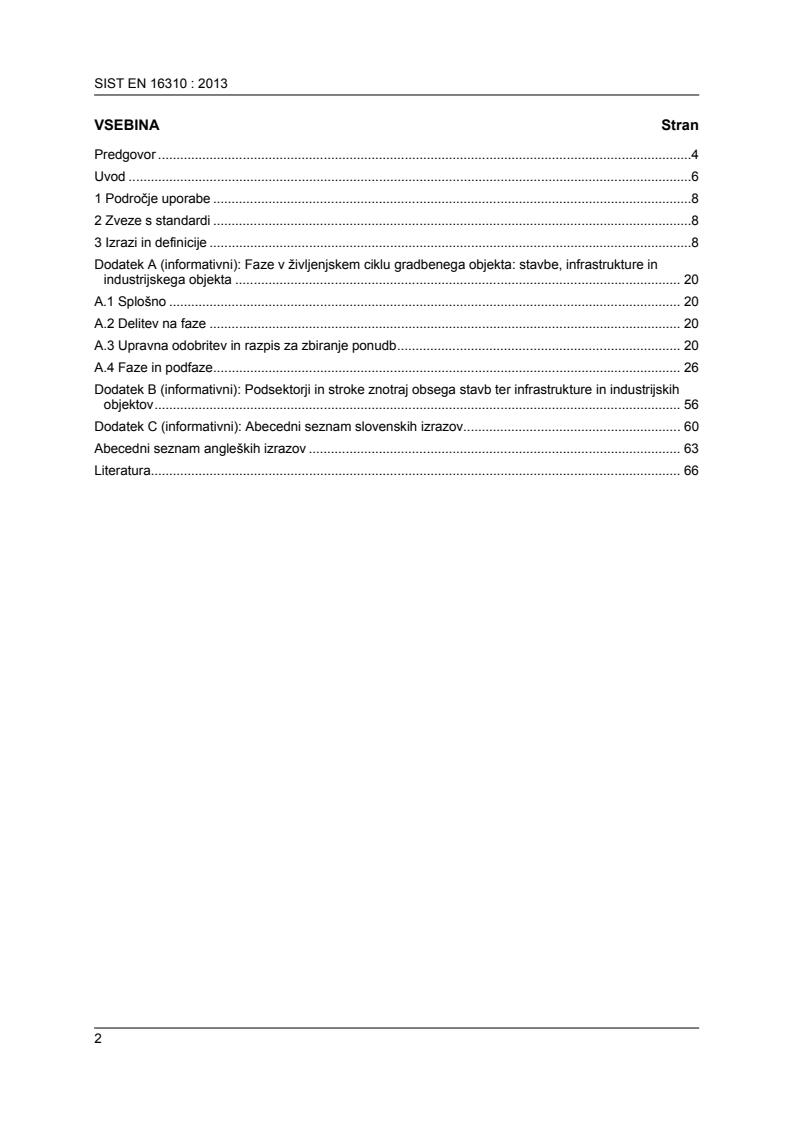
VSEBINA Stran
Predgovor .4
Uvod .6
1 Področje uporabe .8
2 Zveze s standardi .8
3 Izrazi in definicije .8
Dodatek A (informativni): Faze v življenjskem ciklu gradbenega objekta: stavbe, infrastrukture in
industrijskega objekta . 20
A.1 Splošno . 20
A.2 Delitev na faze . 20
A.3 Upravna odobritev in razpis za zbiranje ponudb. 20
A.4 Faze in podfaze. 26
Dodatek B (informativni): Podsektorji in stroke znotraj obsega stavb ter infrastrukture in industrijskih
objektov. 56
Dodatek C (informativni): Abecedni seznam slovenskih izrazov. 60
Abecedni seznam angleških izrazov . 63
Literatura. 66
SIST EN 16310 : 2013
CONTENTS Page
Foreword.5
Introduction.7
1 Scope.9
2 Normative references .9
3 Terms and definitions .9
Annex A Stages in the life cycle of built assets: Buildings, Infrastructure and
Industrial Facilities (informative) . 21
A.1 General. 21
A.2 Staging . 21
A.3 Statutory approval and tendering. 21
A.4 Stages and sub stages. 27
Annex B (informative): Sub Sectors and Disciplines within the Scope of Buildings, Infrastructure and
Industrial Facilities . 57
Annex C (informative): Alphabetical index (Slovenian) . 60
Annex C (informative): Alphabetical index (English) .63
Bibliography. 67
SIST EN 16310 : 2013
PREDGOVOR
Ta dokument (EN 16310:2013) je pripravil tehnični odbor CEN/TC 395 Inženirske svetovalne storitve,
katerega sekretariat vodi ANFOR.
Ta evropski standard mora dobiti status nacionalnega standarda bodisi z objavo istovetnega besedila
ali z razglasitvijo najpozneje avgusta 2013, nasprotujoče nacionalne standarde pa je treba razveljaviti
najpozneje avgusta 2013.
Opozoriti je treba na možnost, da so lahko nekateri elementi tega dokumenta predmet patentnih
pravic. CENELEC [in/ali CEN] ne prevzema odgovornosti za identifikacijo nekaterih ali vseh takih
patentnih pravic.
V skladu z notranjimi predpisi CEN/CENELEC morajo ta evropski standard obvezno uvesti nacionalne
organizacije za standardizacijo naslednjih držav: Avstrije, Belgije, Bolgarije, Cipra, Češke republike,
Danske, Estonije, Finske, Francije, Grčije, Hrvaške, Irske, Islandije, Italije, Latvije, Litve, Luksemburga,
Madžarske, Malte, Nekdanje jugoslovanske republike Makedonije, Nemčije, Nizozemske, Norveške,
Poljske, Portugalske, Romunije, Slovaške, Slovenije, Španije, Švedske, Švice, Turčije in Združenega
kraljestva.
SIST EN 16310 : 2013
FOREWORD
This document (EN 16310:2013) has been prepared by Technical Committee CEN/TC 395 “Engineering
consultancy services”, the secretariat of which is held by AFNOR.
This European Standard shall be given the status of a national standard, either by publication of an
identical text or by endorsement, at the latest by August 2013, and conflicting national standards shall be
withdrawn at the latest by August 2013.
Attention is drawn to the possibility that some of the elements of this document may be the subject of
patent rights. CEN [and/or CENELEC] shall not be held responsible for identifying any or all such patent
rights.
According to the CEN/CENELEC Internal Regulations, the national standards organisations of the
following countries are bound to implement this European Standard: Austria, Belgium, Bulgaria, Croatia,
Cyprus, Czech Republic, Denmark, Estonia, Finland, Former Yugoslav Republic of Macedonia, France,
Germany, Greece, Hungary, Iceland, Ireland, Italy, Latvia, Lithuania, Luxembourg, Malta, Netherlands,
Norway, Poland, Portugal, Romania, Slovakia, Slovenia, Spain, Sweden, Switzerland, Turkey and the
United Kingdom.
SIST EN 16310 : 2013
Uvod
Ta evropski standard vsebuje glosar ključnih besed, ki so povezane z inženirskimi storitvami in se
uporabljajo pri graditvi stavb, infrastrukture in industrijskih objektov. Glosar lahko prispeva k boljšim
pogojem svobodne konkurence in enakih možnosti izvajalcev inženirskih storitev (vključno z arhitekti)
v Evropski skupnosti. Namenjen je zmanjšanju ali odpravljanju ovir, s katerimi se ti izvajalci srečujejo
pri čezmejnem delovanju in sodelovanju zaradi različnih razlag bistvenih izrazov v posameznih
evropskih državah. Izrazi, ki so vključeni v glosar, so v skladu s tistimi, ki jih je za druge industrijske
namene obravnaval CEN/TC 395.
Vsak projekt graditve se vodi v več fazah, zato je delitev na faze pomembna aktivnost pri vodenju in
ocenjevanju inženirskih storitev. Vendar, standardne faze projekta in pripadajoča nacionalna pravila
izvajalcev inženirskih storitev (vključno z arhitekti) se razlikujejo od države do države in so lahko
predmet razlik v zakonodaji. A namen tega standarda ni harmonizirati nacionalna pravila. Pri
čezmejnem delovanju in sodelovanju pa je seveda pomembno, da imajo vse vpletene stranke skupni
pogled na razporeditev posameznih dejanskih faz in na inženirske storitve, ki se izvajajo v posamezni
fazi. Da bi se to olajšalo, so v dodatku A podane informacije o posameznih fazah v življenjskem ciklu
objektov. Ta dodatek nudi skupni referenčni okvir, v katerem lahko izvajalci inženirskih storitev za
čezmejne projekte (vključno z arhitekti) načrtujejo svoj specifični obseg del, pri čemer se dejanski
obseg del specificira v pogodbah.
SIST EN 16310 : 2013
Introduction
This European Standard contains a glossary of key words concerning engineering services, provided
in the construction of buildings, infrastructure and industrial facilities. The glossary can contribute to
the conditions for free competition and a level playing field for engineering service providers (including
architects) in the European Community. It is intended to lower or remove the barriers that these
providers are confronted with in cross border operations and co-operations due to different
interpretations of relevant terms in different European countries. The terms that are incorporated in the
glossary are in line with those developed by CEN/TC 395 for other industries.
Each construction project is managed through a series of stages and therefore staging is important for
the management and assessment of engineering services. However, the standard stages in projects
and related national plans of work of engineering service providers (including architects) differ from
country to country and may also be subject to differences in legislation. For these reasons, it is not the
intention of this standard to harmonise national plans of work. However, in cross border operations
and co-operations it is important that all parties concerned have a common view on the actual staging
and the engineering activities that take place within each stage. To facilitate this, some information
about the stages in the life cycle of built assets is given in Annex A. This annex may offer a common
reference framework onto which engineering service providers (including architects) can ‘map’ their
project-specific scope of work in cross border projects, while the actual scope of work is to be
specified in contracts.
SIST EN 16310 : 2013
1 Področje uporabe
Ta evropski standard obsega glosar izrazov, ki lahko prispevajo k uvajanju pogojev svobodne
konkurence in enakih možnosti izvajalcev inženirskih storitev (vključno z arhitekti) v Evropi pri graditvi
stavb, infrastrukture in industrijskih objektov.
Izrazje v tem evropskem standardu ima namen olajšati sodelovanje med posameznimi sektorji in med
posameznimi državami na področju inženirskih storitev. Strukturirano je po načelu "sledenja fazam" pri
gradnji. Ne vsebuje opisov nalog, ki jih je treba izvesti, niti časovnega načrta niti obravnave
udeležencev, ki so odvisni od nacionalnega konteksta, vrste in pomembnosti del in njihovega okolja.
2 Zveze s standardi
Za uporabo tega standarda so, delno ali v celoti, nujno potrebni spodaj navedeni referenčni
dokumenti. Pri datiranih sklicevanjih se uporablja le navedena izdaja. Pri nedatiranih sklicevanjih se
uporablja zadnja izdaja publikacije (vključno z dopolnili).
EN 15643-3:2012 Trajnostnost gradbenih objektov – Ocenjevanje stavb – 3. del: Okvir za
ocenjevanje družbenega učinka
3 Izrazi in definicije
V tem dokumentu se uporabljajo naslednji izrazi in definicije:
3.1
ocenjevanje
mnenje
sodba
stalni proces zbiranja, analiziranja in komentiranja podatkov, verodostojnosti sodb z namenom
informiranosti in trdnosti ocen (o kakovosti storitve, procesa ali proizvoda)
OPOMBA 1 k izrazu: Povezani izrazi so: obvladovanje, kontrola, nadzor.
3.2
projektna naloga
program
pisni dokument, ki podaja naročnikove zahteve za gradbeni projekt
(VIR: ISO 6707-2:1993)
3.3
stavba
gradbeni objekt, katerega glavna funkcija je dati zavetje stanovalcem ali stvarem in je po navadi
projektiran tako, da ostane ves čas na istem mestu
(VIR: ISO 6707-1:2004)
OPOMBA 1 k izrazu: Glej dodatek B.
3.4
naročnik
oseba ali organizacija, ki poda zahtevo, da se stavba zgradi, prenovi ali razširi, in je odgovorna za
pripravo in potrditev projektne naloge
(VIR: ISO 6707-1:2004)
OPOMBA 1 k izrazu: Povezani izraz je: kupec, ki je definiran kot organizacija ali oseba, ki prejme proizvod
(glej EN ISO 9000:2005).
SIST EN 16310 : 2013
1 Scope
This European Standard contains a glossary of terms, which can contribute to the conditions for free
competition and a level playing field for engineering service providers (including architects) in Europe
in the construction of buildings, infrastructure and industrial facilities.
The terminology in this European Standard aims at facilitating the cooperation between sectors and
between countries in the field of engineering services. It is structured on the basis of "successive
stages" of an operation of construction. It does not concern the description of the contents of the tasks
to be performed, neither on their scheduling, nor on the actors concerned, which depend on the
national context, the type, and of the importance of the work and its environment.
2 Normative references
The following documents, in whole or in part, are normatively referenced in this document and are
indispensable for its application. For dated references, only the edition cited applies. For undated
references, the latest edition of the referenced document (including any amendments) applies.
EN 15643-3:2012 Sustainability of construction works – Assessment of buildings – Part 3:
Framework for the assessment of social performance
3 Terms and definitions
For the purposes of this document, the following terms and definitions apply:
3.1
assessment
appraisal
judgment
ongoing process of gathering, analyzing and reflecting on evidence to make informed and consistent
judgments (about the quality of a service, process or product)
Note 1 to entry: A related term is: control.
3.2
brief
written document that states the client’s requirements for a construction project
[SOURCE: ISO 6707-2:1993]
3.3
building
construction work that has the provision of shelter for its occupants or contents as one of its main
purposes; usually partially or totally enclosed and designed to stand permanently in one place
[SOURCE: ISO 6707-1:2004]
Note 1 to entry: See Annex B.
3.4
client
person or organisation that requires a building to be provided, altered or extended and is responsible
for initiating and approving the brief
[SOURCE: ISO 6707-1:2004]
Note 1 to entry: A related term is: cutomer, which is defined as an organization or person that receives a product
(see EN ISO 90000:2005)
SIST EN 16310 : 2013
3.5
gradbena pogodba
posebna oblika nabave, ki obsega samo dejanska dela na gradbišču, vključno z opremo in materialom
OPOMBA 1 k izrazu: Povezani izrazi so: predkvalifikacija/kvalifikacija pogodbenika, pregledi pogodbenika, razpis/javni razpis
za zbiranje ponudb, preglednice tehničnih podatkov, preglednice komercialnih podatkov, izbira
pogodbenika, oddaja naročila/podpis pogodbe.
3.6
pogodba
zavezujoč dogovor
(VIR: EN ISO 9000:2005)
OPOMBA 1 k izrazu: V Evropi zaradi razlik v pravnih določilih ni enotnega mnenja, kdaj pogodba postane pravno obvezujoča.
OPOMBA 2 k izrazu: Pogodba med izvajalcem inženirskih storitev (ESP) in naročnikom lahko vključuje (se sklicuje na)
splošne pogoje, posebne projektne pogoje, popis obsega del izvajalca inženirskih storitev (ESP) in
finančni sporazum.
3.7
obvladovanje
vodstveni proces, v katerem se dejanska izvršitev del primerja s predvideno, razlike med njima se
merijo, prepoznavajo se vzroki razlik ter izvedejo se popravki, da se odpravijo ali zmanjšajo razlike na
še sprejemljivo mero
OPOMBA 1 k izrazu: Povezani izrazi so: ocenjevanje, overjanje in validacija.
OPOMBA 2 k izrazu: Poleg popravkov se lahko izvedejo korektivni ukrepi, da se odstranijo vzroki zaznanih neskladij ali druga
neželena situacija.
3.8
strošek
količina denarja, potrebna za dosego cilja
OPOMBA 1 k izrazu: Povezani izrazi so: proračun projekta, ciljni proračun, obratovalni stroški, stroški življenjskega ciklusa.
3.9
obratovalni stroški
stroški uporabe/delovanja objekta ali proizvoda
3.10
inženiring
intelektualne aktivnosti, potrebne za opredelitev, zasnovo, izdelavo, uporabo in razgradnjo proizvoda,
procesa ali gradbenega objekta
3.11
inženirske storitve
intelektualne naloge, ki jih med eno ali vsemi fazami v življenjskem ciklu proizvoda, procesa ali
gradbenega objekta izvajajo usposobljeni strokovnjaki
3.12
okoljski vidik
pogled na gradbene objekte, dele objektov, procese ali storitve, ki v celotnem njihovem življenjskem
ciklu lahko vplivajo na okolje
(VIR: ISO 21931-1:2010)
PRIMER: Uporaba energije in materialov, proizvodnja in ločevanje odpadkov, uporaba vode, uporaba zemljišča,
izpusti v zrak (primeri so dodani k definiciji o okoljskih vidikih v ISO 15392).
SIST EN 16310 : 2013
3.5
construction contracting
specific form of procurement, where only the actual execution of the project on site is procured,
including facilities and materials
Note 1 to entry: Related terms are: contractor prequalification/qualification, contractor surveys, calls for bids/tenders,
technical bid tabulations, commercial bids tabulations, contractor selection, contract award.
3.6
contract
binding agreement
[SOURCE: EN ISO 9000:2005]
Note 1 to entry: No consensus in Europe exists about how and when a contract is legally binding, due to differences in legal
requirements.
Note 2 to entry: A contract between an Engineering Service Provider (ESP) and a Client may include (references to) general
conditions, project specific conditions, a specification of the ESP’s scope of work in the project and financial
arrangements.
3.7
control
management process in which the actual performance is compared with planned performance, the
difference between the two is measured, causes contributing to the difference are identified and
corrections are made to eliminate or minimise the difference to an acceptable level
Note 1 to entry: Related terms are: assessment, verification and validation.
Note 2 to entry: In addition to corrections, corrective actions may be taken to eliminate the cause of a detected
nonconformity or other undesirable situation.
3.8
cost
amount of money necessary for the attainment of a goal
Note 1 to entry: Related terms are: project budget, target budget, cost in use, life cycle cost.
3.9
cost in use
cost of running/operating a facility or product
3.10
engineering
intellectual activities necessary to define, design, produce, sustain and recycle a product, a process or
a built asset
3.11
engineering services
intellectual tasks provided during one or all stages of the life cycle of a product, a process or a built
asset by specialised professionals
3.12
environmental aspect
aspect of construction works, part of works, processes or services related to their life cycle that can
cause change to the environment
[SOURCE: ISO 21931-1:2010]
EXAMPLE Use of energy and mass flow, production and segregation of wastes, water use, land use, emissions to air
(examples added to the definition of environmental aspect in ISO 15392).
SIST EN 16310 : 2013
3.13
okoljski vpliv
vsaka sprememba v okolju, negativna ali pozitivna, ki je delno ali v celoti posledica okoljskih vidikov
(VIR: EN 15643-3:2012)
OPOMBA 1 k izrazu: Povezan izraz je trajnostnost.
3.14
delovanje
delovanje objekta, opreme ali proizvoda
OPOMBA 1 k izrazu: Povezana izraza sta zmogljivost, tehnična lastnost.
3.15
naročnikova odobritev
odločitev naročnika, da nadaljuje, spremeni ali prekine projekt, vse na podlagi ocene rezultatov
posamezne faze (podfaze)
3.16
predaja
stopnja, pri kateri se lastništvo gradbenega objekta po končani gradnji preda naročniku, in to s pridržki
ali brez njih
(VIR: EN 15643-4)
OPOMBA 1 k izrazu: Povezani izraz je: podpisovanje (pogodbe).
3.17
industrijski objekt
vsaka fiksna oprema in/ali objekt, ki se uporablja s procesom ali sistemom za industrijsko proizvodnjo
ali izdelkom ali je njun del
OPOMBA 1 k izrazu: Glej dodatek A.
3.18
infrastruktura
grajeni objekti, ki so potrebni za zadovoljevanje razvojnih in obratovalnih potreb skupnosti, vključno z
na primer cestami, železnicami, vodotoki, vodovodnimi in kanalizacijskimi sistemi, energetskimi
omrežji in podatkovnimi omrežji
OPOMBA 1 k izrazu: Glej dodatek B.
3.19
življenjski cikel
vse zaporedne in povezane faze v življenjski dobi obravnavanega objekta
(VIR: ISO 15392:2008)
Opomba 1 k izrazu: Definicija v EN ISO 14040 se glasi: "zaporedne in povezane faze izdelave, od nabave surovin ali
generacije iz naravnih virov vse do končnega odlagališča".
OPOMBA 2 k izrazu: Dodatek A prikazuje primer življenjskega cikla s pripadajočimi fazami in podfazami.
3.20
stroški življenjskega cikla
LCC
stroški stavbe ali dela gradbenega objekta skozi njegov celoten življenjski cikel ob zadovoljevanju
tehničnih in funkcionalnih zahtev
(VIR: EN 15643-4:2012)
SIST EN 16310 : 2013
3.13
environmental impact
any change to the environment whether adverse or beneficial, wholly or partially resulting from
environmental aspects
[SOURCE: EN 15643-3:2012]
Note 1 to entry: Related terms are: durability, sustainability.
3.14
functioning
working of an asset, equipment or product
Note 1 to entry: A related term is: performance.
3.15
client approval
decision by the client to continue, change or terminate the project, on the basis of an assessment of
(sub) stage results
3.16
handover
step at which possession of the construction works is surrendered to the client upon completion with or
without reservation
[SOURCE: EN 15643-4]
Note 1 to entry: A related term is: signing off (a contract).
3.17
industrial facility
any fixed equipment and/or facility which is used in connection with, or as part of, any process or
system for industrial production or output
Note 1 to entry: See Annex A.
3.18
infrastructure
built facilities that are required in order to serve a community's developmental and operational needs,
including e.g. roads, railroads, water ways, water and sewer systems, energy networks and data networks
Note 1 to entry: See Annex B.
3.19
life cycle
all consecutive and interlinked stages in the life of the object under consideration
[SOURCE: ISO 15392:2008]
Note 1 to entry: The definition in EN ISO 14040 is: "consecutive and interlinked stages of a product system, from raw
material acquisition or generation from natural resources to final disposal'.
Note 2 to entry: Annex A shows an example of a life cycle with respective stages and sub-stages.
3.20
life cycle cost
LCC
cost of a building or part of works throughout its life cycle, while fulfilling technical requirements an
functional requirements
[SOURCE: EN 15643-4:2012]
SIST EN 16310 : 2013
3.21
vzdrževanje
kombinacija vseh tehničnih in pripadajočih administrativnih aktivnosti v delovni dobi, da se stavba ali
pridruženi sistem (del objekta) obdrži v stanju, da lahko izpolnjuje tehnične in funkcionalne zahteve
OPOMBA 1 k izrazu: Vzdrževanje vključuje čiščenje, servisiranje, obnavljanje pleskanja, popravljanje, zamenjevanje delov
konstrukcije, kjer je potrebno, itd. (glej usmerjevalni dokument Direktive o gradbenih proizvodih – CPD
(Guidance Paper F)).
OPOMBA 2 k izrazu: Prirejeno po definicijah v ISO 15686-1 in ISO 6707-1 v skladu s CPD Guidance Paper F.
3.22
vzdrževalna podpora
storitve, ki zadržijo objekt v skladu z vnaprej določenimi cilji
3.23
obratovalna podpora
storitve, ki omogočajo optimalno in varno obratovanje objekta, vključno s spremljanjem in vodenjem
pričakovanih kazalcev kakovosti
3.24
tehnične lastnosti
izraz, ki se nanaša na velikost posameznega vidika obravnavanega objekta v razmerju do navedenih
zahtev, usmeritev in/ali ciljev
OPOMBA 1 k izrazu: Prirejeno po definiciji v ISO 6707-1 v skladu z osnutkom priporočila ISO/TC 59/AHG Terminologija.
3.25
preskušanje tehničnih lastnosti
ovrednotenje skladnosti objekta, opreme ali izdelka z določenimi tehničnimi lastnostmi
3.26
proces
skupek med seboj povezanih ali medsebojno vplivajočih aktivnosti, ki pretvarjajo vhode v izhode
(VIR: EN ISO 9000:2005)
3.27
nabavljanje
proces, ki ustvarja, vodi in izpolnjuje pogodbe za nabavo blaga, storitev, inženirskih storitev, gradbenih
ali odstranitvenih del ali kakršno koli njihovo kombinacijo
(VIR: ISO 10845-1:2010)
OPOMBA 1 k izrazu: Povezani izrazi so: nabavne storitve, plan nabave, analiziranje in izbira dobaviteljev, analiza vrednosti,
pogajanja o ceni, predkvalifikacija dobaviteljev, kvalifikacija dobaviteljev, pregled dobaviteljev,
razpis/javni razpis za zbiranje ponudb, preglednice tehničnih podatkov, preglednice komercialnih
podatkov, izbira dobavitelja, podelitev/podpis pogodbe.
OPOMBA 2 k izrazu: "Storitve nabave" je treba razlikovati od samega "nabavljanja", ker storitve nabave lahko izvaja izvajalec
inženirskih storitev, čeprav obseg, podan v ECF, ne vključuje dejanskega podpisa pogodbe (ta ostaja v
izključni odgovornosti naročnika).
3.28
projekt
enkraten proces, ki sestoji iz skupka koordiniranih in obvladanih aktivnosti s časovno opredeljenim
začetkom in koncem. Sproži se za doseganje cilja, skladnega s specifičnimi zahtevami, vključno z
omejitvami časa, stroškov in virov
(VIR: EN ISO 9000:2005)
SIST EN 16310 : 2013
3.21
maintenance
combination of all technical and associated administrative actions during the service life to retain a
building or an assembled system (part of works) in a state in which it can fulfil its technical and
functional requirements
Note 1 to entry: Maintenance includes cleaning, servicing, repainting, repairing, replacing parts of the construction works
where needed, etc. (see CPD Guidance Paper F).
Note 2 to entry: Adapted from the definition in ISO 15686-1 and ISO 6707-1 according to the CPD Guidance Paper F.
3.22
maintenance support
services in relation to maintaining the facility according to predetermined objectives
3.23
operation support
services in relation to running the facility in an optimum and safe way, including the monitoring and
management of the expected performance
3.24
performance
expression relating the magnitude of a particular aspect of the object of consideration relative to
specified requirements, objectives and/or targets
Note 1 to entry: Adapted from the definition in ISO 6707-1 according to the draft recommendation of ISO/TC59/AHG
Terminology.
3.25
performance testing
evaluation of the compliance of an asset, equipment or product with specified performance
requirements
3.26
process
set of interrelated activities which transforms inputs into outputs
[SOURCE: EN ISO 9000:2005]
3.27
procurement
process which creates, manages and fulfils contracts relating to the provision of goods, services and
engineering and construction works or disposals, or any combination thereof
[SOURCE: ISO 10845-1:2010]
Note 1 to entry: Related terms are: procurement services, purchase planning, supplier research and selection, value
analysis, price negotiations, supplier prequalification, supplier qualification, supplier surveys, calls for
bids/tenders, technical bid tabulations, commercial bid tabulations, supplier selection, contract award.
Note 2 to entry: ‘Procurement services’ are distinguished from 'Procurement', as these services may be provided by an
engineering service provider, though the scope of the ECF does not include the actual signing of the
contract (this is the sole responsibility of the client) and the supply of their object.
3.28
project
unique process, consisting of a set of coordinated and controlled activities with start and finish dates,
undertaken to achieve an objective conforming to specific requirements, including the constraints of
time, cost and resources
[SOURCE: EN ISO 9000:2005]
SIST EN 16310 : 2013
3.29
proračun projekta
ocena stroškov projekta
3.30
projektna dokumentacija
skupek dokumentacije, ki opredeli obseg in naravo gradbenega objekta ali proizvoda
3.31
vodenje projekta
strokovna storitev, ki uporablja metode, orodja, tehnike in znanje za celovito planiranje, usklajevanje in
nadzor projekta v njegovem življenjskem ciklu, od zamisli do dokončanja, vse z namenom izpolniti
naročnikove zahteve, da se izvede funkcionalno in finančno primeren projekt, in to v predvidenem času,
v okviru odobrenih stroškov in po zahtevanih standardih kakovosti
OPOMBA 1 k izrazu: Ta definicija razširja obstoječo definicijo o vodenju projekta v ISO 10007.
OPOMBA 2 k izrazu: Neposredni viri za to definicijo so:
– ISO/TC 236 – Project Management – ISO 21500,
th
– Code of Practice for Project Management for Construction and Development: 4 Edition (1966) izdan
pri CIOB Chartered Institute of Building / International Construction Project Management Association,
– Capstone CM Body of Knowledge, CMAA Construction Project Management Association of America.
3.32
kakovost
stopnja, na kateri skupek svojstvenih karakteristik izpolnjuje zahteve
(VIR: EN ISO 9000:2005)
OPOMBA 1 k izrazu: Pri stavbah, na primer, kakovost gradbenega objekta pomeni, da ta ustreza zmogljivostim, ki
zadovoljujejo uporabnikove zahteve, kot je to določeno na začetku (glej definicijo za stavbo, ki je
podana v 3.3).
3.33
tveganje
učinek negotovosti na doseganje ciljev
(VIR: ISO Guide 73)
OPOMBA 1 k izrazu: Učinek je odklon od pričakovanega – pozitiven in/ali negativen.
OPOMBA 2 k izrazu: Cilji imajo lahko različne vidike (na primer finance, zdravje in varnost ter okoljski cilji) in se lahko
uporabljajo na različnih ravneh (na primer strateški nivo, nivo celotne organizacije, nivo projekta, nivo
proizvoda in nivo procesa).
OPOMBA 3 k izrazu: Tveganje je pogosto opredeljeno s pojavom potencialnih dogodkov in posledic ali z njihovo kombinacijo.
OPOMBA 4 k izrazu: Tveganje je pogosto izraženo s kombinacijo posledic dogodka (vključno s spremembami v okoliščinah)
in pripadajočo verjetnostjo pojavljanja.
OPOMBA 5 k izrazu: Negotovost je stanje pomanjkanja informacij, lahko le delno, ki so potrebne za razumevanje ali
poznavanje nekega dogodka, njegovih posledic ali verjetnosti nastopanja.
3.34
stopnja
faza
obdobje v življenjskem ciklu objekta, ki se nanaša na njegovo zagonsko fazo, projektiranje, gradnjo,
obratovanje ali razgradnjo/recikliranje
SIST EN 16310 : 2013
3.29
project budget
assessment of the cost of a project
3.30
project documentation
set of documents used to define the extent and nature of a built asset or a product
3.31
project management
professional service that applies (application) methods, tools, techniques and competences to the
overall planning, co-ordination and control of a project life cycle, from inception to completion, aimed at
meeting a client's requirements in order to produce a functionally an financially viable project that will
be completed on time within authorised cost and to the required quality standards
Note 1 to entry: This definition enhances an existing definition of project management in ISO 10007.
Note 2 to entry: Direct sources for this definition are:
– ISO/TC 236 - Project Management - ISO 21500;
– Code of Practice for Project Management for Construction and Development: 4th Edition (1996), issued
by CIOB Chartered Institute of Building / International Construction Project Management Association;
– Capstone CM Body of Knowledge, CMAA Construction Project Management Association of America.
3.32
quality
degree to which a set of inherent characteristics fulfils requirements
[SOURCE: EN ISO 9000:2005]
Note 1 to entry: For example for buildings, the quality of the built asset corresponds with the capacity of meeting user’s
needs as defined at the outset (see definition of building given in 3.3).
3.33
risk
effect of uncertainty on objectives
[SOURCE: ISO Guide 73]
Note 1 to entry: An effect is a deviation from the expected - positive and/or negative.
Note 2 to entry: Objectives can have different aspects (such as financial, health and safety, and environmental goals)
and can apply at different levels (such as strategic, organisation-wide, project, product and process).
Note 3 to entry: Risk is often characterised by reference to potential events and consequences, or a combination of
these.
Note 4 to entry: Risk is often expressed in terms of a combination of the consequences of an event (including changes
in circumstances) and the associated likelihood of occurrence.
Note 5 to entry: Uncertainty is the state, even partial, of deficiency of information related to, understanding or knowledge
of, an event, its consequence, or likelihood.
3.34
stage
phase
period within the life cycle of an entity that relates to the state of its initiation, design, construction,
operation or dismantling/recycling
SIST EN 16310 : 2013
3.35
upravna odobritev
uradno dovoljenje za gradnjo, ki ga izdajo lokalne oblasti, potem ko so ugotovile, da projektna
dokumentacija ustreza vsem veljavnim zakonskim zahtevam
OPOMBA 1 k izrazu: Povezan izraz je: gradbeno dovoljenje.
OPOMBA 2 k izrazu: V nekaterih državah EU je pridobivanje gradbenega dovoljenja posebna faza ali podfaza.
3.36
nadzor
preverjanje na kraju samem, da je objekt zgrajen v skladu s projektno dokumentacijo in zakonskimi
zahtevami
OPOMBA 1 k izrazu: Povezana izraza sta: obvladovanje, spremljanje.
3.37
ciljni proračun
postavljene meje zahtevanih sredstev za določen obseg del
3.38
čas
(ocenjen) čas, uporabljen pri nizu dejavnosti
OPOMBA 1 k izrazu: Povezani izrazi so: terminski načrt, celovit terminski načrt, mejniki, podrobni terminski načrt.
OPOMBA 2 k izrazu: Zakonska pravila za izračunavanje časovnih trajanj in period se razlikujejo v posameznih državah EU. Da bi se
zagotovila pravna varnost in izognili nesporazumi (npr. periode, izražene v delovnih dnevih ali v koledarskih
dnevih), se priporoča, da se stranke sklicujejo na splošna pravila o štetju časa. Primer takega skupnega
standarda je npr. člen I.-1:110 iz Draft Common Frame of Reference fo European Private Law (DCFR).
3.39
validacija
potrditev na podlagi stvarnega dokaza, da so zahteve za specifično nameravano uporabo ali aplikacijo
izpolnjene
(VIR: EN ISO 9000:2005)
OPOMBA 1 k izrazu: Izraz "validiran" se uporablja za označitev pripadajočega statusa.
OPOMBA 2 k izrazu: Za validacijo so lahko uporabljeni realni ali simulirani pogoji.
OPOMBA 3 k izrazu: Povezani izrazi so: ustrezno namenu, obvladovanje, overjanje.
OPOMBA 4 k izrazu: Validacija se lahko opiše tudi kot: "preveriti, ali je bil zgrajen pravi objekt".
3.40
overjanje
potrditev na podlagi stvarnega dokaza, da so specificirane zahteve izpolnjene
(VIR: EN ISO 9000:2005)
OPOMBA 1 k izrazu: Izraz "overjen" se uporablja za označitev pripadajočega statusa.
OPOMBA 2 k izrazu: Potrditev lahko obsega aktivnosti, kot so:
– priprava alternativnih izračunov,
– primerjava novih projektnih specifikacij s podobnimi, že preverjenimi,
– izvedba preskusov in prikazov ter
– revizija dokumentacije pred izdajo.
OPOMBA 3 k izrazu: Povezana izraza sta: obvladovanje in validacija
OPOMBA 4 k izrazu: Overjanje se lahko opiše kot "preveriti, ali je bil objekt zgrajen pravilno" ali "preveriti, ali so komponente
ali objekt zgrajeni v skladu z zahtevami".
OPOMBA 5 k izrazu: Drugi izrazi, povezani s fazami in podfazami življenjskega cikla, so v dodatku C, opisi teh dodatnih
izrazov pa so v dodatku A.
SIST EN 16310 : 2013
3.35
statutory approval
official license to build, to be issued by the local authorities, after these authorities have determined
compliancy of the design with the applicable regulatory requirements
Note 1 to entry: A related term is: building permit.
Note 2 to entry: In some EU countries, the application of a building permit is a (sub) stage in its own right.
3.36
supervision
monitoring that the asset is constructed on site in compliance with the project documentation and
regulatory requirements
Note 1 to entry: Related terms are: control, monitoring.
3.37
target budget
established boundaries for the funding required for a defined scope of works
3.38
time
(estimated) time involved with a set of activities
Note 1 to entry: Related terms are: schedule, overall schedule, milestones, detailed schedule.
Note 2 to entry: The legal rules for regulating the computation of time limits and periods differ among EU countries. In order to
ensure legal certainty and to avoid misunderstandings (e.g. periods expressed in working days or calendar days),
it is advisable for parties to refer to a general rule for the computation of time. One example of such a common
standard is Article I.-1:110 of the Draft Common Frame of Reference for European Private Law (DCFR).
3.39
validation
confirmation, through the provision of objective evidence, that the requirements for a specific intended
use or application have been fulfilled
[SOURCE: EN ISO 9000:2005]
Note 1 to entry: The term “validated” is used to designate the corresponding status.
Note 2 to entry: The use conditions for validation can be real or simulated.
Note 3 to entry: Related terms are: fit for purpose, control, verification.
Note 4 to entry: Validation may be described as ‘to check if the right thing is built’.
3.40
verification
confirmation, through the provision of objective evidence, that specified requirements have been fulfilled
[SOURCE: EN ISO 9000:2005]
Note 1 to entry: The term “verified” is used to designate the corresponding status.
Note 2 to entry: Confirmation can comprise activities such as:
– performing alternative calculations,
– comparing a new design specification with a similar proven design specification,
– undertaking tests and demonstrations, and
– reviewing documents prior to issue.
Note 3 to entry: Related terms are: control and validation.
Note 4 to entry: Verification may be described as: ‘to check if it is correctly built’ or: ‘to check the component or asset is built
as required’.
Note 5 to entry: Other terms related to life cycle stages and sub-stages can be found in Annex C; descriptions of these
additional terms can be found in Annex A.
SIST EN 16310 : 2013
Dodatek A
(informativni)
Faze v življenjskem ciklu gradbenega objekta: stavbe, infrastrukture in
industrijskega objekta
A.1 Splošno
Ta dodatek opisuje faze in podfaze v življenjskem ciklu stavb, infrastrukture in industrijskih objektov.
Opis naj bi bil referenčni okvir, znotraj katerega lahko izvajalci inženirskih storitev (vključno z arh
...