


EN 15890:2010
(Main)Foodstuffs - Determination of patulin in fruit juice and fruit based purée for infants and young children - HPLC method with liquid/liquid partition cleanup and solid phase extraction and UV detection
Foodstuffs - Determination of patulin in fruit juice and fruit based purée for infants and young children - HPLC method with liquid/liquid partition cleanup and solid phase extraction and UV detection
This European Standard specifies a method for the determination of patulin in fruit juices and fruit-based purée, such as baby food purée, using high performance liquid chromatography with ultra-violet detection (HPLC-UV). Using naturally contaminated and spiked samples this method has been validated for the determination of patulin in apple juice, at levels ranging from 3,0 μg/kg to 15,5 μg/kg, and in fruit-based baby food purée, at levels ranging from 3,4 μg/kg to 17,9 μg/kg. Baby food fruit purée (commercially available on the European market) used in this study contained the following ingredients: blueberry; apple; banana; lemon; wheat biscuits; wheat syrup; whole milk; and vegetable oil. A detailed listing, including the fractions, of each product used in this study is given in [1].
Further information on validation, see Clause 9 and Annex B.
Lebensmittel - Bestimmung von Patulin in Fruchtsaft und Obstbrei für Säuglinge und Kleinkinder - HPLC-Verfahren mit Reinigung durch Flüssig/Flüssig-Verteilung, Festphasenextraktion und UV-Detektion
Diese Europäische Norm legt ein Verfahren zur Bestimmung von Patulin in Fruchtsäften und Obstbreien, wie z. B. Beikost in Form von Obstbrei, durch Hochleistungsflüssigchromatographie mit Ultraviolett-Detektion (HPLC-UV) fest. Unter Verwendung von natürlich kontaminierten und aufgestockten Proben wurde das Verfahren für die Bestimmung von Patulin in Apfelsaft in einem Konzentrationsbereich von 3,0 µg/kg bis 15,5 µg/kg validiert, wie auch für Beikost (Obstbrei) in einem Bereich von 3,4 µg/kg bis 17,9 µg/kg. Die in dieser Studie verwendete Beikost enthielt eine Mischung der folgenden im europäischen Markt erhältlichen Zutaten: Heidelbeere, Apfel, Banane, Zitrone, Weizenkeks, Weizensirup, Vollmilch und Pflanzenöl. Eine ausführliche Auflistung der Anteile jedes in dieser Studie verwendeten Erzeugnisses ist in [1] angeführt.
Weitere Informationen zu Validierungsdaten siehe Abschnitt 9 und Anhang B.
Denrées alimentaires - Dosage de la patuline dans le jus de fruits et la compote de fruits en alimentation infantile - Méthode par CLHP avec purification par partition liquide-liquide et extraction en phase solide et détection UV
La présente Norme européenne spécifie une méthode de dosage de la patuline dans les jus de fruits et les compotes de fruits, telles que compotes pour bébés, par chromatographie en phase liquide à haute performance avec détection dans l'ultraviolet (CLHP-UV). Cette méthode a été validée pour permettre de doser la patuline dans des échantillons naturellement contaminés et supplémentés de jus de pommes à des teneurs comprises entre 3,0 µg/kg et 15,5 µg/kg et de compotes de fruits pour bébés à des teneurs comprises entre 3,4 µg/kg et 17,9 µg/kg. Les compotes de fruits pour bébés utilisées dans cette étude contiennent un mélange des ingrédients suivants qui sont disponibles dans le commerce sur le marché européen : myrtille, pomme, banane, citron, biscuits de blé, sirop de blé, lait entier et huile végétale. La liste détaillée des proportions de chaque produit utilisé dans cette étude est donnée en [1].
Pour de plus amples informations sur la validation, voir l'Article 9 et l'Annexe B.
Živila - Določevanje patulina v sadnem soku in sadnih kašicah za dojenčke in majhne otroke - HPLC metoda z ekstrakcijo tekoče/tekoče, čiščenje z ekstrakcijo na trdni fazi in UV detekcijo
Ta evropski standard določa metodo za določevanje patulina v sadnem soku in sadnih kašicah, kot je kašica za dojenčke, z uporabo tekočinske kromatografije visoke ločljivosti, ki uporablja ultravijolično detekcijo (HPLC-UV). Z uporabo naravno kontaminiranih vzorcev in vzorcev z internimi dodatki je bila ta metoda potrjena za določevanje patulina v jabolčnem soku v stopnjah v razponu od 3,0 μg/kg do 15,5 μg/kg in v sadnih kašicah za dojenčke v stopnjah v razponu od 3,4 μg/kg do 17,9 μg/kg. Sadna kašica za dojenčke, uporabljena v tej študiji, vsebuje mešanico naslednjih sestavin, ki so komercialno razpoložljive na evropskem trgu: borovnice; jabolka; banane; limone; pšenični piškoti; pšenični sirup; polnomastno mleko; in rastlinsko olje. Podan je podroben seznam, vključno s frakcijami vsakega proizvoda, uporabljenega v tej študiji. Za nadaljnje informacije za potrditev glej klavzulo 9 in dodatek B.
General Information
- Status
- Published
- Publication Date
- 28-Sep-2010
- Technical Committee
- CEN/TC 275 - Food analysis - Horizontal methods
- Drafting Committee
- CEN/TC 275/WG 5 - Biotoxins
- Current Stage
- 9093 - Decision to confirm - Review Enquiry
- Start Date
- 02-Jul-2021
- Completion Date
- 14-Apr-2025
Overview
EN 15890:2010 (CEN) specifies a validated analytical method for the determination of patulin in fruit juices and fruit‑based purées (including baby food purée) using HPLC-UV. The method combines a liquid–liquid partition extraction (ethyl acetate/hexane), cleanup by silica solid phase extraction (SPE), solvent evaporation and reconstitution in pH 4 water, followed by reverse‑phase HPLC with ultraviolet detection (recommended at ~276 nm). Validation details are given in Clause 9 and Annex B; the method was validated on apple juice (3.0–15.5 µg/kg) and on fruit‑based baby food purée (3.4–17.9 µg/kg).
Key topics and technical requirements
- Scope & matrixes: Fruit juices and fruit‑based purées intended for infants and young children (including commercially available baby purée ingredients used in validation).
- Sample extraction: Ethyl acetate/hexane extraction in presence of anhydrous sodium sulfate and sodium hydrogen carbonate. Rapid handling required because patulin is unstable in alkaline conditions.
- Clean‑up: Silica SPE (500 mg SiO2) with a pre‑wash of acetic acid/ethyl acetate mixture, followed by elution and evaporation to dryness under nitrogen (≤ 40 °C).
- Chromatography: Reverse‑phase HPLC with polar end‑capped or polar‑embedded C18 type columns (e.g., Synergy®, Atlantis®, Luna® types), isocratic pump (≈1 mL/min), UV detection at ~276 nm. Mobile phase: mainly water with small proportions of acetonitrile and perchloric acid; composition may be adjusted to resolve interferences (e.g., 5‑hydroxymethylfurfural).
- Standards & calibration: Patulin stock and working standards prepared in ethyl acetate/ethanol; spectrophotometric verification of concentration recommended.
- Safety & quality: Patulin and acetonitrile are hazardous-use fume hood, gloves, and safety eyewear. Water for analysis should comply with EN ISO 3696:1995.
Applications and users
- Who uses it: Food testing laboratories, baby food manufacturers, regulatory agencies, QA/QC teams, and research labs performing patulin monitoring or compliance testing.
- Practical uses:
- Regulatory compliance testing and surveillance of patulin levels in juices and infant purées.
- Routine quality control of raw materials and finished products.
- Method transfer, inter-laboratory comparisons and validation studies.
- Troubleshooting chromatographic interferences and optimizing SPE cleanup for complex purée matrices.
Related standards
- EN ISO 3696:1995 - Water for analytical laboratory use (referenced for reagent water quality).
- Validation and precision data are provided in Clause 9 and Annex B of EN 15890:2010 for laboratory implementation and performance assessment.
Keywords: EN 15890:2010, patulin, HPLC-UV, fruit juice testing, baby food purée, solid phase extraction, liquid–liquid partition, CEN, patulin determination.



Frequently Asked Questions
EN 15890:2010 is a standard published by the European Committee for Standardization (CEN). Its full title is "Foodstuffs - Determination of patulin in fruit juice and fruit based purée for infants and young children - HPLC method with liquid/liquid partition cleanup and solid phase extraction and UV detection". This standard covers: This European Standard specifies a method for the determination of patulin in fruit juices and fruit-based purée, such as baby food purée, using high performance liquid chromatography with ultra-violet detection (HPLC-UV). Using naturally contaminated and spiked samples this method has been validated for the determination of patulin in apple juice, at levels ranging from 3,0 μg/kg to 15,5 μg/kg, and in fruit-based baby food purée, at levels ranging from 3,4 μg/kg to 17,9 μg/kg. Baby food fruit purée (commercially available on the European market) used in this study contained the following ingredients: blueberry; apple; banana; lemon; wheat biscuits; wheat syrup; whole milk; and vegetable oil. A detailed listing, including the fractions, of each product used in this study is given in [1]. Further information on validation, see Clause 9 and Annex B.
This European Standard specifies a method for the determination of patulin in fruit juices and fruit-based purée, such as baby food purée, using high performance liquid chromatography with ultra-violet detection (HPLC-UV). Using naturally contaminated and spiked samples this method has been validated for the determination of patulin in apple juice, at levels ranging from 3,0 μg/kg to 15,5 μg/kg, and in fruit-based baby food purée, at levels ranging from 3,4 μg/kg to 17,9 μg/kg. Baby food fruit purée (commercially available on the European market) used in this study contained the following ingredients: blueberry; apple; banana; lemon; wheat biscuits; wheat syrup; whole milk; and vegetable oil. A detailed listing, including the fractions, of each product used in this study is given in [1]. Further information on validation, see Clause 9 and Annex B.
EN 15890:2010 is classified under the following ICS (International Classification for Standards) categories: 67.080.10 - Fruits and derived products; 67.160.20 - Non-alcoholic beverages; 67.230 - Prepackaged and prepared foods. The ICS classification helps identify the subject area and facilitates finding related standards.
EN 15890:2010 is associated with the following European legislation: Standardization Mandates: M/383. When a standard is cited in the Official Journal of the European Union, products manufactured in conformity with it benefit from a presumption of conformity with the essential requirements of the corresponding EU directive or regulation.
You can purchase EN 15890:2010 directly from iTeh Standards. The document is available in PDF format and is delivered instantly after payment. Add the standard to your cart and complete the secure checkout process. iTeh Standards is an authorized distributor of CEN standards.
Standards Content (Sample)
2003-01.Slovenski inštitut za standardizacijo. Razmnoževanje celote ali delov tega standarda ni dovoljeno.Lebensmittel - Bestimmung von Patulin in Fruchtsaft und Obstbrei für Säuglinge und Kleinkinder - HPLC-Verfahren mit Reinigung durch Flüssig/Flüssig-Verteilung, Festphasenextraktion und UV-DetektionDenrées alimentaires - Dosage de la patuline dans le jus de fruits et la compote de fruits en alimentation infantile - Méthode par CLHP avec purification par partition liquide-liquide et extraction en phase solide et détection UVFoodstuffs - Determination of patulin in fruit juice and fruit based purée for infants and young children - HPLC method with liquid/liquid partition cleanup and solid phase extraction and UV detection67.230Predpakirana in pripravljena hranaPrepackaged and prepared foods67.080.10Sadje in sadni proizvodiFruits and derived productsICS:Ta slovenski standard je istoveten z:EN 15890:2010SIST EN 15890:2011en,fr,de01-marec-2011SIST EN 15890:2011SLOVENSKI
STANDARD
EUROPEAN STANDARD NORME EUROPÉENNE EUROPÄISCHE NORM
EN 15890
September 2010 ICS 67.080.10; 67.160.20; 67.230 English Version
Foodstuffs - Determination of patulin in fruit juice and fruit based purée for infants and young children - HPLC method with liquid/liquid partition cleanup and solid phase extraction and UV detection
Denrées alimentaires - Dosage de la patuline dans le jus de fruits et la compote de fruits en alimentation infantile - Méthode par CLHP avec purification par partition liquide-liquide et extraction en phase solide et détection UV
Lebensmittel - Bestimmung von Patulin in Fruchtsaft und Obstbrei für Säuglinge und Kleinkinder - HPLC-Verfahren mit Reinigung durch Flüssig/Flüssig-Verteilung, Festphasenextraktion und UV-Detektion This European Standard was approved by CEN on 28 August 2010.
CEN members are bound to comply with the CEN/CENELEC Internal Regulations which stipulate the conditions for giving this European Standard the status of a national standard without any alteration. Up-to-date lists and bibliographical references concerning such national standards may be obtained on application to the CEN Management Centre or to any CEN member.
This European Standard exists in three official versions (English, French, German). A version in any other language made by translation under the responsibility of a CEN member into its own language and notified to the CEN Management Centre has the same status as the official versions.
CEN members are the national standards bodies of Austria, Belgium, Bulgaria, Croatia, Cyprus, Czech Republic, Denmark, Estonia, Finland, France, Germany, Greece, Hungary, Iceland, Ireland, Italy, Latvia, Lithuania, Luxembourg, Malta, Netherlands, Norway, Poland, Portugal, Romania, Slovakia, Slovenia, Spain, Sweden, Switzerland and United Kingdom.
EUROPEAN COMMITTEE FOR STANDARDIZATION
COMITÉ EUROPÉEN DE NORMALISATION EUROPÄISCHES KOMITEE FÜR NORMUNG
Management Centre:
Avenue Marnix 17,
B-1000 Brussels © 2010 CEN All rights of exploitation in any form and by any means reserved worldwide for CEN national Members. Ref. No. EN 15890:2010: ESIST EN 15890:2011
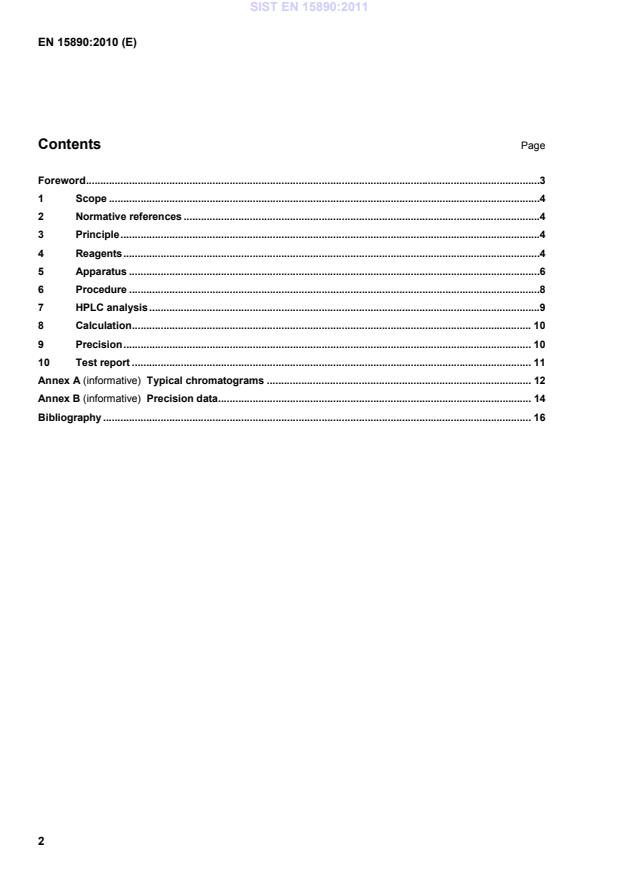
Typical chromatograms . 12Annex B (informative)
Precision data . 14Bibliography . 16 SIST EN 15890:2011
Specification and test methods (ISO 3696:1987) 3 Principle Patulin is extracted from apple juice, or fruit-based purée, with a mixture of ethyl-acetate and hexane in the presence of sodium sulfate and sodium hydrogen carbonate. An aliquot of the extract is purified by solid-phase extraction and evaporated. The residue is re-dissolved in water of pH = 4 and patulin is separated by reverse phase (RP)-HPLC and quantitatively determined by UV detection. 4 Reagents 4.1 General Use only reagents of recognized analytical grade and water complying with grade 1 of EN ISO 3696:1995, unless otherwise specified. Solvents shall be of quality for HPLC analysis, unless otherwise specified. Commercially available solutions with equivalent properties to the reagents listed may be used. 4.2 Perchloric acid, the mass fraction w(HClO4) ≥ 60 % in water. 4.3 Sand, 50 mesh to 70 mesh particle size.
4.4 Silicagel solid phase extraction (SPE) cartridges (500 mg SiO2). 4.5 Sodium sulfate anhydrous, Na2SO4. 4.6 Sodium hydrogen carbonate, NaHCO3. 4.7 Glacial acetic acid, w(CH3COOH) ≈ 98 % in water. SIST EN 15890:2011
NOTE A mobile phase of 990 part of water with one part of perchloric acid has been found to give sufficient separation between patulin and other interfering substances (in particular 5-hydroxymethylfurfural when used in combination with a Synergy® 1) column of 250 mm length and 4,6 mm diameter with a particle size of 4 µm and 8 nm porosity (see 5.13.4)). 4.16 Patulin. WARNING — Patulin is a suspect mutagen and has been reported to have immunotoxic and neurotoxic properties. Gloves and safety glasses should be worn at all times and all standard and sample preparation stages should be carried out in a fume cupboard. 4.17 Patulin stock solution. Dissolve 5 mg of patulin or the contents of one ampoule (if patulin has been obtained as a film) in ethyl acetate (4.11). Transfer the solution to a 25 ml volumetric flask and dilute to volume with ethyl acetate to produce a solution containing approximately 200 µg/ml of patulin.
1) Synergy® is a trade name of a suitable product available commercially. This information is given for the convenience of users of this European Standard and does not constitute an endorsement by CEN of the product named. Equivalent products may be used if they can be shown to lead to the same results. SIST EN 15890:2011
4.18 Patulin standard solution. Evaporate 1 000 µl of the stock solution (4.17) to dryness under nitrogen and then immediately dissolve it in 20 ml of ethanol (4.9) to obtain a mass concentration of approximately 10 µg/ml of patulin. To determine the exact mass concentration, record the absorption curve between 250 nm and 350 nm in a 1 cm quartz cell with ethanol as reference. Identify the wavelength for maximum absorption. Calculate the mass concentration of patulin, pat, in micrograms per millilitre, using Equation 1:
bMA×××=ερ100maxpat (1) where Amax is the absorption determined at the maximum of the absorption curve (here: at approximately 276 nm); M is the molar mass, in grams per mole, of patulin (M = 154 g/mol); 0 is the molar absorption coefficient, in square metres per mole, of patulin in ethanol (here: 1 460 m2/mol, see [2]); b is the optical path length, in centimetres, of the quartz cell. Store this solution in a freezer at approximately - 18 °C. A solution stored in this way is stable for several months. Ensure that the standard solution is allowed to reach room temperature before use to avoid incorporation of water by condensation. Confirm the concentration of the solution if it is older than six weeks. 4.19 Spiking solutions. For spiking experiments at levels of 10 ng/ml and 25 ng/ml patulin in the sample, prepare spiking solutions of patulin in water of pH = 4 (4.8) at mass concentrations of 200 ng/ml and 500 ng/ml, respectively.
These solutions can be obtained by evaporating exactly 100 µl and 250 µl respectively of the stock solution (4.17) to dryness under nitrogen in a 100 ml volumetric flask, followed by immediate dissolution in water of pH = 4 (4.8) to obtain a mass concentration of approximately 200 ng/ml and 500 ng/ml respectively of patulin, depending on the exact mass concentration of patulin in the stock solution. Make sure that the patulin is completely dissolved in the water of pH = 4 before the volumetric flask is filled up to the mark. In case the patulin standard solution (4.18) has a different mass concentration than 10 µg/ml, adjust spiking solutions by calculating the correct aliquots in order to take account of the actual mass concentration of the standard solution determined in 4.18. Store this solution in a refrigerator at 4 °C. A solution stored in this way is stable for at least eight weeks. 5 Apparatus 5.1 General Usual laboratory apparatus and, in particular, the following. SIST EN 15890:2011
...
The article discusses the European Standard EN 15890:2010, which outlines a method for determining the presence of patulin in fruit juices and fruit-based purée, including baby food purée. The method uses high performance liquid chromatography with ultra-violet detection (HPLC-UV). The validation of the method involved testing naturally contaminated and spiked samples of apple juice and fruit-based baby food purée. The study found that patulin levels in apple juice ranged from 3.0 μg/kg to 15.5 μg/kg, while levels in fruit-based baby food purée ranged from 3.4 μg/kg to 17.9 μg/kg. The article also mentions the specific ingredients used in the baby food purée tested in the study. More information on the validation process can be found in Clause 9 and Annex B of the standard.
기사 제목: EN 15890:2010 - 식품 - 유아용과 어린이용 과일 주스 및 과일 퓨레에서 패튈린의 확인 - 액체 / 액체 분할 정화와 고체상 추출 및 자외선 감지를 이용한 HPLC 방법 기사 내용: 이 유럽 표준은 고성능 액체 크로마토그래피와 자외선 감지 (HPLC-UV)를 사용하여 과일 주스 및 과일 기반의 퓨레, 예를 들어 아기용 퓨레에서 패튈린을 확인하는 방법을 규정한다. 자연적으로 오염된 샘플과 가짜로 받은 샘플을 사용하여, 이 방법은 사과 주스에서 3.0 μg/kg에서 15,5 μg/kg까지 범위의 패튈린 및 과일 기반 유아용 식품 퓨레에서 3.4 μg/kg에서 17.9 μg/kg까지의 패튈린을 확인하기 위해 검증되었다. 이 연구에서 사용된 유럽시장에서 상업적으로 판매되는 아기용 과일 퓨레에는 블루베리, 사과, 바나나, 레몬, 밀 비스킷, 밀 시럽, 전체 우유, 채소 오일과 같은 성분이 포함되어 있다. 이 연구에서 사용된 각 제품의 구성 요소 및 분할의 자세한 목록은 [1]에서 확인할 수 있다. 유효성에 대한 자세한 정보는 9조 및 부록 B를 참조하십시오.
記事のタイトル:EN 15890:2010 - 食品-幼児と子供向けフルーツジュースおよびフルーツベースのピューレ中のパチュリンの決定-液/液分割クリーンアップおよび固相抽出と紫外線検出を用いたHPLC法 記事の内容:このヨーロッパ標準は、高性能液体クロマトグラフィー紫外線検出(HPLC-UV)を使用して、フルーツジュースおよびフルーツベースのピューレ、例えば赤ちゃん用フルーツピューレにパチュリンの存在を確認するための方法を規定しています。自然に汚染されたおよび添加されたサンプルを使用して、この方法はリンゴジュース中のパチュリンの濃度が3.0μg/kgから15.5μg/kg、およびフルーツベースの赤ちゃん用フードピューレ中のパチュリンの濃度が3.4μg/kgから17.9μg/kgの範囲で確認されました。この研究で使用されたヨーロッパ市場で販売されている赤ちゃん用フルーツピューレには、ブルーベリー、りんご、バナナ、レモン、小麦ビスケット、小麦シロップ、全乳、野菜油などの成分が含まれていました。この研究で使用された各製品の詳細なリスト(および分数)は[1]に記載されています。 検証に関する詳細な情報については、9条および付録Bを参照してください。
Questions, Comments and Discussion
Ask us and Technical Secretary will try to provide an answer. You can facilitate discussion about the standard in here.
Loading comments...