


EN 12859:2001
(Main)Gypsum blocks - Definitions, requirements and test methods
Gypsum blocks - Definitions, requirements and test methods
This European Standard specifies the characteristics and performance of gypsum blocks with smooth faces for which the main intended uses are construction of non-load bearing partitions or independent wall linings and the fire protection of columns, lift shafts, etc. The gypsum blocks are not used to build ceilings.
It covers the following performance characteristics related to the essential requirements :
- reaction to fire ;
- resistance to fire ;
- direct airborne sound insulation ;
- release of dangerous substances ;
to be measured according to the corresponding european test methods, as well as :
- thermal resistance
to be calculated from the thermal conductivity values given in 4.3.2.
It describes the reference tests for technical specifications.
This European Standard covers also additional technical characteristics that are of importance for the use and acceptance of the product by the construction industry ;
- convenience class for density ;
- convenience class for pH ;
- surface hardness.
It provides for the evaluation of conformity of the product to this European Standard.
This European Standard does not cover gypsum blocks of thickness less than 50 mm or gypsum storey height units.
Gips-Wandbauplatten - Begriffe, Anforderungen und Prüfverfahren
Diese Europäische Norm beschreibt Eigenschaften und Leistungsmerkmale von Gips-Wandbauplatten mit glatten Sichtflächen, die hauptsächlich zur Herstellung nichttragender Trennwände, freistehender Wand-Vorsatzschalen sowie Brandschutzbekleidungen von Stützen, Schächten usw. eingesetzt werden. Gips-Wandbauplatten werden nicht zur Herstellung von Decken verwendet.
Die Norm enthält Aussagen zu den folgenden, auf den wesentlichen Anforderungen beruhenden Leistungsmerkmalen:
- Brandverhalten;
- Feuerwiderstand;
- Luftschalldämmung;
- Freisetzung von Gefahrstoffen.
Diese Leistungsmerkmale sind mit den entsprechenden europäischen Prüfverfahren nachzuweisen.
Ferner wird
- der Wärmedurchlasswiderstand
behandelt, der aus den in 4.3.2 angegebenen Werten für die Wärmeleitfähigkeit zu berechnen ist.
Die Norm definiert die Referenzprüfverfahren für technische Festlegungen.
Sie behandelt darüber hinaus auch zusätzliche technische Eigenschaften, die für die Akzeptanz und die Anwendung der Platten durch das Baugewerbe wichtig sind:
- Rohdichteklasse
- pH-Klasse
- Oberflächenhärte
Diese Norm legt die Bewertung der Konformität von Produkten nach dieser Europäischen Norm fest.
Diese Europäische Norm gilt nicht für Gips-Wandbauplatten mit Dicken unter 50 mm oder für geschosshohe Plattenelemente.
Carreaux de plâtre - Définitions, spécifications et méthodes d'essai
La présente Norme européenne spécifie les caractéristiques et les performances des carreaux de plâtre à faces lisses destinés principalement à la construction de cloisons de distribution non porteuses ou de doublages indépendants et à la protection contre l'incendie de poteaux, de cages d'ascenseurs, etc. Les carreaux de plâtre ne sont pas utilisés pour réaliser des plafonds.
Elle couvre les performances suivantes en relation avec les exigences essentielles :
- la réaction au feu ;
- la résistance au feu ;
- l'isolation contre les bruits aériens directs ;
- l'émission de substances dangereuses ;
à mesurer selon les méthodes d'essai européennes correspondantes ainsi que :
- la résistance thermique, à calculer à l'aide des valeurs de conductivité thermique données en 4.3.2.
Elle définit les essais de référence pour les spécifications techniques.
La présente norme européenne couvre également les caractéristiques techniques suivantes :
- classes de convenance pour la densité ;
- classes de convenance pour le pH ;
- dureté superficielle
qui sont importantes en vue de l'emploi et de l'acceptation du produit par l'industrie du bâtiment.
Elle prévoit l'évaluation de la conformité du produit à la présente Norme européenne.
La présente norme européenne ne couvre pas les carreaux de plâtre d'épaisseur inférieure à
50 mm ni des éléments en plâtre de hauteur d'étage.
Bloki iz mavca - Definicije, zahteve in metode preskušanja
General Information
- Status
- Withdrawn
- Publication Date
- 12-Jun-2001
- Withdrawal Date
- 01-Apr-2008
- Technical Committee
- CEN/TC 241 - Gypsum and gypsum based products
- Drafting Committee
- CEN/TC 241/WG 2 - Cast products
- Current Stage
- 9960 - Withdrawal effective - Withdrawal
- Start Date
- 02-Apr-2008
- Completion Date
- 02-Apr-2008
- Directive
- 89/106/EEC - Construction products
Relations
- Effective Date
- 22-Dec-2008
- Effective Date
- 28-Jan-2026
- Effective Date
- 28-Jan-2026
- Effective Date
- 22-Dec-2008

Get Certified
Connect with accredited certification bodies for this standard

ICC Evaluation Service
Building products evaluation and certification.

QAI Laboratories
Building and construction product testing and certification.

Aboma Certification B.V.
Specialized in construction, metal, and transport sectors.
Sponsored listings
Frequently Asked Questions
EN 12859:2001 is a standard published by the European Committee for Standardization (CEN). Its full title is "Gypsum blocks - Definitions, requirements and test methods". This standard covers: This European Standard specifies the characteristics and performance of gypsum blocks with smooth faces for which the main intended uses are construction of non-load bearing partitions or independent wall linings and the fire protection of columns, lift shafts, etc. The gypsum blocks are not used to build ceilings. It covers the following performance characteristics related to the essential requirements : - reaction to fire ; - resistance to fire ; - direct airborne sound insulation ; - release of dangerous substances ; to be measured according to the corresponding european test methods, as well as : - thermal resistance to be calculated from the thermal conductivity values given in 4.3.2. It describes the reference tests for technical specifications. This European Standard covers also additional technical characteristics that are of importance for the use and acceptance of the product by the construction industry ; - convenience class for density ; - convenience class for pH ; - surface hardness. It provides for the evaluation of conformity of the product to this European Standard. This European Standard does not cover gypsum blocks of thickness less than 50 mm or gypsum storey height units.
This European Standard specifies the characteristics and performance of gypsum blocks with smooth faces for which the main intended uses are construction of non-load bearing partitions or independent wall linings and the fire protection of columns, lift shafts, etc. The gypsum blocks are not used to build ceilings. It covers the following performance characteristics related to the essential requirements : - reaction to fire ; - resistance to fire ; - direct airborne sound insulation ; - release of dangerous substances ; to be measured according to the corresponding european test methods, as well as : - thermal resistance to be calculated from the thermal conductivity values given in 4.3.2. It describes the reference tests for technical specifications. This European Standard covers also additional technical characteristics that are of importance for the use and acceptance of the product by the construction industry ; - convenience class for density ; - convenience class for pH ; - surface hardness. It provides for the evaluation of conformity of the product to this European Standard. This European Standard does not cover gypsum blocks of thickness less than 50 mm or gypsum storey height units.
EN 12859:2001 is classified under the following ICS (International Classification for Standards) categories: 01.040.91 - Construction materials and building (Vocabularies); 91.100.10 - Cement. Gypsum. Lime. Mortar. The ICS classification helps identify the subject area and facilitates finding related standards.
EN 12859:2001 has the following relationships with other standards: It is inter standard links to EN 12859:2008, EN 12860:2001, EN 15318:2007, EN 12859:2001/A1:2004. Understanding these relationships helps ensure you are using the most current and applicable version of the standard.
EN 12859:2001 is associated with the following European legislation: EU Directives/Regulations: 305/2011, 89/106/EEC; Standardization Mandates: M/106. When a standard is cited in the Official Journal of the European Union, products manufactured in conformity with it benefit from a presumption of conformity with the essential requirements of the corresponding EU directive or regulation.
EN 12859:2001 is available in PDF format for immediate download after purchase. The document can be added to your cart and obtained through the secure checkout process. Digital delivery ensures instant access to the complete standard document.
Standards Content (Sample)
2003-01.Slovenski inštitut za standardizacijo. Razmnoževanje celote ali delov tega standarda ni dovoljeno.Gypsum blocks - Definitions, requirements and test methodsBloki iz mavca - Definicije, zahteve in metode preskušanjaCarreaux de plâtre - Définitions, spécifications et méthodes d'essaiGips-Wandbauplatten - Begriffe, Anforderungen und Prüfverfahren91.100.10Cement. Mavec. Apno. MaltaCement. Gypsum. Lime. Mortar01.040.91Gradbeni materiali in gradnja (Slovarji)Construction materials and building (Vocabularies)ICS:SIST EN 12859:2002enTa slovenski standard je istoveten z:EN 12859:200101-april-2002SIST EN 12859:2002SLOVENSKI
STANDARD
EUROPEAN STANDARDNORME EUROPÉENNEEUROPÄISCHE NORMEN 12859June 2001ICS 01.040.91; 91.100.10English versionGypsum blocks - Definitions, requirements and test methodsCarreaux de plâtre - Définitions, spécifications et méthodesd'essaiGips-Wandbauplatten - Begriffe, Anforderungen undPrüfverfahrenThis European Standard was approved by CEN on 7 January 2001.CEN members are bound to comply with the CEN/CENELEC Internal Regulations which stipulate the conditions for giving this EuropeanStandard the status of a national standard without any alteration. Up-to-date lists and bibliographical references concerning such nationalstandards may be obtained on application to the Management Centre or to any CEN member.This European Standard exists in three official versions (English, French, German). A version in any other language made by translationunder the responsibility of a CEN member into its own language and notified to the Management Centre has the same status as the officialversions.CEN members are the national standards bodies of Austria, Belgium, Czech Republic, Denmark, Finland, France, Germany, Greece,Iceland, Ireland, Italy, Luxembourg, Netherlands, Norway, Portugal, Spain, Sweden, Switzerland and United Kingdom.EUROPEAN COMMITTEE FOR STANDARDIZATIONCOMITÉ EUROPÉEN DE NORMALISATIONEUROPÄISCHES KOMITEE FÜR NORMUNGManagement Centre: rue de Stassart, 36
B-1050 Brussels© 2001 CENAll rights of exploitation in any form and by any means reservedworldwide for CEN national Members.Ref. No. EN 12859:2001 E
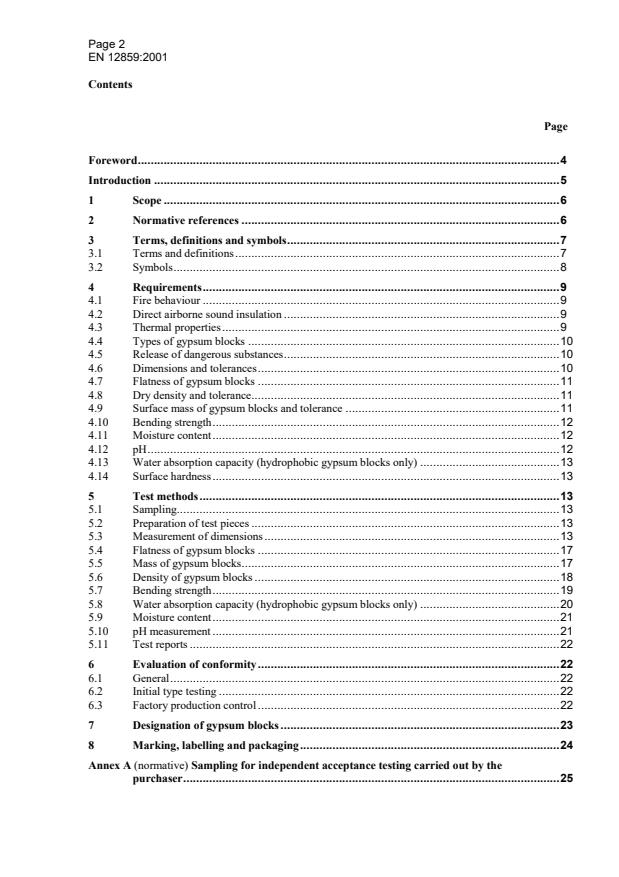
Page 2EN 12859:2001ContentsPageForeword.4Introduction.51Scope.62Normative references.63Terms, definitions and symbols.73.1Terms and definitions.73.2Symbols.84Requirements.94.1Fire behaviour.94.2Direct airborne sound insulation.94.3Thermal properties.94.4Types of gypsum blocks.104.5Release of dangerous substances.104.6Dimensions and tolerances.104.7Flatness of gypsum blocks.114.8Dry density and tolerance.114.9Surface mass of gypsum blocks and tolerance.114.10Bending strength.124.11Moisture content.124.12pH.124.13Water absorption capacity (hydrophobic gypsum blocks only).134.14Surface hardness.135 Test methods.135.1Sampling.135.2Preparation of test pieces.135.3Measurement of dimensions.135.4Flatness of gypsum blocks.175.5
Mass of gypsum blocks.175.6Density of gypsum blocks.185.7Bending strength.195.8Water absorption capacity (hydrophobic gypsum blocks only).205.9Moisture content.215.10pH measurement.215.11Test reports.226 Evaluation of conformity.226.1General.226.2Initial type testing.226.3Factory production control.227 Designation of gypsum blocks.238 Marking, labelling and packaging.24Annex A (normative) Sampling for independent acceptance testing carried out by thepurchaser.25
Page 3EN 12859:2001Annex B (informative) Surface hardness.27Annex C (informative) Visual identification by coloration of gypsum blocks.29Annex ZA (informative) Clauses of this European Standard addressing the provisions of theEU Construction Products Directive.30Bibliography.34
Page 4EN 12859:2001ForewordThis European Standard has been prepared by Technical Committee CEN/TC 241 "Gypsum and gypsumbased products", the secretariat of which is held by AFNOR.This European Standard shall be given the status of a national standard, either by publication of an identicaltext or by endorsement, at the latest by December 2001, and conflicting national standards shall bewithdrawn at the latest by March 2003.This European Standard has been prepared under a mandate given to CEN by the European Commission andthe European Free Trade Association, and supports essential requirements of EU Directive(s).For relationship with EU Directive(s), see informative Annex ZA, which is an integral part of this standard.This European Standard includes :- a normative annex concerning sampling for independent test ;- an informative annex recommending requirements and test method for measuring surface hardness ;- an infomative annex for a visual identification by coloration of gypsum blocks.According to the CEN/CENELEC Internal Regulations, the national standards organizations of thefollowing countries are bound to implement this European Standard: Austria, Belgium, Czech Republic,Denmark, Finland, France, Germany, Greece, Iceland, Ireland, Italy, Luxembourg, Netherlands, Norway,Portugal, Spain, Sweden, Switzerland and the United Kingdom.
Page 5EN 12859:2001IntroductionDiagram 1 shows the relationship between this standard and the package of standards prepared to supportthe family of gypsum products.Diagram 1 - Family of gypsum binders and gypsum productsGypsum binders for furtherdry powder products(A1)Gypsum binders for directuse on site(A2)Gypsum binders for furtherprocessing e.g.- blocks- plasterboards- ceiling elements- etc.(A3)Gypsum plasters(B1 to B8)Gypsum plasters for specialpurposes(C1 to C6)Other dry powder productse.g.- jointing- adhesives- compounds- etcproducts not covered by any European Standardproducts covered by a European Standardproducts covered by this European StandardRaw gypsum
Page 6EN 12859:20011ScopeThis European Standard specifies the characteristics and performance of gypsum blocks with smooth facesfor which the main intended uses are construction of non-load bearing partitions or independent wall liningsand the fire protection of columns, lift shafts, etc. The gypsum blocks are not used to build ceilings.It covers the following performance characteristics related to the essential requirements :- reaction to fire ;- resistance to fire ;- direct airborne sound insulation ;- release of dangerous substances ;to be measured according to the corresponding european test methods, as well as :- thermal resistance to be calculated from the thermal conductivity values given in 4.3.2.It describes the reference tests for technical specifications.This European Standard covers also additional technical characteristics that are of importance for the useand acceptance of the product by the construction industry ;- convenience class for density ;- convenience class for pH ;- surface hardness.It provides for the evaluation of conformity of the product to this European Standard.This European Standard does not cover gypsum blocks of thickness less than 50 mm or gypsum storeyheight units.2Normative referencesThis European Standard incorporates by dated or undated reference, provisions from other publications.These normative references are cited at the appropriate places in the text and the publications are listedhereafter. For dated references, subsequent amendments to or revisions of any of these publications apply tothis European standard only when incorporated in it by amendment or revision. For undated references thelatest edition of the publication referred to applies (including amendments).EN 12524, Building materials and products - Hygrothermal properties - Tabulated design valuesprEN 13501-1:2000, Fire classification of construction products and building elements - Part 1 :Classification using data from reaction to fire testsprEN 13501-2:1999, Fire classification of construction products and building elements - Part 2 :Classification using data from fire resistance tests (excluding products for use in ventilation systems)
Page 7EN 12859:2001EN ISO 140-3, Acoustics - Measurement of sound insulation in buildings and of building elements -Part 3 : Laboratory measurements of airborne sound insulation of building elements (ISO 140-3:1995)EN ISO 717-1, Acoustics - Rating of sound insulation in buildings and of building elements - Part 1 :Airborne sound insulation (ISO 717-1:1996)EN ISO 6946, Building components and building elements - Thermal resistance and thermaltransmittance - Calculation method (ISO 6946:1996)EN ISO 10456, Building materials and products – Procedures for determining declared and design thermalvalues (ISO 10456:1999)3 Terms, definitions and symbols3.1Terms and definitionsFor the purposes of this European Standard, the following terms and definitions apply :3.1.1gypsum blockfactory made building element produced from calcium sulphate and water. It may incorporate fibres, fillers,aggregates and other additives as far as they are not classified as dangerous substances in accordance withEuropean regulations. It may be coloured by pigmentation.NOTE
The gypsum block is a rectangular parallelopiped with tongues and grooves on at least two oftheir opposite edges.3.1.2solid gypsum blockgypsum block manufactured without cavities.3.1.3cavity gypsum blockgypsum block which incorporate preformed cavities.3.1.4preformed cavityformed cavity parallel to the faces which may or may not pass completely through the block. It may runparallel with the height or the length (see Figure 1).3.1.5faceplain and smooth surface intended to provide the finish of a partition (see Figure 1).3.1.6edgeextreme side of the gypsum block having tongues and grooves (see Figure 1).3.1.7thicknessdistance between the two faces of a gypsum block (see Figure 1).
Page 8EN 12859:2001Key1 Preformed cavities2 Face3 Thickness4 Height5 LengthFigure 1 - Gypsum block3.2SymbolsFor the purposes of this European Standard, the following symbols apply ::gross dry density, in kilograms per cubic metre (kg/m³) ;:thermal conductivity, in Watts per metre per Kelvin (W/m·k) ; 23-50:thermal conductivity of the hardened plaster when in equilibrium at 23 °C and 50 %relative humidity, in Watts per metre per Kelvin (W/m·k) ;M:mass of the gypsum block in kilograms (kg).
Page 9EN 12859:20014Requirements4.1Fire behaviour4.1.1
Reaction to fireGypsum blocks are classified in Euroclass A.1 (no contribution to fire) without testing when they containless than 1 % by weight or volume (whichever is the more onerous) of organic material.If they contain 1 % or more, by weight or volume of organic material, they shall be determined andclassified in accordance with prEN 13501-1:2000.4.1.2Fire resistanceResistance to fire is a property of an assembled system and not of the product itself.When relevant, the fire resistance of a system including gypsum blocks assembled with adhesive for gypsumblocks shall be determined and classified in accordance with prEN 13501-2:1999.4.2Direct airborne sound insulationDirect airborne sound insulation is a property of an assembled system and not of the product itself.When relevant, the direct airborne sound insulation of a system including gypsum block assembled withadhesive for gypsum blocks shall be determined in accordance with EN ISO 140-3 and EN ISO 717-1.4.3Thermal properties4.3.1Thermal resistanceWhen the intended use of gypsum blocks is to contribute to thermal resistance in building constructionworks, the thermal resistance is calculated using the formula given in EN ISO 6946.The values of thermal conductivity necessary for this calculation are given in 4.3.2 and thickness values tobe used shall be measured according to 5.3.1.4.3.2Thermal conductivityDesign values of the thermal conductivity of hardened gypsum plaster used in the manufacture of gypsumblocks are given in Table 1.
Page 10EN 12859:2001Table 1 - Design values of thermal conductivity of gypsum plaster in kg/m3 23-50 in W/(m.K)6000,187000,228000,269000,3010000,3411000,3912000,4313000,4714000,5115000,56The values given in Table 1 are taken from EN 12524. Design values concern dry material used inside.When the material is wet, adjust these values using EN ISO 10456.4.4Types of gypsum blocksGypsum blocks are manufactured in three types of density (see 4.8). Some blocks can be hydrophobic(see
4.13)Codes of coloration may be used to a visual identification between the different types of gypsum blocks (seeannex C).4.5Release of dangerous substancesNOTE
For CE marking purposes, see annex ZA1 note.4.6Dimensions and tolerances4.6.1DimensionsGypsum block dimensions are determined by the thickness, the length, and the height.The thickness shall be at least 50 mm and shall not exceed 150 mm.The length shall not exceed 1000 mm.The height shall be determined in conjunction with the length so that the surface area of a block is at least0,20 m2.NOTE
Preferred dimensions are for thickness : 50 mm, 60 mm, 70 mm, 80 mm, 100 mm, for length :666 mm and for height : 500 mm.In cavity gypsum blocks, the wall gypsum plaster shall be at least 15 mm thick through out the block. Thetotal cavity volume shall not exceed 40 %.
Page 11EN 12859:20014.6.2TolerancesThe dimensions of individual blocks, when measured in accordance with 5.3, shall have tolerances asfollows :- thickness :± 0,5 mm ;- length : ± 5 mm ;- height :± 2 mm.4.7Flatness of gypsum blocksThe flatness of individual blocks when measured in accordance with 5.4, shall have a deviation not greaterthan 1 mm.4.8Dry density and tolerance4.8.1Classes of densityThe gross dry density of the hardened gypsum of the solid part of the block, which is the mean gross densityof the specified number of samples in accordance with 5.1 and measured in accordance with 5.6, shall be asfollows :- High density1100
1500 kg/m3- Medium density800
1100 kg/m3- Low density600
800 kg/m34.8.2ToleranceThe average gross dry density within each class shall not deviate by more than 5 % from the average valuemeasured in accordance with 5.6.4.9Surface mass of gypsum blocks and toleranceThe producer declares the surface mass (mass per square metre) of his gypsum blocks.When the mass of gypsum blocks is determined in accordance with 5.5 and their surface calculated inaccordance with 5.3.2 and 5.3.3,
the average surface mass of gypsum blocks shall not deviate by more than5 % from the declared surface mass.
Page 12EN 12859:20014.10Bending strengthGypsum blocks shall have a bending strength appropriate to their use, and for this, when tested inaccordance with 5.7, they shall withstand the load given in Table 2.Table 2 - Breaking load of gypsum blocksGypsum blocks equal or longer than 650 mm witha height of 500 mm aMinimum average breaking loadkNSolid blocks (medium density)Thickness in mm :50 60 70 80 100 1,71,92,32,74,0Cavity and low density blocks> 1,7a For gypsum blocks shorter than 650 mm and/or with a height different to 500 mm, thevalues in the second colomn shall be amended in the ratio of the spans and/or heigths (see5.7.4).No individual value shall be more than 10 % below the average load.The specimens shall be sampled in accordance with 5.1 and tested in accordance with 5.7.4.11Moisture contentThe average moisture content of gypsum blocks shall be measured at the time of the departure from theplant.The average moisture content shall not exceed 6 %, with no individual value exceeding 8 %.The specimens shall be sampled in accordance with 5.1 and tested in accordance with 5.9.4.12pHThe surface pH of each gypsum block shall not deviate from the following prescribed values :- block with standard pH : 6,5 < pH < 10,5- block with low pH : 4,5 < pH < 6,5The specimens shall be sampled in accordance with 5.10.3 and tested in accordance with 5.10.
Page 13EN 12859:20014.13Water absorption capacity (hydrophobic gypsum blocks only)No block shall absorb more than 5 % water relative to its dry weight when tested in accordance with 5.8.The specimens shall be sampled in accordance with 5.1.4.14Surface hardnessWhen surface hardness is required, the performance and test method are given in annex B.5 Test methods5.1SamplingA minimum of three gypsum blocks shall be subjected to the physical, chemical and mechanical tests(see 5.3, 5.4, 5.5, 5.6, 5.7, 5.9, 5.10). In the case of hydrophobic gypsum blocks, three further blocks shall besubjected to the water absorption test (see 5.8).5.2Preparation of test piecesWeigh all the blocks and then dry them to constant mass1 for determination of the residual moisture contentprior to undergoing the different tests according to this standard.The drying to constant mass shall be carried out according to one of the following methods :- method A - Storage in a ventilated room at (23 ± 2) °C and (50 ± 5) % relative humidity ;- method B - Storage in a drying cabinet at (40 ± 2) °C prior to cooling to room temperature.5.3Measurement of dimensions5.3.1Thickness5.3.1.1 PrincipleThe distance between the two faces is measured.5.3.1.2 ApparatusA vernier caliper permitting a reading to 0,1 mm.5.3.1.3 ProcedureThe thickness shall be measured on each gypsum block in the centre of each side and approximately 50 mmfrom the ends (see Figure 2 a).
Constant mass is defined as two successive weighings 24 h apart, differing by less than 0,1%
Page 14EN 12859:20015.3.1.4 Expression of resultsThe thickness is the average value of the three measurements.5.3.2Length5.3.2.1 PrincipleThe longer perimeter dimension of the face is measured.5.3.2.2 ApparatusA metal rule or a metal tape graduated in millimetres and permitting a reading to 1 mm.5.3.2.3 ProcedureThe length shall be measured on each gypsum block parallel to the edges, on the ends and in the centre ofthe block, disregarding the tongues, grooves and slits (see Figure 2 b).
Page 15EN 12859:2001Dimensions in millimetresFigure 2 - Measurement of dimensions
Page 16EN 12859:20015.3.2.4 Expression of resultsThe length is the average value of the measurements.5.3.3Height5.3.3.1 PrincipleThe shorter dimension of the face is measured.5.3.3.2 ApparatusA metal rule or a metal tape graduated in millimetres and permitting a reading to 1 mm.5.3.3.3 ProcedureThe height shall be measured on each gypsum block parallel to the edges, on the ends and in the centre ofthe block, disregarding the tongues, grooves and slits (see Figure 2 c).5.3.3.4 Expression of resultsThe height is the average values of the measurements.5.3.4Cavity gypsum blocksFor this kind of gypsum blocks, the procedures defined in 5.3.1 to 5.3.3.4 shall be applied and, in addition,measurement of the distances between cavities and between the cavity and the face shall be measured attheir narrowest point (see Figure 3).Figure 3 - Measurement of the distance between cavities and between the cavity and the face
Page 17EN 12859:20015.4Flatness of gypsum blocks5.4.1PrincipleThe gypsum block is placed on a flat surface and the maximum distance between the faces of the block andthe flat surface is measured.5.4.2Apparatusa) A flat and smooth surface.b) A metal rule.c) Feeler gauges.5.4.3ProcedurePlace the gypsum block on the flat and smooth surface. Apply the rule parallel to the flat surface on thediagonals of the block and introduce the gauges in the gap between the rule and the block surface.Turn over the gypsum block and repeat the measure on the other face.5.4.4Expression of resultsThe deviation from flatness is the average of the measured values expressed in millimetres.5.5
Mass of gypsum blocks5.5.1PrincipleThe gypsum blocks are weighed prior to conditioning (mass M1) and after conditioning (mass M2).5.5.2ApparatusA balance with an accuracy of
0,1 % with regard to the mass to weigh.5.5.3ProcedureWeigh the gypsum blocks, note the mass (M1) and then submit them to conditioning according to 5.2.Weigh again and note the mass (M2).5.5.4Expression of resultsThe average mass of th
...
Questions, Comments and Discussion
Ask us and Technical Secretary will try to provide an answer. You can facilitate discussion about the standard in here.
Loading comments...