

EN 15163:2008
(Main)Machines and installations for the exploitation and processing of natural stone - Safety - Requirements for diamond wire saws
General Information
- Abstract
This European Standard applies to diamond wire saws being used in quarries as well as in processing plants for cutting marble, granite and other stones out of a mass of rocks in a quarry or of blocks having been al-ready extracted. The machines can be either stationary or travelling on rails during operation.
Diamond wire saws in the scope have an electric main motor. This standard deals with machines working in one main axis as well as in several axes. Furthermore, this standard does not deal with problems caused by an irregular structure of the stones to be cut.
Diamond wire saws are intended to be used with diamond cutting wires also referred to as tools in this stan-dard.
For transportable machines, this standard deals only with machines using coated wire tools.
This standard deals with all significant hazards, hazardous situations and events relevant to diamond wire saws, when they are used as intended and under conditions of misuse which are reasonably foreseeable by the manufacturer (see Clause 4). This European Standard deals with the hazards during transport, commissioning, use and maintenance.
This standard does not deal with noise as a significant hazard.
This European Standard does not deal with:
- operation under extreme ambient conditions (outside the limits defined in EN 60204-1);
- upstream and downstream conveying elements for transporting the work-pieces.
This document is not applicable to machines which are manufactured before the date of its publication as EN.
- Status
- Withdrawn
- Publication Date
- 20-May-2008
- Withdrawal Date
- 29-Sep-2026
- Technical Committee
- CEN/TC 151 - Construction equipment and building material machines - Safety
- Current Stage
- 9960 - Withdrawal effective - Withdrawal
- Start Date
- 14-Jun-2017
- Completion Date
- 30-Sep-2026
- Directive
- 2006/42/EC - Directive 2006/42/EC of the European Parliament and of the Council of 17 May 2006 on machinery, and amending Directive 95/16/EC (recast)OJ Ref: C, C 214 OJ Date: 08-Sep-2009
98/37/EC - MachineryOJ Ref: C, C 22 OJ Date: 28-Jan-2009

Relations
- Effective Date
- 26-Dec-2012
- Effective Date
- 25-Aug-2026
- Effective Date
- 09-Feb-2026
- Effective Date
- 09-Feb-2026
- Effective Date
- 09-Feb-2026
- Effective Date
- 09-Feb-2026
- Effective Date
- 28-Jan-2026
- Effective Date
- 28-Jan-2026
- Refers
EN ISO 13850:2006 - Safety of machinery - Emergency stop - Principles for design (ISO 13850:2006) - Effective Date
- 28-Jan-2026
- Effective Date
- 28-Jan-2026
- Effective Date
- 28-Jan-2026
- Effective Date
- 28-Jan-2026
- Effective Date
- 28-Jan-2026
- Effective Date
- 28-Jan-2026
- Effective Date
- 28-Jan-2026
Get Certified
Connect with accredited certification bodies for this standard

Bureau Veritas Chile
Bureau Veritas certification services in Chile.
Bureau Veritas Peru
Bureau Veritas certification services in Peru.
BVQI Peru
Bureau Veritas certification in Peru.
Sponsored listings
Frequently Asked Questions
EN 15163:2008 is a standard published by the European Committee for Standardization (CEN). Its full title is "Machines and installations for the exploitation and processing of natural stone - Safety - Requirements for diamond wire saws". This standard covers: This European Standard applies to diamond wire saws being used in quarries as well as in processing plants for cutting marble, granite and other stones out of a mass of rocks in a quarry or of blocks having been al-ready extracted. The machines can be either stationary or travelling on rails during operation. Diamond wire saws in the scope have an electric main motor. This standard deals with machines working in one main axis as well as in several axes. Furthermore, this standard does not deal with problems caused by an irregular structure of the stones to be cut. Diamond wire saws are intended to be used with diamond cutting wires also referred to as tools in this stan-dard. For transportable machines, this standard deals only with machines using coated wire tools. This standard deals with all significant hazards, hazardous situations and events relevant to diamond wire saws, when they are used as intended and under conditions of misuse which are reasonably foreseeable by the manufacturer (see Clause 4). This European Standard deals with the hazards during transport, commissioning, use and maintenance. This standard does not deal with noise as a significant hazard. This European Standard does not deal with: - operation under extreme ambient conditions (outside the limits defined in EN 60204-1); - upstream and downstream conveying elements for transporting the work-pieces. This document is not applicable to machines which are manufactured before the date of its publication as EN.
This European Standard applies to diamond wire saws being used in quarries as well as in processing plants for cutting marble, granite and other stones out of a mass of rocks in a quarry or of blocks having been al-ready extracted. The machines can be either stationary or travelling on rails during operation. Diamond wire saws in the scope have an electric main motor. This standard deals with machines working in one main axis as well as in several axes. Furthermore, this standard does not deal with problems caused by an irregular structure of the stones to be cut. Diamond wire saws are intended to be used with diamond cutting wires also referred to as tools in this stan-dard. For transportable machines, this standard deals only with machines using coated wire tools. This standard deals with all significant hazards, hazardous situations and events relevant to diamond wire saws, when they are used as intended and under conditions of misuse which are reasonably foreseeable by the manufacturer (see Clause 4). This European Standard deals with the hazards during transport, commissioning, use and maintenance. This standard does not deal with noise as a significant hazard. This European Standard does not deal with: - operation under extreme ambient conditions (outside the limits defined in EN 60204-1); - upstream and downstream conveying elements for transporting the work-pieces. This document is not applicable to machines which are manufactured before the date of its publication as EN.
EN 15163:2008 is classified under the following ICS (International Classification for Standards) categories: 73.120 - Equipment for processing of minerals. The ICS classification helps identify the subject area and facilitates finding related standards.
EN 15163:2008 has the following relationships with other standards: It is inter standard links to EN 15163:2017, ISO 8598:1996, EN 61310-1:1995, EN 60825-1:1994, EN 60529:1991, EN 60825-4:2006, EN ISO 12100-2:2003, EN 614-1:2006, EN ISO 13850:2006, EN 547-1:1996, EN ISO 13849-1:2006, EN 547-3:1996, EN ISO 12100-1:2003, EN 983:1996, EN 953:1997. Understanding these relationships helps ensure you are using the most current and applicable version of the standard.
EN 15163:2008 is associated with the following European legislation: EU Directives/Regulations: 2006/42/EC, 98/37/EC; Standardization Mandates: M/BC/CEN/88/13. When a standard is cited in the Official Journal of the European Union, products manufactured in conformity with it benefit from a presumption of conformity with the essential requirements of the corresponding EU directive or regulation.
EN 15163:2008 is available in PDF format for immediate download after purchase. The document can be added to your cart and obtained through the secure checkout process. Digital delivery ensures instant access to the complete standard document.
Standards Content (Sample)
SLOVENSKI STANDARD
01-september-2008
Stroji in oprema za pridobivanje in predelavo naravnega kamna - Varnost - Zahteve
za žage z diamantno žico
Machines and installations for the exploitation and processing of natural stone - Safety -
Requirements for diamond wire saws
Maschinen und Anlagen zur Gewinnung und Bearbeitung von Naturstein - Sicherheit -
Anforderungen für Diamantseilsägen
Machines et installations d'extraction et d'usinage des pierres naturelles - Sécurité -
Prescriptions relatives aux scies à fil diamanté
Ta slovenski standard je istoveten z: EN 15163:2008
ICS:
25.100.01 Rezalna orodja na splošno Cutting tools in general
73.120 Oprema za predelavo rudnin Equipment for processing of
minerals
2003-01.Slovenski inštitut za standardizacijo. Razmnoževanje celote ali delov tega standarda ni dovoljeno.
EUROPEAN STANDARD
EN 15163
NORME EUROPÉENNE
EUROPÄISCHE NORM
May 2008
ICS 73.120
English Version
Machines and installations for the exploitation and processing of
natural stone - Safety - Requirements for diamond wire saws
Machines et installations d'extraction et d'usinage des Maschinen und Anlagen zur Gewinnung und Bearbeitung
pierres naturelles - Sécurité - Prescriptions relatives aux von Naturstein - Sicherheit - Anforderungen für
scies à fil diamanté Diamantseilsägen
This European Standard was approved by CEN on 18 April 2008.
CEN members are bound to comply with the CEN/CENELEC Internal Regulations which stipulate the conditions for giving this European
Standard the status of a national standard without any alteration. Up-to-date lists and bibliographical references concerning such national
standards may be obtained on application to the CEN Management Centre or to any CEN member.
This European Standard exists in three official versions (English, French, German). A version in any other language made by translation
under the responsibility of a CEN member into its own language and notified to the CEN Management Centre has the same status as the
official versions.
CEN members are the national standards bodies of Austria, Belgium, Bulgaria, Cyprus, Czech Republic, Denmark, Estonia, Finland,
France, Germany, Greece, Hungary, Iceland, Ireland, Italy, Latvia, Lithuania, Luxembourg, Malta, Netherlands, Norway, Poland, Portugal,
Romania, Slovakia, Slovenia, Spain, Sweden, Switzerland and United Kingdom.
EUROPEAN COMMITTEE FOR STANDARDIZATION
COMITÉ EUROPÉEN DE NORMALISATION
EUROPÄISCHES KOMITEE FÜR NORMUNG
Management Centre: rue de Stassart, 36 B-1050 Brussels
© 2008 CEN All rights of exploitation in any form and by any means reserved Ref. No. EN 15163:2008: E
worldwide for CEN national Members.
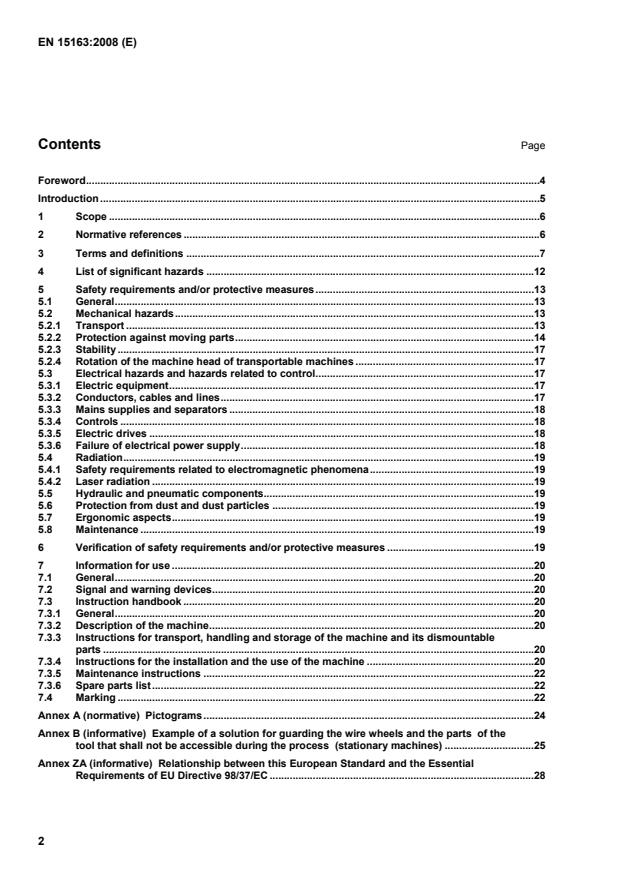
Contents Page
Foreword.4
Introduction .5
1 Scope .6
2 Normative references .6
3 Terms and definitions .7
4 List of significant hazards .12
5 Safety requirements and/or protective measures.13
5.1 General.13
5.2 Mechanical hazards.13
5.2.1 Transport .13
5.2.2 Protection against moving parts.14
5.2.3 Stability .17
5.2.4 Rotation of the machine head of transportable machines .17
5.3 Electrical hazards and hazards related to control.17
5.3.1 Electric equipment.17
5.3.2 Conductors, cables and lines.17
5.3.3 Mains supplies and separators .18
5.3.4 Controls .18
5.3.5 Electric drives .18
5.3.6 Failure of electrical power supply.18
5.4 Radiation.19
5.4.1 Safety requirements related to electromagnetic phenomena.19
5.4.2 Laser radiation .19
5.5 Hydraulic and pneumatic components.19
5.6 Protection from dust and dust particles .19
5.7 Ergonomic aspects.19
5.8 Maintenance .19
6 Verification of safety requirements and/or protective measures .19
7 Information for use .20
7.1 General.20
7.2 Signal and warning devices.20
7.3 Instruction handbook .20
7.3.1 General.20
7.3.2 Description of the machine.20
7.3.3 Instructions for transport, handling and storage of the machine and its dismountable
parts .20
7.3.4 Instructions for the installation and the use of the machine .20
7.3.5 Maintenance instructions .22
7.3.6 Spare parts list.22
7.4 Marking .22
Annex A (normative) Pictograms .24
Annex B (informative) Example of a solution for guarding the wire wheels and the parts of the
tool that shall not be accessible during the process (stationary machines) .25
Annex ZA (informative) Relationship between this European Standard and the Essential
Requirements of EU Directive 98/37/EC .28
Annex ZB (informative) Relationship between this European Standard and the Essential
Requirements of EU Directive 2006/42/EC.29
Figures
Figure 1 — Transportable diamond wire saw.8
Figure 2 — Travelling diamond wire saw.8
Figure 3 — Stationary block wire saw with block trolley .9
Figure 4 — Stationary block wire saw without block trolley.9
Figure 5 — Contour wire saw.10
Figure 6 — Examples of multi-wire saw.11
Figure 7 — Examples of marking in vertical cut .16
Figure 8 — Examples of marking in horizontal cut.17
Figure A.1 — Mandatory signal “Read the manual” .24
Figure A.2 — Prohibitory sign “No access for unauthorised persons” .24
Figure B.1 — Wire-wheel guard .25
Figure B.2 — Guard for the upper part of the tool .25
Figure B.3 — Guarding system for the lower part of the tool near the working area .26
Figure B.4 — Detail of the guarding system shown in Figure B.3 .26
Tables
Table 1 — List of significant hazards .13
Foreword
This document (EN 15163:2008) has been prepared by Technical Committee CEN/TC 151 “Construction
equipment and building material machines — Safety”, the secretariat of which is held by DIN.
This European Standard shall be given the status of a national standard, either by publication of an identical
text or by endorsement, at the latest by November 2008, and conflicting national standards shall be withdrawn
at the latest by November 2008.
This document has been prepared under a mandate given to CEN by the European Commission and the
European Free Trade Association and supports essential requirements of EU Directive(s).
For relationship with EU Directive(s), see informative Annexes ZA and ZB, which are integral parts of this
document.
According to the CEN/CENELEC Internal Regulations, the national standards organizations of the following
countries are bound to implement this European Standard: Austria, Belgium, Bulgaria, Cyprus, Czech Repub-
lic, Denmark, Estonia, Finland, France, Germany, Greece, Hungary, Iceland, Ireland, Italy, Latvia, Lithuania,
Luxembourg, Malta, Netherlands, Norway, Poland, Portugal, Romania, Slovakia, Slovenia, Spain, Sweden,
Switzerland and United Kingdom.
Introduction
This document is a type C standard as stated in EN ISO 12100-1.
The machinery concerned and the extent to which hazards, hazardous situations and events are covered are
indicated in the scope of this document.
When provisions of this type C standard are different from those which are stated in type A or B standards, the
provisions of this type C standard take precedence over the provisions of the other standards for machines
that have been designed and built according to the provisions of this type C standard.
1 Scope
This European Standard applies to diamond wire saws being used in quarries as well as in processing plants
for cutting marble, granite and other stones out of a mass of rocks in a quarry or of blocks having been al-
ready extracted. The machines can be either stationary or travelling on rails during operation.
Diamond wire saws in the scope have an electric main motor. This standard deals with machines working in
one main axis as well as in several axes. Furthermore, this standard does not deal with problems caused by
an irregular structure of the stones to be cut.
Diamond wire saws are intended to be used with diamond cutting wires also referred to as tools in this stan-
dard.
For transportable machines, this standard deals only with machines using coated wire tools.
This standard deals with all significant hazards, hazardous situations and events relevant to diamond wire
saws, when they are used as intended and under conditions of misuse which are reasonably foreseeable by
the manufacturer (see Clause 4). This European Standard deals with the hazards during transport, commis-
sioning, use and maintenance.
This standard does not deal with noise as a significant hazard.
This European Standard does not deal with:
operation under extreme ambient conditions (outside the limits defined in EN 60204-1);
upstream and downstream conveying elements for transporting the work-pieces.
This document is not applicable to machines which are manufactured before the date of its publication as EN.
2 Normative references
The following referenced documents are indispensable for the application of this document. For dated refer-
ences, only the edition cited applies. For undated references the latest edition of the referenced document
(including any amendments) applies.
EN 294:1992, Safety of machinery — Safety distances to prevent danger zones being reached by the upper
limbs
EN 547-1:1996, Safety of machinery — Human body measurements — Part 1: Principles for determining the
dimensions required for openings for whole body access into machinery
EN 547-2:1996, Safety of machinery — Human body measurements — Part 2: Principles for determining the
dimensions required for access openings
EN 547-3:1996, Safety of machinery — Human body measurements — Part 3: Anthropometric data
EN 614-1:2006, Safety of machinery — Ergonomic design principles — Part 1: Terminology and general prin-
ciples
EN 953:1997, Safety of machinery — Guards — General requirements for the design and construction of fixed
and movable guards
EN 982:1996, Safety of machinery — Safety requirements for fluid power systems and their components —
Hydraulics
EN 983:1996, Safety of machinery — Safety requirements for fluid power systems and their components —
Pneumatics
EN 1088:1995, Safety of machinery — Interlocking devices associated with guards — Principles for design
and selection
EN 60204-1:2006, Safety of machinery — Electrical equipment of machines — Part 1: General requirements
(IEC 60204-1:2005, modified)
EN 60529:1991, Degrees of protection provided by enclosures (IP code) (IEC 60529:1989)
EN 60825-1:1994, Safety of laser products — Part 1: Equipment classification, requirements and user's guide
(IEC 60825-1:1993)
EN 60825-4:2006, Safety of laser products — Part 4: Laser guards (IEC 60825-4:2006)
EN 61310-1:1995, Safety of machinery — Indication, marking and actuation — Part 1: Requirements for vis-
ual, auditory and tactile signals (IEC 61310-1:1995)
EN ISO 12100-1:2003, Safety of machinery — Basic concepts, general principles for design — Part 1: Basic
terminology, methodology (ISO 12100-1:2003)
EN ISO 12100-2:2003, Safety of machinery — Basic concepts, general principles for design — Part 2: Tech-
nical principles (ISO 12100-2:2003)
EN ISO 13849-1:2006, Safety of machinery — Safety-related parts of control systems — Part 1: General prin-
ciples for design (ISO 13849-1:2006)
EN ISO 13850:2006, Safety of machinery — Emergency stop — Principles for design (ISO 13850:2006)
3 Terms and definitions
For the purposes of this document, the terms and definitions given in EN ISO 12100-1 and the following apply.
3.1
diamond wire saw
machinery for cutting marble, granite and other natural stones from stone deposits or already extracted stone
into blocks and slabs using a suitable diamond wire as tool. During the cutting operation, the tool can be
cooled by water. In that case, the water also serves for the suppression of dust emission during the cutting
operation.
The diamond wire saws in the scope have an electric motor as main drive.
Different types of diamond wire saws:
transportable diamond wire saws (mining of natural stone) (see Figure 1);
travelling diamond wire saws (see Figure 2);
stationary diamond wire saws with block trolley (see Figure 3);
stationary diamond wire saws without block trolley (Figure 4);
diamond wire saws for contour (two and more axes) (see Figure 5);
multi-wire saws (see Figure 6).
Key
1 rails 4 unit to shift the machine on rails 7 supports for electrical cables
2 rack 5 control unit 8 diamond wire
3 drive unit for the tool 6 control unit (remote control)
Figure 1 — Transportable diamond wire saw
Key
1 guard 3 wire wheel 5 guide wheel 7 block
2 machine frame 4 carriage 6 sill 8 diamond wire
Figure 2 — Travelling diamond wire saw
Key
1 guard 5 guide wheel
2 machine frame 6 rails for block trolley
3 wire wheel 7 block
4 foundations 8 diamond wire
Figure 3 — Stationary block wire saw with block trolley
Key
1 guard 5 guide wheel
2 machine frame 6 block
3 wire wheel 7 sill
4 foundations 8 diamond wire
Figure 4 — Stationary block wire saw without block trolley
Key
1 guard 5 diamond wire
2 machine frame 6 sill
3 wire wheel 7 guide wheels
4 carriage 8 guide-wheel carrier
Figure 5 — Contour wire saw
Key
1 guard 5 diamond wire 9 carriage
2 machine frame 6 sill 10 multi-wire wheel
3 wire wheel 7 block
4 carriage 8 guide-wheel carrier
Figure 6 — Examples of multi-wire saw
3.2
block
square natural stone being processed to a half-finished product in natural stone extraction
3.3
block trolley
travelling work-piece table on which blocks are placed to be processed by the wire saw
3.4
wire wheel
rotating wheel on which the diamond wire is guided
3.5
guide wheel
guide wheels are mostly smaller wire wheels guiding precisely and stabilizing the rotating diamond wire
3.6
drive wheel
wire wheel for transmitting the drive power to the diamond wire
3.7
tension wheel
adjustably arranged wire pulley which creates the required wire tension
3.8
diamond wire
tool of a wire saw. It is a steel wire equipped with diamond-tipped cutting rings (pearls)
3.9
wheel guard
casing of the wire wheels to protect persons against hazards that might be caused by the rotating wire wheels
3.10
machine frame
is bearing the machine parts. Within the machine frame, the height adjustment is integrated
3.11
main drive
creates the motion of the tool. Power transmission is done by the drive wheel
3.12
feed drive
serve as drive for the adjustable axes (height adjustment, vertical feed, etc.)
4 List of significant hazards
This clause contains all significant hazards, hazardous situations and events, as far as they are dealt with in
this standard, identified by risk assessment as significant for this type of machinery and which require action
to eliminate or reduce the risk.
Table 1 — List of significant hazards
Hazards Relevant subclauses
4.1 Mechanical hazards
4.1.1 Crushing 5.2.1; 5.2.2.1 to 5.2.2.3; 5.2.2.5; 5.2.2.6
4.1.2 Shearing 5.2.2.1 to 5.2.2.3; 5.2.2.5
4.1.3 Cutting or severing 5.2.2.1 to 5.2.2.3; 5.2.2.7; 5.2.2.8
4.1.4 Entanglement 5.2.2.1 to 5.2.2.3; 5.2.2.8
4.1.5 Drawing-in or trapping 5.2.2.1 to 5.2.2.3; 5.2.2.5
4.1.6 Impact 5.2.1; 5.2.2.3 to 5.2.2.6; 5.2.2.8
4.2 High-pressure fluid injection or ejection 5.5
4.3 Direct or indirect electrical contact 5.3.1 to 5.3.5
4.4 Laser radiation hazard 5.4.2
4.5 Hazards from dust particles 5.6
4.6 Neglecting ergonomic principles (including 5.2.2.3; 5.7; 5.8; 7
measures against human error)
4.7 Failure of the power supply –- failure of the control 5.3.3; 5.3.4; 5.3.6
circuit
4.8 Failure or disorder of the control system 5.3.3; 5.3.4; 5.4.1
4.9 Falling or ejected objects (material/work pieces) 5.2.2.7; 5.2.2.8
4.10 Loss of stability (machines and machine parts) 5.2.1; 5.2.2.5; 5.2.2.6; 5.2.3; 5.2.4
4.11 Slip, trip and fall of persons (related to machinery) 5.7; 7.3
5 Safety requirements and/or protective measures
5.1 General
Machinery shall comply with the safety requirements and/or protective measures of this clause.
In addition, the machine shall be designed according to the principles of EN ISO 12100-2 for hazards relevant
but not significant which are not dealt with by this document (e.g. sharp edges).
For application of type B standards, such as EN 294, EN 547-1, EN 953, EN 982, EN 983, EN 1088,
EN 60204-1, EN 60529, EN ISO 13849-1, EN ISO 13850, the manufacturer shall carry out an adequate risk
assessment for the requirements thereof where choice is necessary (as far as the choice is not made in the
requirements of this clause).
5.2 Mechanical hazards
5.2.1 Transport
For the transport of the machine, appropriate provisions for the easy and safe handling shall be made in ac-
cordance with EN ISO 12100-2:2003, 5.5.5.
5.2.2 Protection against moving parts
5.2.2.1 Transmission parts
Moving parts, e.g. couplings and drive shafts, shall be provided with fixed guards or interlocking moveable
guards to prevent contact. Guards shall comply with EN 953:1997 and in particular with Clauses 5 to 7. Fixed
guards shall be used and be held in position either by welding or mounting them in such a way that they can
only be opened or removed with the aid of tools or keys. The fixed guards shall not remain in place without
their fixings.
Guards shall comply with the provisions of EN 294 on safety distances. Distance guards shall be in accor-
dance with EN 294:1992, Table 1. Opening in guards shall be in accordance with EN 294:1992, Table 4.
When frequent access (once a day or more) is required for service or mai
...