

EN 15163-1:2022
(Main)Machines and installations for the exploitation and processing of natural stone - Safety - Part 1: Requirements for stationary diamond wire saws
General Information
- Abstract
This document deals with all significant hazards, hazardous situations and events, as listed in Annex A, which are relevant to stationary diamond wire saws (stationary diamond mono-wire saws and stationary diamond multi-wire saws), as defined in Clause 3.
Stationary diamond wire saws may be used in quarries or in sawmill for cutting natural stones (e.g. marble, granite), when they are used as intended and under conditions of misuse which are reasonably foreseeable by the manufacturer (see Annex A).
This document deals only with stationary diamond wire saws using coated diamond wire as tool.
This document specifies the appropriate technical measures to eliminate or reduce risks arising from the significant hazards.
This document deals all significant hazards that may occur within the expected lifetime of the machinery including the phases of transport, assembly, dismantling, disabling and scrapping.
This document does not deal with the significant hazards arising by the use of other facilities/devices not described in this document, that may be fitted on the machines or that may be used during the work cycle.
This document does not deal with:
a) operation under extreme ambient conditions (outside the limits defined in EN 60204-1:2018);
b) upstream and downstream conveying elements, not integrated with stationary diamond wire saws, for transporting of the work-pieces.
This document is not applicable to machines which are manufactured before the date of publication of this document by CEN.
- Status
- Published
- Publication Date
- 07-Jun-2022
- Withdrawal Date
- 30-Dec-2022
- Technical Committee
- CEN/TC 151 - Construction equipment and building material machines - Safety
- Current Stage
- 6060 - Definitive text made available (DAV) - Publishing
- Start Date
- 08-Jun-2022
- Due Date
- 15-Mar-2021
- Completion Date
- 08-Jun-2022
- Directive
- 2006/42/EC - Directive 2006/42/EC of the European Parliament and of the Council of 17 May 2006 on machinery, and amending Directive 95/16/EC (recast)OJ Ref: OJ L 194 OJ Date: 02-Aug-2023


Overview
EN 15163-1:2022 - Machines and installations for the exploitation and processing of natural stone - Safety - Part 1: Requirements for stationary diamond wire saws - is a harmonized European (CEN) type‑C safety standard that specifies safety and risk‑reduction measures for stationary diamond mono‑wire and multi‑wire saws using coated diamond wire. It applies to machines used in quarries and sawmills for cutting natural stone (e.g., marble, granite) when used as intended or under reasonably foreseeable misuse. The standard covers the full expected machine lifetime including transport, assembly, installation, dismantling, disabling and scrapping.
Key technical topics and requirements
The standard structures safety requirements and guidance across these core areas (see Clauses 3–5 and annexes):
- Scope and definitions
- Applies only to stationary diamond wire saws using coated diamond wire; machines manufactured before the publication date are excluded.
- Controls and control system safety
- Requirements for reliability and position of controls, start/stop functions, emergency stop, mode selection and behavior on power supply failure.
- Mechanical protections
- Prevention of access to moving parts, guards to reduce ejection hazards, transport and installation stability measures.
- Non‑mechanical hazards
- Measures addressing fire, noise, electrical safety, ergonomics and handling, hydraulic/pneumatic components, electromagnetic compatibility, laser radiation, hazardous substances, slipping/tripping/falling and lightning.
- Maintenance and isolation
- Safe procedures for maintenance, isolation from energy sources and instructions for disabling and scrapping.
- Information for use
- Marking, signals, warnings and comprehensive operator and maintenance instructions.
- Normative and informative annexes
- Annex A: list of significant hazards; Annex B: noise test code and declaration procedures; Annex D: impact test method for rigid guards; Annex ZA: relationship to EU Machinery Directive.
Practical applications and who uses this standard
EN 15163-1:2022 is intended for:
- Machine manufacturers designing and certifying stationary diamond wire saws to meet EU machinery safety requirements.
- Health & safety bodies, regulators and conformity assessors evaluating compliance with the Machinery Directive.
- Quarry and sawmill operators, maintenance teams and OEM service providers implementing safe operation, maintenance and risk‑mitigation measures.
- Purchasing/specification teams who select equipment and require documented safety features (guards, emergency stop, noise limits, etc.).
Related standards and references
- Supports conformity with the EU Machinery Directive and is a type‑C standard under EN ISO 12100.
- Cross‑references include EN 60204‑1:2018 (electrical equipment of machines) and other referenced normative documents listed in Clause 2.
Keywords: EN 15163-1:2022, stationary diamond wire saws, coated diamond wire, natural stone safety, quarry sawmill safety, machine guards, noise test code.
Relations
- Effective Date
- 15-Jun-2022
- Effective Date
- 09-Feb-2026
- Effective Date
- 09-Feb-2026
- Effective Date
- 09-Feb-2026
- Effective Date
- 09-Feb-2026
- Effective Date
- 09-Feb-2026
- Effective Date
- 09-Feb-2026
- Refers
EN 60825-1:2014 - Safety of laser products - Part 1: Equipment classification and requirements - Effective Date
- 09-Feb-2026
- Effective Date
- 28-Jan-2026
- Effective Date
- 28-Jan-2026
- Effective Date
- 28-Jan-2026
- Effective Date
- 28-Jan-2026
- Effective Date
- 28-Jan-2026
- Effective Date
- 28-Jan-2026
- Effective Date
- 28-Jan-2026
Get Certified
Connect with accredited certification bodies for this standard

Bureau Veritas Chile
Bureau Veritas certification services in Chile.
Bureau Veritas Peru
Bureau Veritas certification services in Peru.
BVQI Peru
Bureau Veritas certification in Peru.
Sponsored listings
Frequently Asked Questions
EN 15163-1:2022 is a standard published by the European Committee for Standardization (CEN). Its full title is "Machines and installations for the exploitation and processing of natural stone - Safety - Part 1: Requirements for stationary diamond wire saws". This standard covers: This document deals with all significant hazards, hazardous situations and events, as listed in Annex A, which are relevant to stationary diamond wire saws (stationary diamond mono-wire saws and stationary diamond multi-wire saws), as defined in Clause 3. Stationary diamond wire saws may be used in quarries or in sawmill for cutting natural stones (e.g. marble, granite), when they are used as intended and under conditions of misuse which are reasonably foreseeable by the manufacturer (see Annex A). This document deals only with stationary diamond wire saws using coated diamond wire as tool. This document specifies the appropriate technical measures to eliminate or reduce risks arising from the significant hazards. This document deals all significant hazards that may occur within the expected lifetime of the machinery including the phases of transport, assembly, dismantling, disabling and scrapping. This document does not deal with the significant hazards arising by the use of other facilities/devices not described in this document, that may be fitted on the machines or that may be used during the work cycle. This document does not deal with: a) operation under extreme ambient conditions (outside the limits defined in EN 60204-1:2018); b) upstream and downstream conveying elements, not integrated with stationary diamond wire saws, for transporting of the work-pieces. This document is not applicable to machines which are manufactured before the date of publication of this document by CEN.
This document deals with all significant hazards, hazardous situations and events, as listed in Annex A, which are relevant to stationary diamond wire saws (stationary diamond mono-wire saws and stationary diamond multi-wire saws), as defined in Clause 3. Stationary diamond wire saws may be used in quarries or in sawmill for cutting natural stones (e.g. marble, granite), when they are used as intended and under conditions of misuse which are reasonably foreseeable by the manufacturer (see Annex A). This document deals only with stationary diamond wire saws using coated diamond wire as tool. This document specifies the appropriate technical measures to eliminate or reduce risks arising from the significant hazards. This document deals all significant hazards that may occur within the expected lifetime of the machinery including the phases of transport, assembly, dismantling, disabling and scrapping. This document does not deal with the significant hazards arising by the use of other facilities/devices not described in this document, that may be fitted on the machines or that may be used during the work cycle. This document does not deal with: a) operation under extreme ambient conditions (outside the limits defined in EN 60204-1:2018); b) upstream and downstream conveying elements, not integrated with stationary diamond wire saws, for transporting of the work-pieces. This document is not applicable to machines which are manufactured before the date of publication of this document by CEN.
EN 15163-1:2022 is classified under the following ICS (International Classification for Standards) categories: 73.120 - Equipment for processing of minerals. The ICS classification helps identify the subject area and facilitates finding related standards.
EN 15163-1:2022 has the following relationships with other standards: It is inter standard links to EN 15163:2017, EN 60204-1:2018, EN 60825-1:2014/A11:2021, EN 60529:1991/A2:2013, EN 60529:1991/A1:2000, EN 50370-2:2003, EN 60529:1991, EN 60825-1:2014, EN ISO 13857:2019, EN 1005-4:2005+A1:2008, EN 1005-2:2003+A1:2008, EN ISO 11688-1:2009, EN ISO 4871:2009, EN ISO 11201:2010, EN 13236:2019. Understanding these relationships helps ensure you are using the most current and applicable version of the standard.
EN 15163-1:2022 is associated with the following European legislation: EU Directives/Regulations: 2006/42/EC; Standardization Mandates: M/396. When a standard is cited in the Official Journal of the European Union, products manufactured in conformity with it benefit from a presumption of conformity with the essential requirements of the corresponding EU directive or regulation.
EN 15163-1:2022 is available in PDF format for immediate download after purchase. The document can be added to your cart and obtained through the secure checkout process. Digital delivery ensures instant access to the complete standard document.
Standards Content (Sample)
SLOVENSKI STANDARD
01-september-2022
Nadomešča:
SIST EN 15163:2017
Stroji in oprema za pridobivanje in obdelavo naravnega kamna - Varnost - 1. del:
Zahteve za nepremične enožične diamantne žage
Machines and installations for the exploitation and processing of natural stone - Safety -
Part 1: Requirements for stationary diamond wire saws
Maschinen und Anlagen zur Gewinnung und Bearbeitung von Naturstein - Sicherheit -
Teil 1: Anforderungen für stationäre Diamantseilsägen
Machines et installations pour l’exploitation et la transformation de la pierre naturelle -
Sécurité - Partie 1 : Prescriptions pour les scies à fil diamanté fixes
Ta slovenski standard je istoveten z: EN 15163-1:2022
ICS:
25.100.40 Žagni listi Saws
73.120 Oprema za predelavo rudnin Equipment for processing of
minerals
2003-01.Slovenski inštitut za standardizacijo. Razmnoževanje celote ali delov tega standarda ni dovoljeno.
EN 15163-1
EUROPEAN STANDARD
NORME EUROPÉENNE
June 2022
EUROPÄISCHE NORM
ICS 73.120 Supersedes EN 15163:2017
English Version
Machines and installations for the exploitation and
processing of natural stone - Safety - Part 1: Requirements
for stationary diamond wire saws
Machines et installations pour l'exploitation et la Maschinen und Anlagen zur Gewinnung und
transformation de la pierre naturelle - Sécurité - Partie Bearbeitung von Naturstein - Sicherheit - Teil 1:
1 : Prescriptions pour les scies à fil diamanté fixes Anforderungen für stationäre Diamantseilsägen
This European Standard was approved by CEN on 27 March 2022.
CEN members are bound to comply with the CEN/CENELEC Internal Regulations which stipulate the conditions for giving this
European Standard the status of a national standard without any alteration. Up-to-date lists and bibliographical references
concerning such national standards may be obtained on application to the CEN-CENELEC Management Centre or to any CEN
member.
This European Standard exists in three official versions (English, French, German). A version in any other language made by
translation under the responsibility of a CEN member into its own language and notified to the CEN-CENELEC Management
Centre has the same status as the official versions.
CEN members are the national standards bodies of Austria, Belgium, Bulgaria, Croatia, Cyprus, Czech Republic, Denmark, Estonia,
Finland, France, Germany, Greece, Hungary, Iceland, Ireland, Italy, Latvia, Lithuania, Luxembourg, Malta, Netherlands, Norway,
Poland, Portugal, Republic of North Macedonia, Romania, Serbia, Slovakia, Slovenia, Spain, Sweden, Switzerland, Turkey and
United Kingdom.
EUROPEAN COMMITTEE FOR STANDARDIZATION
COMITÉ EUROPÉEN DE NORMALISATION
EUROPÄISCHES KOMITEE FÜR NORMUNG
CEN-CENELEC Management Centre: Rue de la Science 23, B-1040 Brussels
© 2022 CEN All rights of exploitation in any form and by any means reserved Ref. No. EN 15163-1:2022 E
worldwide for CEN national Members.
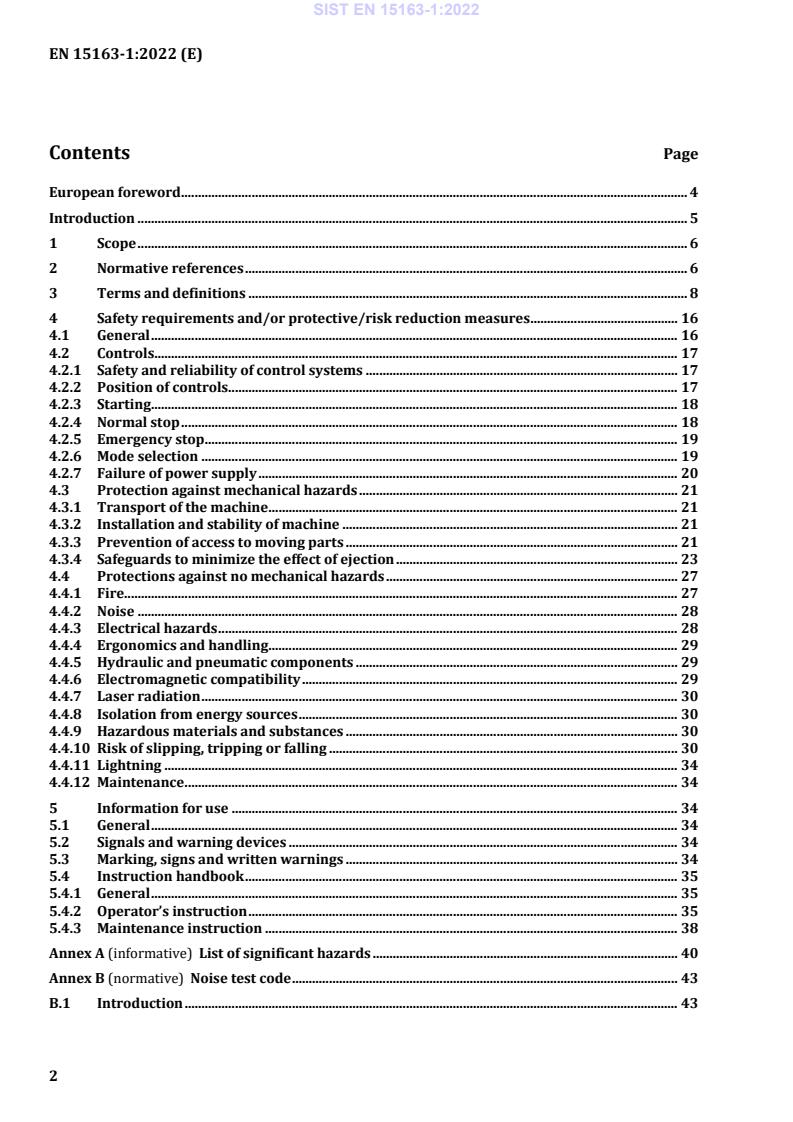
Contents Page
European foreword . 4
Introduction . 5
1 Scope . 6
2 Normative references . 6
3 Terms and definitions . 8
4 Safety requirements and/or protective/risk reduction measures . 16
4.1 General . 16
4.2 Controls . 17
4.2.1 Safety and reliability of control systems . 17
4.2.2 Position of controls . 17
4.2.3 Starting . 18
4.2.4 Normal stop . 18
4.2.5 Emergency stop . 19
4.2.6 Mode selection . 19
4.2.7 Failure of power supply . 20
4.3 Protection against mechanical hazards . 21
4.3.1 Transport of the machine . 21
4.3.2 Installation and stability of machine . 21
4.3.3 Prevention of access to moving parts . 21
4.3.4 Safeguards to minimize the effect of ejection . 23
4.4 Protections against no mechanical hazards . 27
4.4.1 Fire. 27
4.4.2 Noise . 28
4.4.3 Electrical hazards . 28
4.4.4 Ergonomics and handling . 29
4.4.5 Hydraulic and pneumatic components . 29
4.4.6 Electromagnetic compatibility . 29
4.4.7 Laser radiation . 30
4.4.8 Isolation from energy sources . 30
4.4.9 Hazardous materials and substances . 30
4.4.10 Risk of slipping, tripping or falling . 30
4.4.11 Lightning . 34
4.4.12 Maintenance . 34
5 Information for use . 34
5.1 General . 34
5.2 Signals and warning devices . 34
5.3 Marking, signs and written warnings . 34
5.4 Instruction handbook . 35
5.4.1 General . 35
5.4.2 Operator’s instruction . 35
5.4.3 Maintenance instruction . 38
Annex A (informative) List of significant hazards . 40
Annex B (normative) Noise test code . 43
B.1 Introduction . 43
B.2 Measurement of the A-weighted emission sound pressure level at the operator's
positions or other specified positions . 43
B.2.1 Basic standards . 43
B.2.2 Measurement procedure and positions . 43
B.2.3 Measurement uncertainty . 44
B.3 Determination of A-weighted sound-power level. 44
B.3.1 Measurement procedure and positions . 44
B.4 Installation, mounting and operating conditions for noise emission measurement . 44
B.5 Information to be recorded and reported . 45
B.6 Declaration and verification of noise emission values . 47
B.6.1 General . 47
B.6.2 Example of a declaration of noise emission values in the instruction handbook for
stationary diamond wire saws . 48
Annex C (informative) Types of granites for noise test measurement . 53
Annex D (normative) Rigid guards on stationary diamond wire saws-- Impact test method . 56
D.1 General . 56
D.2 Test method . 56
D.2.1 Preliminary remarks . 56
D.2.2 Testing equipment . 56
D.2.2.1 General . 56
D.2.2.2 Projectiles . 56
D.2.2.3 Sampling and supporting the guard under test . 57
D.2.3 Test procedure . 57
D.3 Results . 57
D.4 Assessment. 58
D.5 Test report . 58
D.6 Example of propulsion device for impact test . 58
Annex ZA (informative) Relationship between this European Standard and the essential
requirements of Directive 2006/42/EC aimed to be covered . 60
Bibliography . 63
European foreword
This document (EN 15163-1:2022) has been prepared by Technical Committee CEN/TC 151
“Construction equipment and building material machines - Safety”, the secretariat of which is held by
DIN.
This European Standard shall be given the status of a national standard, either by publication of an
identical text or by endorsement, at the latest by December 2022, and conflicting national standards shall
be withdrawn at the latest by December 2022.
Attention is drawn to the possibility that some of the elements of this document may be the subject of
patent rights. CEN shall not be held responsible for identifying any or all such patent rights.
This document supersedes EN 15163:2017.
This document has been prepared under a Standardization Request given to CEN by the European
Commission and the European Free Trade Association, and supports essential requirements of EU
Directive(s) / Regulation(s).
For relationship with EU Directive(s) / Regulation(s), see informative Annex ZA, which is an integral part
of this document.
This document deals with safety requirements of stationary diamond wire saws previously treated in
EN 15163:2017 with safety requirements of transportable diamond wire saws now treated in
EN 15163-2:2022. As safety requirements related two types of machines have been separated, this
document edition is completely different from the previous one.
Safety requirements treated in Clause 4, information for use treated in Clause 5 and related annexes have
been deeply modified, in addition, the following changes have been introduced:
— list of the significant hazards has been moved from Clause 4 to Annex A, according to 6.10.3.1 of
CEN Guide 414;
— normative references have been modified and updated to Clause 2;
— new terms and definitions have been introduced and improved to Clause 3 (e.g. coated diamond
wire);
— Annex ZA has been modified according to the last edition of CEN Guide 414.
Any feedback and questions on this document should be directed to the users’ national standards body.
A complete listing of these bodies can be found on the CEN website.
According to the CEN-CENELEC Internal Regulations, the national standards organisations of the
following countries are bound to implement this European Standard: Austria, Belgium, Bulgaria, Croatia,
Cyprus, Czech Republic, Denmark, Estonia, Finland, France, Germany, Greece, Hungary, Iceland, Ireland,
Italy, Latvia, Lithuania, Luxembourg, Malta, Netherlands, Norway, Poland, Portugal, Republic of North
Macedonia, Romania, Serbia, Slovakia, Slovenia, Spain, Sweden, Switzerland, Turkey and the United
Kingdom.
Introduction
This document has been prepared to be a harmonized standard to provide one means of conforming to
the essential health and safety requirements of the Machinery Directive and associated EFTA Regulations.
This document is a type-C standard as stated in EN ISO 12100.
This document is of relevance, in particular, for the following stakeholder groups representing the market
players with regard to machinery safety:
— machine manufacturers (small, medium and large enterprises);
— health and safety bodies (regulators, accident prevention organizations, market surveillance, etc.).
Others can be affected by the level of machinery safety achieved with the means of the document by the
above-mentioned stakeholder groups:
— machine users/employers (small, medium and large enterprises);
— machine users/employees (e.g. trade unions, organizations for people with special needs);
— service providers, e.g. for maintenance (small, medium and large enterprises);
— consumers (in case of machinery intended for use by consumers).
The above-mentioned stakeholder groups have been given the possibility to participate at the drafting
process of this document.
The machinery concerned and the extent to which hazards, hazardous situations or hazardous events are
covered are indicated in the scope of this document.
When requirements of this type-C standard are different from those which are stated in type-A or type-B
standards, the requirements of this type-C standard take precedence over the requirements of the other
standards for machines that have been designed and built according to the requirements of this type-C
standard.
1 Scope
This document deals with all significant hazards, hazardous situations and events as listed in Annex A,
which are relevant to stationary diamond wire saws (stationary diamond mono-wire saws and stationary
diamond multi-wire saws), as defined in Clause 3, when they are used as intended and under conditions
of misuse which are reasonably foreseeable by the manufacturer.
Stationary diamond wire saws can be used in quarries or in sawmill for cutting natural stones, e.g. marble,
granite (see Annex A).
This document deals only with stationary diamond wire saws using coated diamond wire as tool.
This document specifies the appropriate technical measures to eliminate or reduce risks arising from the
significant hazards.
This document deals all significant hazards that could occur within the expected lifetime of the machinery
including the phases of transport, assembly, dismantling, disabling and scrapping.
This document does not deal with the significant hazards arising by the use of other facilities/devices not
described in this document, that could be fitted on the machines or that can be used during the work
cycle.
This document does not apply to:
1) machines intended for operation in a potentially explosive atmosphere;
2) machines which are manufactured before the date of publication of this document.
2 Normative references
The following documents are referred to in the text in such a way that some or all of their content
constitutes requirements of this document. For dated references, only the edition cited applies. For
undated references, the latest edition of the referenced document (including any amendments) applies.
EN 166:2001, Personal eye-protection — Specifications
EN 207:2017, Personal eye-protection equipment — Filters and eye-protectors against laser radiation
(laser eye-protectors)
EN 1005-2:2003+A1:2008, Safety of machinery — Human physical performance — Part 2: Manual
handling of machinery and component parts of machinery
EN 1005-4:2005+A1:2008, Safety of machinery — Human physical performance — Part 4: Evaluation of
working postures and movements in relation to machinery
EN 50370-2:2003, Electromagnetic compatibility (EMC) — Product family standard for machine tools —
Part 2: Immunity
EN 60204-1:2018, Safety of machinery — Electrical equipment of machines — Part 1: General requirements
(IEC 60204-1:2016)
EN 60529:1991, Degrees of protection provided by enclosures (IP Code) (IEC 60529:1989)
EN 60825-1:2014, Safety of laser products — Part 1: Equipment classification and requirements
(IEC 60825-1:2014)
EN ISO 4413:2010, Hydraulic fluid power — General rules and safety requirements for systems and their
components (ISO 4413:2010)
EN ISO 4414:2010, Pneumatic fluid power — General rules and safety requirements for systems and their
components (ISO 4414:2010)
EN ISO 4871:2009, Acoustics — Declaration and verification of noise emission values of machinery and
equipment (ISO 4871:1996)
EN ISO 11201:2010, Acoustics — Noise emitted by machinery and equipment — Determination of emission
sound pressure levels at a work station and at other specified positions in an essentially free field over a
reflecting plane with negligible environmental corrections (ISO 11201:2010)
EN ISO 11202:2010, Acoustics — Noise emitted by machinery and equipment — Determination of emission
sound pressure levels at a work station and at other specified positions applying approximate environmental
corrections (ISO 11202:2010)
EN ISO 11204:2010, Acoustics — Noise emitted by machinery and equipment — Determination of emission
sound pressure levels at a work station and at other specified positions applying accurate environmental
corrections (ISO 11204:2010)
EN ISO 11688-1:2009, Acoustics — Recommended practice for the design of low-noise machinery and
equipment — Part 1: Planning (ISO/TR 11688-1:1995)
EN ISO 12100:2010, Safety of machinery — General principles for design — Risk assessment and risk
reduction (ISO 12100:2010)
EN 13236:2019, Safety requirements for superabrasive products
EN ISO 13849-1:2015, Safety of machinery — Safety-related parts of control systems — Part 1: General
principles for design (ISO 13849-1:2015)
EN ISO 13850:2015, Safety of machinery — Emergency stop function — Principles for design (ISO
13850:2015)
EN ISO 13857:2019, Safety of machinery — Safety distances to prevent hazard zones being reached by
upper and lower limbs (ISO 13857:2019)
EN ISO 14118:2018, Safety of machinery — Prevention of unexpected start-up (ISO 14118:2017)
EN ISO 14119:2013, Safety of machinery — Interlocking devices associated with guards — Principles for
design and selection (ISO 14119:2013)
As impacted by EN 60529:1991/AC:2006-12, EN 60529:1991/A1:2000, EN 60529:1991/A2:2013 and
EN 60529:1991/A2:2013/AC:2019-02.
As impacted by EN 60825-1:2014/AC:2017-06, EN 60825-1:2014/A11:2020.
EN ISO 14120:2015, Safety of machinery — Guards — General requirements for the design and
construction of fixed and movable guards (ISO 14120:2015)
EN ISO 14122-2:2016, Safety of machinery — Permanent means of access to machinery — Part 2: Working
platforms and walkways (ISO 14122-2:2016)
EN ISO 14122-3:2016, Safety of machinery — Permanent means of access to machinery — Part 3: Stairs,
stepladders and guard-rails (ISO 14122-3:2016)
EN ISO 14122-4:2016, Safety of machinery — Permanent means of access to machinery — Part 4: Fixed
ladders (ISO 14122-4:2016)
3 Terms and definitions
For the purposes of this document, the terms and definitions given in EN ISO 12100:2010 and the
following apply.
ISO and IEC maintain terminological databases for use in standardization at the following addresses:
— ISO Online browsing platform: available at https://www.iso.org/obp
— IEC Electropedia: available at https://www.electropedia.org/
3.1
stationary diamond wire saw
integrated fed machine designed for cutting natural stones (e.g. marble, granite), in quarries or in
sawmills, by the use of one or more coated diamond wires as tools and not intended to be easily
transported
Note 1 to entry: Stationary diamond wire saw may work in one main axis as well as in several axes.
Note 2 to entry: Stationary diamond wire saws include two types of machines as listed below:
— stationary diamond mono-wire saws;
— stationary diamond multi-wire saws.
3.1.1
stationary diamond mono-wire saw
stationary diamond wire saw, intended for both indoor and outdoor use, powered by an electric motor
as main drive, for cutting natural stones into benches, blocks and slabs using an only coated diamond
wire as tool and where the cutting is performed by the movement of the wire joined to the moving down
of the structure of machine along its vertical columns or joined to the horizontal translation of the
machinery or the block trolley
Note 1 to entry: During cutting operation, the coated diamond wire can be cooled by water.
3.1.1.1
travelling diamond mono-wire saw
stationary diamond mono-wire saw (see Figure 1) with a carriage on which the machinery may move
towards the stone block
Note 1 to entry: The machinery, by means of the movement on its carriage, in addition to the vertical cutting,
allows performing the horizontal cutting of the stone block.
Key
1 guard 4 carriage 7 block
2 machine frame 5 guide wheel 8 coated diamond wire
3 drive wheel 6 sill
Figure 1 — Example of a travelling diamond mono-wire saw
3.1.1.2
stationary block diamond mono-wire saw
stationary diamond mono-wire saw (see Figures 2 and 3) standing on its foundations and the stone block
may be moved under the machinery by a block trolley
Note 1 to entry: If the stone block is moved by the block trolley, the machinery, by means of the movement of the
block trolley on its rails, in addition to the vertical cutting, allows performing the horizontal cutting of the stone
block.
Note 2 to entry: See Figure 2 for a stationary block diamond mono-wire saw with block trolley and Figure 3 for a
stationary block diamond mono-wire saw without block trolley.
Key
1 guard 4 foundations 7 block trolley
2 machine frame 5 guide wheel 8 coated diamond wire
3 drive wheel 6 rails for block trolley
Figure 2 — Example of a stationary block diamond mono-wire saw with block trolley
Key
1 guard 4 foundations 7 sill
2 machine frame 5 guide wheel 8 coated diamond wire
3 drive wheel 6 block
Figure 3 — Example of a stationary block diamond mono-wire saw without block trolley
3.1.1.3
stationary-mobile combined diamond mono-wire saw
stationary diamond mono-wire (see Figure 4) saw constituted by two frames, the first one is standing on
its foundations, the second one is mobile on its rails and may move towards the stone block
Note 1 to entry: The machinery, through of the movement on its rails, in addition to the vertical cutting, allows
performing the horizontal cutting of the stone block.
Key
1 stationary wire saw 5 block 9 tensioning wire wheel
2 mobile wire saw 6 machine frame 10 coated diamond wire
3 mobile wire saw rails 7 drive wheel 11 guard
4 block trolley 8 idle wire wheel
Figure 4 — Example of a stationary-mobile combined diamond mono-wire saw
3.1.2
stationary diamond multi-wire saw
stationary diamond wire saw, intended both for indoor and outdoor use, powered by an electric motor
as main drive, for cutting blocks of natural stones into slabs using more coated diamond wires as tools
and where the cutting is performed by the movement of the wires joined to the moving down of the
structure of machine along its vertical columns (see Figure 5), or joined the rising of the block trolley (see
Figure 6)
Note 1 to entry: During the cutting operation, the diamond wires can be cooled by water.
Key
1 machine frame 5 tensioning wire wheel 9 block
2 saw frame 6 guard 10 guide wheel
3 drive wheel 7 coated diamond wire 11 trolley rail
4 idle wire wheel 8 block trolley
Figure 5 — Example of a stationary diamond multi-wire saw
Key
1 machine frame 4 tensioning wire wheel 7 block trolley
2 drive wheel 5 coated diamond wire 8 block
3 idle wire wheel 6 guard 9 trolley rail
Figure 6 — Example of a stationary diamond multi-wire saw
3.2
coated diamond wire
plastic or rubber assembled diamond wire (see Figure 7) injected with polymer with no modification of
the supporting steel cable section and used as a tool during the cutting
Note 1 to entry: The polymer, penetrating inside the strands under the threaded diamond beads creates a biting
effect between the steel wire and the beads, reducing the probability of ejection of them in case of whiplash (3.16).
Key
1 steel wire 3 thermoplastic polymer or vulcanized rubber
2 diamond beads 4 spring
Figure 7 — Example of a coated diamond wire
3.3
block
mass of natural stone extracted from a quarry to be processed to a half-finished product
3.4
block trolley
powered work piece table, integrated with the machine, on which blocks are placed to be processed by
the stationary diamond mono or multi wire saw
3.5
wire wheel
rotating wheel on which the coated diamond wire is guided
3.6
guide wheel
not driven wheel mounted on the machine frame which guides the tool entering and exiting the main
drive wheel
3.7
drive wheel
power transmission wheel which allows the rotation of the tool
3.8
machine frame
structure supporting the machine
Note 1 to entry: Within the machine frame, the height adjustment is integrated.
3.9
main drive
power transmission produced by the drive wheel that generates the motion of the tool
3.10
feed drive
power transmission that generates the movements of all the other main axes that contribute directly to
cutting operations unless the main drive
3.11
maintenance panel
hand-held control device used only for maintenance or wires replacement
3.12
peripheral enclosure
combination of fixed guards and interlocking movable guards with guard locking which encloses the
machine danger zone preventing access to it and may also form a means of safeguarding against ejected
parts
3.13
safety function
function of the machine whose failure can result in an immediate increase of the risk(s)
[SOURCE: EN ISO 12100:2010, 3.30]
3.14
safety-related part of a control system
SRP/CS
part of a control system that responds to safety-related input signals and generates safety-related output
signals
Note 1 to entry: The combined safety-related parts of a control system start at the point where the safety-related
input signals are initiated (including for example the actuating cam and the roller of the position switch) and end at
the output of the power control elements (including for example the main contacts of the contactor).
Note 2 to entry: If monitoring systems are used for diagnostics, they are also considered as SRP/CS.
[SOURCE: EN ISO 13849-1:2015, 3.1.1]
3.15
performance level
PL
discrete level used to specify the ability of safety-related parts of control systems to perform a safety
function under foreseeable conditions
[SOURCE: EN ISO 13849-1:2015, 3.1.23, 4.5.1]
3.16
whiplash
dangerous movement of the diamond wire that can generate risk of impact and/or ejection of parts of the
diamond wire in case of coated diamond wire breakage
4 Safety requirements and/or protective/risk reduction measures
4.1 General
Machinery shall comply with the safety requirements and/or protective measures of this clause. In
addition, the machine shall be designed according to the principles of EN ISO 12100:2010 for relevant
but not significant hazards (e.g. sharp edges of the machine frame) which are not dealt with this
document.
4.2 Controls
4.2.1 Safety and reliability of control systems
For the purpose of this document, safety-related part of a control system means the system which
implements safety functions from the initial device (e.g. actuator, position detector or sensor) up to
include the power-control element of the final machine actuator (e.g. motor). Safety-related parts of the
control system of this machine comprise parts concerning the following functions and they shall fulfil the
requirements of the PL given below, in accordance with the requirements of EN ISO 13849-1:2015:
a) for starting: PL = c (see 4.2.3);
b) for normal stop: No PL is required (see 4.2.4);
c) for emergency stop: PL = c (see 4.2.5);
d) for prevention of automatic restart: PL = c (see 4.2.7);
e) for interlocking with guard locking: PL = c (see 4.2.6, 4.3.3.1);
f) for hold-to-run control or limited speed/increment monitoring: PL = c (see 4.2.6.3);
g) for mode selection: PL = c (see 4.2.6);
h) for wire-tension system: PL = c (see 4.3.4.2);
i) for maximum wire tension-system pressure value: PL = c (see 4.3.4.2);
j) for limited speed control of block trolley translation: PL = c (see 4.3.3.3).
Verification: By checking the relevant drawings and/or circuit diagrams, calculation and inspection of the
machine.
4.2.2 Position of controls
4.2.2.1 General
The main electrical control devices that are: control power on, starting, normal stop, emergency stop,
mode selector, enabling control, reset control, hold-to-run control, shall be located on the main control
panel outside the peripheral enclosure (see 3.12). The main control panel shall be positioned at a distance
of at least 1 000 mm and not exceeding 1 800 mm from the floor level or from the operator’s platform
level.
The emergency-stop device shall be provided at each working station and in particular:
a) at the main control panel;
b) at the hand-held control sets permanently connected by fixed cable control panel or wireless (if
provided) (see 4.2.2.2);
c) inside any enclosure fitted with access door.
Verification: By checking the relevant drawings and/or circuit diagrams, inspection and functional testing
of the machine.
4.2.2.2 Hand-held control set
A maintenance panel (see 3.11), additional control devices for cycle setting (see 4.2.6.3 e)), may be
provided on hand-held control set with cable connection or wireless.
No reset function control device, no cycle starting control device, no mode-selection switch shall be
placed on wireless control sets or control sets with cable connection.
Verification: By checking the relevant drawings and/or circuit diagrams, inspection of the machine and
functional testing of the machine.
4.2.3 Starting
Start or restart shall only be possible by actuation of the start control device provided for that purpose.
This start-control device shall be protected against unintended actuation e.g. by shrouded control
devices.
Starting shall conform to the requirements of EN 60204-1:2018, 9.2.3.2, and in addition start or restart
of the machine shall be possible if the following conditions shall be met:
a) all safeguards are in place and functional;
b) the wire-tension system is set;
c) the cooling supply for coated diamond wires is in place and functional (if provided).
The starting sequence shall be:
a) start of drive wheel to initiate the rotation of the coated diamond wires;
b) start of the vertical motion of the frame;
c) alternatively, for horizontal cutting (see 3.1.1.1 - 3.1.1.3), instead of start of vertical motion of the
frame, start of translation of the machinery on its carriage or translation of the block trolley on its
rails.
The control system for starting or restarting shall be PL = c in accordance with the requirements of
EN ISO 13849-1:2015.
Verification: By checking the relevant drawings and/or circuit diagrams, calculation, inspection and
functional testing of the machine.
4.2.4 Normal stop
A normal stop control system shall be provided, which, when actuated, shall fulfil the stopping sequences
and shall disconnect power from all machine actuators.
Stationary diamond wire saws shall be fitted with normal stop control of stop category 0 or 1 in
accordance with EN 60204-1:2018, 9.2.2.
The stopping sequence for normal stop shall be:
a) stop of the vertical motion of the frame;
b) alternatively, for horizontal cutting (see 3.1.1.1 - 3.1.1.3), instead of stop of vertical motion of the
frame, stop of translation of the machinery on its carriage or translation of the block trolley on its
rails;
c) stop of drive wheel.
For normal stop control circuit, no PL, according to EN ISO 13849-1:2015, is required.
Verification: By checking the relevant drawings and/or circuit diagrams, calculation, inspection and
functional testing of the machine.
4.2.5 Emergency stop
Stationary diamond wire saws shall be fitted with an emergency stop control device which complies with
the requirements of EN ISO 13850:2015 and additionally with the requirements of EN 60204-1:2018,
10.7.
The emergency-stop function shall comply with the requirements of EN 60204-1:2018, 9.2.3.4.2, and
shall fulfil the following requirements:
a) stop category 0 for the feed drive in accordance with the requirements of EN 60204-1:2018, 9.2.2;
b) stop category 1 for the main drive in accordance with the requirements of EN 60204-1:2018, 9.2.2.
The stopping sequence for emergency stop shall be:
a) stop of the vertical motion of the frame;
b) alternatively, for horizontal cutting (see 3.1.1.1 - 3.1.1.3), instead of stop of vertical motion of the
frame, stop of translation of the machinery on its carriage or translation of the block trolley on its
rails;
c) stop of drive wheel.
The control circuit for emergency stop shall be at least PL = c in accordance with the requirements of
EN ISO 13849-1:2015.
Verification: By checking the relevant drawings and/or circuit diagrams, calculation, inspection and
functional testing of the machine.
4.2.6 Mode selection
4.2.6.1 General
Where machines are designed to be operated during setting with the movable interlocked guards and/or
protective devices disabled, a mode selector to select between machining mode of operation (see 4.2.6.2)
and machine setting mode of operation (4.2.6.3) shall be provided, and the following conditions shall be
met:
a) the mode selector shall be lockable in each position (e.g. by key or password) and shall be located
outside the peripheral enclosure (see 3.12), e.g. on the main control panel (see 4.2.2 for location of
control devices);
b) the control system for mode selection shall be at least PL = c in accordance with the requirements of
EN ISO 13849-1:2015;
c) the mode selector shall not allow more than one mode to be active at any one time;
d) it shall not be possible to change the mode of operation before the machine has been brought to a
complete and safe stop. The mode selection by itself shall not initiate any machine operation.
Verification: By checking the relevant drawings and/or circuit diagrams, calculation, inspection and
functional testing of the machine.
4.2.6.2 Machining mode of operation
In the machining mode, any movement shall only be possible when the interlocking guards (for definition
see EN ISO 14119:2013, 3.2 and 3.5) and/or protective devices are in place and functional.
Verification: By checking the relevant drawings and/or circuit diagrams and inspection and functional
testing of the machine.
4.2.6.3 Machine-setting mode of operation
In the machine-setting mode of operation if the movable guards are open and/or protective devices
disabled, any movement shall only be possible when the following requirements are met:
a) the tangential speed of wheels shall be limited to 0,2 m/s;
b) any single axis movement shall be controlled by a hold-to-run control. The movement shall be limited
to a peripheral speed of 5 m/min or a maximum increment of 10 mm for a single step. Both the hold-
to-run control and speed/increment monitoring shall be PL = c in accordance with the requirements
of EN ISO 13849-1:2015. If this is technically not possible, alternatively hold-to-run control and the
speed/increment monitoring shall be provided in conjunction enabling device PL = c in accordance
with the requirements of EN ISO 13849-1:2015;
c) the wire-tension system requirements shall be in accordance with the requirements of 4.3.4.2;
d) the translation movement of the block trolley shall be in accordance with the requirements of 4.3.3.3;
e) the hold-to-run control devices and enabling devices for wheel, axes movements, block trolley
translation and wire-tension system, shall be located on the main control panel and/or on the
maintenance panel connected to the machine by a cable or wire-less system (see 4.2.2). For wireless
hand-held control sets, EN 60204-1:2018, 9.2.4, applies.
f) the automatic restart of the machine shall be prevented in accordance with the requirements of
EN ISO 14118:2018, Clause 6.
Verification: By checking the relevant drawings and/or circuit diagrams, calculation, inspection and
functional testing of the machine.
4.2.7 Failure of power supply
Stationary diamond wire saws shall be equipped by mechanical systems that stop any movement of the
machine in case of interruption or reduction of hydraulic or pneumatic pressure levels below a set value
of design.
If a machine stops in any working position as result of a failure of power supply, no further movements
shall be possible.
For electric supply, see EN 60204-1:2018, 7.5, paragraphs 1 and 3.
The requirements of EN ISO 14118:2018, Clause 6, apply.
The safety-related part of the control system to prevent automatic restart shall achieve at least PL = c.
Verification: By checking the relevant drawings, calculation, circuit diagrams, inspection of the machine.
4.3 Protection against mechanical hazards
4.3.1 Transport of the machine
For the transport of the machine, appropriate provisions for the easy and safe handling shall be made in
accordance with EN ISO 12100:2010, 6.3.5.5.
If lifting accessories (e.g. eyelets inside the structure/frame of machinery) are provided, strength
calculations shall take acc
...