

EN 14617-5:2012
(Main)Agglomerated stone - Test methods - Part 5: Determination of freeze and thaw resistance
- Abstract
This European Standard specifies a method to assess the effect of freeze/thaw cycles on agglomerated stones. It contains provisions for a technological test to be carried out to assess the effect of freeze/thaw cycles on the flexural strength characteristics of the stone.
- Status
- Published
- Publication Date
- 10-Apr-2012
- Withdrawal Date
- 30-Oct-2012
- Technical Committee
- CEN/TC 246 - Natural stones
- Drafting Committee
- CEN/TC 246/WG 4 - Agglomerated stones (JWG 229/246)
- Current Stage
- 9093 - Decision to confirm - Review Enquiry
- Start Date
- 05-Jun-2023
- Completion Date
- 07-Oct-2026

Overview
EN 14617-5:2012 - published by CEN - specifies a standardized test method for assessing freeze/thaw resistance of agglomerated stone. The standard defines a technological procedure to quantify how repetitive freezing and thawing affects the flexural strength of agglomerated stone specimens. This method is used to produce a repeatable metric (coefficient of freeze/thaw resistance) that indicates durability when exposed to freeze/thaw cycles.
Key topics and technical requirements
- Scope: Assessment of the effect of freeze/thaw cycles on agglomerated stones with focus on flexural strength changes.
- Specimens: At least 5 specimens per test set; two sets required (one exposed to freeze/thaw cycles, one unfrosted control). Specimen dimensions and surface finish follow EN 14617-2.
- Conditioning: Dry specimens conditioned at (40 ± 5) °C until constant mass, then stored at (20 ± 5) °C prior to testing.
- Water saturation: Specimens for cycling are immersed in tap water at (20 ± 5) °C until constant mass (difference < 0.1 %).
- Freeze/thaw cycle parameters:
- Freezing at (−20 ± 5) °C for at least 4 hours.
- Thawing by immersion in tap water at (20 ± 5) °C for at least 2 hours.
- 25 complete cycles are performed.
- Flexural strength testing: Performed according to EN 14617-2 on both cycled and control specimens.
- Result expression: The freeze/thaw resistance coefficient (KMf25) is the ratio of average flexural strength after 25 cycles (RMf) to the average flexural strength of unfrosted specimens (Rf), expressed as a percentage:
KMf25 = (RMf / Rf) × 100 - Reporting: Test report must include identification, sample details, cycle protocol, specimen dimensions, deviations, uncertainty statements and signatures.
Practical applications and users
Who uses EN 14617-5:2012
- Material laboratories and test houses performing durability testing on agglomerated stone.
- Manufacturers of engineered stone, architectural cladding and paving to validate product durability.
- Specifiers and consultants (architects, civil engineers) assessing suitability of agglomerated stone for climates with freeze/thaw exposure.
- Certification bodies and quality assurance teams requiring standardized evidence of frost resistance.
Why it matters
- Provides a reproducible metric for freeze/thaw durability tied to structural performance (flexural strength).
- Supports specification, product comparison, compliance, and risk assessment for exterior applications in cold climates.
Related standards
- EN 14617-2:2008 - Determination of flexural strength (bending) (normative reference).
- Other parts of the EN 14617 series (e.g., Part 1 density/water absorption, Part 4 abrasion, Part 6 thermal shock) for comprehensive agglomerated stone characterization.
Keywords: EN 14617-5:2012, agglomerated stone, freeze/thaw resistance, test methods, flexural strength, CEN, freeze-thaw cycles, stone testing.
Relations
- Effective Date
- 18-Apr-2012
- Effective Date
- 28-Jan-2026
- Referred By
EN 15564:2008 - Precast concrete products - Resin bound concrete - Requirements and test methods - Effective Date
- 28-Jan-2026
- Referred By
EN 15286:2013 - Agglomerated stone - Slabs and tiles for wall finishes (internal and external) - Effective Date
- 28-Jan-2026
- Effective Date
- 28-Jan-2026
- Referred By
EN 15285:2008 - Agglomerated stone - Modular tiles for flooring and stairs (internal and external) - Effective Date
- 28-Jan-2026
Get Certified
Connect with accredited certification bodies for this standard

DIBt (Deutsches Institut für Bautechnik)
German Institute for Building Technology.
DIN CERTCO
DIN Group product certification.

Aboma Certification B.V.
Specialized in construction, metal, and transport sectors.
Sponsored listings
Frequently Asked Questions
EN 14617-5:2012 is a standard published by the European Committee for Standardization (CEN). Its full title is "Agglomerated stone - Test methods - Part 5: Determination of freeze and thaw resistance". This standard covers: This European Standard specifies a method to assess the effect of freeze/thaw cycles on agglomerated stones. It contains provisions for a technological test to be carried out to assess the effect of freeze/thaw cycles on the flexural strength characteristics of the stone.
This European Standard specifies a method to assess the effect of freeze/thaw cycles on agglomerated stones. It contains provisions for a technological test to be carried out to assess the effect of freeze/thaw cycles on the flexural strength characteristics of the stone.
EN 14617-5:2012 is classified under the following ICS (International Classification for Standards) categories: 91.100.15 - Mineral materials and products. The ICS classification helps identify the subject area and facilitates finding related standards.
EN 14617-5:2012 has the following relationships with other standards: It is inter standard links to EN 14617-5:2005, EN 14617-2:2008, EN 15564:2008, EN 15286:2013, EN 16954:2018, EN 15285:2008. Understanding these relationships helps ensure you are using the most current and applicable version of the standard.
EN 14617-5:2012 is available in PDF format for immediate download after purchase. The document can be added to your cart and obtained through the secure checkout process. Digital delivery ensures instant access to the complete standard document.
Standards Content (Sample)
2003-01.Slovenski inštitut za standardizacijo. Razmnoževanje celote ali delov tega standarda ni dovoljeno.Aglomeriran kamen - Preskusne metode - 5. del: Ugotavljanje zmrzovanja in odtajevanjaKünstlich hergestellter Stein - Prüfverfahren - Teil 5: Bestimmung der Frost-Tau-WechselbeständigkeitPierre agglomérée - Méthodes d'essai - Partie 5: Détermination de la résistance au gel et au dégelAgglomerated stone - Test methods - Part 5: Determination of freeze and thaw resistance91.100.15Mineralni materiali in izdelkiMineral materials and productsICS:Ta slovenski standard je istoveten z:EN 14617-5:2012SIST EN 14617-5:2012en,fr,de01-julij-2012SIST EN 14617-5:2012SLOVENSKI
STANDARDSIST EN 14617-5:20051DGRPHãþD
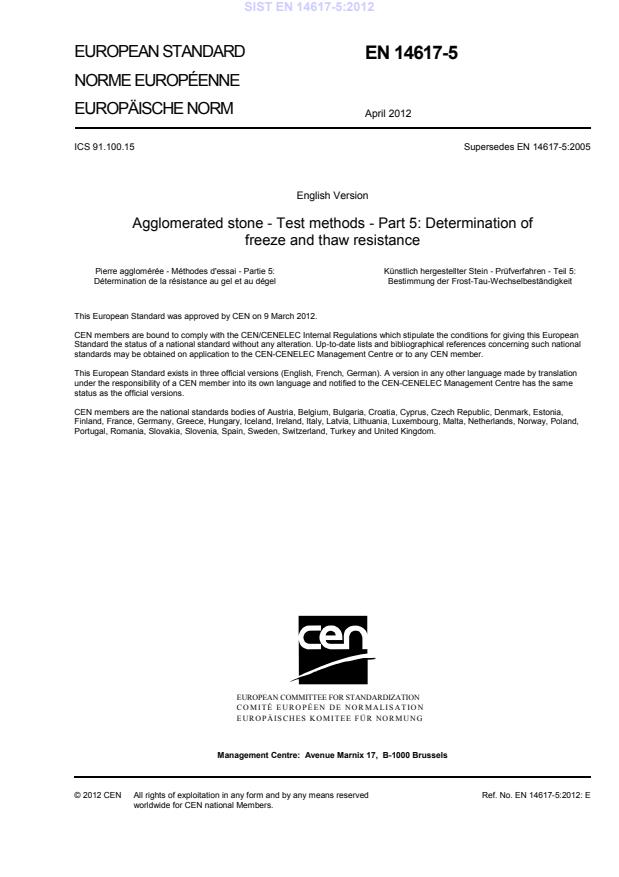
EUROPEAN STANDARD NORME EUROPÉENNE EUROPÄISCHE NORM
EN 14617-5
April 2012 ICS 91.100.15 Supersedes EN 14617-5:2005English Version
Agglomerated stone - Test methods - Part 5: Determination of freeze and thaw resistance
Pierre agglomérée - Méthodes d'essai - Partie 5: Détermination de la résistance au gel et au dégel
Künstlich hergestellter Stein - Prüfverfahren - Teil 5: Bestimmung der Frost-Tau-Wechselbeständigkeit This European Standard was approved by CEN on 9 March 2012.
CEN members are bound to comply with the CEN/CENELEC Internal Regulations which stipulate the conditions for giving this European Standard the status of a national standard without any alteration. Up-to-date lists and bibliographical references concerning such national standards may be obtained on application to the CEN-CENELEC Management Centre or to any CEN member.
This European Standard exists in three official versions (English, French, German). A version in any other language made by translation under the responsibility of a CEN member into its own language and notified to the CEN-CENELEC Management Centre has the same status as the official versions.
CEN members are the national standards bodies of Austria, Belgium, Bulgaria, Croatia, Cyprus, Czech Republic, Denmark, Estonia, Finland, France, Germany, Greece, Hungary, Iceland, Ireland, Italy, Latvia, Lithuania, Luxembourg, Malta, Netherlands, Norway, Poland, Portugal, Romania, Slovakia, Slovenia, Spain, Sweden, Switzerland, Turkey and United Kingdom.
EUROPEAN COMMITTEE FOR STANDARDIZATION
COMITÉ EUROPÉEN DE NORMALISATION EUROPÄISCHES KOMITEE FÜR NORMUNG
Management Centre:
Avenue Marnix 17,
B-1000 Brussels © 2012 CEN All rights of exploitation in any form and by any means reserved worldwide for CEN national Members. Ref. No. EN 14617-5:2012: ESIST EN 14617-5:2012
...