

EN 1996-1-2:2024/FprA1
(Amendment)Eurocode 6 - Design of masonry structures - Part 1-2: Structural fire design
- Abstract
1.1 Scope of prEN 1996-1-2
(1) This document gives rules for the design of masonry structures for the accidental situation of fire exposure. This document only identifies differences from, or supplements to, normal temperature design.
(2) This document applies to structures, or parts of structures, that are within the scope of EN 1996-1-1 or EN 1996-3 and are designed accordingly.
(3) This document gives rules for the design of structures for specified requirements in respect of the aforementioned functions and the levels of performance.
(5) This document does not cover masonry built with natural stone units according to EN 771-6.
(6) This document deals with:
- non-loadbearing internal walls;
- non-loadbearing external walls;
- loadbearing internal walls with separating or non-separating functions;
- loadbearing external walls with separating or non-separating functions.
1.2 Assumptions
(1) The assumptions of EN 1990 and EN 1996-1-1 apply to this document.
(2) This document is intended to be used together with EN 1990, EN 1991-1-2, EN 1996-1-1, EN 1996 2 and EN 1996-3.
(3) In addition to the general assumptions of EN 1990 and EN 1996-1-1, the following assumptions apply:
- the choice of the relevant design fire scenario is made by appropriate qualified and experienced personnel, or is given by the relevant national regulation;
- any fire protection measure taken into account in the design will be adequately maintained.
- Status
- Not Published
- Publication Date
- 17-Feb-2027
- Technical Committee
- CEN/TC 250 - Structural Eurocodes
- Drafting Committee
- CEN/TC 250/SC 6/WG 3 - Structural fire design
- Current Stage
- 4599 - Dispatch of FV draft to CMC - Finalization for Vote
- Start Date
- 03-Nov-2026
- Due Date
- 26-Aug-2027
- Completion Date
- 26-Aug-2027
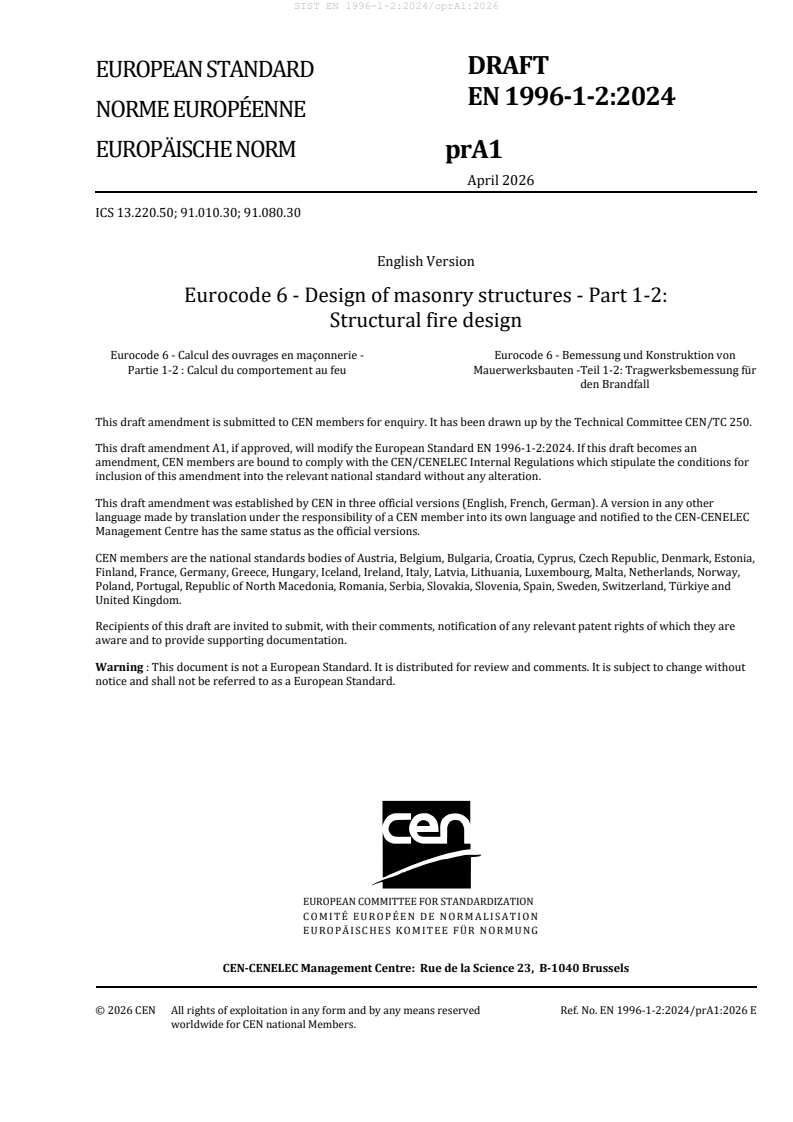

EN 1996-1-2:2024/FprA1 is a CEN draft amendment to Eurocode 6, Part 1-2, for the structural fire design of masonry structures. It updates EN 1996-1-2:2024 for designers, checking engineers, manufacturers and authorities that use Eurocode rules for masonry exposed to fire. The amendment mainly aligns references, revises introductory wording, and clarifies how fire resistance data may be supported by test results.
What does EN 1996-1-2:2024/FprA1 specify?
EN 1996-1-2:2024/FprA1 specifies changes to EN 1996-1-2:2024, which gives rules for designing masonry structures in the accidental situation of fire exposure. The underlying standard supplements normal temperature design, so it is used together with the normal masonry design rules rather than instead of them.
The scope applies to structures or parts of structures within EN 1996-1-1 or EN 1996-3, and it covers specified requirements for function and performance levels in fire. It deals with non-loadbearing internal and external walls, and with loadbearing internal and external walls, whether they have separating or non-separating functions. Masonry built with natural stone units according to EN 771-6 is outside the scope.
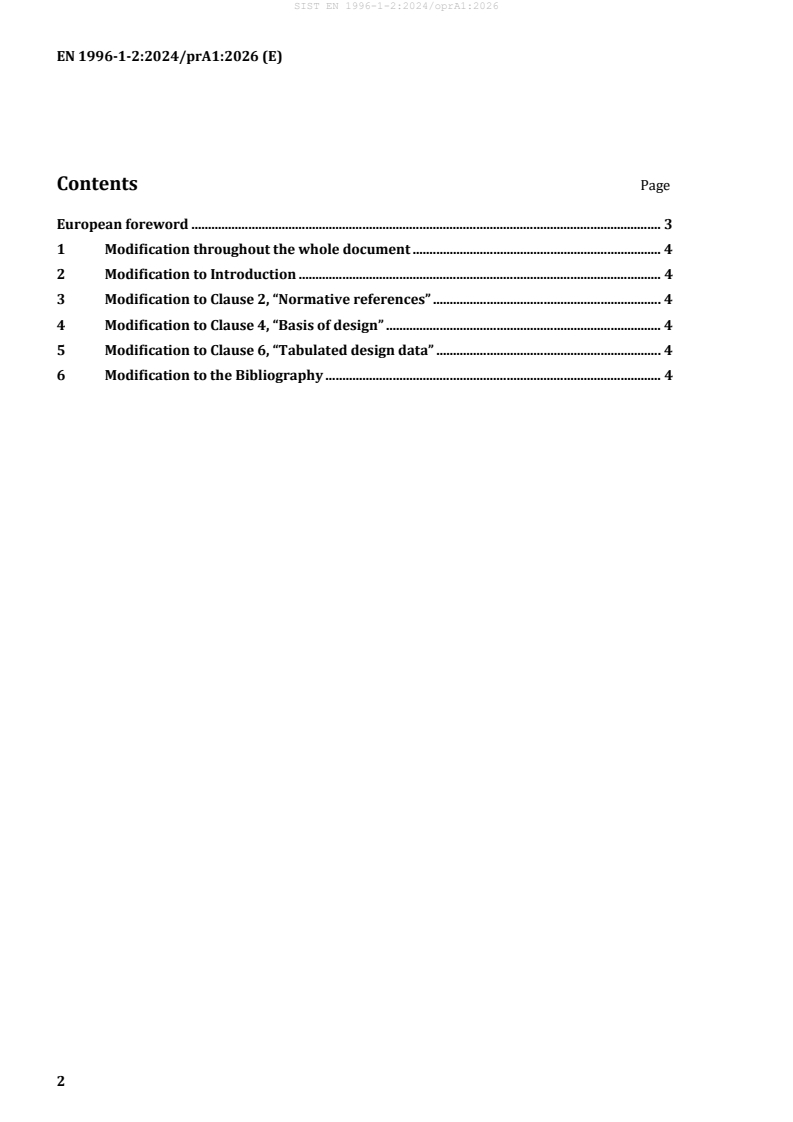
This amendment is organized as a short change package. The contents list a European foreword and modification items for the whole document, the Introduction, Clause 2 on normative references, Clause 4 on basis of design, Clause 6 on tabulated design data, and the Bibliography.
What are the key requirements of EN 1996-1-2:2024/FprA1?
EN 1996-1-2:2024/FprA1 does not rewrite the whole fire design standard. Its main effect is to update cross-references and clarify how the fire design rules are applied and documented.
Scope and assumptions
- EN 1996-1-2:2024/FprA1 keeps fire design focused on the accidental situation of fire exposure. In practice, the designer still starts from the normal-temperature design basis and then checks the fire case.
- EN 1996-1-2:2024/FprA1 applies only where the masonry design already falls under EN 1996-1-1 or EN 1996-3. In practice, users first confirm that the project is a Eurocode masonry project.
- The assumptions state that the choice of the relevant design fire scenario is made by qualified and experienced personnel, or is set by national regulation. In practice, the fire case must be selected deliberately and recorded.
- Any fire protection measure used in the design must be adequately maintained. In practice, the design assumption is only valid if the protection is kept in working condition.
Reference updates
- Clause 2 replaces the normative reference to EN 1990 with EN 1990-1:2023+A1:2026. In practice, the basis-of-design reference is being brought into line with the updated structural and geotechnical design part.
- The document-wide change replaces “EN 1990” with “EN 1990-1” except in subclause 0.1. In practice, users need to check their cross-references when reading or applying the standard.
- The Introduction adds EN 19100, Eurocode 10 - Design of glass structures, and revises the example of future Eurocode work. In practice, the foreword is being kept aligned with the wider Eurocode framework.
Fire resistance evidence
- Clause 6.2.1(2) clarifies that, for all types of masonry walls and columns, fire resistance may be obtained from tests made in accordance with EN 1363-1, EN 1363-2, EN 1364-1, EN 1365-1 and EN 1365-4, where appropriate. In practice, tested evidence can support the fire design of walls and columns instead of relying only on tabulated values.
- The amendment also touches Clause 4 on basis of design and the Bibliography. In practice, those edits keep the internal references and supporting references consistent with the updated Eurocode wording.
What terms does EN 1996-1-2:2024/FprA1 define?
EN 1996-1-2:2024/FprA1 uses a small set of recurring technical terms that matter in fire design.
- Accidental situation of fire exposure - the fire case treated as an accidental design situation.
- Design fire scenario - the fire case chosen for design, either by qualified and experienced personnel or by national regulation.
- Fire resistance - the performance of a wall or column in fire, which can be supported by tests cited in Clause 6.
- Loadbearing wall - a wall that carries structural load; the document covers internal and external versions.
- Non-loadbearing wall - a wall that does not carry structural load; the document covers internal and external versions.
- Separating function - a function of a wall that helps separate spaces during fire.
- National Annexes - national documents used to set safety-related values at national level within the Eurocode system.
Who uses EN 1996-1-2:2024/FprA1?
EN 1996-1-2:2024/FprA1 is used by structural engineers, masonry designers and fire engineers who need to design or check masonry for fire exposure. It is also relevant to contractors, product manufacturers, laboratories and testing bodies when they support fire resistance claims with test evidence.
Building control bodies, regulators and specifiers use it when they need a common Eurocode basis for masonry fire design. For buyers and project teams, it helps identify whether a masonry wall or column can be justified by tabulated data, by calculation rules or by test evidence.
What changed in EN 1996-1-2:2024/FprA1 from the previous edition?
EN 1996-1-2:2024/FprA1 will amend EN 1996-1-2:2024 with these changes:
- Replaces “EN 1990” with “EN 1990-1” throughout the document, except in subclause 0.1.
- Adds EN 19100 - Eurocode 10 - Design of glass structures to the Introduction.
- Replaces the Introduction wording about future Eurocode parts under development.
- Updates Clause 2 to cite EN 1990-1:2023+A1:2026.
- Updates Clause 4 references in 4.6(2) and 4.6(3).
- Clarifies Clause 6.2.1(2) on fire resistance obtained from test standards.
- Makes an editorial Bibliography change by adding a tab in reference [2].
Which standards are used with EN 1996-1-2:2024/FprA1?
| Standard | What it contributes |
|---|---|
| EN 1990-1:2023+A1:2026 | Basis of structural and geotechnical design used in Clause 2 and Clause 4. |
| EN 1991-1-2 | Fire actions and fire-related loading assumptions used together with the fire design rules. |
| EN 1996-1-1 | Normal-temperature masonry design basis for structures in scope. |
| EN 1996-2 | Supporting masonry design and execution rules used with the Eurocode masonry system. |
| EN 1996-3 | Another masonry design part within the stated scope of EN 1996-1-2. |
| EN 771-6 | Identifies the natural stone units excluded from this document’s scope. |
| EN 1363-1, EN 1363-2, EN 1364-1, EN 1365-1, EN 1365-4 | Fire test standards referenced for obtaining fire resistance data where appropriate. |
| EN 19100 | Eurocode 10, added in the Introduction as part of the wider Eurocode set. |
What does the EN 1996-1-2:2024/FprA1 document contain?
EN 1996-1-2:2024/FprA1 is a focused amendment text, not a full reissue of the fire design standard. Its contents page shows where changes are made in the base document: the whole document, the Introduction, Clause 2, Clause 4, Clause 6 and the Bibliography.
The amendment text provides line-by-line replacements and insertions, including updated references and one clarification on test-based fire resistance. For users, the practical value is in knowing exactly which clauses of EN 1996-1-2:2024 are being revised and which external standards the revised wording points to.
Relations
- Amends
EN 1996-1-2:2024 - Eurocode 6 - Design of masonry structures - Part 1-2: Structural fire design - Effective Date
- 19-Nov-2025
Get Certified
Connect with accredited certification bodies for this standard

DIBt (Deutsches Institut für Bautechnik)
German Institute for Building Technology.

DIN CERTCO
DIN Group product certification.

Kiwa BDA Testing
Building and construction product certification.
Sponsored listings
Frequently Asked Questions
EN 1996-1-2:2024/FprA1 is a draft published by the European Committee for Standardization (CEN). Its full title is "Eurocode 6 - Design of masonry structures - Part 1-2: Structural fire design". This standard covers: 1.1 Scope of prEN 1996-1-2 (1) This document gives rules for the design of masonry structures for the accidental situation of fire exposure. This document only identifies differences from, or supplements to, normal temperature design. (2) This document applies to structures, or parts of structures, that are within the scope of EN 1996-1-1 or EN 1996-3 and are designed accordingly. (3) This document gives rules for the design of structures for specified requirements in respect of the aforementioned functions and the levels of performance. (5) This document does not cover masonry built with natural stone units according to EN 771-6. (6) This document deals with: - non-loadbearing internal walls; - non-loadbearing external walls; - loadbearing internal walls with separating or non-separating functions; - loadbearing external walls with separating or non-separating functions. 1.2 Assumptions (1) The assumptions of EN 1990 and EN 1996-1-1 apply to this document. (2) This document is intended to be used together with EN 1990, EN 1991-1-2, EN 1996-1-1, EN 1996 2 and EN 1996-3. (3) In addition to the general assumptions of EN 1990 and EN 1996-1-1, the following assumptions apply: - the choice of the relevant design fire scenario is made by appropriate qualified and experienced personnel, or is given by the relevant national regulation; - any fire protection measure taken into account in the design will be adequately maintained.
1.1 Scope of prEN 1996-1-2 (1) This document gives rules for the design of masonry structures for the accidental situation of fire exposure. This document only identifies differences from, or supplements to, normal temperature design. (2) This document applies to structures, or parts of structures, that are within the scope of EN 1996-1-1 or EN 1996-3 and are designed accordingly. (3) This document gives rules for the design of structures for specified requirements in respect of the aforementioned functions and the levels of performance. (5) This document does not cover masonry built with natural stone units according to EN 771-6. (6) This document deals with: - non-loadbearing internal walls; - non-loadbearing external walls; - loadbearing internal walls with separating or non-separating functions; - loadbearing external walls with separating or non-separating functions. 1.2 Assumptions (1) The assumptions of EN 1990 and EN 1996-1-1 apply to this document. (2) This document is intended to be used together with EN 1990, EN 1991-1-2, EN 1996-1-1, EN 1996 2 and EN 1996-3. (3) In addition to the general assumptions of EN 1990 and EN 1996-1-1, the following assumptions apply: - the choice of the relevant design fire scenario is made by appropriate qualified and experienced personnel, or is given by the relevant national regulation; - any fire protection measure taken into account in the design will be adequately maintained.
EN 1996-1-2:2024/FprA1 is classified under the following ICS (International Classification for Standards) categories: 13.220.50 - Fire-resistance of building materials and elements; 91.010.30 - Technical aspects; 91.080.30 - Masonry. The ICS classification helps identify the subject area and facilitates finding related standards.
EN 1996-1-2:2024/FprA1 has the following relationships with other standards: It is inter standard links to EN 1996-1-2:2024. Understanding these relationships helps ensure you are using the most current and applicable version of the standard.
EN 1996-1-2:2024/FprA1 is available in PDF format for immediate download after purchase. The document can be added to your cart and obtained through the secure checkout process. Digital delivery ensures instant access to the complete standard document.
Standards Content (Sample)
Contents
- European foreword
- 1 Modification throughout the whole document
- 2 Modification to the Introduction
- 3 Modification to Clause 2, “Normative references”
- 4 Modification to Clause 4, “Basis of design”
- 5 Modification to Clause 6, “Tabulated design data”
- 6 Modification to the Bibliography
European foreword
This document (EN 1996-1-2:2024/prA1:2026) has been prepared by Technical Committee CEN/TC 250 “Structural Eurocodes”, the secretariat of which is held by BSI. CEN/TC 250 is responsible for all Structural Eurocodes and has been assigned responsibility for structural and geotechnical design matters by CEN.
This document is currently submitted to the CEN Enquiry.
This document will amend EN 1996-1-2:2024.
...