

EN 1442:2006
(Main)LPG equipment and accessories - Transportable refillable welded steel cylinders for LPG - Design and construction
- Abstract
This European Standard specifies the minimum requirements for the design, construction and testing during manufacture of transportable refillable welded steel Liquefied Petroleum Gas (LPG) cylinders, of water capacity from 0,5 l up to and including 150 l, exposed to ambient temperatures.
This European Standard applies only to cylinders having a circular cross-section.
- Status
- Withdrawn
- Publication Date
- 20-Jun-2006
- Withdrawal Date
- 29-Jan-2008
- Technical Committee
- CEN/TC 286 - Liquefied petroleum gas equipment and accessories
- Drafting Committee
- CEN/TC 286/WG 1 - Design and manufacture of LPG pressure vessels
- Current Stage
- 9960 - Withdrawal effective - Withdrawal
- Start Date
- 30-Jan-2008
- Completion Date
- 30-Jan-2008

Relations
- Effective Date
- 22-Dec-2008
- Effective Date
- 22-Dec-2008
- Effective Date
- 22-Dec-2008
- Effective Date
- 22-Dec-2008
- Effective Date
- 19-Jan-2023
Get Certified
Connect with accredited certification bodies for this standard

Institut za varilstvo d.o.o. (Welding Institute)
Slovenia's leading welding institute since 1952. ISO 3834, EN 1090, pressure equipment certification, NDT personnel, welder qualification. Only IIW Au
Sponsored listings
Frequently Asked Questions
EN 1442:2006 is a standard published by the European Committee for Standardization (CEN). Its full title is "LPG equipment and accessories - Transportable refillable welded steel cylinders for LPG - Design and construction". This standard covers: This European Standard specifies the minimum requirements for the design, construction and testing during manufacture of transportable refillable welded steel Liquefied Petroleum Gas (LPG) cylinders, of water capacity from 0,5 l up to and including 150 l, exposed to ambient temperatures. This European Standard applies only to cylinders having a circular cross-section.
This European Standard specifies the minimum requirements for the design, construction and testing during manufacture of transportable refillable welded steel Liquefied Petroleum Gas (LPG) cylinders, of water capacity from 0,5 l up to and including 150 l, exposed to ambient temperatures. This European Standard applies only to cylinders having a circular cross-section.
EN 1442:2006 is classified under the following ICS (International Classification for Standards) categories: 23.020.30 - Pressure vessels, gas cylinders; 23.020.35 - Gas cylinders. The ICS classification helps identify the subject area and facilitates finding related standards.
EN 1442:2006 has the following relationships with other standards: It is inter standard links to EN 1442:1998/A1:2002, EN 1442:1998/A2:2005, EN 1442:1998, EN 1442:1998/AC:1999, EN 1442:2006+A1:2008. Understanding these relationships helps ensure you are using the most current and applicable version of the standard.
EN 1442:2006 is associated with the following European legislation: EU Directives/Regulations: 94/55/EC, 96/49/EC, 96/86/EC, 96/87/EC; Standardization Mandates: M/086. When a standard is cited in the Official Journal of the European Union, products manufactured in conformity with it benefit from a presumption of conformity with the essential requirements of the corresponding EU directive or regulation.
EN 1442:2006 is available in PDF format for immediate download after purchase. The document can be added to your cart and obtained through the secure checkout process. Digital delivery ensures instant access to the complete standard document.
Standards Content (Sample)
2003-01.Slovenski inštitut za standardizacijo. Razmnoževanje celote ali delov tega standarda ni dovoljeno.LPG equipment and accessories - Transportable refillable welded steel cylinders for LPG - Design and constructionOprema in pribor za UNP – Ponovno polnljive varjene plinske jeklenke za UNP – Zasnova in izdelavaÉquipements pour GPL et leurs accessoires - Bouteilles en acier soudé transportables et rechargeables pour gaz de pétrole liquéfiés (GPL) - Conception et fabricationFlüssiggas-Geräte und Ausrüstungsteile - Ortsbewegliche, wiederbefüllbare, geschweißte Flaschen aus Stahl für Flüssiggas (LPG) - Gestaltung und KonstruktionTa slovenski standard je istoveten z:EN 1442:2006SIST EN 1442:2006en23.020.30MHNOHQNHPressure vessels, gas cylindersICS:SIST EN 1442:1999/A2:2005SIST EN 1442:1999/AC:2000SIST EN 1442:1999SIST EN 1442:1999/A1:20021DGRPHãþDSLOVENSKI
STANDARDSIST EN 1442:200601-oktober-2006
EUROPEAN STANDARDNORME EUROPÉENNEEUROPÄISCHE NORMEN 1442June 2006ICS 23.020.30Supersedes EN 1442:1998
English VersionLPG equipment and accessories - Transportable refillablewelded steel cylinders for LPG - Design and constructionÉquipements pour GPL et leurs accessoires - Bouteilles enacier soudé transportables et rechargeables pour gaz depétrole liquéfiés (GPL) - Conception et fabricationFlüssiggas-Geräte und Ausrüstungsteile - Ortsbewegliche,wiederbefüllbare, geschweißte Flaschen aus Stahl fürFlüssiggas (LPG) - Gestaltung und KonstruktionThis European Standard was approved by CEN on 18 May 2006.CEN members are bound to comply with the CEN/CENELEC Internal Regulations which stipulate the conditions for giving this EuropeanStandard the status of a national standard without any alteration. Up-to-date lists and bibliographical references concerning such nationalstandards may be obtained on application to the Central Secretariat or to any CEN member.This European Standard exists in three official versions (English, French, German). A version in any other language made by translationunder the responsibility of a CEN member into its own language and notified to the Central Secretariat has the same status as the officialversions.CEN members are the national standards bodies of Austria, Belgium, Cyprus, Czech Republic, Denmark, Estonia, Finland, France,Germany, Greece, Hungary, Iceland, Ireland, Italy, Latvia, Lithuania, Luxembourg, Malta, Netherlands, Norway, Poland, Portugal, Romania,Slovakia, Slovenia, Spain, Sweden, Switzerland and United Kingdom.EUROPEAN COMMITTEE FOR STANDARDIZATIONCOMITÉ EUROPÉEN DE NORMALISATIONEUROPÄISCHES KOMITEE FÜR NORMUNGManagement Centre: rue de Stassart, 36
B-1050 Brussels© 2006 CENAll rights of exploitation in any form and by any means reservedworldwide for CEN national Members.Ref. No. EN 1442:2006: E
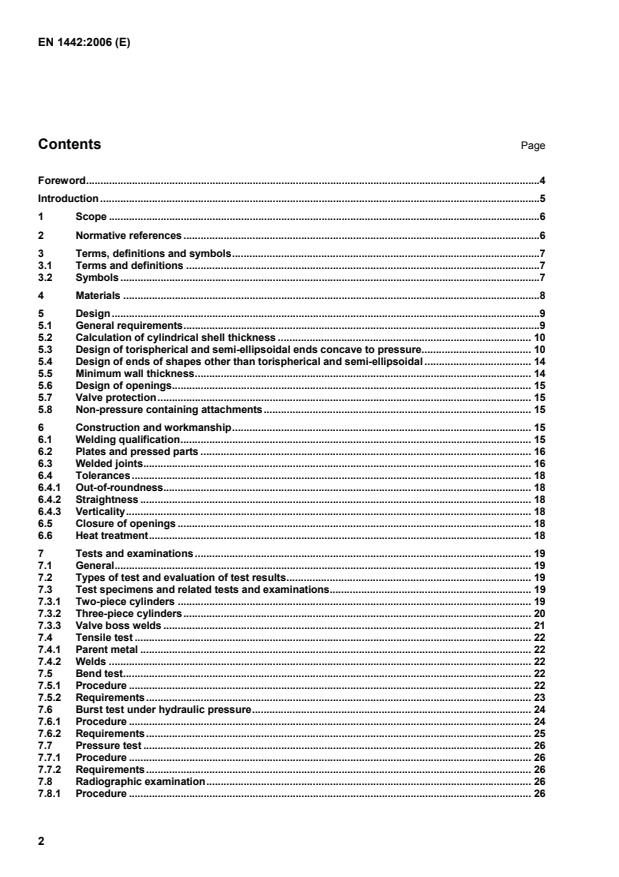
Manufacturer's marking.36 Bibliography.37
Therefore the standards listed in the normative references and covering basic requirements of the RID/ADR not addressed within the present standard are normative only when the standards themselves are referred to in the RID and/or in the technical annexes of the ADR. This European Standard has been extensively re-formatted to align with other more recent LPG cylinder standards. The main technical changes are a widening of the range of materials permitted, reference to the latest
ISO welding standards, the introduction of radioscopy as a permitted alternative to radiographic examination of welds, a reduction in the minimum required burst pressure from 50 bar to 35 bar and simplification of the marking requirements by reference to EN 14894. According to the CEN/CENELEC Internal Regulations, the national standards organizations of the following countries are bound to implement this European Standard: Austria, Belgium, Cyprus, Czech Republic, Denmark, Estonia, Finland, France, Germany, Greece, Hungary, Iceland, Ireland, Italy, Latvia, Lithuania, Luxembourg, Malta, Netherlands, Norway, Poland, Portugal, Romania, Slovakia, Slovenia, Spain, Sweden, Switzerland and United Kingdom.
(ISO 15614-1:2004) 3 Terms, definitions and symbols 3.1 Terms and definitions For the purposes of this document, the following terms and definitions apply. 3.1.1 yield strength upper yield strength ReH or 0,2 % proof strength (non-proportional elongation), Rp0,2, for steels that do not exhibit a defined yield 3.1.2 normalised condition resulting from heat treatment in which a finished cylinder is heated to a uniform temperature above the upper critical point (Ac3) of the steel and then cooled under controlled conditions 3.1.3 stress relieved condition resulting from heat treatment in which a finished cylinder is heated to a uniform temperature below the lower critical point (Ac1) of the steel and cooled in a still atmosphere, the object of which is to reduce the residual stresses without altering the metallurgical structure of the steel 3.1.4 weld-overrun zone area on a circumferential weld where the weld metal deposition has carried on beyond the start point 3.2 Symbols a calculated thickness of the cylindrical shell, in millimetres. A percentage elongation after fracture. b calculated thickness of the end of the cylinder, in millimetres. C shape factor for ends (see Table 2, Figure 2 and Figure 3). D outside diameter of the cylinder as given in the design drawing (see Figure 1), in millimetres. Dp outside diameter of a bend test mandrel (see Figure 8), in millimetres. e actual thickness of the material in the finished cylinder (at the point under consideration), in millimetres. h height of the cylindrical part of the end (see Figure 1), in millimetres. H outside height of the domed part of the end (see Figure 1), in millimetres.
Proof strength, non proportional extension in newtons per square millimetre, as defined in
EN 10002–1. 4 Materials 4.1 Materials for shells and end pressings shall be in accordance with EN 10120 or other equivalent material specification or standard meeting the requirements of Table 1.
Alternative material specifications shall, as a minimum, specify chemical composition, mechanical properties, heat treatment and delivery conditions. NOTE "Materials" refers to materials in the state before any specific transformation occurring during the manufacturing process. 4.2 All parts welded to the cylinder shall be made of material compatible with the cylinder material. 4.3 The welding consumables shall be such that they are capable of giving consistent welds. 4.4 The cylinder manufacturer shall obtain certificates showing the chemical analysis and details of the mechanical properties of the steel supplied for the construction of the pressure retaining parts.
The certificates/reports shall be in accordance with EN 10204:2004, Type 3.1 for shells and ends and Type 2.2 for the valve boss. 4.5 The manufacturer shall maintain a system of identification for the materials used in the fabrication in order that all materials for pressure parts in the completed cylinder can be traced to their origin.
0,22 max. 0,50 max. 0,30 min. to 1,60 max. 0,025 max. 0,020 max. 0,040 max. Use of micro-alloying elements such as niobium, titanium and vanadium shall be limited to the following contents: Niobium Titanium Vanadium Niobium plus vanadium
0,05 max. 0,05 max. 0,05 max. 0,08 max. Where other micro-alloying elements are used, their presence and amounts shall be reported, together with the above, in the steel manufacturer's certificate. Should check analyses be required, they shall be carried out either on specimens taken during manufacture from material in the form as supplied by the steel manufacturer to the cylinder manufacturer or from finished cylinders.
5 Design 5.1 General requirements 5.1.1 The calculation of the wall thickness of the pressure parts shall be based on the yield strength of the material. 5.1.2 For calculation purposes, the value of the yield strength Ro is limited to a maximum of 0,85 Rg. 5.1.3 The calculation pressure (Pc) shall be not less than the higher of: absolute developed pressure at 65 °C of the highest pressure LPG mixture to be filled minus 1 bar, or 10 bar.
Test pressures for tabulated mixtures of LPG are listed in table P200 of ADR. 5.1.4 A drawing, which includes full dimensions that define the cylinder type (see 8.2) and the specification of the material, shall be produced. 5.2 Calculation of cylindrical shell thickness The wall thickness, a, of the cylindrical shell shall be not less than: cocPJ)R( DPa+×××=15
For cylindrical shells with a longitudinal weld: J = 0,9 For cylindrical shells, including the cylindrical parts of ends, without a longitudinal weld: J = 1,0 5.3 Design of torispherical and semi-ellipsoidal ends concave to pressure 5.3.1 The shape of ends shall be such that the following conditions are fulfilled: for torispherical ends
R < D ; r > 0,1 D ; h > 4b (see Figure 1); for semi-ellipsoidal ends H > 0,2 D ; h > 4b (see Figure 1).
Key 1 torispherical end 2 semi-ellipsoidal end Figure 1 — Illustration of cylinder ends concave to pressure NOTE For torispherical ends the height H can be calculated using: )](D) [(]D)[()(b r
2b R2
b R
b R H+−++×−+−+=2 5.3.2 The wall thickness, a, of any cylindrical part shall be calculated in accordance with 5.2. This requirement is not applicable where the length of the cylindrical portion of the cylinder, measured between the beginning of the domed parts of the two ends, is not more thanbD2.
In this case the wall thickness shall be not less than that of the domed part. The thickness, b, of the domed part shall be not less than: cocP)R(C DPb+×××=15
In this equation, C is a shape factor, the value of which depends on the ratio H/D. The value of C shall be obtained from Figure 2 or Figure 3/Table 2.
Figure 2 — Values of shape factor C for H/D between 0,2 and 0,25
Figure 3 — Values of shape factor C for H/D between 0,25 and 0,5
5.4 Design of ends of shapes other than torispherical and semi-ellipsoidal Ends of shapes other than those covered by 5.3 may be used provided that the adequacy of their design is demonstrated by a fatigue test in accordance with 7.11 or by appropriate stress analysis.
For ends convex to pressure, the minimum end thickness shall be not less than 2 times that required by 5.2. 5.5 Minimum wall thickness The minimum wall thickness of the cylindrical shell and ends shall be not less than the greater of: the values of a and b determined in accordance with 5.2 and 5.3 or 5.4, as appropriate, or the following values, as appropriate: for D < 100 mm: 1,1 mm for 100 mm < D < 150 mm: [1,1 + 0,008 (D-100)] mm for D > 150 mm: [0,7250 +D] mm, but not less than 1,5 mm. These equations apply to cylindrical shells and ends irrespective of whether they are designed by calculation as specified in 5.2 and 5.3 or by testing as specified in 5.4.
The suitability of the design of the reinforcement or design changes within an approved type of cylinder shall be confirmed by design calculations or a fatigue test in accordance with 7.11. 5.6.3 The welds of the opening reinforcement shall be not less than bD2,5 mm from any circumferential joints. 5.6.4 Unless otherwise specified, valve boss threads shall conform to an established dimensional specification. NOTE Suitable thread specifications include ISO 10920 for 25E thread and EN ISO 11116-1 for the 17E thread. 5.7 Valve protection The design of a cylinder shall provide protection for valves against damage in order to avoid the release of the contents, unless the valve is protected by other means. When the valve protection is integral with the cylinder, this shall be demonstrated by drop testing in accordance with EN 962:1996, 6.7. NOTE When the cylinder is not provided with integral valve protection, the manufacturer should specify that cylinders containing LPG should be conveyed in crates or cradles or should be provided during transportation with some other effective valve protection.
Otherwise the cylinder should be fitted with valves that have demonstrated, by impact tests in accordance with EN 13152 or EN 13153, that the valve can withstand damage without leakage of the contents. 5.8 Non-pressure containing attachments 5.8.1 Attachments shall be designed so as to avoid trapping water and to permit external inspection of the attachment welds.
They shall be clear of longitudinal and circumferential joints. 5.8.2 Where a foot-ring is fitted, it shall be of adequate strength to provide stability and be attached so that it does not prevent inspection of any pressure containing welds.
Any foot-ring shall be suitably drained and the space enclosed by the foot-ring suitably ventilated e.g. by means of openings. 6 Construction and workmanship 6.1 Welding qualification 6.1.1 Welding associated with the pressure envelope including non pressure-containing parts shall: have a welding procedure specification for all joints in accordance with EN ISO 15609-1, qualified in accordance with EN ISO 15614-1 or EN ISO 15613; be done by welders qualified in accordance with EN 287–1 and welding personnel approved in accordance with EN 1418. The manufacturer shall maintain records of such procedures, qualifications and approvals. 6.1.2 Welding procedure approval tests shall be on welds that are representative of those made in prod
...