


FprEN 14570
(Main)LPG equipment and accessories - Equipping of overground and underground LPG vessels
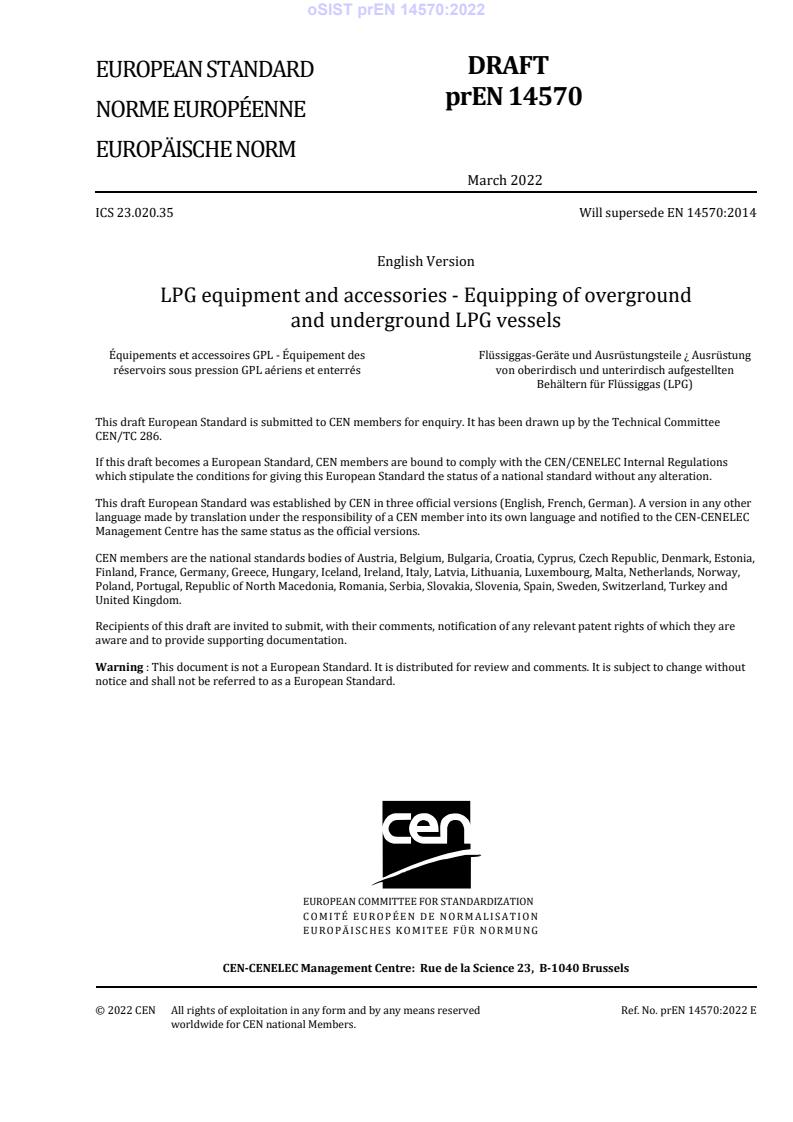
LPG equipment and accessories - Equipping of overground and underground LPG vessels
This European Standard specifies requirements for the equipping of LPG pressure vessels, overground and underground, with a volume not greater than 13 m3 manufactured in accordance with EN 12542 or equivalent and have been hydraulically tested.
The equipment covered by this European Standard is directly mounted onto the pressure vessel connections.
This European Standard excludes the equipping of depot storage vessels and refrigerated storage vessels.
Flüssiggas-Geräte und Ausrüstungsteile - Ausrüstung von oberirdisch und unterirdisch aufgestellten Behältern für Flüssiggas (LPG)
Équipements pour GPL et leurs accessoires - Équipement des réservoirs sous pression GPL aériens et enterrés
Oprema in pribor za utekočinjeni naftni plin (UNP) - Oprema za nadzemne in podzemne posode za UNP
General Information
Relations
Standards Content (Sample)
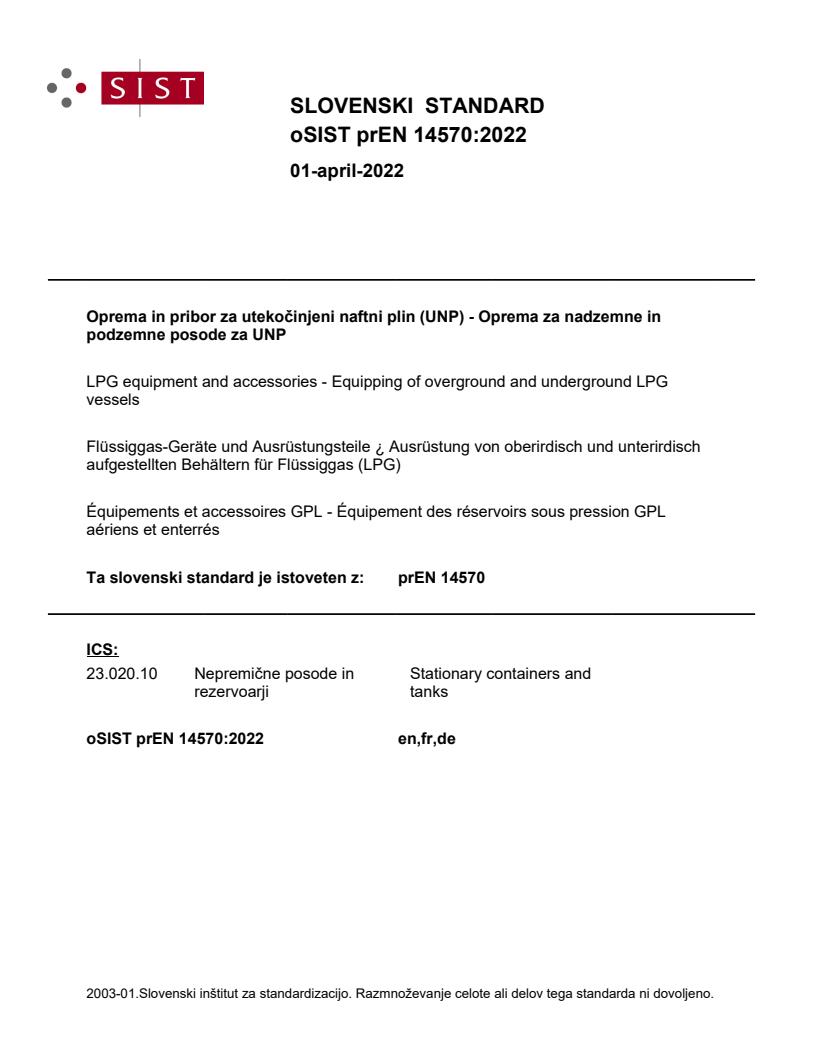
SLOVENSKI STANDARD
01-april-2022
Oprema in pribor za utekočinjeni naftni plin (UNP) - Oprema za nadzemne in
podzemne posode za UNP
LPG equipment and accessories - Equipping of overground and underground LPG
vessels
Flüssiggas-Geräte und Ausrüstungsteile ¿ Ausrüstung von oberirdisch und unterirdisch
aufgestellten Behältern für Flüssiggas (LPG)
Équipements et accessoires GPL - Équipement des réservoirs sous pression GPL
aériens et enterrés
Ta slovenski standard je istoveten z: prEN 14570
ICS:
23.020.10 Nepremične posode in Stationary containers and
rezervoarji tanks
2003-01.Slovenski inštitut za standardizacijo. Razmnoževanje celote ali delov tega standarda ni dovoljeno.
DRAFT
EUROPEAN STANDARD
prEN 14570
NORME EUROPÉENNE
EUROPÄISCHE NORM
March 2022
ICS 23.020.35 Will supersede EN 14570:2014
English Version
LPG equipment and accessories - Equipping of overground
and underground LPG vessels
Équipements et accessoires GPL - Équipement des Flüssiggas-Geräte und Ausrüstungsteile ¿ Ausrüstung
réservoirs sous pression GPL aériens et enterrés von oberirdisch und unterirdisch aufgestellten
Behältern für Flüssiggas (LPG)
This draft European Standard is submitted to CEN members for enquiry. It has been drawn up by the Technical Committee
CEN/TC 286.
If this draft becomes a European Standard, CEN members are bound to comply with the CEN/CENELEC Internal Regulations
which stipulate the conditions for giving this European Standard the status of a national standard without any alteration.
This draft European Standard was established by CEN in three official versions (English, French, German). A version in any other
language made by translation under the responsibility of a CEN member into its own language and notified to the CEN-CENELEC
Management Centre has the same status as the official versions.
CEN members are the national standards bodies of Austria, Belgium, Bulgaria, Croatia, Cyprus, Czech Republic, Denmark, Estonia,
Finland, France, Germany, Greece, Hungary, Iceland, Ireland, Italy, Latvia, Lithuania, Luxembourg, Malta, Netherlands, Norway,
Poland, Portugal, Republic of North Macedonia, Romania, Serbia, Slovakia, Slovenia, Spain, Sweden, Switzerland, Turkey and
United Kingdom.
Recipients of this draft are invited to submit, with their comments, notification of any relevant patent rights of which they are
aware and to provide supporting documentation.
Warning : This document is not a European Standard. It is distributed for review and comments. It is subject to change without
notice and shall not be referred to as a European Standard.
EUROPEAN COMMITTEE FOR STANDARDIZATION
COMITÉ EUROPÉEN DE NORMALISATION
EUROPÄISCHES KOMITEE FÜR NORMUNG
CEN-CENELEC Management Centre: Rue de la Science 23, B-1040 Brussels
© 2022 CEN All rights of exploitation in any form and by any means reserved Ref. No. prEN 14570:2022 E
worldwide for CEN national Members.
prEN 14570:2022 (E)
Contents Page
European foreword . 4
Introduction . 5
1 Scope . 6
2 Normative references . 6
3 Terms, definitions and abbreviations . 7
3.1 Terms and definitions . 7
3.2 Abbreviations . 9
4 Pressure vessel equipment . 9
4.1 General. 9
4.2 Selection of pressure vessel equipment . 10
4.3 Screwed joints . 10
4.4 Seals and gaskets . 10
5 Operational functions . 11
5.1 General. 11
5.2 Pressure relief . 12
5.2.1 General. 12
5.2.2 Isolating devices and manifolds . 12
5.2.3 Vent pipes . 12
5.3 Drainage . 13
5.4 Liquid removal system . 13
5.5 Maximum fill indication/control . 13
5.5.1 General. 13
5.5.2 Fixed liquid level gauge . 13
5.5.3 Overfill protection device . 14
5.6 Filling system. 14
5.7 Vapour off-take . 14
5.8 Vapour return . 14
5.9 Liquid off-take . 14
5.10 Liquid return . 14
5.11 Temperature indication . 14
5.12 Pressure indication . 14
5.13 Liquid level indication . 15
5.14 Road tanker potential bonding . 15
5.15 Earthing . 15
5.16 Cathodic protection . 15
6 Equipping . 15
6.1 General. 15
6.2 Screwed joints . 16
6.3 Flanged joints . 16
7 Checking and testing . 16
7.1 General. 16
7.2 Leak tightness . 16
7.3 Excess flow valve . 17
prEN 14570:2022 (E)
7.4 Completion and purging . 17
8 Storage, handling and transportation . 17
9 Documentation . 17
Annex A (informative) Examples of alternative means of over pressure protection for
underground/mounded pressure vessels . 18
Annex B (normative) Settings and discharge rates for PRVs and hydrostatic relief valves . 19
B.1 Setting . 19
B.2 Discharge rates . 19
B.2.1 General . 19
B.2.2 Above ground pressure vessels . 19
B.2.3 Underground/fully mounded pressure vessels . 20
B.2.4 Semi-mounded pressure vessels . 20
Annex ZA (informative) Relationship between this European Standard and the Essential
Requirements of EU Directive 2014/68/EU aimed to be covered . 21
Bibliography . 23
prEN 14570:2022 (E)
European foreword
This document (prEN 14570:2022) has been prepared by Technical Committee CEN/TC 286 “Liquefied
petroleum gas equipment and accessories”, the secretariat of which is held by NSAI.
This document is currently submitted to the CEN Enquiry.
This document will supersede EN 14570:2014.
In comparison with the previous edition, the following technical modifications have been made:
— Update to align with Directive 2014/68/EU;
— Update to 4.1, 4.2, 4.4;
— Introduction of 5.16 Cathodic protection; and
— Update to 7.2.
This document has been prepared under a Standardization Request given to CEN by the European
Commission and the European Free Trade Association, and supports essential requirements of EU
Directive(s) / Regulation(s).
For relationship with EU Directive(s) / Regulation(s), see informative Annex ZA, which is an integral part
of this document.
prEN 14570:2022 (E)
Introduction
This document calls for the use of substances and procedures that may be injurious to health and/or the
environment if adequate precautions are not taken. It refers only to technical suitability: it does not
absolve the user from their legal obligations at any stage.
It is recommended that manufacturers develop an environmental management policy. For guidance, see
the EN ISO 14000 series [1], [2] and [3].
Protection of the environment is a key political issue in Europe and elsewhere. For TC 286 this is covered
in CEN/TS 16765 [4] LPG equipment and accessories - Environmental considerations for CEN/TC 286
standards, and this Technical Specification should be read in conjunction with this standard. The
Technical Specification provides guidance on the environmental aspects to be considered regarding
equipment and accessories produced for the LPG industry and the following is addressed:
a) design;
b) manufacture;
c) packaging;
d) use and operation; and
e) disposal.
It has been assumed in the drafting of this document that the execution of its provisions is entrusted to
appropriately qualified and experienced people.
All pressures are gauge pressures unless otherwise stated.
prEN 14570:2022 (E)
1 Scope
This document specifies requirements for the equipping (fitting out) of LPG pressure vessels with fittings
and accessories.
It is applicable to overground and underground LPG pressure vessels, with a volume not greater than
13 m manufactured in accordance with EN 12542:2020 or equivalent and which have been hydraulically
tested.
The fittings and accessories covered by this document are directly mounted onto the pressure vessel
connections.
This document excludes the equipping of depot storage pressure vessels and refrigerated storage vessels.
It does not cover spare parts which have to be selected according to equipment design and manufacturing
standards.
2 Normative references
The following documents are referred to in the text in such a way that some or all of their content
constitutes requirements of this document. For dated references, only the edition cited applies. For
undated references, the latest edition of the referenced document (including any amendments) applies
EN 549:2019, Rubber materials for seals and diaphragms for gas appliances and gas equipment
EN 751-2:1996, Sealing materials for metallic threaded joints in contact with 1st, 2nd and 3rd family gases
and hot water — Part 2: Non-hardening jointing compounds
EN 751-3:1996, Sealing materials for metallic threaded joints in contact with 1st, 2nd and 3rd family gases
and hot water — Part 3: Unsintered PTFE tapes
EN 12068:1998, Cathodic protection - External organic coatings for the corrosion protection of burried or
immersed steel pipelines used in conjunction with cathodic protection - Tapes and shrinkable materials
EN 12542:2020, LPG equipment and accessories - Static welded steel cylindrical pressure vessels, serially
produced for the storage of Liquefied Petroleum Gas (LPG) having a volume not greater than 13 m - Design
and manufacture
EN 13175:2019+A1:2020, LPG equipment and accessories - Specification and testing for Liquefied
Petroleum Gas (LPG) tank valves and fittings
EN 13636:2004, Cathodic protection of buried metallic tanks and related piping
EN 13799:2012, LPG equipment and accessories - Contents gauges for Liquefied Petroleum Gas (LPG)
pressure vessels
EN 14071:2015+A1:2019, Pressure relief valves for LPG tanks - Ancillary equipment
EN 14129:2014, LPG Equipment and accessories - Pressure relief valves for LPG pressure vessels
EN ISO 10497:2010, Testing of valves - Fire type-testing requirements (ISO 10497:2010)
Safety devices for protection against excessive pressure - Part 7: Common data
ISO 4126-7:2013,
(ISO 4126-7:2013)
Document impacted by A1:2016
prEN 14570:2022 (E)
3 Terms, definitions and abbreviations
3.1 Terms and definitions
For the purposes of this document, the following terms and definitions apply.
ISO and IEC maintain terminological databases for use in standardization at the following addresses:
— ISO Online browsing platform: available at https://www.iso.org/obp
— IEC Electropedia: available at http://www.electropedia.org/
3.1.1
liquefied petroleum gas
LPG
low pressure liquefied gas composed of one or more light hydrocarbons which are assigned to UN 1011,
UN 1075, UN 1965, UN 1969 or UN 1978 only and which consists mainly of propane, propene, butane,
butane isomers, butene with traces of other hydrocarbon gases
3.1.2
pressure vessel
assembly of the pressure envelope (including the openings and their closures) and non-pressure-
retaining parts attached directly to it
3.1.3
underground pressure vessel
pressure vessel below the surrounding ground level and completely covered
3.1.4
overground pressure vessel
pressure vessel above the surrounding ground level and not covered
3.1.5
fixed liquid level gauge
control device, such as a dip tube in combination with a vent valve to indicate when a predetermined
liquid level has been reached or surpassed
3.1.6
depot storage vessel
pressure vessel at an installation where LPG is stored before being transferred into road/rail tankers
and/or LPG cylinders for distribution
3.1.7
remotely operated
operated from a point at least 3 m from the vessel
3.1.8
drainage
process of removal of residual vessel content
3.1.9
liquid removal
withdrawal of LPG from the vessel for a purpose different from the normal use of the LPG (e.g. removal
of LPG for decommissioning, maintenance or in case of an emergency)
prEN 14570:2022 (E)
3.1.10
vapour service
delivery of LPG in its vapour phase
Note 1 to entry: Vapour service is also referred to as vapour off-take.
3.1.11
liquid service
delivery of LPG in its liquid phase
Note 1 to entry: Liquid service is also referred to as liquid off-take.
3.1.12
connection
boss, flange, pad provided at an opening for the purpose of attaching equipment piping or pipe fittings
3.1.13
fail-safe shut-off valve
valve that automatically returns to its safe position in case of actuating power failure or fire engulfment
3.1.14
shut-off valve
valve to provide a leak-tight seal which is operated either manually, remotely or is self-closing
3.1.15
hydrostatic relief valve
self-closing valve which automatically, without the assistance of any energy other than that of the fluid
concerned, discharges fluid at a predetermined pressure
3.1.16
filler valve
valve system for liquid fill service
3.1.17
overfill protection device
OPD
device designed to automatically reduce the filling rate to a minimal flow when the fill level reaches a
predetermined amount
Note 1 to entry: In automotive applications, the predetermined amount is 80 % of the water capacity.
3.1.18
mounded vessel
pressure vessel above or partially underground of which the part above the ground is completely covered
3.1.19
semi-mounded vessel
pressure vessel above or partially underground of which the part above the ground is partially covered
prEN 14570:2022 (E)
3.1.20
pressure relief valve
PRV
self-closing valve which automatically, without the assistance of any energy other than that of the vapour
concerned, discharges vapour at a predetermined pressure, and operates with a pop action
Note 1 to entry: This is known as a “safety valve” in ADR.
3.1.21
non-return valve
valve designed to close automatically to restrict reverse flow
3.1.22
excess flow valve
valve designed to close automatically, with a small residual flow, when the fluid flow passing through it
exceeds a predetermined value, and to re-open when the pressure differential across the valve has been
restored below a certain value
3.1.23
occasional liquid withdrawal valve
normally blanked valve, used for occasional liquid withdrawal which is designed to be opened by the
engagement of a special connector valve
3.1.24
plug
component which seals a female connection
3.1.25
cap
component which seals a male connection
3.2 Abbreviations
PRV Pressure Relief Valve
PS Maximum allowable pressure
PED Pressure Equipment Directive (Directive 2014/68/EU [1])
PTFE Polytetrafluoroethylene
4 Pressure vessel equipment
4.1 General
Pressure vessel connections, that are not in use or piped up during normal operation, shall be plugged or
capped or blanked off (blind flange). A valve may be fitted between the connection and the plug, or cap
or blind flange.
Except for PRVs and level gauges, all operating valves shall be protected from unauthorised operations.
This can be achieved for example by enclosure within a lockable valve cover or a secure compound.
In the case of underground/mounded pressure vessels, when valves are below the ground/backfill level,
the valves shall be enclosed in for example a lockable access chamber or a secure compound.
prEN 14570:2022 (E)
4.2 Selection of pressure vessel equipment
The selection of pressure vessel equipment is related to the size of the pressure vessel and/or the
complexity of the operation, and shall match the operations and safety requirement.
Pressure vessel equipment shall be selected to meet the design conditions of the pressure vessel,
including its maximum allowable pressure (PS), and shall be in accordance with
EN 13175:2019+A1:2020, EN 13799:2012, EN 14071:2015+A1:2019 and EN 14129:2014, as
appropriate.
Normal service connections, where the passageway diameter into the pressure vessel is greater
than 1,5 mm and up to 3 mm for liquid and 8 mm for vapour, shall be equipped with either manual or
remotely operated fail-safe shut-off valve.
Normal service connections, where the passageway diameter into the pressure vessel is greater
than 3 mm for liquid and 8 mm for vapour, shall be equipped with at least one of the following:
a) a remotely operated fail-safe shut-off valve;
b) an excess flow valve plus manual shut-off valve;
c) a non-return valve plus manual shut-off valve.
Where two valves are fitted, they shall be located as close as practicable to each other.
These requirements shall not apply to:
1) pressure relief valves (PRV's);
2) filler connections which include a double non-return valve;
3) occasional liquid withdrawal valves which shall include an excess flow valve unless this is provided
by the special connector used to open the valve;
4) level gauges.
Where fitted, valve actuators shall be sized to operate the valve at the maximum allowable pressure (PS)
likely to be seen in service.
Remotely operated failsafe shut-off valves shall be fire safe in accordance with EN ISO 10497:2010 and
shall close in a controlled manner so as to avoid excessive pressure surge in the piping system, unless
provision is made to protect the pipe-work in such a situation.
4.3 Screwed joints
Screwed joints shall onl
...
Questions, Comments and Discussion
Ask us and Technical Secretary will try to provide an answer. You can facilitate discussion about the standard in here.