

EN 15051:2006
(Main)Workplace atmospheres - Measurement of the dustiness of bulk materials - Requirements and reference test methods
- Abstract
This document specifies the two reference test apparatuses and reference test methods for the reproducible production of dust from a bulk material under standard conditions, and the measurement of the inhalable, thoracic and respirable fractions of this dust, with reference to the existing CEN standards, where relevant (see Clause 6).
This document specifies the environmental conditions, the sample handling and analysis procedures and the method of calculating and presenting the results. A classification scheme for dustiness is specified, to provide a standardised way to express and communicate the results to users of the bulk materials.
In Annex D, a test method is described that enables dustiness information produced by test methods other than these two reference test methods to be related to that produced using these standard reference test methods.
This document is applicable to powdered, granular or pelletised materials. A standard sample volume is used.
This document is not applicable to test the dust released when solid materials are mechanically reduced (e.g. cut, crushed) or to test handling procedures for the materials.
- Status
- Withdrawn
- Publication Date
- 25-Apr-2006
- Withdrawal Date
- 26-Nov-2013
- Technical Committee
- CEN/TC 137 - Assessment of workplace exposure
- Drafting Committee
- CEN/TC 137/WG 3 - Particulate matter
- Current Stage
- 9960 - Withdrawal effective - Withdrawal
- Start Date
- 27-Nov-2013
- Completion Date
- 27-Nov-2013


Relations
- Effective Date
- 08-Jun-2022
- Effective Date
- 08-Jun-2022
- Effective Date
- 08-Jun-2022
- Effective Date
- 25-Aug-2026
- Effective Date
- 28-Jan-2026
- Effective Date
- 28-Jan-2026
- Effective Date
- 28-Jan-2026
- Effective Date
- 28-Jan-2026
- Effective Date
- 28-Jan-2026
- Effective Date
- 28-Jan-2026
- Effective Date
- 28-Jan-2026
- Effective Date
- 28-Jan-2026
- Effective Date
- 28-Jan-2026
- Referred By
EN 12952-15:2003 - Water-tube boilers and auxiliary installations - Part 15: Acceptance tests - Effective Date
- 28-Jan-2026
Get Certified
Connect with accredited certification bodies for this standard

CIS Institut d.o.o.
Personal Protective Equipment (PPE) certification body. Notified Body NB-2890 for EU Regulation 2016/425 PPE.

Kiwa BDA Testing
Building and construction product certification.
Kmetijski inštitut Slovenije
Agricultural Institute of Slovenia. Soil testing, plant health, agricultural product analysis.
Sponsored listings
Frequently Asked Questions
EN 15051:2006 is a standard published by the European Committee for Standardization (CEN). Its full title is "Workplace atmospheres - Measurement of the dustiness of bulk materials - Requirements and reference test methods". This standard covers: This document specifies the two reference test apparatuses and reference test methods for the reproducible production of dust from a bulk material under standard conditions, and the measurement of the inhalable, thoracic and respirable fractions of this dust, with reference to the existing CEN standards, where relevant (see Clause 6). This document specifies the environmental conditions, the sample handling and analysis procedures and the method of calculating and presenting the results. A classification scheme for dustiness is specified, to provide a standardised way to express and communicate the results to users of the bulk materials. In Annex D, a test method is described that enables dustiness information produced by test methods other than these two reference test methods to be related to that produced using these standard reference test methods. This document is applicable to powdered, granular or pelletised materials. A standard sample volume is used. This document is not applicable to test the dust released when solid materials are mechanically reduced (e.g. cut, crushed) or to test handling procedures for the materials.
This document specifies the two reference test apparatuses and reference test methods for the reproducible production of dust from a bulk material under standard conditions, and the measurement of the inhalable, thoracic and respirable fractions of this dust, with reference to the existing CEN standards, where relevant (see Clause 6). This document specifies the environmental conditions, the sample handling and analysis procedures and the method of calculating and presenting the results. A classification scheme for dustiness is specified, to provide a standardised way to express and communicate the results to users of the bulk materials. In Annex D, a test method is described that enables dustiness information produced by test methods other than these two reference test methods to be related to that produced using these standard reference test methods. This document is applicable to powdered, granular or pelletised materials. A standard sample volume is used. This document is not applicable to test the dust released when solid materials are mechanically reduced (e.g. cut, crushed) or to test handling procedures for the materials.
EN 15051:2006 is classified under the following ICS (International Classification for Standards) categories: 13.040.30 - Workplace atmospheres. The ICS classification helps identify the subject area and facilitates finding related standards.
EN 15051:2006 has the following relationships with other standards: It is inter standard links to EN 15051-1:2013, EN 15051-3:2013, EN 15051-2:2013, ISO 15767:2003, EN 13205-2:2014, EN ISO 13137:2022, EN 207:2009, CEN/TR 13205-3:2014, EN 13205-1:2014, EN 13205-5:2014, EN 13205-6:2014, EN 13205-4:2014, EN 12953-11:2003, EN 12952-15:2003. Understanding these relationships helps ensure you are using the most current and applicable version of the standard.
EN 15051:2006 is available in PDF format for immediate download after purchase. The document can be added to your cart and obtained through the secure checkout process. Digital delivery ensures instant access to the complete standard document.
Standards Content (Sample)
2003-01.Slovenski inštitut za standardizacijo. Razmnoževanje celote ali delov tega standarda ni dovoljeno.Workplace atmospheres - Measurement of the dustiness of bulk materials - Requirements and reference test methodsAtmosphere des lieux de travail - Mesure du pouvoir de resuspension des matériaux pulvérulents en vrac - Exigences et méthodes d'essai de référenceArbeitsplatzatmosphäre - Messung des Staubungsverhaltens von Schüttgütern - Anforderungen und Referenzprüfverfahren13.040.30Kakovost zraka na delovnem mestuWorkplace atmospheresICS:SIST EN 15051:2006en,fr,deTa slovenski standard je istoveten z:EN 15051:200601-julij-2006SIST EN 15051:2006SLOVENSKI
STANDARD
EUROPEAN STANDARDNORME EUROPÉENNEEUROPÄISCHE NORMEN 15051April 2006ICS 13.040.30 English VersionWorkplace atmospheres - Measurement of the dustiness of bulkmaterials - Requirements and reference test methodsAtmosphère des lieux de travail - Mesure du pouvoir deresuspension des matériaux pulvérulents en vrac -Exigences et méthodes d'essai de référenceArbeitsplatzatmosphäre - Messung desStaubungsverhaltens von Schüttgütern - Anforderungenund ReferenzprüfverfahrenThis European Standard was approved by CEN on 16 March 2006.CEN members are bound to comply with the CEN/CENELEC Internal Regulations which stipulate the conditions for giving this EuropeanStandard the status of a national standard without any alteration. Up-to-date lists and bibliographical references concerning such nationalstandards may be obtained on application to the Central Secretariat or to any CEN member.This European Standard exists in three official versions (English, French, German). A version in any other language made by translationunder the responsibility of a CEN member into its own language and notified to the Central Secretariat has the same status as the officialversions.CEN members are the national standards bodies of Austria, Belgium, Cyprus, Czech Republic, Denmark, Estonia, Finland, France,Germany, Greece, Hungary, Iceland, Ireland, Italy, Latvia, Lithuania, Luxembourg, Malta, Netherlands, Norway, Poland, Portugal, Romania,Slovakia, Slovenia, Spain, Sweden, Switzerland and United Kingdom.EUROPEAN COMMITTEE FOR STANDARDIZATIONCOMITÉ EUROPÉEN DE NORMALISATIONEUROPÄISCHES KOMITEE FÜR NORMUNGManagement Centre: rue de Stassart, 36
B-1050 Brussels© 2006 CENAll rights of exploitation in any form and by any means reservedworldwide for CEN national Members.Ref. No. EN 15051:2006: E
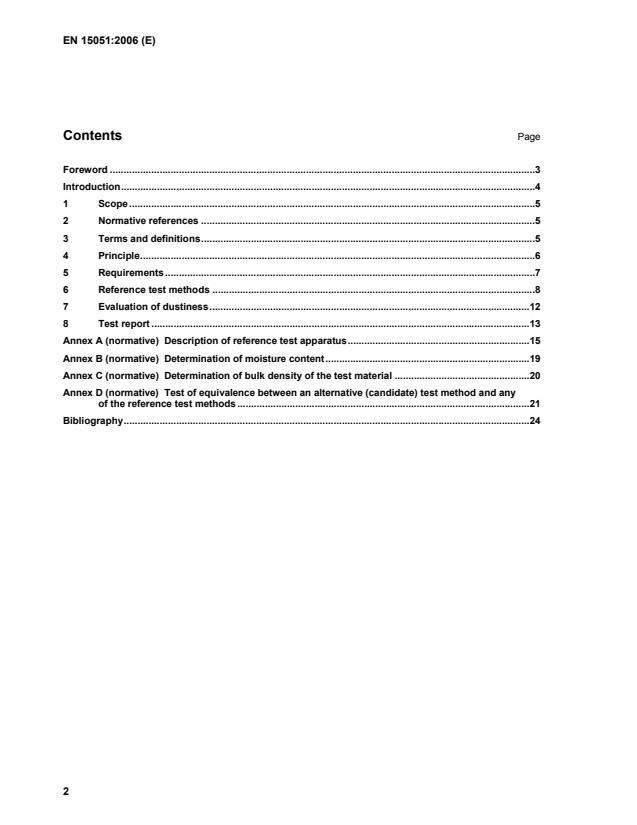
Description of reference test apparatus.15 Annex B (normative)
Determination of moisture content.19 Annex C (normative)
Determination of bulk density of the test material.20 Annex D (normative)
Test of equivalence between an alternative (candidate) test method and any of the reference test methods.21 Bibliography.24
b) control can involve the use of costly ventilation and filtration systems;
c) can be costly in terms of lost product;
d) can contaminate machinery and products.
It is advantageous, therefore, for occupational hygienists and process engineers to have accurate information about the propensity of materials to produce airborne dust (the ‘dustiness’ of the material) so that risks can be evaluated, controlled and minimised. No single method of dustiness testing is likely to represent and reproduce the various types of processing and handling used in industry. Therefore a number of dustiness testing methods are in use in different industries. Different methods use different test apparatus and measuring principles, and express results in different ways. Methods that do not separate the dust cloud produced into the three health-related size fractions - inhalable, thoracic and respirable dust - can serve the needs of manufacturing industry for process and batch control, but give limited information on the health hazard due to the dustiness of the material. Dustiness is a relative term and the measurement obtained will depend on the test apparatus used, the properties of the dust and various environmental variables. The test and the variables therefore need to be closely specified to ensure reproducibility. Recognising the above it was concluded that there was a need for standardised reference methods to measure the dustiness of bulk materials, based on the biologically relevant aerosol fractions defined in EN 481. This document establishes reference test methods that classify the dustiness, in terms of health-related fractions, of bulk solid materials. The dustiness classification is intended to provide users (e.g. manufacturers, producers, occupational hygienists and workers) with information on the potential for dust emissions when the material is handled or processed in workplaces. It provides the manufacturers of materials with information that can help to improve their products. It allows the users of the materials to assess the effects of pre-treatments, and also to select less dusty products, if available. Although this document does not discuss the analysis of dust released from bulk materials (except in terms of health-related fractions), the test method produces samples with the potential for chemical analysis of the contents. This document also provides reference test methods to which users of alternative test methods on dustiness can compare their own measurements. A standardised test of equivalence is used to test whether the alternative test method is capable of reproducing the dustiness classifications of the reference test methods, for a range of standardised test dusts. If the requirements for equivalence are satisfied the alternative test method can be used to classify the dustiness of bulk materials. This document was developed based on the results of the European project SMT4-CT96-2074 Development of a Method for Dustiness Testing (see [1]). This project investigated the dustiness of 12 materials, with the intention to test as wide a range of materials as possible, i.e. magnitude of dustiness, industrial sectors, chemical composition and particle size distribution.
This document is not applicable to test the dust released when solid materials are mechanically reduced (e.g. cut, crushed) or to test handling procedures for the materials. 2 Normative references The following referenced documents are indispensable for the application of this document. For dated references, only the edition cited applies. For undated references, the latest edition of the referenced document (including any amendments) applies. EN 1232, Workplace atmospheres - Pumps for personal sampling of chemical agents - Requirements and test methods EN 13205, Workplace atmospheres – Assessment of performance of instruments for measurement of airborne particle concentrations ISO 15767, Workplace atmospheres – Controlling and characterizing errors in weighing collected aerosols 3 Terms and definitions For the purposes of this document, the following terms and definitions apply. 3.1 airborne dust finely divided matter in solid form, dispersed in air 3.2 health-related fractions inhalable, thoracic and respirable fractions of airborne dust NOTE For definitions of the inhalable, thoracic and respirable fractions, see EN 481. 3.3 collected sample airborne particles collected on the sampling media (e.g. filter, foam or impaction plate) for subsequent analysis NOTE Sample deposits in other parts of the sampler such as inner walls are only included in the collected sample where the method description includes specific instructions for the recovery of such deposits.
dustiness classification of the inhalable fraction NOTE Classification assigned according to the scheme described in Clause 7. 3.6 thoracic dustiness dustiness classification of the thoracic fraction NOTE Classification assigned according to the scheme described in Clause 7. 3.7 respirable dustiness dustiness classification of the respirable fraction NOTE Classification assigned according to the scheme described in Clause 7. 3.8 inhalable dustiness mass fraction wI,A , wI,B ratio of the inhalable dust produced by the dustiness test procedure, in milligrams, to the test mass of material used for the test, in kilograms NOTE For reference test method A the value of the test mass equals the initial mass, and for reference test method B the value of the test mass equals the mass collected in the collector tank. 3.9 thoracic dustiness mass fraction wT,A ratio of the thoracic dust produced by the dustiness test procedure, in milligrams, to the initial mass of material used for the test, in kilograms 3.10 respirable dustiness mass fraction wR,A , wR,B ratio of the respirable dust produced by the dustiness test procedure, in milligrams, to the test mass of material used for the test, in kilograms NOTE For reference test method A the value of the test mass equals the initial mass, and for reference test method B the value of the test mass equals the mass collected in the collector tank. 4 Principle A dustiness tester consists of the following elements: dust generation section; dust transfer section; sampling section;
Test conditions: relative humidity (RH): (50 ± 10) %; temperature: (21 ± 3) °C; The test apparatus should be electrically grounded. NOTE In many cases, a separate determination of the particle size can be valuable. 5.3 Moisture content The moisture content of the bulk material shall be determined and documented according to the procedure given in Annex B. 5.4 Bulk density The bulk density of the test material shall be determined and documented according to the procedure given in Annex C. 5.5 Test procedure The dustiness shall be tested according to one of the reference test methods described in Clause 6 and Annex A. The choice of reference test method shall be justified in the test report, see Clause 6. Providing the requirements for equivalence are satisfied, the dustiness may be tested using an alternative test method (see Annex D).
The test apparatus shall only be cleaned as described in this clause before the first test run. Between the test runs, after the inlet and outlet stages have been removed, the apparatus shall be cleaned by pouring out the remaining material into a waste receptacle. Then, with the drum vertical, the side of the drum is tapped with a soft hammer to remove the loose material from the internal surfaces of the drum.
6.2.5 Weighing the foams and filters The mass of the collected sample is determined by weighing the foams and filters before and after the test. All weighing shall be done in accordance with ISO 15767. After the test, the foams and filter are reweighed in the same sequence. As the test materials and filters are sensitive to moisture and electrostatic conditions in the atmosphere, it is essential that a protocol be followed as to when the mass indicated by the balance should be recorded. The reading of the balance should be taken at a set period (e.g. 30 s) after the specimen is placed on the balance pan and the balance door closed, or when the reading of the balance is stabilised. In order to minimise the risk of disturbance and loss of material foams and filters should be handled or lifted only at their edges and kept to a minimum. Gloves should be worn or tweezers used to lift or handle the foams, and only tweezers used when handling the filters. The masses m of dust collected in the size selecting stages n are calculated by equation (1): )()(Ci,Cf,Si,Sf,nnnnnmmmmm−−−=∆ (1) where ∆mn
is the mass of dust collected by the n th stage, in milligrams; mf,Sn is the final mass of the n th test stage substrate, in milligrams; mi,Sn is the initial mass of the n th test stage substrate, in milligrams; mf,Cn is the final mass of the n th control stage substrate, in milligrams; mi,Cn is the initial mass of the n th control stage substrate, in milligrams. The n th test stage substrate corresponds to either the 800 pores per meter (20 ppi) foam, the 3 200 pores per meter (80 ppi) foam or the backing filter in the foam/filter assembly. The use of the control stage substrates enables the correction of any mass change in the foams and filters due to changing environmental conditions between the two weighings. 6.2.6 Determination of the inhalable, thoracic and respirable dustiness mass fractions The dustiness mass fraction of each health-related fraction, given in milligrams per kilogram (mg kg-1), is calculated by dividing the mass collected from each health-related fraction, in milligrams, by the mass, in kilograms, of the material placed in the test apparatus. The dustiness mass fractions shall be calculated using equations (2) to (4):
is the inhalable dustiness mass fraction, in milligrams per kilogram; wT,A
is the thoracic dustiness mass fraction, in milligrams per kilogram; wR,A
is the respirable dustiness mass fraction, in milligrams per kilogram; ms
is the mass of the test sample; ∆m20 is the mass collected by the 800 pores per meter (20 ppi) foam; ∆m80 is the mass collected by the 3 200 pores per meter (80 ppi) foam; ∆mf
is the mass collected by the backing filter. For each dustiness mass fraction, calculate the average and the standard deviation. The average is used for the classification in Clause 7. 6.3 Method B: Continuous drop method 6.3.1 General The continuous drop method involves the continuous single dropping of material in a slow vertical air current. The dust released from dropping material is conducted by the airflow to a sampling section where it is separated aerodynamically into the inhalable and respirable fractions. The standard reference test apparatus is described in A.2. 6.3.2 Preparation of test sample The amount of sample material required is obtained from the drop mass flow (6 g min-1 to 10 g min-1), the measuring duration (standard 10 min), the intended number of tests (i.e. 5) and allowance for adequate filling of the metering device. Normally at least 500 g of sample material is required. Test samples should be extracted from the bulk material using a method, which will result in representative sampling (see e.g. DIN 51701-3 or BS 3406-1). 6.3.3 Preparation of test apparatus Before carrying out the measurements on the sample, the backflow pipe, the collector tank, the sampling heads and also the main flow pump protective filter shall be carefully cleaned. Before performing the actual test runs the drop mass flow shall be adjusted to the desired rate. This preliminary activity (see A.2) is considered as a conditioning step for the test apparatus.
...