

EN 15316-4-3:2007
(Main)Heating systems in buildings - Method for calculation of system energy requirements and system efficiencies - Part 4-3: Heat generation systems, thermal solar systems
- Abstract
This European Standard is part of a series of standards on the method for calculation of system energy requirements and system efficiencies. The framework for the calculation is described in prEN 15603.
The scope of this specific part is to standardise the:
- required inputs,
- calculation method,
- required outputs,
for thermal solar systems (including control) for space heating, domestic hot water production and the combination of both.
The following typical thermal solar systems are considered:
- domestic hot water systems characterized by EN 12976 (factory made) or ENV 12977 (custom built);
- combisystems (for domestic hot water and space heating) characterized by ENV 12977 or the Direct Characterisation method developed in Task 26 ‘Solar Combisystems’ of the IEA Solar Heating and Cooling programme;
space heating systems characterized by ENV 12977.
- Status
- Withdrawn
- Publication Date
- 24-Jul-2007
- Withdrawal Date
- 29-Sep-2026
- Technical Committee
- CEN/TC 228 - Heating systems in buildings
- Current Stage
- 9960 - Withdrawal effective - Withdrawal
- Start Date
- 03-May-2017
- Completion Date
- 30-Sep-2026

Relations
- Effective Date
- 10-May-2017
- Effective Date
- 28-Jan-2026
- Refers
EN 12976-2:2019 - Thermal solar systems and components - Factory made systems - Part 2: Test methods - Effective Date
- 28-Jan-2026
Get Certified
Connect with accredited certification bodies for this standard

DIBt (Deutsches Institut für Bautechnik)
German Institute for Building Technology.
DIN CERTCO
DIN Group product certification.

Aboma Certification B.V.
Specialized in construction, metal, and transport sectors.
Sponsored listings
Frequently Asked Questions
EN 15316-4-3:2007 is a standard published by the European Committee for Standardization (CEN). Its full title is "Heating systems in buildings - Method for calculation of system energy requirements and system efficiencies - Part 4-3: Heat generation systems, thermal solar systems". This standard covers: This European Standard is part of a series of standards on the method for calculation of system energy requirements and system efficiencies. The framework for the calculation is described in prEN 15603. The scope of this specific part is to standardise the: - required inputs, - calculation method, - required outputs, for thermal solar systems (including control) for space heating, domestic hot water production and the combination of both. The following typical thermal solar systems are considered: - domestic hot water systems characterized by EN 12976 (factory made) or ENV 12977 (custom built); - combisystems (for domestic hot water and space heating) characterized by ENV 12977 or the Direct Characterisation method developed in Task 26 ‘Solar Combisystems’ of the IEA Solar Heating and Cooling programme; space heating systems characterized by ENV 12977.
This European Standard is part of a series of standards on the method for calculation of system energy requirements and system efficiencies. The framework for the calculation is described in prEN 15603. The scope of this specific part is to standardise the: - required inputs, - calculation method, - required outputs, for thermal solar systems (including control) for space heating, domestic hot water production and the combination of both. The following typical thermal solar systems are considered: - domestic hot water systems characterized by EN 12976 (factory made) or ENV 12977 (custom built); - combisystems (for domestic hot water and space heating) characterized by ENV 12977 or the Direct Characterisation method developed in Task 26 ‘Solar Combisystems’ of the IEA Solar Heating and Cooling programme; space heating systems characterized by ENV 12977.
EN 15316-4-3:2007 is classified under the following ICS (International Classification for Standards) categories: 91.140.10 - Central heating systems. The ICS classification helps identify the subject area and facilitates finding related standards.
EN 15316-4-3:2007 has the following relationships with other standards: It is inter standard links to EN 15316-4-3:2017, EN ISO 7345:1995, EN 12976-2:2019. Understanding these relationships helps ensure you are using the most current and applicable version of the standard.
EN 15316-4-3:2007 is associated with the following European legislation: Standardization Mandates: M/343. When a standard is cited in the Official Journal of the European Union, products manufactured in conformity with it benefit from a presumption of conformity with the essential requirements of the corresponding EU directive or regulation.
EN 15316-4-3:2007 is available in PDF format for immediate download after purchase. The document can be added to your cart and obtained through the secure checkout process. Digital delivery ensures instant access to the complete standard document.
Standards Content (Sample)
2003-01.Slovenski inštitut za standardizacijo. Razmnoževanje celote ali delov tega standarda ni dovoljeno.Heating systems in buildings - Method for calculation of system energy requirements and system efficiencies - Part 4-3: Heat generation systems, thermal solar systemsSystemes de chauffage dans les bâtiments - Méthode de calcul des besoins énergétiques et d'efficacité des systemes - Partie 2-2-3 : Systemes de génération de chauffage des locaux - Systemes solaires thermiquesHeizsysteme in Gebäuden - Verfahren zur Berechnung der Energieanforderungen und Nutzungsgrade der Anlagen - Teil 4-3: Wärmeerzeugungssysteme, thermische SolaranlagenTa slovenski standard je istoveten z:EN 15316-4-3:2007SIST EN 15316-4-3:2007en91.140.10Sistemi centralnega ogrevanjaCentral heating systemsICS:SLOVENSKI
STANDARDSIST EN 15316-4-3:200701-november-2007
EUROPEAN STANDARDNORME EUROPÉENNEEUROPÄISCHE NORMEN 15316-4-3July 2007ICS 91.140.10 English VersionHeating systems in buildings - Method for calculation of systemenergy requirements and system efficiencies - Part 4-3: Heatgeneration systems, thermal solar systemsSystèmes de chauffage dans les bâtiments - Méthode decalcul des besoins énergétiques et des rendements dessystèmes - Partie 4-3 : Systèmes de génération de chaleur,systèmes solaires thermiquesHeizsysteme in Gebäuden - Verfahren zur Berechnung derEnergieanforderungen und Wirkungsgrade von Systemen -Teil 4-3: Wärmeerzeugungssysteme ThermischeSolaranlagenThis European Standard was approved by CEN on 30 June 2007.CEN members are bound to comply with the CEN/CENELEC Internal Regulations which stipulate the conditions for giving this EuropeanStandard the status of a national standard without any alteration. Up-to-date lists and bibliographical references concerning such nationalstandards may be obtained on application to the CEN Management Centre or to any CEN member.This European Standard exists in three official versions (English, French, German). A version in any other language made by translationunder the responsibility of a CEN member into its own language and notified to the CEN Management Centre has the same status as theofficial versions.CEN members are the national standards bodies of Austria, Belgium, Bulgaria, Cyprus, Czech Republic, Denmark, Estonia, Finland,France, Germany, Greece, Hungary, Iceland, Ireland, Italy, Latvia, Lithuania, Luxembourg, Malta, Netherlands, Norway, Poland, Portugal,Romania, Slovakia, Slovenia, Spain, Sweden, Switzerland and United Kingdom.EUROPEAN COMMITTEE FOR STANDARDIZATIONCOMITÉ EUROPÉEN DE NORMALISATIONEUROPÄISCHES KOMITEE FÜR NORMUNGManagement Centre: rue de Stassart, 36
B-1050 Brussels© 2007 CENAll rights of exploitation in any form and by any means reservedworldwide for CEN national Members.Ref. No. EN 15316-4-3:2007: E
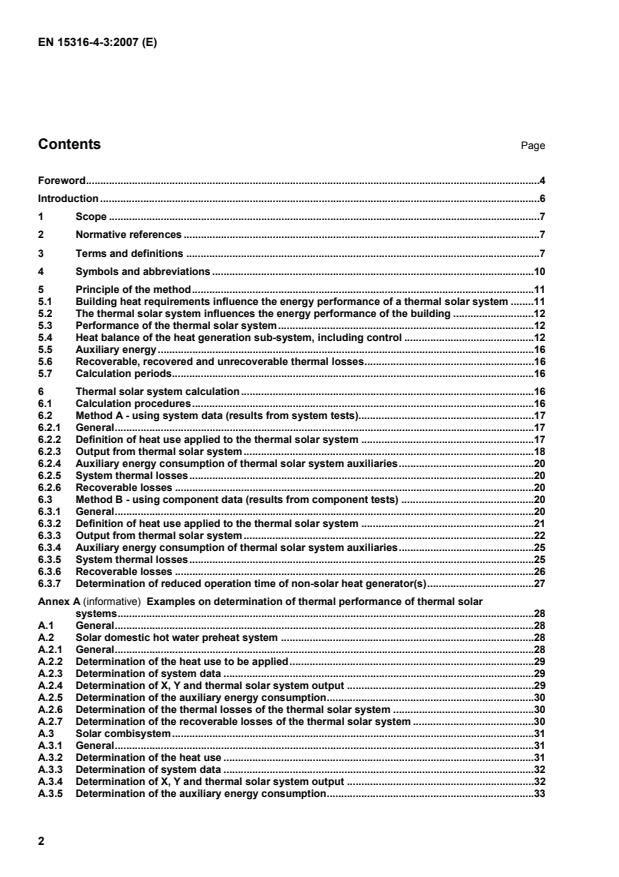
Examples on determination of thermal performance of thermal solar systems.28 A.1 General.28 A.2 Solar domestic hot water preheat system.28 A.2.1 General.28 A.2.2 Determination of the heat use to be applied.29 A.2.3 Determination of system data.29 A.2.4 Determination of X, Y and thermal solar system output.29 A.2.5 Determination of the auxiliary energy consumption.30 A.2.6 Determination of the thermal losses of the thermal solar system.30 A.2.7 Determination of the recoverable losses of the thermal solar system.30 A.3 Solar combisystem.31 A.3.1 General.31 A.3.2 Determination of the heat use.31 A.3.3 Determination of system data.32 A.3.4 Determination of X, Y and thermal solar system output.32 A.3.5 Determination of the auxiliary energy consumption.33
Informative values for use in the calculation methods.36 B.1 System type coefficients.36 B.2 Thermal solar system default values.36 B.2.1 General.36 B.2.2 Typical values.37 B.2.3 Penalty values.38 B.3 Storage tank capacity correction coefficient fst.38 B.4 Reference temperature θθθθref.39 B.5 Solar irradiance on the collector plane and incidence angle modifier.40 B.6 Thermal losses of the solar storage tank.41 B.7 Thermal losses of the distribution between the thermal solar system and the back-up heater.41 B.8 Recoverable part of system losses.41 Annex C (informative)
Product classification.42 C.1 Solar collectors.42 C.2 Solar hot water heaters.42 C.3 Storage tanks.42 Annex D (informative)
Savings calculation.44 Bibliography.45
2 Normative references The following referenced documents are indispensable for the application of this document. For dated references, only the edition cited applies. For undated references, the latest edition of the referenced document (including any amendments) applies. EN 12976-2, Thermal solar systems and components — Factory made systems — Part 2: Test methods EN ISO 7345:1995, Thermal insulation — Physical quantities and definitions (ISO 7345:1987) 3 Terms and definitions For the purposes of this document, the terms and definitions given in EN ISO 7345:1995 and the following apply. 3.1 aperture area solar collector maximum projected area through which un-concentrated solar radiation enters the collector 3.2 auxiliary energy electrical energy used by technical building systems for heating, cooling, ventilation and/or domestic hot water to support energy transformation to satisfy energy needs NOTE 1 This includes energy for fans, pumps, electronics etc. Electrical energy input to the ventilation system for air transport and heat recovery is not considered as auxiliary energy, but as energy use for ventilation.
Table 1 — Symbols and units
A collector aperture area m² AC* effective collector loop area m² a1 heat loss coefficient of solar collector W/(m²·K) a2 temperature dependence of the heat loss coefficient W/(m²·K2) a, b, c,d,e,f correlation factors - CS heat capacity of the storage tank MJ/K E solar irradiation in a tilted plane kWh/m² faux fraction of the storage tank volume used for back-up heating - fsol solar fraction % fst storage tank capacity correction factor - I solar irradiance on the collector plane W/m² IAM collector incidence angle modifier - P power W Q quantity of heat kWh S
savings
t time, period of time hours U heat loss coefficient W/(m²·K) UC* effective collector heat loss coefficient
(related to effective collector aperture area) W/(m²·K) V volume litres W auxiliary (electrical) energy kWh x, y dimensionless factors - ∆Τ reference temperature difference K θa average ambient air temperature over the considered period °C θcw mains water temperature °C θe outside air temperature over the considered period °C η efficiency factor -
5 Principle of the method 5.1 Building heat requirements influence the energy performance of a thermal solar system The performance of a thermal solar system depends on the thermal use applied to the system. The thermal use applied to the thermal solar system is the heat requirements of the building, including the energy needs, the thermal losses from the emission systems (emitters) and the thermal losses from the distribution systems (pumps and pipes). In general, the higher the total thermal use applied to the thermal solar system is, the higher is the output of the thermal solar system. Therefore, before starting determination of the system output, it is necessary to know the energy use applied to the thermal solar system: Energy use applied for the space heating system: required space heating needs (see EN ISO 13790); thermal losses from space heating emission (see EN 15316-2-1); thermal losses from space heating distribution (see EN 15316-2-3). Energy use applied for the domestic hot water system: required energy for domestic hot water needs, including emission losses (see prEN 15316-3-1); thermal losses from domestic hot water distribution (see prEN 15316-3-2).
Key T thermal solar system Esol,in incident solar energy on the plane of the collector array QW,sol,out heat delivered by the thermal solar system to domestic hot water distribution system QH,sol,out heat delivered by the thermal solar system to space heating distribution system QHW,sol,out total heat delivered by the thermal solar system to space heating and domestic hot water distribution system Wsol,aux auxiliary electrical energy for pumps and controllers QH,sol,aux,rbl recoverable auxiliary electrical energy for pumps and controllers. Part of the auxiliary electrical energy, which is recoverable for space heating Qsol,aux,rvd internally recovered auxiliary electrical energy for pumps and controllers. Part of the auxiliary electrical energy, which is transferred as useful heat to the thermal solar system Qsol,aux,nrbl non recoverable auxiliary electrical energy for pumps and controllers. Part of the auxiliary electrical energy, which is neither recoverable for space heating nor transferred as useful heat to the thermal solar system Qsol,th,ls total thermal losses from the thermal solar system QH,sol,th,ls,rbl thermal losses from the thermal solar system, which are recoverable for space heating Qsol,th,ls,nrbl non recoverable thermal losses from the thermal solar system. Part of the total thermal losses, which are not recoverable for space heating Figure 1 — Heat balance for a solar preheat system / solar-only system NOTE In case of a solar preheat system, the heat use for the external heat generator is reduced by QHW,sol,out
Key T thermal solar system Esol,in incident solar energy on the plane of the collector array QW,sol,out heat delivered by the thermal solar system to domestic hot water distribution system QH,sol,out heat delivered by the thermal solar system to space heating distribution system QHW,sol,out total heat delivered by the thermal solar system to space heating and domestic hot water distribution system Qbu,sol,int internal back-up heat input required Wsol,aux auxiliary electrical energy for pumps and controllers QH,sol,aux,rbl recoverable auxiliary electrical energy for pumps and controllers. Part of the auxiliary electrical energy, which is recoverable for space heating Qsol,aux,rvd internally recovered auxiliary electrical energy for pumps and controllers. Part of the auxiliary electrical energy which is transferred as useful heat to the thermal solar system Qsol,aux,nrbl non recoverable auxiliary electrical energy for pumps and controllers. Part of the auxiliary electrical energy, which is neither recoverable for space heating nor transferred as useful heat to the thermal solar system Qsol,th,ls total thermal losses from the thermal solar system QH,sol,th,ls,rbl thermal losses from the thermal solar system, which are recoverable for space heating Qsol,th,ls,nrbl non recoverable thermal losses from the thermal solar system. Part of the total thermal losses, which are not recoverable for space heating Figure 2 — Heat balance for a solar-plus-supplementary system
EN ISO 9488. 5.6 Recoverable, recovered and unrecoverable thermal losses The calculated thermal losses are not necessarily lost. Parts of the losses are recoverable, and parts of these recoverable losses are actually recovered. Recoverable thermal losses QH,sol,th,ls,rbl are e.g. the thermal losses from the distribution between the thermal solar sub-system and the back-up heater. 5.7 Calculation periods The objective of the calculation is to determine the annual heat output of the thermal solar sub-system. This may be done in one of the following two different ways: by using annual data for the system operation period and performing the calculations using annual average values; by dividing the year into a number of calculation periods (e.g. months, operation periods as defined in
EN ISO 13790), performing the calculations for each period using period-dependent values and sum up the results for all the periods over the year. 6 Thermal solar system calculation 6.1 Calculation procedures In the following, two methods are given for determination of solar output, auxiliary energy consumption and recoverable losses from the thermal solar system and other output data related to the system and required for performing the energy performance calculation of a building with a thermal solar system. The two methods enable the use of different type of input data: method A (see 6.2) uses system data, i.e. input data from system tests or default system input values given in the format of EN 12976-2 (performance indicators) – also system simulations (simulated tests) can be used; method B (see 6.3) uses component data, i.e. input data from component tests (or default component input values). With method A, specific system parameters/characteristics (i.e. control strategies) can be better taken into account. Method B uses only test results (or default values) for components. NOTE Method A can also be used for solar combisystems with collector areas smaller than 6 m2. Limiting condition for testing these systems according to EN 12976-2 is that it is possible to test the domestic hot water function apart from
thermal losses of the thermal solar system (losses from solar storage tank and solar collector loop) shall not be added to the heat use applied.
EN 12976-2 shall be available for the system and the actual operation conditions. Performance indicators for the actual climate and for a heat use higher than or equal to the actual heat use as well as for a heat use lower than or equal to the actual heat use shall be available. 6.2.3.2 Solar-only and solar preheat systems - determination of monthly solar output The annual output Qsol,out,an of a solar-only system or a solar preheat system is calculated by:
Qsol,out,an = fsol · Qsol,us,an [kWh]
(1) where fsol
is the solar fraction determined by interpolation to match the actual annual heat use applied (see below); Qsol,us,an
is the actual annual heat use applied to the solar system in kWh determined according to 6.2.2. Determination of fsol for the actual heat use applied: Qsol,us,an given in kWh is converted to MJ to comply with the performance indicator Qd calculated according to EN 12976-2: Qd = Qsol,us,an · 3,6 where fsol is determined by interpolation from test reports:
fsol = fsol,i-1 + (fsol,i+1 - fsol,i-1) · (Qd - Qd,i-1) / (Qd,i+1 - Qd,i-1) [%] (2) The indices i-1 and i+1 correspond to the nearest set of values below and above the actual value of Qd (standard interpolation procedure). Determination of monthly output: The monthly outputs Qsol,out,m of the thermal solar system are assumed to be proportional to the monthly irradiance and are determined by:
Qsol,out,m = Qsol,out,an · (Im · tm) / (Ian · tan) [kWh] (3) where Im
is the average solar irradiance on the collector plane
[W/m2] during the considered period. The values are defined in B.5; tm
is the length of the month in hours
(28 days: 672 hours, 30 days: 720 hours, 31 days: 744 hours); Ian is the average solar irradiance on the collector plane
[W/m2] during the entire year. The values are defined in B.5; tan
is the length of the year in hours: tan = 8760 hours.
Qsol,out,an = Qsol,us,an – Qbu,sol,int [kWh] (4) where Qsol,us,an
is the actual annual heat use applied to the system in kWh determined according to 6.2.2; Qbu,sol,int is the energy demand of the heating system delivered by the back-up heater to the solar storage tank, determined by interpolation to match the actual heat use applied (see below). Determination of Qbu,sol,int for the actual use applied: Qsol,us,an given in kWh is converted to MJ to comply with the performance indicator Qd calculated according to EN 12976-2: Qd = Qsol,us,an · 3,6 where Qbu,sol,int is determined by interpolation from test reports:
Qbu,sol,int = Qbu,sol,int,i-1 + (Qbu,sol,int,i+1 - Qbu,sol,int,i-1) · (Qd - Qd,i-1) / (Qd,i+1 - Qd,i-1) [kWh]
(5) The indices i-1 and i+1 correspond to the nearest set of values below and above the actual value of Qd (standard interpolation procedure). Determination of monthly output: The monthly outputs Qsol,out,an of the thermal solar system are assumed to be proportional to the monthly irradiance and are determined by:
Qsol,out,m = Qsol,out,an · (Im · tm) / (Ian · tan) [kWh]
(6) where Im
is the average solar irradiance on the collector plane
[W/m2] during the considered period. The values are defined in B.5; tm
is the length of the month in hours
(28 days: 672 hours, 30 days: 720 hours, 31 days: 744 hours); Ian is the average solar irradiance on the collector plane
[W/m2] during the entire year. The values are defined in B.5; tan
is the length of the year in hours: tan = 8 760 hours.
[kWh]
(7) where Qpar is the annual auxiliary energy consumption in MJ by pumps and controllers determined by interpolation to match the actual annual heat use applied. The monthly values of auxiliary energy consumption are determined by distribution of the annual auxiliary energy consumption corresponding to the monthly distribution of the solar irradiance from B.5 (e.g. if January irradiance is 5 % of annual irradiance, then January auxiliary energy consumption of the pump is 5 % of the annual auxiliary energy consumption of the pump). 6.2.5 System thermal losses The system thermal losses are calculated according to 6.3.5 (method B). 6.2.6 Recoverable losses The recoverable losses are calculated according to 6.3.6 (method B). 6.3 Method B - using component data (results from component tests) 6.3.1 General This calculation method, based on the f-chart method (see [1]), comprises the following steps: define the use(s) applied to the thermal solar system (data input to this calculation): calculate the ratio of space heating heat use applied to t
...