

EN 14540:2004+A1:2007
(Main + Amendment)Fire-fighting hoses - Non-percolating layflat hoses for fixed systems
- Abstract
This European Standard specifies the requirements and test methods for non-percolating layflat hoses for fixed systems. The hoses are intended for use at a maximum working pressure of 1,5 MPa over a range of inside diameters from 15 mm to 52 mm.
The standard applies exclusively to hoses for fire-fighting purposes intended for use at a minimum ambient temperature of -20 °C in normal conditions, and a minimum temperature of -30 °C in colder climatic conditions.
Hoses conforming to this standard should be used with fire hose couplings conforming to the relevant national standards for couplings.
Hoses in marine applications and/or aggressive environments to be used with wall hydrants as specified in EN 671-2 can conform to the requirements of this Standard or prEN 1924, but prEN 1924 is preferred in these applications.
NOTE All pressures are gauge pressures and are expressed in megapascals .
- Status
- Withdrawn
- Publication Date
- 10-Apr-2007
- Withdrawal Date
- 06-Oct-2026
- Technical Committee
- CEN/TC 192 - Fire service equipment
- Drafting Committee
- CEN/TC 192/WG 1 - Hoses for firefighting
- Current Stage
- 9960 - Withdrawal effective - Withdrawal
- Start Date
- 16-Jul-2014
- Completion Date
- 07-Oct-2026

Relations
- Effective Date
- 18-Jan-2023
- Effective Date
- 11-Jun-2011
- Refers
ISO 188:1998 - Rubber, vulcanized or thermoplastic — Accelerated ageing and heat resistance tests - Effective Date
- 09-Feb-2026
- Effective Date
- 28-Jan-2026
- Effective Date
- 28-Jan-2026
- Effective Date
- 28-Jan-2026
- Effective Date
- 28-Jan-2026
- Effective Date
- 28-Jan-2026
- Effective Date
- 28-Jan-2026
- Effective Date
- 28-Jan-2026
- Effective Date
- 28-Jan-2026
- Effective Date
- 28-Jan-2026
- Effective Date
- 28-Jan-2026
- Effective Date
- 28-Jan-2026
- Effective Date
- 28-Jan-2026
Get Certified
Connect with accredited certification bodies for this standard

CIS Institut d.o.o.
Personal Protective Equipment (PPE) certification body. Notified Body NB-2890 for EU Regulation 2016/425 PPE.
Institut za varilstvo d.o.o. (Welding Institute)
Slovenia's leading welding institute since 1952. ISO 3834, EN 1090, pressure equipment certification, NDT personnel, welder qualification. Only IIW Au

Kiwa BDA Testing
Building and construction product certification.
Sponsored listings
Frequently Asked Questions
EN 14540:2004+A1:2007 is a standard published by the European Committee for Standardization (CEN). Its full title is "Fire-fighting hoses - Non-percolating layflat hoses for fixed systems". This standard covers: This European Standard specifies the requirements and test methods for non-percolating layflat hoses for fixed systems. The hoses are intended for use at a maximum working pressure of 1,5 MPa over a range of inside diameters from 15 mm to 52 mm. The standard applies exclusively to hoses for fire-fighting purposes intended for use at a minimum ambient temperature of -20 °C in normal conditions, and a minimum temperature of -30 °C in colder climatic conditions. Hoses conforming to this standard should be used with fire hose couplings conforming to the relevant national standards for couplings. Hoses in marine applications and/or aggressive environments to be used with wall hydrants as specified in EN 671-2 can conform to the requirements of this Standard or prEN 1924, but prEN 1924 is preferred in these applications. NOTE All pressures are gauge pressures and are expressed in megapascals .
This European Standard specifies the requirements and test methods for non-percolating layflat hoses for fixed systems. The hoses are intended for use at a maximum working pressure of 1,5 MPa over a range of inside diameters from 15 mm to 52 mm. The standard applies exclusively to hoses for fire-fighting purposes intended for use at a minimum ambient temperature of -20 °C in normal conditions, and a minimum temperature of -30 °C in colder climatic conditions. Hoses conforming to this standard should be used with fire hose couplings conforming to the relevant national standards for couplings. Hoses in marine applications and/or aggressive environments to be used with wall hydrants as specified in EN 671-2 can conform to the requirements of this Standard or prEN 1924, but prEN 1924 is preferred in these applications. NOTE All pressures are gauge pressures and are expressed in megapascals .
EN 14540:2004+A1:2007 is classified under the following ICS (International Classification for Standards) categories: 13.220.10 - Fire-fighting; 23.040.70 - Hoses and hose assemblies. The ICS classification helps identify the subject area and facilitates finding related standards.
EN 14540:2004+A1:2007 has the following relationships with other standards: It is inter standard links to EN 14540:2004, EN 14540:2014, ISO 188:1998, EN ISO 8033:2017, EN ISO 8330:2000, EN ISO 1402:2021, EN ISO 4671:2022, EN ISO 1307:2008, EN ISO 10364:2024, EN ISO 22632:2019, EN ISO 9311-2:2011, EN ISO 17178:2020, EN ISO 22633:2019, EN ISO 10364:2018, EN ISO 22635:2019. Understanding these relationships helps ensure you are using the most current and applicable version of the standard.
EN 14540:2004+A1:2007 is associated with the following European legislation: EU Directives/Regulations: 305/2011, 89/106/EEC. When a standard is cited in the Official Journal of the European Union, products manufactured in conformity with it benefit from a presumption of conformity with the essential requirements of the corresponding EU directive or regulation.
EN 14540:2004+A1:2007 is available in PDF format for immediate download after purchase. The document can be added to your cart and obtained through the secure checkout process. Digital delivery ensures instant access to the complete standard document.
Standards Content (Sample)
2003-01.Slovenski inštitut za standardizacijo. Razmnoževanje celote ali delov tega standarda ni dovoljeno.Fire-fighting hoses - Non-percolating layflat hoses for fixed systemsTuyaux de lutte contre l'incendie - Tuyaux aplatissables étanches pour systemes fixesFeuerlöschschläuche - Flachschläuche für WandhydrantenTa slovenski standard je istoveten z:EN 14540:2004+A1:2007SIST EN 14540:2004+A1:2007en;fr;de23.040.70Gumene cevi in armatureHoses and hose assemblies13.220.10Gašenje požaraFire-fightingICS:SLOVENSKI
STANDARDSIST EN 14540:2004+A1:200701-julij-2007
EUROPEAN STANDARD NORME EUROPÉENNE EUROPÄISCHE NORM
EN 14540:2004+A1
April 2007 ICS 13.220.10; 23.040.70 Supersedes EN 14540:2004English Version
Fire-fighting hoses - Non-percolating layflat hoses for fixed systems
Tuyaux de lutte contre l'incendie - Tuyaux aplatissables étanches pour systèmes fixes
Feuerlöschschläuche - Flachschläuche für WandhydrantenThis European Standard was approved by CEN on 1 August 2003 and includes Amendment 1 approved by CEN on 12 March 2007.
CEN members are bound to comply with the CEN/CENELEC Internal Regulations which stipulate the conditions for giving this European Standard the status of a national standard without any alteration. Up-to-date lists and bibliographical references concerning such national standards may be obtained on application to the CEN Management Centre or to any CEN member.
This European Standard exists in three official versions (English, French, German). A version in any other language made by translation under the responsibility of a CEN member into its own language and notified to the CEN Management Centre has the same status as the official versions.
CEN members are the national standards bodies of Austria, Belgium, Bulgaria, Cyprus, Czech Republic, Denmark, Estonia, Finland, France, Germany, Greece, Hungary, Iceland, Ireland, Italy, Latvia, Lithuania, Luxembourg, Malta, Netherlands, Norway, Poland, Portugal, Romania, Slovakia, Slovenia, Spain, Sweden, Switzerland and United Kingdom.
EUROPEAN COMMITTEE FOR STANDARDIZATION
COMITÉ EUROPÉEN DE NORMALISATION EUROPÄISCHES KOMITEE FÜR NORMUNG
Management Centre: rue de Stassart, 36
B-1050 Brussels © 2007 CEN All rights of exploitation in any form and by any means reserved worldwide for CEN national Members. Ref. No. EN 14540:2004+A1:2007: E
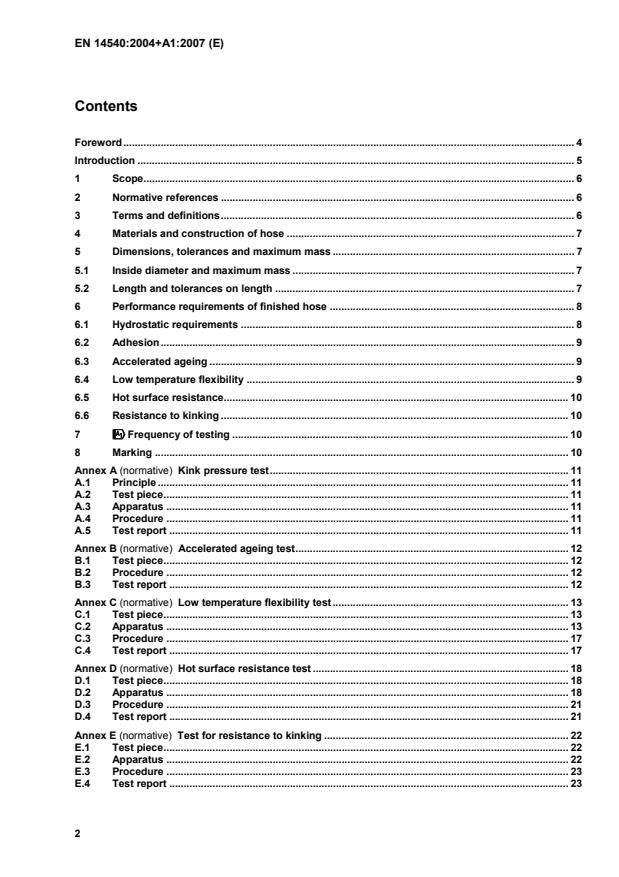
Kink pressure test.11 A.1 Principle.11 A.2 Test piece.11 A.3 Apparatus.11 A.4 Procedure.11 A.5 Test report.11 Annex B (normative)
Accelerated ageing test.12 B.1 Test piece.12 B.2 Procedure.12 B.3 Test report.12 Annex C (normative)
Low temperature flexibility test.13 C.1 Test piece.13 C.2 Apparatus.13 C.3 Procedure.17 C.4 Test report.17 Annex D (normative)
Hot surface resistance test.18 D.1 Test piece.18 D.2 Apparatus.18 D.3 Procedure.21 D.4 Test report.21 Annex E (normative)
Test for resistance to kinking.22 E.1 Test piece.22 E.2 Apparatus.22 E.3 Procedure.23 E.4 Test report.23
According to the CEN/CENELEC Internal Regulations, the national standards organizations of the following countries are bound to implement this European Standard: Austria, Belgium, Bulgaria, Cyprus, Czech Republic, Denmark, Estonia, Finland, France, Germany, Greece, Hungary, Iceland, Ireland, Italy, Latvia, Lithuania, Luxembourg, Malta, Netherlands, Norway, Poland, Portugal, Romania, Slovakia, Slovenia, Spain, Sweden, Switzerland and United Kingdom.
1 1 MPa = 10 bar
kg/m mm mm max. 25 -0,5 to +1,0 0,18 38
0,24 40/42/45 -0,5 to +1,5 0,29 50/51/52
0,35
5.2 Length and tolerances on length The total length of hose supplied shall be in accordance with the purchaser’s requirements and shall be stated in metres. Tolerances on length shall be in accordance with EN ISO 1307. NOTE The coil or flake size, and the test procedures to determine these can, if considered necessary, be agreed between the manufacturer and purchaser.
Tolerances
% Change in length 0,0 to +5,0 Change in external diameter 0,0 to +5,0
Table 3 — Twisting line Inside diameter Maximum twist mm °/m 25 120 38 to 52 inclusive 100
6.1.2 Deformation under proof pressure A proof pressure hold test shall be carried out on three hose lengths each of 1 m in accordance with EN ISO 1402. The proof pressure shall be as given in Table 4 and on examination during the test, the test pieces shall not show any evidence of leakage, cracking, abrupt distortion or other signs of failure.
Table 4 — Working pressure
...