

EN 13925-3:2005
(Main)Non destructive testing - X ray diffraction from polycrystalline and amorphous materials - Part 3: Instruments
- Abstract
This document sets out the characteristics of instruments used for X-ray powder diffraction ("powder" as defined in EN 13925-1:2003, Clause 5) as a basis for their control and hence quality assurance of the measurements made by this technique. Performance testing indicators are given for diffractometer performance testing. Different types and makes of X-ray powder diffractometer vary considerably in their design and intended fields of application. This document attempts to cover as much of this range as possible by keeping to common principles. To make the standard more readily applicable, the Bragg-Brentano configuration is addressed in most detail because of its wide use. Additional considerations and adaptations may be necessary to cover some types of instruments or configuration and some fields of application. Some of these types of instrument are described in Annex B.
- Status
- Published
- Publication Date
- 03-May-2005
- Withdrawal Date
- 29-Nov-2005
- Technical Committee
- CEN/TC 138 - Non-destructive testing
- Drafting Committee
- CEN/TC 138 - Non-destructive testing
- Current Stage
- 9060 - Closure of 2 Year Review Enquiry - Review Enquiry
- Start Date
- 04-Jun-2025
- Completion Date
- 04-Jun-2025


Overview
EN 13925-3:2005 (CEN) defines the characteristics and control principles for instruments used in X‑ray powder diffraction (XRPD) applied to non‑destructive testing (NDT) of polycrystalline and amorphous materials. The standard provides a basis for instrument alignment, calibration, performance testing and quality assurance of diffractometers, with detailed attention to the widely used Bragg–Brentano configuration while also addressing other instrument types (see Annex B).
Key topics and technical requirements
- Scope and purpose: Establishes common principles and performance indicators for XRPD instruments to ensure reproducible, comparable measurements across laboratories.
- Instrument components described:
- X‑ray sources: conventional sealed tubes, rotating anodes, microfocus sources and synchrotron radiation - characteristics, effects on intensity and spectrum.
- Incident and diffracted beam optics: monochromators, filters, beam geometry and dimensions.
- Detectors: detector types and their spatial/energy resolution considerations.
- Goniometers and specimen stages: mechanical positioning and sample handling specifics.
- Data collection systems: data acquisition and processing requirements for XRPD.
- Performance control:
- Procedures for equipment characterisation, instrument alignment and calibration (Clause 5–6).
- Performance testing and monitoring metrics and recommended tests (Clause 7 and Annex C) including line position, intensity and breadth, angular deviation curves and profile analysis.
- Environmental considerations: temperature, pressure and humidity control for reproducible line profiles; beam path attenuation (air vs helium or evacuated paths).
- Safety: Highlights the need for appropriate radiation protection per national regulations or ICRP recommendations.
- Supporting material: Informative annexes with procedures, alignment guidance for Bragg–Brentano instruments, and sample report forms (Annexes A–D).
Applications and users
EN 13925-3:2005 is practical for organizations and professionals involved in:
- NDT laboratories performing XRPD for phase identification, texture, microstrain and crystallite size analysis.
- Quality assurance and metrology teams implementing instrument performance monitoring and inter-laboratory comparison.
- Materials scientists and researchers using laboratory or synchrotron diffractometers.
- Instrument manufacturers and service engineers designing, commissioning or validating diffractometers.
- Regulatory and accreditation bodies assessing conformity of XRPD measurement systems.
Related standards
- EN 13925-1: General principles for XRPD (referenced)
- EN 13925-2: Procedures for XRPD
- prEN 1330-11: Terminology for X‑ray diffraction from polycrystalline and amorphous materials
This standard supports consistent, traceable X‑ray powder diffraction measurements by defining instrument characteristics, alignment and testing practices central to reliable XRPD-based non‑destructive testing.
Relations
- Effective Date
- 28-Jan-2026
- Effective Date
- 28-Jan-2026
- Effective Date
- 28-Jan-2026
- Effective Date
- 28-Jan-2026
- Effective Date
- 28-Jan-2026
Get Certified
Connect with accredited certification bodies for this standard

IMP NDT d.o.o.
Non-destructive testing services. Radiography, ultrasonic, magnetic particle, penetrant, visual inspection.
Inštitut za kovinske materiale in tehnologije
Institute of Metals and Technology. Materials testing, metallurgical analysis, NDT.
Q Techna d.o.o.
NDT and quality assurance specialist. 30+ years experience. NDT personnel certification per ISO 9712, nuclear and thermal power plant inspections, QA/
Sponsored listings
Frequently Asked Questions
EN 13925-3:2005 is a standard published by the European Committee for Standardization (CEN). Its full title is "Non destructive testing - X ray diffraction from polycrystalline and amorphous materials - Part 3: Instruments". This standard covers: This document sets out the characteristics of instruments used for X-ray powder diffraction ("powder" as defined in EN 13925-1:2003, Clause 5) as a basis for their control and hence quality assurance of the measurements made by this technique. Performance testing indicators are given for diffractometer performance testing. Different types and makes of X-ray powder diffractometer vary considerably in their design and intended fields of application. This document attempts to cover as much of this range as possible by keeping to common principles. To make the standard more readily applicable, the Bragg-Brentano configuration is addressed in most detail because of its wide use. Additional considerations and adaptations may be necessary to cover some types of instruments or configuration and some fields of application. Some of these types of instrument are described in Annex B.
This document sets out the characteristics of instruments used for X-ray powder diffraction ("powder" as defined in EN 13925-1:2003, Clause 5) as a basis for their control and hence quality assurance of the measurements made by this technique. Performance testing indicators are given for diffractometer performance testing. Different types and makes of X-ray powder diffractometer vary considerably in their design and intended fields of application. This document attempts to cover as much of this range as possible by keeping to common principles. To make the standard more readily applicable, the Bragg-Brentano configuration is addressed in most detail because of its wide use. Additional considerations and adaptations may be necessary to cover some types of instruments or configuration and some fields of application. Some of these types of instrument are described in Annex B.
EN 13925-3:2005 is classified under the following ICS (International Classification for Standards) categories: 19.100 - Non-destructive testing. The ICS classification helps identify the subject area and facilitates finding related standards.
EN 13925-3:2005 has the following relationships with other standards: It is inter standard links to EN 1330-11:2007, EN 15305:2008, EN ISO 21432:2020, CEN ISO/TS 21432:2005, EN 13925-2:2003. Understanding these relationships helps ensure you are using the most current and applicable version of the standard.
EN 13925-3:2005 is available in PDF format for immediate download after purchase. The document can be added to your cart and obtained through the secure checkout process. Digital delivery ensures instant access to the complete standard document.
Standards Content (Sample)
SLOVENSKI STANDARD
01-julij-2005
Neporušitveno preskušanje – Uklon rentgenskih žarkov na polikristalnih in
amorfnih materialih – 3. del: Naprave
Non destructive testing - X ray diffraction from polycrystalline and amorphous materials -
Part 3: Instruments
Zerstörungsfreie Prüfung - Röntgendiffraktometrie von polykristallinen und amorphen
Materialien - Teil 3: Geräte
Essais non destructifs - Diffraction des rayons X appliquée aux matériaux polycristallins
et amorphes - Partie 3 : Appareillage
Ta slovenski standard je istoveten z: EN 13925-3:2005
ICS:
19.100 Neporušitveno preskušanje Non-destructive testing
2003-01.Slovenski inštitut za standardizacijo. Razmnoževanje celote ali delov tega standarda ni dovoljeno.
EUROPEAN STANDARD
EN 13925-3
NORME EUROPÉENNE
EUROPÄISCHE NORM
May 2005
ICS 19.100
English version
Non destructive testing - X ray diffraction from polycrystalline
and amorphous materials - Part 3: Instruments
Essais non destructifs - Diffraction des rayons X appliquée Zerstörungsfreie Prüfung - Röntgendiffraktometrie von
aux matériaux polycristallins et amorphes - Partie 3: polykristallinen und amorphen Materialien - Teil 3: Geräte
Appareillage
This European Standard was approved by CEN on 21 March 2005.
CEN members are bound to comply with the CEN/CENELEC Internal Regulations which stipulate the conditions for giving this European
Standard the status of a national standard without any alteration. Up-to-date lists and bibliographical references concerning such national
standards may be obtained on application to the Central Secretariat or to any CEN member.
This European Standard exists in three official versions (English, French, German). A version in any other language made by translation
under the responsibility of a CEN member into its own language and notified to the Central Secretariat has the same status as the official
versions.
CEN members are the national standards bodies of Austria, Belgium, Cyprus, Czech Republic, Denmark, Estonia, Finland, France,
Germany, Greece, Hungary, Iceland, Ireland, Italy, Latvia, Lithuania, Luxembourg, Malta, Netherlands, Norway, Poland, Portugal, Slovakia,
Slovenia, Spain, Sweden, Switzerland and United Kingdom.
EUROPEAN COMMITTEE FOR STANDARDIZATION
COMITÉ EUROPÉEN DE NORMALISATION
EUROPÄISCHES KOMITEE FÜR NORMUNG
Management Centre: rue de Stassart, 36 B-1050 Brussels
© 2005 CEN All rights of exploitation in any form and by any means reserved Ref. No. EN 13925-3:2005: E
worldwide for CEN national Members.
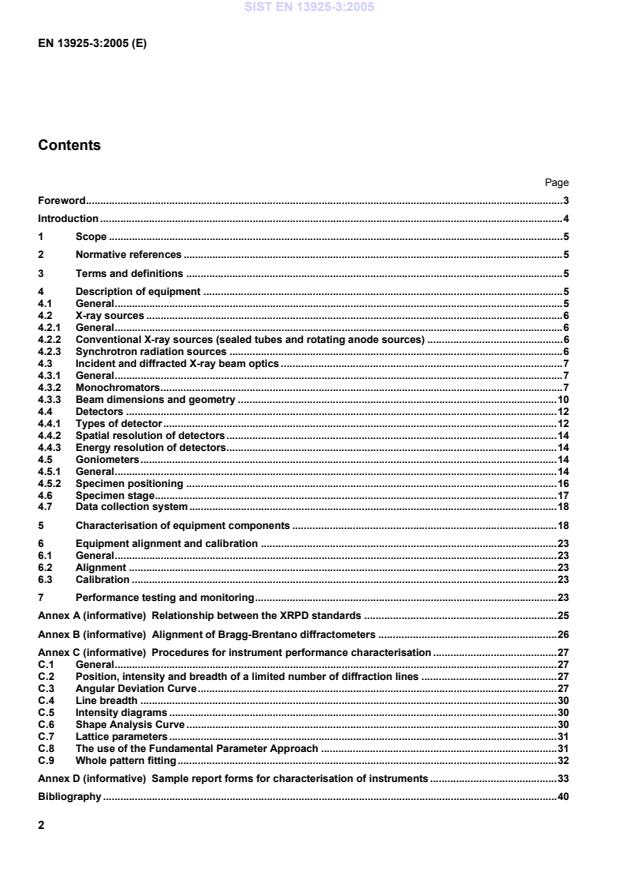
Contents
Page
Foreword.3
Introduction .4
1 Scope .5
2 Normative references .5
3 Terms and definitions .5
4 Description of equipment .5
4.1 General.5
4.2 X-ray sources .6
4.2.1 General.6
4.2.2 Conventional X-ray sources (sealed tubes and rotating anode sources) .6
4.2.3 Synchrotron radiation sources .6
4.3 Incident and diffracted X-ray beam optics .7
4.3.1 General.7
4.3.2 Monochromators.7
4.3.3 Beam dimensions and geometry .10
4.4 Detectors .12
4.4.1 Types of detector.12
4.4.2 Spatial resolution of detectors.14
4.4.3 Energy resolution of detectors.14
4.5 Goniometers.14
4.5.1 General.14
4.5.2 Specimen positioning .16
4.6 Specimen stage.17
4.7 Data collection system.18
5 Characterisation of equipment components .18
6 Equipment alignment and calibration .23
6.1 General.23
6.2 Alignment .23
6.3 Calibration .23
7 Performance testing and monitoring.23
Annex A (informative) Relationship between the XRPD standards .25
Annex B (informative) Alignment of Bragg-Brentano diffractometers .26
Annex C (informative) Procedures for instrument performance characterisation .27
C.1 General.27
C.2 Position, intensity and breadth of a limited number of diffraction lines .27
C.3 Angular Deviation Curve.27
C.4 Line breadth .30
C.5 Intensity diagrams .30
C.6 Shape Analysis Curve .30
C.7 Lattice parameters.31
C.8 The use of the Fundamental Parameter Approach .31
C.9 Whole pattern fitting.32
Annex D (informative) Sample report forms for characterisation of instruments .33
Bibliography .40
Foreword
This document (EN 13925-3:2005) has been prepared by Technical Committee CEN/TC 138 “Non destructive
testing”, the secretariat of which is held by AFNOR.
This European Standard shall be given the status of a national standard, either by publication of an identical text or
by endorsement, at the latest by November 2005, and conflicting national standards shall be withdrawn at the latest
by November 2005.
This European Standard about “Non destructive testing - X-ray diffraction from polycrystalline and amorphous
material” is composed of:
- prEN 1330-11, Terminology - Part 11: X-Ray Diffraction from Polycrystalline and Amorphous Materials
- EN 13925-1, Part 1:General principles
- EN 13925-2, Part 2: Procedures
- EN 13925-3 Part 3: Instruments
- WI 00138070, Reference Materials
In order to explain the relationship between the topics described in the different standards, a diagram illustrating
typical operation involved in XRPD is given in Annex A.
According to the CEN/CENELEC Internal Regulations, the national standards organizations of the following
countries are bound to implement this European Standard: Austria, Belgium, Cyprus, Czech Republic, Denmark,
Estonia, Finland, France, Germany, Greece, Hungary, Iceland, Ireland, Italy, Latvia, Lithuania, Luxembourg, Malta,
Netherlands, Norway, Poland, Portugal, Slovakia, Slovenia, Spain, Sweden, Switzerland and United Kingdom.
Introduction
X-ray powder diffraction (XRPD) is a powerful Non-Destructive Testing (NDT) method for determining a range of
physical and chemical characteristics of materials. These include the type and quantities of phases present, the
crystallographic unit cell and structure, crystallographic texture, macrostress, crystallite size and microstrain, and
the electron radial distribution function.
This document aims to describe the general aspects of the XRPD technique and its applications but not to define a
specific or detailed standard for each field of application or type of analysis.
The main purposes of the standard are therefore to provide:
• practical guidance, unified concepts and terminology for use of the XRPD technique in the area of Non-
Destructive Testing with general information about its capabilities and limitations of relevance to laboratories
working at different levels of sophistication, from routine testing to research;
• a basis for Quality Assurance in XRPD laboratories allowing performance testing and monitoring of instruments
as well as the comparison of results from different instruments;
• a general basis (without imposing specifications) for further specific NDT product standards and related Quality
Assurance applications, with aspects common to most fields of application.
In order to make the standard immediately usable in a wide range of laboratories and applications, diffractometers
with Bragg-Brentano geometry are considered in more detail than other instruments.
Radiation Protection: Exposure of any part of the human body to X-rays can be injurious to health. It is therefore
essential that whenever X-ray equipment is used, adequate precautions should be taken to protect the operator
and any other person in the vicinity. Recommended practice for radiation protection as well as limits for the levels
of X-radiation exposure are established by national legislation in each country. If there are no official regulations or
recommendations in a country, the latest recommendations of the International Commission on Radiological
Protection should be applied.
1 Scope
This document sets out the characteristics of instruments used for X-ray powder diffraction (“powder” as defined in
EN 13925-1:2003, Clause 5) as a basis for their control and hence quality assurance of the measurements made
by this technique. Performance testing indicators are given for diffractometer performance testing. Different types
and makes of X-ray powder diffractometer vary considerably in their design and intended fields of application. This
document attempts to cover as much of this range as possible by keeping to common principles. To make the
standard more readily applicable, the Bragg-Brentano configuration is addressed in most detail because of its wide
use. Additional considerations and adaptations may be necessary to cover some types of instruments or
configuration and some fields of application. Some of these types of instrument are described in Annex B.
2 Normative references
The following referenced documents are indispensable for the application of this document. For dated references,
only the edition cited applies. For undated references, the latest edition of the referenced document (including any
amendments) applies.
EN 13925-2:2003, Non-destructive testing – X-ray diffraction from polycrystalline and amorphous materials – Part
2: Procedures
prEN 1330-11:2004, Non-destructive testing – Terminology – Part 11: X-ray Diffraction from Polycrystalline and
Amorphous Materials
3 Terms and definitions
For the purposes of this document, the terms and definitions of prEN 1330-11:2004 apply.
4 Description of equipment
4.1 General
This description is particularly intended for instruments dedicated to the fields of application described in
EN 13925-1. For other applications, additional considerations may be required.
A diffractometer generally comprises:
− goniometer;
− X-ray source;
− incident beam optics which may include monochromatisation or filtering, collimation and/or focusing or
parallelism of the beam;
− diffracted beam optics which may include monochromatisation or filtering, collimation and/or focusing or
parallelism of the beam;
− specimen stage;
− detector;
− data collection system.
These parts of the instrument are considered in more detail below. A data processing system is also required to
produce measurements from the instrument. Data processing systems, whether manual or computerised, shall be
included with the data processing procedures of EN 13925-2.
A well-controlled environment (temperature and pressure) is strongly recommended for analysis where
reproducible measurement of line profile position, width and shape is required.
Humidity is may be important because compounds in the specimen may react with water or absorb it with a
consequent change in their lattice constants, e.g. clay minerals.
The X-ray beam is partially scattered and attenuated by the air in the beam path with consequential effects on the
detected diffraction pattern background and intensity. This effect has sometimes been minimised by use of an
evacuated or helium filled beam path.
For all the items described in this clause the corresponding main characteristics to be controlled are given in
Clause 5.
4.2 X-ray sources
4.2.1 General
There are several types of x-ray source that can be used for XRPD measurements ranging from conventional
laboratory sources to intense and well-collimated synchrotron sources. Each source exhibits characteristics that
make it more suitable for particular types of analysis. The main source types are described below.
4.2.2 Conventional X-ray sources (sealed tubes and rotating anode sources)
X-rays are obtained by bombarding a metal anode with electrons emitted by the thermoionic effect and accelerated
in a strong electric field produced by a high-voltage generator. Most of the kinetic energy of the electrons is
converted to heat, which limits the power of the tubes and requires efficient anode cooling. An increase of about
two orders of magnitude in brilliance can be obtained using rotating anodes instead of sealed tubes. Microfocus
sources operate at relatively low power settings but maintain brightness by electrostatically or magnetically steering
the beam inside the X-ray tube onto the target. The spectrum emitted by a conventional X-ray source operating at
sufficiently high voltage consists firstly of a continuous background of polychromatic radiation with a sharp cut off at
short wavelengths determined by the maximum voltage applied. Upon this is superimposed a limited number of
narrow characteristic lines whose wavelengths are characteristic of the anode material. The emitted radiation is not
polarised.
The type of X-ray source and the electron emission current, and accelerating voltage applied to it by the high
voltage generator have a marked effect on X-ray intensity and its energy distribution. The emission current and
accelerating voltage of a conventional X-ray tube normally give reproducible adjustment of the X-ray beam intensity
and energy spectrum on a time scale of days. However, experience has shown that the absolute X-ray intensity
differs significantly for nominally equal sources and that it decreases with source age.
4.2.3 Synchrotron radiation sources
A beam of charged particles strongly accelerated in an electric field and deflected in a magnetic field emits a
continuous spectrum of X-rays that is as much as 10 times as brilliant as sealed X-ray tubes. It is called
"synchrotron radiation". This increased brilliance relates to the total energy spectrum. Monochromatisation of the
beam typically results in diffraction intensities one or two orders of magnitude greater than from conventional
sources.
The main advantages of using synchrotron radiation for XRPD measurements are:
- nearly parallel-beam diffraction geometry;
- highly monochromatised and tunable radiation;
- very small and almost symmetric contribution of the instrument to the observed line shape that leads to simpler
characterisation of line profiles and very good angular resolution.
This type of X-ray radiation source requires beam flux monitoring with time (the beam flux can decrease
significantly during the experiment) and wavelength calibration. The emitted radiation is strongly polarised in the
plane of deflection of the charged particles.
4.3 Incident and diffracted X-ray beam optics
4.3.1 General
The main characteristics of the incident and diffracted beams are their wavelength spectrum, their direction of
propagation, their cross-sectional area and shape at the specimen as well as their degree of collimation (axial and
equatorial divergence) and focusing. The items of equipment that determine these characteristics are called "beam
optics". The effects of these items are referred to by the general term "beam conditioning".
The items of equipment described below are used to obtain different degrees of radiation purity and different
geometries, i.e. a so-called "focused" beam, "monochromatised" beam, "collimated" beam, or "parallel" beam.
4.3.2 Monochromators
4.3.2.1 General
The wavelengths conventionally used with laboratory sources correspond to the characteristic spectral lines from
specific anode materials.
For many XRPD applications it is advantageous to eliminate all other spectral components emitted from the X-ray
source or the specimen. When using the K doublet is sometimes helpful to additionally suppress the K -line, i.e.
α1,2 α2
to work with highly monochromatic K -radiation.
α1
Monochromatisation devices can be used singly or in combination.
4.3.2.2 Filters and filters
ββββ
Partial monochromatisation can be obtained using K filters, i.e. foils made of a metal selected as having an
β
absorption edge between the wavelengths of the K and K radiation emitted by the source.
α β
Standard K filters are designed to reduce the K intensity to about two orders of magnitude less than the
β
β
K intensity. Such a filter also attenuates the K doublet intensity, typically by a factor of 2, and reduces the
α α
polychromatic radiation from the source. Two filters are sometimes combined to form so-called "balanced filters"
[1].
Spectral filters shall be used with caution because the absorption edges of the filter material cause significant steps
in the background close to each of the observed diffraction lines. Such steps impede accurate analysis when the
complete line profile(s) are used, for example, in line-broadening analysis.
In some cases it is useful to attenuate the incident or the diffracted beam. Then a foil is used that is made of a
metal (often aluminium) selected as having no absorption edge near the radiation wavelength used.
4.3.2.3 Crystal Monochromators
Monochromatisation of radiation is most often accomplished by diffraction from a crystal. We may distinguish:
a) a mosaic crystal. The relative energy or wavelength resolution (∆Ε/Ε and ∆λ/λ, respectively) is typically a few
parts per hundred. Most of the K radiation and of the continuous polychromatic radiation is eliminated. The
β
orientations of the coherently diffracting parts of the mosaic crystal (generally graphite) are spread over about
0,4 degrees for many commercially available monochromators. For such crystals more than 50 % of the incident
intensity of the K doublet can be retained. Mosaic crystal monochromators are usually installed in the diffracted
α1,2
beam. In this configuration, they also eliminate specimen fluorescence from all elements except the one that
constitutes the anode.
b) a single crystal. The energy resolution is typically better than two parts per thousand. The two components of
the K doublet can be separated and the K radiation eliminated. This type of monochromatisation causes a
α1,2 α2
large loss in intensity as typically only about 15 % of the incident intensity of a spectral line is retained. Single
crystal monochromators (usually almost perfect single crystals of quartz, silicon or germanium) are generally used
on the primary beam often in a focusing arrangement. The intensity loss may be largely offset by the associated
reduction in axial divergence of the beam, eliminating the need for one set of Soller slits (see 4.3.3.3.2).
Two or more crystals (e.g. [2]) may be combined to achieve much better resolution than one, but the use of multiple
crystals may yield insufficient intensity for normal powder diffraction. Care shall be taken to ensure that the
harmonics of the chosen wavelength are eliminated by the positioning of suitable apertures (slits) within the
monochromator, or by other means.
These devices can be used in the incident and/or diffracted beams (see Figures 1 and 2).
Key
1 Focus of X-ray tube
2 Monochromator
3 Apparent source (on the goniometer circle)
Figure 1 - Positioning the monochromator on the incident beam
Key
1 Receiving slit
2 Monochromator
3 Detector slit
Figure 2 - Positioning the monochromator on the diffraction beam
4.3.2.4 Electronic filters
Electronic filtering uses photon-counting detectors (see 4.4) and is often referred to as pulse height discrimination
or “discrimination” or “energy discrimination”. It electronically selects the pulses arising from the photons of the
radiation chosen for the experiment.
An effect similar to partial monochromatisation can be achieved by the use of a solid-state detector, e.g. Peltier-
cooled. The relative energy resolution of these systems is of the same order as that of a mosaic crystal
monochromator (about one part per 100), i.e. it is sufficient to eliminate the K component and most of the
β
continuous background, but not to separate the K doublet. Detectors of this type typically have high counting
α1,2
efficiencies but are susceptible to dead time effects (prEN 1330-11). Such effects result in a non-linear response
above about 10 counts per second, including all wavelengths registered by the detector, whether or not used for
the measurement. Care shall therefore be taken to limit the maximum count rate observed to a level at which the
detector function properly. If necessary an appropriate dead time correction shall be applied.
4.3.2.5 Multilayer mirrors
Multilayer mirrors usually consist of alternating thin layers of two elements (e.g. W and C) deposited onto an
appropriately curved substrate. The layers have a thickness of the order of a few times the wavelength of the
X-radiation used [3].
Multilayer mirrors for X-radiation are primarily used to reconfigure a divergent beam into an intense parallel or
convergent beam (see 4.3.3.3.4). The mirror unit also acts as a monochromator by suppressing the K and
β
polychromatic radiation from the source. The thickness of the layers deposited on the surface varies along the
length of the mirror in such a way that Bragg’s law is satisfied over a range of beam divergence angles and the
corresponding incidence angles at the mirror. These systems reach a reflectivity close to 100 % and thereby
provide high intensity beams. A common configuration uses a parabolic graded mirror to transform the divergent
incident radiation from the source into an intense nearly parallel beam. Elliptic graded mirrors may be used to
transform the divergent radiation from the source into a convergent (focused) beam. For special applications
several mirrors can be combined in the incident and/or diffracted beams.
4.3.3 Beam dimensions and geometry
4.3.3.1 General
The geometric dimensions of the incident and diffracted X-ray beams can be controlled using collimators and slits.
The geometric dimensions may also be altered significantly by crystal monochromators and graded multilayer
mirrors.
The items described below define the beam dimensions and geometry and are illustrated schematically in Figure 3.
Key
1, 2 Possible position of divergence anti-scatter slit
3, 4 Possible position of receiving anti-scatter slit
5 Source
6 Divergence slit
7 Knife edge
8 Specimen surface
9 Detector window
10 Receiving slit
11 Goniometer circle
A, B, D Possible position of Soller slit
C Centre of specimen surface and of the goniometer circle
Figure 3 — Schematic arrangement of the devices for control of beam dimension and geometry with
respect to the centre of the goniometer circle (C)
4.3.3.2 Slits
4.3.3.2.1 General
Different types of slit can be placed in the incident and diffracted beam paths, usually to limit their equatorial and
axial (see 4.5.1) divergence. Slits can also serve to reduce parasitic scattering, to define the radius of the focusing
circle and to control the angular resolution. They are often made of a metal with high X-ray attenuation. Orthogonal
slit pairs are used for some measurements (e.g. for crystallographic texture measurements) to control the
equatorial and axial beam divergence. In 4.3.3.2.2 to 4.3.3.2.7 only slits will be dealt with, because in XRPD slits
are far more widely used than other apertures.
A useful quantitative geometric treatment of slits for Bragg-Brentano diffractometers is described in [4].
4.3.3.2.2 Variable aperture slits
Mechanically or computer controlled slits can be applied as variable divergence, antiscatter and receiving slits.
A variable aperture slit is most often used in diffractometers with Bragg-Brentano geometry to maintain a constant
irradiated surface area of the specimen while the angle between the incident beam and the specimen surface is
varied. As a consequence, the irradiated specimen volume varies during the 2θ scan.
A matched variable anti-scatter slit may be used in conjunction with a variable divergence slit. This can be
particularly effective in minimising parasitic scattering at low 2θ angles.
4.3.3.2.3 Divergence slits
Divergence slits between the X-ray tube and the specimen. They limit the equatorial divergence of the incident
beam.
4.3.3.2.4 Antiscatter slits
Antiscatter slits reduce parasitic scattering caused by the interaction of the incident and diffracted beams with the
air, the specimen stage and the components of the optical system. They are placed in the path of the X-ray beams
directly before or after the specimen or after the receiving slit. They may be used singly or in combination. If
properly aligned they do not restrict the incident or diffracted beams and they do not change the diffraction
geometry.
4.3.3.2.5 Knife edge
The so-called "knife edge" can be used for flat specimens. It is a flat blade or wedge with a straight edge positioned
close to the specimen surface, parallel to the specimen surface and the goniometer axis. A knife edge reduces the
parasitic scattering by limiting the irradiated area of the specimen. It has the same function as the divergence and
the antiscatter slits. The position of the knife edge can be stationary or variable, and it can be mechanically or
computer controlled.
4.3.3.2.6 Receiving slits
A receiving slit serves to select the radiation seen by the detector at the angular position sampled. It is placed in the
diffracted beam, in front of the detector or in front of the diffracted beam monochromator, if present.
For Bragg-Brentano geometry, the receiving slit shall be placed on the focusing circle (see 4.5.1). Its size is an
important factor in determining the angular resolution. It is sometimes called a “focusing slit”, or “resolution slit”.
4.3.3.2.7 Detector slits
A detector slit selects the radiation diffracted by the specimen that is allowed to enter the detector. It prevents
parasitic radiation from entering the detector, e.g. radiation scattered by components of the instrument, or K
β
radiation when the monochromator is tuned to Κ radiation. The receiving slit often serves as detector slit.
α
If a monochromator is used in the diffracted beam, a detector slit can be placed in the diffracted beam between the
monochromator and the detector and is often incorporated in the monochromator housing. For (para)focusing
monochromators it is usually positioned at the focusing point of the radiation diffracted by the monochromator.
4.3.3.3 Collimators and related components
4.3.3.3.1 General
A collimator is a device intended to render the X-ray beam more nearly parallel, accomplishing this by restricting
the beam dimensions and / or the divergence of the beam. It should be constructed in such a way that the stray
radiation produced from the slits or diaphragms used for this task is excluded as completely as possible from the
diffraction pattern of the specimen registered by the detector. The design of collimators may differ considerably and
depends on the diffractometer configuration and the diffraction geometry used. They are often made of a metal with
high X-ray attenuation. Simple slits, crystal monochromators and graded multi-layer mirrors are normally not
regarded to be collimators, although some of their functions may be similar.
4.3.3.3.2 Parallel plate collimators (Soller slits)
A parallel plate collimator (or set of Soller slits) comprises an array of parallel thin plates (foils) that limit the beam
divergence, in the direction perpendicular to the foils. They can be used in the incident and/or diffracted beams and
they can be used to limit the divergence in the axial and/or equatorial direction.
4.3.3.3.3 Tube collimators
A tube collimator is a tube with diaphragms or sets of slits at each end to control the dimensions and the
divergence of the beam.
4.3.3.3.4 Capillary optics
Capillary optics are formed from hollow optical fibres that guide the radiation by total reflection on their inner walls.
Placed in the incident beam, they typically limit its divergence to about 0,3 degrees and suppress short wavelength
radiation while increasing the intensity at the specimen. A single capillary produces a beam with a very small cross-
section. An assembly made from a large number of parallel fibres bundled together produces a large cross-section
beam with low divergence and reduced short wavelength radiation [5].
Micromirrors are monocapillaries with a shaped inner surface, normally parabolic and gold coated. The curvature
changes with position along the mirror so that a convergent (focused) X-ray beam is formed by single bounce total
reflection (see 4.3.2.4).
4.4 Detectors
4.4.1 Types of detector
Detectors used in XRPD may be very different in type, size, shape (curvature) and in the physical principles by
which they function. They include photographic films, gas ionisation counters (Geiger-Müller and proportional),
solid-state detectors (scintillators or semiconductors), fluorescent screens and image plates. Detectors can be
categorised by considering:
a) physical principle of radiation detection:
integrating detectors: photographic films, image plates and charge coupled devices (CCD). These detectors
accumulate X-rays over a time interval and with intrinsic spatial resolution. They have a limited dynamic range
(total number of X-rays per angular interval) and low energy resolution. Electronic readout of data from these
detectors is required for reproducible measurements;
photon counting detectors: Geiger-Müller counters, proportional counters, scintillation counters and semi-
conductor detectors. They have, in principle, an unlimited dynamic range, when counts are summed into a
computer memory. However, they have a limited linear response range for count rates;
b) position sensitivity of the detector:
"spot" counters such as Geiger-Müller counters, proportional counters, scintillation counters and semi-
conductor detectors, that only register the number of the detected X-ray photon;
linear position sensitive detectors (also called one-dimensional PSDs), such as proportional counters where
the position at which the detected X-ray photons strike the device can be read out in addition to their number;
area detectors (also called two-dimensional PSDs), such as two dimensional position sensitive proportional
counters, photographic films, image plates, photo-luminescence tubes (as used in TV cameras), and charge
coupled devices (CCD).
The physical principle of radiation detection is important in XRPD, because it is related to the statistical counting
error in an observation as well as the detection efficiency. For photon counting detectors the variance in the
number of photons detected during a given time interval is equal to the number of photons detected (Poisson
statistics). Such a simple relation does not exist for integrating detectors.
The primary function of a position sensitive detector is to make simultaneous observations of count rate over a
range of positions and thus improve the efficiency of data collection. In many diffraction geometries, e.g. Bragg-
Brentano geometry and Seeman-Bohlin geometry, there is a degradation of the focusing or parafocusing condition
that should be taken into account. This results in a shifting and broadening of diffraction-line profiles that strongly
depends on diffraction angle. When a PSD is used, crystallites with orientations spread over half the range of
diffraction angles covered by the detector contribute to the diffracted intensity, thereby increasing the apparent
randomness of orientation (see Figure 4).
Key
1 Source
2 Specimen
A = π/2 - θ
min
B = π/2 - θ
max
PSD Position Sensitive Detector
∆ω Maximum difference of the orientation of lattice planes (with identical spacing) that contribute simultaneously to the radiation
detected by linear position sensitive detector
NOTE Technical characteristics of various types of detector can be found in references such as [6].
Figure 4 — Simultaneous registration of crystallite orientations when using a linear Position Sensitive
Detector (PSD)
4.4.2 Spatial resolution of detectors
The spatial resolution of a "spot" counter and of a detector that integrates over the area of its entrance window is
normally determined by the size of the receiving slit situated in front of it. For linear and two-dimensional detectors,
spatial resolution depends on the technical characteristics and electronic adjustment.
4.4.3 Energy resolution of detectors
The energy resolution of a detector depends on its technical characteristics and the electronic adjustment, including
the upper and lower acceptance limits for energy discrimination.
4.5 Goniometers
4.5.1 General
The mechanical and electrical constituent parts of a diffractometer that are used to control the position of the
diffractometer components in relation to the specimen are referred to as the goniometer.
The plane containing the centres of the source (or apparent source if an incident beam monochromator is used),
the specimen and the detector is known as the plane of diffraction.
The plane of diffraction is also named the equatorial plane. The direction perpendicular to this plane, and parallel to
the goniometer axis, is known as the axial direction. For most standard powder diffraction measurements, the
surface of a flat specimen shall lie perpendicular to the equatorial plane and shall contain the goniometer axis.
The measurement of the angle between the incident and diffracted beams is distinguished from the movement of
the specimen itself.
In diffractometers that use focusing or parafocusing diffraction geometry the (apparent) X-ray source is positioned
on the goniometer circle and the diffracted intensities are collected on the goniometer circle. When using a linear
(or flat) position sensitive detector the diffracted intensity is collected in a plane tangent to the goniometer circle.
In Bragg-Brentano geometry the (apparent) source, the specimen and the receiving slit all lay on the focusing
circle, which has a radius R . It is related to the diffraction angle 2θ and the radius R of the goniometer circle by R =
f f
R / 2sin θ (see Figure 5). Seeman-Bohlin geometry differs from Bragg-Brentano geometry in that the goniometer
circle is superimposed on the focusing circle so that, in Figure 5, R = R.
f
Key
1 Focusing circle
2 Specimen surface
3 Goniometer circle
NOTE The equatorial plane is defined by the point (S) representing the radiation source and the coinciding θ and 2θ axes. [C
is the point where the coinciding θ and 2θ axes intersect the equatorial plane.] The point (D) representing the detector is situated
in the equatorial plane at the same distance from the coinciding θ and 2θ axes as the point S. The line through C and parallel to
SD represents the specimen surface. The circle defined by the points S, C, and D and by the radius R is called the focusing
f
circle. In all powder diffractometers the plane of diffraction coincides with the equatorial plane. In a real Bragg-Brentano
parafocusing diffractometer the goniometer axis coincides with the θ and 2θ axes, S is the centre of the "line" shaped radiation
source that is perpendicular to the equatorial plane, and D is the centre of the area that is exposed to the radiation to be
detected and that resembles the radiation source in size and shape. The goniometer circle passes through the centre of the
"line" shaped radiation source and through the centre of the area that is exposed to the radiation to be detected. The goniometer
axis passes through the centre of the goniometer circle.
Figure 5 — Arrangement of the focusing circle and the goniometer circle in the parafocusing configuration
(Bragg-Brentano geometry)
The diffraction pattern is usually recorded by scanning rotationally around the goniometer circle with a "spot"
detector or with a position-sensitive detector placed tangent to the goniometer circle. Parts of the diffraction pattern
can be recorded by placing a stationary one- or two-dimensional detector tangent to the goniometer circle at a fixed
diffraction angle.
Many diffractometers (e.g. Bragg-Brentano and Seeman-Bohlin) can be distinguished with respect to the
orientation of their goniometer axis as:
'horizontal': horizontal goniometer circle, the goniometer axisis vertical. The specimen surface contains the
goniometer axis and tilts about it (i.e. the equatorial plane lies horizontally and the axial direction is vertical); or
'vertical': vertical goniometer circle, the goniometer axis is horizontal. The specimen surface contains the
goniometer axisand tilts about it (i.e. the equatorial plane lies vertically and the axial direction is horizontal). If
the specimen surface is flat, it is usually arranged to face upwards.
Such diffractometers can also be distinguished with respect to the functioning of their goniometer axis as:
θ−2θ when the flat specimen surface is tilted to remain at half the angle between source and receiving slit (or
detector) during data collection. Conventionally, the source remains stationary and the detector is rotated at
twice the speed of the specimen;
or
- θ−θ when the flat specimen surface remains static during a data collection. Conventionally it is placed
horizontally and fixed to this position during data collection. The X-ray source and the detector are then rotated
simultaneously at the same speed and in opposite directions.
4.5.2 Specimen positioning
4.5.2.1 General
The specimen is positioned using a specimen stage (see 4.6).
Diffractometer geometries are generally optimised for flat or rod-shaped specimens. The specimen shape should
therefore correspond as closely as possible to this design criterion. The required positional precision depends on
the instrument and its configuration. It is typically in the range of a few microns for flat specimens or tens of microns
for rod-shaped specimens.
4.5.2.2 Rod-shaped specimens (capillary, fibre)
A rod-shaped specimen (capillary, fibre) shall have its axis coinciding with the goniometer axis. The specimen has
no movement synchronised with the 2θ-scan, although it is usually rotated around the rod axis to improve the
statistical randomness of crystallite orientation. With step-counting diffractometers this rotation shall be timed to
avoid possible periodic anomalies in the collected data arising from any variation in diffracted intensities through a
rota
...