

FprEN 18192
(Main)Masonry products - Environmental product declarations for masonry units - Product category rules complementary to EN 15804:2012+A2:2019/AC:2021
- Abstract
This document provides complementary product category rules (c-PCR) guidance for the development of environmental declarations for masonry units according to EN 15804:2012+A2:2019/AC:2021.
This document defines the parameters to be reported, the EPD types (and life cycle stages) to be covered, the rules to be followed in order to generate life cycle inventories (LCI) and conduct life cycle impact assessments (LCIA), and the data quality to be used in the development of EPDs.
This document is also applicable to clay construction products manufactured with the same materials and using the same processes as clay masonry units.
In addition to the common parts of EN 15804:2012+A2:2019/AC:2021, this document:
- defines the system boundaries;
- defines the modelling and assessment of material-specific characteristics;
- defines allocation procedures for multi-output processes along the production chain;
- defines allocation procedures for reuse and recycling;
- includes the rules for calculating the LCI and the LCIA underlying the EPD;
- provides guidance/specific rules for the determination of the reference service life (RSL);
- gives guidance on the establishment of default scenarios; and
- gives guidance on default declared units for masonry units.
This document is intended to be used for cradle to gate, cradle to gate with options or cradle to grave assessments, when the intention is clearly stated in the system boundary description.
- Status
- Not Published
- Publication Date
- 24-Feb-2027
- Technical Committee
- CEN/TC 125 - Masonry
- Drafting Committee
- CEN/TC 125/WG 8 - Environmental product declaration
- Current Stage
- 5020 - Submission to Vote - Formal Approval
- Start Date
- 05-Nov-2026
- Due Date
- 18-Nov-2026
- Completion Date
- 18-Nov-2026

FprEN 18192 is a CEN draft European Standard for environmental product declarations (EPD) of masonry units. It sets complementary product category rules to EN 15804:2012+A2:2019, so users know what to report, how to calculate life cycle results, and how to describe carbonisation and end-of-life scenarios for masonry products.
The standard is aimed at people preparing, checking or buying EPDs for masonry units and related clay construction products made with the same materials and processes as clay masonry units. In practice, it tells you which life cycle stages to cover, which units to declare, how to handle reuse and recycling, and how to present the results.
What does FprEN 18192 specify?
FprEN 18192 gives product category rules for environmental declarations of masonry units according to EN 15804:2012+A2:2019. It defines the parameters to report, the EPD types and life cycle stages to cover, the rules for life cycle inventory (LCI) and life cycle impact assessment (LCIA), and the data quality to use.
The scope also extends to clay construction products made with the same materials and processes as clay masonry units. The document is organised into clauses on general aspects, product category rules for LCA, EPD content, project reporting, and verification and validity, followed by annexes A to G.
| Annex | What it covers |
|---|---|
| Annex A | Requirements and guidance on the reference service life (RSL) |
| Annex B | Waste |
| Annex C | Impact categories, indicators, methodologies and characterization factors |
| Annex D | End-of-life formulae |
| Annex E | Data quality assessment schemes for generic and specific data |
| Annex F | Product stage guidance for defining system boundaries |
| Annex G | Re-carbonation of masonry units |
What are the key requirements of FprEN 18192?
FprEN 18192 requires masonry-unit EPDs to be declared as cradle to grave and module D declarations, covering modules A, B, C and D. In practice, this means the EPD should show the full product story, including upstream production, construction, use, end-of-life, and any benefits or loads beyond the system boundary.
EPD type, declared unit and product coverage
Clause 5.2 states that the EPD type is cradle to grave with module D, based on a functional unit or a declared unit. Clause 6.1 limits the product category to masonry units conforming to EN 771-1 to EN 771-6. For clay masonry units, the declared unit is 1 tonne of product, while other unit conventions are given for CSMU, AAC, aggregate concrete, manufactured stone and natural stone masonry units in 6.3.3. This matters because the declared unit controls how results are compared and converted.
Life cycle stages and scenarios
Clause 6.2 and clause 6.3.9 set the required life cycle stages and scenario content. The standard expects product-stage data for A1 to A3, construction-stage data for A4 and A5, use-stage information for B1 to B7, end-of-life data for C1 to C4, and module D for benefits and loads beyond the system boundary. For readers, this means transport to site, installation, use, demolition, recycling and reuse need to be described in a way that matches the real product and local practice.
Reference service life and system boundaries
Clause 6.3.4 and Annex A address the reference service life (RSL). The standard says masonry units normally have an RSL exceeding that of the construction works and that, under normal service conditions, the RSL may be taken as at least 150 years. Clause 6.3.5 also requires carbonation to be taken into account within the system boundaries during production, storage, use and end of life when relevant. In practice, this affects how long the product is assumed to stay in service and where CO2 uptake is counted.
Carbonation and re-carbonation
Clause 6.5.1 and Annex G are central to the document. FprEN 18192 requires carbonation to be included where applicable, with a characterization factor for global warming potential of -1, and the amount and calculation method to be reported. Annex G explains how re-carbonation is treated for fired clay products, calcium silicate masonry units, concrete-related masonry units and AAC, and states when use-stage and end-of-life uptake should be counted. This matters because carbonation can change the climate profile of masonry units.
Data quality, allocation and inventory rules
Clauses 6.3.7, 6.3.8 and 6.4 require appropriate data selection, data quality assessment, and allocation of input flows and emissions, including for co-products, reuse, recycling and recovery. Annex E gives the schemes for assessing generic and specific data. For the user, this means the EPD must be based on traceable data and clear rules for splitting impacts between products, especially where processes have multiple outputs.
Content and reporting of the EPD
Clause 7 sets what the EPD has to contain: general information, LCA-derived environmental indicators, scenarios and technical information, possible additional information on dangerous substances, and aggregation of information modules. For clay masonry units, clause 5.4.2 requires the additional environmental impact indicators to be declared. In practice, this tells the report writer what has to appear in the final declaration and what must be backed up in the project report.
What terms does FprEN 18192 define?
- End of waste status - A waste material reaches this status when it has been recovered and can be used as a product again under the stated conditions.
- Aggregate - Granular construction material of natural, manufactured or recycled origin.
- Masonry unit - A preformed component intended for use in masonry construction.
- Clay masonry unit - A masonry unit made from clay or other argillaceous materials and fired to achieve a ceramic bond.
- CSMU - Calcium silicate masonry unit, made predominantly from lime and siliceous materials and hardened by high-pressure steam.
- AAC - Autoclaved aerated concrete masonry unit, made with hydraulic binders, siliceous material, a cell-generating material and steam curing.
- c-PCR - Complementary product category rules, meaning the product-specific rules that add to EN 15804.
- RSL - Reference service life, the period used to model expected service performance in the EPD.
Who uses FprEN 18192?
FprEN 18192 is used by EPD authors, manufacturers of masonry units, and consultants who calculate environmental declarations for construction products. It is also relevant for verification bodies, sustainability assessors, specifiers, buyers and quality managers who need to understand what an EPD for masonry units covers.
In practice, it supports product development, environmental reporting, procurement decisions and construction-work assessments where masonry units are part of the building fabric. It is also useful where clay construction products are made with the same materials and processes as clay masonry units.
Which standards are used with FprEN 18192?
FprEN 18192 is based on EN 15804:2012+A2:2019, which supplies the core rules for construction-product EPDs. The introduction also places it within the broader sustainability-of-construction-works suite, including EN 15643, EN 15978, EN 15941, EN 15942, CEN/TR 16970, EN 17472, EN 17672 and EN 17680, which support framework assessment, building assessment, data quality and communication formats.
The document also refers to EN 16757:2022 for the carbonation calculation approach used in Annex G. For product coverage, it ties masonry units to EN 771-1 through EN 771-6, so users can align the EPD with the product specification that matches the unit type.
What does the FprEN 18192 document contain?
FprEN 18192 contains rule sets, scenario guidance and calculation instructions for preparing EPDs for masonry units. It includes declared-unit rules by product type, system-boundary guidance, allocation guidance for multi-output processes, and treatment of reuse and recycling at end of life.
It also contains formal annexes with the RSL guidance, waste topics, impact categories and characterization factors, end-of-life formulae, data quality schemes, system-boundary guidance for the product stage, and a detailed carbonation annex with formulas and examples. For a practitioner, these parts are the working material used for modelling, checking and verifying the declaration rather than just describing the product.
Get Certified
Connect with accredited certification bodies for this standard

BSI Group
BSI (British Standards Institution) is the business standards company that helps organizations make excellence a habit.

Bureau Veritas
Bureau Veritas is a world leader in laboratory testing, inspection and certification services.

DNV
DNV is an independent assurance and risk management provider.
Sponsored listings
Frequently Asked Questions
FprEN 18192 is a draft published by the European Committee for Standardization (CEN). Its full title is "Masonry products - Environmental product declarations for masonry units - Product category rules complementary to EN 15804:2012+A2:2019/AC:2021". This standard covers: This document provides complementary product category rules (c-PCR) guidance for the development of environmental declarations for masonry units according to EN 15804:2012+A2:2019/AC:2021. This document defines the parameters to be reported, the EPD types (and life cycle stages) to be covered, the rules to be followed in order to generate life cycle inventories (LCI) and conduct life cycle impact assessments (LCIA), and the data quality to be used in the development of EPDs. This document is also applicable to clay construction products manufactured with the same materials and using the same processes as clay masonry units. In addition to the common parts of EN 15804:2012+A2:2019/AC:2021, this document: - defines the system boundaries; - defines the modelling and assessment of material-specific characteristics; - defines allocation procedures for multi-output processes along the production chain; - defines allocation procedures for reuse and recycling; - includes the rules for calculating the LCI and the LCIA underlying the EPD; - provides guidance/specific rules for the determination of the reference service life (RSL); - gives guidance on the establishment of default scenarios; and - gives guidance on default declared units for masonry units. This document is intended to be used for cradle to gate, cradle to gate with options or cradle to grave assessments, when the intention is clearly stated in the system boundary description.
This document provides complementary product category rules (c-PCR) guidance for the development of environmental declarations for masonry units according to EN 15804:2012+A2:2019/AC:2021. This document defines the parameters to be reported, the EPD types (and life cycle stages) to be covered, the rules to be followed in order to generate life cycle inventories (LCI) and conduct life cycle impact assessments (LCIA), and the data quality to be used in the development of EPDs. This document is also applicable to clay construction products manufactured with the same materials and using the same processes as clay masonry units. In addition to the common parts of EN 15804:2012+A2:2019/AC:2021, this document: - defines the system boundaries; - defines the modelling and assessment of material-specific characteristics; - defines allocation procedures for multi-output processes along the production chain; - defines allocation procedures for reuse and recycling; - includes the rules for calculating the LCI and the LCIA underlying the EPD; - provides guidance/specific rules for the determination of the reference service life (RSL); - gives guidance on the establishment of default scenarios; and - gives guidance on default declared units for masonry units. This document is intended to be used for cradle to gate, cradle to gate with options or cradle to grave assessments, when the intention is clearly stated in the system boundary description.
FprEN 18192 is classified under the following ICS (International Classification for Standards) categories: 13.020.50 - Ecolabelling; 91.080.30 - Masonry. The ICS classification helps identify the subject area and facilitates finding related standards.
FprEN 18192 is associated with the following European legislation: EU Directives/Regulations: 305/2011. When a standard is cited in the Official Journal of the European Union, products manufactured in conformity with it benefit from a presumption of conformity with the essential requirements of the corresponding EU directive or regulation.
FprEN 18192 is available in PDF format for immediate download after purchase. The document can be added to your cart and obtained through the secure checkout process. Digital delivery ensures instant access to the complete standard document.
Standards Content (Sample)
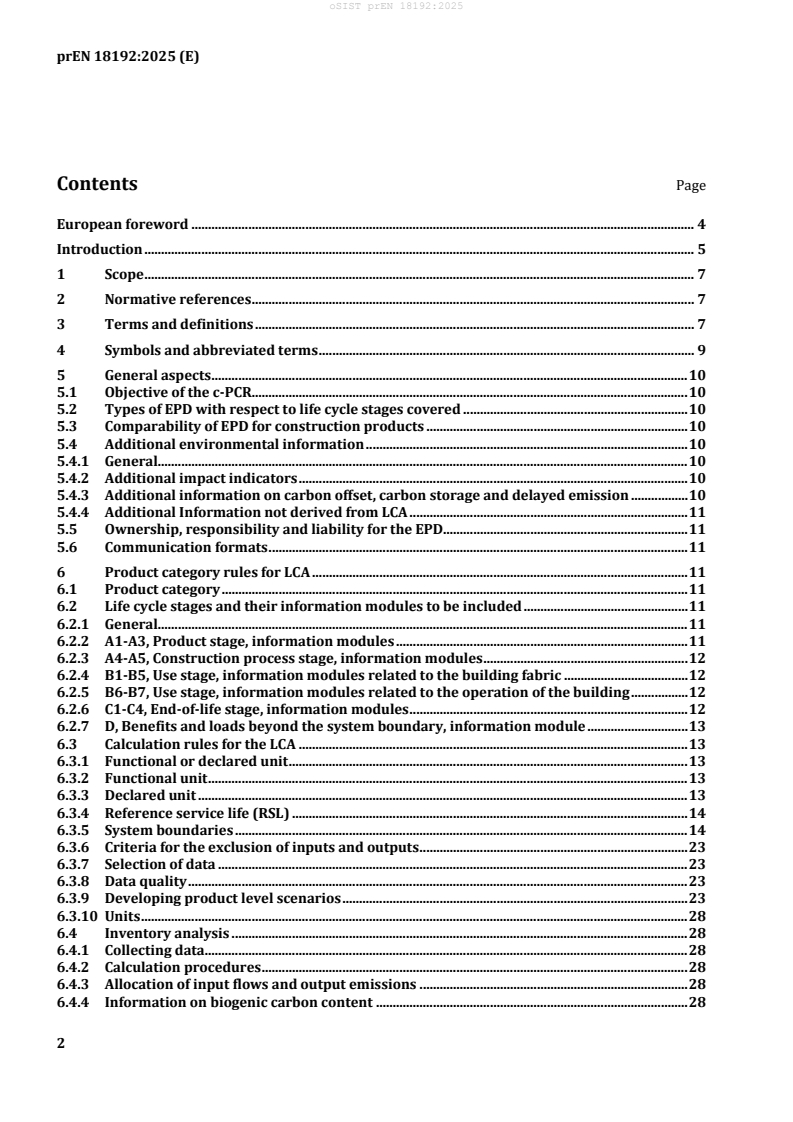
Contents
- Introduction
- 1 Scope
- 2 Normative references
- 3 Terms and definitions
- 3.1 end of waste status
- 3.2 aggregate
- 3.3 masonry unit
- 3.4 clay masonry unit
- 3.5 calcium silicate masonry units
- 3.6 carbonation
- 3.7 aggregate concrete masonry unit
- 3.8 autoclaved aerated concrete masonry unit
- 3.9 manufactured stone masonry unit
- 3.10 natural stone masonry unit
- 3.11 cement
- 3.12 additives
- 3.13 quicklime
- 4 Symbols and abbreviated terms
- 5 General aspects
- 5.1 Objective of the c-PCR
- 5.2 Types of EPD with respect to life cycle stages covered
- 5.3 Comparability of EPD for construction products
- 5.4 Additional environmental information
- 5.5 Ownership, responsibility and liability for the EPD
- 5.6 Communication formats
- 6 Product category rules for LCA
- 6.1 Product category
- 6.2 Life cycle stages and their information modules to be included
- 6.3 Calculation rules for the LCA
- 6.4 Inventory analysis
- 6.5 Impact assessment
- 7 Content of the EPD
- 7.1 Declaration of general information
- 7.2 Declaration of environmental indicators derived from LCA
- 7.3 Scenarios and additional technical information
- 7.4 Additional information on release of dangerous substances to indoor air, soil and
- 7.5 Aggregation of information modules
- 8 Project report
- 8.1 General
- 8.2 LCA-related elements of the project report
- 8.3 Documentation on additional information
- 8.4 Data availability for verification
- 9 Verification and validity of an EPD
- Annex A
- Annex B
- Annex C
- Annex D
- Annex E
- Annex F
- Annex G
- 2 Xcm
- Bibliography
Introduction
This document provides rules for environmental product declarations (EPD) for masonry units. It complements the core product category rules for all construction products and services given in EN 15804:2012+A2:2019, Sustainability of construction works — Environmental product declarations — Core rules for the product category of construction products.
This document provides additional rules for EPD of masonry units. It complements the core rules for all construction products and services as established in EN 15804:2012+A2:2019. EPD information is expressed in information modules as defined in EN 15804:2012+A2:2019, which allow easy organization and expression of data packages throughout the life cycle of masonry units. The approach requires that the underlying data should be consistent, reproducible and comparable. In line with EN 15804:2012+A2:2019, the EPD is expressed in a form that allows aggregation to provide complete information for buildings. This document does not deal with aggregation at the building level nor does this document describe the rules for applying EPD in a building assessment. This document refers to and mirrors relevant parts of EN 16757:2022, Sustainability of construction works — Environmental product declarations — Product Category Rules for concrete and concrete elements, drafted to cover concrete products to CEN/TC 104 and precast concrete products to CEN/TC 229. In respect of the mechanism for re-carbonation of clay and cementitious masonry units, this document references and follows the calculation methodology of of EN 16757:2022 Annex G, G.2, ‘CO
uptake by carbonation — Guidance on calculation’.
The document deals with a limited number of quantifiable parameters as predefined in EN 15804:2012+A2:2019. Future revisions of EN 15804 may lead to the incorporation in this document of additional predetermined parameters. This document provides the means for developing an environmental declaration for masonry units in the context of the suite of standards that are intended to assess the sustainability of construction works.
This suite of standards includes:
- EN 15643, Sustainability of construction works — Framework for assessment of buildings and civil engineering works;
- EN 15978, Sustainability of construction works — Assessment of environmental performance of buildings — Calculation methods;
- EN 15804:2012+A2:2019, Sustainability of construction works — Environmental product declaration —Core rules for the product category of construction products;
- EN 15941, Sustainability of construction works — Environmental product declarations — Data quality for the environmental assessment of products and construction works — Selection and use of data;
- EN 15942, Sustainability of construction works — Environmental product declarations — Communication format — Business to business;
- CEN/TR 16970:2016, Sustainability of construction works — Guidance for the implementation of EN 15804;
- EN 17472 Sustainability of construction works —Sustainability assessment of civil engineering works
- Calculation methods;
- EN 17672 Sustainability of construction works — Environmental product declarations — Horizontal rules for business to consumer communication; and
oSIST prEN 18192:2025 prEN 18192:2025 (E) - EN 17680 Sustainability of construction works — Evaluation of the potential for sustainable refurbishment of buildings.
oSIST prEN 18192:2025 prEN 18192:2025 (E)
1 Scope
This document provides product category rules (PCR) guidance for the development of environmental declarations for masonry units according to EN 15804:2012+A2:2019. This document defines the parameters to be reported, the EPD types (and life cycle stages) to be covered, the rules to be followed in order to generate life cycle inventories (LCI) and conduct life cycle impact assessments (LCIA), and the data quality to be used in the development of EPDs. This document is also applicable to clay construction products manufactured with the same materials and using the same processes as clay masonry units, In addition to the common parts of EN 15804:2012+A2:2019, this document:
- defines the system boundaries;
- defines the modelling and assessment of material-specific characteristics;
- defines allocation procedures for multi-output processes along the production chain;
- defines allocation procedures for reuse and recycling;
- includes the rules for calculating the LCI and the LCIA underlying the EPD;
- provides guidance/specific rules for the determination of the reference service life (RSL);
- gives guidance on the establishment of default scenarios; and
- gives guidance on default functional units for masonry products. This document is intended to be used for cradle to gate, cradle to gate with options or cradle to grave assessments, when the intention is clearly stated in the system boundary description.
2 Normative references
The following documents are referred to in the text in such a way that some or all of their content constitutes requirements of this document. For dated references, only the edition cited applies. For undated references, the latest edition of the referenced document (including any amendments) applies. EN 15804:2012+A2:2019, Sustainability of construction works - Environmental product declarations - Core rules for the product category of construction products
3 Terms and definitions
For the purposes of this document, the terms and definitions given in EN 15804:2012+A2:2019 and the following apply.
ISO and IEC maintain terminology databases for use in standardization at the following addresses:
- IEC Electropedia: available at https://www.electropedia.org/
- ISO Online browsing platform: available at https://www.iso.org/obp/ui/
3.1 end of waste status
certain specified waste which ceases to be waste after it has undergone a recycling or other recovery operation and complies with the following conditions:
oSIST prEN 18192:2025 prEN 18192:2025 (E) a) the substance or object is used for specific purposes; b) a market or demand exists for such a substance or object; c) the substance or object fulfils the technical requirements for the specific purposes and meets the existing legislation and standards applicable to products; and d) the use of the substance or object will not lead to overall adverse environmental or human health impacts Note 1 to entry: Adapted from Directive 2008/98/EC 3.1.
3.2 aggregate
granular material of natural, manufactured, or recycled origin used in construction [SOURCE: EN 12620:2002+A1:2008, X.X]
3.3 masonry unit
preformed component intended for use in masonry construction [SOURCE: EN 771:2011+A1:2015, X.X]
3.4 clay masonry unit
masonry unit made from clay or other argillaceous materials with or without sand, fuel or other additives fired at a sufficiently high temperature to achieve a ceramic bond [SOURCE: EN 771-1:2011+A1:2015, X.X]
3.5 calcium silicate masonry units
CSMU masonry units made predominantly from lime and siliceous materials, hardened by high pressure steam [SOURCE: EN 771-2:2011+A1:2015, X.X]
3.6 carbonation
carbon dioxide reaction with calcium and magnesium containing minerals to form carbonates
3.7 aggregate concrete masonry unit
masonry unit manufactured from cementitious binder, aggregates and water and which may contain admixtures and additions and colouring pigments and other materials incorporated or applied during or subsequent to unit manufacture [SOURCE: EN 771-3:2011+A1:2015, X.X]
oSIST prEN 18192:2025 prEN 18192:2025 (E)
3.8 autoclaved aerated concrete masonry unit
AAC masonry unit masonry unit manufactured from hydraulic binders such as cement and/or lime, combined with siliceous based fine material, cell generating material and water and cured with high pressure steam in autoclaves [SOURCE: EN 771-4:2011+A1:2015, X.X]
3.9 manufactured stone masonry unit
facing masonry unit having at least one exposed face with a close structure formed from either one or two homogeneous mixtures of aggregate, cementitious binder and other materials moulded under pressure and/or vibration and with or without further processing, intended to resemble and be used as an alternative to natural stone [SOURCE: EN 771-5:2011+A1:2015, X.X]
3.10 natural stone masonry unit
masonry unit manufactured from natural stone [SOURCE: EN 771-6:2011+A1:2015, X.X]
3.11 cement
finely ground inorganic material which, when mixed with water, forms a paste that sets and hardens by means of hydration reactions and processes and which, after hardening, retains its strength and stability even under water [SOURCE: EN 197-1:2011, X.X]
3.12 additives
addition or admixture added during the mixing process in order to improve certain properties or to achieve special properties [SOURCE: EN 206:2013+A2:2021, X.X]
3.13 quicklime
air lime mainly in the oxide form which reacts exothermically on contact with water Note 1 to entry: Quicklime is available in a range of sizes from lump to powder. [SOURCE: EN 459-1:2015, X.X - Modified to remove term defined and add note to entry]
4 Symbols and abbreviated terms
For the purposes of this document, the symbols and abbreviations given in EN 15804:2012+A2:2019 and the following apply.
EOL End of life FU Functional unit
oSIST prEN 18192:2025 prEN 18192:2025 (E) DU Declared unit CSMU Calcium silicate masonry unit AAC Autoclaved aerated concrete c-PCR Complementary product category rules
5 General aspects
5.1 Objective of the c-PCR
The objective of this c-PCR is to provide rules specific to masonry units for the application of EN 15804:2012+A2:2019. In addition to the objectives of EN 15804, this document aims to:
- define the parameters being declared collated and reported;
- describe which stages of a product’s life cycle are considered in the EPD and which processes are to be included in the life cycle stages;
- define rules for the development of scenarios;
- communicate EPDs and environmental information about masonry units; and
- ensure that comparisons between construction products are only carried out in the context of their application in construction works.
NOTE This c-PCR enables transparency for the EPD-development for masonry units.
5.2 Types of EPD with respect to life cycle stages covered
For masonry units, the following type of EPD shall be declared: cradle to grave and module D (A, B, C and D). This declaration shall be based on a functional unit or a declared unit. EN 15804:2012+A2:2019 applies.
5.3 Comparability of EPD for construction products
EN 15804:2012+A2:2019 applies.
5.4 Additional environmental information
5.4.1 General
EN 15804:2012+A2:2019 applies.
5.4.2 Additional impact indicators
In addition to the text in EN 15804:2012+A2:2019:
For clay masonry units, the additional environmental impact indicators shall be declared. This declaration shall be based on a functional unit or declared unit.
5.4.3 Additional information on carbon offset, carbon storage and delayed emission
EN 15804:2012+A2:2019 applies.
oSIST prEN 18192:2025 prEN 18192:2025 (E)
5.4.4 Additional Information not derived from LCA
EN 15804:2012+A2:2019 applies.
5.5 Ownership, responsibility and liability for the EPD
EN 15804:2012+A2:2019 applies.
5.6 Communication formats
EN 15804:2012+A2:2019 applies.
6 Product category rules for LCA
6.1 Product category
The product category referred to in this document includes masonry units conforming to EN 771-1 to EN 771-6.
6.2 Life cycle stages and their information modules to be included
6.2.1 General
See 5.2.
6.2.2 A1-A3, Product stage, information modules
In addition to the text of EN 15804:2012+A2:2019:
When the full LCI of constituents is not available, impact indicators and aspects from the EPDs complying to EN 15804:2012+A2:2019 for the constituents, covering modules A1 to A3, can be used for the assessment of module A1 of the masonry unit. If transport is included, then the impacts and aspects covering modules A1 to A4 can be used for the assessment of modules A1 and A2 (see Figure 1).
oSIST prEN 18192:2025 prEN 18192:2025 (E)
NOTE For the use of aggregates in masonry units, when the EPD of aggregates is used, modules A1 to A3 of the aggregate EPD becomes part of modules A1 of masonry unit EPD and module A4 of aggregate EPD becomes part of modules A2 of masonry unit EPD if relevant and in accordance with the supply chain scenario. Figure 1 — EPD for constituents (top) and for masonry units (bottom)
6.2.3 A4-A5, Construction process stage, information modules
EN 15804:2012+A2:2019 applies.
6.2.4 B1-B5, Use stage, information modules related to the building fabric
EN 15804:2012+A2:2019 applies.
NOTE Carbonation of masonry units takes place in module B1.
6.2.5 B6-B7, Use stage, information modules related to the operation of the building
EN 15804:2012+A2:2019 applies.
6.2.6 C1-C4, End-of-life stage, information modules
EN 15804:2012+A2:2019 applies.
NOTE Carbonation of masonry units can also take place in these modules.
oSIST prEN 18192:2025 prEN 18192:2025 (E)
6.2.7 D, Benefits and loads beyond the system boundary, information module
EN 15804:2012+A2:2019 applies.
At the end of life of masonry units, there are many options for new uses, e.g. ground clay masonry units may be used as a cement replacement in concrete production with a potential reduction of up to 230 kg CO / tonne [15].
6.3 Calculation rules for the LCA
6.3.1 Functional or declared unit
EN 15804:2012+A2:2019 applies.
6.3.2 Functional unit
6.3.2.1 General
EN 15804:2012+A2:2019 applies.
6.3.2.2 Performance in a functional unit
EN 15804:2012+A2:2019 applies.
6.3.3 Declared unit
In addition to the text in EN 15804:2012+A2:2019:
For clay masonry units:
- The declared unit for clay construction products is: 1 tonne of a clay product. 2 3
- Other units are allowed (e.g. m or m ) only if conversion factors are included in the EPD in order to make the transition to 1 tonne in a transparent way.
- The gross dry density (kg/m ) should be specified in the EPD. For calcium silicate masonry units:
- The declared unit is: 1 m CSMU.
- By dividing the results by the gross dry density you get the Life cycle assessment results per tonne. 3 3 NOTE Example of declared unit is: 1 m of CSMU with a gross dry density of e.g. 2000 kg/m . For aggregate concrete and manufactured stone masonry units:
- The declared unit is: m of a declared thickness (cm)
- Other units are allowed (e.g. tonne or m ) only if conversion factors are included in the EPD in order
to make the transition to m in a transparent way.
- The gross dry density (kg/m ) should be specified in the EPD. For AAC masonry units:
3 3 - The declared unit is: 1 m AAC of a declared gross dry density (kg/m ).
- Other units (e.g. m of a declared thickness (cm) and a declared gross dry density) are also allowed.
oSIST prEN 18192:2025 prEN 18192:2025 (E) For natural stone masonry units:
- The declared unit is: m of a declared thickness (cm).
6.3.4 Reference service life (RSL)
6.3.4.1 General
In addition to the text in EN 15804:2012+A2:2019:
Masonry units have a RSL normally exceeding that of the construction works. Under normal service conditions, the RSL of masonry units may be taken to be at least 150 years. NOTE The RSL can be specified by national requirements or the intended use.
6.3.4.2 Scenarios for RSL and functional unit
EN 15804:2012+A2:2019 applies.
6.3.5 System boundaries
6.3.5.1 General
In addition to the text in EN 15804:2012+A2:2019:
For masonry units, the following type of EPD shall be declared: cradle to grave and module D (A, B, C and D).
The general layout of system boundaries may be found in Figure 2.
oSIST prEN 18192:2025 prEN 18192:2025 (E)
Figure 2 — General layout of system boundaries Within the system boundaries, the impact of carbonation during the production, storage, use and the endof-life stages of the product shall be taken into account. Carbonation is a natural process which can occur during the life cycle of masonry units containing reactive calcium components. Carbonation is a continuous process, if the building is demolished earlier than the RSL, then carbonation should be taken into account at the end of life. The quantity of CO bound varies according to the exposure conditions in use.
Annex G provides methods to assess carbon dioxide uptake through carbonation. Other calculation methods may be used if transparently documented.
oSIST prEN 18192:2025 prEN 18192:2025 (E) When carbonation is not taken into account, this shall be stated on the EPD. When carbonation is taken into account, assumptions made have to be specified.
For carbonization characterization factor, see 6.5.1.
Clause 6.3.5.5 clearly defines the system boundaries of the end-of-life stage, in order to distinguish between the benefits within and beyond the system boundaries.
6.3.5.2 Product stage
In addition to the text in EN 15804:2012+A2:2019:
A1 Production of raw materials or constituent products.
All resources (raw materials and constituent products) entering the production process shall be declared. The main raw and auxiliary materials for the different masonry unit types are:
Clay masonry units Raw materials:
- Primary raw materials (including source) (e.g. clay, sand, loam, additives) including extraction and processing;
- Processing of secondary materials, (including source);
- Recycled or return production materials;
- Energy (including source); and
- Water (including source).
Auxiliary materials and consumables:
- Manufacturing of packaging of raw materials (if relevant);
- Additions;
- Insulation materials (if relevant);
- Packaging; and
- Pallets.
Calcium silicate masonry units (CSMU) Raw materials:
- Aggregates (including source), including extraction and processing;
- Recycled or return production materials;
- Quicklime;
- Hydrated lime;
- Steam (if generated outside the plant);
- Water (including source); and
oSIST prEN 18192:2025 prEN 18192:2025 (E) - Energy (including source).
Auxiliary materials and consumables:
- Water conditioners (e.g. NaCl, NaOH, HCl);
- Pallets; and
- Packaging.
Aggregate concrete and manufactured stone masonry units Raw materials:
- Cement;
- Other binders;
- Aggregates (including source), including extraction and processing;
- Fibres (if relevant);
- Recycled or return production materials;
- Water (including source); and
- Energy (including source).
Auxiliary materials and consumables:
- Admixtures;
- Additions;
- Steel reinforcement (if relevant);
- Mould oil;
- Insulation material (if relevant);
- Packaging; and
- Pallets.
Autoclaved aerated concrete masonry units (AAC) Raw materials:
- Cement;
- Quicklime;
- Hydrated lime;
- Quartz sand;
- Quartz powder;
oSIST prEN 18192:2025 prEN 18192:2025 (E) - Rock powder; - Fly ash; - Return slurry; - Recycled AAC, anhydrite (natural, from industry); - Gypsum (natural or flue gas desulphurization); - Aluminium powder; - Aluminium paste; - Water (including source); and - Energy (including source).
Auxiliary materials and consumables:
- Mould oil;
- Grinding balls;
- Superplasticizer;
- Hydrophobic agents;
- Steam additives;
- Water conditioners (e.g. NaCl, NaOH, HCl);
- Pallets; and
- Packaging.
Natural stone masonry units Raw materials:
...