

EN 13732:2002+A2:2009
(Main + Amendment)Food processing machinery - Bulk Milk Coolers on Farms - Requirements for construction, performance, suitability for use, safety and hygiene
- Abstract
1.1 This European Standard specifies requirements for design, construction, performance, suitability for use, safety and hygiene of refrigerated bulk bovine milk coolers and the related methods of test.
It applies to refrigerated bulk milk tanks with air cooled condensing units and automatic control intended for installation on farms or at milk collecting points. It applies to tanks for two milkings (24 h), four milkings (48 h) and six milkings (72 h), in which the cooling takes place totally or partially within the tank.
Performance requirements in 5.4.1.2.1 and 5.4.1.2.2 do not apply to tanks where cooling does not take place totally within the tank nor where the tank is associated with a continuous system of milking (e.g. milking with robot).
1.2 This European Standard does not cover:
- mobile tanks;
- tanks intended to be tilted for drainage;
- equipment for delivering the milk to the tank;
- equipment for pre-cooling or instant cooling of the milk.
1.3 This standard covers significant hazards at machines falling within this scope when used as intended by the manufacturer and as identified by risk assessment (see EN 1050:1997).
Noise is not considered to be a significant hazard for bulk milk coolers. This standard includes information in 7.1 and in annex A concerning the manufacturer's declaration of the noise emission level of the cooler.
1.4 This standard does not cover the calibration requirements for the tank to be used as a system for payment purpose.
1.5 This standard applies primarily to the machines which are manufactured after its date of issue.
- Status
- Withdrawn
- Publication Date
- 07-Apr-2009
- Withdrawal Date
- 30-Jul-2013
- Technical Committee
- CEN/TC 153 - Food processing machinery - Safety and hygiene specifications
- Drafting Committee
- CEN/TC 153/WG 8 - Bulk milk coolers
- Current Stage
- 9960 - Withdrawal effective - Withdrawal
- Start Date
- 31-Jul-2013
- Completion Date
- 31-Jul-2013
- Directive
- 2006/42/EC - Directive 2006/42/EC of the European Parliament and of the Council of 17 May 2006 on machinery, and amending Directive 95/16/EC (recast)OJ Ref: C, C 214 OJ Date: 08-Sep-2009

Relations
- Effective Date
- 19-Jan-2023
- Effective Date
- 15-Aug-2009
- Effective Date
- 07-Aug-2013
- Effective Date
- 25-Aug-2026
- Effective Date
- 25-Aug-2026
- Effective Date
- 25-Aug-2026
- Effective Date
- 09-Feb-2026
- Effective Date
- 09-Feb-2026
- Effective Date
- 09-Feb-2026
- Effective Date
- 09-Feb-2026
- Effective Date
- 28-Jan-2026
- Effective Date
- 28-Jan-2026
- Effective Date
- 28-Jan-2026
- Effective Date
- 28-Jan-2026
- Effective Date
- 28-Jan-2026
Get Certified
Connect with accredited certification bodies for this standard

BSI Group
BSI (British Standards Institution) is the business standards company that helps organizations make excellence a habit.

Bureau Veritas
Bureau Veritas is a world leader in laboratory testing, inspection and certification services.

DNV
DNV is an independent assurance and risk management provider.
Sponsored listings
Frequently Asked Questions
EN 13732:2002+A2:2009 is a standard published by the European Committee for Standardization (CEN). Its full title is "Food processing machinery - Bulk Milk Coolers on Farms - Requirements for construction, performance, suitability for use, safety and hygiene". This standard covers: 1.1 This European Standard specifies requirements for design, construction, performance, suitability for use, safety and hygiene of refrigerated bulk bovine milk coolers and the related methods of test. It applies to refrigerated bulk milk tanks with air cooled condensing units and automatic control intended for installation on farms or at milk collecting points. It applies to tanks for two milkings (24 h), four milkings (48 h) and six milkings (72 h), in which the cooling takes place totally or partially within the tank. Performance requirements in 5.4.1.2.1 and 5.4.1.2.2 do not apply to tanks where cooling does not take place totally within the tank nor where the tank is associated with a continuous system of milking (e.g. milking with robot). 1.2 This European Standard does not cover: - mobile tanks; - tanks intended to be tilted for drainage; - equipment for delivering the milk to the tank; - equipment for pre-cooling or instant cooling of the milk. 1.3 This standard covers significant hazards at machines falling within this scope when used as intended by the manufacturer and as identified by risk assessment (see EN 1050:1997). Noise is not considered to be a significant hazard for bulk milk coolers. This standard includes information in 7.1 and in annex A concerning the manufacturer's declaration of the noise emission level of the cooler. 1.4 This standard does not cover the calibration requirements for the tank to be used as a system for payment purpose. 1.5 This standard applies primarily to the machines which are manufactured after its date of issue.
1.1 This European Standard specifies requirements for design, construction, performance, suitability for use, safety and hygiene of refrigerated bulk bovine milk coolers and the related methods of test. It applies to refrigerated bulk milk tanks with air cooled condensing units and automatic control intended for installation on farms or at milk collecting points. It applies to tanks for two milkings (24 h), four milkings (48 h) and six milkings (72 h), in which the cooling takes place totally or partially within the tank. Performance requirements in 5.4.1.2.1 and 5.4.1.2.2 do not apply to tanks where cooling does not take place totally within the tank nor where the tank is associated with a continuous system of milking (e.g. milking with robot). 1.2 This European Standard does not cover: - mobile tanks; - tanks intended to be tilted for drainage; - equipment for delivering the milk to the tank; - equipment for pre-cooling or instant cooling of the milk. 1.3 This standard covers significant hazards at machines falling within this scope when used as intended by the manufacturer and as identified by risk assessment (see EN 1050:1997). Noise is not considered to be a significant hazard for bulk milk coolers. This standard includes information in 7.1 and in annex A concerning the manufacturer's declaration of the noise emission level of the cooler. 1.4 This standard does not cover the calibration requirements for the tank to be used as a system for payment purpose. 1.5 This standard applies primarily to the machines which are manufactured after its date of issue.
EN 13732:2002+A2:2009 is classified under the following ICS (International Classification for Standards) categories: 65.040.10 - Livestock buildings, installations and equipment; 67.260 - Plants and equipment for the food industry. The ICS classification helps identify the subject area and facilitates finding related standards.
EN 13732:2002+A2:2009 has the following relationships with other standards: It is inter standard links to EN 13732:2002, EN 13732:2002/A1:2005, EN 13732:2013, ISO 2852:1993, ISO 2446:1976, ISO 2853:1993, EN 60529:1991, EN 60204-1:1997, EN 50087:1993, EN 60947-2:1996, EN 10088-2:2024, EN 1088:1995, EN 378-3:2000, EN 1337-8:2007, EN 1672-2:1997. Understanding these relationships helps ensure you are using the most current and applicable version of the standard.
EN 13732:2002+A2:2009 is associated with the following European legislation: EU Directives/Regulations: 2006/42/EC, 98/37/EC; Standardization Mandates: M/079, M/396. When a standard is cited in the Official Journal of the European Union, products manufactured in conformity with it benefit from a presumption of conformity with the essential requirements of the corresponding EU directive or regulation.
EN 13732:2002+A2:2009 is available in PDF format for immediate download after purchase. The document can be added to your cart and obtained through the secure checkout process. Digital delivery ensures instant access to the complete standard document.
Standards Content (Sample)
2003-01.Slovenski inštitut za standardizacijo. Razmnoževanje celote ali delov tega standarda ni dovoljeno.Nahrungsmittelmaschinen - Behältermilchkühlanlagen für Milcherzeugerbetriebe - Anforderungen für Konstruktion, Leistung, Gebrauchstauglichkeit, Sicherheit und HygieneMachines pour les produits alimentaires - Refroidisseurs de lait en vrac à la ferme - Prescriptions pour la construction, les performances, l'aptitude à l'emploi, la sécurité et l'hygièneFood processing machinery - Bulk Milk Coolers on Farms - Requirements for construction, performance, suitability for use, safety and hygiene67.260Tovarne in oprema za živilsko industrijoPlants and equipment for the food industry65.040.10Poslopja, naprave in oprema za živinoLivestock buildings, installations and equipmentICS:Ta slovenski standard je istoveten z:EN 13732:2002+A2:2009SIST EN 13732:2003+A2:2009en,fr01-junij-2009SIST EN 13732:2003+A2:2009SLOVENSKI
STANDARD
EUROPEAN STANDARD NORME EUROPÉENNE EUROPÄISCHE NORM
EN 13732:2002+A2
April 2009 ICS 65.040.10; 67.260 Supersedes EN 13732:2002English Version
Food processing machinery - Bulk milk coolers on farms - Requirements for construction, performance, suitability for use, safety and hygiene
Machines pour les produits alimentaires - Refroidisseurs de lait en vrac à la ferme - Prescriptions pour la construction, les performances, l'aptitude à l'emploi, la sécurité et l'hygiène
Nahrungsmittelmaschinen - Behältermilchkühlanlagen für Milcherzeugerbetriebe - Anforderungen für Konstruktion, Leistung, Gebrauchstauglichkeit, Sicherheit und Hygiene This European Standard was approved by CEN on 26 August 2002 and includes Amendment 1 approved by CEN on 24 June 2005 and Amendment 2 approved by CEN on 7 March 2009.
CEN members are bound to comply with the CEN/CENELEC Internal Regulations which stipulate the conditions for giving this European Standard the status of a national standard without any alteration. Up-to-date lists and bibliographical references concerning such national standards may be obtained on application to the CEN Management Centre or to any CEN member.
This European Standard exists in three official versions (English, French, German). A version in any other language made by translation under the responsibility of a CEN member into its own language and notified to the CEN Management Centre has the same status as the official versions.
CEN members are the national standards bodies of Austria, Belgium, Bulgaria, Cyprus, Czech Republic, Denmark, Estonia, Finland, France, Germany, Greece, Hungary, Iceland, Ireland, Italy, Latvia, Lithuania, Luxembourg, Malta, Netherlands, Norway, Poland, Portugal, Romania, Slovakia, Slovenia, Spain, Sweden, Switzerland and United Kingdom.
EUROPEAN COMMITTEE FOR STANDARDIZATION
COMITÉ EUROPÉEN DE NORMALISATION EUROPÄISCHES KOMITEE FÜR NORMUNG
Management Centre:
Avenue Marnix 17,
B-1000 Brussels © 2009 CEN All rights of exploitation in any form and by any means reserved worldwide for CEN national Members. Ref. No. EN 13732:2002+A2:2009: ESIST EN 13732:2003+A2:2009
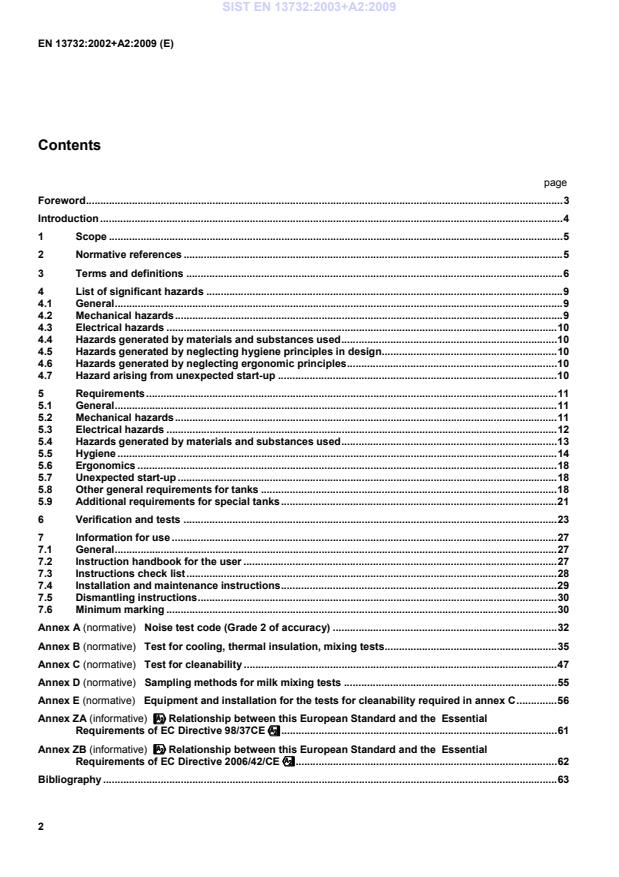
Noise test code (Grade 2 of accuracy) . 32Annex B (normative)
Test for cooling, thermal insulation, mixing tests . 35Annex C (normative)
Test for cleanability . 47Annex D (normative)
Sampling methods for milk mixing tests . 55Annex E (normative)
Equipment and installation for the tests for cleanability required in annex C . 56Annex ZA (informative)
####Relationship between this European Standard and the
Essential Requirements of EC Directive 98/37CE$$$$ . 61Annex ZB (informative)
####Relationship between this European Standard and the
Essential Requirements of EC Directive 2006/42/CE$$$$ . 62Bibliography . 63 SIST EN 13732:2003+A2:2009
!" and # $. This document has been prepared under a mandate given to CEN by the European Commission and the European Free Trade Association, and supports essential requirements of EU Directives. #For relationship with the EU Directives, see informative Annexes ZA and ZB, which are integral parts of this document.$ In this European Standard the annexes A, B, C, D and E are normative. According to the CEN/CENELEC Internal Regulations, the national standards organizations of the following countries are bound to implement this European Standard: Austria, Belgium, Bulgaria, Cyprus, Czech Republic, Denmark, Estonia, Finland, France, Germany, Greece, Hungary, Iceland, Ireland, Italy, Latvia, Lithuania, Luxembourg, Malta, Netherlands, Norway, Poland, Portugal, Romania, Slovakia, Slovenia, Spain, Sweden, Switzerland and United Kingdom.
5.7 concerns other requirements; 5.8 concerns additional requirements for special tanks. NOTE 2 For hazards which are to be reduced by the application of a standard such as EN 378-1:2000, EN 378-2:2000,
EN 378-3:2000, EN 378-4:2000, EN 1672-2:1997, EN 60204-1:1997, etc, the manufacturer should carry out a risk assessment to establish the requirements of this standard which are to be applied. This specific risk assessment should be part of the general risk assessment of the machine. Where the means of reducing the risk is by a safe system of working the machinery, the manufacturer shall include in the information for use details of the system and of the elements of training required by the operating personnel. 5.2 Mechanical hazards 5.2.1 Lids The opening, closing and locking operations shall require a positive action (examples: gravity, spring, hook, balancing cylinder, …). Hinged lids shall have a safe device to keep them in the open position. It shall be clearly and visibly marked, adjacent to the manhole, that: before the closing of the cover, it shall be checked that nobody is in the vessel; before entering the tank, it shall be necessary to read the instruction handbook. 5.2.2 Agitators 5.2.2.1 General No hazardous part of the agitator shall come into contact with the operator during the operation of the unit (see 5.2.2.2 and 5.2.2.3). No projecting parts shall be present on the agitator shaft with the exception of the agitator blades and accessories for the cleaning system. 5.2.2.2 Agitators attached to the lid For agitator attached to the lid of a tank, an interlocking device e.g. a mercury switch, a gravity switch with positive operation or a device complying with EN 1088:1995, shall be provided to automatically stop the agitator and disconnect the power of the agitator before the hazardous parts of the agitator can be reached on when opening the lid. 5.2.2.3 Agitators not attached to the lid For agitators not attached to the lid, the tank shall be clearly and visibly marked to the lids to indicate that the electrical supply of the tank shall be disconnected before entering the tank (see 7.5.6). SIST EN 13732:2003+A2:2009
Classification Performance temperature (PT) °C Safe operating temperature (SOT) °C A
B
C 38
25 43
Specified cooling time for all milkings from + 35 °C to + 4 °C h 0
I
II
III 2
2,5
3,5
5.5.1.2.2 Milk cooling rate If a tank for two milkings is either empty or contains 50 % of its rated volume of milk at + 4 °C, and 50 % of the rated volume of milk at + 35 °C is added in one batch, all of the milk shall be cooled to + 4 °C in not more than the specified cooling time. If a tank for four milkings is either empty or contains 25 %, 50 % or 75 % of the rated volume of milk at + 4 °C, and 25 % of the rated volume of milk at + 35 °C is added in one batch, all of the milk shall be cooled to + 4 °C in not more than the specified cooling time. If a tank for six milkings is either empty or contains 16,7 %; 33,3 %; 50 %; 66,7 % or 83,3 % of its rated volume of milk at + 4 °C and 16,7 % of the rated volume of milk at + 35 °C is added in one batch, all of the milk shall be cooled to + 4 °C in not more than the specified cooling time. The above requirements shall apply at ambient temperatures between + 5 °C and the PT. 5.5.1.2.3 Storage of the milk Under normal operating conditions the storage temperature of the milk, between cooling periods shall be not higher than + 4 °C. This requirement shall apply at ambient temperatures between + 5 °C and the PT. 5.5.1.2.4 Thermal insulation The tank shall be provided with thermal insulation the efficiency of which shall be such that at the PT the rate of rise of the mean temperature of the milk, initially at about + 4 °C, shall not exceed + 3 °C in 12 h when the rated volume is allowed to stand undisturbed, without agitation nor refrigeration. 5.5.1.2.5 Freezing of the milk Ice shall not form in the milk under the milk surface during either cooling or storage when the tank is used in ambient temperature between + 5 °C and the PT and is filled with milk to: a) for two milking tanks: between 20 % and 100 % of its rated volume; b) for four milking tanks: between 10 % and 100 % of its rated volume; c) for six milking tanks: between 6,7 % and 100 % of its rated volume. SIST EN 13732:2003+A2:2009
Key R
Radius Figure 1 - Inner vessel
Every component which is permanently attached within the inner vessel shall be welded to it. The welds shall have radii not less than 3 mm and the angles shall be not less than 1,57 rad (90°). All components which are not practical to be welded to the inner vessel shall be fastened so that they can be easily removed for cleaning. 5.5.2.3 Openings and lids in connection with the inner vessel a) !The tank shall be provided with at least one opening for inspection having dimensions of at least equivalent to an ellipse of 350 mm × 450 mm. Each opening shall have upturned edges not less than 10 mm high;" b) Each opening shall be provided with a lid which overlaps the opening and has adequate down turned edges to protect the milk from contamination; c) Openings and lids shall permit easy and safe inspection of all internal parts of the inner vessel, the milk and also sampling of the milk; d) On tanks to be cleaned manually the openings and lids shall be so constructed that all internal parts of the inner vessel can be cleaned easily and safely by hand from outside the tank; e) Openings and lids shall have all inside corners constructed to provide internal radii of not less than 3 mm; f) Any aperture in a lid, or a bridge which forms part of a tank lid assembly, shall also be provided with a cover. All apertures and covers shall comply with above requirements with regard to upturns, downturns and radii; g) Lids and covers over openings and apertures shall provide the inner vessel with a degree of protection against the ingress of foreign solid parts and water not less than IP 43 as detailed in EN 60529:1991. 5.5.2.4 Thermometers Glass thermometers and thermometers with mercury shall not be used. SIST EN 13732:2003+A2:2009
3 mm; d) the lowest point at which milk could enter a coupling on an agitator shall be at least 30 mm above the level of milk which corresponds to maximum volume. 5.5.2.6 Cleaning The inner vessel shall be designed to be cleanable as defined in 3.5.1 of EN 1672-2:1997. Tanks having a manhole(s) as the only access to the inner vessel, shall be fitted with an automatic cleaning equipment complying with annex C. 5.6 Ergonomics Lids shall be so designed and constructed that during the opening and closing operations the ergonomic requirements of EN 1005-3:2002 are fully met. The height of the rim of the tank above the floor or a permanent working platform shall be not more than 1,35 m at any access point when the tank is installed in its reference position. When this is achieved by means of ladder and platform assemblies fixed to the tank, these ladders and platforms shall comply with the following requirements: the platform dimensions shall be at least 300 mm wide and 250 mm deep; the distance from floor to the first step shall be max. 450 mm; the distance from the platform to the rim at the biggest opening of the tank shall be not less than 1 m. 5.7 Unexpected start-up As the tank is provided to operate under automatic control, the hazard due to unexpected start-up exists only during maintenance operations. Then it shall be able to be safely disconnected from electrical supply (see 5.2.2.3). If the electrical disconnecting device is not visible from the maintenance operating points, it shall be lockable. If the lockable disconnecting device is not a part of the tank, information shall be given in the instruction handbook (see 7.4). NOTE see 5.2.2.3. The same protective measure can be used for both requirements. 5.8 Other general requirements for tanks 5.8.1 Temperature resistance The tank and associated equipment shall be designed and constructed to withstand the following temperatures: operation from + 5 °C to SOT SIST EN 13732:2003+A2:2009
up to + 70 °C continuously 5.8.2 Inner vessel The inner vessel shall be so designed that the rated volume (Vr) is between 90 % and 98 % of the maximum volume (Vm). 5.8.3 Outer casing The outer casing shall be rigid, shall prevent the ingress of water and foreign matter and shall be self draining of surface water. 5.8.4 Thermal insulation The insulating material shall be non-settling and shall not be liable to displacement during storage, transportation or operation. Adequate provision shall be taken to ensure that the thermal insulation will comply permanently with the requirements of 5.5.1.2.4. 5.8.5 Supports and feet A tank shall be fitted with adjustable supports or feet to permit it to be placed in its reference position when installed on a floor with a gradient not greater than 1 in 50 in any direction so long as the fall of the floor between the outer supports is not greater than 50 mm. The distance between the tank and the floor (with the exception of the supports or feet) when installed on a horizontal floor shall be not less than 100 mm. 5.8.6 Milk inlet aperture The tank shall be provided with at least one milk inlet aperture. All milk inlet apertures shall have a diameter of not less than 40 mm, and not more than 210 mm. NOTE Milk should enter the tank without turbulence and without forming froth. 5.8.7 Outlet The tank shall be provided with an outlet. The outlet orifice and the bottom of the inner vessel shall be designed so that all the contents drain to the outlet. With the tank in its reference position and containing 40 l of test water, at least 39,8 l shall run out in 1 min by gravity. The highest point of the inside of the outer end of the outlet pipe, including the outlet valve, shall be lower than an imaginary line continued from the line of the inner vessel (see example in Figure 2).
Key 1 Horizontal 2 Line which represents the level of the vessel Figure 2 — Example of outlet pipe
The outlet pipe shall be constructed from stainless steel and shall have an inner diameter of at least 48 mm. The outlet pipe shall have not more than one bend and one detachable hygienic joint, or if an outlet valve is fitted 2 detachable hygienic joints. The outlet valve or, if there is no valve, the outlet pipe, shall terminate with a male thread fitting which shall be provided with a cap. The fitting shall comply with ISO 2852:1993 and ISO 2853:1993. The total length of the outlet shall be as short as practicable.
...