

EN 1200:2005
(Main)Chemicals used for treatment of water intended for human consumption - Trisodium orthophosphate
- Abstract
This document is applicable to trisodium orthophosphate used for treatment of water intended for human consumption. It describes the characteristics and specifies the requirements and the corresponding test methods for trisodium orthophosphate. It gives information on its use in water treatment. It also determines the rules relating to safe handling and use (see annex A).
- Status
- Published
- Publication Date
- 15-Mar-2005
- Technical Committee
- CEN/TC 164 - Water supply
- Drafting Committee
- CEN/TC 164/WG 9 - Drinking water treatment
- Current Stage
- 9093 - Decision to confirm - Review Enquiry
- Start Date
- 09-Mar-2026
- Completion Date
- 07-Oct-2026

Overview
EN 1200:2005 (CEN) specifies requirements for trisodium orthophosphate (Na3PO4) when used in the treatment of water intended for human consumption. The standard describes identification, physical and chemical properties, purity criteria, required test methods, and rules for labelling, transportation and storage. It also includes practical information on use in water treatment (Annex A) and safety rules (Annex B). EN 1200:2005 supersedes EN 1200:1997.
Key identifiers included:
- Chemical name: Trisodium orthophosphate (synonym: sodium phosphate, tribasic)
- Empirical formula: Na3PO4; relative molecular mass 164.0
- CAS: 7601-54-9; EINECS: 231-509-8
- Typical properties: 1% solution pH ≈ 12; solubility ≈ 120 g/L at 25 °C.
Key topics and technical requirements
- Scope and description: Commercial forms (powder, granules, clear solutions), bulk density ranges and solution densities.
- Composition: On a dry-mass basis the product shall contain:
- Phosphate (expressed as P2O5): (41 ± 1.0) %
- Sodium (expressed as Na2O): (53 ± 1.0) %
- Impurities limits (examples):
- Sulfate (SO4 2–): max 500 mg/kg
- Fluoride (F–): max 10 mg/kg
- Trace chemical parameters (examples):
- Antimony, arsenic, cadmium, selenium: max 3 mg/kg
- Chromium, lead, nickel: max 10 mg/kg
- Cyanide: max 5 mg/kg; mercury: max 1 mg/kg
- Test and sampling methods:
- Sampling: ISO 3165, ISO 6206, ISO 8213 guidance for solids and liquids (drums, tanks, tankers).
- Main composition: alkalimetric titration (pH endpoints ~4.45 and ~9.22) to determine P2O5 and Na2O.
- Impurities and trace elements: methods referenced include EN 1483, EN ISO 11885 (ICP), EN ISO 11969 (hydride AAS), ISO methods for fluoride, sulfate and cyanide.
- Labelling, storage and transport: requirements and safe-handling rules are detailed; Annex B is normative on safety.
Applications and users
Practical uses:
- Water utilities and treatment plant operators for corrosion control, pH adjustment and phosphate dosing.
- Chemical manufacturers and suppliers for product specification, QC and conformity assessment.
- Analytical laboratories performing quality control tests and regulatory compliance checks.
- Regulators and public health authorities referencing purity, impurity limits and testing protocols for chemicals used in drinking water.
Keywords: EN 1200:2005, trisodium orthophosphate, water treatment, drinking water standard, sodium phosphate, purity criteria, test methods, sampling, labelling, safety.
Related standards
Normative references cited in EN 1200:2005 include (selected): EN 1483, EN ISO 3696, EN ISO 11885, EN ISO 11969, ISO 2997, ISO 3360, ISO 3165, ISO 8213. These specify analytical and sampling procedures used to verify conformity.
Relations
- Effective Date
- 22-Dec-2008
- Effective Date
- 11-Mar-2026
- Effective Date
- 11-Mar-2026
- Effective Date
- 11-Mar-2026
- Refers
ISO 9174:1998 - Water quality — Determination of chromium — Atomic absorption spectrometric methods - Effective Date
- 11-Mar-2026
- Effective Date
- 11-Mar-2026
- Refers
ISO 6703-1:1984 - Water quality — Determination of cyanide — Part 1: Determination of total cyanide - Effective Date
- 11-Mar-2026
- Effective Date
- 11-Mar-2026
- Effective Date
- 09-Feb-2026
- Effective Date
- 09-Feb-2026
- Effective Date
- 28-Jan-2026
- Effective Date
- 28-Jan-2026
- Effective Date
- 28-Jan-2026
- Effective Date
- 28-Jan-2026
- Effective Date
- 28-Jan-2026
Get Certified
Connect with accredited certification bodies for this standard

ECOCERT
Organic and sustainability certification.

Eurofins Food Testing Global
Global leader in food, environment, and pharmaceutical product testing.

Intertek Bangladesh
Intertek certification and testing services in Bangladesh.
Sponsored listings
Frequently Asked Questions
EN 1200:2005 is a standard published by the European Committee for Standardization (CEN). Its full title is "Chemicals used for treatment of water intended for human consumption - Trisodium orthophosphate". This standard covers: This document is applicable to trisodium orthophosphate used for treatment of water intended for human consumption. It describes the characteristics and specifies the requirements and the corresponding test methods for trisodium orthophosphate. It gives information on its use in water treatment. It also determines the rules relating to safe handling and use (see annex A).
This document is applicable to trisodium orthophosphate used for treatment of water intended for human consumption. It describes the characteristics and specifies the requirements and the corresponding test methods for trisodium orthophosphate. It gives information on its use in water treatment. It also determines the rules relating to safe handling and use (see annex A).
EN 1200:2005 is classified under the following ICS (International Classification for Standards) categories: 71.100.80 - Chemicals for purification of water. The ICS classification helps identify the subject area and facilitates finding related standards.
EN 1200:2005 has the following relationships with other standards: It is inter standard links to EN 1200:1997, ISO 3360:1976, ISO 6206:1979, ISO 8288:1986, ISO 9174:1998, ISO 9965:1993, ISO 6703-1:1984, ISO 3165:1976, ISO 2997:1974, ISO 8213:1986, EN 13445-5:2002/A10:2008, EN 14847:2005, EN ISO 3696:1995, EN ISO 11885:2009, EN ISO 8751:1997. Understanding these relationships helps ensure you are using the most current and applicable version of the standard.
EN 1200:2005 is associated with the following European legislation: EU Directives/Regulations: 305/2011, 89/106/EEC. When a standard is cited in the Official Journal of the European Union, products manufactured in conformity with it benefit from a presumption of conformity with the essential requirements of the corresponding EU directive or regulation.
EN 1200:2005 is available in PDF format for immediate download after purchase. The document can be added to your cart and obtained through the secure checkout process. Digital delivery ensures instant access to the complete standard document.
Standards Content (Sample)
2003-01.Slovenski inštitut za standardizacijo. Razmnoževanje celote ali delov tega standarda ni dovoljeno.Kemikalije, ki se uporabljajo za pripravo pitne vode – Trinatrijev fosfatProdukte zur Aufbereitung von Wasser für den menschlichen Gebrauch - TrinatriumphosphatProduits chimiques utilisés pour le traitement de l'eau destinée a la consommation humaine - Phosphate trisodiqueChemicals used for treatment of water intended for human consumption - Trisodium orthophosphate71.100.80Chemicals for purification of water13.060.20Pitna vodaDrinking waterICS:Ta slovenski standard je istoveten z:EN 1200:2005SIST EN 1200:2005en01-julij-2005SIST EN 1200:2005SLOVENSKI
STANDARDSIST EN 1200:19991DGRPHãþD
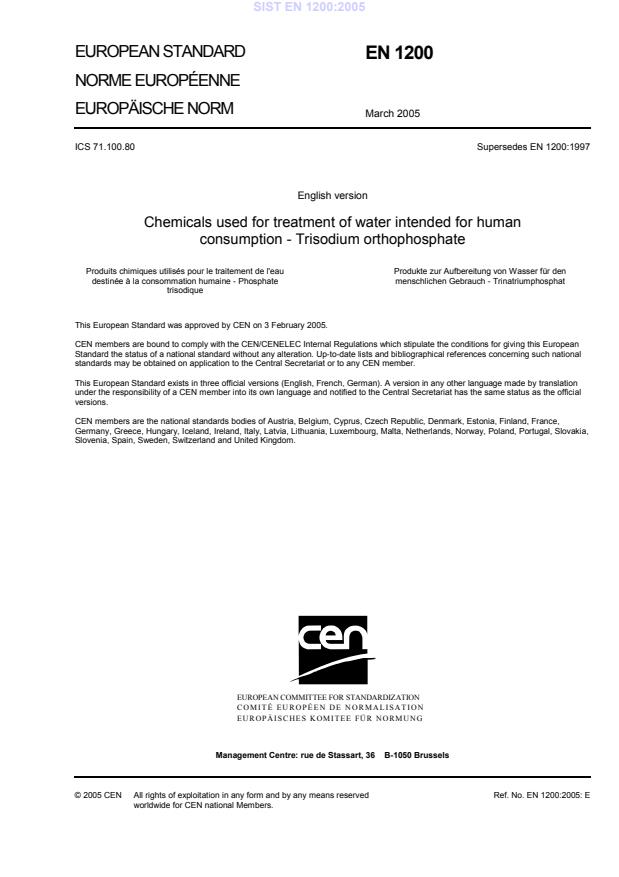
EUROPEAN STANDARD NORME EUROPÉENNE EUROPÄISCHE NORM
EN 1200
March 2005 ICS 71.100.80 Supersedes EN 1200:1997 English version
Chemicals used for treatment of water intended for human consumption - Trisodium orthophosphate
Produits chimiques utilisés pour le traitement de l'eau destinée à la consommation humaine - Phosphate trisodique
Produkte zur Aufbereitung von Wasser für den menschlichen Gebrauch - Trinatriumphosphat This European Standard was approved by CEN on 3 February 2005.
CEN members are bound to comply with the CEN/CENELEC Internal Regulations which stipulate the conditions for giving this European Standard the status of a national standard without any alteration. Up-to-date lists and bibliographical references concerning such national standards may be obtained on application to the Central Secretariat or to any CEN member.
This European Standard exists in three official versions (English, French, German). A version in any other language made by translation under the responsibility of a CEN member into its own language and notified to the Central Secretariat has the same status as the official versions.
CEN members are the national standards bodies of Austria, Belgium, Cyprus, Czech Republic, Denmark, Estonia, Finland, France, Germany, Greece, Hungary, Iceland, Ireland, Italy, Latvia, Lithuania, Luxembourg, Malta, Netherlands, Norway, Poland, Portugal, Slovakia, Slovenia, Spain, Sweden, Switzerland and United Kingdom.
EUROPEAN COMMITTEE FOR STANDARDIZATION COMITÉ EUROPÉEN DE NORMALISATION EUROPÄISCHES KOMITEE FÜR NORMUNG
Management Centre: rue de Stassart, 36
B-1050 Brussels © 2005 CEN All rights of exploitation in any form and by any means reserved worldwide for CEN national Members. Ref. No. EN 1200:2005: ESIST EN 1200:2005
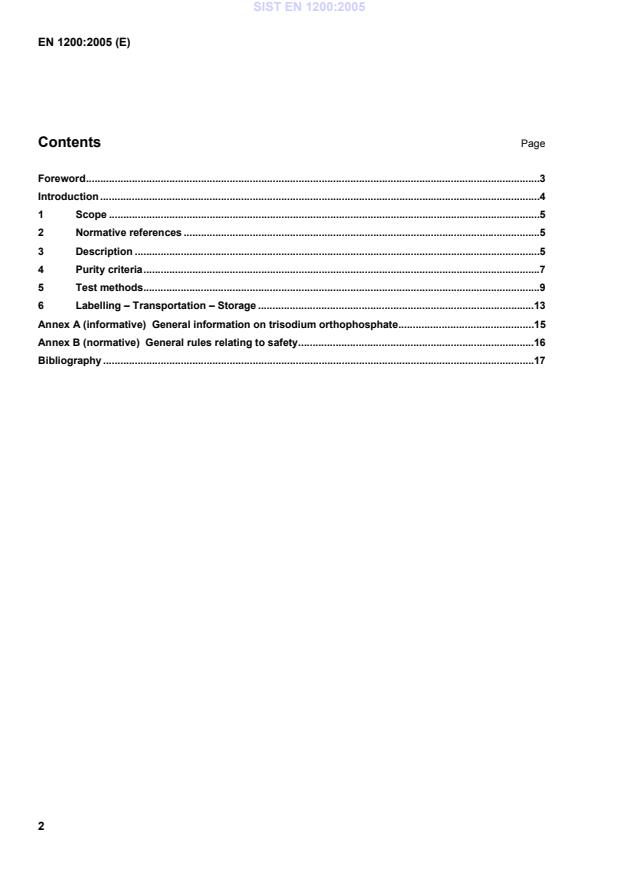
General information on trisodium orthophosphate.15 Annex B (normative)
General rules relating to safety.16 Bibliography.17
EN 26595 by EN ISO 11969; c) introduction of annex B as normative. According to the CEN/CENELEC Internal Regulations, the national standards organizations of the following countries are bound to implement this European Standard: Austria, Belgium, Cyprus, Czech Republic, Denmark, Estonia, Finland, France, Germany, Greece, Hungary, Iceland, Ireland, Italy, Latvia, Lithuania, Luxembourg, Malta, Netherlands, Norway, Poland, Portugal, Slovakia, Slovenia, Spain, Sweden, Switzerland and United Kingdom. SIST EN 1200:2005
- Determination of arsenic- Atomic absorption spectrometric method (hydride technique (ISO 11969:1996)). ISO 2997, Phosphoric acid for industrial use – Determination of sulfate content – Method by reduction and titrimetry. ISO 3165, Sampling of chemical products for industrial use – Safety in sampling. ISO 3360, Phosphoric acid and sodium phosphates for industrial use (including foodstuffs) - Determination of fluorine content – Alizarin complexone and lanthanum nitrate photometric method. ISO 6206, Chemical products for industrial use – Sampling – Vocabulary. ISO 6703-1, Water quality – Determination of cyanide – Part 1 : Determination of total cyanide. ISO 8213, Chemical products for industrial use – Sampling techniques – Solid chemical products in the form of particles varying from powders to coarse lumps. ISO 8288, Water quality – Determination of cobalt, nickel, copper, zinc, cadmium and lead – Flame atomic absorption spectrometric methods. ISO 9174, Water quality – Determination of chromium – Atomic absorption spectrometric methods. ISO 9965, Water quality – Determination of selenium – Atomic absorption spectrometric method (hydride technique). 3 Description 3.1 Identification 3.1.1 Chemical name Trisodium orthophosphate. SIST EN 1200:2005
3.1.3 Relative molecular mass 164,0. 3.1.4 Empirical formula Na3PO4. 3.1.5 Chemical formula Na3PO4. 3.1.6 CAS Registry Number1) 7601-54-9. 3.1.7 EINECS reference2) 231-509-8. 3.2 Commercial forms The trisodium orthophosphate is available in a number of different forms (see 3.3.1). Different commercial forms, solids or dissolved in water are possible. All concentrations mentioned refer to the active matter and shall be calculated accordingly. NOTE Trisodium orthophosphate can be a component of mixtures sold for water treatment purposes. 3.3 Physical properties 3.3.1 Appearance Solid : the product is a white powder or granules. Liquid : the product is a clear solution. 3.3.2 Density Solid : the bulk density of this product varies from 400 g/dm3 to 1 000 g/dm3. Liquid : the density of solution is 1,047 g/ml for a product concentration of 50 g/l at 20 °C. 3.3.3 Solubility in water The solubility in water is approximately 120 g/l at 25 °C.
1) Chemical Abstracts Service Registry Number. 2) European Inventory of Existing Commercial Chemical Substances. SIST EN 1200:2005
3) 100 kPa = 1 bar. SIST EN 1200:2005
mass fraction of (41 ± 1,0) in %
; sodium content expressed as Na2O :
mass fraction of (53 ± 1,0) in % . 4.3 Impurities and main by-products The product shall conform to the requirements specified in Table 1. Table 1 — Impurities Impurity
Limit
mg/kg of dry product Sulfate (SO42-) max.500 Fluoride (F-) max.10 4.4 Chemical parameters Content of various chemical parameters depends on the origin of the raw materials, most of these elements are present only as traces. The product shall conform to the requirements specified in Table 2. Table 2 — Chemical parameters Parameter
Limit
mg/kg of dry product Antimony (Sb) max. 3 Arsenic (As) max. 3 Cadmium (Cd) max. 3 Chromium (Cr) max. 10 Cyanide (CN) max. 5 Lead (Pb) max. 10 Mercury (Hg) max. 1 Nickel (Ni) max. 10 Selenium (Se) max. 3 NOTE Pesticides and polycyclic aromatic hydrocarbons are not relevant in trisodium orthophosphate. For parametric values of trisodium orthophosphate on trace metal content in drinking water, see [1]. SIST EN 1200:2005
...