

EN 14917:2021+A1:2026
(Main + Amendment)Metal bellows expansion joints for pressure applications
General Information
- Abstract
This document specifies the requirements for design, manufacture and installation of metal bellows expansion joints with circular cross section for pressure applications with maximum allowable pressure greater than 0,5 bar.
- Status
- Published
- Publication Date
- 07-Apr-2026
- Technical Committee
- CEN/TC 342 - Metal hoses, hose assemblies, bellows and expansion joints
- Drafting Committee
- CEN/TC 342/WG 2 - Expansion joints
- Current Stage
- 6060 - Definitive text made available (DAV) - Publishing
- Start Date
- 08-Apr-2026
- Due Date
- 11-Sep-2025
- Completion Date
- 08-Apr-2026

Overview
EN 14917:2021+A1:2026 is a European standard developed by CEN for metal bellows expansion joints used in pressure applications. This standard outlines the requirements for the design, manufacture, and installation of metal bellows expansion joints with a circular cross-section, specifically for applications where the maximum allowable pressure exceeds 0.5 bar. Its scope covers pipeline and pressure vessel components across various industries, setting a framework for safe and reliable operation under pressure.
This standard ensures metal bellows expansion joints meet stringent quality, performance, and safety criteria and aligns with Directive 2014/68/EU on pressure equipment. Adoption of EN 14917 harmonizes practices across Europe and improves compatibility, performance, and regulatory compliance.
Key Topics
EN 14917:2021+A1:2026 includes comprehensive requirements and guidelines, such as:
- Design Criteria: Outlines principles for safe design, including stress calculations, fatigue analysis, and consideration of various loading scenarios (axial, angular, lateral, universal movements, and pressure balance).
- Material Requirements: Specifies allowable materials for pressure-bearing and non-pressure-bearing components, with requirements for ductility, toughness, and traceability.
- Manufacturing Practices: Covers fabrication processes, joining methods, heat treatment, and forming techniques for bellows and associated hardware.
- Testing and Inspection: Details procedures for in-process and final inspections, non-destructive testing (NDT) methods, quality documentation, and acceptance criteria in line with pressure equipment standards.
- Installation and Handling: Provides guidelines for transportation, handling, storage, installation, and mounting of expansion joints to maintain integrity and safety.
- Marking and Labelling: Requires specific marking for traceability, including compliance with applicable standards and operating parameters.
- Risk Assessment: Addresses risk analyses as mandated by EU regulations, with recommendations for minimizing risks in pressure systems.
- Documentation: Specifies comprehensive documentation from manufacturing through installation, including material certificates, testing results, and user instructions.
Applications
Metal bellows expansion joints covered by EN 14917:2021+A1:2026 are vital in:
- Industrial Piping Systems: Absorbing thermal expansion, vibration, and movement in pipelines carrying steam, gases, or fluids under pressure.
- Pressure Vessels: Compensating for dynamic loads and alignment deviations in pressure-retaining equipment.
- Power Plants: Managing high-temperature and high-pressure conditions in boiler and heat exchanger connections.
- Chemical and Petrochemical Plants: Ensuring safe operation in corrosive environments and systems with fluctuating pressure and temperature.
- HVAC and Building Services: Reducing stress and movement in pressured water and steam lines.
These applications benefit from improved safety, extended equipment life, enhanced reliability, and simplified compliance with European and national regulations.
Related Standards
EN 14917:2021+A1:2026 references or complements several key standards, including:
- EN 764 Series: Pressure equipment technical delivery and inspection documentation
- EN 1092-1: Flanges and their joints for pipes and fittings
- EN 1591-1: Gasketed flange connections - calculation rules
- EN 10028 Series: Flat products made of steels for pressure purposes
- EN 10216 / EN 10217 Series: Seamless and welded steel tubes for pressure purposes
- EN 13445 & EN 13480 series: Unfired pressure vessels and metallic piping design
- EN ISO 148-1, EN ISO 5817, EN ISO 9606-1: Testing and qualification related to metallic materials and welding
Practical Value
Compliance with EN 14917:2021+A1:2026 assures customers and regulators of quality and safety in pressure systems. The standard provides manufacturers, specifiers, and installers with clear requirements, promoting operational reliability and facilitating regulatory approval across the European market. Using EN 14917 improves product performance, reduces failure risk, and streamlines supply chain quality assurance for metal bellows expansion joints in pressure applications.
Relations
- Effective Date
- 14-Jan-2026
- Effective Date
- 06-May-2026
- Effective Date
- 06-May-2026
- Effective Date
- 06-May-2026
- Effective Date
- 06-May-2026
- Effective Date
- 06-May-2026
- Effective Date
- 06-May-2026
- Effective Date
- 06-May-2026
- Effective Date
- 06-May-2026
- Effective Date
- 06-May-2026
- Effective Date
- 06-May-2026
- Effective Date
- 06-May-2026
- Effective Date
- 06-May-2026
- Effective Date
- 06-May-2026
- Refers
EN 10028-7:2016 - Flat products made of steels for pressure purposes - Part 7: Stainless steels - Effective Date
- 06-May-2026
Get Certified
Connect with accredited certification bodies for this standard

Institut za varilstvo d.o.o. (Welding Institute)
Slovenia's leading welding institute since 1952. ISO 3834, EN 1090, pressure equipment certification, NDT personnel, welder qualification. Only IIW Au
Sponsored listings
Frequently Asked Questions
EN 14917:2021+A1:2026 is a standard published by the European Committee for Standardization (CEN). Its full title is "Metal bellows expansion joints for pressure applications". This standard covers: This document specifies the requirements for design, manufacture and installation of metal bellows expansion joints with circular cross section for pressure applications with maximum allowable pressure greater than 0,5 bar.
This document specifies the requirements for design, manufacture and installation of metal bellows expansion joints with circular cross section for pressure applications with maximum allowable pressure greater than 0,5 bar.
EN 14917:2021+A1:2026 is classified under the following ICS (International Classification for Standards) categories: 23.040.99 - Other pipeline components. The ICS classification helps identify the subject area and facilitates finding related standards.
EN 14917:2021+A1:2026 has the following relationships with other standards: It is inter standard links to EN 14917:2021, EN ISO 15614-8:2016, EN ISO 15613:2004, EN ISO 15614-11:2002, EN ISO 15614-12:2014, EN ISO 14732:2013, EN ISO 15609-5:2011, EN ISO 9712:2012, EN ISO 9445-2:2010, EN 13480-2:2017, EN 10028-4:2017, EN ISO 15614-6:2006, EN 10222-2:2017, EN 764-4:2014, EN 10028-7:2016. Understanding these relationships helps ensure you are using the most current and applicable version of the standard.
EN 14917:2021+A1:2026 is associated with the following European legislation: EU Directives/Regulations: 2014/68/EU; Standardization Mandates: M/601. When a standard is cited in the Official Journal of the European Union, products manufactured in conformity with it benefit from a presumption of conformity with the essential requirements of the corresponding EU directive or regulation.
EN 14917:2021+A1:2026 is available in PDF format for immediate download after purchase. The document can be added to your cart and obtained through the secure checkout process. Digital delivery ensures instant access to the complete standard document.
Standards Content (Sample)
SLOVENSKI STANDARD
01-junij-2026
Kompenzatorji s kovinskimi mehovi v tlačnih cevovodih (vključno z dopolnilom
A1)
Metal bellows expansion joints for pressure applications
Kompensatoren mit metallischen Bälgen für Druckanwendungen
Compensateurs de dilatation à soufflets métalliques pour appareils à pression
Ta slovenski standard je istoveten z: EN 14917:2021+A1:2026
ICS:
23.040.99 Drugi sestavni deli za Other pipeline components
cevovode
2003-01.Slovenski inštitut za standardizacijo. Razmnoževanje celote ali delov tega standarda ni dovoljeno.
EN 14917:2021+A1
EUROPEAN STANDARD
NORME EUROPÉENNE
April 2026
EUROPÄISCHE NORM
ICS 23.040.99 Supersedes EN 14917:2021
English Version
Metal bellows expansion joints for pressure applications
Compensateurs de dilatation à soufflets métalliques Kompensatoren mit metallischen Bälgen für
pour appareils à pression Druckanwendungen
This European Standard was approved by CEN on 21 June 2021 and includes Amendment 1 approved by CEN on 2 February
2026.
CEN members are bound to comply with the CEN/CENELEC Internal Regulations which stipulate the conditions for giving this
European Standard the status of a national standard without any alteration. Up-to-date lists and bibliographical references
concerning such national standards may be obtained on application to the CEN-CENELEC Management Centre or to any CEN
member.
This European Standard exists in three official versions (English, French, German). A version in any other language made by
translation under the responsibility of a CEN member into its own language and notified to the CEN-CENELEC Management
Centre has the same status as the official versions.
CEN members are the national standards bodies of Austria, Belgium, Bulgaria, Croatia, Cyprus, Czech Republic, Denmark, Estonia,
Finland, France, Germany, Greece, Hungary, Iceland, Ireland, Italy, Latvia, Lithuania, Luxembourg, Malta, Netherlands, Norway,
Poland, Portugal, Republic of North Macedonia, Romania, Serbia, Slovakia, Slovenia, Spain, Sweden, Switzerland, Türkiye and
United Kingdom.
EUROPEAN COMMITTEE FOR STANDARDIZATION
COMITÉ EUROPÉEN DE NORMALISATION
EUROPÄISCHES KOMITEE FÜR NORMUNG
CEN-CENELEC Management Centre: Rue de la Science 23, B-1040 Brussels
© 2026 CEN All rights of exploitation in any form and by any means reserved Ref. No. EN 14917:2021+A1:2026 E
worldwide for CEN national Members.
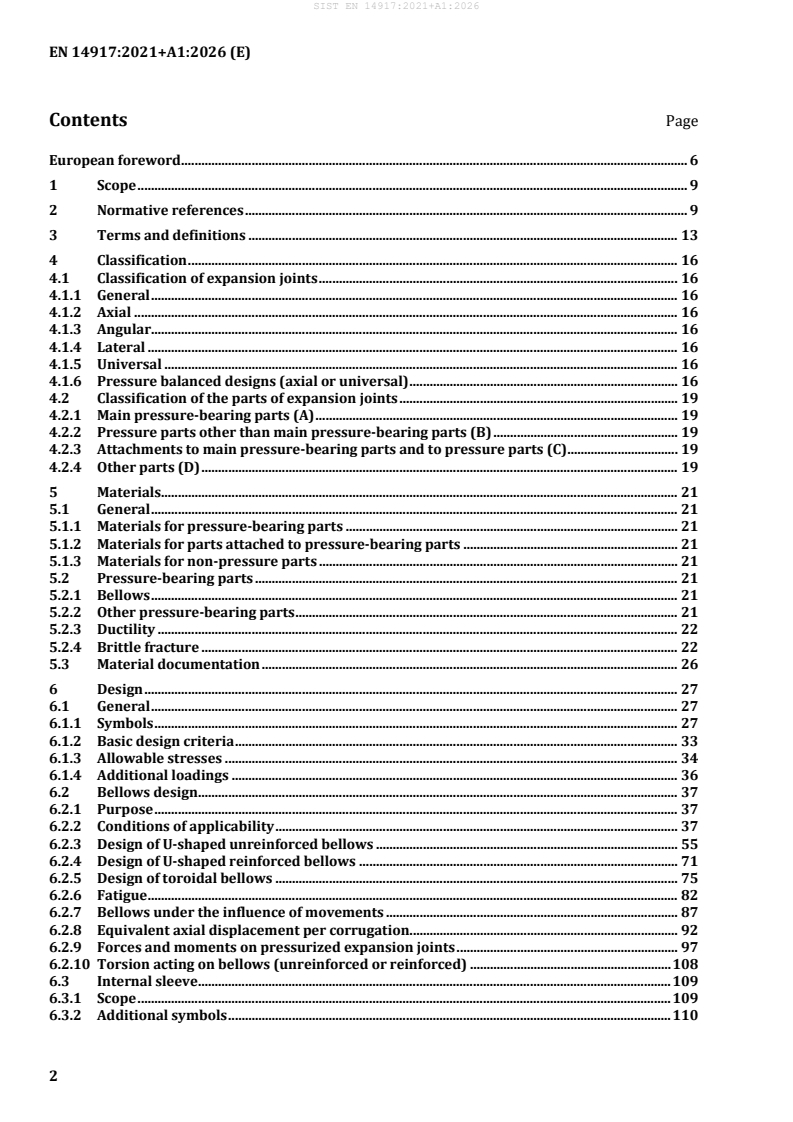
Contents Page
European foreword . 6
1 Scope . 9
2 Normative references . 9
3 Terms and definitions . 13
4 Classification . 16
4.1 Classification of expansion joints . 16
4.1.1 General . 16
4.1.2 Axial . 16
4.1.3 Angular . 16
4.1.4 Lateral . 16
4.1.5 Universal . 16
4.1.6 Pressure balanced designs (axial or universal) . 16
4.2 Classification of the parts of expansion joints . 19
4.2.1 Main pressure-bearing parts (A) . 19
4.2.2 Pressure parts other than main pressure-bearing parts (B) . 19
4.2.3 Attachments to main pressure-bearing parts and to pressure parts (C) . 19
4.2.4 Other parts (D) . 19
5 Materials . 21
5.1 General . 21
5.1.1 Materials for pressure-bearing parts . 21
5.1.2 Materials for parts attached to pressure-bearing parts . 21
5.1.3 Materials for non-pressure parts . 21
5.2 Pressure-bearing parts . 21
5.2.1 Bellows . 21
5.2.2 Other pressure-bearing parts . 21
5.2.3 Ductility . 22
5.2.4 Brittle fracture . 22
5.3 Material documentation . 26
6 Design . 27
6.1 General . 27
6.1.1 Symbols . 27
6.1.2 Basic design criteria . 33
6.1.3 Allowable stresses . 34
6.1.4 Additional loadings . 36
6.2 Bellows design . 37
6.2.1 Purpose . 37
6.2.2 Conditions of applicability . 37
6.2.3 Design of U-shaped unreinforced bellows . 55
6.2.4 Design of U-shaped reinforced bellows . 71
6.2.5 Design of toroidal bellows . 75
6.2.6 Fatigue . 82
6.2.7 Bellows under the influence of movements . 87
6.2.8 Equivalent axial displacement per corrugation . 92
6.2.9 Forces and moments on pressurized expansion joints . 97
6.2.10 Torsion acting on bellows (unreinforced or reinforced) . 108
6.3 Internal sleeve . 109
6.3.1 Scope . 109
6.3.2 Additional symbols . 110
6.3.3 Flow velocity . 110
6.3.4 Design conditions . 112
6.4 Hardware . 113
6.4.1 General . 113
6.4.2 Design parameters . 113
6.4.3 Hardware parts . 115
6.4.4 Permanent joints . 116
7 Manufacturing . 118
7.1 General . 118
7.2 Materials . 118
7.2.1 General . 118
7.2.2 Material traceability . 119
7.3 Permanent joints . 119
7.3.1 General . 119
7.3.2 Process and personal . 119
7.3.3 Repair and rework during manufacturing . 120
7.4 Forming of the bellows . 120
7.4.1 Forming processes . 120
7.4.2 Heat treatment . 121
7.5 Tolerances . 122
7.5.1 General . 122
7.5.2 Bellows . 122
7.5.3 Expansion joint . 123
7.6 Production tests . 124
8 Testing, inspection and documentation . 124
8.1 General . 124
8.2 Abbreviations . 124
8.3 Documents . 124
8.4 In-process inspection and testing . 125
8.4.1 General . 125
8.4.2 Materials . 125
8.4.3 Permanent joints . 125
8.4.4 Non-destructive testing of welds . 127
8.5 NDT methods . 134
8.5.1 Quality level . 134
8.5.2 Acceptance levels and testing techniques . 134
8.5.3 Non-destructive testing Personnel qualifications and approval . 135
8.5.4 Non-destructive testing documentation . 135
8.6 Final assessment and documentation . 137
8.6.1 General . 137
8.6.2 Final inspection . 138
8.7 Documentation . 140
8.7.1 Final documentation package . 140
8.7.2 Declaration/certification . 140
8.7.3 Operating instructions . 141
9 Marking and labelling . 141
10 Handling and installation . 141
10.1 General instructions . 141
10.2 Packaging and storage . 142
10.3 Installation . 142
10.4 Unrestrained expansion joints . 142
10.5 Restrained expansions joints. 142
Annex A (informative) Categories of expansion joints . 143
A.1 General . 143
A.2 Determination of expansion joints categories . 143
A.3 Fluid groups . 143
A.4 Technical requirements. 144
A.5 Expansion joint category . 145
Annex B (informative) Specification for materials 1.4828, 1.4876, 2.4360 and 2.4858 . 147
Annex C (informative) Incorporation of expansion joints into piping or pressure vessels . 154
C.1 General . 154
C.2 Specific symbols and definitions . 155
C.3 Application criteria for expansion joints in piping . 156
C.4 Application criteria for expansion joints in pressure vessels . 173
Annex D (informative) Calculation methods for systems of pipes containing expansion joints . 175
D.1 General . 175
D.2 Approximate calculation of bellows movement . 177
D.3 Exact calculation of bellows movement . 182
D.4 Calculation of forces and moments . 190
Annex E (informative) Explanatory notes on the design of expansion bellows . 191
E.1 General . 191
E.2 Calculation design . 191
E.3 Types of bellows . 192
E.4 Fatigue life expectancy . 192
E.5 Instability . 193
E.6 Bellows spring rate . 194
Annex F (informative) Procedure for setting-up a design fatigue curve . 196
F.1 General . 196
F.2 Procedure for setting up a design fatigue curve for expansion bellows . 196
F.3 Tests . 197
F.4 Evaluation of the test results . 199
F.5 Linear regression . 204
Annex G (informative) Polynomial approximations for coefficients C , C , C . 205
p f d
G.1 Coefficient C . 205
p
G.2 Coefficient C . 206
f
G.3 Coefficient C . 207
d
G.4 Linear interpolation . 208
Annex H (informative) Required design data and information . 210
H.1 Required design conditions. 210
H.2 Additional information . 210
Annex I (informative) Expansion joints risk analyses . 211
Annex J (informative) Additional material properties . 212
Annex K (normative) Hardware calculation . 216
K.1 General . 216
K.2 Additional symbols . 216
K.3 Force due to pressure . 220
K.4 Tie bar . 220
K.5 Pin . 222
K.6 Lug with bore . 224
K.7 Gimbal, square and round . 227
K.8 Attachment plate. 232
K.9 Lug-plate connection (hinge/gimbal) . 243
K.10 Tie bar and lug attachment on flanges . 248
K.11 Gusset . 255
K.12 Gusset with reinforcing rings . 255
Annex L (informative) Benchmarks for calculation . 261
Annex ZA (informative) !Relationship between this European Standard and the Essential
Requirements of EU Directive 2014/68/EU. 275
Bibliography . 277
European foreword
This document (EN 14917:2021+A1:2026) has been prepared by Technical Committee CEN/TC 342
“Metal hoses, hose assemblies, bellows and expansion joints”, the secretariat of which is held by SNV.
This European Standard shall be given the status of a national standard, either by publication of an
identical text or by endorsement, at the latest by October 2026, and conflicting national standards shall
be withdrawn at the latest by October 2026.
Attention is drawn to the possibility that some of the elements of this document may be the subject of
patent rights. CEN shall not be held responsible for identifying any or all such patent rights.
This document includes Amendment 1 approved by CEN on 2 February 2026.
This document supersedes !EN 14917:2021".
The start and finish of text introduced or altered by amendment is indicated in the text by tags !".
!This document has been prepared under a standardization request addressed to CEN by the European
Commission. The Standing Committee of the EFTA States subsequently approves these requests for its
Member States.
For the relationship with EU Legislation, see informative Annex ZA, which is an integral part of this
document."
Modifications to EN 14917:2009+A1:2012:
— adaptation to Directive 2014/68/EU;
— general revision and correction;
— complete revision and restructuring of Clause 6, i.a.;
— addition of design in the creep range;
— modification of stress calculation for internal pressure capability;
— reformulation of column instability calculation;
— modification of in-plane instability calculation;
— harmonisation of fatigue calculation for all bellows types and introduction of 4 fatigue curves for
different material classes;
— extension of material characteristics for calculating forces and moments on pressurised
expansion joints;
— addition of Annex K for stress calculation of hardware;
— revision of Testing, inspection and documentation;
— revision of material properties in Annex B and Annex J;
— correction of Coefficient C .
p
Any feedback and questions on this document should be directed to the users’ national standards body.
A complete listing of these bodies can be found on the CEN website.
According to the CEN-CENELEC Internal Regulations, the national standards organizations of the
following countries are bound to implement this European Standard: Austria, Belgium, Bulgaria, Croatia,
Cyprus, Czech Republic, Denmark, Estonia, Finland, France, Germany, Greece, Hungary, Iceland, Ireland,
Italy, Latvia, Lithuania, Luxembourg, Malta, Netherlands, Norway, Poland, Portugal, Republic of North
Macedonia, Romania, Serbia, Slovakia, Slovenia, Spain, Sweden, Switzerland, Türkiye and the United
Kingdom.
Introduction
Metal bellows expansion joints are used as parts in pressure vessels or piping components.
If an expansion joint is designed and manufactured covered by EU-Directive 2014/68/EU a risk
assessment has to be done. The possible risks of an expansion joint and how they have been dealt in this
document are described in Annex I.
1 Scope
This document specifies the requirements for design, manufacture and installation of metal bellows
expansion joints with circular cross section for pressure applications with maximum allowable pressure
greater than 0,5 bar.
2 Normative references
The following documents are referred to in the text in such a way that some or all of their content
constitutes requirements of this document. For dated references, only the edition cited applies. For
undated references, the latest edition of the referenced document (including any amendments)
applies.
EN 764-4:2014, Pressure equipment — Part 4: Establishment of technical delivery conditions for
metallic materials
EN 764-5:2014, Pressure equipment — Part 5: Inspection documentation of metallic materials and
compliance with the material specification
EN 1092-1:2018, Flanges and their joints — Circular flanges for pipes, valves, fittings and accessories,
PN designated — Part 1: Steel flanges
EN 1591-1:2013, Flanges and their joints — Design rules for gasketed circular flange connections — Part 1:
Calculation
EN 1759-1:2004, Flanges and their joints — Circular flanges for pipes, valves, fittings and accessories, Class
designated — Part 1: Steel flanges, NPS 1/2 to 24
EN 10028-1:2017, Flat products made of steels for pressure purposes — Part 1: General requirements
EN 10028-2:2017, Flat products made of steels for pressure purposes — Part 2: Non-alloy and alloy steels
with specified elevated temperature properties
EN 10028-3:2017, Flat products made of steels for pressure purposes — Part 3: Weldable fine grain steels,
normalized
EN 10028-4:2017, Flat products made of steels for pressure purposes — Part 4: Nickel alloy steels with
specified low temperature properties
EN 10028-7:2016, Flat products made of steels for pressure purposes — Part 7: Stainless steels
EN 10204:2004, Metallic products — Types of inspection documents
EN 10216-1:2013, Seamless steel tubes for pressure purposes — Technical delivery conditions — Part 1:
Non-alloy steel tubes with specified room temperature properties
EN 10216-2:2013+A1:2019, Seamless steel tubes for pressure purposes — Technical delivery conditions —
Part 2: Non-alloy and alloy steel tubes with specified elevated temperature properties
EN 10216-3:2013, Seamless steel tubes for pressure purposes — Technical delivery conditions — Part 3:
Alloy fine grain steel tubes
EN 10216-4:2013, Seamless steel tubes for pressure purposes — Technical delivery conditions — Part 4:
Non-alloy and alloy steel tubes with specified low temperature properties
EN 10216-5:2013, Seamless steel tubes for pressure purposes — Technical delivery conditions — Part 5:
Stainless steel tubes
EN 10217-1:2019, Welded steel tubes for pressure purposes — Technical delivery conditions — Part 1:
Electric welded and submerged arc welded non-alloy steel tubes with specified room temperature properties
EN 10217-2:2019, Welded steel tubes for pressure purposes — Technical delivery conditions — Part 2:
Electric welded non-alloy and alloy steel tubes with specified elevated temperature properties
EN 10217-3:2019, Welded steel tubes for pressure purposes — Technical delivery conditions — Part 3:
Electric welded and submerged arc welded alloy fine grain steel tubes with specified room, elevated and low
temperature properties
EN 10217-4:2019, Welded steel tubes for pressure purposes — Technical delivery conditions — Part 4:
Electric welded non-alloy steel tubes with specified low temperature properties
EN 10217-5:2019, Welded steel tubes for pressure purposes — Technical delivery conditions — Part 5:
Submerged arc welded non-alloy and alloy steel tubes with specified elevated temperature properties
EN 10217-6:2019, Welded steel tubes for pressure purposes — Technical delivery conditions — Part 6:
Submerged arc welded non-alloy steel tubes with specified low temperature properties
EN 10217-7:2014, Welded steel tubes for pressure purposes — Technical delivery conditions — Part 7:
Stainless steel tubes
EN 10222-2:2017, Steel forgings for pressure purposes — Part 2: Ferritic and martensitic steels with
specified elevated temperatures properties
EN 10222-3:2017, Steel forgings for pressure purposes — Part 3: Nickel steels with specified low
temperature properties
EN 10222-4:2017, Steel forgings for pressure purposes — Part 4: Weldable fine grain steels with high proof
strength
EN 10222-5:2017, Steel forgings for pressure purposes — Part 5: Martensitic, austenitic and austenitic-
ferritic stainless steels
EN 10253-2:2007, Butt-welding pipe fittings — Part 2: Non alloy and ferritic alloy steels with specific
inspection requirements
EN 10253-3:2008, Butt-welding pipe fittings — Part 3: Wrought austenitic and austenitic-ferritic (duplex)
stainless steels without specific inspection requirements
EN 10253-4:2008, Butt-welding pipe fittings — Part 4: Wrought austenitic and austenitic-ferritic (duplex)
stainless steels with specific inspection requirements
EN 10269:2013, Steels and nickel alloys for fasteners with specified elevated and/or low temperature
properties
EN 10272:2016, Stainless steel bars for pressure purposes
EN 10273:2016, Hot rolled weldable steel bars for pressure purposes with specified elevated temperature
properties
EN 13184:2001, Non-destructive testing — Leak testing — Pressure change method
!EN 13445-2:2021+A1:2023", Unfired pressure vessels — Part 2: Materials
!EN 13445-3:2021", Unfired pressure vessels — Part 3: Design
EN 13480-2:2017, Metallic industrial piping — Part 2: Materials
EN 13480-2:2017/A1:2018, Metallic industrial piping — Part 2: Materials
EN 13480-2:2017/A2:2018, Metallic industrial piping — Part 2: Materials
EN 13480-2:2017/A3:2018, Metallic industrial piping — Part 2: Materials
EN 13480-3:2017, Metallic industrial piping — Part 3: Design and calculation
EN ISO 148-1:2016, Metallic materials — Charpy pendulum impact test — Part 1: Test method
(ISO 148-1:2016)
EN ISO 643:2020, Steels — Micrographic determination of the apparent grain size (ISO 643:2019, Corrected
version 2020-03)
EN ISO 3651-2:1998, Determination of resistance to intergranular corrosion of stainless steels — Part 2:
Ferritic, austenitic and ferritic-austenitic (duplex) stainless steels — Corrosion test in media containing
sulfuric acid (ISO 3651-2:1998)
EN ISO 5817:2014, Welding — Fusion-welded joints in steel, nickel, titanium and their alloys (beam welding
excluded) — Quality levels for imperfections (ISO 5817:2014)
EN ISO 6506-1:2014, Metallic materials — Brinell hardness test — Part 1: Test method (ISO 6506-1:2014)
EN ISO 6892-1:2019, Metallic materials — Tensile testing — Part 1: Method of test at room temperature
(ISO 6892-1:2019)
EN ISO 6892-2:2018, Metallic materials — Tensile testing — Part 2: Method of test at elevated temperature
(ISO 6892-2:2018)
EN ISO 9445-1:2010, Continuously cold-rolled stainless steel — Tolerances on dimensions and form — Part
1: Narrow strip and cut lengths (ISO 9445-1:2009)
EN ISO 9445-2:2010, Continuously cold-rolled stainless steel — Tolerances on dimensions and form — Part
2: Wide strip and plate/sheet (ISO 9445-2:2009)
EN ISO 9606-1:2017, Qualification testing of welders — Fusion welding — Part 1: Steels (ISO 9606-1:2012
including Cor 1:2012 and Cor 2:2013)
EN ISO 9606-4:1999, Approval testing of welders — Fusion welding — Part 4: Nickel and nickel alloys
(ISO 9606-4:1999)
EN ISO 9712:2012, Non-destructive testing — Qualification and Certification of NDT personnel
(ISO 9712:2012)
EN ISO 14732:2013, Welding personnel — Qualification testing of welding operators and weld setters for
mechanized and automatic welding of metallic materials (ISO 14732:2013)
EN ISO 15609-1:2019, Specification and qualification of welding procedures for metallic materials —
Welding procedure specification — Part 1: Arc welding (ISO 15609-1:2019)
EN ISO 15609-2:2019, Specification and qualification of welding procedures for metallic materials —
Welding procedure specification — Part 2: Gas welding (ISO 15609-2:2019)
EN ISO 15609-3:2004, Specification and qualification of welding procedures for metallic materials —
Welding procedures specification — Part 3: Electron beam welding (ISO 15609-3:2004)
EN ISO 15609-4:2009, Specification and qualification of welding procedures for metallic materials —
Welding procedure specification — Part 4: Laser beam welding (ISO 15609-4:2009)
EN ISO 15609-5:2011, Specification and qualification of welding procedures for metallic materials —
Welding procedure specification — Part 5: Resistance welding (ISO 15609-5:2011, Corrected version 2011-
12-01)
EN ISO 15609-6:2013, Specification and qualification of welding procedures for metallic materials —
Welding procedure specification — Part 6: Laser-arc hybrid welding (ISO 15609-6:2013)
EN ISO 15610:2003, Specification and qualification of welding procedures for metallic materials —
Qualification based on tested welding consumables (ISO 15610:2003)
EN ISO 15613:2004, Specification and qualification of welding procedures for metallic materials —
Qualification based on pre-production welding test (ISO 15613:2004)
EN ISO 15614-1:2017, Specification and qualification of welding procedures for metallic materials —
Welding procedure test — Part 1: Arc and gas welding of steels and arc welding of nickel and nickel alloys
(ISO 15614-1:2017, Corrected version 2017-10-01)
EN ISO 15614-2:2005, Specification and qualification of welding procedures for metallic materials —
Welding procedure test — Part 2: Arc welding of aluminium and its alloys (ISO 15614-2:2005)
EN ISO 15614-3:2008, Specification and qualification of welding procedures for metallic materials —
Welding procedure test — Part 3: Fusion welding of non-alloyed and low-alloyed cast irons (ISO 15614-
3:2008)
EN ISO 15614-4:2005, Specification and qualification of welding procedures for metallic materials —
Welding procedure test — Part 4: Finishing welding of aluminium castings (ISO 15614-4:2005)
EN ISO 15614-5:2004, Specification and qualification of welding procedures for metallic materials —
Welding procedure test — Part 5: Arc welding of titanium, zirconium and their alloys (ISO 15614-5:2004)
EN ISO 15614-6:2006, Specification and qualification of welding procedures for metallic materials —
Welding procedure test — Part 6: Arc and gas welding of copper and its alloys (ISO 15614-6:2006)
EN ISO 15614-7:2019; Specification and qualification of welding procedures for metallic materials —
Welding procedure test — Part 7: Overlay welding (ISO 15614-7:2016)
EN ISO 15614-8:2016, Specification and qualification of welding procedures for metallic materials —
Welding procedure test — Part 8: Welding of tubes to tube-plate joints (ISO 15614-8:2016)
As impacted by EN ISO 15614-1:2017/A1:2019.
EN ISO 15614-10:2005, Specification and qualification of welding procedures for metallic materials —
Welding procedure test — Part 10: Hyperbaric dry welding (ISO 15614-10:2005)
EN ISO 15614-11:2002, Specification and qualification of welding procedures for metallic materials —
Welding procedure test — Part 11: Electron and laser beam welding (ISO 15614-11:2002)
EN ISO 15614-12:2014, Specification and qualification of welding procedures for metallic materials —
Welding procedure test — Part 12: Spot, seam and projection welding (ISO 15614-12:2014)
EN ISO 15614-13:2012, Specification and qualification of welding procedures for metallic materials —
Welding procedure test — Part 13: Upset (resistance butt) and flash welding (ISO 15614-13:2012)
EN ISO 15614-14:2013, Specification and qualification of welding procedures for metallic materials —
Welding procedure test — Part 14: Laser-arc hybrid welding of steels, nickel and nickel alloys (ISO 15614-
14:2013)
EN ISO 17635:2016, Non-destructive testing of welds — General rules for metallic materials
(ISO 17635:2016)
EN ISO 20485:2018, Non-destructive testing — Leak testing — Tracer gas method (ISO 20485:2017)
3 Terms and definitions
For the purposes of this document the following terms and definitions apply.
3.1
expansion joint
metal equipment consisting of one or more bellows used to absorb movements such as caused by thermal
or mechanical effects in piping or pressure vessels
Note 1 to entry: See also Clause 4 Classification.
3.2
bellows
flexible element consisting of one or more corrugations and the end tangents
3.3
corrugation
convolution
flexible unit of a bellows with a leakproof wall consisting of one or more plies
3.4
ply
element of the bellows’ wall usually made from sheet or strip material
3.5
end tangent
straight un-corrugated portion at the ends of a bellows
3.6
reinforcing collar
reinforcing sleeve or ring attached to the end tangent for reinforcement
3.7
assisting collar
ring placed around the end tangents to facilitate welding
3.8
reinforcing and equalizing ring
reinforcing member
device fitting snugly in the roots of the corrugations in
...