

EN 17415-1:2020
(Main)District cooling pipes - Bonded single pipe systems for directly buried cold water networks - Part 1: Factory made pipe assembly of steel or plastic service pipe, polyurethane thermal insulation and a casing of polyethylene
- Abstract
This document specifies requirements, design and test methods for straight lengths of factory made thermally insulated pipe-in-pipe assemblies for directly buried district cooling distribution systems, comprising a service pipe from DN 15 to DN 1200, rigid polyurethane foam insulation and a casing of polyethylene. The pipe assembly can also include the following additional elements: measuring wires, spacers and diffusion barriers.
This document applies only to insulated pipe assemblies, for continuous operation with water at various temperatures (1 to 30) °C and a maximum operation pressure of 25 bar.
The design is based on an expected service life with continuous operation of a minimum 50 years.
- Status
- Published
- Publication Date
- 28-Jul-2020
- Withdrawal Date
- 30-Jan-2021
- Technical Committee
- CEN/TC 107 - Pre-fabricated district heating pipe systems
- Current Stage
- 9060 - Closure of 2 Year Review Enquiry - Review Enquiry
- Start Date
- 04-Mar-2026
- Completion Date
- 04-Mar-2026


Overview
EN 17415-1:2020 is a CEN European standard that specifies requirements, design criteria and test methods for factory-made, bonded single pipe assemblies used in directly buried district cooling (cold water) distribution networks. The standard covers straight lengths of thermally insulated pipe-in-pipe assemblies composed of a steel or plastic service pipe (DN 15 … DN 1200), rigid polyurethane (PUR) foam thermal insulation, and an outer polyethylene (PE) casing. It applies to continuous operation with water at temperatures from 1 °C to 30 °C, a maximum operating pressure of 25 bar, and a design service life of at least 50 years.
Key Topics
- Product scope: Factory-made bonded single pipe systems (straight lengths) for directly buried cold water networks; optional elements include measuring wires, spacers and diffusion barriers.
- Materials: Steel or plastic service pipes, rigid PUR insulation, PE outer casing - with referenced material and delivery standards cited in the normative references.
- Design life & operating limits: Continuous operation 1–30 °C, max 25 bar, design for minimum 50 years.
- Technical requirements: Specifications for service pipes, casing and PUR foam insulation; dimensional, mechanical and thermal performance criteria.
- Test methods & quality control: Procedures for testing casing, insulation and complete assemblies, including thermal conductivity measurement and inspection guidance.
- Marking and documentation: Requirements for product marking and delivery documentation to ensure traceability and compliance.
- Environmental considerations: Guidance on waste treatment and recycling (informative annex).
Applications
EN 17415-1:2020 is intended for specification, procurement, manufacture, testing and acceptance of pre-insulated pipe assemblies used in:
- District cooling networks and chilled-water distribution systems
- Directly buried cold-water distribution for urban, commercial and campus installations Practical benefits include improved thermal performance, predictable long-term operation, simplified installation of factory-finished assemblies, and harmonized acceptance criteria across Europe.
Who will use this standard:
- Pipe manufacturers and fabricators producing factory-made pipe assemblies
- Design engineers and system specifiers preparing district cooling projects
- Contractors and installers executing buried pipework
- Asset owners, utilities and municipal authorities defining procurement requirements
- Test laboratories and conformity assessors performing type and production testing
Related standards
EN 17415-1 is part of the EN 17415 series for bonded single pipe systems. Related CEN documents and referenced standards include:
- EN 17415 (other parts: fittings, valve assemblies)
- EN 17248 (terms & definitions)
- EN 17414 series (factory-made flexible pipe systems)
- EN 14419 (surveillance systems) Normative references in EN 17415-1 include applicable steel and plastics standards (e.g., EN 10216, EN 12201) and various EN/ISO test methods for insulation and polymers.
Relations
- Refers
EN ISO 844:2026 - Rigid cellular plastics - Determination of compressive properties (ISO 844:2026) - Effective Date
- 15-Jul-2026
- Effective Date
- 11-Mar-2026
- Effective Date
- 11-Mar-2026
- Effective Date
- 09-Feb-2026
- Effective Date
- 09-Feb-2026
- Effective Date
- 09-Feb-2026
- Effective Date
- 28-Jan-2026
- Effective Date
- 28-Jan-2026
- Effective Date
- 28-Jan-2026
- Effective Date
- 28-Jan-2026
- Refers
EN ISO 844:2021 - Rigid cellular plastics - Determination of compression properties (ISO 844:2021) - Effective Date
- 28-Jan-2026
- Effective Date
- 28-Jan-2026
- Effective Date
- 28-Jan-2026
- Effective Date
- 28-Jan-2026
- Effective Date
- 28-Jan-2026
Get Certified
Connect with accredited certification bodies for this standard

Institut za varilstvo d.o.o. (Welding Institute)
Slovenia's leading welding institute since 1952. ISO 3834, EN 1090, pressure equipment certification, NDT personnel, welder qualification. Only IIW Au
Sponsored listings
Frequently Asked Questions
EN 17415-1:2020 is a standard published by the European Committee for Standardization (CEN). Its full title is "District cooling pipes - Bonded single pipe systems for directly buried cold water networks - Part 1: Factory made pipe assembly of steel or plastic service pipe, polyurethane thermal insulation and a casing of polyethylene". This standard covers: This document specifies requirements, design and test methods for straight lengths of factory made thermally insulated pipe-in-pipe assemblies for directly buried district cooling distribution systems, comprising a service pipe from DN 15 to DN 1200, rigid polyurethane foam insulation and a casing of polyethylene. The pipe assembly can also include the following additional elements: measuring wires, spacers and diffusion barriers. This document applies only to insulated pipe assemblies, for continuous operation with water at various temperatures (1 to 30) °C and a maximum operation pressure of 25 bar. The design is based on an expected service life with continuous operation of a minimum 50 years.
This document specifies requirements, design and test methods for straight lengths of factory made thermally insulated pipe-in-pipe assemblies for directly buried district cooling distribution systems, comprising a service pipe from DN 15 to DN 1200, rigid polyurethane foam insulation and a casing of polyethylene. The pipe assembly can also include the following additional elements: measuring wires, spacers and diffusion barriers. This document applies only to insulated pipe assemblies, for continuous operation with water at various temperatures (1 to 30) °C and a maximum operation pressure of 25 bar. The design is based on an expected service life with continuous operation of a minimum 50 years.
EN 17415-1:2020 is classified under the following ICS (International Classification for Standards) categories: 23.040.99 - Other pipeline components. The ICS classification helps identify the subject area and facilitates finding related standards.
EN 17415-1:2020 has the following relationships with other standards: It is inter standard links to EN ISO 844:2026, ISO 18553:2002, ISO 6964:2019, ISO 11414:2009, ISO 13953:2001, ISO 16770:2019, EN ISO 6259-1:2015, EN 12201-5:2024, EN 10216-2:2024, EN ISO 3127:2017, EN ISO 844:2021, EN 10204:2004, EN ISO 11357-6:2025, EN ISO 4590:2016, EN 17414-2:2020. Understanding these relationships helps ensure you are using the most current and applicable version of the standard.
EN 17415-1:2020 is available in PDF format for immediate download after purchase. The document can be added to your cart and obtained through the secure checkout process. Digital delivery ensures instant access to the complete standard document.
Standards Content (Sample)
SLOVENSKI STANDARD
01-oktober-2020
Cevi za daljinsko hlajenje - Vezani enocevni sistemi za neposredno vkopana
hladnovodna omrežja - 1. del: Tovarniško izdelan cevni sestav iz delovne cevi iz
jekla ali polimernih materialov, poliuretanske toplotne izolacije in polietilenskega
plašča
District cooling pipes - Bonded single pipe systems for directly buried cold water
networks - Part 1: Factory made pipe assembly of steel or plastic service pipe,
polyurethane thermal insulation and a casing of polyethylene
Fernkältesysteme - Verbundmantelrohrsysteme für direkt erdverlegte Fernkältenetze -
Teil 1: Werkmäßig gedämmtes Verbund-Rohrsystem, bestehend aus Stahl oder Plastik
Mediumrohr, Polyurethan-Wärmedämmung und einem Außenmantel aus Polyethylen
Réseaux d'eau glacée - Systèmes bloqués de tuyaux préisolés pour les réseaux d’eau
glacée enterrés directement - Partie 1 : Tube de service en acier ou en matière
plastique, isolation thermique en polyuréthane et protection en polyéthylène
Ta slovenski standard je istoveten z: EN 17415-1:2020
ICS:
23.040.99 Drugi sestavni deli za Other pipeline components
cevovode
2003-01.Slovenski inštitut za standardizacijo. Razmnoževanje celote ali delov tega standarda ni dovoljeno.
EN 17415-1
EUROPEAN STANDARD
NORME EUROPÉENNE
July 2020
EUROPÄISCHE NORM
ICS 23.040.99
English Version
District cooling pipes - Bonded single pipe systems for
directly buried cold water networks - Part 1: Factory made
pipe assembly of steel or plastic service pipe, polyurethane
thermal insulation and a casing of polyethylene
Réseaux d'eau glacée - Systèmes bloqués de tuyaux Fernkältesysteme - Verbundmantelrohrsysteme für
pour les réseaux d'eau glacée enterrés directement - direkt erdverlegte Fernkältenetze - Teil 1: Werkmäßig
Partie 1 : Assemblage de tube de service en acier ou en gedämmtes Verbund-Rohrsystem, bestehend aus Stahl
matière plastique, isolation thermique en polyuréthane oder Plastik Mediumrohr, Polyurethan-
et protection en polyéthylène Wärmedämmung und einem Außenmantel aus
Polyethylen
This European Standard was approved by CEN on 22 June 2020.
CEN members are bound to comply with the CEN/CENELEC Internal Regulations which stipulate the conditions for giving this
European Standard the status of a national standard without any alteration. Up-to-date lists and bibliographical references
concerning such national standards may be obtained on application to the CEN-CENELEC Management Centre or to any CEN
member.
This European Standard exists in three official versions (English, French, German). A version in any other language made by
translation under the responsibility of a CEN member into its own language and notified to the CEN-CENELEC Management
Centre has the same status as the official versions.
CEN members are the national standards bodies of Austria, Belgium, Bulgaria, Croatia, Cyprus, Czech Republic, Denmark, Estonia,
Finland, France, Germany, Greece, Hungary, Iceland, Ireland, Italy, Latvia, Lithuania, Luxembourg, Malta, Netherlands, Norway,
Poland, Portugal, Republic of North Macedonia, Romania, Serbia, Slovakia, Slovenia, Spain, Sweden, Switzerland, Turkey and
United Kingdom.
EUROPEAN COMMITTEE FOR STANDARDIZATION
COMITÉ EUROPÉEN DE NORMALISATION
EUROPÄISCHES KOMITEE FÜR NORMUNG
CEN-CENELEC Management Centre: Rue de la Science 23, B-1040 Brussels
© 2020 CEN All rights of exploitation in any form and by any means reserved Ref. No. EN 17415-1:2020 E
worldwide for CEN national Members.
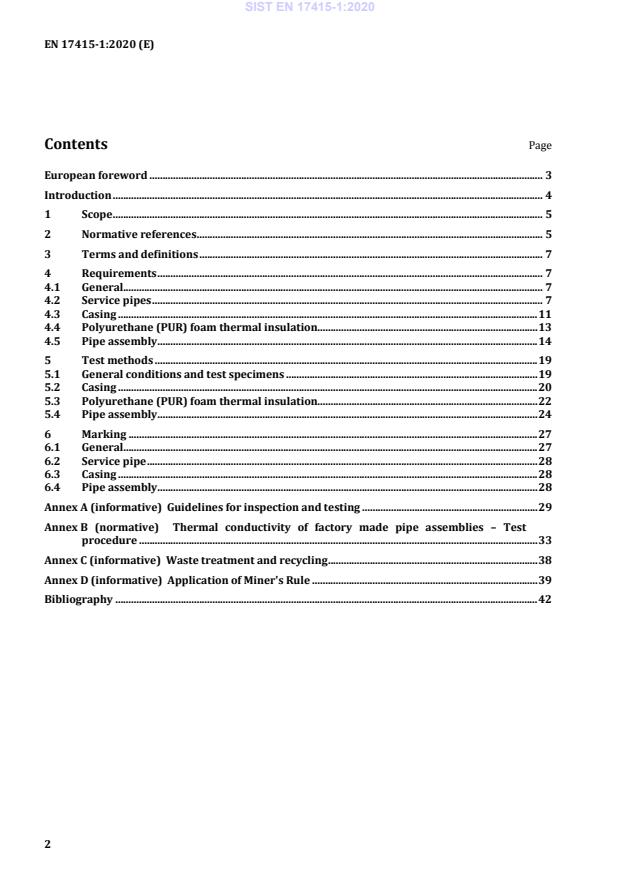
Contents Page
European foreword . 3
Introduction . 4
1 Scope . 5
2 Normative references . 5
3 Terms and definitions . 7
4 Requirements . 7
4.1 General. 7
4.2 Service pipes . 7
4.3 Casing . 11
4.4 Polyurethane (PUR) foam thermal insulation. 13
4.5 Pipe assembly . 14
5 Test methods . 19
5.1 General conditions and test specimens . 19
5.2 Casing . 20
5.3 Polyurethane (PUR) foam thermal insulation. 22
5.4 Pipe assembly . 24
6 Marking . 27
6.1 General. 27
6.2 Service pipe . 28
6.3 Casing . 28
6.4 Pipe assembly . 28
Annex A (informative) Guidelines for inspection and testing . 29
Annex B (normative) Thermal conductivity of factory made pipe assemblies – Test
procedure . 33
Annex C (informative) Waste treatment and recycling . 38
Annex D (informative) Application of Miner's Rule . 39
Bibliography . 42
European foreword
This document (EN 17415-1:2020) has been prepared by Technical Committee CEN/TC 107
“Prefabricated district heating and district cooling pipe systems”, the secretariat of which is held by DS.
This European Standard shall be given the status of a national standard, either by publication of an
identical text or by endorsement, at the latest by January 2021, and conflicting national standards shall
be withdrawn at the latest by January 2021.
Attention is drawn to the possibility that some of the elements of this document may be the subject of
patent rights. CEN shall not be held responsible for identifying any or all such patent rights.
According to the CEN-CENELEC Internal Regulations, the national standards organisations of the
following countries are bound to implement this European Standard: Austria, Belgium, Bulgaria,
Croatia, Cyprus, Czech Republic, Denmark, Estonia, Finland, France, Germany, Greece, Hungary, Iceland,
Ireland, Italy, Latvia, Lithuania, Luxembourg, Malta, Netherlands, Norway, Poland, Portugal, Republic of
North Macedonia, Romania, Serbia, Slovakia, Slovenia, Spain, Sweden, Switzerland, Turkey and the
United Kingdom.
Introduction
Factory made bonded single pipe systems for directly buried district cooling networks are of common
technical usage. In order to ensure quality including product-related service life, to ensure safety in use,
economical energy usage and to facilitate comparability in the market, CEN/TC 107 decided to set up
standards for these products.
This document is one of a series of standards which form several parts of EN 17415, District cooling
pipes – Bonded single pipe systems for directly buried cold water networks:
— Part 1: Factory made pipe assembly of steel or plastic service pipe, polyurethane thermal insulation
and a casing of polyethylene (this document);
— Part 2: Factory made fitting assemblies of steel or plastic service pipe, polyurethane thermal insulation
and a casing of polyethylene ;
— Part 3: Factory made steel valve assembly for steel or plastic service pipe, polyurethane thermal
1;
insulation and a casing of polyethylene
The other standards from CEN/TC 107 covering this subject are:
— EN 17414-1, District cooling pipes - Factory made flexible pipe systems - Part 1: Classification, general
requirements and test methods;
— EN 17414-2, District cooling pipes - Factory made flexible pipe systems - Part 2: Bonded system with
plastic service pipes - Requirements and test methods;
— EN 17414-3, District cooling pipes - Factory made flexible pipe systems - Part 3: Non bonded system
with plastic service pipes - Requirements and test methods;
— EN ZZZZZ-1, District cooling pipes – Design and installation of thermal insulated bonded single and
;
twin pipe systems for directly buried cold water networks – Part 1: Design
— EN ZZZZZ-2, District cooling pipes – Design and installation of thermal insulated bonded single and
twin pipe systems for directly buried cold water networks – Part 2: Installation ;
— EN 489-1, District heating pipes - Bonded single and twin pipe systems for buried hot water networks -
Part 1: Joint casing assemblies and thermal insulation for hot water networks in accordance with
EN 13941-1;
— EN 14419, District heating pipes - Bonded single and twin pipe systems for buried hot water networks
- Surveillance systems.
Waste management and recycling of materials is dealt with in Annex C.
Under development.
1 Scope
This document specifies requirements, design and test methods for straight lengths of factory made
thermally insulated pipe-in-pipe assemblies for directly buried district cooling distribution systems,
comprising a service pipe from DN 15 to DN 1200, rigid polyurethane foam insulation and a casing of
polyethylene. The pipe assembly can also include the following additional elements: measuring wires,
spacers and diffusion barriers.
This document applies only to insulated pipe assemblies, for continuous operation with water at
various temperatures (1 to 30) °C and a maximum operation pressure of 25 bar.
The design is based on an expected service life with continuous operation of a minimum 50 years.
2 Normative references
The following documents are referred to in the text in such a way that some or all of their content
constitutes requirements of this document. For dated references, only the edition cited applies. For
undated references, the latest edition of the referenced document (including any amendments) applies.
EN 10204, Metallic products — Types of inspection documents
EN 10216-1:2013, Seamless steel tubes for pressure purposes — Technical delivery conditions — Part 1:
Non-alloy steel tubes with specified room temperature properties
EN 10216-2, Seamless steel tubes for pressure purposes — Technical delivery conditions — Part 2: Non-
alloy and alloy steel tubes with specified elevated temperature properties
EN 10217-1:2019, Welded steel tubes for pressure purposes — Technical delivery conditions — Part 1:
Electric welded and submerged arc welded non-alloy steel tubes with specified room temperature
properties
EN 10217-2, Welded steel tubes for pressure purposes — Technical delivery conditions — Part 2: Electric
welded non-alloy and alloy steel tubes with specified elevated temperature properties
EN 10217-5, Welded steel tubes for pressure purposes — Technical delivery conditions — Part 5:
Submerged arc welded non-alloy and alloy steel tubes with specified elevated temperature properties
EN 10220, Seamless and welded steel tubes — Dimensions and masses per unit length
EN 12201-2, Plastics piping systems for water supply, and for drainage and sewerage under pressure —
Polyethylene (PE) — Part 2: Pipes
EN 12201-5, Plastics piping systems for water supply, and for drainage and sewerage under pressure —
Polyethylene (PE) — Part 5: Fitness for purpose of the system
EN 14419, District heating pipes — Bonded single and twin pipe systems for buried hot water networks —
Surveillance systems
EN 17248, District heating and district cooling pipe systems — Terms and definitions
EN 17414-2, District cooling pipes — Factory made flexible pipe systems — Part 2: Bonded system with
plastic service pipes - Requirements and test methods
EN ISO 844, Rigid cellular plastics — Determination of compression properties (ISO 844)
EN ISO 845, Cellular plastics and rubbers — Determination of apparent density (ISO 845)
EN ISO 1133 (all parts), Plastics — Determination of the melt mass-flow rate (MFR) and melt volume-flow
rate (MVR) of thermoplastics (ISO 1133 series)
EN ISO 2505, Thermoplastics pipes — Longitudinal reversion — Test method and parameters (ISO 2505)
EN ISO 3126, Plastics piping systems — Plastics components — Determination of dimensions (ISO 3126)
EN ISO 3127:2017, Thermoplastics pipes — Determination of resistance to external blows — Round-the-
clock method (ISO 3127:1994)
EN ISO 4590, Rigid cellular plastics — Determination of the volume percentage of open cells and of closed
cells (ISO 4590)
EN ISO 6259-1, Thermoplastics pipes — Determination of tensile properties — Part 1: General test
method (ISO 6259-1)
EN ISO 8501-1, Preparation of steel substrates before application of paints and related products — Visual
assessment of surface cleanliness — Part 1: Rust grades and preparation grades of uncoated steel
substrates and of steel substrates after overall removal of previous coatings (ISO 8501-1)
EN ISO 9080, Plastics piping and ducting systems — Determination of the long-term hydrostatic strength
of thermoplastics materials in pipe form by extrapolation (ISO 9080)
EN ISO 11357-6, Plastics — Differential scanning calorimetry (DSC) — Part 6: Determination of oxidation
induction time (isothermal OIT) and oxidation induction temperature (dynamic OIT) (ISO 11357-6)
EN ISO 12162, Thermoplastics materials for pipes and fittings for pressure applications — Classification,
designation and design coefficient (ISO 12162)
ISO 6964, Polyolefin pipes and fittings — Determination of carbon black content by calcination and
pyrolysis — Test method
ISO 11414:2009, Plastics pipes and fittings — Preparation of polyethylene (PE) pipe/pipe or pipe/fitting
test piece assemblies by butt fusion
ISO 13953, Polyethylene (PE) pipes and fittings — Determination of the tensile strength and failure mode
of test pieces from a butt-fused joint
ISO 16770, Plastics — Determination of environmental stress cracking (ESC) of polyethylene — Full-notch
creep test (FNCT)
ISO 18553, Method for the assessment of the degree of pigment or carbon black dispersion in polyolefin
pipes, fittings and compounds
3 Terms and definitions
For the purposes of this document, the terms and definitions given in EN 17248 and the following apply.
ISO and IEC maintain terminological databases for use in standardization at the following addresses:
— IEC Electropedia: available at http://www.electropedia.org/
— ISO Online browsing platform: available at https://www.iso.org/obp
3.1
foam density
apparent density of the foam of the insulating layer at any position
3.2
insulation material
material which reduces the heat loss
3.3
melt mass-flow rate
MFR
rate of extrusion of molten resin through a die of specified length and diameter under prescribed
conditions of temperature, load and piston position in the barrel of an extrusion plastometer, the rate
being determined as the mass extruded over a specified time
3.4
pipe assembly
assembled product, consisting of at least one service pipe, insulating material and casing
3.5
standard dimension ratio
SDR
numerical designation of a pipe series, which is a convenient round number, approximately equal to the
dimension ratio of the nominal outside diameter and the minimum wall thickness
4 Requirements
4.1 General
Unless otherwise specified, the requirements shall be valid for each single measurement.
For information on suitable guidelines for inspection, see Annex A.
4.2 Service pipes
4.2.1 Steel service pipes
4.2.1.1 Specification
The technical delivery conditions of the steel service pipe shall be in accordance with Table 1.
Table 1 — Steel service pipe specification
a
Type of pipe Diameter EN standard Material
b
Seamless ≤ DN 300 EN 10216-1 P235TR1
Seamless All EN 10216-1 P235TR2
Seamless All EN 10216-2 P235GH
b
ERW ≤ DN 300 EN 10217-1 P235TR1
ERW All EN 10217-1 P235TR2
ERW All EN 10217-2 P235GH
SAW All EN 10217-5 P235GH
a
Equivalent or higher steel grades according to approved European
standards may be used by agreement.
b
If P235TR1 material is used, an impact test at 0 °C, according to
EN 10216-1:2013, Table 5, or EN 10217-1:2019, Table 4, as specified for
P235TR2 shall be performed and specific inspection in accordance with
EN 10216-1 or EN 10217-1, Option 9 shall be carried out.
For the calculation of the yield strength R , at the design temperature in the temperature range up to
p0,2
30 °C, the value of R for room temperature shall be used for P235TR1, P235TR2 and P235GH.
p0,2
For higher steel grades than those given in Table 1 the yield strength is defined in their related
standards. If such higher steel grades are used for medium pipes, it shall be verified that all components
used in the involved part of the system are compatible to the higher yield strength of the pipes.
All steel pipes and components used for manufacturing of pipe assemblies under the scope of this
document shall as a minimum be delivered to the manufacturer with an inspection certificate 3.1
according to EN 10204. The inspection certificate shall on request be passed on to the client who orders
the pipe assemblies.
In case a material related inspection certificate 3.1 according to EN 10204 is required by the client who
orders the pipe assemblies, this request shall be given whilst placing the order with the manufacturer of
the pipe assemblies.
NOTE Any later request for provision of such documentation could be too late and possibly can't be met by
the manufacturer, since the manufacturer has to organize the assignment of 3.1 certificates to pipes and part of
pipes before starting the production.
A length of pipe shall not include a circular weld.
ERW pipes supplied shall not include the welds used to join together the strip prior to forming.
4.2.1.2 Diameter
The diameter shall be in accordance with Table 2 which is derived from EN 10220.
The tolerances on the outside diameter, d , of the steel service pipe at the pipe ends, shall be in
o
accordance with the respective pipe standard as given in Table 1. Diameter measurements shall be
made using a circumferential tape. The diameter shall be calculated as the actual circumference divided
by π. Outside diameter, d , 168,3 mm and smaller may be measured using a slide calliper.
o
The out-of-roundness shall be determined in accordance with the respective pipe standard as given in
Table 1.
4.2.1.3 Wall thickness
The wall thicknesses, t, and masses shall be in accordance with EN 10220 with a minimum as indicated
in Table 2.
Subject to design considerations, other wall thicknesses may be used, but in no case they shall be less
than the minima indicated in Table 2.
The tolerances on the wall thickness of the steel service pipe shall be in accordance with the respective
pipe standard as given in Table 1.
Table 2 — Steel service pipe dimensions
Nominal diameter Outside diameter Minimum nominal wall
thickness
DN d
o
t
mm
mm
15 21,3 2,0
20 26,9 2,0
25 33,7 2,3
32 42,4 2,6
40 48,3 2,6
50 60,3 2,9
65 76,1 2,9
80 88,9 3,2
100 114,3 3,6
125 139,7 3,6
150 168,3 4,0
200 219,1 4,5
250 273,0 5,0
300 323,9 5,6
350 355,6 5,6
400 406,4 6,3
450 457,0 6,3
500 508,0 6,3
600 610,0 7,1
700 711,0 8,0
800 813,0 8,8
900 914,0 10,0
1 000 1 016,0 11,0
1 200 1 219,0 12,5
4.2.1.4 Surface condition
In order to ensure proper bonding between the steel service pipe and the thermal insulation, the
following procedure shall be followed:
a) Prior to thermal insulation, the outer surface of the pipe shall be cleaned so that it is free from rust,
mill scale, oil, grease, dust, paint, moisture and other contaminants.
b) Before cleaning the steel service pipe, the outer surface shall comply with rust grade A, B or C
according to EN ISO 8501-1, without pitting.
It is recommended to clean the surface to Sa 2 according to EN ISO 8501-1.
4.2.1.5 Pipe ends
All steel service pipes used for manufacturing of pipe assemblies shall be delivered with pipe ends
prepared for welding. For this, the relevant order option in accordance with the respective pipe
standard as given in Table 1 shall be agreed.
4.2.2 Plastic service pipes
4.2.2.1 Specification
Plastics service pipes shall be
— polyethylene pipes PE 80 or PE 100 in accordance with EN 12201-2,
or alternatively,
— PP, PB, PE-X, PE-RT or multilayer plastics service pipes in accordance with the respective pipe
standard as given in EN 17414-2.
A length of pipe shall not include a circular joint.
4.2.2.2 Diameter
The nominal outside diameter and diameter tolerances of the PE plastic service pipe shall be in
accordance with EN 12201-2.
The nominal outside diameter and diameter tolerances of the PP, PB, PE-X, PE-RT and multilayer
plastics service pipe shall be in accordance with the respective pipe standard as given in EN 17414-2.
4.2.2.3 Wall thickness
The wall thickness of the PE plastic service pipe shall be in accordance with EN 12201-2.
Table 3 defines the maximum SDR ratios of the service pipe required to withstand different operating
pressures.
Table 3 — Maximum SDR ratios for different operating pressures
Operating pressure
bar
Service pipe
6 10 16 20 25
PE 100 21 13,6 9 7,4 6
PE 80 17 11 7,4 6 –
NOTE The maximum SDR numbers given in Table 3 have been calculated based on EN ISO 15494 with the
safety factor 1,25 for a continuous operating temperature of 30 °C and a service life of 50 years. Other
temperature/time profiles can be applied in accordance with EN ISO 13760 (Miner's Rule). Further information is
given in Annex D.
Due to welding requirements, PE 100 and PE 80 shall not be combined in the same system.
The tolerance on the actual wall thickness of the PE plastic service pipe shall be in accordance with
EN 12201-2.
The wall thickness and the tolerance on the actual wall thickness of the PP, PB, PE-X, PE-RT and
multilayer plastics service pipe shall be in accordance with the respective pipe standard as given in
EN 17414-2. The SDR numbers for the PP, PB, PE-X, PE-RT and multilayer plastics service pipes shall be
in accordance with EN 17414-2.
4.2.2.4 Surface condition
In order to ensure proper bonding between the plastic service pipe and the thermal insulation, the
following procedure shall be followed:
Prior to insulation, the outer surface of the pipe shall be cleaned so that it is free from, oil, grease, dust,
paint, moisture and other contaminants.
Surface treatment to improve the shear strength between the thermal insulation and plastic service
pipe is permissible provided that the treated pipe assembly still complies with the specification.
4.3 Casing
4.3.1 Material properties
4.3.1.1 Material composition
The casing material shall be black coloured PE virgin or rework material containing only those anti-
oxidants, UV-stabilizers and carbon black necessary for the manufacture and use of pipe assemblies to
this specification. The black coloured PE material to be extruded shall be tested in accordance with
EN ISO 9080 and classified at least a PE 80 material in accordance with EN ISO 12162.
The casing may be a separately manufactured pipe or be applied directly onto the PUR thermal
insulation by extrusion.
The carbon black content shall, when tested in accordance with ISO 6964, be (2,0 to 2,5) % by mass.
NOTE The required carbon black content ensures UV stability for the service life.
The carbon black shall be finely dispersed in the material. When tested in accordance with 5.2.3, the
following requirements shall be met:
— Carbon black agglomerates and particles shall be grade ≤ 3.
— Dispersion appearance rating not worse than A1, A2 or A3 in ISO 18553.
4.3.1.2 Melt mass-flow rate
The melt mass-flow rate (MFR), in g/10 min, of black PE materials used for the manufacturing of
casings shall lie within 0,2 ≤ MFR ≤ 1,0 g/10 min determined in accordance with EN ISO 1133 (all
parts), condition 5 kg, 190 °C.
Black coloured PE materials conforming to 4.3.1.1, which do not differ more than 0,5 g/10 min in MFR
shall be considered fusible to each other.
Casings made of PE materials outside this MFR range of 0,5 g/10 min may be fusion welded if fusion
compatibility has been demonstrated by the manufacturer of the pipe assembly. This shall be done by
preparing a butt fusion joint using the parameters as specified in ISO 11414:2009, Annex A. The
requirement of fusion compatibility is a ductile failure mode of the joint when tested at 23 °C in
accordance with ISO 13953.
4.3.1.3 Thermal stability
The thermal stability is determined by oxygen induction time (OIT) of the black coloured PE material
and shall be at least 20 min when tested at 210 °C according to EN ISO 11357-6.
4.3.1.4 Use of rework material
Only clean, not degraded, rework material, generated from the manufacturer's own production of pipes
that does not include any PU insulation material shall be used.
4.3.2 Casing properties
4.3.2.1 Nominal outside diameter
The nominal outside diameter of the casing should be selected from Table 4.
The actual outside diameter shall be measured in accordance with EN ISO 3126.
4.3.2.2 Wall thickness
The wall thickness of the casing shall be in accordance with Table 4. When the casing includes a
diffusion barrier, the wall thickness of one single PE layer of the casing shall be in accordance with
Table 4.
The actual wall thickness shall be measured in accordance with EN ISO 3126.
Table 4 — Casing dimensions
Nominal outside Minimum wall thickness
diameter
e
min
D
c
mm
mm
75 3,0
90 3,0
110 3,0
125 3,0
140 3,0
160 3,0
180 3,0
200 3,2
225 3,4
250 3,6
280 3,9
315 4,1
355 4,5
400 4,8
450 5,2
500 5,6
560 6,0
630 6,6
Nominal outside Minimum wall thickness
diameter
e
min
D
c
mm
mm
710 7,2
800 7,9
900 8,7
1 000 9,4
1 100 10,2
1 200 11,0
1 400 12,5
4.3.2.3 Appearance, surface finish, casing ends
The internal and external surfaces of the casing shall be clean and free from such grooving or other
defects that might impair its functional properties (see 5.2.1).
The casing ends shall be cleanly cut and shall be square within 2,5° with the axis of the pipe.
Surface treatment to improve the shear strength between the PUR foam and casing is permissible
provided that the treated pipe assembly still complies with the specification.
4.3.2.4 Elongation at break
The elongation at break determined in accordance with 5.2.2 shall not be less than 350 %.
4.3.2.5 Heat reversion
When tested in accordance with EN ISO 2505, the longitudinal length at any position on the casing shall
not change by more than 3 %. On inspection after testing, the casing shall not show any faults, cracks,
cavities or blisters.
4.3.2.6 Stress crack resistance
When tested in accordance with 5.2.4, the time to failure shall not be less than 300 h.
4.4 Polyurethane (PUR) foam thermal insulation
4.4.1 Composition
The manufacturer of the pipe assembly shall be responsible for the choice of raw materials, composition
and manufacturing conditions.
The manufacturer shall keep records, documenting the raw materials used, the prescribed mixing ratio
and the tests performed.
The records shall demonstrate that the PUR foam from the production of pipe assemblies is of the same
composition as the foam sample used for the thermal conductivity test in 5.4.2 and meets the
requirements of 4.4.
4.4.2 Cell structure
4.4.2.1 General appearance
The PUR foam shall have a uniform cell structure free from smears.
4.4.2.2 Cell size
The average size of the cells in a radial direction shall be less than 0,5 mm, determined in accordance
with 5.3.2.1.
4.4.2.3 Closed cell content
The closed cell content determined in accordance with 5.3.2.2 shall be not less than 88 %.
4.4.2.4 Voids and bubbles
The average area of voids and bubbles determined on the five cross sections in accordance with 5.3.2.3
shall not constitute more than 5 % of the cross sectional area of the PUR foam. No single void shall be
larger than 2/3 of the insulation thickness between the service pipe and the casing at the position of the
void. However, for series 0 according to Tables 6 and 7 the local insulation thickness shall be minimum
15 mm.
4.4.3 Compressive strength
The compressive strength or the compressive stress at 10 % relative deformation as defined in
EN ISO 844 shall be not less than 0,3 MPa in a radial direction when tested in accordance with 5.3.3.
4.4.4 Foam density
The density of the foam at any position shall comply with the criteria below when determined in
accordance with 5.3.4.
.
At both pipe ends, all three specimens, shall each have a density of minimum 55 kg/m
4.4.5 Water absorption at elevated temperature
When tested in accordance with 5.3.5, the water absorption after 90 min of immersion in boiling water
shall not exceed 10 % of the original volume. The volume of each specimen after the test shall not be
less than 75 % of the original volume.
4.5 Pipe assembly
4.5.1 General
All requirements are valid including the diffusion barrier, if any.
4.5.2 Service pipe ends without thermal insulation
Both ends of the service pipe shall be free from thermal insulation. The length of the free ends shall be
between 150 mm and 250 mm.
The manufacturer shall declare a value for the length of the free end. The tolerance on the declared
value shall be ± 10 mm.
4.5.3 Service pipe end preparation
4.5.3.1 Steel service pipes
Steel service pipe ends shall be prepared for welding in accordance with 4.2.1.5.
4.5.3.2 Plastics service pipes
PE pipes intended to be used for jointing by butt fusion or electrofusion shall be prepared in accordance
with EN 12201-5.
PP, PB, PE-X, PE-RT and multilayer plastics service pipes intended to be used for jointing by butt fusion
or electrofusion shall be prepared in accordance with the respective pipe standard as given in
EN 17414-2.
4.5.4 Diameter and wall thickness of the casing
and the
The outside diameter of the casing shall at any point be between the minimum diameter Dmin
maximum diameter D as given in Table 5. The minimum wall thickness of the casing, e , shall at any
max min
point be in accordance with Table 6. The measured values for the outside diameter and wall thickness
shall be rounded off to the next higher 0,1 mm.
Table 5 — Casing dimensions of the pipe assembly
Nominal Minimum Maximum Minimum wall
outside outside outside thickness
diameter diameter diameter
e
min
D D D
c min max
mm
mm mm mm
75 75 79 3,0
90 90 95 3,0
110 110 116 3,0
125 125 132 3,0
140 140 147 3,0
160 160 168 3,0
180 180 189 3,0
200 200 206 3,2
225 225 232 3,4
250 250 258 3,6
280 280 289 3,9
315 315 325 4,1
355 355 366 4,5
400 400 412 4,8
450 450 464 5,2
500 500 515 5,6
560 560 577 6,0
630 630 649 6,6
710 710 732 7,2
800 800 824 7,9
900 900 927 8,7
1 000 1 000 1 030 9,4
1 100 1 100 1 133 10,2
1 200 1 200 1 236 11,0
1 400 1 400 1 442 12,5
4.5.5 Thermal insulation series – steel service pipes
The allocation of the nominal diameter of steel service pipes and casing diameters for the thermal
insulation series 0, 1 and 2 is given in Table 6.
Table 6 — Thermal insulation series of the pipe assembly – steel service pipes
Nominal and Casing diameter and thermal insulation thickness
outer diameter of
service pipes Series 0 Series 1 Series 2
a b c c c
DN d D t D t D t
o c i c i c i
mm mm mm mm mm mm mm
20 26,9 75 21,1 90 28,6 110 38,6
25 33,7 75 17,7 90 25,2 110 35,2
32 42,4 90 20,8 110 30,8 125 38,3
40 48,3 90 17,9 110 27,9 125 35,4
50 60,3 110 21,9 125 29,4 140 36,9
65 76,1 125 21,5 140 29,0 160 39,0
80 88,9 140 22,6 160 32,6 180 42,6
100 114,3 180 29,9 200 39,7 225 52,0
125 139,7 200 27,0 225 39,3 250 51,6
150 168,3 225 25,0 250 37,3 280 52,3
200 219,1 280 26,9 315 43,9 355 63,5
250 273,0 355 36,5 400 58,7 450 83,3
300 323,9 400 33,3 450 57,9 500 82,5
350 355,6 450 42,0 500 66,6 560 96,2
400 406,4 500 41,2 560 70,8 630 105,2
450 457,0 560 45,5 630 79,9 710 119,3
500 508,0 630 54,4 710 93,8 800 138,1
600 610,0 710 42,8 800 87,1 900 136,3
700 711,0 800 36,6 900 85,8 1 000 135,1
800 813,0 900 34,8 1 000 84,1 1 100 133,3
900 914,0 1 000 33,6 1 100 82,8 1 200 132,0
1 000 1 016,0 1 100 31,8 1 200 81,0
1 200 1 219,0 1 400 78,0
a
Dimensions, see Table 2.
b
Dimensions, see Table 4.
c
Resulting insulation thickness, for information.
4.5.6 Thermal insulation series – plastics service pipes
The allocation of the nominal diameter of plastics service pipes and casing diameters for the thermal
insulation series 0, 1 and 2 is given in Table 7.
Table 7 — Thermal insulation series of the pipe assembly – plastics service pipes
Nominal and Casing diameter and thermal insulation thickness
outer diameter of
service pipes Series 0 Series 1 Series 2
a b c c c
DN d D t D t D t
o c i c i c i
mm mm mm mm mm mm mm
25 25 75 22,0 90 29,5 110 39,5
32 32 75 18,5 90 26,0 110 36,0
40 40 90 22,0 110 32,0 125 39,5
50 50 90 17,0 110 27,0 125 34,5
63 63 110 20,5 125 28,0 140 35,5
75 75 125 22,0 140 29,5 160 39,5
90 90 140 22,0 160 32,0 180 42,0
110 110 180 32,0 200 41,8 225 54,1
125 125 180 24,5 200 34,3 225 46,6
140 140 200 26,8 225 39,1 250 51,4
160 160 225 29,1 250 41,4 280 56,4
180 180 250 31,4 280 46,4 315 63,4
200 200 280 36,4 315 53,4 355 73,0
225 225 315 40,9 355 60,5 400 82,7
250 250 315 28,4 355 48,0 400 70,2
280 280 355 33,0 400 55,2 450 79,8
315 315 400 37,7 450 62,3 500 86,9
355 355 450 42,3 500 66,9 560 96,5
400 400 500 44,4 560 74,0 630 108,4
450 450 560 49,0 630 83,4 710 122,8
500 500 630 58,4 710 97,8 800 142,1
560 560 630 28,4 710 67,8 800 112,1
630 630 710 32,8 800 77,1 900 126,3
710 710 800 37,1 900 86,3 1 000 135,6
800 800 900 41,3 1 000 90,6 1 100 139,8
900 900 1 000 40,6 1 100 89,8 1 200 139,0
1 000 1 000 1 100 39,8 1 200 89,0
1 200 1 200 1 400 87,5
a
Dimensions, see EN 12201-2.
b
Dimensions, see Table 4.
c
Resulting insulation thickness, for information.
4.5.7 Centre line deviation
The distance between the centre lines of the service pipe and the casing at any point shall not exceed
the limits given in Table 8.
Table 8 — Centre line deviation related to the nominal diameters
Nominal outside diameter of PE pipe Maximum centre line deviation
mm mm
75 to 160 3,0
180 to 400 5,0
450 to 630 8,0
710 to 800 10,0
900 to 1 400 14,0
NOTE For pipe assemblies Series 0 minimum local distance between the service pipe and the casing due to
maximum unfavourable centre line deviation in combination with required minimum local insulation thickness
15 mm in accordance with 4.4.2 reduces the allowed size of a single void at the position of the centre line
deviation. This is concerning in particular pipe dimensions DN 150 and DN 700 to DN 1000.
4.5.8 Expected service life
4.5.8.1 General remarks
For normal applications, the pipe assembly should have a service life of at least 50 years at a continuous
operating temperature of 1 °C, and at a maximum operating temperature of 30 °C.
4.5.8.2 Shear strength
The shear strength shall fulfil the minimum requirements of Table 9 or 10.
The shear strength shall be tested in axial direction in accordance with 5.4.1.
Table 9 — Shear strength for steel service pipes
Test temperature Test clause τ
ax
°C
min.
MPa
23 ± 2 5.4.1.4 0,12
Table 10 — Shear strength for plastics service pipes
Test temperature Test clause τ
ax
°C
min.
MPa
23 ± 2 5.4.1.4 0,09
4.5.9 Thermal conductivity
When tested in accordance with 5.4.2, the thermal conductivity (λ ) shall not exceed 0,027 W/(m × K).
For type test the thermal conductivity shall be reported together with the foam density, cell size,
compressive strength and composition of the gas in the cells of the insulation.
The λ value shall be given at 15 °C calculated by linear regression using the results obtained at three
different pipe temperatures.
4.5.10 Impact resistance
After testing in accordance with 5.4.3, the casing shall have no visible cracks.
4.5.11 Surface conditions at delivery
The surface flattening of the pipe assembly shall not exceed 15 % of the insulation thickness –
measured from the original surface.
Scratches in the casing from the handling and the storage shall not exceed 10 % of the original wall
thickness of the casing. On casings with a wall thickness exceeding 10 mm scratches shall not be deeper
than 1 mm.
Pipe assembly ends shall be sealed to protect the insulation from vapour.
4.5.12 Measuring wires for surveillance systems
Measuring wires, if any, shall comply with the requirements of EN 14419.
4.5.13 Linear water tightness
When tested in accordance with 5.4.4 there shall be no water leaking at the bottom pipe end after 168 h.
5 Test methods
5.1 General conditions and test specimens
5.1.1 General conditions
Where test requirements specified in this document differ from those in other standards referred to, the
requirements laid down in this document shall apply.
All test specimens shall be representative for the production.
All tests on the pipe assembly shall include the diffusion barrier, if any, except those which are
particularly mentioned to be without.
5.1.2 Test specimens
5.1.2.1 Test specimens shall only be taken from the casing after it has been stored at a temperature
of (23 ± 2) °C for not less than 16 h, or from the PUR foam thermal insulation and pipe assembly after
they have been stored at a temperature of (23 ± 2) °C for not less than 72 h. Deviations from these
periods are allowed, e.g. for quality control purposes. However, in event of a dispute, the required
periods shall be observed.
5.1.2.2 Test specimens to establish foam properties and to determine properties of the pipe
assembly shall be taken from pipe assemblies from regular production, but in such a way as to exclude
at least 500 mm from the end of the foam. Test specimens may be taken closer to the end of the foam,
e.g. for quality control purposes. However, in event of a dispute the result from test specimens taken at
least 500 mm from the end of the foam shall apply.
5.1.2.3 Test specimens to determine foam properties, except voids and bubbles, shall be taken from
one location at each end of the pipe assembly. At the location where test specimens are taken to
determine cell structure (4.4.2), compressive strength (4.4.3), foam density (4.4.4) and water
absorption (4.4.5), 3 test specimens shall be taken, from each end of the pipe assembly, equally
distributed around the circumference.
5.1.2.4 When cutting test specimens from the foam to determine cell structure (4.4.2), compressive
strength (4.4.3), foam density (4.4.4) and water absorption (4.4.5), the foam adjacent to the service pipe
surface and casing surface shall be excluded; a clearance of at least 5 mm and 3 mm respectively shall
be allowed.
5.1.2.5 The outside dimensions of the test specimens shall be measured with an accuracy
of ± 0,1 mm.
5.1.2.6 On test specimens cut from the casing to determine casing properties, any visible surface
irregularities that influence the test result, such as diffusion barrier, scratches, weld seams or foam
remains, may be cut or machined away from the test specimen.
If cutting or machining on multilayer casing is not possible, it is allowed to produce a single-layer casing
without additional layers. The same PE raw material and processing parameters as for the multilayer
casing shall be used.
5.2 Casing
5.2.1 Appearance and surface finish
The internal and external surfaces of the casing shall be visually examined without magnification (see
4.3.2.3).
5.2.2 Elongation at break
The test bars shall be stamped or machined according to Figure 1, type A. Any diffusion barrier shall be
cut or machined away from the test bar.
Test bars may be cut in the longitudinal or circumferential direction and shall be equally distributed
over the circumference of the casing in the same cross section.
The number of test bars to be cut and tested shall be 5 in accordance with EN ISO 6259-1.
Using an ink or wax crayon, the two reference lines shall be drawn equidistant from the ends of the
calibrated length of the test bar. See Figure 1.
The test bars shall be test
...