

EN 13146-3:2012
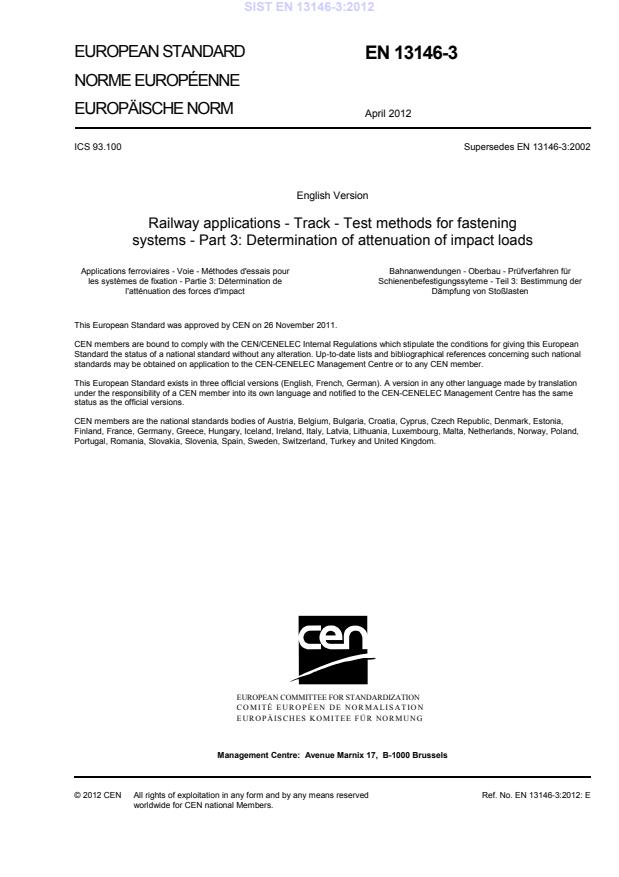
(Main)Railway applications - Track - Test methods for fastening systems - Part 3: Determination of attenuation of impact loads
- Abstract
This European Standard specifies laboratory test procedures for applying an impact to a rail fastened to a concrete sleeper or bearer which simulates the impact loading caused by traffic on railway tracks and measuring the strain induced in the sleeper. They are used for comparing the attenuation of impact loads on concrete sleepers or bearers by different rail pads. A reference procedure and alternative procedure are included.
This test is only applicable to ballasted track.
These test procedures apply to a complete fastening assembly.
- Status
- Published
- Publication Date
- 03-Apr-2012
- Technical Committee
- CEN/TC 256 - Railway applications
- Drafting Committee
- CEN/TC 256/SC 1/WG 17 - Fastening systems
- Current Stage
- 9093 - Decision to confirm - Review Enquiry
- Start Date
- 05-Jun-2023
- Completion Date
- 07-Oct-2026

Overview
EN 13146-3:2012 (CEN) defines laboratory test methods for assessing the attenuation of impact loads by rail pads and complete fastening assemblies on concrete sleepers/bearers. The standard specifies how to apply an impact to a rail mounted on a concrete sleeper and measure the induced strain, enabling objective comparison of how different rail pads reduce (attenuate) dynamic impact loads. This test is applicable only to ballasted track and covers both a reference procedure (crushed-stone support) and an alternative procedure (rubber mat support with preload).
Key topics and technical requirements
- Scope and purpose: Simulate track traffic impact loading and measure sleeper strain to quantify pad attenuation.
- Test specimens: Complete fastening assembly including baseplate where used; uncracked concrete sleeper with two bonded resistance strain gauges.
- Strain gauge placement: One gauge near the top of the rail seat; the other between 10 mm and 25 mm above the sleeper base, both parallel to the base.
- Support methods:
- Reference: bed of crushed stone (ballast) in a tank; typical ballast depth and deflection tolerance specified.
- Alternative: rubber mat on a firm base with a vertical preload (50 kN) applied to the rail.
- Impact application: Free-fall drop mass configured so the first impulse duration is 1–5 ms and induced strain at gauges stays below 80% of the sleeper’s cracking/rail-seat resistance moment.
- Instrumentation: Strain vs time recording with time resolution ≤ 0.1 ms and voltage measurement to ±0.1 mV.
- Test conditioning: Components conditioned at (23 ± 5) °C for ≥4 hours prior to testing.
- Results and calculations: Attenuation reported as percent reduction in peak strain (top and bottom of sleeper) comparing test pad vs reference pad; results averaged over three measured impacts and rounded to 5%.
- Quality checks: Repeatability checks, sleeper integrity checks (comparing strain ratios to static loading), and rig-conditioning procedures are defined.
Practical applications and users
- Rail fastening and rail pad manufacturers: Validate product performance and demonstrate impact attenuation properties.
- Independent test laboratories: Carry out standardized comparative tests for product certification and R&D.
- Infrastructure managers and railway engineers: Select fastening systems and pads optimized for dynamic load reduction to extend sleeper life and reduce maintenance.
- Standards bodies and compliance teams: Reference for conformity assessment and procurement specifications.
Related standards
- EN 13146 series (Parts 1–9) - broader test methods for fastening systems (longitudinal restraint, torsion, stiffness, etc.)
- EN 13481-1 - performance requirements for fastening systems
- EN 13230 series - requirements for concrete sleepers and bearers
Keywords: EN 13146-3, railway fastening test, impact attenuation, rail pads, concrete sleepers, ballasted track, CEN standard, fastening systems testing.
Relations
- Effective Date
- 06-Jun-2009
- Effective Date
- 28-Jan-2026
- Effective Date
- 28-Jan-2026
- Effective Date
- 28-Jan-2026
- Effective Date
- 28-Jan-2026
- Effective Date
- 28-Jan-2026
- Effective Date
- 28-Jan-2026
- Effective Date
- 28-Jan-2026
- Referred By
EN 13232-5:2005+A1:2011 - Railway applications - Track - Switches and crossings - Part 5: Switches - Effective Date
- 28-Jan-2026
- Effective Date
- 28-Jan-2026
- Effective Date
- 28-Jan-2026
- Effective Date
- 28-Jan-2026
- Effective Date
- 28-Jan-2026
- Effective Date
- 28-Jan-2026
- Effective Date
- 28-Jan-2026
Get Certified
Connect with accredited certification bodies for this standard

Zavod za gradbeništvo Slovenije (ZAG) - Inšpekcija
ZAG inspection body for construction products, structures, and materials.
Sponsored listings
Frequently Asked Questions
EN 13146-3:2012 is a standard published by the European Committee for Standardization (CEN). Its full title is "Railway applications - Track - Test methods for fastening systems - Part 3: Determination of attenuation of impact loads". This standard covers: This European Standard specifies laboratory test procedures for applying an impact to a rail fastened to a concrete sleeper or bearer which simulates the impact loading caused by traffic on railway tracks and measuring the strain induced in the sleeper. They are used for comparing the attenuation of impact loads on concrete sleepers or bearers by different rail pads. A reference procedure and alternative procedure are included. This test is only applicable to ballasted track. These test procedures apply to a complete fastening assembly.
This European Standard specifies laboratory test procedures for applying an impact to a rail fastened to a concrete sleeper or bearer which simulates the impact loading caused by traffic on railway tracks and measuring the strain induced in the sleeper. They are used for comparing the attenuation of impact loads on concrete sleepers or bearers by different rail pads. A reference procedure and alternative procedure are included. This test is only applicable to ballasted track. These test procedures apply to a complete fastening assembly.
EN 13146-3:2012 is classified under the following ICS (International Classification for Standards) categories: 93.100 - Construction of railways. The ICS classification helps identify the subject area and facilitates finding related standards.
EN 13146-3:2012 has the following relationships with other standards: It is inter standard links to EN 13146-3:2002, EN 13481-1:2012, EN 13230-3:2016, EN 13230-2:2016, EN 13146-9:2009, EN 13230-1:2016, EN 13481-2:2012, EN 13232-7:2006+A1:2011, EN 13232-5:2005+A1:2011, EN 16431:2014, EN 13481-7:2012, EN 13481-8:2006, EN 13481-2:2022, EN 13232-6:2005+A1:2011, EN 13481-2:2012+A1:2017. Understanding these relationships helps ensure you are using the most current and applicable version of the standard.
EN 13146-3:2012 is associated with the following European legislation: EU Directives/Regulations: 2008/57/EC; Standardization Mandates: M/275, M/334, M/483. When a standard is cited in the Official Journal of the European Union, products manufactured in conformity with it benefit from a presumption of conformity with the essential requirements of the corresponding EU directive or regulation.
EN 13146-3:2012 is available in PDF format for immediate download after purchase. The document can be added to your cart and obtained through the secure checkout process. Digital delivery ensures instant access to the complete standard document.
Standards Content (Sample)
2003-01.Slovenski inštitut za standardizacijo. Razmnoževanje celote ali delov tega standarda ni dovoljeno.Bahnanwendungen - Oberbau - Prüfverfahren für Schienenbefestigungssyteme - Teil 3: Bestimmung der Dämpfung von StosslastenApplications ferroviaires - Voie - Méthodes d'essais pour les systèmes de fixation - Partie 3 : Détermination de l'atténuation des forces d'impactRailway applications - Track - Test methods for fastening systems - Part 3: Determination of attenuation of impact loads93.100Gradnja železnicConstruction of railwaysICS:Ta slovenski standard je istoveten z:EN 13146-3:2012SIST EN 13146-3:2012en,de01-julij-2012SIST EN 13146-3:2012SLOVENSKI
STANDARDSIST EN 13146-3:20041DGRPHãþD
EUROPEAN STANDARD NORME EUROPÉENNE EUROPÄISCHE NORM
EN 13146-3
April 2012 ICS 93.100 Supersedes EN 13146-3:2002English Version
Railway applications - Track - Test methods for fastening systems - Part 3: Determination of attenuation of impact loads
Applications ferroviaires - Voie - Méthodes d'essais pour les systèmes de fixation - Partie 3: Détermination de l'atténuation des forces d'impact
Bahnanwendungen - Oberbau - Prüfverfahren für Schienenbefestigungssyteme - Teil 3: Bestimmung der Dämpfung von Stoßlasten This European Standard was approved by CEN on 26 November 2011.
CEN members are bound to comply with the CEN/CENELEC Internal Regulations which stipulate the conditions for giving this European Standard the status of a national standard without any alteration. Up-to-date lists and bibliographical references concerning such national standards may be obtained on application to the CEN-CENELEC Management Centre or to any CEN member.
This European Standard exists in three official versions (English, French, German). A version in any other language made by translation under the responsibility of a CEN member into its own language and notified to the CEN-CENELEC Management Centre has the same status as the official versions.
CEN members are the national standards bodies of Austria, Belgium, Bulgaria, Croatia, Cyprus, Czech Republic, Denmark, Estonia, Finland, France, Germany, Greece, Hungary, Iceland, Ireland, Italy, Latvia, Lithuania, Luxembourg, Malta, Netherlands, Norway, Poland, Portugal, Romania, Slovakia, Slovenia, Spain, Sweden, Switzerland, Turkey and United Kingdom.
EUROPEAN COMMITTEE FOR STANDARDIZATION
COMITÉ EUROPÉEN DE NORMALISATION EUROPÄISCHES KOMITEE FÜR NORMUNG
Management Centre:
Avenue Marnix 17,
B-1000 Brussels © 2012 CEN All rights of exploitation in any form and by any means reserved worldwide for CEN national Members. Ref. No. EN 13146-3:2012: ESIST EN 13146-3:2012
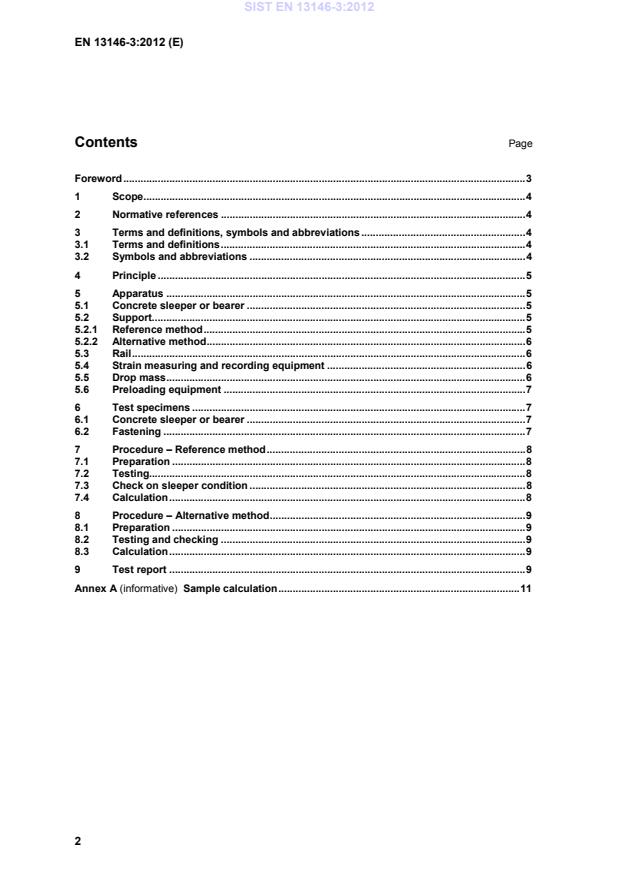
Sample calculation . 11 SIST EN 13146-3:2012
sleepers EN 13230-3, Railway applications — Track — Concrete sleepers and bearers — Part 3: Twin-block reinforced sleepers EN 13481-1:2012, Railway applications — Track — Performance requirements for fastening systems — Part 1: Definitions 3 Terms and definitions, symbols and abbreviations 3.1 Terms and definitions For the purposes of this document, the terms and definitions given in EN 13481-1:2012 apply. 3.2 Symbols and abbreviations For the purposes of this document, the following symbols apply. a attenuation expressed as per cent reduction in sleeper strain
...