

FprEN 14392
(Main)Aluminium and aluminium alloys - Requirements for anodised products for use in contact with foodstuff
- Abstract
This document specifies requirements for coloured or uncoloured anodic oxidation coatings on wrought and cast products in aluminium and aluminium alloys for use in contact with food.
These requirements cover the chemical composition of the bath, the sealing and the properties of the obtained anodic oxidation coatings. They do not cover dyestuffs and pigments but do cover the metallic deposits produced by electrolytic colouring.
- Status
- Not Published
- Publication Date
- 03-Jan-2027
- Technical Committee
- CEN/TC 132 - Aluminium and aluminium alloys
- Drafting Committee
- WG 33 - Specific applications
- Current Stage
- 5020 - Submission to Vote - Formal Approval
- Start Date
- 10-Sep-2026
- Due Date
- 27-Sep-2027
- Completion Date
- 10-Sep-2026

FprEN 14392 is a CEN draft European Standard for anodised aluminium and aluminium alloy products intended for contact with food. It specifies requirements for coloured or uncoloured anodic oxidation coatings on wrought and cast products, including the bath chemistry, sealing, and coating properties that matter to manufacturers, suppliers, and purchasers.
What does FprEN 14392 specify?
FprEN 14392 specifies the requirements for anodic oxidation coatings on aluminium and aluminium alloy products used in contact with food. It covers both coloured and uncoloured coatings on wrought and cast products, and it focuses on the coating process and the resulting coating properties.
The document is organized into clauses on scope, normative references, terms and definitions, ordering information, substrate composition, anodization bath composition, sealing, and demonstration of conformity. Annex A gives A-deviations.
| Annex | What it covers |
|---|---|
| Annex A | A-deviations |
The scope is narrow in a practical sense: it is about anodised food-contact products, not general anodising. Dyestuffs and pigments are outside the requirements, while metallic deposits produced by electrolytic colouring are included.
What are the key requirements of FprEN 14392?
Materials and anodization bath
Clause 5 requires the aluminium or aluminium alloy used for products intended for contact with food to comply with EN 601 or EN 602, as applicable. In practice, the base material has to be the right food-contact grade before anodising starts.
Clause 6 requires anodization to be carried out in a diluted aqueous solution of one or more listed acids, including sulfuric, sulfomaleic, sulfosalicylic, oxalic, sulfophthalic and phosphoric acid. This tells the producer which bath chemistry is within the scope of the standard.
Sealing requirements
Clause 7 states that the anodic oxidation coating shall be sealed unless the coating was produced in a bath containing only diluted phosphoric acid, or unless another organic or inorganic coating will be applied before use in contact with food. For the reader, this means sealing is normally part of the process and must be planned unless one of those exceptions applies.
Clause 7.2 requires sealing in distilled or demineralized water, with appropriate additives if used. The inspection certificate has to confirm that the additives and their concentrations comply with current legal requirements.
Clause 7.3 says the sealing parameters, especially temperature, pH, treatment time, and additive type and concentration, shall be chosen to reduce absorption, improve chemical resistance, and minimize migration of potentially hazardous additives. In practice, the sealing process has to be controlled, not left as an unspecified shop-floor step.
Clause 7.4 requires a suitable quality assurance system to monitor sealing quality. For routine control, EN ISO 2143 and EN ISO 2931 are used, and EN ISO 3210 is used for calibration purposes. That gives producers a defined way to check whether sealing is working consistently.
Ordering and conformity
Clause 4 requires the order document to identify this standard and to state any requirement for the periodicity of inspection certificates. This matters because buyer and supplier have to agree how evidence of conformity will be supplied.
Clause 8 requires anodising to be carried out within a quality assurance system that allows traceability of each delivered lot to the relevant production parameters from Clauses 5 to 7. The manufacturer shall also issue an inspection certificate "3.1" according to EN 10204, either for each lot or periodically, by agreement and for a period not exceeding twelve months.
What terms does FprEN 14392 define?
- Anodic oxidation coating - a coating made by an electrolytic oxidation process, with protective, decorative or functional properties.
- Sealing - a hydrothermal treatment applied after anodising to reduce porosity and absorption in the coating.
- Order document - the document or set of documents agreed between supplier and purchaser at the time of ordering.
- Inspection certificate "3.1" - the EN 10204 certificate used to state compliance of delivered products with this standard.
- A-deviation - a national deviation caused by regulations, where the national rule temporarily replaces the European Standard provision.
Who uses FprEN 14392?
FprEN 14392 is used by producers of anodised aluminium and aluminium alloy products for food contact, especially when they need to control coating chemistry, sealing, and conformity documentation. It is also used by suppliers and purchasers who agree ordering details and inspection certificates.
Quality managers, production engineers, and inspection bodies use it to define process controls, traceability, and the checks needed for routine control and calibration. It is relevant in the aluminium products sector and in materials and articles intended for contact with foodstuffs.
What changed in FprEN 14392 from the previous edition?
FprEN 14392 will supersede EN 14392:2007. The foreword states one significant technical change: withdrawn EN normative references have been replaced by EN ISO replacing documents.
Which standards are used with FprEN 14392?
- EN 601 - gives the chemical composition requirements for castings used in contact with foodstuff.
- EN 602 - gives the chemical composition requirements for wrought semi-finished products used to make articles for contact with foodstuff.
- EN 10204 - provides the inspection document type used for the required "3.1" certificate.
- EN 12258-1 - supplies general aluminium terms and definitions used with the standard.
- EN ISO 7599 - is referenced for defining the product and its properties in ordering information.
- EN ISO 2143 - is used for routine control of sealing quality.
- EN ISO 2931 - is used for routine control of sealing quality.
- EN ISO 3210 - is used for calibration purposes in sealing quality assessment.
What does the FprEN 14392 document contain?
The document contains the requirements that govern food-contact anodising of aluminium and aluminium alloys, plus the terminology and ordering information needed to apply those requirements consistently. It also contains the process rules for substrate composition, anodization bath chemistry, sealing, and conformity demonstration.
Annex A adds national A-deviations, with France listed against Clause 7.1. The main text also points readers to inspection certificates, routine sealing-control methods, and traceability of delivered lots, so the standard supports both production control and documentary proof of conformity.
Relations
- Effective Date
- 08-Oct-2025
Get Certified
Connect with accredited certification bodies for this standard

BSI Group
BSI (British Standards Institution) is the business standards company that helps organizations make excellence a habit.

Bureau Veritas
Bureau Veritas is a world leader in laboratory testing, inspection and certification services.

DNV
DNV is an independent assurance and risk management provider.
Sponsored listings
Frequently Asked Questions
FprEN 14392 is a draft published by the European Committee for Standardization (CEN). Its full title is "Aluminium and aluminium alloys - Requirements for anodised products for use in contact with foodstuff". This standard covers: This document specifies requirements for coloured or uncoloured anodic oxidation coatings on wrought and cast products in aluminium and aluminium alloys for use in contact with food. These requirements cover the chemical composition of the bath, the sealing and the properties of the obtained anodic oxidation coatings. They do not cover dyestuffs and pigments but do cover the metallic deposits produced by electrolytic colouring.
This document specifies requirements for coloured or uncoloured anodic oxidation coatings on wrought and cast products in aluminium and aluminium alloys for use in contact with food. These requirements cover the chemical composition of the bath, the sealing and the properties of the obtained anodic oxidation coatings. They do not cover dyestuffs and pigments but do cover the metallic deposits produced by electrolytic colouring.
FprEN 14392 is classified under the following ICS (International Classification for Standards) categories: 67.250 - Materials and articles in contact with foodstuffs; 77.150.10 - Aluminium products. The ICS classification helps identify the subject area and facilitates finding related standards.
FprEN 14392 has the following relationships with other standards: It is inter standard links to EN 14392:2007. Understanding these relationships helps ensure you are using the most current and applicable version of the standard.
FprEN 14392 is available in PDF format for immediate download after purchase. The document can be added to your cart and obtained through the secure checkout process. Digital delivery ensures instant access to the complete standard document.
Standards Content (Sample)
SLOVENSKI STANDARD
oSIST prEN 14392:2026
01-marec-2026
Aluminij in aluminijeve zlitine - Zahteve za anodizirane proizvode, ki se uporabljajo
v stiku z živili
Aluminium and aluminium alloys - Requirements for anodised products for use in contact
with foodstuff
Aluminium und Aluminiumlegierungen - Anforderungen an anodisierte Erzeugnisse, die
in Kontakt mit Lebensmitteln kommen
Aluminium et alliages d’aluminium - Exigences relatives aux produits anodisés destinés
à entrer en contact avec les aliments
Ta slovenski standard je istoveten z: prEN 14392
ICS:
67.250 Materiali in predmeti v stiku z Materials and articles in
živili contact with foodstuffs
77.150.10 Aluminijski izdelki Aluminium products
oSIST prEN 14392:2026 en,fr,de
2003-01.Slovenski inštitut za standardizacijo. Razmnoževanje celote ali delov tega standarda ni dovoljeno.
oSIST prEN 14392:2026
oSIST prEN 14392:2026
DRAFT
EUROPEAN STANDARD
prEN 14392
NORME EUROPÉENNE
EUROPÄISCHE NORM
January 2026
ICS 67.250 Will supersede EN 14392:2007
English Version
Aluminium and aluminium alloys - Requirements for
anodised products for use in contact with foodstuff
Aluminium et alliages d'aluminium - Exigences Aluminium und Aluminiumlegierungen -
relatives aux produits anodisés destinés à entrer en Anforderungen an anodisierte Erzeugnisse, die in
contact avec les aliments Kontakt mit Lebensmitteln kommen
This draft European Standard is submitted to CEN members for enquiry. It has been drawn up by the Technical Committee
CEN/TC 132.
If this draft becomes a European Standard, CEN members are bound to comply with the CEN/CENELEC Internal Regulations
which stipulate the conditions for giving this European Standard the status of a national standard without any alteration.
This draft European Standard was established by CEN in three official versions (English, French, German). A version in any other
language made by translation under the responsibility of a CEN member into its own language and notified to the CEN-CENELEC
Management Centre has the same status as the official versions.
CEN members are the national standards bodies of Austria, Belgium, Bulgaria, Croatia, Cyprus, Czech Republic, Denmark, Estonia,
Finland, France, Germany, Greece, Hungary, Iceland, Ireland, Italy, Latvia, Lithuania, Luxembourg, Malta, Netherlands, Norway,
Poland, Portugal, Republic of North Macedonia, Romania, Serbia, Slovakia, Slovenia, Spain, Sweden, Switzerland, Türkiye and
United Kingdom.
Recipients of this draft are invited to submit, with their comments, notification of any relevant patent rights of which they are
aware and to provide supporting documentation.
Warning : This document is not a European Standard. It is distributed for review and comments. It is subject to change without
notice and shall not be referred to as a European Standard.
EUROPEAN COMMITTEE FOR STANDARDIZATION
COMITÉ EUROPÉEN DE NORMALISATION
EUROPÄISCHES KOMITEE FÜR NORMUNG
CEN-CENELEC Management Centre: Rue de la Science 23, B-1040 Brussels
© 2026 CEN All rights of exploitation in any form and by any means reserved Ref. No. prEN 14392:2026 E
worldwide for CEN national Members.
oSIST prEN 14392:2026
prEN 14392:2026 (E)
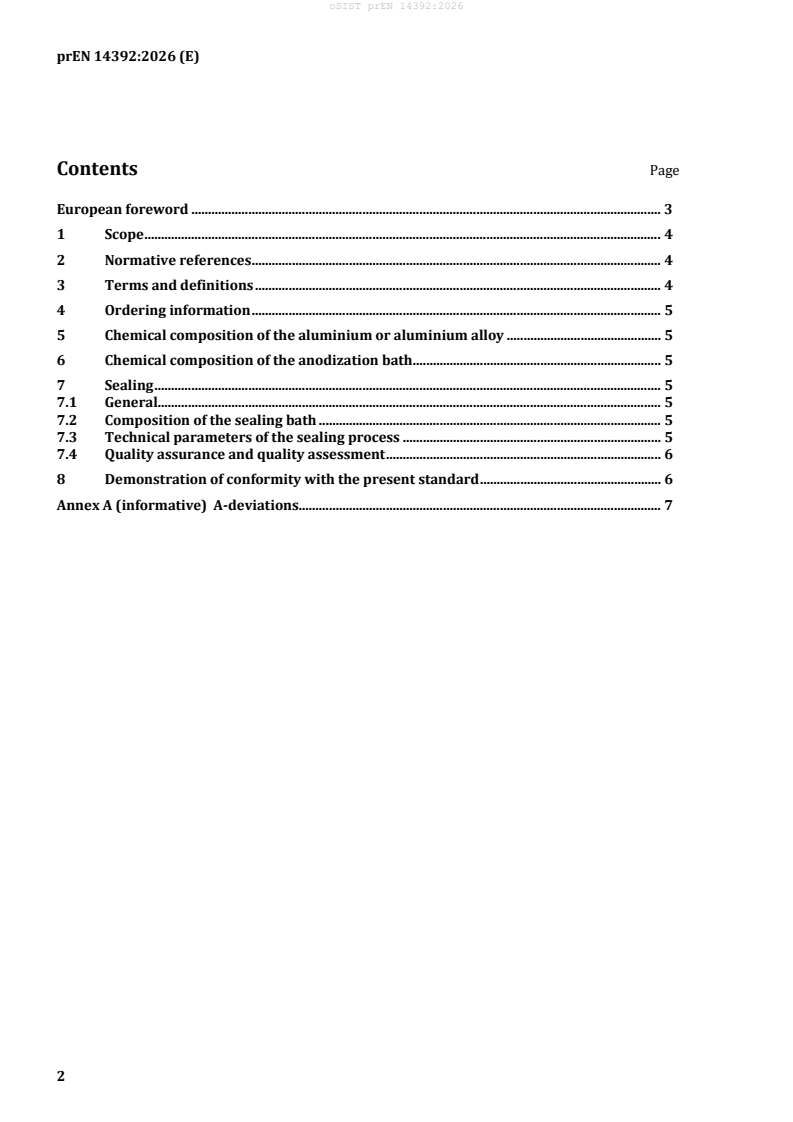
Contents Page
European foreword . 3
1 Scope . 4
2 Normative references . 4
3 Terms and definitions . 4
4 Ordering information . 5
5 Chemical composition of the aluminium or aluminium alloy . 5
6 Chemical composition of the anodization bath . 5
7 Sealing . 5
7.1 General. 5
7.2 Composition of the sealing bath . 5
7.3 Technical parameters of the sealing process . 5
7.4 Quality assurance and quality assessment . 6
8 Demonstration of conformity with the present standard . 6
Annex A (informative) A-deviations . 7
oSIST prEN 14392:2026
prEN 14392:2026 (E)
European foreword
This document (prEN 14392:2026) has been prepared by Technical Committee CEN/TC 132 “Aluminium
and aluminium alloys”, the secretariat of which is held by AFNOR.
This document is currently submitted to the CEN Enquiry.
This document will supersede EN 14392:2007.
prEN 14392:2026 includes the following significant technical changes with respect to EN 14392:2007:
— replacement of withdrawn EN normative references by EN ISO replacing documents
oSIST prEN 14392:2026
prEN 14392:2026 (E)
1 Scope
This document specifies requirements for coloured or uncoloured anodic oxidation coatings on wrought
and cast products in aluminium and aluminium alloys for use in contact with food.
These requirements cover the chemical composition of the bath, the sealing and the properties of the
obtained anodic oxida
...