


CEN/TS 15427-2-2:2021
(Main)Railway applications - Wheel/Rail friction management - Part 2-2: Properties and Characteristics - Top of Rail materials
Railway applications - Wheel/Rail friction management - Part 2-2: Properties and Characteristics - Top of Rail materials
This document specifies the requirements of materials intended to be applied to the interface between the wheel tread and the rail crown (active interface). It can be applied either directly or indirectly to the wheel tread or rail.
It outlines the information required for most approval procedures, the method of testing and routine control/monitoring of the material.
This document does not deal with adhesion materials, for example:
- sand;
- adhesion enhancers.
Bahnanwendungen - Reibungsmanagement zwischen Rad und Schiene - Teil 2-2: Eigenschaften und Merkmale - Kraftschlussmodifikatoren
Dieses Dokument legt die Anforderungen an Materialien für die Anwendung auf der Kontaktfläche zwischen der Radlauffläche und der Fahrfläche der Schiene (aktive Kontaktfläche) fest. Sie kann direkt oder indirekt auf die Radlauffläche oder die Schiene angewendet werden.
Es beschreibt die erforderlichen Informationen für die meisten Genehmigungsverfahren, das Prüfverfahren und die regelmäßige Kontrolle/Überwachung des Materials.
Dieses Dokument behandelt keine kraftschlusserhöhenden Materialien wie etwa:
- Sand;
- Haftverstärker.
Applications ferroviaires - Gestion des frottements roue/rail - Partie 2-2 : Propriétés et caractéristiques - Lubrifiants de tête de rail
Le présent document spécifie les exigences applicables aux lubrifiants destinés à être appliqués sur l'interface entre la bande de roulement de la roue et la tête de rail (interface active). Ils peuvent être appliqués directement ou indirectement, sur la bande de roulement ou sur le rail.
Il précise également les informations nécessaires à la plupart des procédures de validation, la méthode d'essai et les tâches de contrôle/surveillance de routine du lubrifiant.
Le présent document n'aborde pas les matériaux assurant l'adhérence, notamment :
- le sable ;
- les amplificateurs d'adhérence.
Železniške naprave - Trenje na stiku kolo-tirnica - 2-2. del: Lastnosti in karakteristike - Materiali za zgornjo površino tirnic
General Information
- Status
- Withdrawn
- Publication Date
- 19-Jan-2021
- Withdrawal Date
- 13-Apr-2025
- Technical Committee
- CEN/TC 256 - Railway applications
- Drafting Committee
- CEN/TC 256/SC 2/WG 38 - Flange lubrication
- Current Stage
- 9960 - Withdrawal effective - Withdrawal
- Start Date
- 11-Oct-2023
- Completion Date
- 14-Apr-2025
Relations
- Effective Date
- 19-Jan-2023

Frequently Asked Questions
CEN/TS 15427-2-2:2021 is a technical specification published by the European Committee for Standardization (CEN). Its full title is "Railway applications - Wheel/Rail friction management - Part 2-2: Properties and Characteristics - Top of Rail materials". This standard covers: This document specifies the requirements of materials intended to be applied to the interface between the wheel tread and the rail crown (active interface). It can be applied either directly or indirectly to the wheel tread or rail. It outlines the information required for most approval procedures, the method of testing and routine control/monitoring of the material. This document does not deal with adhesion materials, for example: - sand; - adhesion enhancers.
This document specifies the requirements of materials intended to be applied to the interface between the wheel tread and the rail crown (active interface). It can be applied either directly or indirectly to the wheel tread or rail. It outlines the information required for most approval procedures, the method of testing and routine control/monitoring of the material. This document does not deal with adhesion materials, for example: - sand; - adhesion enhancers.
CEN/TS 15427-2-2:2021 is classified under the following ICS (International Classification for Standards) categories: 45.080 - Rails and railway components; 45.120 - Equipment for railway/cableway construction and maintenance. The ICS classification helps identify the subject area and facilitates finding related standards.
CEN/TS 15427-2-2:2021 has the following relationships with other standards: It is inter standard links to CEN/TS 15427-2-2:2023. Understanding these relationships helps ensure you are using the most current and applicable version of the standard.
CEN/TS 15427-2-2:2021 is associated with the following European legislation: EU Directives/Regulations: 2008/57/EC; Standardization Mandates: M/483. When a standard is cited in the Official Journal of the European Union, products manufactured in conformity with it benefit from a presumption of conformity with the essential requirements of the corresponding EU directive or regulation.
You can purchase CEN/TS 15427-2-2:2021 directly from iTeh Standards. The document is available in PDF format and is delivered instantly after payment. Add the standard to your cart and complete the secure checkout process. iTeh Standards is an authorized distributor of CEN standards.
Standards Content (Sample)
SLOVENSKI STANDARD
01-marec-2021
Železniške naprave - Trenje na stiku kolo-tirnica - 2-2. del: Lastnosti in
karakteristike - Materiali za zgornjo površino tirnic
Railway applications - Wheel/Rail friction management - Part 2-2: Properties and
Characteristics - Top of Rail materials
Bahnanwendungen - Reibungsmanagement zwischen Rad und Schiene - Teil 2-2:
Eigenschaften und Merkmale - Behandlung der Schienenoberfläche
Applications ferroviaires - Gestion de la friction rail/roue - Partie 2-2 : Propriétés et
caractéristiques - Matériaux de la surface du rail
Ta slovenski standard je istoveten z: CEN/TS 15427-2-2:2021
ICS:
45.040 Materiali in deli za železniško Materials and components
tehniko for railway engineering
45.080 Tračnice in železniški deli Rails and railway
components
2003-01.Slovenski inštitut za standardizacijo. Razmnoževanje celote ali delov tega standarda ni dovoljeno.
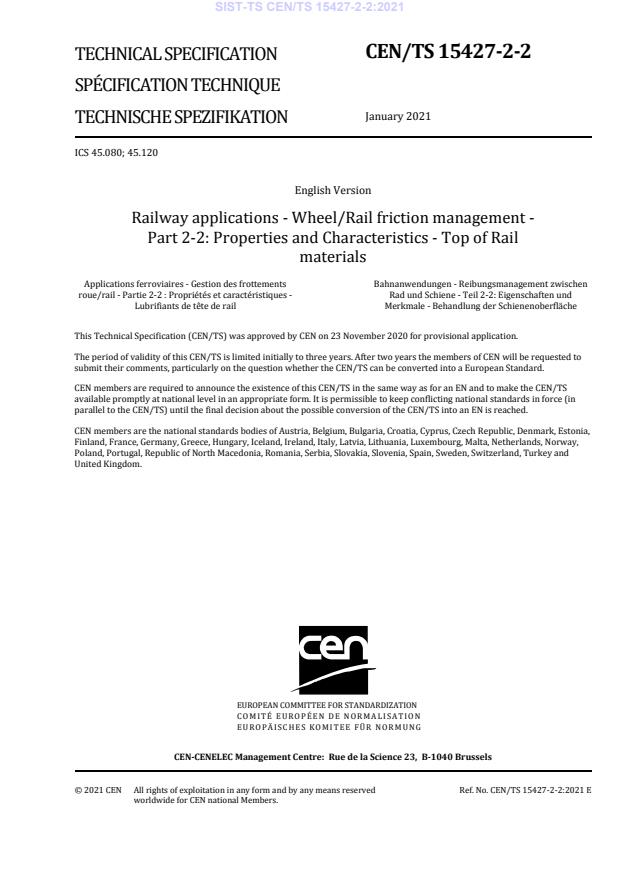
CEN/TS 15427-2-2
TECHNICAL SPECIFICATION
SPÉCIFICATION TECHNIQUE
January 2021
TECHNISCHE SPEZIFIKATION
ICS 45.080; 45.120
English Version
Railway applications - Wheel/Rail friction management -
Part 2-2: Properties and Characteristics - Top of Rail
materials
Applications ferroviaires - Gestion des frottements Bahnanwendungen - Reibungsmanagement zwischen
roue/rail - Partie 2-2 : Propriétés et caractéristiques - Rad und Schiene - Teil 2-2: Eigenschaften und
Lubrifiants de tête de rail Merkmale - Behandlung der Schienenoberfläche
This Technical Specification (CEN/TS) was approved by CEN on 23 November 2020 for provisional application.
The period of validity of this CEN/TS is limited initially to three years. After two years the members of CEN will be requested to
submit their comments, particularly on the question whether the CEN/TS can be converted into a European Standard.
CEN members are required to announce the existence of this CEN/TS in the same way as for an EN and to make the CEN/TS
available promptly at national level in an appropriate form. It is permissible to keep conflicting national standards in force (in
parallel to the CEN/TS) until the final decision about the possible conversion of the CEN/TS into an EN is reached.
CEN members are the national standards bodies of Austria, Belgium, Bulgaria, Croatia, Cyprus, Czech Republic, Denmark, Estonia,
Finland, France, Germany, Greece, Hungary, Iceland, Ireland, Italy, Latvia, Lithuania, Luxembourg, Malta, Netherlands, Norway,
Poland, Portugal, Republic of North Macedonia, Romania, Serbia, Slovakia, Slovenia, Spain, Sweden, Switzerland, Turkey and
United Kingdom.
EUROPEAN COMMITTEE FOR STANDARDIZATION
COMITÉ EUROPÉEN DE NORMALISATION
EUROPÄISCHES KOMITEE FÜR NORMUNG
CEN-CENELEC Management Centre: Rue de la Science 23, B-1040 Brussels
© 2021 CEN All rights of exploitation in any form and by any means reserved Ref. No. CEN/TS 15427-2-2:2021 E
worldwide for CEN national Members.
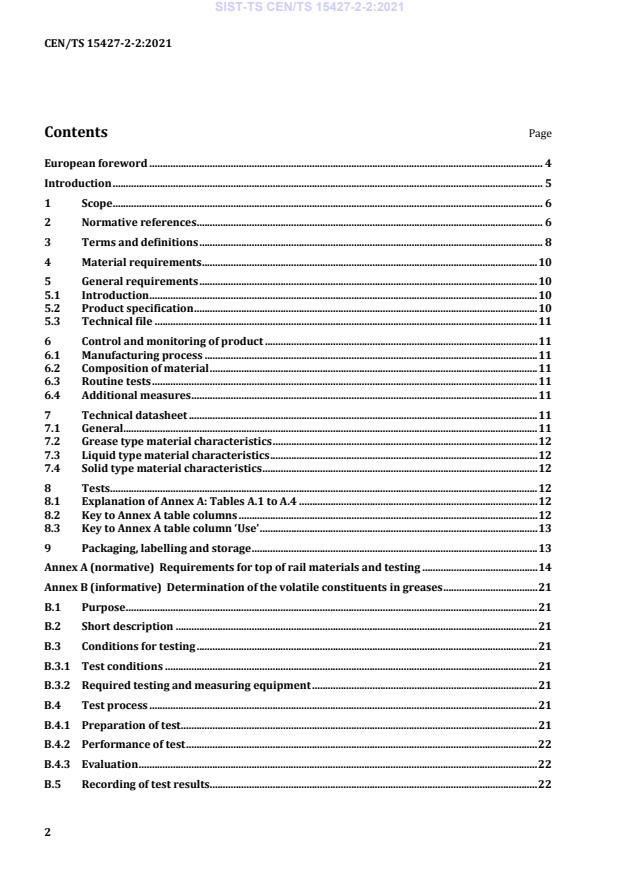
Contents Page
European foreword . 4
Introduction . 5
1 Scope . 6
2 Normative references . 6
3 Terms and definitions . 8
4 Material requirements . 10
5 General requirements . 10
5.1 Introduction . 10
5.2 Product specification . 10
5.3 Technical file . 11
6 Control and monitoring of product . 11
6.1 Manufacturing process . 11
6.2 Composition of material . 11
6.3 Routine tests . 11
6.4 Additional measures . 11
7 Technical datasheet . 11
7.1 General. 11
7.2 Grease type material characteristics . 12
7.3 Liquid type material characteristics . 12
7.4 Solid type material characteristics . 12
8 Tests . 12
8.1 Explanation of Annex A: Tables A.1 to A.4 . 12
8.2 Key to Annex A table columns . 12
8.3 Key to Annex A table column ‘Use’ . 13
9 Packaging, labelling and storage . 13
Annex A (normative) Requirements for top of rail materials and testing . 14
Annex B (informative) Determination of the volatile constituents in greases . 21
B.1 Purpose . 21
B.2 Short description . 21
B.3 Conditions for testing . 21
B.3.1 Test conditions . 21
B.3.2 Required testing and measuring equipment . 21
B.4 Test process . 21
B.4.1 Preparation of test . 21
B.4.2 Performance of test . 22
B.4.3 Evaluation . 22
B.5 Recording of test results. 22
Annex C (informative) Functional test on specific equipment . 23
C.1 General . 23
C.2 Sprayability of liquid TOR materials . 23
C.2.1 Purpose . 23
C.2.2 Short description . 23
C.2.3 Conditions for testing . 23
C.2.4 Test process . 24
Annex D (informative) Twin-disc machine Retentivity and Coefficient of Traction test . 25
D.1 Purpose . 25
D.2 Description . 25
D.3 Conditions for test . 25
D.3.1 Test conditions . 25
D.3.2 Twin discs . 25
D.3.3 Performance of the Test . 26
D.3.4 Evaluation of the Test. 26
Annex E (informative) Twin-disc machine test for determining Creep force vs Creep rate curve
(for solid sticks comparable to MTM machine test). 28
E.1 Purpose . 28
E.2 Description . 28
E.3 Conditions for test . 29
E.3.1 Test conditions . 29
E.3.2 Twin discs . 29
E.3.3 Test Process Example . 29
E.3.4 Evaluation of the Test. 30
Annex F (informative) MTM machine creep curve test . 32
F.1 General . 32
F.1.1 Purpose . 32
F.1.2 Description . 32
F.2 Test equipment. 32
F.3 Application of TOR material to metal disk . 33
F.4 Performance of the Test . 35
F.5 Evaluation of the Test. 36
Bibliography . 37
European foreword
This document (CEN/TS 15427-2-2:2021) has been prepared by Technical Committee CEN/TC 256
“Railway applications”, the secretariat of which is held by DIN.
Attention is drawn to the possibility that some of the elements of this document may be the subject of
patent rights. CEN shall not be held responsible for identifying any or all such patent rights.
This document is part of the EN 15427 series, Railway applications - Wheel/Rail friction management,
which consists of the following parts:
— Part 1-1: Equipment and Application - Flange Lubrication;
— Part 1-2: Equipment and Application - Top of Rail materials;
— Part 1-3: Equipment and Application - Adhesion materials;
— Part 2-1: Properties and Characteristics - Flange lubricants;
— Part 2-2: Properties and Characteristics - Top of Rail materials;
— Part 2-3: Properties and Characteristics - Adhesion materials;
— Part 3: Rationale for requirements and further background information.
According to the CEN/CENELEC Internal Regulations, the national standards organisations of the
following countries are bound to announce this Technical Specification: Austria, Belgium, Bulgaria,
Croatia, Cyprus, Czech Republic, Denmark, Estonia, Finland, France, Germany, Greece, Hungary, Iceland,
Ireland, Italy, Latvia, Lithuania, Luxembourg, Malta, Netherlands, Norway, Poland, Portugal, Republic of
North Macedonia, Romania, Serbia, Slovakia, Slovenia, Spain, Sweden, Switzerland, Turkey and the United
Kingdom.
Introduction
Friction management using solid or fluid (oil, grease, etc.) substances at the wheel-rail interface is a
complex subject and includes the following aspects:
— lubrication of the wheel flange / rail gauge corner interface, commonly referred to as “flange or rail
lubrication”;
— lubrication of the back of flange/ check rail interface; commonly referred to as “check rail
lubrication”;
— altering the level of friction at the interface between the top of rail and the wheel tread, commonly
referred to as “top of rail friction management”;
— altering the level of adhesion at the interface between the top of rail and the wheel tread.
This document sets out requirements for the material to be used on the top of rail. It specifies
requirements for the material, how to test it and how to approve it.
The material for top of rail should be tested to confirm there is:
— compatibility with top of rail material applicator equipment;
— no intolerable increased risk of fire;
— no harmful environmental effects;
— no incompatibility between the different materials/lubricants in use, particularly between solid and
fluid systems;
— satisfactory and consistent product quality and performance;
— no degradation to the safety of the railway (braking, signalling).
The main purpose of a top of rail material is to influence the third layer to reduce friction to a level where
a reduction in noise or wear can be realized.
1 Scope
This document specifies the requirements of materials intended to be applied to the interface between
the wheel tread and the rail crown (active interface). It can be applied either directly or indirectly to the
wheel tread or rail.
It outlines the information required for most approval procedures, the method of testing and routine
control/monitoring of the material.
This document does not deal with adhesion materials, for example:
— sand;
— adhesion enhancers.
2 Normative references
The following documents are referred to in the text in such a way that some or all of their content
constitutes requirements of this document. For dated references, only the edition cited applies. For
undated references, the latest edition of the referenced document (including any amendments) applies.
EN ISO 868, Plastics and ebonite - Determination of indentation hardness by means of a durometer (Shore
hardness) (ISO 868)
EN ISO 2160, Petroleum products - Corrosiveness to copper - Copper strip test (ISO 2160)
EN ISO 2592, Petroleum and related products - Determination of flash and fire points - Cleveland open cup
method (ISO 2592)
EN ISO 3104, Petroleum products - Transparent and opaque liquids - Determination of kinematic viscosity
and calculation of dynamic viscosity (ISO 3104)
EN ISO 3146, Plastics - Determination of melting behaviour (melting temperature or melting range) of semi-
crystalline polymers by capillary tube and polarizing-microscope methods (ISO 3146)
EN ISO 3675, Crude petroleum and liquid petroleum products - Laboratory determination of density -
Hydrometer method (ISO 3675)
EN ISO 4589-1, Plastics - Determination of burning behaviour by oxygen index - Part 1: General
requirements (ISO 4589-1)
EN ISO 4589-2, Plastics - Determination of burning behaviour by oxygen index - Part 2: Ambient-
temperature test (ISO 4589-2)
EN ISO 5659-1, Plastics — Smoke generation — Part 1: Guidance on optical-density testing (ISO 5659-1)
EN ISO 5659-2, Plastics - Smoke generation - Part 2: Determination of optical density by a single-chamber
test (ISO 5659-2)
ISO/TR 5659-3, Plastics — Smoke generation — Part 3: Determination of optical density by a dynamic-flow
method
EN ISO 7827, Water quality - Evaluation of the "ready", "ultimate" aerobic biodegradability of organic
compounds in an aqueous medium - Method by analysis of dissolved organic carbon (DOC) (ISO 7827)
EN ISO 9408, Water quality - Evaluation of ultimate aerobic biodegradability of organic compounds in
aqueous medium by determination of oxygen demand in a closed respirometer (ISO 9408)
EN ISO 9439, Water quality - Evaluation of ultimate aerobic biodegradability of organic compounds in
aqueous medium - Carbon dioxide evolution test (ISO 9439)
EN ISO 10707, Water quality - Evaluation in an aqueous medium of the "ultimate" aerobic biodegradability
of organic compounds - Method by analysis of biochemical oxygen demand (closed bottle test) (ISO 10707)
EN ISO 12185, Crude petroleum and petroleum products - Determination of density - Oscillating U-tube
method (ISO 12185)
ISO 2049, Petroleum products — Determination of colour (ASTM scale)
ISO 3016, Petroleum and related products from natural or synthetic sources — Determination of pour point
ISO 6072, Rubber — Compatibility between hydraulic fluids and standard elastomeric materials
ISO 6743-99, Lubricants, industrial oils and related products (class L) — Classification — Part 99: General
ISO 7120, Petroleum products and lubricants — Petroleum oils and other fluids — Determination of rust-
preventing characteristics in the presence of water
ISO 9772, Cellular plastics — Determination of horizontal burning characteristics of small specimens
subjected to a small flame
ISO 11007, Petroleum products and lubricants — Determination of rust-prevention characteristics of
lubricating greases
DIN 51418-1, X-ray spectrometry — X-ray emissions and X-ray fluorescence analysis (XRF) — Part 1:
Definitions and principles
DIN 51418-2, X-ray spectrometry — X-ray emissions and X-ray fluorescence analysis (XRF) — Part 2:
Definitions and basic principles for measurements, calibration and evaluation of results
DIN 51451, Testing of petroleum products and related products — Analysis by infrared spectrometry —
General working principles
DIN 51817, Testing of lubricants — Determination of oil separation from greases under static conditions
DIN 51820-1, Testing of lubricants — Analysis of greases by infrared spectrometry — Taking and
evaluating an infrared spectrum
3 Terms and definitions
For the purposes of this document, the terms and definitions given in EN 15085-1, EN 17018 and in
EN 13306 as well as the following apply.
ISO and IEC maintain terminological databases for use in standardization at the following addresses:
— ISO Online browsing platform: available at https://www.iso.org/obp
— IEC Electropedia: available at http://www.electropedia.org/
3.1
top of rail (TOR) material
substance that influences the rheology of the third layer body
3.2
liquid lubricant
oil, water or emulsion-based products
Note 1 to entry: Oil can be mineral, natural or synthetic in origin and can have additives included.
3.3
grease
semi-solid lubricant
Note 1 to entry: Grease consists of a thickener and additives integrated in a lubricating oil.
3.4
stick
encapsulated solid lubricant
Note 1 to entry: Typically, the stick comprises a solid lubricant which is encapsulated in a polymeric binder/carrier.
The product is designed for direct contact with a rotating wheel flange; the polymeric binder has a sufficiently high
melting point such that it does not melt but rather wears when in contact with the wheel flange to ensure
dimensional stability.
3.5
batch
entire content of a single identified production of material from the same manufacturing process
3.6
active interface
contact area between the wheel tread and the crown of the rail
Note 1 to entry: For more information on this definition, see CEN/TS 15427-1-2.
3.7
rail lubrication
lubrication of the active interface by applying a lubricant to the rail gauge side face
3.8
lubricant application unit
LAU
component of the lubrication system (trainborne or trackside) that delivers lubricant to the active
interface
Note 1 to entry: This includes spray nozzles, trackside grease distribution units/blades, stick applicators, etc.
3.9
lubrication system
components required to apply lubricant to the active interface
Note 1 to entry: A lubrication system can include one or more Lubricant Application Units, a reservoir unit, pump
and/or a control device.
3.10
trainborne equipment
type of equipment that delivers product to the active interface installed on a train
3.11
trackside
type of lubrication system installed on or adjacent to the track
3.12
customer
railway undertaking, infrastructure owner, manufacturer or buyer of railway products or subassemblies,
or their representative
3.13
supplier
supplier of lubricants
Note 1 to entry: A supplier might also be the manufacturer of the product.
3.14
product specification
document prepared by the customer that describes the conditions and requirements for the lubricant
3.15
coefficient of friction
COF
and the multi- vector reaction between the wheel and rail
relationship between the force of friction
Note 1 to entry: Used between the flange and gauge corner of the rail.
3.16
coefficient of adhesion
COA
ratio of the tangential force at the wheel-rail interface and the force at this interface acting perpendicular
to the surface of the rail
3.17
coefficient of traction
COT
ratio of the tangential force at the wheel-rail interface and the force at this interface acting perpendicular
to the surface of the rail
4 Material requirements
The material shall be designed to meet at least one of the following:
— reduction in noise and vibration;
— reduction in the rate of wear;
— reduction of the rate of corrugation growth;
— reduction in the number of wheel and rail defects.
When applied within the specified limits to the active interface the material shall not compromise the
safety of the railway (i.e. braking distances, signalling systems).
NOTE Specified limits are normally understood and agreed before use of material.
5 General requirements
5.1 Introduction
This section outlines the information required to gain approval on most railway networks. It does not
cover its performance on the railway.
5.2 Product specification
The product specification shall be fully documented and shall include the following information:
a) purpose of material;
b) conformity to the applicable type tests as set out in Tables A.1 to A.3;
c) conformance with other relevant local requirements (such as environmental, fire, toxicity, etc.);
d) application data:
1) including equipment, it can be used with;
2) operating temperatures;
NOTE 1 The typical operating temperature range to take into account is from −25 °C to +80 °C.
e) additional validation tests (see Table A.4);
f) any previous relevant experience;
g) conditions for packaging, storage and labelling (see Clause 9);
h) environmental tests are defined in Tables A.1 to A.3.
NOTE 2 Where legislation and regulations (European, national or local) concerning ecological and
environmental compatibility of lubricants (biodegradability, toxicity, etc.) are applicable, consideration will need to
be given to the relevant requirements.
5.3 Technical file
A file of technical data showing compliance with the requirements in the product specification and the
results of type tests and trials shall be provided. A technical datasheet shall also be provided (see
Clause 7).
A material safety data sheet (MSDS) for the product in the language of the interested customer or country
shall be included.
6 Control and monitoring of product
6.1 Manufacturing process
If the manufacturing process is changed in a way that may affect the chemical composition, it shall be
documented and the customer shall be notified.
NOTE In some cases, this leads to a new approval being required.
6.2 Composition of material
If the composition of the material is changed in any way, it shall be documented and the customer shall
be notified.
NOTE In some cases, this leads to a new approval being required.
6.3 Routine tests
Routine tests ensure product consistency from batch to batch.
The routine tests are listed in Tables A1 to A3. If additional tests are required (such as those not included
in the tables or a type test) this and the frequency can be agreed between the client and supplier.
The sample of material assessed for quality testing shall have been manufactured in a regular production
batch. The entire sample of material used for the approval tests shall be taken from the same production
batch and delivered in a single consignment.
The results of the routine tests shall be recorded.
6.4 Additional measures
Retention of test records and samples, witnessing of tests, calibration of test equipment shall be
considered.
7 Technical datasheet
7.1 General
The technical datasheet shall include the individual identifying code or name of the material, a description
of the product’s field of use and typical means of application. For each material type, the information in
the following subclauses shall also be included.
7.2 Grease type material characteristics
The product shall be described by its consistency, its temperature range, the type of thickener and type
of base oil used. Where solid particulates are used, the type and content shall be reported. Further
technical data shall be provided as listed under the ‘datasheet’ column in Table A.1.
7.3 Liquid type material characteristics
The material, which includes, water based, oil based and hybrid based, shall be described by its viscosity,
its temperature range and by the type of oil used. Where solid particulates are used, the type and content
shall be reported. Further technical data shall be provided as listed under the ‘datasheet’ column in
Table A.2.
7.4 Solid type material characteristics
The product shall be described by its melting point, hardness, dimensions and its temperature range.
Further technical data shall be provided as listed under the ‘datasheet’ column in Table A.3.
The product shall be designed to minimize stick debris on the ballast.
It is suggested that the mass of any piece of debris should be no greater than 5 g.
8 Tests
8.1 Explanation of Annex A: Tables A.1 to A.4
The tables have 2 purposes:
1. Tests to show the product can be used in the railway environment;
NOTE Values may vary depending on where the material is used.
2. Product consistency.
For each required property of the material, Tables A.1, A.2 and A.3 list the mandatory and optional tests
for grease, oil, water based and sticks respectively, and parameters for trainborne and trackside
applications.
Table A.4 lists additional tests to check the performance characteristics of the material and that the
material will operate correctly with the equipment it is to be used with.
8.2 Key to Annex A table columns
The key to the columns ‘Type’, ‘Routine’ and ‘Technical Datasheet’ in Tables A.1 to A.4 is as follows:
— ‘Type’ = This indicates the type tests required for the purpose of approval testing (see 6.1 and 6.2).
— ‘Routine’ = This indicates the routine tests required for testing from approved mass-produced
batches (see 6.3).
— ‘Technical Datasheet’ = This indicates the characteristics to be listed in the product documentation.
In each column, a symbol is used to indicate the required test or information:
— ‘X’ indicates the test or piece of information is mandatory;
— ‘O’ indicates the test or piece of information is optional;
8.3 Key to Annex A table column ‘Use’
Tables A.1 to A.4 include a column headed ‘Use’ and the letters used mean the following:
— A = Trainborne using liquid or grease type materials;
— B = Trackside using liquid or grease type materials;
— C = Trainborne using a solid material.
This column identifies the most common systems in current use. Most trainborne equipment sprays the
material and most trackside equipment pumps the material. However, where alternatives exist, careful
consideration to the tests required is needed.
9 Packaging, labelling and storage
The packaging shall protect the contents from contamination and damage.
The labelling shall include at least the following:
— supplier’s name;
— brand name and/or code of the material;
— batch number and date of manufacture, uncoded or coded;
— net mass/quantity/volume;
NOTE Local regulatory requirements will apply.
The following additional information shall be included if specified in the product specification:
— customer stock number;
— an indication that the batch has been accepted by the customer.
The storage conditions and, if necessary, the date limit of use of the material shall be provided.
Annex A
(normative)
Requirements for top of rail materials and testing
Table A.1 — Requirements for greases
Item Property Use Unit Test method Values Type Routine Datasheet Comments
A.1.1 Appearance A - Visual Homogenous X X X This is useful to see if the product looks as it
and should.
B
A.1.2 Colour A - ISO 2049 Homogenous X O X
and
B
A.1.3 Consistency A - ISO 6743-99 To be provided for X X X
information
B - ISO 6743-99 To be provided for X X X
information
A.1.7 Flash point A °C EN ISO 2592 ≥ 200 X X This test is required for safety purposes and
and should be retained.
B
Need a standard for finished grease product.
Current ISO quoted is for oils.
A.1.12 Oil separation / Required for TOR, left in as it indicates the
“bleeding” stability of the product.
A.1.12.1 (18 h at 40 °C) A % mass DIN 51817 ≤ 5 X O Without 100 g weight
A.1.12.2 (168 h [7 days] at B % mass DIN 51817 5 % maximum by X O With 100 g weight
40 °C) weight for NLGI No.2
grease &
7 % maximum by
weight for a NLGI No.1
grease
Item Property Use Unit Test method Values Type Routine Datasheet Comments
A.1.13 Corrosion test Required for TOR, only need to check against
steel and only ISO test is required.
a) Steel A Level Annex C 1 O O O Deleted as not needed for TOR
A Rating ISO 11007 using 0; 0 X O X
and water
B
b) Copper A Grade DIN 51811 1 O O O
and
24 h at 50 °C
B
A.1.14 Compatibility with A Where applicable
elastomers (60 °C for and
168 h) B
a) Change in volume for % ISO 6072 +15/-0 O Other elastomer types may be tested as
NBR1 necessary
b) Change in hardness for IRHD ISO 6072 ±8 O Other elastomer types may be tested as
NBR1 necessary
A.1.15 Identity testing: A Standard laboratory For routine tests X O Applicable standards:
and method. compare with approved
Using Infrared, or DIN 51418-1
B batch using same
(See comments for
Xray fluorescence, or DIN 51418-2
process
applicable standards)
Inductively coupled DIN 51451
plasma
DIN 51820-1
Required for TOR, not required as it is a quality
test.
Item Property Use Unit Test method Values Type Routine Datasheet Comments
A.1.16 Apparent viscosity A
(1° cone, s = 300 s,
−1
D = 1 000 s ) at:
a) 25 °C mPa·s DIN 51810-1 ≥ 150 O O O
b) 0 °C ≥ 400 O O O
c) −25 °C ≤ 4 000 O O O
A.1.19 Low temperature flow B mbar DIN 51805 compatibility with O O Required for TOR – values yet to be defined.
pressure equipment
(pumpability)
A.1.20 Density at 15 °C A kg/m3 EN ISO 12185 Informative – no criteria O O O Required for TOR
EN ISO 3675
A.1.21 Biodegradability A % One of the following Local conditions may X O As defined in Product Specification.
and test methods: apply
See normative references in Clause 2.
B
EN ISO 7827
Required for TOR – need to check values
EN ISO 9408
EN ISO 9439
EN ISO 10707
A.1.22 Fire behaviour A As defined in client/ Local conditions may O O Required for TOR
and supplier discussion. apply
a) Smoke
B
b) Spread of flame
c) Toxicity
A.1.24 Water pollution A As As defined in the Local conditions may O For example, in Germany: Verwaltungsvorschrift
and required Product Specification, apply wassergefährdender Stoffe [German
B see comment. Administrative Regulation on Substances
Hazardous to Water]
Required in the TOR
A.1.27 Electrical resistance A As defined in the O Required for TOR, no standard test needs to be
and Product Specification defined.
B
Table A.2 — Requirements for liquid materials
Item Property Use Unit Test method Values Type Routine Datasheet Comments
A.2.1 Appearance A - Visual Homogenous X X O Appearance is a holistic assessment of the
product.
A.2.2 Colour A - ISO 2049 Homogenous X O O
A.2.3 Flash point A °C EN ISO 2592 ≥ 200 X X Deferred to understand minimum temperatures
required for flashpoint.
A.2.4 Corrosion test
a) Steel A level ISO 7120 1 O O O
b) Copper A grade EN ISO 2160 1b O O O
3 h at 50 °C
A.2.5 Compatibility with A Where applicable
elastomers (60 °C for
– required to check compatibility with rubber
168 h)
valves and seals.
a) Change in volume for % ISO 6072 +15/-0 O Other elastomer types may be tested as necessary
NBR1 (change in volume of elastomer)
b) Change in hardness for IRHD ISO 6072 ±8 O Other elastomer types may be tested as necessary
NBR1 (change in hardness of elastomer)
A.2.6 Identity testing: A Standard laboratory For routine tests O O Applicable standards:
method. compare with approved
Using Infrared, or DIN 51418-1
batch using same
(See comments for
Xray fluorescence, or DIN 51418-2
process
applicable standards)
ICP DIN 51451
DIN 51820-1
A.2.7 Density at 15 °C A EN ISO 12185 Informative – no criteria O O O
kg/m
EN ISO 3675
A.2.8 Biodegradability A % EN ISO 9439 Local conditions may X O As defined in Product Specification.
apply
See normative references in Clause 2.
Item Property Use Unit Test method Values Type Routine Datasheet Comments
A.2.9 Fire behaviour A As defined in the O O Read EN 45545–1 and understand whether or not
Product Specification it is relevant to this standard. Only relevant for
a) Smoke
trainborne? IEC 60721
b) Spread of flame
c) Toxicity
A.2.10 Pour point A °C ISO 3016 Lower than operating O O
range lower limit
A.2.11 Dynamic viscosity at A mPa⋅s EN ISO 3104 Informative – no criteria O O O
40 °C
A.2.12 Brookfield viscosity at A mPa⋅s DIN 51398 Informative – no criteria O O O Deletion deferred until further discussion
40 °C (required to give the kinematic viscosity which is
required for ISO class)
A.2.13 Dynamic viscosity at A mPa⋅s EN ISO 3104 Informative – no criteria O O O
40 °C
A.2.14 Brookfield viscosity at A mPa⋅s DIN 51398 Informative – no criteria O O O Deletion deferred until further discussion
40 °C (required to give the kinematic viscosity which is
required for ISO class)
A.2.15 Water pollution A As As defined in the Local conditions may O For example, in Germany: Verwaltungsvorschrift
required Product Specification, apply wassergefährdender Stoffe [German
see comment Administrative Regulation on Substances
Hazardous to Water].
Table A.3 — Requirements for sticks
Item Property Use Unit Test method Values Type Routine Datasheet Comments
A.3.1 Appearance C - Visual Homogeneous X X O Batch to batch comparison.
A.3.2 Colour C - ISO 2049 Homogeneous X X X Batch to batch comparison.
A.3.3 Melting point C °C EN ISO 3146 Higher than operating X Add definition of operating range.
range
a) Smoke - See comments O O EN ISO 5659-1
EN ISO 5659-2
ISO/TR 5659-3
b) Spread of - See comments O O EN ISO 4589-1
flame
EN ISO 4589-2
ISO 9772
c) Toxicity - See comments O O
A.3.8 Identity C Standard laboratory For routine tests compare O
testing method with approved batch using
same process
Using ICP /
LECO or
X-ray
fluorescence
A.3.10 Hardness C Shore EN ISO 868 For routine tests compare X X See Note 3.
with approved batch
A.3.11 Water C As As defined in the Local conditions might also O For example, in Germany: Verwaltungsvorschrift
pollution required Product Specification, apply wassergefährdender Stoffe [German Administrative
see comment Regulation on Substances Hazardous to Water]
NOTE 1 Consistent stick dimensions are critical to ensure that the solid sticks fit and do not jam in the applicator.
NOTE 2 Significant differences in density could indicate a change in composition or level of solid lubricants, or presence of voids in product.
NOTE 3 Different hardness value could lead to differing stick consumption values under similar operating conditions.
Table A.4 — Functional tests for all material types
Item Property Use Unit Test method Values Type Routine Datasheet Comments
A.4.2 Functional tests using A and Annex D O – Annex K to be revised
application B accordingly.
equipment (at low,
normal and high
temperature)
A.4.3 Field testing A, B Refer to O Refer to CEN/TS 15427-1-2,
and C CEN/TS 15427-1-2, Annex B for more guidance
Annex B for more
guidance
A.4.4 Film retention A, B Twin disc test in film retention O
and C Annex L
A.4.5 Creep test A, B Mini Traction O
Machine (MTM) test
Annex M
A.4.6 Rolling contact A, B Twin disc test in O
fatigue and C Annex N
A.4.7 Friction value C Twin disk test
Annex P
Annex B
(informative)
Determination of the volatile constituents in greases
B.1 Purpose
The volatile constituent in a lubricant is the low-boiling point component of the grease used to improve
low-temperature behaviour. The volatile constituents determined with the method below are
predominantly solvents. It is of considerable interest in real-life practice to know the solvent content of
a wheel-flange lubricant; and since no suitable standard exists to date, the method described below has
been developed as a guide.
This method can help identify where solvents are used to lower the lubricant viscosity at low
temperature. The use of these modified lubricants can lead to problems when the solvent content
evaporates with time.
B.2 Short description
A defined amount of grease is weighed out onto an evaporating dish and placed in a heating cabinet for a
period of time. It is then weighed to determine the volatile constituent content.
B.3 Conditions for testing
B.3.1 Test conditions
The test is carried out at a temperature of (60 ± 0,5) °C for a duration of 24 h. The conditions for the tests
are set by a heating cabinet.
B.3.2 Required testing and measuring equipment
— thermometer, with a measuring range of 0 °C to 70 °C and accuracy of 0,5 °C.
— analytical balance, with a range of 0 g to 200 g and accuracy of 0,001 g.
— heating cabinet.
— flat porcelain evaporating dish, 95 mm in diameter. For the test described, here, the dish above is
used. Where other sizes or types are used, the result might be different.
— desiccator.
B.4 Test process
B.4.1 Preparation of test
None.
B.4.2 Performance of test
1) Weigh the empty porcelain evaporating dish with the analytical balance. Add (10 ± 0
...
Questions, Comments and Discussion
Ask us and Technical Secretary will try to provide an answer. You can facilitate discussion about the standard in here.
Loading comments...