


EN 13508-2:2003
(Main)Conditions of drain and sewer systems outside buildings - Part 2: Visual inspection coding system
General Information
- Abstract
This European Standard is applicable to the establishment of the condition of sewers, drains, manholes and inspection chambers by inspection, status codification and consideration of external factors and other information. It is applicable to drain and sewer systems, which operate essentially under gravity, from the point where the sewage leaves a building or roof drainage system, or enters a road gully, to the point where it is discharged into a treatment works or receiving water.
- Status
- Withdrawn
- Publication Date
- 20-May-2003
- Withdrawal Date
- 17-May-2011
- Technical Committee
- CEN/TC 165 - Waste water engineering
- Drafting Committee
- CEN/TC 165/WG 22 - Drainage outside buildings
- Current Stage
- 9960 - Withdrawal effective - Withdrawal
- Start Date
- 18-May-2011
- Completion Date
- 18-May-2011
- Directive
- Harmonized Standard305/2011 - Regulation (eu) No 305/2011 of the European Parliament and of the Council of 9 march 2011 laying down harmonised conditions for the marketing of construction products and repealing council directive 89/106/eec
Not Harmonized89/106/EEC - Construction products

Relations
- Effective Date
- 05-Mar-2011
- Effective Date
- 28-Jan-2026
- Referred By
EN 1991-1-5:2003 - Eurocode 1: Actions on structures - Part 1-5: General actions - Thermal actions - Effective Date
- 28-Jan-2026
- Effective Date
- 28-Jan-2026
- Effective Date
- 28-Jan-2026
- Effective Date
- 22-Dec-2008
Get Certified
Connect with accredited certification bodies for this standard

Zavod za gradbeništvo Slovenije (ZAG) - Inšpekcija
ZAG inspection body for construction products, structures, and materials.
Sponsored listings
Frequently Asked Questions
EN 13508-2:2003 is a standard published by the European Committee for Standardization (CEN). Its full title is "Conditions of drain and sewer systems outside buildings - Part 2: Visual inspection coding system". This standard covers: This European Standard is applicable to the establishment of the condition of sewers, drains, manholes and inspection chambers by inspection, status codification and consideration of external factors and other information. It is applicable to drain and sewer systems, which operate essentially under gravity, from the point where the sewage leaves a building or roof drainage system, or enters a road gully, to the point where it is discharged into a treatment works or receiving water.
This European Standard is applicable to the establishment of the condition of sewers, drains, manholes and inspection chambers by inspection, status codification and consideration of external factors and other information. It is applicable to drain and sewer systems, which operate essentially under gravity, from the point where the sewage leaves a building or roof drainage system, or enters a road gully, to the point where it is discharged into a treatment works or receiving water.
EN 13508-2:2003 is classified under the following ICS (International Classification for Standards) categories: 93.030 - External sewage systems. The ICS classification helps identify the subject area and facilitates finding related standards.
EN 13508-2:2003 has the following relationships with other standards: It is inter standard links to EN 13508-2:2003+A1:2011, EN 1991-3:2006, EN 1991-1-5:2003, EN ISO 19900:2013, EN ISO 19903:2006, EN 13508-2:2003/AC:2007. Understanding these relationships helps ensure you are using the most current and applicable version of the standard.
EN 13508-2:2003 is associated with the following European legislation: EU Directives/Regulations: 305/2011, 89/106/EEC. When a standard is cited in the Official Journal of the European Union, products manufactured in conformity with it benefit from a presumption of conformity with the essential requirements of the corresponding EU directive or regulation.
EN 13508-2:2003 is available in PDF format for immediate download after purchase. The document can be added to your cart and obtained through the secure checkout process. Digital delivery ensures instant access to the complete standard document.
Standards Content (Sample)
2003-01.Slovenski inštitut za standardizacijo. Razmnoževanje celote ali delov tega standarda ni dovoljeno.Conditions of drain and sewer systems outside buildings - Part 2: Visual inspection coding systemUgotavljanje stanja drenažnih in kanalizacijskih sistemov zunaj stavb – 2. del: Sistem za vizualni nadzor in kodiranjeCondition des réseaux d'évacuation et d'assainissement a l'extérieur des bâtiments - Partie 2 : Systeme de codage de l'inspection visuelleZustandserfassung von Entwässerungssystemen außerhalb von Gebäuden - Teil 2: Kodiersystem für die optische InspektionTa slovenski standard je istoveten z:EN 13508-2:2003SIST EN 13508-2:2003en93.030ICS:SLOVENSKI
STANDARDSIST EN 13508-2:200301-oktober-2003
EUROPEAN STANDARDNORME EUROPÉENNEEUROPÄISCHE NORMEN 13508-2May 2003ICS 93.030English versionConditions of drain and sewer systems outside buildings - Part2: Visual inspection coding systemCondition des réseaux d'évacuation et d'assainissement àl'extérieur des bâtiments - Partie 2: Système de codage del'inspection visuelleZustandserfassung von Entwässerungssystemenaußerhalb von Gebäuden - Teil 2: Kodiersystem für dieoptische InspektionThis European Standard was approved by CEN on 4 November 2002.CEN members are bound to comply with the CEN/CENELEC Internal Regulations which stipulate the conditions for giving this EuropeanStandard the status of a national standard without any alteration. Up-to-date lists and bibliographical references concerning such nationalstandards may be obtained on application to the Management Centre or to any CEN member.This European Standard exists in three official versions (English, French, German). A version in any other language made by translationunder the responsibility of a CEN member into its own language and notified to the Management Centre has the same status as the officialversions.CEN members are the national standards bodies of Austria, Belgium, Czech Republic, Denmark, Finland, France, Germany, Greece,Hungary, Iceland, Ireland, Italy, Luxembourg, Malta, Netherlands, Norway, Portugal, Slovakia, Spain, Sweden, Switzerland and UnitedKingdom.EUROPEAN COMMITTEE FOR STANDARDIZATIONCOMITÉ EUROPÉEN DE NORMALISATIONEUROPÄISCHES KOMITEE FÜR NORMUNGManagement Centre: rue de Stassart, 36
B-1050 Brussels© 2003 CENAll rights of exploitation in any form and by any means reservedworldwide for CEN national Members.Ref. No. EN 13508-2:2003 E
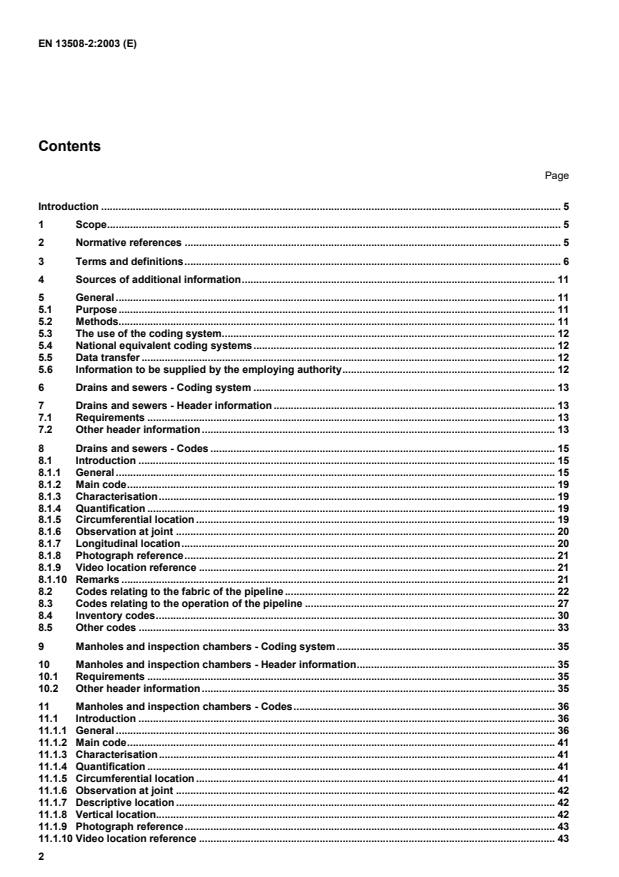
National equivalent coding systems.59A.1Header information.59A.2Codes.59Annex B (informative)
Format for electronic transfer of coded data.60B.1Introduction.60B.2General.60B.3File header information.60B.4Inspection header information.62B.5Inspection data.62B.6Examples.63Annex C (informative)
Recommended system for coding of header information for drains and sewers.64C.1Introduction.64C.2Location of the inspection.64C.3Inspection details.66C.4Pipeline details.68C.5Other information.71C.6Changes to header information.71Annex D (informative)
Recommended system for coding of header information for manholes andinspection chambers.74D.1Introduction.74D.2Location of the inspection.74D.3Inspection details.75D.4Manhole or inspection chamber details.78D.5Other information.80D.6Changes to header information.81Annex E (informative)
Sample coding sheet.83Annex F (informative)
Photographs illustrating the coding system for drains and sewers.85Annex G (informative)
Photographs illustrating the coding system for manholes and inspectionchambers.131Annex H (informative)
Sources of additional information.152H.1International Standards.152H.2Austria.152H.2.1Austrian Water and Waste Management Association – Rules of Practice (ÖWAV -Österreichischer Wasser- und Abfallwirtschaftsverband - Regelblätter).152H.2.2Other guidelines.152H.3Denmark.153H.4Finland.153H.5France.153H.6Germany.153H.7Netherlands.154H.8Norway.154H.9Sweden.154H.10Switzerland.154H.11United Kingdom.155Bibliography.156
Where appropriate, it can also beused for pressure and vacuum systems in accordance with the requirements of the employing authority.This part of the European Standard does not generally specify requirements for carrying out inspections.2 Normative referencesThis European Standard incorporates by dated or undated reference, provisions from other publications. Thesenormative references are cited at the appropriate places in the text, and the publications are listed hereafter. Fordated references, subsequent amendments to or revisions of any of these publications apply to this EuropeanStandard only when incorporated in it by amendment or revision. For undated references the latest edition of thepublication referred to applies (including amendments).EN 476:1997, General requirements for components used in discharge pipes, drains and sewers for gravitysystems.EN 752-1:1995, Drain and sewer systems outside buildings – Part 1: Generalities and definitions.EN 752-5:1997, Drain and sewer systems outside buildings – Part 5: Rehabilitation.ISO 8601, Data elements and interchange formats — Information interchange — Representation of dates andtimes.
working space above the channel3.5chamber unitcomponent part of a manhole or inspection chamber manufactured as a single entity and intended to be joined withother chamber units3.6combined systemsewer system designed to carry both wastewater and surface water in the same pipeline(s)[EN 752-1:1995]3.7connectiongeneral term used for the location at which one pipeline joins another pipeline or a manhole or inspection chamber3.8drainpipeline, usually underground, designed to carry wastewater and/or surface water from a source to a sewer.[EN 752-1:1995]3.9drain systemnetwork of pipelines and ancillary works that conveys wastewater and/or surface water to a cesspool, sewersystem or other place of disposal[EN 752-1:1995]3.10employing authorityorganisation which owns or is responsible for the inspection of a drain or sewer system3.11exfiltrationescape of flow from a drain or sewer system into surrounding ground[EN 752-1:1995]
that broadly describes the feature, together withthe following additional information where required.¾ Characterisation - up to two codes which describes the feature in more detail. (see 8.1.3)¾ Quantification - up to two values which quantify the feature (see 8.1.4).¾ Circumferential location - up to two clockface references which locate the position of the observation aroundthe circumference (see 8.1.5).¾ Joint - identifies when the observation is associated with a joint (see 8.1.6).¾ Longitudinal location - the distance from the stated reference point including a method of recordingobservations which continue over a significant length (see 8.1.7).¾ Photograph reference (see 8.1.8).¾ Video reference (see 8.1.9).¾ Remarks - text which describes aspects of the observation which cannot be described any other way. (see8.1.10)The employing authority may specify which observations are to be recorded and the amount of detail that isrecorded for each observation (see 5.6).An example of the record for a longitudinal crack at the top of the pipe 10.5 metres from the start point is shown inTable 1 (see 8.2).
to be located on the videosequence shall be recorded. The method of locating used shall be stated in the header information in accordancewith clause 7. Where a time based method is used, the time shall be recorded in accordance with ISO 8601 in ahh:mm:ss format.8.1.10 RemarksWhere an observation cannot be fully described by a code, further details should be recorded in the remarkssection. A remark should be as short and descriptive as possible.
...