


EN 14105:2011
(Main)Fat and oil derivatives - Fatty Acid Methyl Esters (FAME) - Determination of free and total glycerol and mono-, di-, triglyceride contents
General Information
- Abstract
The purpose of this European Standard is to determine the free glycerol and residual mono-, di- and triglyceride contents in fatty acid methyl esters (FAME) intended for addition to mineral oils. The total glycerol content is then calculated from the obtained results. This method is the reference method for the determination of the free glycerol content.
Under the conditions described, the quantification limits are 0,001 % (m/m) for free glycerol, 0,10 % (m/m) for all glycerides (mono-, di- and tri-). This method is suitable for FAME prepared from rapeseed, sunflower, soybean, palm, animal oils and fats and mixture of them. It is not suitable for FAME produced from or containing coconut and palm kernel oils derivatives because of overlapping of different glyceride peaks.
NOTE For the purposes of this European Standard, the term "% (m/m)" is used to represent respectively the mass fraction.
WARNING - The use of this method may involve hazardous equipment, materials and operations. This method does not purport to address to all of the safety problems associated with its use, but it is the responsibility of the user to search and establish appropriate safety and health practices and determine the applicability of regulatory limitations prior to use.
- Status
- Withdrawn
- Publication Date
- 26-Apr-2011
- Withdrawal Date
- 22-Sep-2026
- Current Stage
- 9960 - Withdrawal effective - Withdrawal
- Start Date
- 02-Dec-2020
- Completion Date
- 23-Sep-2026

Relations
- Effective Date
- 20-Jun-2009
- Effective Date
- 09-Dec-2020
- Effective Date
- 28-Jan-2026
- Effective Date
- 28-Jan-2026
- Effective Date
- 28-Jan-2026
Get Certified
Connect with accredited certification bodies for this standard

BSI Group
BSI (British Standards Institution) is the business standards company that helps organizations make excellence a habit.

Bureau Veritas
Bureau Veritas is a world leader in laboratory testing, inspection and certification services.

DNV
DNV is an independent assurance and risk management provider.
Sponsored listings
Frequently Asked Questions
EN 14105:2011 is a standard published by the European Committee for Standardization (CEN). Its full title is "Fat and oil derivatives - Fatty Acid Methyl Esters (FAME) - Determination of free and total glycerol and mono-, di-, triglyceride contents". This standard covers: The purpose of this European Standard is to determine the free glycerol and residual mono-, di- and triglyceride contents in fatty acid methyl esters (FAME) intended for addition to mineral oils. The total glycerol content is then calculated from the obtained results. This method is the reference method for the determination of the free glycerol content. Under the conditions described, the quantification limits are 0,001 % (m/m) for free glycerol, 0,10 % (m/m) for all glycerides (mono-, di- and tri-). This method is suitable for FAME prepared from rapeseed, sunflower, soybean, palm, animal oils and fats and mixture of them. It is not suitable for FAME produced from or containing coconut and palm kernel oils derivatives because of overlapping of different glyceride peaks. NOTE For the purposes of this European Standard, the term "% (m/m)" is used to represent respectively the mass fraction. WARNING - The use of this method may involve hazardous equipment, materials and operations. This method does not purport to address to all of the safety problems associated with its use, but it is the responsibility of the user to search and establish appropriate safety and health practices and determine the applicability of regulatory limitations prior to use.
The purpose of this European Standard is to determine the free glycerol and residual mono-, di- and triglyceride contents in fatty acid methyl esters (FAME) intended for addition to mineral oils. The total glycerol content is then calculated from the obtained results. This method is the reference method for the determination of the free glycerol content. Under the conditions described, the quantification limits are 0,001 % (m/m) for free glycerol, 0,10 % (m/m) for all glycerides (mono-, di- and tri-). This method is suitable for FAME prepared from rapeseed, sunflower, soybean, palm, animal oils and fats and mixture of them. It is not suitable for FAME produced from or containing coconut and palm kernel oils derivatives because of overlapping of different glyceride peaks. NOTE For the purposes of this European Standard, the term "% (m/m)" is used to represent respectively the mass fraction. WARNING - The use of this method may involve hazardous equipment, materials and operations. This method does not purport to address to all of the safety problems associated with its use, but it is the responsibility of the user to search and establish appropriate safety and health practices and determine the applicability of regulatory limitations prior to use.
EN 14105:2011 is classified under the following ICS (International Classification for Standards) categories: 67.200.10 - Animal and vegetable fats and oils. The ICS classification helps identify the subject area and facilitates finding related standards.
EN 14105:2011 has the following relationships with other standards: It is inter standard links to EN 14105:2003, EN 14105:2020, EN 14214:2012, EN 14214:2012+A2:2019, EN 14214:2012+A1:2014. Understanding these relationships helps ensure you are using the most current and applicable version of the standard.
EN 14105:2011 is available in PDF format for immediate download after purchase. The document can be added to your cart and obtained through the secure checkout process. Digital delivery ensures instant access to the complete standard document.
Standards Content (Sample)
2003-01.Slovenski inštitut za standardizacijo. Razmnoževanje celote ali delov tega standarda ni dovoljeno.Erzeugnisse aus pflanzlichen und tierischen Fetten und Ölen - Fettsäure-Methylester (FAME) - Bestimmung des Gehaltes an freiem und Gesamtglycerin und Mono-, Di- und TriglyceridenProduits dérivés des corps gras - Esters méthyliques d'acides gras - Détermination de la teneur en glycérols libre et total et en mono-, di- et triglycéridesFat and oil derivatives - Fatty Acid Methyl Esters (FAME) - Determination of free and total glycerol and mono-, di-, triglyceride contents67.200.10Animal and vegetable fats and oilsICS:Ta slovenski standard je istoveten z:EN 14105:2011SIST EN 14105:2011en,fr,de01-julij-2011SIST EN 14105:2011SLOVENSKI
STANDARDSIST EN 14105:20031DGRPHãþD
EUROPEAN STANDARD NORME EUROPÉENNE EUROPÄISCHE NORM
EN 14105
April 2011 ICS 67.200.10 Supersedes EN 14105:2003English Version
Fat and oil derivatives - Fatty Acid Methyl Esters (FAME) - Determination of free and total glycerol and mono-, di-, triglyceride contents
Produits dérivés des corps gras - Esters méthyliques d'acides gras (EMAG) - Détermination de la teneur en glycérols libre et total et en mono-, di- et triglycérides
Erzeugnisse aus pflanzlichen und tierischen Fetten und Ölen - Fettsäure-Methylester (FAME) - Bestimmung des Gehaltes an freiem und Gesamtglycerin und Mono-, Di-und Triglyceriden This European Standard was approved by CEN on 10 March 2011.
CEN members are bound to comply with the CEN/CENELEC Internal Regulations which stipulate the conditions for giving this European Standard the status of a national standard without any alteration. Up-to-date lists and bibliographical references concerning such national standards may be obtained on application to the CEN-CENELEC Management Centre or to any CEN member.
This European Standard exists in three official versions (English, French, German). A version in any other language made by translation under the responsibility of a CEN member into its own language and notified to the CEN-CENELEC Management Centre has the same status as the official versions.
CEN members are the national standards bodies of Austria, Belgium, Bulgaria, Croatia, Cyprus, Czech Republic, Denmark, Estonia, Finland, France, Germany, Greece, Hungary, Iceland, Ireland, Italy, Latvia, Lithuania, Luxembourg, Malta, Netherlands, Norway, Poland, Portugal, Romania, Slovakia, Slovenia, Spain, Sweden, Switzerland and United Kingdom.
EUROPEAN COMMITTEE FOR STANDARDIZATION
COMITÉ EUROPÉEN DE NORMALISATION EUROPÄISCHES KOMITEE FÜR NORMUNG
Management Centre:
Avenue Marnix 17,
B-1000 Brussels © 2011 CEN All rights of exploitation in any form and by any means reserved worldwide for CEN national Members. Ref. No. EN 14105:2011: ESIST EN 14105:2011
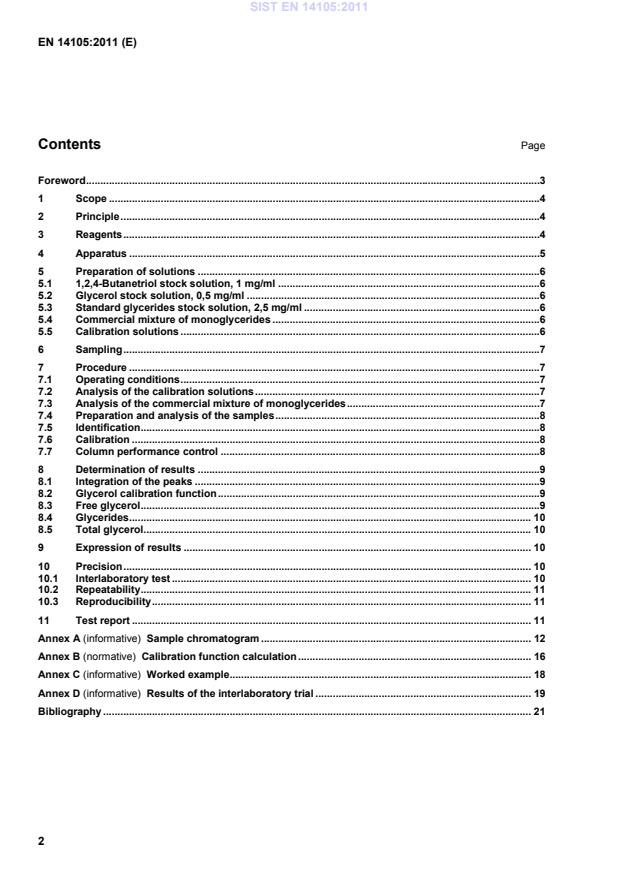
Sample chromatogram . 12Annex B (normative)
Calibration function calculation . 16Annex C (informative)
Worked example. 18Annex D (informative)
Results of the interlaboratory trial . 19Bibliography . 21 SIST EN 14105:2011
1) Monononadecaoin available from Larodan, ref. 31-1900-11 (www.larodan.se) 2) 1,3-dinonadecaoin available from Larodan, ref.
32-1903-8 (www.larodan.se) 3) Trinonadecaoin available from Larodan, ref.
33-1900-13 (www.larodan.se), or from Sigma , ref. T4632-1G (www.sigmaaldrich.com) SIST EN 14105:2011
The solution shall be perfectly limpid at ambient temperature. After storage in refrigerator at 4 °C the solution might show a precipitate that must re-dissolve spontaneously when restored at ambient temperature, without any external heating. NOTE If stored at 4 °C the solution is stable for almost 3 months. 5.4 Commercial mixture of monoglycerides Made up of mono-palmitoylglycerol (monopalmitin), mono-stearoylglycerol (monostearin) and of mono-oleoylglycerol (monoolein), present in quantities having an identical mass. Prepare a stock solution of this mixture by weighing approximately 100 mg in a 10 ml volumetric flask (4.5) and make up to the mark with pyridine (3.2).
This solution may be used to locate the relevant peaks in GC paths. 5.5 Calibration solutions Prepare four calibration solutions by transferring into a series of vials (4.6) the volumes of stock solutions of glycerol (5.2) and of 1,2,4-butanetriol (5.1) given in Table 1, using the 100 µl microsyringes (4.8). Do not use syringe at maximum capacity, but dispense the half volume twice (i.e.: in case of 100 µI dosing using a 100 µI syringe, load 50 µI twice). Make sure that needle and body of the syringe are free from air bubbles, and measure volumes only by difference (i.e.: when dispensing 80 µI, fill syringe up to 100 µI and supply solution up to the 20 µI mark). SIST EN 14105:2011
...