

EN 13204:2004+A1:2012
(Main + Amendment)Double acting hydraulic rescue tools for fire and rescue service use - Safety and performance requirements
- Abstract
This document deals with the technical requirements to minimise the risks of hazards listed in Clause 4 which can arise during the operation and/or maintenance of double acting hydraulic rescue tool systems, when carried out as intended by the manufacturer or his authorised representative.
All the safety requirements of this document apply to double acting hydraulic rescue tools manufactured after the date of publication.
Double acting hydraulic rescue tool systems are intended for use by the fire fighting and rescue services, principally for cutting through, spreading or pushing apart the structural parts of road vehicles, ships, trains, aircraft's and building structures involved in accidents. They consist, as defined in Clause 3 of a separate power pack, the tool[s] and the necessary interconnections and intended accessories.
NOTE 1 The aim is to assist whilst extracting the casualties or to create a working space for paramedical services taking the local conditions into account.
This document does not establish the additional requirements for:
a) operation in severe conditions (e.g. extreme environmental conditions such as: temperatures outside the range -20 °C +55 °C, corrosive environment, tropical environment, contaminating environments, strong magnetic fields, potentially explosive atmospheres);
b) the risk directly arising from the means provided for the portability, transportability and mobility of double-acting hydraulic rescue tools during periods of their operation.
NOTE 2 For the EU/EEA other Directives can be applicable to the equipment in the scope, for example the Electro Magnetic Compatibility Directive.
- Status
- Withdrawn
- Publication Date
- 19-Jun-2012
- Withdrawal Date
- 06-Oct-2026
- Technical Committee
- CEN/TC 192 - Fire service equipment
- Drafting Committee
- CEN/TC 192 - Fire service equipment
- Current Stage
- 9960 - Withdrawal effective - Withdrawal
- Start Date
- 07-Sep-2016
- Completion Date
- 07-Oct-2026
- Directive
- 2006/42/EC - Directive 2006/42/EC of the European Parliament and of the Council of 17 May 2006 on machinery, and amending Directive 95/16/EC (recast)OJ Ref: C, C 256 OJ Date: 24-Aug-2012

Relations
- Effective Date
- 02-May-2012
- Effective Date
- 02-May-2012
- Effective Date
- 14-Sep-2016
- Effective Date
- 25-Aug-2026
- Effective Date
- 29-Apr-2026
- Effective Date
- 29-Apr-2026
- Refers
EN 854:2026 - Rubber hoses and hose assemblies - Textile reinforced hydraulic type - Specification - Effective Date
- 29-Apr-2026
- Effective Date
- 29-Apr-2026
- Effective Date
- 09-Feb-2026
- Effective Date
- 28-Jan-2026
- Effective Date
- 28-Jan-2026
- Effective Date
- 28-Jan-2026
- Effective Date
- 28-Jan-2026
- Effective Date
- 28-Jan-2026
- Effective Date
- 28-Jan-2026
Get Certified
Connect with accredited certification bodies for this standard

CIS Institut d.o.o.
Personal Protective Equipment (PPE) certification body. Notified Body NB-2890 for EU Regulation 2016/425 PPE.

Kiwa BDA Testing
Building and construction product certification.
Kmetijski inštitut Slovenije
Agricultural Institute of Slovenia. Soil testing, plant health, agricultural product analysis.
Sponsored listings
Frequently Asked Questions
EN 13204:2004+A1:2012 is a standard published by the European Committee for Standardization (CEN). Its full title is "Double acting hydraulic rescue tools for fire and rescue service use - Safety and performance requirements". This standard covers: This document deals with the technical requirements to minimise the risks of hazards listed in Clause 4 which can arise during the operation and/or maintenance of double acting hydraulic rescue tool systems, when carried out as intended by the manufacturer or his authorised representative. All the safety requirements of this document apply to double acting hydraulic rescue tools manufactured after the date of publication. Double acting hydraulic rescue tool systems are intended for use by the fire fighting and rescue services, principally for cutting through, spreading or pushing apart the structural parts of road vehicles, ships, trains, aircraft's and building structures involved in accidents. They consist, as defined in Clause 3 of a separate power pack, the tool[s] and the necessary interconnections and intended accessories. NOTE 1 The aim is to assist whilst extracting the casualties or to create a working space for paramedical services taking the local conditions into account. This document does not establish the additional requirements for: a) operation in severe conditions (e.g. extreme environmental conditions such as: temperatures outside the range -20 °C +55 °C, corrosive environment, tropical environment, contaminating environments, strong magnetic fields, potentially explosive atmospheres); b) the risk directly arising from the means provided for the portability, transportability and mobility of double-acting hydraulic rescue tools during periods of their operation. NOTE 2 For the EU/EEA other Directives can be applicable to the equipment in the scope, for example the Electro Magnetic Compatibility Directive.
This document deals with the technical requirements to minimise the risks of hazards listed in Clause 4 which can arise during the operation and/or maintenance of double acting hydraulic rescue tool systems, when carried out as intended by the manufacturer or his authorised representative. All the safety requirements of this document apply to double acting hydraulic rescue tools manufactured after the date of publication. Double acting hydraulic rescue tool systems are intended for use by the fire fighting and rescue services, principally for cutting through, spreading or pushing apart the structural parts of road vehicles, ships, trains, aircraft's and building structures involved in accidents. They consist, as defined in Clause 3 of a separate power pack, the tool[s] and the necessary interconnections and intended accessories. NOTE 1 The aim is to assist whilst extracting the casualties or to create a working space for paramedical services taking the local conditions into account. This document does not establish the additional requirements for: a) operation in severe conditions (e.g. extreme environmental conditions such as: temperatures outside the range -20 °C +55 °C, corrosive environment, tropical environment, contaminating environments, strong magnetic fields, potentially explosive atmospheres); b) the risk directly arising from the means provided for the portability, transportability and mobility of double-acting hydraulic rescue tools during periods of their operation. NOTE 2 For the EU/EEA other Directives can be applicable to the equipment in the scope, for example the Electro Magnetic Compatibility Directive.
EN 13204:2004+A1:2012 is classified under the following ICS (International Classification for Standards) categories: 13.220.10 - Fire-fighting. The ICS classification helps identify the subject area and facilitates finding related standards.
EN 13204:2004+A1:2012 has the following relationships with other standards: It is inter standard links to EN 13204:2004/FprA1, EN 13204:2004, EN 13204:2016, ISO 8598:1996, EN 856:2026, EN 857:2026, EN 854:2026, EN 853:2026, EN 60529:1991, EN ISO 11688-1:2009, EN ISO 4871:2009, EN ISO 11201:2010, EN 659:2003+A1:2008, EN ISO 3949:2020, EN ISO 7751:1997. Understanding these relationships helps ensure you are using the most current and applicable version of the standard.
EN 13204:2004+A1:2012 is associated with the following European legislation: EU Directives/Regulations: 2006/42/EC; Standardization Mandates: M/396, M/481. When a standard is cited in the Official Journal of the European Union, products manufactured in conformity with it benefit from a presumption of conformity with the essential requirements of the corresponding EU directive or regulation.
EN 13204:2004+A1:2012 is available in PDF format for immediate download after purchase. The document can be added to your cart and obtained through the secure checkout process. Digital delivery ensures instant access to the complete standard document.
Standards Content (Sample)
2003-01.Slovenski inštitut za standardizacijo. Razmnoževanje celote ali delov tega standarda ni dovoljeno.Doppelt wirkende hydraulische Rettungsgeräte für die Feuerwehr und Rettungsdienste - Sicherheits- und LeistungsanforderungenMatériels hydrauliques de désincarcération à double effet à usage des services d'incendie et de secours - Prescriptions de sécurité et de performanceDouble acting hydraulic rescue tools for fire and rescue service use - Safety and performance requirements13.220.10Gašenje požaraFire-fighting11.160First aidICS:Ta slovenski standard je istoveten z:EN 13204:2004+A1:2012SIST EN 13204:2005+A1:2012en,fr,de01-november-2012SIST EN 13204:2005+A1:2012SLOVENSKI
STANDARD
EUROPEAN STANDARD NORME EUROPÉENNE EUROPÄISCHE NORM
EN 13204:2004+A1
June 2012 ICS 13.220.10 Supersedes EN 13204:2004English Version
Double acting hydraulic rescue tools for fire and rescue service use - Safety and performance requirements
Matériels hydrauliques de désincarcération à double effet à usage des services d'incendie et de secours - Prescriptions de sécurité et de performance
Doppelt wirkende hydraulische Rettungsgeräte für die Feuerwehr und Rettungsdienste - Sicherheits- und Leistungsanforderungen This European Standard was approved by CEN on 27 October 2004 and includes Amendment 1 approved by CEN on 13 May 2012.
CEN members are bound to comply with the CEN/CENELEC Internal Regulations which stipulate the conditions for giving this European Standard the status of a national standard without any alteration. Up-to-date lists and bibliographical references concerning such national standards may be obtained on application to the CEN-CENELEC Management Centre or to any CEN member.
This European Standard exists in three official versions (English, French, German). A version in any other language made by translation under the responsibility of a CEN member into its own language and notified to the CEN-CENELEC Management Centre has the same status as the official versions.
CEN members are the national standards bodies of Austria, Belgium, Bulgaria, Croatia, Cyprus, Czech Republic, Denmark, Estonia, Finland, France, Germany, Greece, Hungary, Iceland, Ireland, Italy, Latvia, Lithuania, Luxembourg, Malta, Netherlands, Norway, Poland, Portugal, Romania, Slovakia, Slovenia, Spain, Sweden, Switzerland, Turkey and United Kingdom.
EUROPEAN COMMITTEE FOR STANDARDIZATION
COMITÉ EUROPÉEN DE NORMALISATION EUROPÄISCHES KOMITEE FÜR NORMUNG
Management Centre:
Avenue Marnix 17,
B-1000 Brussels © 2012 CEN All rights of exploitation in any form and by any means reserved worldwide for CEN national Members. Ref. No. EN 13204:2004+A1:2012: ESIST EN 13204:2005+A1:2012
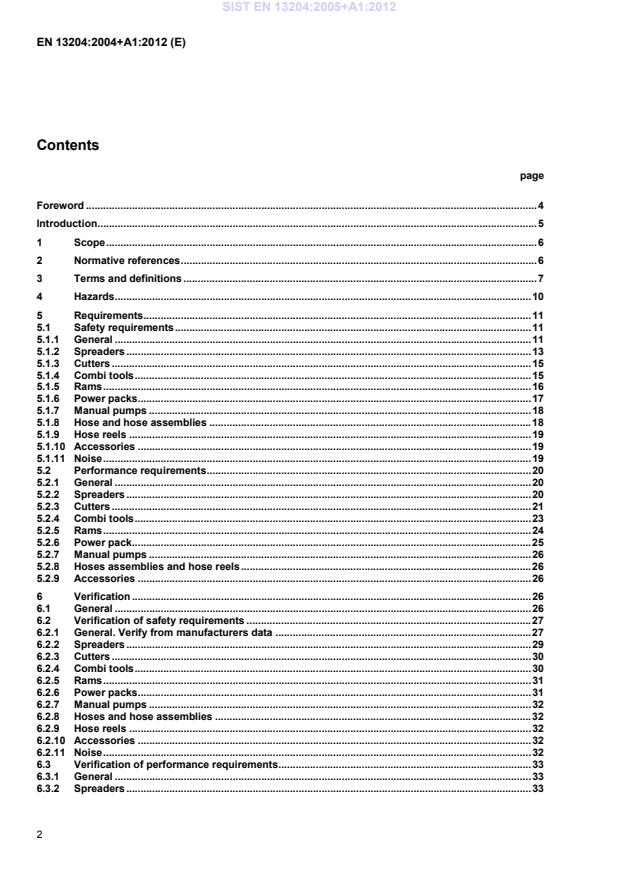
List of hazards . 39Annex B (normative)
Noise test code (Grade 2 of accuracy) . 42Annex C (informative)
Additional recommendations . 45Annex D (informative)
Examples of technical measures for noise reduction . 46Annex ZA
(informative)
!!!!Relationship between this European Standard and the Essential Requirements of EU Directive 2006/42/EC"""" . 47Bibliography . 48 SIST EN 13204:2005+A1:2012
(ISO 3744:2010)" EN ISO 4871, Acoustics — Declaration and verification of noise emission values of machinery and equipment (ISO 4871:1996) EN ISO 7751:1997, Rubber and plastic hoses and hose assemblies — Ratios of proof and burst pressure to design working pressure (ISO 7751:1991) !EN ISO 11201, Acoustics — Noise emitted by machinery and equipment — Determination of emission sound pressure levels at a work station and at other specified positions in an essentially free field over a reflecting plane with negligible environmental corrections (ISO 11201)" EN ISO 11688-1, Acoustics — Recommended practice for the design of low-noise machinery and equipment — Part 1: Planning (ISO/TR 11688-1:1995) 3 Terms and definitions For the purposes of this document, the terms and definitions given in EN 1070:1998 and the following apply. 3.1 accessories additional attachable parts that are used to adapt a tool enabling it to perform a certain special task, e.g.: pulling attachments, manifolds, saddles, extension tubes, etc. 3.2 detachable parts parts or components that can be removed by hand (without tools) under no load conditions SIST EN 13204:2005+A1:2012
5.1.1.4.3 Where size or shape prevents the use of carrying handles, such as with small single hand operated tools, the location of intended handling positions to safely carry and/or operate the tool shall be unambiguous. Their location and/or design shall prevent the operator extending his finger(s) and contacting any moving parts (i.e. arms, blades, jaws) which are likely to create a hazard (as listed in Annex A) whilst operating the tool. 5.1.1.4.4 Tools, power packs or hose reels with a mass exceeding 25 kg, shall be provided with adequate handles and/or handling positions to facilitate extra person(s) to assist the operator carrying and operating the tool. For power packs and hose reels the design shall be such that the centre of gravity is always below these means. 5.1.1.4.5 Carrying handles and or handling positions of tools (rams excluded) shall be positioned and designed to create equilibrium where the main axis of the tool deviates no more than 10º of the horizontal. 5.1.1.5 Hydraulic fluid 5.1.1.5.1 Hydraulic fluid shall not have toxic or allergic effects when coming into direct contact with persons. 5.1.1.5.2 Hydraulic fluid shall have a flash point not less than 90 °C. 5.1.1.6 Mass 5.1.1.6.1 The maximum mass of a hydraulic rescue tool or power pack or hose reel designed to be carried and operated by one person shall not exceed 25 kg. 5.1.1.6.2 Tools, power packs or hose reels with a mass exceeding 25 kg shall be designed to be carried by 2 or more persons depending on multiples of 25 kg. NOTE Users should consider the ergonomic conditions under which they require the hydraulic rescue tool system to be operated and may after a risk assessment specify the appropriate masses (see Introduction, negotiations). SIST EN 13204:2005+A1:2012
5 min when not pressurised and when pressurised to the allowable pressure (see EN 764) whilst coupled. The quick action couplers, the hose fittings and the hose shall not show any visible permanent deformation nor shall they leak fluid after the test. 5.1.1.7.5 Quick action couplings shall be designed to prevent continuous leakage of fluid during connecting or disconnecting. 5.1.1.7.6 Disconnected quick action couplings shall not leak at allowable pressure. 5.1.1.7.7 For connecting/disconnecting purposes, quick action couplings shall allow for the release of pressure. NOTE This will enable users to release pressures of hose assemblies resulting from expansion due to external heat.
5.1.1.8 Tool integrity 5.1.1.8.1 In the event of a system pressure drop, e.g. hose rupture, external to the tool and during operation of the manual control actuator, all moving parts of the tool shall stop within 0,5 s and remain in that position for a period of at least 5 min ± 15 s. 5.1.1.8.2 Tool integrity shall be maintained for 15 s ± 5 s whilst connected to a power pack which is providing a constant flow of hydraulic fluid, with the return line disconnected, without load, and whilst: a) the manual control actuator is in the neutral position and b) the manual control actuator is permanently and fully engaged to operate the tool in each direction and to reversing direction 5 times. 5.1.2 Spreaders 5.1.2.1 Overload capability 5.1.2.1.1 Spreaders shall withstand a mechanical overload whilst spreading, corresponding to 1,5 times the allowable pressure, at 10 %, 50 % and 90 % (± 5%) of their spreading distance, without showing continuous external leakage, visible permanent deformation or visible surface cracks. Thereafter they shall operate as intended. 5.1.2.1.2 Spreaders shall withstand a mechanical overload whilst pulling, corresponding to 1,5 times the allowable pressure, at 10 %, 50 % and 90 % (± 5 %) of their maximum pulling distance, without showing continuous external leakage, visible permanent deformation or visible surface cracks. Thereafter they shall operate as intended.
5.1.2.1.3
Spreaders shall withstand an off-centre force at 50 % ± 5 % of the tips width whilst spreading, corresponding to 1,25 times the maximum spreading force, applied at 50 % ± 5 % of the maximum spreading distance without showing continuous external leakage, visible permanent deformation or visible surface cracks. Thereafter they shall operate as intended (see Figure 2). SIST EN 13204:2005+A1:2012
Dimensions in millimetres FF251 Key 1 Distance between two parallel mild steel anvils F Force Figure 3 — Test between anvils for spreaders and combi tools 5.1.3 Cutters Cutters shall withstand a hydrostatic and mechanical overload by cutting 5 times into a 60 mm diameter solid mild steel bar at 1,5 times the allowable pressure and shall not show continuous external leakage, visible permanent deformation (blades excluded) or visible surface cracks. Thereafter they shall operate as intended. 5.1.4 Combi tools 5.1.4.1 Overload capability 5.1.4.1.1 Combi tools shall withstand a mechanical overload whilst spreading, corresponding to 1,5 times the allowable pressure, at 10 %, 50 % and 90 % (± 5 %) of their spreading distance, without showing continuous external leakage, visible permanent deformation or visible surface cracks. Thereafter they shall operate as intended. 5.1.4.1.2 Combi tools shall withstand a mechanical overload whilst pulling, corresponding to 1,5 times the allowable pressure, at 10 %, 50 % and 90 % (± 5 %) of their maximum pulling distance, without showing continuous external leakage, visible permanent deformation or visible surface cracks. Thereafter they shall operate as intended. 5.1.4.1.3 Combi tools shall withstand an off-centre force at 50 % ± 5 % of the tips width whilst spreading, corresponding to 1,25 times the maximum spreading force, applied at 50 % ± 5 % of the maximum spreading distance without showing continuous external leakage, visible permanent deformation or visible surface cracks. Thereafter they shall operate as intended (see Figure 2). 5.1.4.1.4 Combi tools shall withstand a hydrostatic and mechanical overload by cutting 5 times into a
60 mm diameter solid mild steel bar at 1,5 times the allowable pressure and shall not show continuous external leakage, visible permanent deformation (blades excluded) or visible surface cracks. Thereafter they shall operate as intended. 5.1.4.2 Jaws 5.1.4.2.1 Combi tools equipped with detachable parts (tips, cutting sections) shall be designed to ensure that those parts do not become detached unintentionally. SIST EN 13204:2005+A1:2012
Key F Force Figure 5 — Off-centre load capability rams
5.1.5.3 The feet of rams shall be profiled to form a gripping surface. This gripping surface shall cover the total contact area of the feet. Rams shall not be ejected from their position whilst pushing against mild steel anvils at least at 95 % of the stroke of the last stage at allowable pressure as shown in Figure 6.
F5º5º
Key F Force Figure 6 — Gripping requirement rams
5.1.6 Power packs 5.1.6.1 Power packs shall be fitted with a tamper resistant pressure relief valve(s), pre-set by the manufacturer to operate within ± 10 % of the allowable pressure. SIST EN 13204:2005+A1:2012
30º ± 3º inclined smooth !trowelled" concrete surface without the prime mover running ![see Figure 12]". 5.1.6.4 Heat generating components of the power pack shall be provided with fixed guards or devices to prevent unintentional contact in accordance to EN 563 and EN 13202, contact duration 0,5 s. 5.1.6.5 All electric components of power packs shall present a minimum degree of protection IP44 according to EN 60529. 5.1.6.6 Rotating parts of the power pack shall be guarded to prevent unintentional contact in accordance to EN 953. 5.1.6.7 Power packs shall be provided with an emergency stop device causing the prime mover to stop within the shortest time compatible with the safety of the system. 5.1.6.8 On/off switch, choke/accelerator, emergency stop device and any other devices for the operation of the prime mover shall be integral parts of the power pack. 5.1.6.9 All pressure containing parts of power packs shall withstand a pressure of 1,5 times the allowable pressure for 60 s ± 1 s. 5.1.6.10 Hydraulic fluid reservoirs shall be provided with an integrated fluid level indicator showing the maximum and minimum fluid level required for operation. 5.1.6.11 The lateral movement of power packs, when positioned on a smooth trouwelled concrete surface, shall not exceed 300 mm in any direction within 5 min, whilst the prime mover is running at idle and maximum speed. 5.1.6.12 The filling opening for fuel and/or hydraulic fluid shall be as such that spilling fuel and/or hydraulic fluid is avoidable during refilling. 5.1.7 Manual pumps 5.1.7.1 Manual pumps shall be fitted with a tamper resistant pressure relief valve, pre-set by the manufacturer, to operate within ± 10 % of the allowable pressure. 5.1.7.2 The force required to operate a manual pump by hand shall not exceed 350 N, by foot 400 N. 5.1.8 Hose and hose assemblies 5.1.8.1 !Hoses and hose assemblies shall have a minimum resistance against abrasion, fluids and ozone as stated in EN 853, EN 854, EN 855, EN 856 and EN 857". The manufacturer shall provide data regarding the applicable choices/tables in these standards. 5.1.8.2 Hydraulic hoses shall conform to EN ISO 7751:1997, Table 1, and position 2 (burst pressure to allowable pressure ratio of 4:1). 5.1.8.3 Hose assemblies shall withstand a proof pressure of at least 2 times the allowable pressure when tested according to EN ISO 1402 and shall not leak nor show any visible permanent deformation after the test. 5.1.8.4 Hydraulic hoses shall have a bend radius not exceeding 75 mm when tested in accordance with EN ISO 1746. 5.1.8.5 Hose assemblies shall be provided with an anti-kink protection at each end, e.g. spring guards. SIST EN 13204:2005+A1:2012
...