

EN 13501-2:2003
(Main)Fire classification of construction products and building elements - Part 2: Classification using data from fire resistance tests, excluding ventilation services
- Abstract
This standard specifies the procedure for classification of construction products and element families using data from fire resistance tests which are within the field of application of the relevant test method. Classification on the basis of extended application is not within the scope of this Standard.
- Status
- Withdrawn
- Publication Date
- 26-Aug-2003
- Withdrawal Date
- 09-Oct-2007
- Technical Committee
- CEN/TC 127 - Fire safety in buildings
- Drafting Committee
- CEN/TC 127 - Fire safety in buildings
- Current Stage
- 9960 - Withdrawal effective - Withdrawal
- Start Date
- 10-Oct-2007
- Completion Date
- 10-Oct-2007

Relations
- Effective Date
- 22-Dec-2008
- Effective Date
- 28-Jan-2026
- Effective Date
- 22-Dec-2008
Get Certified
Connect with accredited certification bodies for this standard

CIS Institut d.o.o.
Personal Protective Equipment (PPE) certification body. Notified Body NB-2890 for EU Regulation 2016/425 PPE.

Kiwa BDA Testing
Building and construction product certification.
Kmetijski inštitut Slovenije
Agricultural Institute of Slovenia. Soil testing, plant health, agricultural product analysis.
Sponsored listings
Frequently Asked Questions
EN 13501-2:2003 is a standard published by the European Committee for Standardization (CEN). Its full title is "Fire classification of construction products and building elements - Part 2: Classification using data from fire resistance tests, excluding ventilation services". This standard covers: This standard specifies the procedure for classification of construction products and element families using data from fire resistance tests which are within the field of application of the relevant test method. Classification on the basis of extended application is not within the scope of this Standard.
This standard specifies the procedure for classification of construction products and element families using data from fire resistance tests which are within the field of application of the relevant test method. Classification on the basis of extended application is not within the scope of this Standard.
EN 13501-2:2003 is classified under the following ICS (International Classification for Standards) categories: 13.220.50 - Fire-resistance of building materials and elements. The ICS classification helps identify the subject area and facilitates finding related standards.
EN 13501-2:2003 has the following relationships with other standards: It is inter standard links to EN 13501-2:2007, EN 1634-3:2004; is excused to EN 13501-1:2002. Understanding these relationships helps ensure you are using the most current and applicable version of the standard.
EN 13501-2:2003 is associated with the following European legislation: EU Directives/Regulations: 305/2011, 89/106/EEC; Standardization Mandates: M/088, M/121, M/122. When a standard is cited in the Official Journal of the European Union, products manufactured in conformity with it benefit from a presumption of conformity with the essential requirements of the corresponding EU directive or regulation.
EN 13501-2:2003 is available in PDF format for immediate download after purchase. The document can be added to your cart and obtained through the secure checkout process. Digital delivery ensures instant access to the complete standard document.
Standards Content (Sample)
2003-01.Slovenski inštitut za standardizacijo. Razmnoževanje celote ali delov tega standarda ni dovoljeno.Fire classification of construction products and building elements - Part 2: Classification using data from fire resistance tests, excluding ventilation servicesClassement au feu des produits et éléments de construction - Partie 2: Classement a partir des données d'essais de résistance au feu a l'exclusion des produits utilisés dans les systemes de ventilationKlassifizierung von Bauprodukten und Bauarten zu ihrem Brandverhalten - Teil 2: Klassifizierung mit den Ergebnissen aus den Feuerwiderstandsprüfungen, mit Ausnahme von LüftungsanlagenTa slovenski standard je istoveten z:EN 13501-2:2003SIST EN 13501-2:2003en13.220.50ICS:SLOVENSKI
STANDARDSIST EN 13501-2:200301-november-2003
EUROPEAN STANDARDNORME EUROPÉENNEEUROPÄISCHE NORMEN 13501-2August 2003ICS 13.220.50English versionFire classification of construction products and building elements- Part 2: Classification using data from fire resistance tests,excluding ventilation servicesClassement au feu des produits de construction et deséléments de bâtiment - Partie 2: Classement à partir desdonnées des essais de résistance au feu, services deventilation exclusKlassifizierung von Bauprodukten und Bauarten zu ihremBrandverhalten - Teil 2: Klassifizierung mit denErgebnissen aus den Feuerwiderstandsprüfungen, mitAusnahme von LüftungsanlagenThis European Standard was approved by CEN on 9 April 2003.CEN members are bound to comply with the CEN/CENELEC Internal Regulations which stipulate the conditions for giving this EuropeanStandard the status of a national standard without any alteration. Up-to-date lists and bibliographical references concerning such nationalstandards may be obtained on application to the Management Centre or to any CEN member.This European Standard exists in three official versions (English, French, German). A version in any other language made by translationunder the responsibility of a CEN member into its own language and notified to the Management Centre has the same status as the officialversions.CEN members are the national standards bodies of Austria, Belgium, Czech Republic, Denmark, Finland, France, Germany, Greece,Hungary, Iceland, Ireland, Italy, Luxembourg, Malta, Netherlands, Norway, Portugal, Slovakia, Spain, Sweden, Switzerland and UnitedKingdom.EUROPEAN COMMITTEE FOR STANDARDIZATIONCOMITÉ EUROPÉEN DE NORMALISATIONEUROPÄISCHES KOMITEE FÜR NORMUNGManagement Centre: rue de Stassart, 36
B-1050 Brussels© 2003 CENAll rights of exploitation in any form and by any means reservedworldwide for CEN national Members.Ref. No. EN 13501-2:2003 E
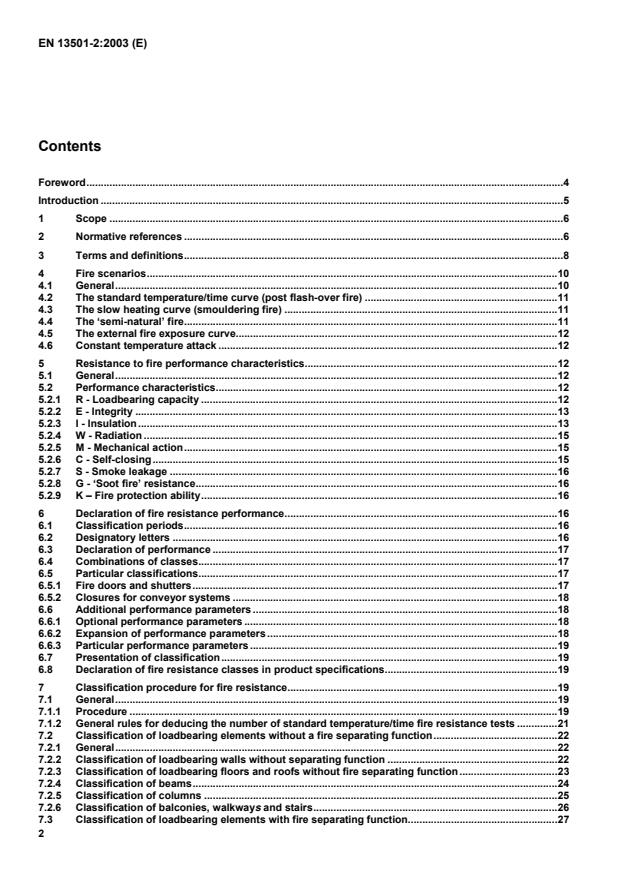
Classification report.52A.1General.52A.2Content and format.52Annex B (informative)
Presentation of characterisation data and their field of application for productsand systems for protecting elements or parts of work.58B.1General.58B.2Characterisation data for protective vertical membranes.58B.3Characterisation data for applied protection to concrete members.59B.4Characterisation data for applied protection to steelwork.60B.5Characterisation data for applied protection to concrete/profiled sheet steel compositemembers.62B.6Characterisation data for applied protection to concrete filled hollow steel columns.63B.7Characterisation data for applied protection to timber members.63Bibliography.68
European Standard shall be given the status of a national standard, either by publication of an identical text orby endorsement, at the latest by February 2004, and conflicting national standards shall be withdrawn at the latestby February 2004.This document has been prepared under a mandate given to CEN by the European Commission and the EuropeanFree Trade Association, and supports essential requirements of the Construction Products Directive.CEN, CENELEC and EOTA committees preparing technical specifications which contain performance requirementsagainst resistance to fire tests should make reference to the resistance to fire classification given in this standard andnot refer directly to any specific fire test method.Some of the methods referred to by this standards are prENs which are still undergoing technical development. Usersof this standard should, therefore, check the availability and acceptability of these prENs before seeking to apply them.Currently EN 13501-2 cannot be applied to classify curtain walling for resistance to fire. This will be possible once eitherEN 1364-3 "Fire resistance tests for non-loadbearing elements – Part 3: Curtain walling – Full configuration (completeassembly)" is made available or alternative provisions for classifying curtain walling for resistance to fire are madeavailable.EN 13501 consists of the following parts:Part 1:Classification using test data from reaction to fire testsPart 2:Classification using data from fire resistance tests, excluding ventilation servicesPart 3:Classification using data from fire resistance tests on components of normal building service installationsPart 4:Classification using test data from fire resistance tests on smoke control systemsPart 5:Classification using test data from external fire exposure to roof testsAnnexes A and B are normative.This document includes a Bibliography.According to the CEN/CENELEC Internal Regulations, the national standards organizations of the followingcountries are bound to implement this European Standard: Austria, Belgium, Czech Republic, Denmark, Finland,France, Germany, Greece, Hungary, Iceland, Ireland, Italy, Luxembourg, Malta, Netherlands, Norway, Portugal,Slovakia, Spain, Sweden, Switzerland and the United Kingdom.
Further details relating to the practical application of this curve, and other test parameters e.g. tolerances, are given inEN 1363-2.4.4 The ‘semi-natural’ fireDuring the ‘semi-natural’ fire test the temperature of the fire gases adjacent to the soffit of the ceiling shall reach 1000 °C within 10 min to 20 min of the start of the test.Because of the difficulties in achieving the necessary thermal attack in a conventional furnace, the attack shall beprovided by fire from wooden cribs made from softwood.NOTE 1The ‘semi-natural’ fire is a fire which produces direct flame impingement with a high convective heat transfer contentwhich is not realised in furnace tests using the standard temperature/time curve. The term ‘semi-natural’ fire corresponds to thesingle burning item exposure required for ceilings in 4.3.1.3.4 (a) of the Interpretative Document 2 (not to be confused with the“single burning item” test for reaction to fire). It is relevant only for lightweight suspended horizontal protective membraneshaving a low thermal inertia.NOTE 2Further details relating to the practical application of this thermal attack, and other test parameters, are given inprENV 13381-1.
...