

EN 12111:2002+A1:2009
(Main + Amendment)Tunnelling machines - Road headers, continuous miners and impact rippers - Safety requirements
- Abstract
Description of the machine
This European Standard specifies all significant hazards, hazardous situations and events relevant to road headers, continuous miners and impact rippers, when they are used as intended and under the conditions foreseen by the manufacturer (see clause 4). This standard specifies the appropriate technical measures to eliminate or reduce risks arising from the significant hazards. This European Standard is applicable to road headers, continuous miners and impact rippers used in tunnelling and underground mining.
Certain associated matters are not included in the scope of this standard:
- the supply of electricity up to the machine;
- the provision of a cab or similar accommodation for an operator;
- ancillary tools and equipment used for, at or on the machine;
- equipment for use in potentially explosive atmospheres;
- any method for monitoring gases in the atmosphere of the tunnel or other workplace;
- the method of calculation of the design of any part described or the verification of this;
- loading and transport equipment which is not an integral part of the machine;
- electromagnetic compatibility;
- pressure vessels.
NOTE 1 Directive 94/9/EC concerning equipment and protective systems intended for use in potentially explosive atmos-pheres can be applicable to the type of machine or equipment covered by this European Standard. The present standard is not intended to provide means of complying with the essential health and safety requirements of Directive 94/9/EC.
NOTE 2 prEN 1710 Equipment and components intended for use in potentially explosive atmospheres in mines is currently under preparation in CEN/TC 305.
.2 This standard deals with all significant hazards, hazardous situations and events relevant to road headers, continuous miners and impact rippers, when they are used as intended and under the conditions foreseen by the manufacturer (see clause 4). This standard specifies the appropriate technical measures to e
- Status
- Withdrawn
- Publication Date
- 30-Jun-2009
- Withdrawal Date
- 06-May-2014
- Technical Committee
- CEN/TC 151 - Construction equipment and building material machines - Safety
- Drafting Committee
- CEN/TC 151/WG 4 - Tunnelling machines - Safety
- Current Stage
- 9960 - Withdrawal effective - Withdrawal
- Start Date
- 07-May-2014
- Completion Date
- 07-May-2014
- Directive
- 2006/42/EC - Directive 2006/42/EC of the European Parliament and of the Council of 17 May 2006 on machinery, and amending Directive 95/16/EC (recast)OJ Ref: C, C 309 OJ Date: 18-Dec-2009

Relations
- Effective Date
- 19-Jan-2023
- Effective Date
- 06-May-2009
- Effective Date
- 06-May-2009
- Replaced By
EN 12111:2014 - Tunnelling machines - Road headers and continuous miners - Safety requirements - Effective Date
- 13-May-2014
- Effective Date
- 25-Aug-2026
- Effective Date
- 25-Aug-2026
- Effective Date
- 25-Aug-2026
- Effective Date
- 25-Aug-2026
- Effective Date
- 25-Aug-2026
- Effective Date
- 25-Aug-2026
- Effective Date
- 25-Aug-2026
- Effective Date
- 25-Aug-2026
- Effective Date
- 09-Feb-2026
- Effective Date
- 09-Feb-2026
- Effective Date
- 09-Feb-2026
Get Certified
Connect with accredited certification bodies for this standard

DIBt (Deutsches Institut für Bautechnik)
German Institute for Building Technology.
DIN CERTCO
DIN Group product certification.
Zavod za gradbeništvo Slovenije (ZAG) - Inšpekcija
ZAG inspection body for construction products, structures, and materials.
Sponsored listings
Frequently Asked Questions
EN 12111:2002+A1:2009 is a standard published by the European Committee for Standardization (CEN). Its full title is "Tunnelling machines - Road headers, continuous miners and impact rippers - Safety requirements". This standard covers: Description of the machine This European Standard specifies all significant hazards, hazardous situations and events relevant to road headers, continuous miners and impact rippers, when they are used as intended and under the conditions foreseen by the manufacturer (see clause 4). This standard specifies the appropriate technical measures to eliminate or reduce risks arising from the significant hazards. This European Standard is applicable to road headers, continuous miners and impact rippers used in tunnelling and underground mining. Certain associated matters are not included in the scope of this standard: - the supply of electricity up to the machine; - the provision of a cab or similar accommodation for an operator; - ancillary tools and equipment used for, at or on the machine; - equipment for use in potentially explosive atmospheres; - any method for monitoring gases in the atmosphere of the tunnel or other workplace; - the method of calculation of the design of any part described or the verification of this; - loading and transport equipment which is not an integral part of the machine; - electromagnetic compatibility; - pressure vessels. NOTE 1 Directive 94/9/EC concerning equipment and protective systems intended for use in potentially explosive atmos-pheres can be applicable to the type of machine or equipment covered by this European Standard. The present standard is not intended to provide means of complying with the essential health and safety requirements of Directive 94/9/EC. NOTE 2 prEN 1710 Equipment and components intended for use in potentially explosive atmospheres in mines is currently under preparation in CEN/TC 305. .2 This standard deals with all significant hazards, hazardous situations and events relevant to road headers, continuous miners and impact rippers, when they are used as intended and under the conditions foreseen by the manufacturer (see clause 4). This standard specifies the appropriate technical measures to e
Description of the machine This European Standard specifies all significant hazards, hazardous situations and events relevant to road headers, continuous miners and impact rippers, when they are used as intended and under the conditions foreseen by the manufacturer (see clause 4). This standard specifies the appropriate technical measures to eliminate or reduce risks arising from the significant hazards. This European Standard is applicable to road headers, continuous miners and impact rippers used in tunnelling and underground mining. Certain associated matters are not included in the scope of this standard: - the supply of electricity up to the machine; - the provision of a cab or similar accommodation for an operator; - ancillary tools and equipment used for, at or on the machine; - equipment for use in potentially explosive atmospheres; - any method for monitoring gases in the atmosphere of the tunnel or other workplace; - the method of calculation of the design of any part described or the verification of this; - loading and transport equipment which is not an integral part of the machine; - electromagnetic compatibility; - pressure vessels. NOTE 1 Directive 94/9/EC concerning equipment and protective systems intended for use in potentially explosive atmos-pheres can be applicable to the type of machine or equipment covered by this European Standard. The present standard is not intended to provide means of complying with the essential health and safety requirements of Directive 94/9/EC. NOTE 2 prEN 1710 Equipment and components intended for use in potentially explosive atmospheres in mines is currently under preparation in CEN/TC 305. .2 This standard deals with all significant hazards, hazardous situations and events relevant to road headers, continuous miners and impact rippers, when they are used as intended and under the conditions foreseen by the manufacturer (see clause 4). This standard specifies the appropriate technical measures to e
EN 12111:2002+A1:2009 is classified under the following ICS (International Classification for Standards) categories: 91.220 - Construction equipment; 93.060 - Tunnel construction. The ICS classification helps identify the subject area and facilitates finding related standards.
EN 12111:2002+A1:2009 has the following relationships with other standards: It is inter standard links to EN 12111:2002/AC:2004, EN 12111:2002, EN 12111:2002/prA1, EN 12111:2014, ISO 3864-2:2004, ISO 4414:1998, ISO 6405-1:2004, ISO 4413:1998, ISO 8643:1997, ISO 10567:2007, ISO 3864-3:2006, ISO 3795:1989, EN IEC 61439-3:2024, EN 60529:1991, ISO 3864-1:2002. Understanding these relationships helps ensure you are using the most current and applicable version of the standard.
EN 12111:2002+A1:2009 is associated with the following European legislation: EU Directives/Regulations: 2006/42/EC, 98/37/EC; Standardization Mandates: M/079, M/396. When a standard is cited in the Official Journal of the European Union, products manufactured in conformity with it benefit from a presumption of conformity with the essential requirements of the corresponding EU directive or regulation.
EN 12111:2002+A1:2009 is available in PDF format for immediate download after purchase. The document can be added to your cart and obtained through the secure checkout process. Digital delivery ensures instant access to the complete standard document.
Standards Content (Sample)
2003-01.Slovenski inštitut za standardizacijo. Razmnoževanje celote ali delov tega standarda ni dovoljeno.Stroji za gradnjo predorov - Odkopne naprave - Varnostne zahteveTunnelbaumaschinen - Teilschnittmaschinen, Continuous Miners und Schlagkopfmaschinen - Sicherheitstechnische AnforderungenMachines pour la construction de tunnels - Machines à attaque ponctuelle, mineurs continus, brise-roches - Règles de sécuritéTunnelling machines - Road headers, continuous miners and impact rippers - Safety requirements93.060Gradnja predorovTunnel construction91.220Gradbena opremaConstruction equipmentICS:Ta slovenski standard je istoveten z:EN 12111:2002+A1:2009SIST EN 12111:2003+A1:2009en,fr01-september-2009SIST EN 12111:2003+A1:2009SLOVENSKI
STANDARD
EUROPEAN STANDARD NORME EUROPÉENNE EUROPÄISCHE NORM
EN 12111:2002+A1
July 2009 ICS 91.220; 93.060 Supersedes EN 12111:2002English Version
Tunnelling machines - Road headers, continuous miners and impact rippers - Safety requirements
Machines pour la construction de tunnels - Machines à attaque ponctuelle, mineurs continus, brise-roches - Règles de sécurité
Tunnelbaumaschinen - Teilschnittmaschinen, Continuous Miners und Schlagkopfmaschinen - Sicherheitstechnische Anforderungen This European Standard was approved by CEN on 9 October 2002 and includes Corrigendum 1 issued by CEN on 15 September 2004 and Amendment 1 approved by CEN on 28 May 2009.
CEN members are bound to comply with the CEN/CENELEC Internal Regulations which stipulate the conditions for giving this European Standard the status of a national standard without any alteration. Up-to-date lists and bibliographical references concerning such national standards may be obtained on application to the CEN Management Centre or to any CEN member.
This European Standard exists in three official versions (English, French, German). A version in any other language made by translation under the responsibility of a CEN member into its own language and notified to the CEN Management Centre has the same status as the official versions.
CEN members are the national standards bodies of Austria, Belgium, Bulgaria, Cyprus, Czech Republic, Denmark, Estonia, Finland, France, Germany, Greece, Hungary, Iceland, Ireland, Italy, Latvia, Lithuania, Luxembourg, Malta, Netherlands, Norway, Poland, Portugal, Romania, Slovakia, Slovenia, Spain, Sweden, Switzerland and United Kingdom.
EUROPEAN COMMITTEE FOR STANDARDIZATION
COMITÉ EUROPÉEN DE NORMALISATION EUROPÄISCHES KOMITEE FÜR NORMUNG
Management Centre:
Avenue Marnix 17,
B-1000 Brussels © 2009 CEN All rights of exploitation in any form and by any means reserved worldwide for CEN national Members. Ref. No. EN 12111:2002+A1:2009: ESIST EN 12111:2003+A1:2009
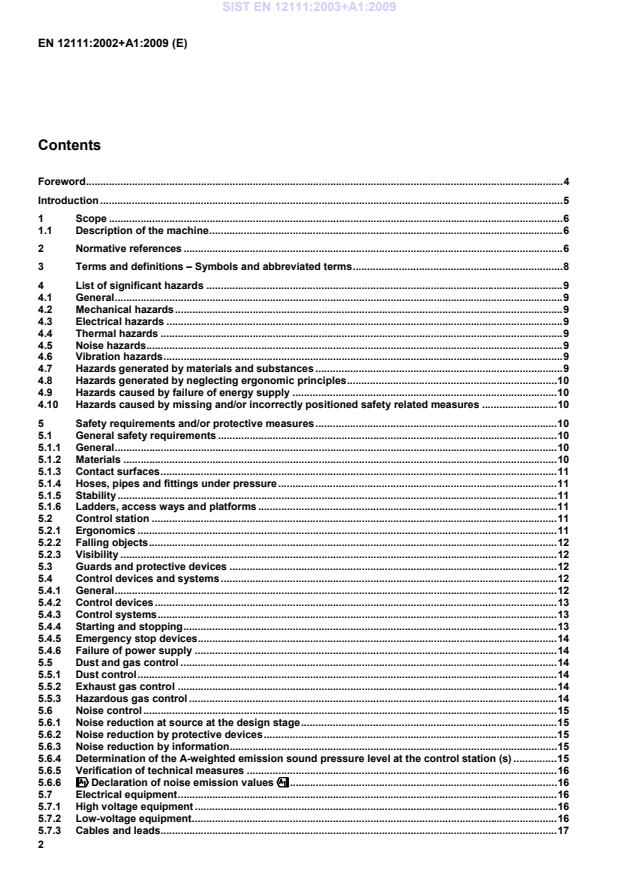
2 Contents Foreword . 4Introduction . 51Scope . 61.1Description of the machine . 62Normative references . 63Terms and definitions – Symbols and abbreviated terms . 84List of significant hazards . 94.1General . 94.2Mechanical hazards . 94.3Electrical hazards . 94.4Thermal hazards . 94.5Noise hazards . 94.6Vibration hazards . 94.7Hazards generated by materials and substances . 94.8Hazards generated by neglecting ergonomic principles . 104.9Hazards caused by failure of energy supply . 104.10Hazards caused by missing and/or incorrectly positioned safety related measures . 105Safety requirements and/or protective measures . 105.1General safety requirements . 105.1.1General . 105.1.2Materials . 105.1.3Contact surfaces . 115.1.4Hoses, pipes and fittings under pressure . 115.1.5Stability . 115.1.6Ladders, access ways and platforms . 115.2Control station . 115.2.1Ergonomics . 115.2.2Falling objects . 125.2.3Visibility . 125.3Guards and protective devices . 125.4Control devices and systems . 125.4.1General . 125.4.2Control devices . 135.4.3Control systems . 135.4.4Starting and stopping . 135.4.5Emergency stop devices . 145.4.6Failure of power supply . 145.5Dust and gas control . 145.5.1Dust control . 145.5.2Exhaust gas control . 145.5.3Hazardous gas control . 145.6Noise control . 155.6.1Noise reduction at source at the design stage . 155.6.2Noise reduction by protective devices . 155.6.3Noise reduction by information . 155.6.4Determination of the A-weighted emission sound pressure level at the control station (s) . 155.6.5Verification of technical measures . 165.6.6!!!!Declaration of noise emission values"""" . 165.7Electrical equipment . 165.7.1High voltage equipment . 165.7.2Low-voltage equipment . 165.7.3Cables and leads. 17SIST EN 12111:2003+A1:2009
Protective measures for electrical accessories and lighting . 24Annex B (normative)
Verification of safety requirements and/or protective measures . 25Annex C (informative)
Figures . 27Annex ZA (informative)
!!!!Relationship between this European Standard and the Essential Requirements of EU Directive 98/37/EC"""" . 30Annex ZB (informative)
!!!!Relationship between this European Standard and the Essential Requirements of EU Directive 2006/42/EC"""" . 31Bibliography . 32 SIST EN 12111:2003+A1:2009
4 Foreword This document (EN 12111:2002+A1:2009) has been prepared by Technical Committee CEN /TC 151, "Construction equipment and building material machines - Safety" the secretariat of which is held by DIN. This European Standard shall be given the status of a national standard, either by publication of an identical text or by endorsement, at the latest by January 2010, and conflicting national standards shall be withdrawn at the latest by January 2010. This European Standard was approved by CEN on 9 October 2002 and includes Corrigendum 1 issued by CEN on 15 September 2004 and Amendment 1 approved by CEN on 28 May 2009. This document supersedes EN 12111:2002. The start and finish of text introduced or altered by amendment is indicated in the text by tags !". The modifications of the related CEN Corrigendum have been implemented at the appropriate places in the text and are indicated by the tags ˜ ™. This document has been prepared under a mandate given to CEN by the European Commission and the European Free Trade Association and supports essential requirements of EU Directive(s). !For relationship with EU Directive(s), see informative Annexes ZA and ZB, which are integral parts of this document." Annex A is normative and contains “Protective measures for electrical accessories and lighting”, Annex B is normative and contains “Verification of safety requirements and/or protective measures” and Annex C is informative and contains “Figures”. This document includes a bibliography. According to the CEN/CENELEC Internal Regulations, the national standards organizations of the following countries are bound to implement this European Standard: Austria, Belgium, Bulgaria, Cyprus, Czech Republic, Denmark, Estonia, Finland, France, Germany, Greece, Hungary, Iceland, Ireland, Italy, Latvia, Lithuania, Luxembourg, Malta, Netherlands, Norway, Poland, Portugal, Romania, Slovakia, Slovenia, Spain, Sweden, Switzerland and United Kingdom. SIST EN 12111:2003+A1:2009
Due to the wide range of geological and environmental conditions in which these types of machines are likely to be employed, it is not possible always to give precise technical requirements in this standard.
The particular conditions of use and places of use of the machinery (e.g. ground and local safety conditions, haz-ardous gas concentration (see 5.5.3)) are the subjects of negotiation between the manufacturers and the user/purchaser. NOTE “Manufacturer” should be understood within the European Union as intended in the Machinery Directive. When provisions of this type C standard are different from those which are stated in type A or B standards, the pro-visions of this type C standard take precedence over the provisions of the other standards, for machines that have been designed and built according to the provisions of this type C standard. SIST EN 12111:2003+A1:2009
6 1 Scope 1.1
Description of the machine This European Standard specifies all significant hazards, hazardous situations and events relevant to road headers, continuous miners and impact rippers, when they are used as intended and under the conditions foreseen by the manufacturer (see clause 4). This standard specifies the appropriate technical measures to eliminate or reduce risks arising from the significant hazards. This European Standard is applicable to road headers, continuous miners and impact rippers used in tunnelling and underground mining. Certain associated matters are not included in the scope of this standard: the supply of electricity up to the machine; the provision of a cab or similar accommodation for an operator; ancillary tools and equipment used for, at or on the machine; equipment for use in potentially explosive atmospheres; any method for monitoring gases in the atmosphere of the tunnel or other workplace; the method of calculation of the design of any part described or the verification of this; loading and transport equipment which is not an integral part of the machine; electromagnetic compatibility; pressure vessels. NOTE 1 Directive 94/9/EC concerning equipment and protective systems intended for use in potentially explosive atmos-pheres can be applicable to the type of machine or equipment covered by this European Standard. The present standard is not intended to provide means of complying with the essential health and safety requirements of Directive 94/9/EC. NOTE 2
prEN 1710 “Equipment and components intended for use in potentially explosive atmospheres in mines” is currently under preparation in CEN/TC 305. 1.2 This standard deals with all significant hazards, hazardous situations and events relevant to road headers, continuous miners and impact rippers, when they are used as intended and under the conditions foreseen by the manufacturer (see clause 4). This standard specifies the appropriate technical measures to eliminate or reduce risks arising from the significant hazards. 1.3 This document is not applicable to machines which are manufactured before the date of publication of this document by CEN. 2 Normative references This European Standard incorporates by dated or undated reference, provisions from other publications. These normative references are cited at the appropriate places in the text, and the publications are listed hereafter. For dated references, subsequent amendments to or revisions of any of these publications apply to this European Standard only when incorporated in it by amendment or revision. For undated references the latest edition of the publication referred to applies (including amendments). EN 3-1, Portable fire extinguishers — Part 1: Description, duration of operation, class A and B fire test. !EN ISO 12100-1:2003 Safety of machinery — Basic concepts, general principles for design — Part 1: Basic terminology, methodology (ISO 12100-1:2003)" SIST EN 12111:2003+A1:2009
EN 619, Continuous handling equipment and systems – Safety and EMC requirements for equipment for mechanical handling of units loads.
EN 954-1:1996, Safety of machinery — Safety related parts of control systems — Part 1: General principles for de-sign. EN 982, Safety of machinery — Safety requirements for fluid power systems and their components — Hydraulics. EN 983, Safety of machinery — Safety requirements for fluid power systems and their components — Pneumatics.
EN 1070:1998, Safety of machinery — Terminology. EN 60204-1:1997, Safety of machinery — Electrical equipment of machines — Part 1: General requirements
(IEC 60204-1:1997). EN 60204-11, Safety of machinery - Electrical equipment of machines - Part 11: Requirements for HV equipment for voltages above 1000 V a.c. or 1500 V d.c. and not exceeding 36 kV (IEC 60204-11:2000). EN 60439-1:1999, Low-voltage switchgear and controlgear assemblies — Part 1: Type-tested and partially type-tested assemblies (IEC 60439-1:1999). EN 60439-2, Low-voltage switchgear and controlgear assemblies — Part 2: Particular requirements for bushbar trunking systems (bushways) (IEC 60439-2:2000). EN 60439-3, Low-voltage switchgear and controlgear assemblies — Part 3: Particular requirements for low-voltage switchgear and controlgear intended to be installed in places where unskilled persons have access for their use — Distribution boards (IEC 60439-3:1991). EN 60439-4, Low-voltage switchgear and controlgear assemblies — Part 4: Particular requirements for assemblies for construction sites (ACS) (IEC 60439-4:1990). EN 60529:1991, Degrees of protection provided by enclosures (IP Code) (IEC 60529:1989). EN 60947-1, Low-voltage switchgear and controlgear — Part 1: General rules (IEC 60947-1:1999, modified). EN 61310-1, Safety of machinery - Indication, marking and actuation — Part 1: Requirements for visual, auditory and tactile signals (IEC 61310-1:1995). EN ISO 2867:1998, Earth-moving machinery — Access systems (ISO 2867:1994). EN ISO 3411, Earth-moving machinery — Human physical dimensions of operators and minimum operator space envelope (ISO 3411:1995). prEN ISO 3457:2000, Earth-moving machinery — Guards and shields — Definitions and specifications (ISO/DIS 3457:2000). EN ISO 7096, Earth-moving machinery — Laboratory evaluation of operator seat vibration (ISO 7096:2000). SIST EN 12111:2003+A1:2009
8 EN ISO 11202, Acoustics — Noise emitted by machinery and equipment — Measurement of emission sound pressure levels at a workstation and at other specified positions — Survey method in situ (ISO 11202:1995). EN ISO 11688-1, Acoustics — Recommended practice for the design of low-noise machinery and equipment — Part 1: Planning (ISO/TR 11688-1:1995). ISO 3795, Road vehicles, and tractors and machinery for agriculture and forestry — Determination of burning behaviour of interior materials. ISO 3864, Safety colours and safety signs. ISO 4413, Hydraulic fluid power — General rules relating to systems. ISO 4414, Pneumatic fluid power — General rules relating to systems. ISO 6405-1, Earth-moving machinery — Symbols for operator controls and other displays — Part 1: Common symbols. ISO 8643, Earth-moving machinery — Hydraulic excavator and backhoe loader boom-lowering control device — Requirements and tests. ISO 10567, Earth-moving machinery — Hydraulic excavators — Lift capacity. ISO 12508, Earth-moving machinery — Operator station and maintenance areas — Bluntness of edges. 3 Terms and definitions – Symbols and abbreviated terms For the purposes of this European Standard, the terms and definitions given in EN 1070:1998 and the following apply.
3.1 road header self-propelled tunnel driving machine, normally mounted on crawler tracks, which is designed and intended to cut and load soft to medium hard rock in sections by means of a rotating cutting tool mounted axially or transversely on a boom. Spoil may be discharged at the rear of the machine. As an example see Figure C.1 3.2 continuous miner self-propelled machine, normally mounted on crawler tracks, which is designed and intended to cut coal or soft minerals by means of a transversely mounted rotating drum. Spoil may be discharged at the rear of the machine. As an example see Figure C.2 3.3 impact ripper self-propelled tunnel driving machine which is designed and intended to excavate the rock in sections by means of a tool such as a percussive hammer. Such tools are excluded from this standard. The machine may be fitted with loading and transport equipment. As an example see Figure C.3 3.4 control station location on a machine from where the functions of the machine can be controlled by an operator. In the basic design, the control station will not be covered by a canopy. Control may alternatively be from a remote station by cable or radio
3.5 servicing point any location on a machine where servicing and maintenance is carried out SIST EN 12111:2003+A1:2009
b) inhalation of dusts, see: 5.4.3, 5.5.1, 5.7.4; c) fire and explosion, see: 5.5.3.1, 5.7.3, 5.10; SIST EN 12111:2003+A1:2009
10 d) rock fall, see: 5.2.2; 4.8 Hazards generated by neglecting ergonomic principles a) unhealthy postures or excessive efforts, see: 5.2.1; b) inadequate local lighting, see: 5.8; 4.9 Hazards caused by failure of energy supply a) failure of energy supply, see: 5.4.3, 5.4.6; b) failure of control system, see: 5.4.3; 4.10 Hazards caused by missing and/or incorrectly positioned safety related measures a) all kinds of guards, see: 5.3; b) all kinds of safety-related devices, see: 5.3, 5.4; c) starting and stopping devices, see: 5.4.2, 5.4.4, 5.4.6; d) warning signs and tags, see clause: 5.11, 7.2, 7.3; e) all kinds of information and warning devices, see: 5.4.4.2, 5.11, 7.2.1, 7.2.2; f) energy supply disconnecting devices, see: 5.4.3, 5.4.4; g) emergency devices, see clause: 5.4.5; h) handling of machinery or parts there of, see: 7.2.3;
i) essential measures for safe maintenance and repair, see: 5.3, 5.4.3, 5.7.2, 7.2.3; 5 Safety requirements and/or protective measures 5.1 General safety requirements 5.1.1 General Machinery shall comply with the safety requirements and/or protective measures of this clause. In addition, the machines shall be designed according to the principles of !EN ISO 12100" for hazards relevant but not significant which are not dealt with by this document (e.g. sharp edges).
Design calculations shall be carried out in accordance with usual engineering practice and calculation codes shall include the effect of elastic deformation. All failure modes of the materials shall be considered including fatigue and wear. 5.1.2 Materials Materials shall be chosen so that they do not cause any danger to the health or safety of exposed persons. The materials shall be suitable for the foreseen ambient temperatures. SIST EN 12111:2003+A1:2009
All parts on a machine within 1,8 m of any access way or the ground shall not present any sharp edges or acute angles or corners. The radius of corners and the bluntness of edges shall comply with ISO 12508. 5.1.3.2 Hot surfaces All parts on a machine within 1,8 m of any access way or the ground shall be designed and manufactured so that no injury due to contact with hot surfaces is possible. See EN 563. 5.1.4 Hoses, pipes and fittings under pressure
Hoses, pipes and fittings shall be able to withstand the stresses anticipated. Hoses shall be marked with the rated working pressure and when required by its fluid, pressure or location, a hose shall be secured by means of ade-quate restraints. The requirements of EN 982 and EN 983 shall be complied with. Where there is a risk that rupture of a hose would cause a hazard to the operator, the hoses in this area shall be provided with protective guards e.g. by protective plates or rubber sheets etc. Hoses, such as those carrying hydraulic oil, air or grout shall be secured by means of adequate restraints.
Any part or component of a machine placed between the pipes or hoses and the operator which may direct the hazard from the operator can be considered a protective device.
Low pressure hydraulic control circuits are not included in these requirements. 5.1.5 Stability Machines shall be constructed and equipped to ensure stability when used as intended.
For road headers and continuous miners, calculations shall be made particularly for transverse stability, and for impact rippers for both longitudinal and transverse stability taken together.
For road headers and continuous miners, the stability against overturning, S, with respect to the most unfavourable
axis
- normally the longitudinal axis - shall be equal to or greater than 1,25, where S = Ms/Mk and Ms is the stabilising moment of the total permanent load with respect to that axis,
and Mk is overturning moment caused by cylinder forces and cutting forces, according to the rated power in-stalled, with respect to that axis.
For impact rippers, the stability shall be calculated and verified as indicated by ISO 10567. 5.1.6 Ladders, access ways and platforms Ladderways and stairways with a height exceeding 1200 mm shall be safeguarded by handrails on open sides. Elevated access ways and working platforms shall be safeguarded by side protection to prevent operators from falling off. They shall have a non-slip surface and be bounded with a toeboard. See clauses 6 and 7 of EN ISO 2867:1998.
5.2 Control station 5.2.1 Ergonomics When remote control is not used, the machine is to be equipped with a control station which shall be ergonomically designed in order to minimise operator fatigue and stress. Consideration shall be given to the fact that operators may wear personal protection equipment. SIST EN 12111:2003+A1:2009
12 Where the design permits, the control station shall be dimensioned in accordance with EN ISO 3411. See EN 474-1. Machines with provision for a seated operator shall be fitted with an adjustable seat that retains the operator in a stable position and allows the operator to control the machine under all expected operating conditions. The seat shall be designed to minimise transmission of vibration to the operator. See EN ISO 7096. 5.2.2 Falling objects The control station shall be protected where necessary by guarding against spoil rolling down the cutter arm, boom or conveyor e.g. by deflector plates. When necessary due to its position, the control station shall be capable of be-ing equipped with a rugged canopy and bars to protect the operator against falling rocks and other objects for which fixings and/or anchorage shall be provided. The maximum dimensions of any opening in such a guard shall not exceed 80 mm x 1 000 mm. The guarding elements shall be designed so that a force of 1 kN will create a deflection of not more than 2 mm.
The conveyor shall be designed and built in such a way that no spoil can fall onto the control station. 5.2.3 Visibility The control station shall be positioned to allow the operator sufficient visibility of the cutting tool for safe operation. For movement of machine, further aids such as mirrors may be provided.
5.3 Guards and protective devices Wherever persons work or have access and there is a risk of injury by trapping, cutting or seizing due to rotating parts, these parts shall be made safe by guards or other protective devices.
Driving drums, front rollers and idlers of conveyor belts shall be provided with protective devices to prevent injury by trapping or seizing. See EN 617 and EN 619. 5.4 Control devices and systems 5.4.1 General Control devices and systems shall be so designed and constructed that they match the high demands of an under-ground environment and are reliable in service. The component parts of control systems shall comply with the requirements of EN 954-1. They shall be able to withstand rigorous handling, severe stresses, shocks and vibration.
Each safety-related part of a control system shall fulfil the requirements of one of the categories described in clause 6 of EN 954-1:1996 in accordance with the following schedule as given in Table 1: SIST EN 12111:2003+A1:2009
Table 1 — Categories Nature of part Category to be fulfilled Mechanical 1 Hydraulic 2 Electrical 2 Electronic 2
5.4.2 Control devices For lifting, slewing and travel control, hold-to-run control devices shall be used. The control device for starting the cutter head motor shall be safeguarded against unintentional operation, for example by double action-control, a two handed-device or mechanical or electrical protection. 5.4.3 Control systems Control systems shall be configured so that: no dangerous condition can occur should the electric power input to the control system fail; the sequence of operations necessary to avoid dangerous operating conditions (for example dust suppression system - conveyor system - cutter head) can only be started or stopped in the prescribed sequence; for maintenance and special operation of the machine, individual movements of the machine shall be possible by means of a lockable operational mode selection switch; machines fitted with dust suppression systems can only cut rock or mineral when the dust suppression system is in operation, unless ground conditions are such that no dust is created. 5.4.4 Starting and stopping 5.4.4.1 Power supply switch Machines shall be provided with switches for connecting and disconnecting the main power supply at the point of input to the electrical equipment supplied by the manufacturer, excepting ancillary circuits. After normal stopping or stopping due to an emergency stop device, restarting after resetting shall only be possible with the corresponding control device. A control cable may be included in the power supply cable in order to isolate the machine from the main transformer, which is situated in the tunnel behind the machine. 5.4.4.2 Warning devices Machines shall be equipped with automatic warning devices activated when electric motors of hydraulic systems, cutter booms and cutter heads are started. These warning devices may be audible. Warning devices shall be inter-locked so that the drive motors automatically start following completion of the warning period (normally 5 s to 10 s) when the warning devices cease to operate. Reversing of the machine shall automatically actuate warning systems such as continuously flashing warning lights. Warning devices, both audible and by bright flashing lamps, shall be ruggedly designed and fabricated. They shall be so mounted, that they cannot be rendered inoperative and shall be placed prominently on the machine. SIST EN 12111:2003+A1:2009
14 5.4.4.3 Stopping and braking
Machines shall be equipped with braking devices for the crawler tracks, conveyor, slewing drive, and movements of all hydraulic cylinders including those for slewing and for lifting and lowering the boom. Movements driven by hy-draulic motors, for example crawler tracks, shall be braked hydrostatically. Movement which is electrically operated, for example crawler tracks, shall be braked by switching off the supply.
In the case of crawler tracks, braking as above shall be augmented by the activation of an automatically-acting me-chanical brake which also acts as a parking brake capable of preventing the machine from moving when parked on a slope. The maximum permissible slope on which the machine can be operated shall be defined in the instruction manual. Movements controlled by hydraulic cylinders, for example slewing and boom control, shall be stopped by hydraulic control valves. Stop valves (pipe rupture valves) shall secure the mechanism should a hydraulic hose or pipe break. When slewing motions are controlled by hydraulic motors, braking shall be augmented by a mechanical brake.
5.4.5 Emergency stop devices
Emergency stop devices shall be located in particular at the control station and on both sides of the machine, at the rear of the machine, and where appropriate at the front of the machine. Emergency stop devices shall conform to EN 418 and in particular: function as Category '0' as defined in 4.1.5 of EN 418:1992; operate in separate safety circuits; be easily and safely accessible from the control station and reachable from the floor at a height not greater than 1,8 m.
5.4.6 Failure of power supply Any interruption or return of power following an interruption, or any other change in the power supply to the ma-chine shall not lead to a hazardous situation. 5.5 Dust and gas control 5.5.1 Dust control Each machine shall be made so that it is possible to install an effective dust suppression system.
5.5.2 Exhaust gas control Internal combustion engines used to drive the machines in tunnels shall be diesel engines. Exhaust gases shall not be discharged upwards. Suitable in this respect are engines with two-stage combustion systems and/or exhaust gas purification equipment, for example, a particulate filter and catalytic converter. The exhaust gas composition shall comply with the relevant National Regulations for operation and testing by analysis.
5.5.3 Hazardous gas control 5.5.3.1 Safety requirements for use in formations with potential for containing flammable or explosive gas
When the negotiation between manufacturers and user/purchaser foresees a future use in such formations, as in-dicated in the Introduction, the machine shall be designed to be able to incorporate a system for continuously monitoring the presence of flammable or explosive gas.
NOTE
For the operation and use in future in formations in which potentially flammable or explosive gas occurs
the requirements of prEN 1710 should be considered. 5.5.3.2 Safety requirements for duty in other gas hazards
The design of the machine shall permit the installation of continuous monitoring equipment capable of detecting oxygen deficiency and/or the presence of toxic gases possibly occurring in the expected formations including gases which are radioactive such as radon. The monitoring equipment shall trigger an optical/acoustical alarm at the con-trol station as soon as the preset critical threshold value is attained. 5.6 Noise control 5.6.1 Noise reduction at source at the design stage Main noise sources are cutter head, conveyor and main drive which can be diesel driven or electrical driven. When designing the machine, the available information and technical measures to control noise at source at the design stage shall be taken into account, in particular see EN ISO 11688-1. NOTE EN ISO 11688-2 gives useful information on noise generation mechanisms in machinery. 5.6.2 Noise reduction by protective devices Noise can be reduced, for example, by the following means: the use of machinery components with low noise emission; reducing vibration; encapsulation. 5.6.3 Noise reduction by information Information on residual risk after technical measures to control noise emission have been implemented shall be given by the manufacturer, see clause 7. 5.6.4 Determination of the A-weighted emission sound pressure level at the control station (s) 5.6.4.1 General !The A-weighted emission sound pressure level at the control station shall be measured according to EN ISO 11202." Whether or not a control station is within a cab, no environmental correction shall be made. These measurements shall be carried out at the first assembly with no excavation process noise present. !The sound pressure level shall not exceed 80 dB(A) at the control station(s)." NOTE The measurement method given in this clause is not a full noise test code for tunnelling machines. It is one step towards it. 5.6.4.2 Operating conditions Operating conditions that are typical of normal operation of the tunnelling machine and provide the highest noise levels shall be chosen. The measurement of the tunnelling machine covers the machine in service without load and without the crawler belt, that means no movement of the chassis. During the measurement the following components shall be in service: electric driven motor with all hydraulic drive units; and
excavation unit; and SIST EN 12111:2003+A1:2009
16 discharge conveyor if the machine is equipped with this; and
conveyor belt if the machine is equipped with this; and
loading unit and gear box if the machine is equipped with these. 5.6.4.3 Measurement position The measurement point shall be at the control station. If the machine is equipped with a seat at the control station, the measurement point is at a height of 0,80 m ± 0,05 m above the seat. If the machine has no seat at the control station the measurement point is at a height o
...